Home Blog Page 225

My Day At the Arena Games – London

0

My Day At the Arena Games – London

Editor’s note: this is part 3 in a 3-part series on Tim’s Arena Games – London experience. If you’re unfamiliar with how the Arena Games work, read part 1 here. You may also want to read part 2 for a firsthand description of the actual races.

It had been 3 years since I had last ventured into London (the global pandemic saw to that) so I was markedly excited about catching the train to the capital.  What was once considered “normal” was now a novelty and something not to be taken for granted.

Back in the day, traveling across London always felt like a mission, one to be endured and not enjoyed, the destination being all important. This time, however, for the first time since I can remember I took pleasure in navigating London’s vast underground train network as I headed out to Stratford and the Olympic Park.      

I was heading to the Arena Games, which is a new triathlon event based solely indoors and conceived during the dark days of “lockdown” in 2020. 
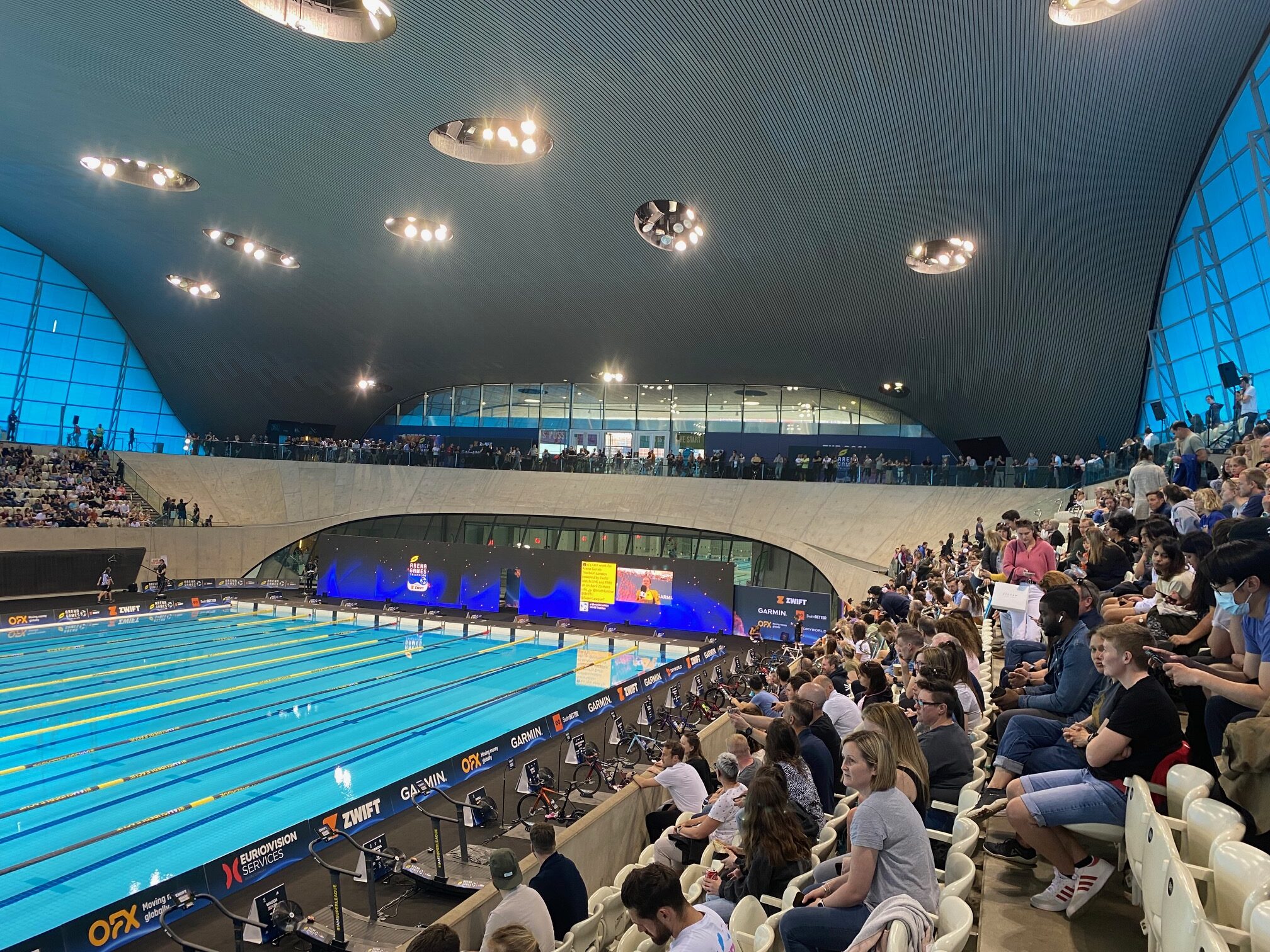
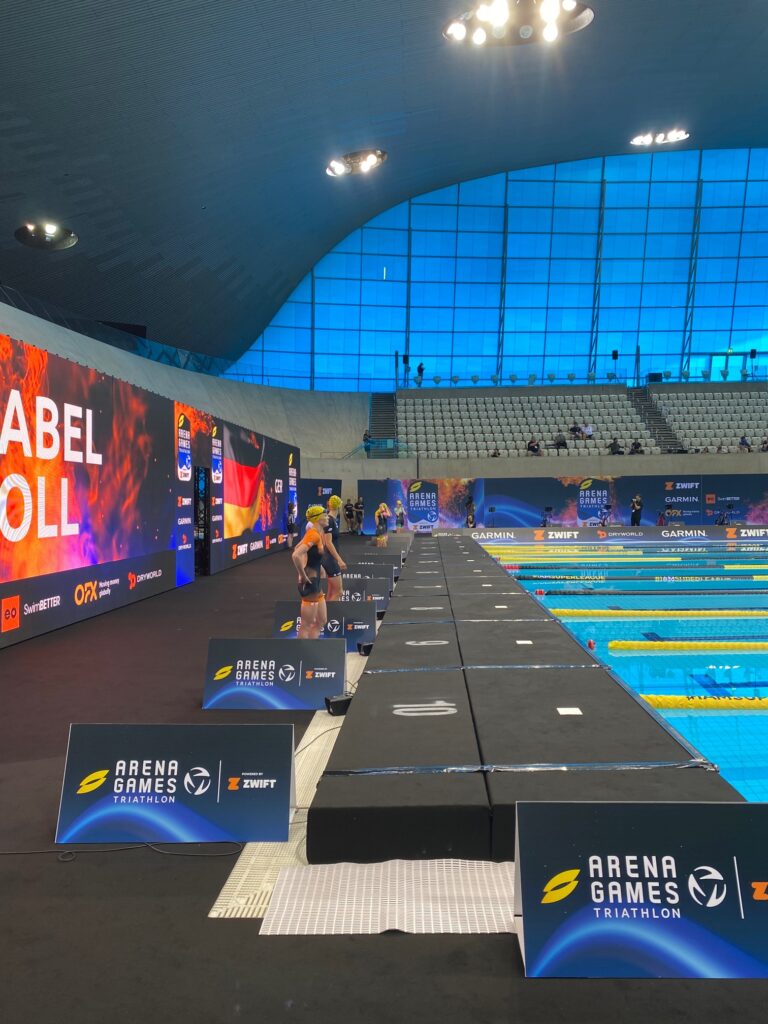
The Aquatic Centre

Despite now being 10 years old, the Olympic Park still retains its grandeur. As I exited the train and began my walk to the Aquatic Centre, the memories of that special summer returned.  

I knew I was heading in the right direction when I saw event branding promoting the event.

Although I was fortunate to attend many of the 2012 Olympic events, I was sadly not able to get tickets for any of the swimming races.  I remember those tickets being “hot property” and at the time I would have had a better chance of finding gold in my garden than getting Olympic Swimming tickets! This was therefore the first time I had attended the Aquatic Centre and I wasn’t disappointed.

I had arrived early, and as I searched for the entrance, I bumped into the Zwift Social Media Team, who like me, were on hand to report on this unique and special event.  
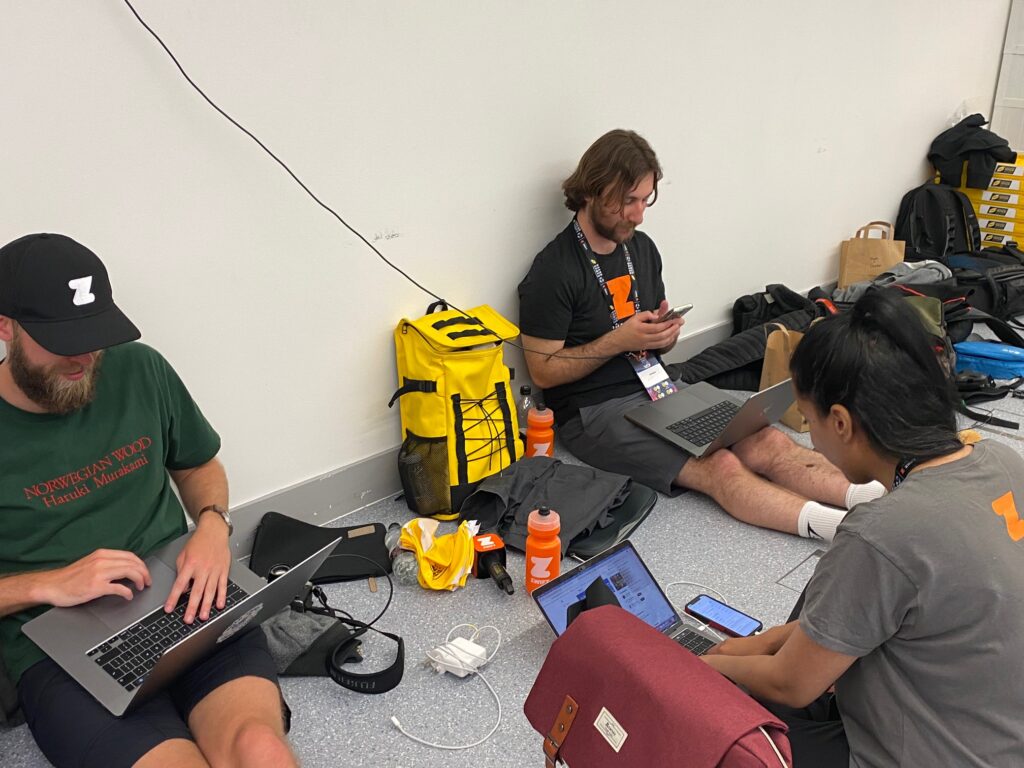
Zwift’s Social Media team

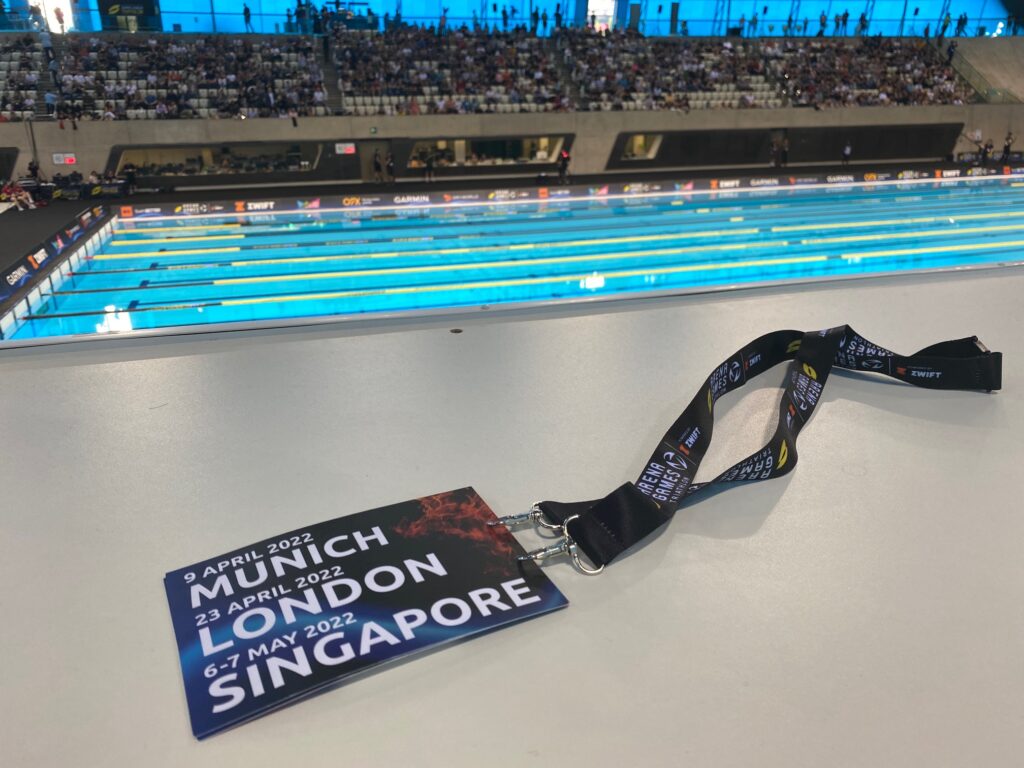
Press Pass

After getting my much-coveted press pass which gave me “all access” around the venue (other than the athlete’s area, which I wouldn’t have ventured into even if I could have), I was good to go.

I was shown where the “Media” area was, where I could set up my laptop and write about the event, but it was too far away from the action for my liking, situated high up where the fans would be.  I wanted to be in the heart of things, so I kept the laptop in the bag and opted for my trusted notepad and pen, giving me the freedom to move around and capture the action. With my Canon camera slung around my neck, I was all kitted up.

The Heats    

I am glad I had attended the event early to witness the qualifying heats.  This is because it gave me an opportunity to understand the intricacies of the event and identify small details that potentially could impact the event. In a race with such intensity and high levels of competition, the margins for winning and losing are slight. Every second counts! 

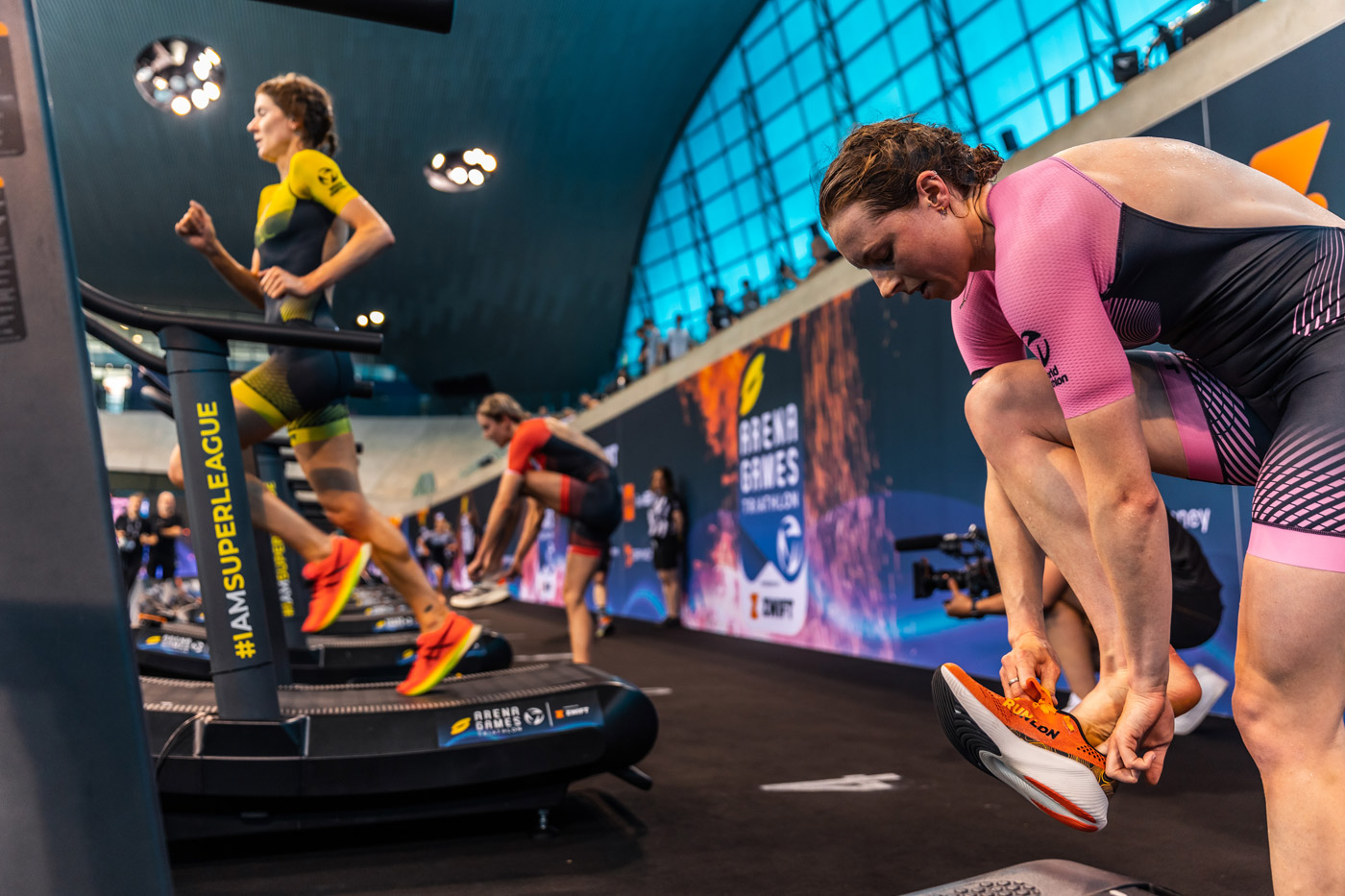
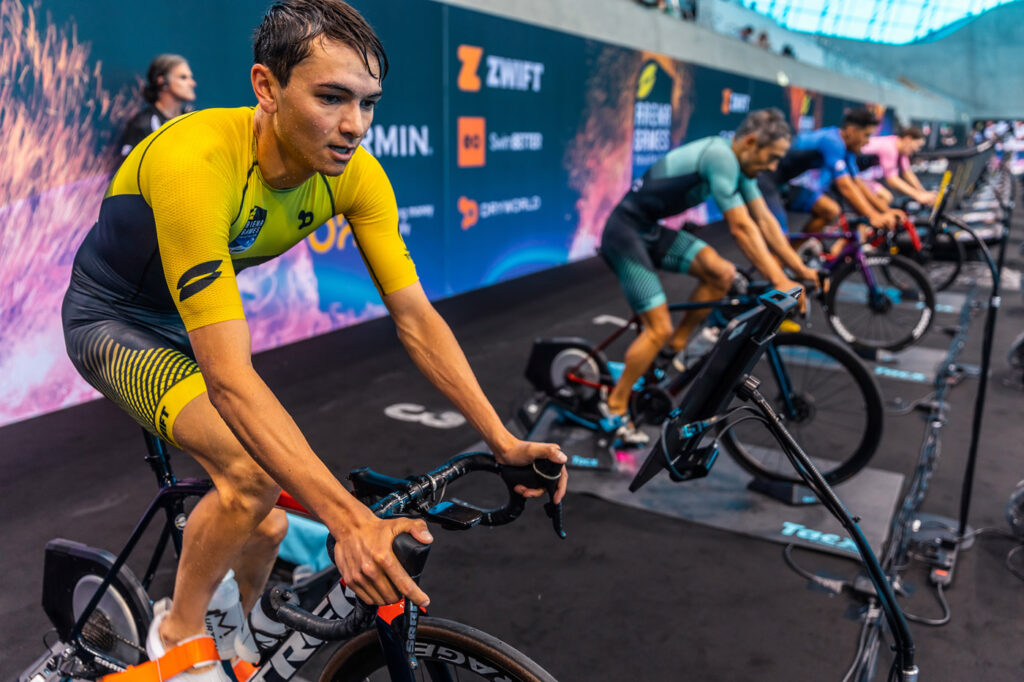
For example, I noted that immediately from the swim transition to the bike, many athletes started pedaling, getting their avatar up to speed, before pausing to slip their feet into their shoes, which were kept in the upright position, usually by elastic bands.  In one case, an athlete could not get their foot into their shoe and it was several minutes before they eventually did. 

The heats also gave me chance to get a good feel for what to expect and helped me understand the race format, which was a new concept for me and one which I liked.  I liked it because despite this being a race between athletes, with the bike being a “no-draft” event and swimming being in your individual lanes, it really was an individual time trial and a true test of your speed and power.  Furthermore, with it being indoors, the variables were as controlled as possible.  (The only possible advantage would be if you were an athlete who lived or trained in a hot environment, because the hot and humid conditions did add a level of difficulty that was an influencing factor. And I am speaking from first-hand experience, having Zwifted in temperatures of more than 35C!)

As well as scribbling useful details in my notepad, I had my camera on hand to capture shots. Then as soon as heats finished, I was switching again as out came the Dictaphone in the form of my iPhone as I recorded my interviews with the athletes.

Being this close to the action, it was easy to see how coordinated and organised everything was.  Everyone has a job, a purpose, everyone working together to ensure the event worked.  This was impressive.  This was teamwork in action. 

Break in Play

Like the athletes, I was relieved when the heats were over and I had a chance to catch my own breath.  Working hard to record all the details of the event in temperatures over 25C was a challenge and it was difficult to know where to focus my attention.

It was during this interlude that I was able to catch up with the Zwift Social Media team who were busy capturing the action in much the same as I was.

Then I decided to get some lunch, realising I could feel my energy waning after being literally on the go since 5am with little more than a slice of toast. At this point I had to navigate around a lady who was sat in the hallway, ironing a shirt.  As I passed her, I turned and offered her help, it was the least I could do.  As we started chatting, I recognised the face and her voice was surprising familiar, I was having one of those moments where I was sure I knew this person, but couldn’t place it. Then I realised it was television presenter Orla Chennaoui!  Orla is front and centre in the cycling world, covering all the major events and so it shouldn’t have been a surprise to see her here. 
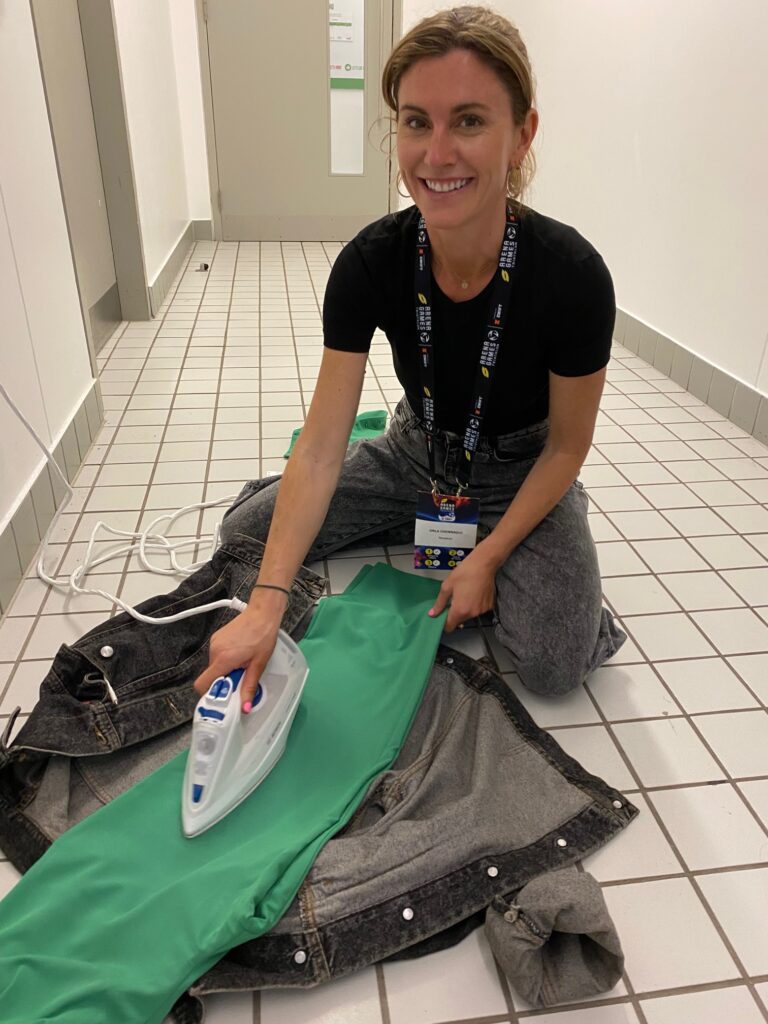
Orla on the floor

Orla was absolute fun, and we joked about her glamourous position of ironing her clothes on the floor.  This was truly behind-the-scenes access.

The Final

Like the athletes I had time for a brief recovery before the start of the Women’s Final and as the spectators took their seats, I decided to position myself in the dedicated space reserved for the media.  The media section was right with the spectators, so I was able to soak in the atmosphere.

After taking photos and watching the first few transitions, I moved down to the side of the swimming pool so I could capture the action from close up.

As I entered the arena floor, I wasn’t prepared for the sheer noise from the crowd.  This was intense and I wasn’t even racing!  I realised this would be the closest I would get to experiencing anything like this and it was exhilarating.

Being this close to the athletes, you could see the suffering they were going through as they pushed themselves beyond their limits to come out victorious. I made sure that I kept out of the ways of the cameramen who were getting up close and personal to capture the important action shots.   

At the end of the race, knowing how pumped on adrenalin I am after a Zwift race, I was conscious to give the athletes space and waited patiently to see who I could talk too.  Fortunately Beth Potter, who I had spoken to earlier, was gracious enough to talk to me about her second place.  You could see she was visibly disappointed, so I regaled her with her stats, which did little to lift her spirits, which I could understand and appreciate.

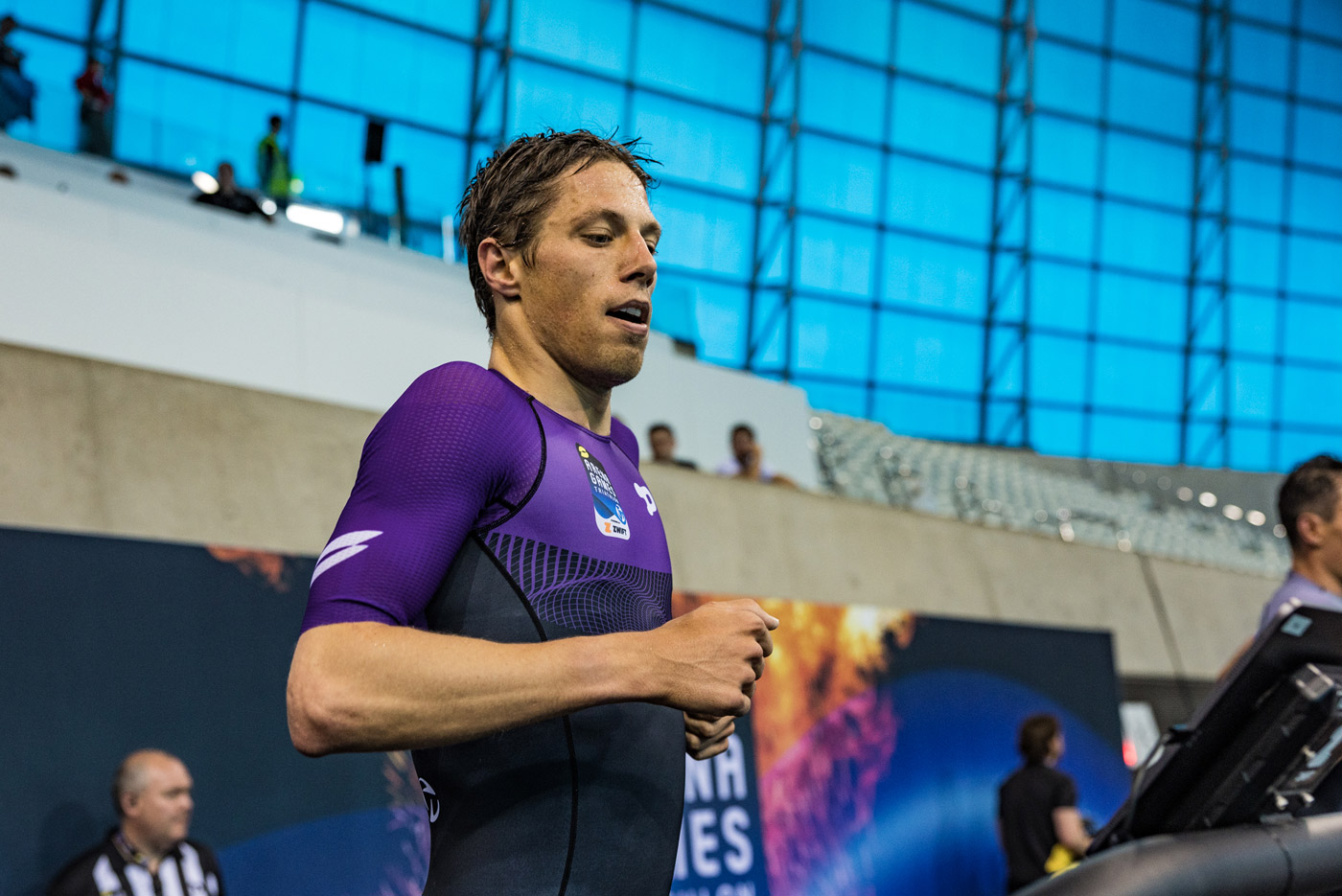
I decided to repeat the same process for the Men’s final, and I headed to the media section, camera at the ready.  The Men’s race was equally as explosive, and at the end one athlete was left on his treadmill, gasping for air. Again, something I could identify with and is often the case after a Zwift bike race.

I didn’t get a chance to speak to any of the athletes that got medals. Instead I had a good conversation with Canadian Jeremy Briand who had set the highest power output of the day, and the fastest bike split, at 5:08 and 6.2w/kg.      
Breaking down

No sooner had I finished speaking to the athletes, then the very surrounding where I had conducted the interview was dismantled.  Fearing I was only in the way, I decided I’d better collect my personal belongings and head to the hotel. 

I was lost in my own thoughts about the day as I navigated the busy London streets to my hotel.  As I entered my room and the door closed to silence and serenity, I sat on the edge of the bed to gather my thoughts. That quite literally had been an unforgettable day!

Kiwi Crew Ride – The Flying Mullet aka Shane Archbold (Zwift PowerUp Cycling Podcast)

In this Kiwi Crew Ride special episode, Greg Henderson takes the listener through what it’s like to take part in the group ride which turns into a 10-minute, all-out, sprint race.

In the newest iteration of the Kiwi Crew Ride, a podcast with a Kiwi guest automatically plays when the ride starts (for this episode, the special guest is Shane Archbold). Then as the ride transitions into the sprint, Greg Henderson sticks around to DS riders while heart-pumping techno music blasts.  

About the Podcast

The Zwift PowerUp Cycling Podcast features training tips from host Matt Rowe (Rowe & King), with regular co-hosts Greg Henderson, Rahsaan Bahati, Dani Rowe, and Kristin Armstrong.

All About the WTRL (ZRL) Racing Finals

All About the WTRL (ZRL) Racing Finals

When WTRL announced the schedule for Zwift Racing League 2021/22 Season 3 there were lots of questions asked about the final two races, since they were described in ways racers had never seen before in ZRL:

  • They were called “Finale” races
  • One was called a points race, the other wasn’t classified at all

Additionally, the last race was scheduled for Saturday instead of Tuesday, and early messages from WTRL seemed to indicate that all teams would be participating in the races, not just Division 1 teams like past seasons.

It took a while for the details of these finale events to get solidified – our guess is WTRL had to work with Zwift to make sure it would work the way they’d like. But this week, WTRL finally released the particulars of both events.

They’re now called the “WTRL Racing Finals”, which indicates that they aren’t an official part of ZRL. Instead, the Finals are more of an experimental series than a set of races endorsed/supported by Zwift.

WTRL Racing Finals: the Basics

Here are the key things racers need to know about the WTRL Racing Finals:

  • The Finals are independent of the regular ZRL season. No team is obligated to race but all teams are invited.
  • Both of the Finals races are points races. Standard points will be up for grabs.
    • The semi-finals events are on Tuesday 17th May 2022 (event times for the majority will not change.)
    • The finals are on Saturday 21st May 2022 (event times will have a +/- 2 hours variance to normal).
  • Some of the regular season leagues are being combined (stacked) for the semi-finals round, then the finals rounds are between teams in an entire region. So everyone will be racing against teams you haven’t yet seen this season.
  • Powerups will be turned off for both races.
  • Event times are available on the WTRL website (click Future and then filter by Zwift Racing League).

Cups, Plates, Shields, and Bowls

The results of the semi-final determine who will race who in the final. Semi-finals are within teams in a league, while finals are within teams in a region.

Teams will be ranked in each league prior to the semi-final. The top half of teams in each league will race in the “Regional Cup Semi Final”, while the bottom half go to the “Regional Shield Semi Final”.

Based on the results of the semi-finals teams will again be divided/sorted heading into the regional finals – so you may race an entirely different set of teams on Saturday (but chances are you’ll be racing some of the same teams as you did on Tuesday). The top half of teams from the Regional Cup Semi-Finals will race in the Regional Cup Final, while the bottom half races in the Regional Plate Final.

Similarly, the top half of teams from the Regional Shield Semi-Final will race in the Regional Shield Final, while the bottom half will race in the Regional Bowl Finals.

After the second race (the final), four teams in each region will come out as “winners”:

  • Regional Cup
  • Regional Plate
  • Regional Shield
  • Regional Bowl

The cup/plate/shield bowl will go to the team to score the most total rider points in their finals race. Cups/plates/shields/bowls will be given per gender (mixed or women’s), per region (Oceans, EMEA, Americas), per division (A1, A2, B1, B2, B3, C1, C2, D1). Where teams are tied, the order to determine the winner will be:

  1. Finish Points
  2. FAL Points
  3. FTS Points
  4. Highest placing rider per team

Confusing? Yeah, a bit. But it’s not easy setting up a fair two-race final for thousands of teams! See WTRL’s page for more details.

New Format Goals

WTRL has stated the following goals for this new finals format:

  • To have as much fun and fair competition as possible.
  • Test out a new format.
  • Establish a team ranking across the entire region for the season and determine regional winners at all levels.

Our guess is, if all goes well, we’ll see this format adopted for the finals next ZRL season.

Team Eligibility

Which teams and riders can race in the WTRL Racing Finals?

Team requirements:

  • All teams who have completed at least 1 race in ZRL Season 3 qualify.
  • Maximum number of riders per team is 6, minimum number of riders is only 2 (normally 4 in the regular season)

Rider requirements:

  • Must have completed at least 1 race with their Finals team in the regular season
  • Must not have received any CODE 7 or 8 DQ with that team during races 1-5 of the regular season
  • 3-race upgrade rule still applies
  • Published power limits for each category still apply
  • Riders may represent one team in the semi-finals, and a different team in the finals

Questions or Comments?

We’re sure some of you will have questions about how the finals will work. Talk to your team captain for clarification, read the WTRL page, but also feel free to comment below.


How the Race Was Lost: Figure 8 TTT (ZRL Week 5)

How the Race Was Lost: Figure 8 TTT (ZRL Week 5)

The second TTT of Zwift Racing League 2021/22 Season 3 was held last Tuesday, and it was a rather technical one compared to the fairly flat first TTT of season 3. My team (the DIRT Roosters) was sitting in first place overall in our B1 Division and were focused on holding our spot and extending our advantage.

But anything can happen in a TTT, so even though your result is entirely up to you, a win is far from a foregone conclusion, even with a very strong team. Mechanicals or bad legs can quickly drop a rider, sometimes even two, and that can be disastrous.

As it turned out, I would be the victim of the course this week. But I’m getting ahead of myself…

Race Prep

Watopia’s Figure 8 course was one our team was pretty familiar with since it’s a popular race route on Zwift. It’s a challenging one to pace optimally in a TTT, since it includes lots of rollers and two actual climbs.

The Roosters’ basic plan was to blob on the climbs, give a little extra push on rollers/bumps, and generally communicate well so we stayed together for most of the race. Captain Antoine put together our pull order:

  1. Clem 30sec – 420w
  2. Sean 30sec – 410w
  3. Thomas 30sec – 370w
  4. Me 30sec – 375w
  5. Arjen 30sec – 365w
  6. Antoine 30sec – 320w

We had our marching orders. I did what I could to be fresh and prepared for the race:

  • Recovery ride the day before
  • Plenty of sleep the night before
  • A clean, carby oatmeal breakfast
  • Beet juice two hours before the race
  • Caffeine gum – three pieces (300mg), one hour before the race
  • PR lotion on my legs about 45 minutes before the race. More bicarb=less burning.
  • A fast virtual bike setup (Specialized S-Works Venge + DT Swiss disc wheels)
  • A 30-minute warmup with the C. Cadence crew which included a few efforts to get the heart rate up into the threshold zone

My legs felt OK, but not great. We chatted on Discord as I clicked to join the pens with a few minutes to go.

Starting Hard

Since we’re currently first in the league, we were the first team to start. Our closest competition (TBR) would be just 30 seconds behind, making it easy to see if we were gaining or losing ground to them during the race.

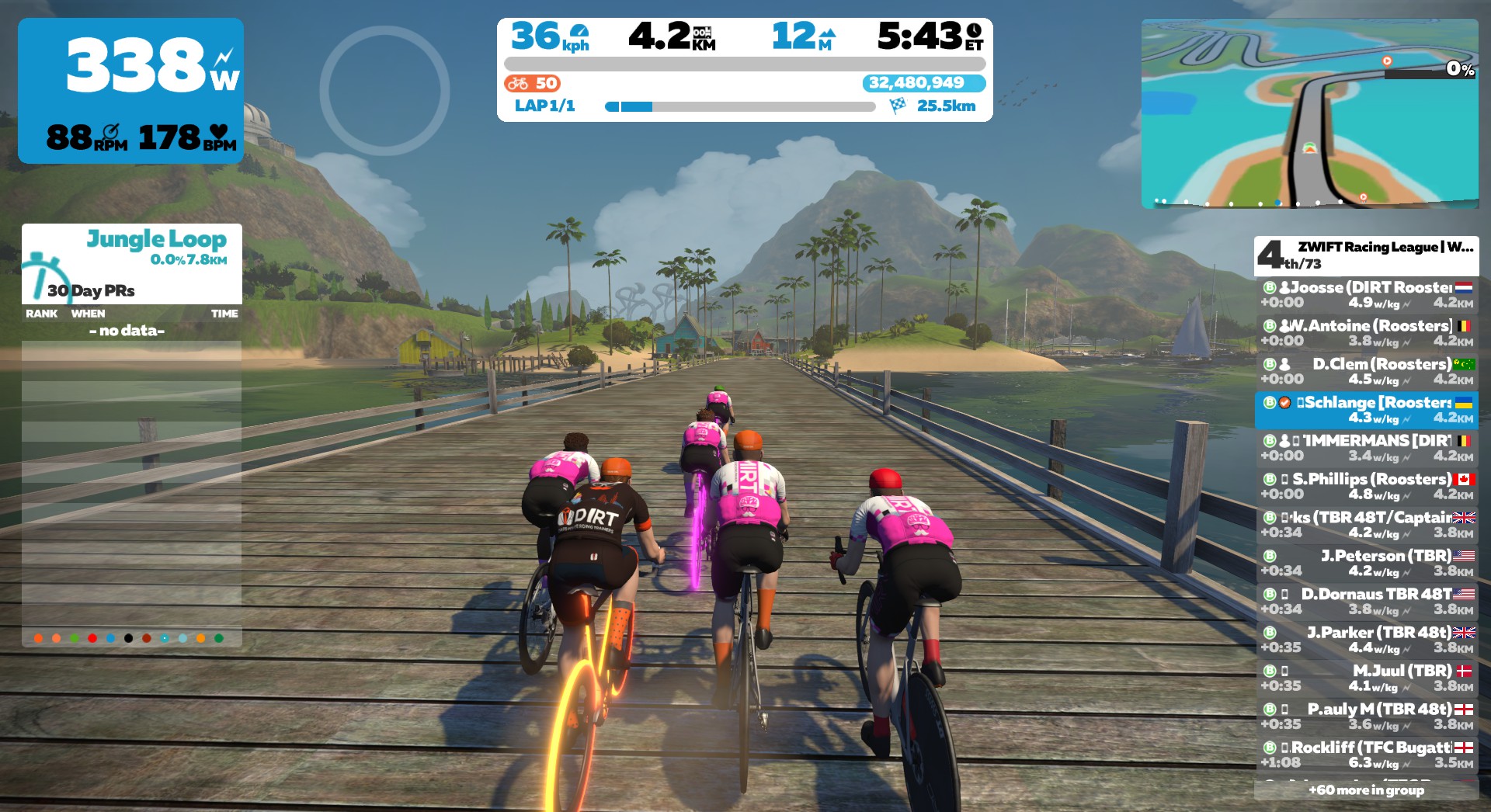
Antoine had instructed us not to start too hard, since we wanted to stay together over the first KOM and on the flats that followed. But as we climbed out of the ocean tunnel I saw good news and bad news:

  • Good news: we were already 4s ahead of TBR
  • Bad news: my heartrate was just over threshold, and we hadn’t hit the hard parts yet

When I’m in a TTT that is paced well for me, the start always feels too easy. But this start wasn’t too easy – I was at threshold, 5 minutes in! But I didn’t say anything – Antoine seemed to see that the pace was a bit high, and he was asking us to slow here and there.

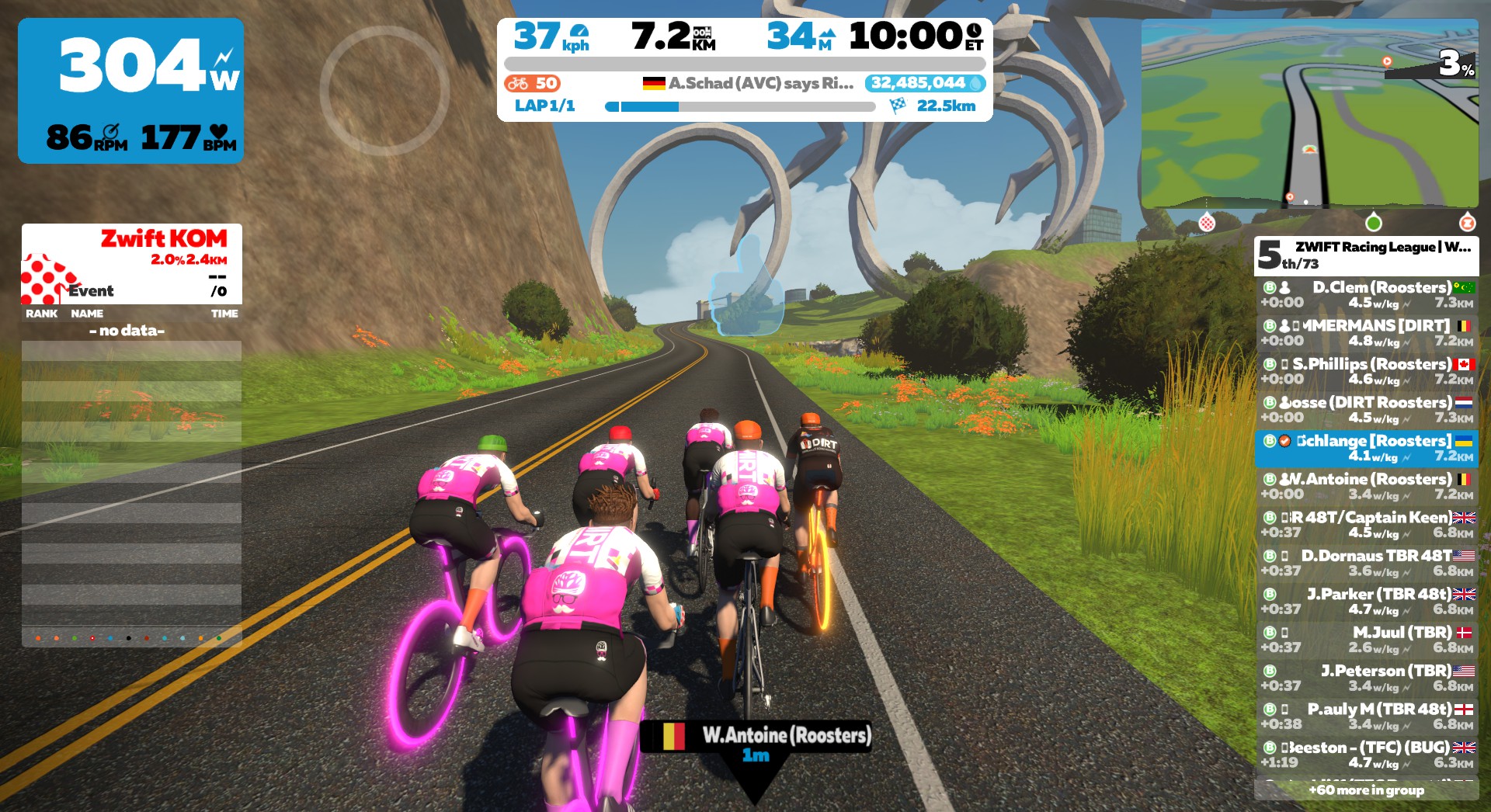
Then we hit the snaking false flat up from the fishing village, and Thomas took the pull with me on deck. I don’t know what kind of numbers he was doing, but I averaged 335W just to hold his wheel for 75 seconds! Ouch. We got to the top and I didn’t have the legs to pull, especially with the KOM Reverse just up the road.

Starting the KOM Reverse

We hit the KOM Reverse 7km into the race, and I knew I was in trouble. I quickly drifted to the back of the group, but Sean saw me struggling and dropped back a bit too, giving me a wheel to help me stay in touch. I asked everyone to ease on Discord too, and they did – so we stayed together over the top.

Getting Dropped

But my legs were toast. I tried to recover on the descent, then sit in on the flats and through the Esses.

I had taken precisely two pulls so far… and those were the only pulls I would take.

After tailgunning to the 18.6km mark, I made the call and told my Roosters not to wait for me. With me unable to take pulls, their waiting for me was only slowing the team down. Continuing to wait would just cost more valuable seconds.

Watching the 5-Man Pain Train

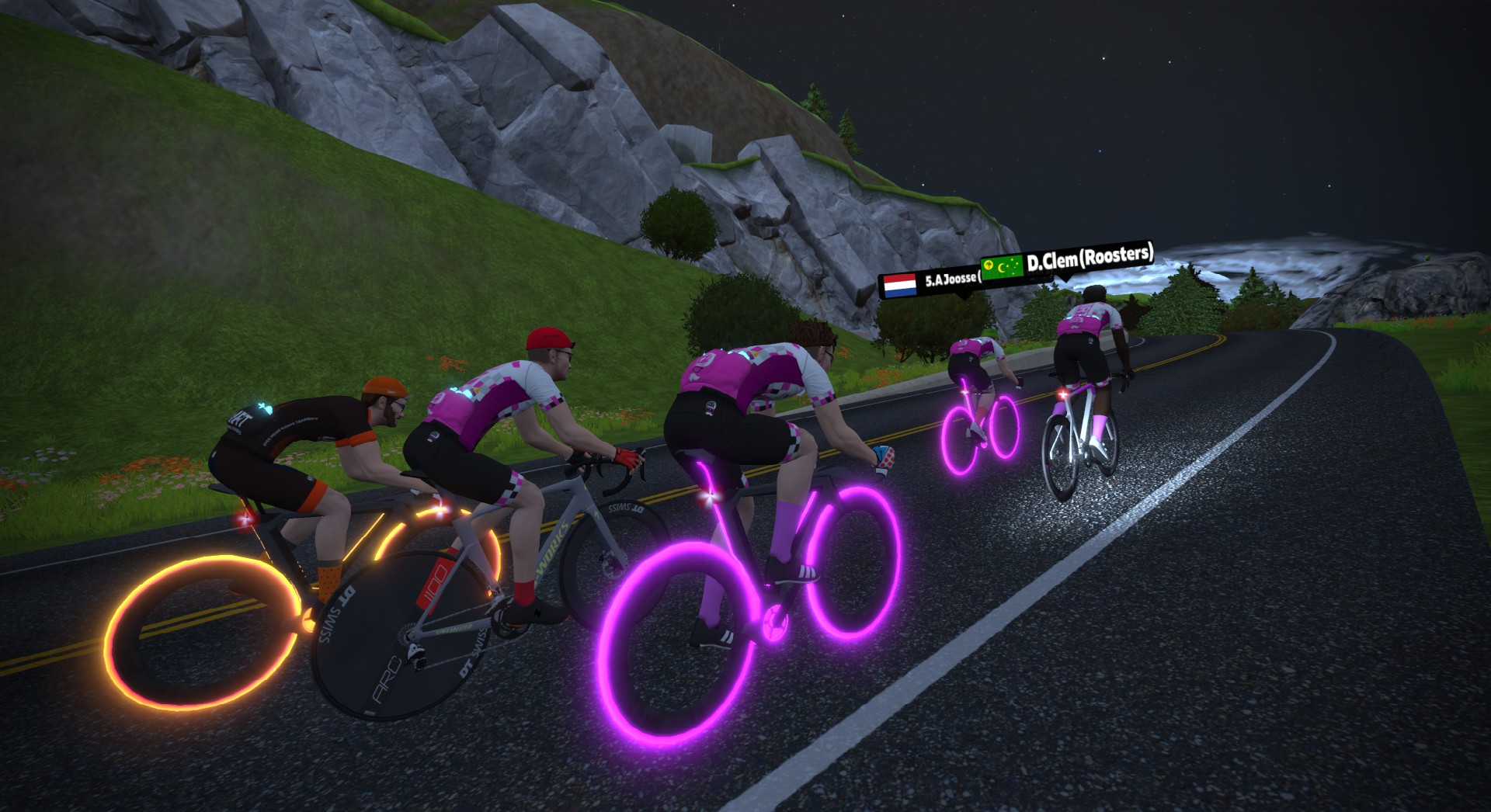
The remaining 5 Roosters head up the KOM forward

With a 17-second lead over TBR I switched to DS mode, clicking to watch my teammates as I kept spinning my pedals. Things were getting a bit messy as everyone was feeling the fatigue, and we had the crucial KOM Forward coming up.

Discord was a godsend as we did our best to pick who was pulling, and who had to skip pulls. Who needed to ease on the climb, and who needed to push. But the 5 Roosters stayed together up the KOM, then grabbed a bit of recovery on the descent before taking turns pulling on the flats and over the Esses to the finish.

See activity on Strava >
See ride on Zwift.com >
See results on ZwiftPower >

Team Result

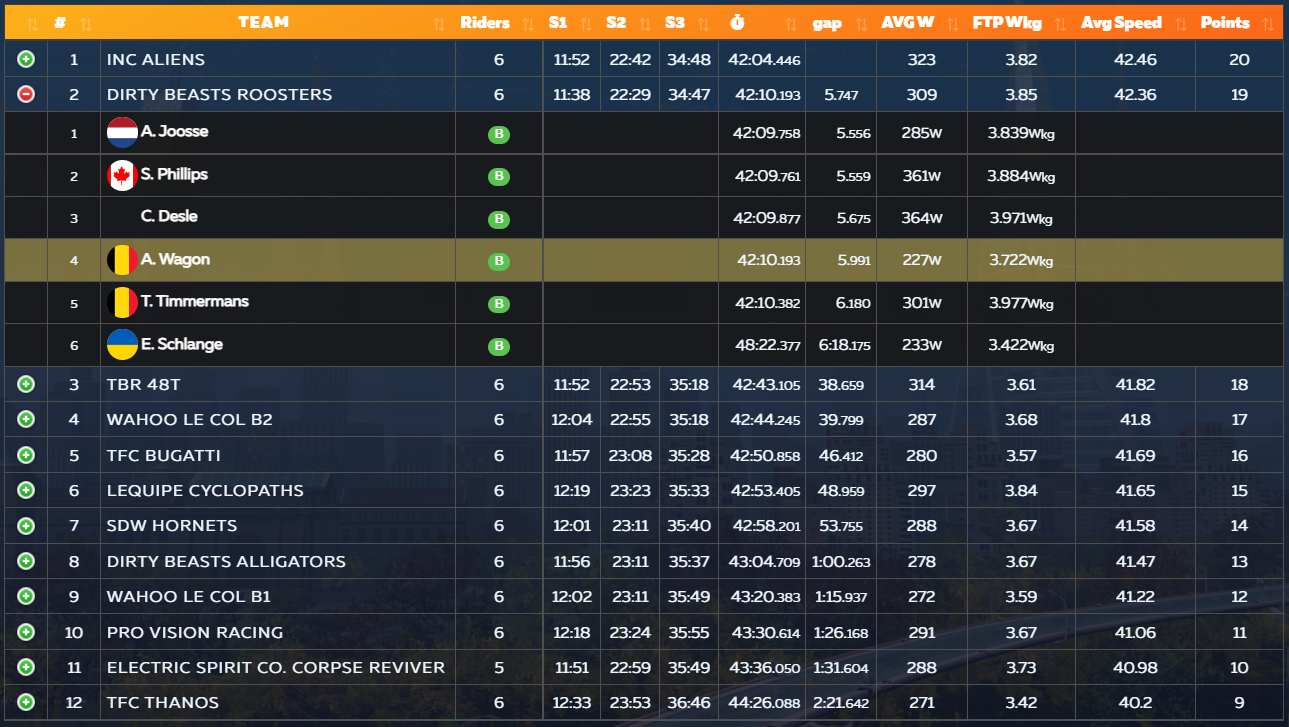
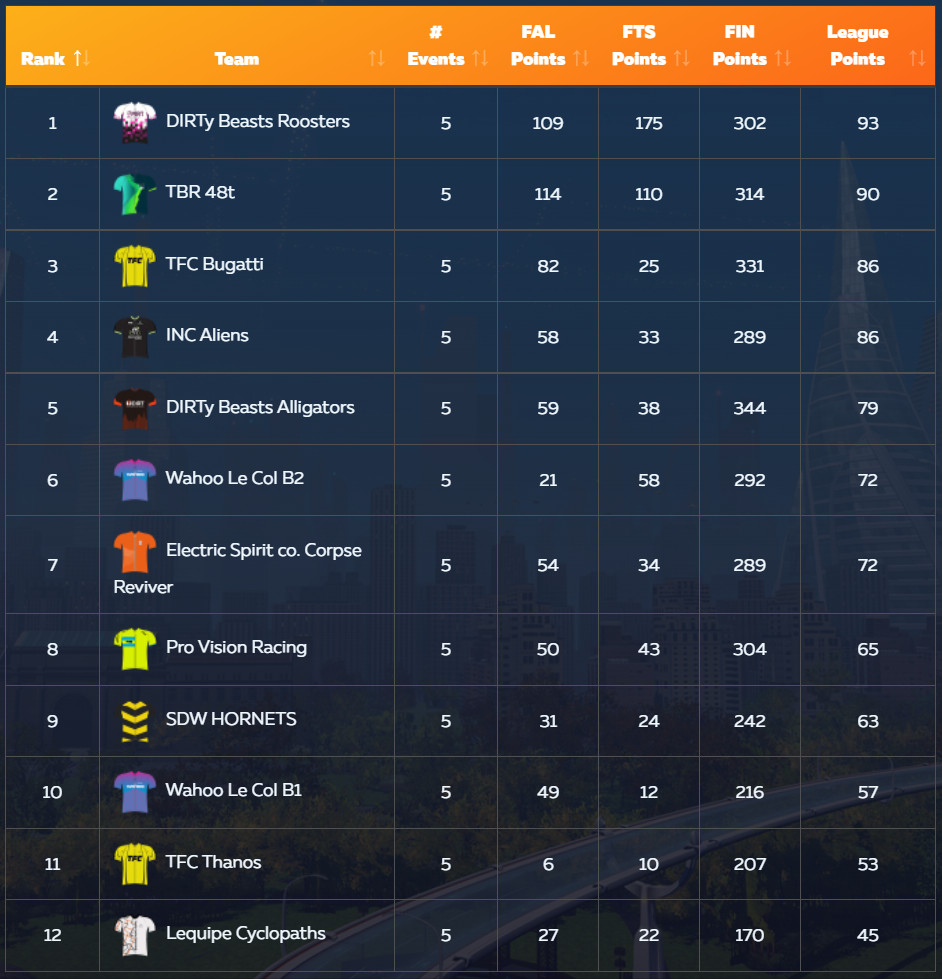
As soon as we finished, we began looking at ZwiftPower times and doing the math to calculate where we placed. We knew we had beaten our closest teams in the rankings (TBR and TFC Bugatti), but it was the INC Aliens who once again took 1st this week, like they did in the previous TTT. Those guys know how to time trial!

The most important thing for us, though, was to beat TBR. And we did that, giving us one more point’s worth of cushion in the overall standings:

Takeaways

Looking at the power numbers afterward, clearly all of the Roosters put in huge efforts in this race:

  • Arjen 20-min: 96% of max
  • Sean 20-min: 98% of max
  • Clem 20-min: 99% of max, 5-min: 91% of max
  • Antoine 20-min: 94% of max
  • Thomas 20-min: New Max Effort! 5-min: 92% of max
  • Me 20-min: 96% of max

Kudos to the Roosters for digging deep and turning in an incredible time, given that we only had 5 riders for the last 11km.

We finished just 5.7s behind first place INC, which is like a stab in the heart for me. Such a small margin leaves a lot of questions:

  • What if my legs had been a bit fresher?
  • What if we hadn’t pushed as hard as early?
  • What if I’d pulled the plug sooner and not asked my team to ease on the KOM Reverse?

It’s nearly impossible to say whether we could have changed something and grabbed first place. But I do think easing a bit in the early portion of the race would have served us well. As they say… “If you lose, don’t lose the lesson.”

What About You?

How did your TTT go? Share your story below!


St George Special with David McNamee and Tim Don (Zwift PowerUp Tri Podcast)

In this St George Special with David McNamee, Tim Don, and Matt Lieto, the trio banter about St George, Kona, and how David McNamee wants to take over the Zwift PowerUp Tri Podcast…

About the Podcast

The Zwift PowerUp Tri Podcast is hosted by former pro triathlete Matt Lieto and Zwift Academy Tri mentor Sarah True. Both are passionate about lending their in-depth knowledge of the multisport to the Zwift Tri audience.

Zwift Racing League 2021/22 Round 3 Week 6 Guide: 2018 UCI Worlds Course (Giant Tips)

6

The sixth race of Zwift Racing League 2021/22 Round 3 is Tuesday, May 10th, and it’s the Queen Stage. This course features the longest climb of the season, and riders strong enough to get away on the climb will be treated to the added bonus of sprint and finish points that follow.

This is also the last race of the regular season. We have the semi-final and finals coming up next. (There’s been some confusion about how these races will work, so watch for a Zwift Insider post discussing these soon, as well as race recons.)

We’ve put together a complete race guide including tips for bike choice, powerups, and crucial segments. Ride smarter… ride harder. Let’s dig in!

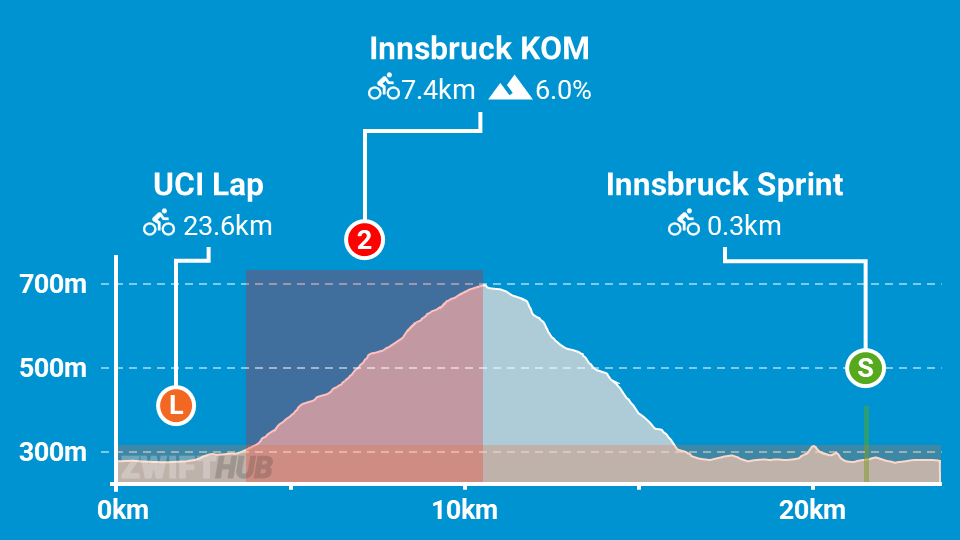
Looking At the Route: Innsbruck’s “2018 UCI Worlds Course Short Lap”

The 2018 UCI Worlds Course Short Lap has one key feature, and it comes early: the Innsbruck KOM (technically called the Römerstraße Climb, but nobody calls it that). This is by far the biggest climb of the ZRL season, and it will, for a large part, determine who gets the sprint and finishing points waiting up the road.

There are three key portions of the course which deserve highlighting:

  • Innsbruck KOM (3.3km in): 7.4km long at 6% (Strava segment), this climb takes top riders around 16 minutes, while middling Bs are closer to 25. It makes for an excellent FTP test, in fact. Many portions are draftable, so being on a wheel is beneficial. Once you finish the climb, find a good group on the descent, then work to catch riders up the road.
  • Leg Snapper (19.9km in): you should be somewhat recovered by the time you reach the second climb of the day – the punchy Leg Snapper (Strava segment). 430m at 6.9%, this is basically an all-out effort that breaks up the group heading into the sprint.
  • Sprint (21.6km in): this is a longish (300m) flat sprint, and with no powerups it’s going to be all about timing and power. Keep in mind you’ve got the finish just 2km up the road!

This course is called the “2018 UCI Worlds Course Short Lap” because it was featured in the 2018 UCI Worlds road race. If you find the course challenging, consider this: the men’s elite racers began in Kufstein and ride 84.7km to Innsbruck, then they completed this circuit 7 times. Amazing!

Read all about the 2018 UCI Worlds Course Short Lap route >

PowerUp Notes

No powerups will be given out during this race. Due to a Zwift bug powerups have been unreliable in ZRL (and other) events lately, so WTRL made the wise decision to just disable powerups for everyone until the bug is fixed in the next Zwift update.

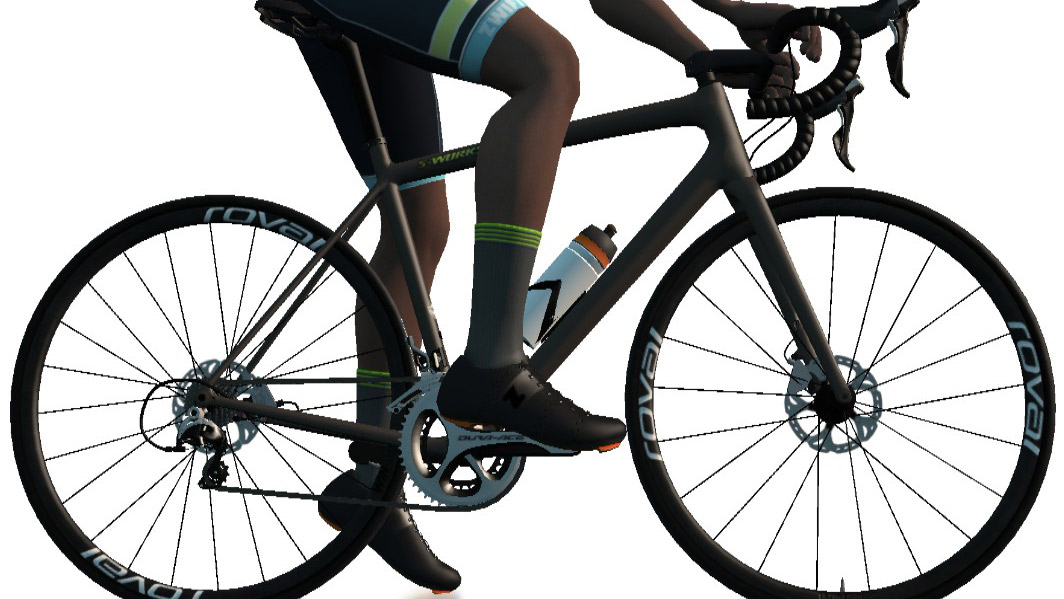
Specialized Aethos + Roval Alpinist wheels

Bike Choice

The key feature on this route is the KOM, so going with a climber or all-arounder is probably your best bet. Based on our frame and wheel tests we’ve estimated the following time savings up the KOM for various popular setups over the standard fast aero rig:

Frame + WheelsTime Saved
Specialized Venge S-Works + DT Swiss Disc0s
Tron8s
Canyon Aeroad + DT Swiss 6211s
Scott Addict RC + ENVE 7.812s
Specialized Aethos + Lightweights or Alpinists19s

Of course, going with a pure climbing rig will cost you in the sprint. In the end, riders must choose a rig that will support your race plan – pure sprinters may choose an aero bike then plan to go easyish on the climb and smash the sprint for FTL points. See our See Tron vs Top Performers Comparison Chart for a helpful comparison of various popular setups.

More Route Recons

Many events are now being planned each weekend on the upcoming ZRL route. If you’re not familiar with this course, jump into one of these events and do some recon! Here’s a list of upcoming 2018 UCI Worlds Short Course events.

Looking for a video recon, with lovely British commentary to boot? Check out the recons below:

Si Bradeley

Get Si’s recon notes here >

Sherpa Dave

Strategic Options

Points Distribution

The maximum points a team of 6 could earn in this race.

Based on the chart above, it would appear as though finishing points are most important, while KOM and sprint points are less so. But mind this: the KOM comes first, and will be the major selection point which defines the finishing groups. So what sort of strategies will we see employed?

  • Climbers gonna climb: strong climbers have every incentive to go hard on the KOM. This will earn them KOM points, and drop the sprinters so there is less competition for sprint and finish points down the road.
  • Slacker sprinters: pure sprinters who have no chance at KOM points may go easy(ish) on the climb, saving their legs for a big effort on the sprint in a bid to grab FTS points. Those sprinters may even choose a more aero bike/wheel combo for maximum advantage, and if a team has multiple sprinters they may choose to work together and benefit from each other’s draft.
  • The chase is on: over the top you’ll see chase groups form and try to pull back the front riders in the ~11km before the sprint point. Teams without riders in the front group would be especially wise to put in the work on these chases.
  • Maximizing in the middle: most riders will find themselves in no-man’s land, unable to grab KOM points, but not strong enough to get sprint FTS points, either. These riders can essentially ignore the intermediates in an attempt to maximize their finishing points. That means a nearly max effort on the KOM to hold their best pack position, then recovering before the Leg Snapper for another hard effort to hold position. Sit in on the sprint, and save the legs for the finishing sprint. Then go go go!

Your Thoughts

Care to share your thoughts about Tuesday’s big race? Comment below!

About This Series

The Giant Tips ZRL series is sponsored by Giant Bicycles and delivers helpful tips for upcoming Zwift Racing League stages so you can unleash your full potential.

Giant is the world’s leading brand of high-quality bicycles and cycling gear. Part of the Giant Group founded in 1972, the brand combines craftsmanship, technology, and innovative design to help all riders unleash their full potential. Learn more at giant-bicycles.com, or visit one of their 12,000+ retail stores around the world.

Notable Zwift Events for the Weekend of May 7-8

1

Despite the improving weather here in the Northern Hemisphere, there are several reasons to continue to log the kilometres on Zwift. Here are four. 


Zwift Insider Rebel Race

This is the first ever race series hosted by Zwift Insider and full details can be read here

There are three events spread over the weekend, two on Saturday and one on Sunday (GTM, at least), giving you the chance to race the “Rebel Routes” which have now made it into Zwift’s official list of courses. 

The first event is hosted on the Downtown Titans route.  This is 24km long with two short hills which no doubt will split the field.  Events are filling up and I have highlighted a Saturday race to try!
Multiple timeslots
See upcoming events at zwift.com/events/tag/zwiftinsider


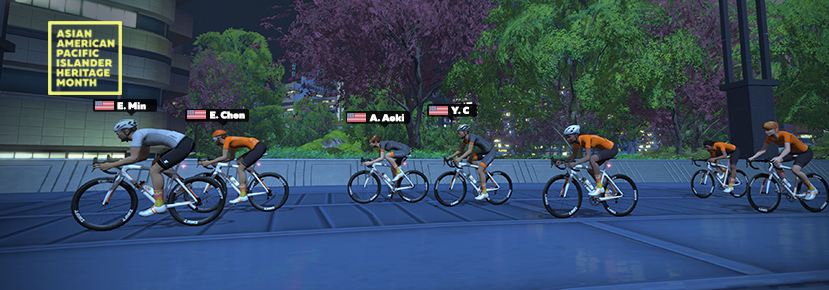
YC Podcast Ride – Asian American and Pacific Islander Heritage Month

To celebrate Asian American and Pacific Islander Heritage Month Zwift are hosting numerous events throughout the month (read more here).

On Saturday join other Zwifters for a podcast featuring YC, Zwift’s Chief Product Officer.  This is a 60-minute timed event on Makuri Islands’ Chasing the Sun route, and it will be fascinating to ride and listen to what YC has to say. I hope he talks about his work, as it will be interesting to hear what it entails.

Saturday, May 7 – Multiple Timeslots
See upcoming AAPI events at zwift.com/events/series/aapi-2022


KISS Racing – The Classic 100 – Category Enforcement

Fancy a long race?  Then this event is for you.  Depending on your Category, it’s either 4 or 5 laps of “Downtown Titans” route, which totals 99.4km to 124km.  Either way, it’s a long old way.   

Sunday, May 1 – 3:35pm BST/10:35am EDT/7:35am PDT
Sign up at
zwift.com/events/view/2981807


BC Bike Race Sunday Endurance Workout

This event caught my eye because it is rather different.  It is 90 minutes of structured training, hosted on the Jungle Circuit Reverse.

The event description states this session is “designed to help build your endurance during the winter months in preparation for the summer.”

Sunday, May 8 – 5pm BST/12pm EDT/9am PDT
Sign up at zwift.com/events/view/2981851

Your Thoughts

Got other events that stand out this weekend? Share below in the comments!

Zwift Announces Deprecation of Older Operating Systems

Zwift Announces Deprecation of Older Operating Systems

One reason Zwift has achieved market dominance is its support of a wide variety of platforms: PC and Mac computers, Android and Apple phones and tablets, and of course AppleTV.

This week Zwift announced via a forum post that they are deprecating older systems “based on industry standard minimums”.

Once deprecated, the following operating systems will no longer be able to run Zwift:

  • Android 7 & 8
  • iOS 12

Additionally, the Zwift Companion App will no longer support:

  • Android 7 & 8
  • iOS 11 & 12

The deprecation is slated to occur on August 1, 2022.

Which OS am I using?

Not sure which operating system version you’re using? Here are some quick links to official support pages:

iOS Impacts

Our guess is the largest set of Zwifters impacted by this change will be those using older iPads and iPhones.

Once the deprecation occurs, Zwift will require an iPhone 6S or newer to run the game or the Companion app.

On the iPad side of things it’s a bit more confusing, given the various iPad models sold over the years. But here’s the list of iPads which will still run Zwift after the deprecation:

  • Any iPad Pro
  • iPad Gen 5 or newer
  • iPad Air 2 or newer
  • iPad Mini 4 or newer

Lastly, for the rare iPod touch user, only the iPod Touch Gen 7 will support Zwift after the deprecation.

Do I really need to upgrade?

Zwift says, “Affected Zwifters currently using these operating systems will see messaging in-game, if applicable, and should also receive notification via email.”

If you are running one of the operating systems listed above, you will need to upgrade your Zwift device before August 1, 2022. To be clear: if you fail to upgrade, Zwift and/or Companion app will no longer run on your system after August 1.

Why the change?

While Zwift has historically supported a wide range of devices, they cannot support aging hardware forever. Deprecation decisions like this are standard practice in the gaming industry, as supporting old hardware and operating systems requires additional development time and can hamstring the implementation of new features.

Essentially, Zwift is saying “If the maker of your device doesn’t support it with current OS updates, neither can we.” And that’s pretty fair. Chances are if you’re still using one of the deprecated devices above, you’ve noticed that certain apps will no longer run on the device, as more and more apps require current OS versions.

Consider these release dates for soon-to-be-deprecated Apple devices:

  • iPhone 6 went on sale September 19, 2014
  • iPad Air was released November 1, 2013
  • iPad Mini 3 was released October 22, 2014
  • iPad Gen 4 was released November 2, 2012

And here are release dates for the macOS and Android versions which will be deprecated (one can assume any hardware stuck on these operating system versions is at least a few years older than the release dates below):

  • macOS 10.12 was released September 20, 2016
  • macOS 10.12 was released September 25, 2017
  • Android 7 was released August 22, 2016
  • Android 8 was released August 21, 2017

Upgrade Recommendations

Most Zwifters probably have a device in their home which will run Zwift after the deprecations kick in: a newer iPhone or Android phone, a tablet, AppleTV, or a decent desktop or laptop computer.

If you need to purchase an upgraded device for your Zwifting, here are two recommendations at different budget levels:

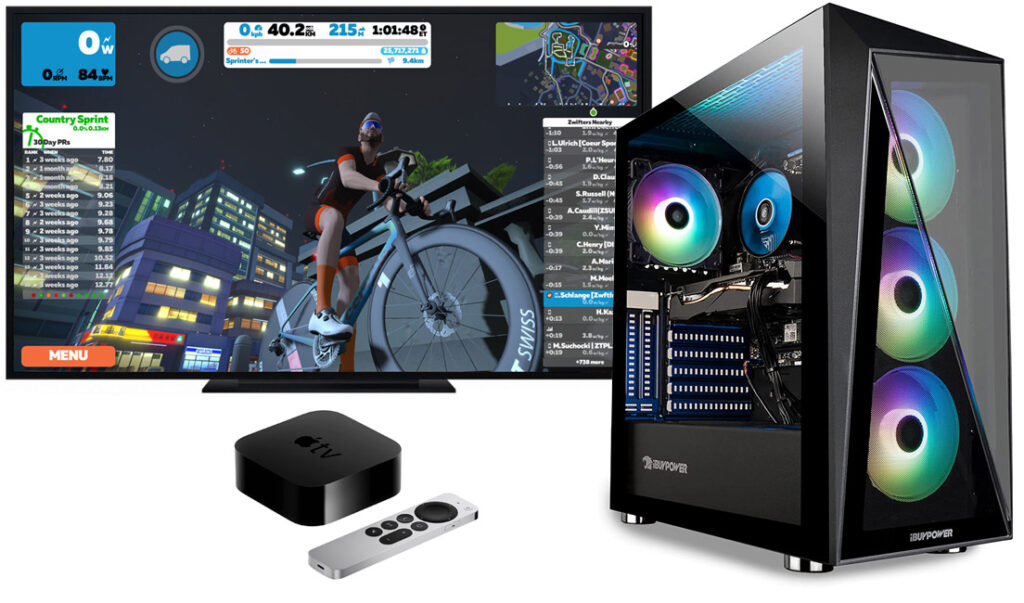
  • Most affordable: 2021 Apple TV 4K (32GB, 5th Gen): only $170USD on Amazon, the latest AppleTV is the most affordable Zwift device on the market today. It’s not perfect – the remote can be a bit of a pain. But it’s dead simple to use, and quite stable. There’s a good reason why a huge number of Zwifters use AppleTV!
  • Best gaming experience: Windows PC with a strong graphics card, fast single-core CPU performance, and an SSD drive. Zwift will run on just about any PC that can run Windows 10, but for premium Zwift performance (ideally connected to a big screen TV) you’ll want a dedicated Nvidia graphics card (1060 or higher), an Intel CPU, and a solid-state drive. Here’s one tower on Amazon that would deliver great Zwift performance without costing an arm and a leg. (For more info on Zwifting on a PC, read “Zwift on PC: The Ultimate Guide to Running Zwift at Its Very Best“.)

Questions or Comments?

Post below!


How the Race Was Lost: Outgunned by Zwift’s CEO

How the Race Was Lost: Outgunned by Zwift’s CEO

When I fired up Zwift in Sunday’s dark morning hours, I was anticipating a fun but unremarkable warmup followed by a Crit City race.

But as often happens on Zwift, I came away with more than I’d planned. Because this was the morning I would find myself in a race with none other than Zwift CEO Eric Min!

The Warmup

Soon after hopping into the C. Cadence group for a race warmup, I noticed Eric Min was in the group as well. I said hello, there was the usual joke or two about lots of Erics (there were three Eric’s in the pack), then I popped the question privately to Eric:

“Heading to the Crit City race in 15 minutes. Want to join me?”

Eric and I had talked about racing together a few times in the past, but had never actually done it. We’ve participated in a lot of group rides where we were both in attendance, and we’ve even spun our way around Watopia on a few free rides (I remember once when we rode up the Volcano together, and he dropped me hard at the finish).

His reply came quickly: “I’ll see you there.”

Woohoo! This was going to be fun. I started thinking of ways we could team up and make the race interesting as I finished my warmup. But I never really settled on any great ideas, and in the end I headed for the pens, deciding to just treat it like a normal race unless Eric pinged me with an idea to do something together.

The Start + Middle (Laps 1-11)

We had a decent turnout of 50 B riders, but nobody was in the mood to attack and make it interesting, so we just spun our way around Crit City, lap after lap, averaging 45 kph.

The Zwift gods granted me an aero powerup heading into the 3rd lap, so I decided to hold onto it unless an attack happened and I really needed a bit of help. I figured the race would come down to a final sprint, and I knew Eric had a strong kick!

The group was whittled down to 34 riders by the time entered the last lap.

The Finish

In my mind a vague memory was bouncing around as we entered that last lap – I seemed to recall seeing a Strava activity or two from Eric where he’d won on Crit City with a long attack. So as we approached the brick climb I stayed near him, near the front of the group, watching for an attack from him or any of the other strong riders in the peloton.

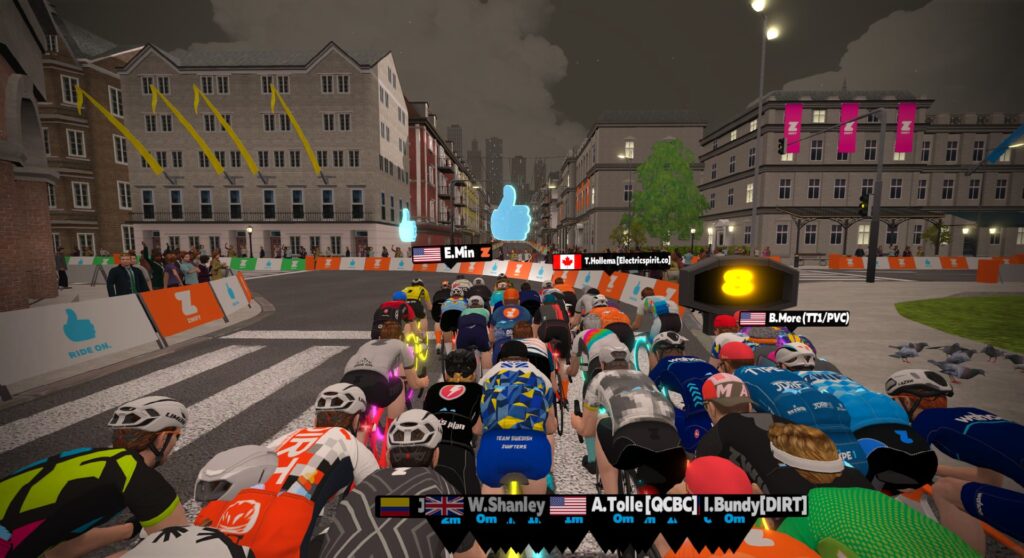
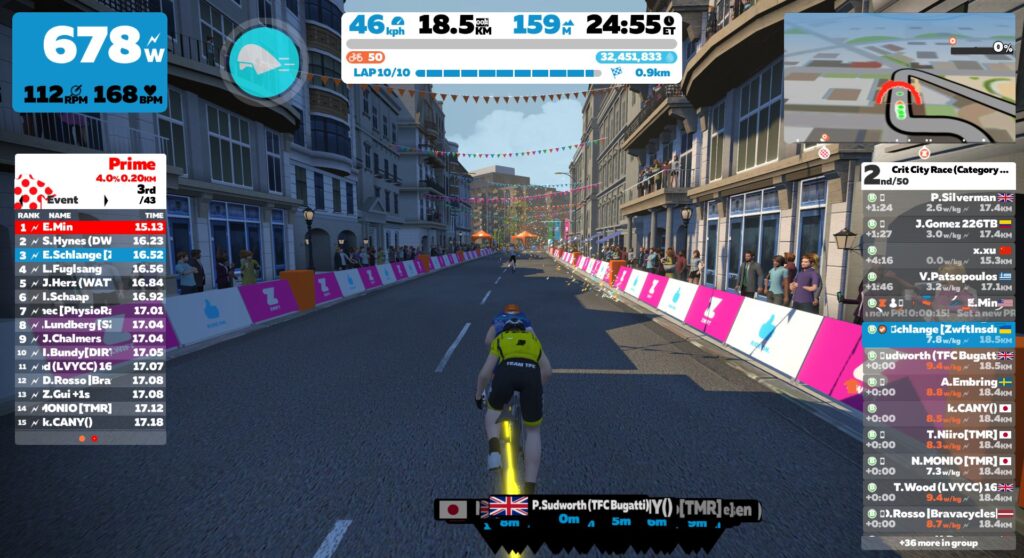
We hit the bricks, and I saw Eric’s avatar stand up to sprint while his numbers flashed orange. It was go time! I stomped on the pedals as quickly as I could, spiking my power just over 1000W… but Eric had gotten a gap. One other strong rider (Sudworth from TFC) was chasing with me, but our 8-9 w/kg was no match for Eric’s 12-13 w/kg. His gap grew, while the rest of the peloton held onto our wheels.

Chasing with Sudworth, but Eric is pulling away

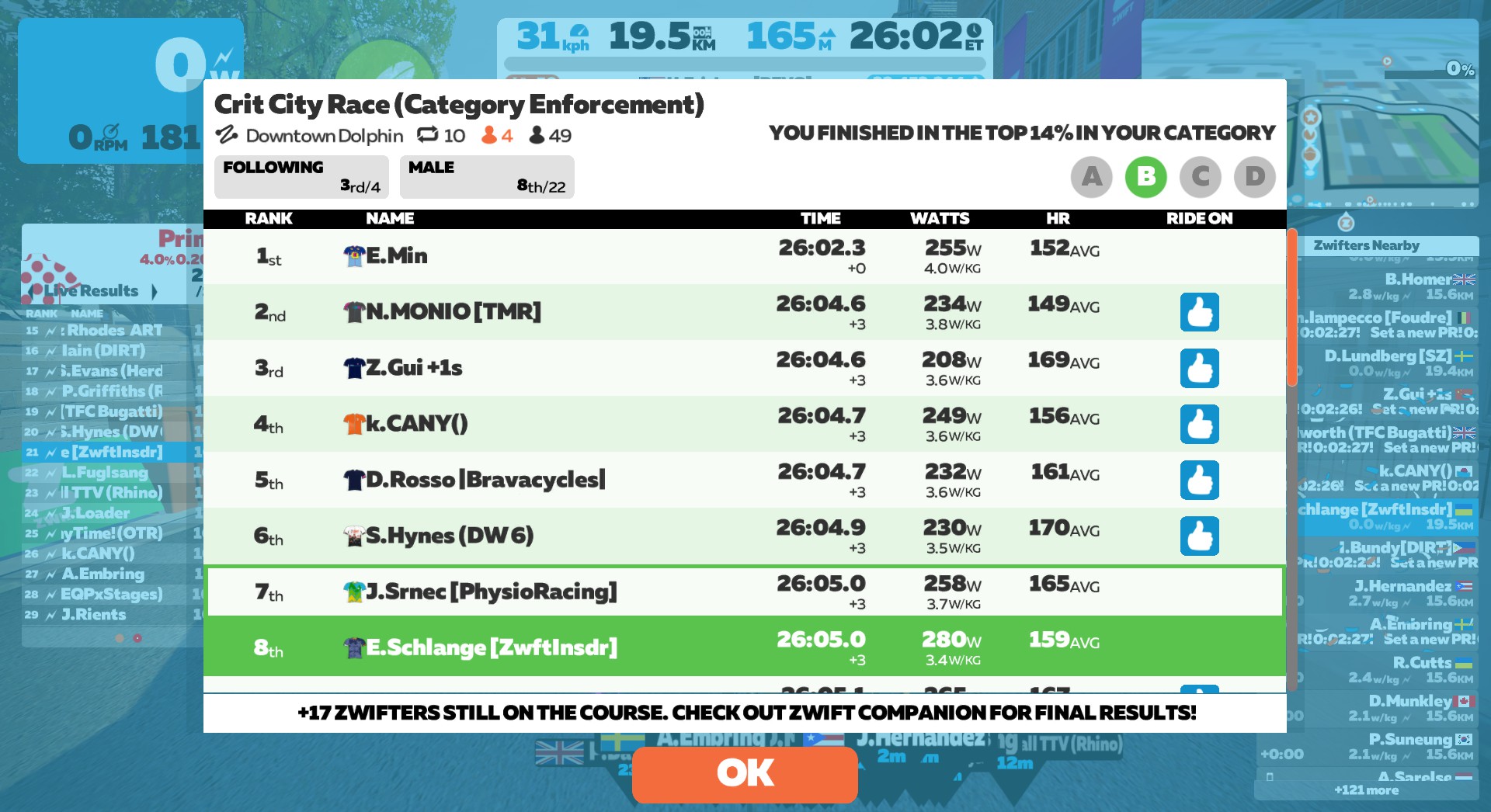
I eased a bit, hoping others would give a hard chase – but nobody had the power to get Eric back. At the finish I delivered a mediocre sprint and came across the line in 8th place. Eric Min took the win by 2.3 seconds, with a category-leading 9.5 w/kg 60-second critical power.

In fact, only one rider in all the categories bested Eric’s 60-second power on the day, and that was the A+ rider who won the As! Impressive.

See activity on Strava >
See ride on Zwift.com >
See results on ZwiftPower >

Watch the Race Video:

Takeaways

Although he doesn’t race super-often on Zwift (7 races in 2022), Eric Min is a very strong rider and an experienced racer well-suited to a course like Crit City (see his ZwiftPower profile here). His 15-second and 1-minute powers of 13.2 w/kg and 9.5 w/kg respectively make him a formidable opponent in the B and even A categories, on certain courses.

What could I have done to improve my result in this race? Looking at our numbers, I’m not sure there’s any way I could beat Eric head to head on this course unless he was having an off day. (He was particularly strong in this race, achieving an XERT Breakthrough with his effort.)

It would take some sort of team effort with repeated attacks to take the win, methinks, because I set my year-best 60s power at the end of this race, and I wasn’t even close to chasing him down.

Alternatively, I could have improved my result two ways:

  1. Not chasing Eric’s attack. Typically on Crit City, when riders attack on the bricks on the final lap they aren’t strong enough to stay away. So I don’t respond, and I let the pack pull me back to the attacking rider. If I’d done that this week we still wouldn’t have caught Eric, but I would have been fresher for the final sprint and could have improved my finishing position.
  2. Responding faster (or even jumping the gun). If I had started my sprint/attack as soon as we hit the bricks, I may have been able to hold Eric’s wheel as he attacked. Maybe. I’m not sure I could have responded much faster than I did, but I should have known he would attack on the bricks. (Popping my aero powerup early may have helped, too.)

Although it always hurts a bit to lose a race, I smile knowing Zwift’s CEO can hold his own as a bike racer. Eric’s a strong, smart rider with a lifelong love of cycling and a competitive spirit. These attributes served him well growing up racing in New York City, and they’ve certainly served him well now as Zwift’s CEO.

Ride on, Eric! Thanks for the race.

Your Comments

Have you ever raced against Mr. Min? What should I do differently the next time we meet up? Comment below!


The Arena Games Race Review – London

The Arena Games Race Review – London

Editor’s note: this is part 2 in a 3-part series on Tim’s Arena Games – London experience. If you’re unfamiliar with how the Arena Games work, read part 1 here.

The Arena Games Triathlon powered by Zwift will take place in three major cities across the world in 2022.  By their own definition, the Area games is an innovative esport concept that blends in real life and virtual racing to deliver a new level of the immersive viewing experience.

The first race was hosted on April 9th in Munich, Germany.  This was the second event was hosted on April 23rd in London, UK, while the Grand Final is going to be held on May 7th in Singapore.

The second round of the Arena Games was hosted at the Aquatic Centre, in London’s Olympic Park. 

The Heats

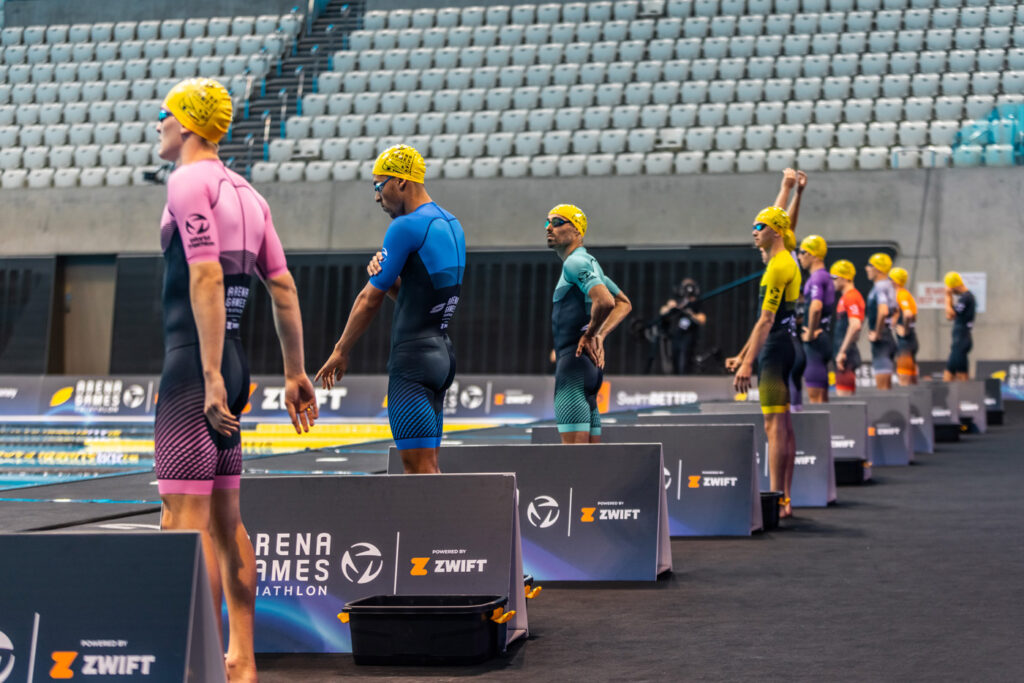
I stood poolside to watch the start of the Women’s first heat, which consisted of a swim four lengths of the indoor pool totaling 200 meters, a 4km non-draft Zwift cycling race, and a 1km treadmill run.  The lead from the first stage was taken into the second in a pursuit style event, where the top four would qualify from each heat, along with the fastest two losers.   

I was nervous and I wasn’t even competing! It wasn’t just me as Hollie Elliott, a British triathlete, jumped the start of the swim, resulting in a five-second penalty. Realising her error, she stopped mid-swim before continuing. 

Britain’s Beth Potter, the winner from the Munich Arena Games several weeks earlier, took the first heat. She explained that, “I went hard on the first stage, but always left a bit in the tank.”  I asked how she had been able to prepare for a unique event like this, and she explained that “the previous year I prepared with a lot of VO2 work, whilst this year I have just come off a really solid winter and am really aerobic and really strong and my threshold zone is good and that helps because I am able to recover between the stages.”

Being sponsored by Garmin, Beth explained that she was familiar with the Tacx Neo used in the bike legs “and it is very useful for my VO2 sessions because I can control it so much.”

I asked about tactics for the final and I very much liked her approach, “no plan, just all guns blazing.”

Winner of the women’s second heat was Jess Learmonth.  I caught up with Jess who explained, “It was good fun and really hard, a bit of a shock to the system.”  She went on to say that, “I think the final, I am getting psyched out even thinking about it to be honest, it’s so hard.”  Jess explained “I don’t think there can be any tactics in this, in the final, the person who does the best transitions will win, it’s that close.  It’s not so much as what you do on the bike or on the run as everyone is so similar, it’s literally who is going to get their shoes on the fastest and who will get on the point the quickest.  It’s going to boil down to that to be honest.” 

Given that conditions within the venue now felt like a sauna, and wishing I was in shorts like many of the crew, I had to ask how Jess was managing with the heat.  “I didn’t manage it, I remembered to move the fan on the bike but on the treadmill I didn’t so after the first run I was absolutely roasting and somebody moved it and made it a lot more bearable.  To finish off I asked about recovery, and Jess noted that “I will have a quick spin on the bike and then come back early and do a few bits before we start.” 

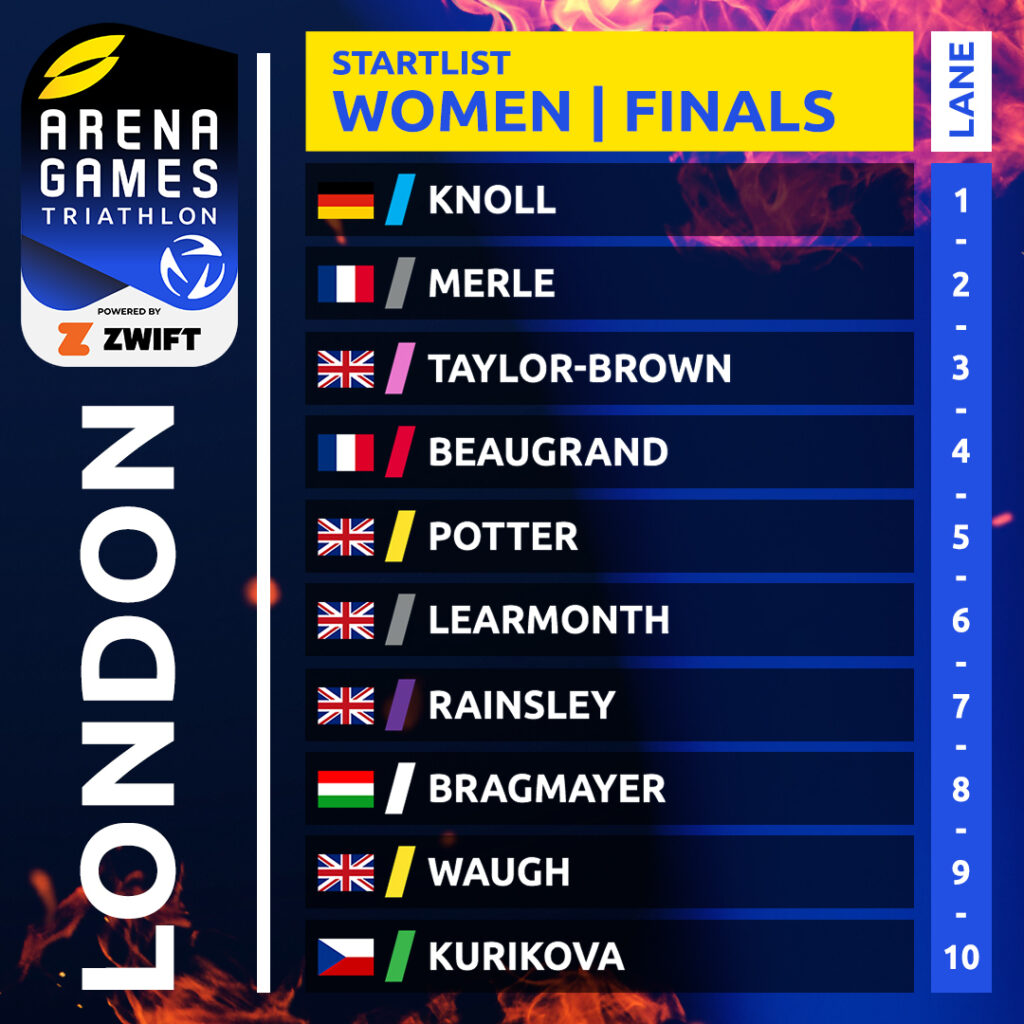
Those who qualified for the finals were: Jess Learmonth, Beth Potter, Sian Rainsley, Zsanett Bragmayer, Kate Waugh, Cassandre BeaugrandGeorgia Taylor-Brown, and Audrey Merle, who took the automatic qualifying spots whilst Anabel Knoll and Petra Kurikova took the fastest losers positions.

The men’s heats were equally as competitive and followed the same format. Britain’s Alex Yee took victory and along the way ran a 2:34 kilometre, which is roughly 23kph or 14.5mph.

Australian Max Stapley, who finished second in Munich, took the second heat. 

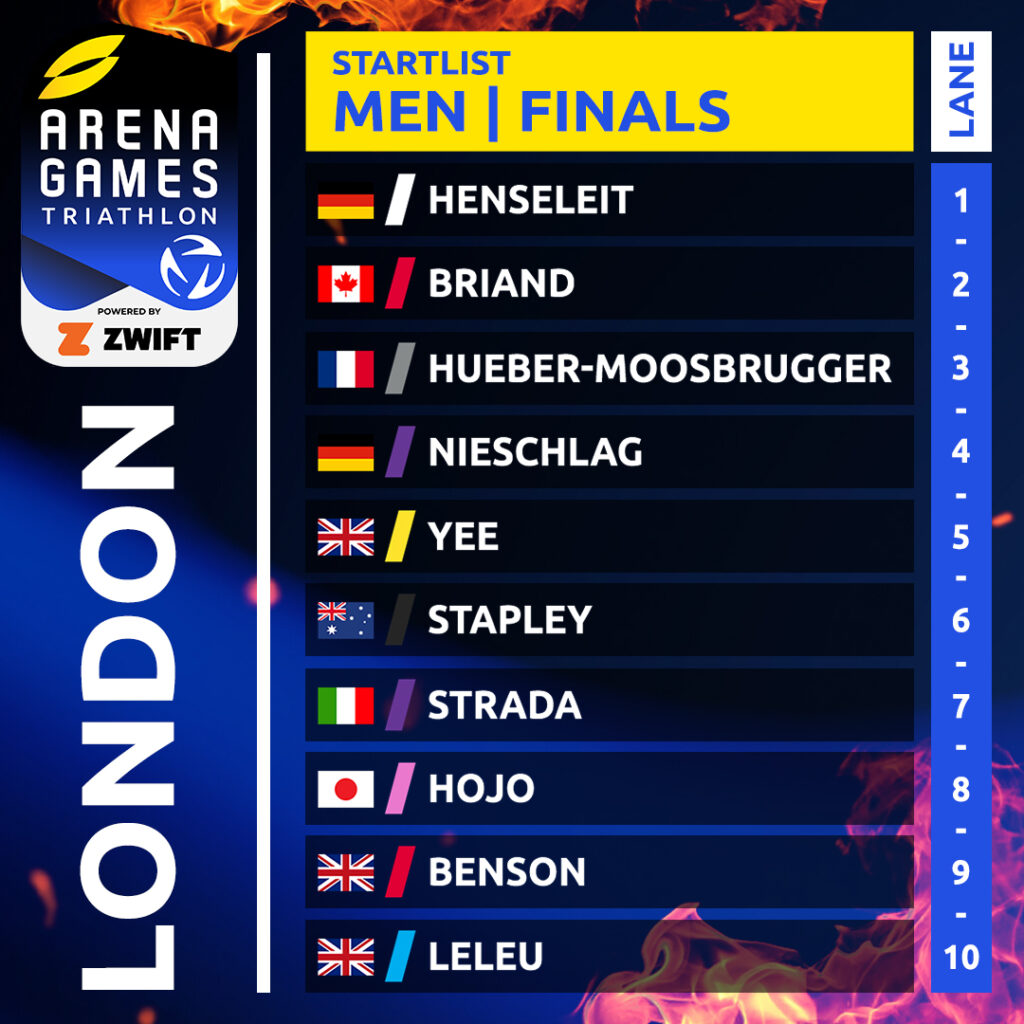
Athletes who qualified for the finals were:  Alex Yee, Justus Nieschlag, Maxime Huber-Moosbrugger, Jeremy Briand, Max Stapley, Nicolo Strada, Takumi Hojo, Gordon Benson, who all qualified by right, and the two fastest loser positions went to Simon Henseleit and Harry Leleu.

I spoke to Portuguese athlete Riccardo Batista, who sadly missed out on qualifying for the final, he explained, “Everything was really hard.” He is planning to head to Singapore for the next event and described the experience as “exciting, competing with my idols.”

The Final

It’s fair to say that both Women’s and Men’s events saw some eye-watering performances in terms of speed and strength and this was with the additional stage, because the final involved three stages.  The first being swim-bike-run, followed by run-bike-swim, then a third stage set up as a pursuit race, with time gaps determined from the previous two stages’ cumulative times. 

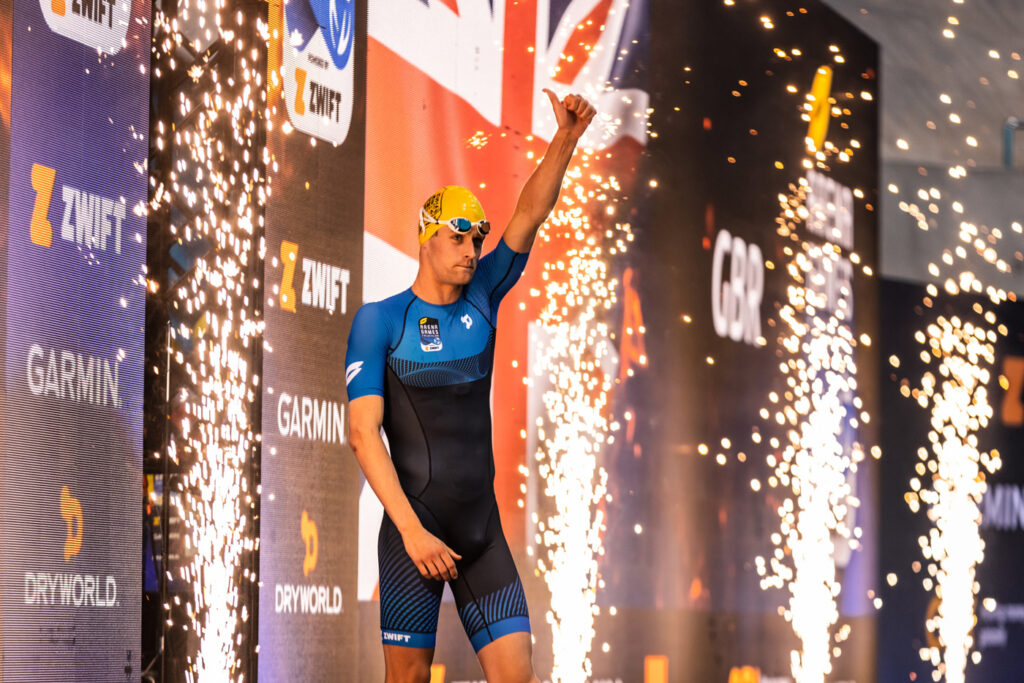
Both races started with fireworks, quite literally. As the finalists were introduced to the sold-out arena they were treated to a brief pyrotechnic display. This would set the scene for the next explosive encounters!

Women’s Race

The Women’s race was close. Cassandre Beaugrand was first out of the pool, with everyone seconds behind, jostling for position in the transition to the bike, something Jess Learmonth mentioned earlier when noting that the transition would be important.  As the bike was a non-draft event, it was all about power, with Beaugrand putting out at times around 5.5 w/kg, however, it was Beth Potter who took the lead on the bike in the early stage. Learmonth caught Beth and this really turned into a head-to-head.  Beaugrand slipped to 9 seconds behind the dueling British pair.  The margins for error were slight and as Learmonth transitioned to the run she struggled to get her trainers on, which echoed her earlier concerns. Potter took the lead.  This was exciting. 

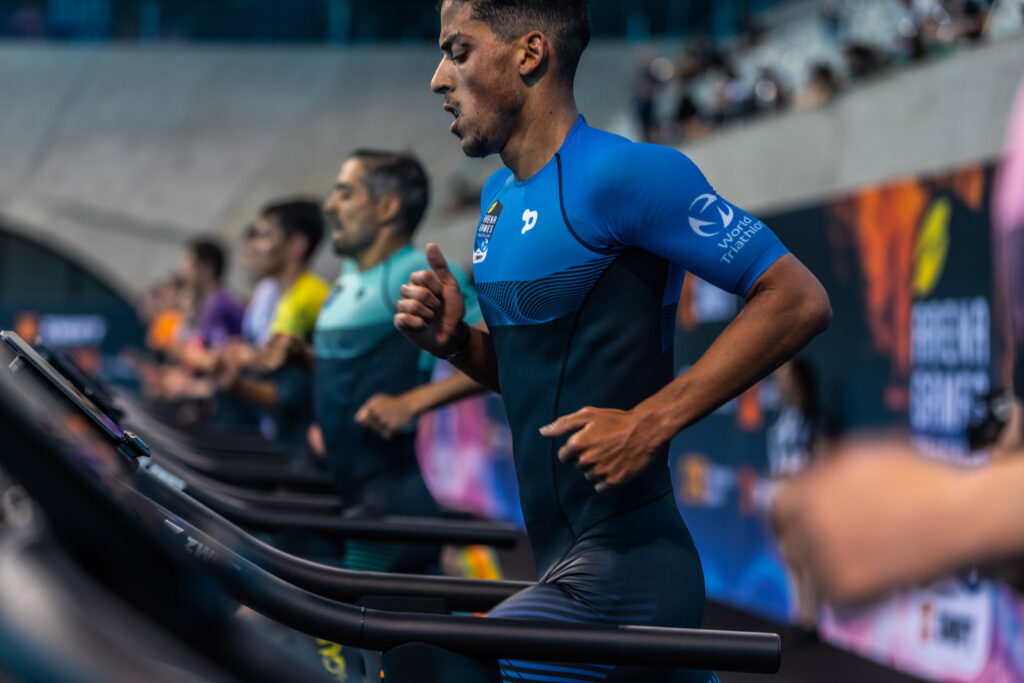
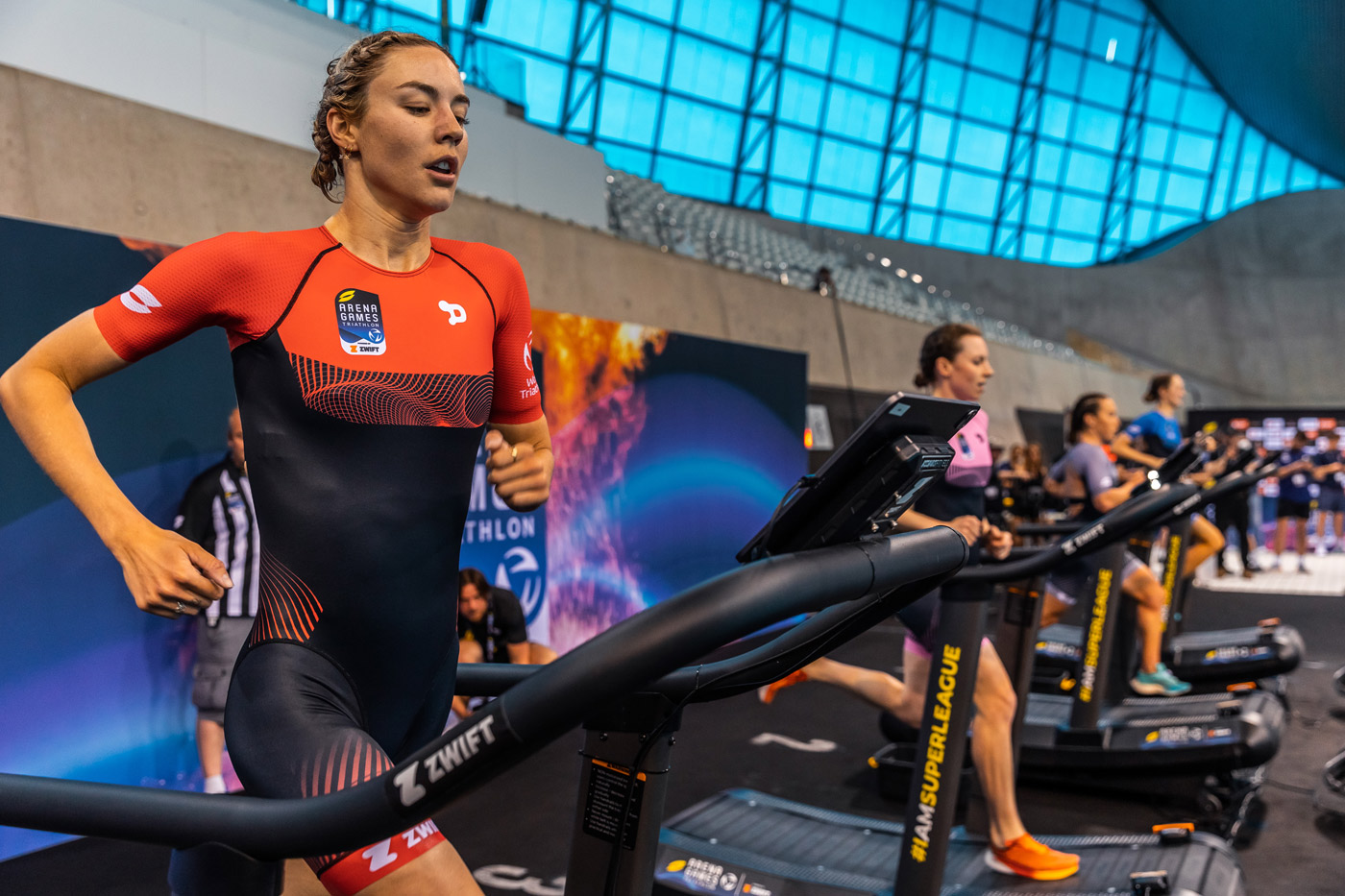
Then things changed. Potter and Learmonth were running at 18kph, which is over 11mph, but Beaugrand was running closer to 20kph, which is staggeringly fast. Her deficit of nine seconds tumbled in quick time. In the space of 350 metres, Beaugrand had moved into second position and was three seconds off the lead.  We were witnessing world-class running.  With 400 meters remaining in Stage 1, Beaugrand took the lead from Potter. Beaugrand finished in first place in Stage 1 with a lead of 3 seconds over Potter, and Learmonth was third, 17.2 seconds behind.

Stage 2 was completed in an even faster time, with Beaugrand leading each discipline and even extending her lead to 17 seconds over Potter in second, with a 2:45-minute kilometre on the run leg. Learmonth sat in third, two seconds behind Potter.  What makes the run even more impressive is that the treadmills have a natural incline thus that was a 2:45-minute kilometre uphill!

Stage 3, the Pursuit, Beaugrand lead from the start, exiting the pool seamlessly and transitioning to the bike without incident, holding her advantage of 17 seconds.  Again during the run she was able to consolidate the win by building on her lead, finishing 32.5 seconds ahead of Potter who took second and Learmonth, who was a further 10 seconds behind in third.

Beaugrand on her final run

I congratulated Potter who explained that she “didn’t feel as good as I did in the morning, it felt hard and Beaugrand was best on the day.” Potter was obviously disappointed but I highlighted her stats of being close to 5 w/kg for bike and 20kph for her run.  It was an immense performance, but naturally you could sense her disappointment, and she noted that, “I dug in and gave everything I had.  That’s all you can really ask for.”  Given the atmosphere, I asked if she could hear the crowd, “Yes, I could hear the crowd and they gave me a good lift.”

I enquired what was next and she explained, “back to training and off to Singapore for the final event.” And that certainly sets up a spectacular final, with both Beaugrand and Potter well-positioned for the first title of Esports World Triathlon Champion.

Men’s Race

The Men’s event was equally as exciting.

Australian Max Stapley was first out of the water, followed immediately by Nicolò Strada, who started pushing over 6 w/kg on the bike.  This was immense and the top positions were separated by a few seconds.  Strada was first off the bike and then it was Stapley, Nieschlag, and Japan’s Takumi Hojo in a small group, six seconds behind.  Within several hundred meters of the run Strada’s lead had been wiped out as Yee and Nieschlag were running at 21kmph.  Yee was able to hold his pace and clocked a 2:36-minute kilometre to complete Stage 1 three seconds ahead of Justus.

Stage 2 saw Nieschlag lead from the start.  He was first to complete the run, again clocking speeds of 21kmph. Then on the bike he rode away from the field, building a 12.7-second lead from Yee and Strada as they entered the swim, where Nieschlag extended his lead ahead of Yee.

Nieschlag dominated stage 3.  Despite the home crowd cheering Alex Yee on, he couldn’t respond to a commanding performance from the German.  As the stage started, he had a 17-second lead which he extended during the swim. On the bike, he edged his advantage to 30 seconds from Alex Yee.  His run was controlled, coming home victorious, 30 seconds ahead of Alex Yee and Nicolò Strada respectively.

Nieschlag on his final run

I spoke to Canadian Jeremey Briand, who finished in 8th. He said, “that was a completely different experience.  It’s very warm, you feel it especially when running, you feel the heat and it makes you so much more tired.”   He explained that, “being from Canada, I train indoors all through winter and this is a good way to transfer that training into a race, but in the heat on the side of the pool, I have never done that before.”

Summing Up

A fantastic event, where on the day the strong athletes prevailed. The stats from the event were staggering:

  • Cassandre Beaugrand swam 2:12. Max Stapley had the fastest with 2:03. 
  • In cycling, Beth Potter had an average power of 5.2 w/kg on the bike in the first stage.  Jeremy Briand set the highest power with 6.2 w/kg and was 10 seconds faster than anyone else.
  • Cassandre Beaugrand had the fastest run splits of the day averaging 2.52.  Alex Yee set the fastest run split of the day in 2:34, 7 seconds faster than the record in Munch which was previously 2:41. 

The margins were slender and show that this competition is wide open as the Arena Games heads to Singapore for the Grand Final.