Watch the Femmes: Ride with Van Vleuten, Vos, and Van der Breggen This Week
This first annual Tour de France Femmes avec Zwift took the cycling world by storm this past summer, and this Thursday (October 27th) the route for the 2023 edition will be announced at the Palais des Congrès in Paris with great fanfare.
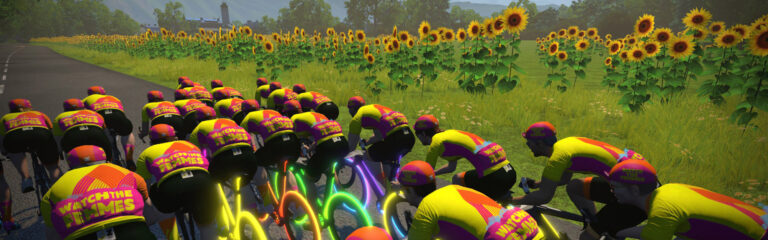
To celebrate the occasion, Zwift has invited three absolute superstars of the women’s WorldTour to ride with the community in three separate events! Everyone will be wearing “Watch the Femmes” cap, kit, and socks for these special rides.
Ride Schedule
All events are 30 minutes long.
Ride with Annemiek van Vleuten: Oct 26 at 6pm CET/10am PDT on France’s R.G.V. Annemiek is the inaugural Tour de France Femmes avec Zwift champion. Shortly after the Dutch cyclist captured the yellow jersey, she won rainbow stripes at the World Road Championship in Willagong. She is a 4x World Champion and Olympic gold medalist.
Ride with Marianne Vos: Oct 27 at 3pm CET/7am PDT on France’s R.G.V. Marianne won the inaugural Tour de France Femmes avec Zwift Green sprinter’s jersey and 2 stages. Considered by many as the greatest cyclist of her generation, Marianne has won World Championships in road, cyclocross, and track, and has captured Olympic gold in road and track across the span of her career. She currently rides for Team Jumbo-Visma.
Because who would want to bear the psychopathy and non-assumed frustrations of a bunch of mixed-gen cyclist wannabes, right?
Phase 0: Getting Tricked By Ricardo
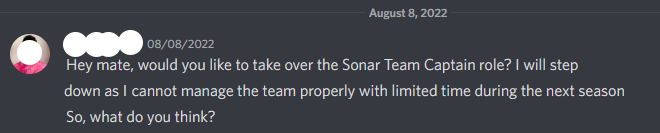
That was my mindset on August 8th, 2022, as I was falling asleep while slurping a mojito and contemplating the sea from Playa América’s beach. So you can imagine the level of hatred I experienced when I was interrupted by the following PM from Ricardo:
I was torn between my oath to never be a ZRL Captain and my commitment to COALITION, and especially to Ricardo. That is why it took me a whole day to get back to him. I made up an excuse for my late reply, but eventually accepted the immense honor of being COALITION Sonar Captain.
I thought I knew what I was getting myself into. But I was wrong. Really wrong.
I understood it immediately, as a few seconds after I answered Ricardo I was given access to seven billion additional threads on the COALITION Discord server.
ZRL Captain threads were ordered by category, topic, and region, and filtered by name and popularity. Then, they were ranked by an algorithm elevating the number of participants of each specific thread to the cube and rooted back to the immediate closest primary number. Or something like that. In any case, it was clear someone put a whole lot of effort into making it incredibly well-organized and easy to understand.
The first instruction you get is the following:
“If you are a new captain, please first read the Team’s Captain Manual.”
The concept of manual is misleading here. Calling it “Team’s Captain Definitive Universal Encyclopedia” would match reality much better.
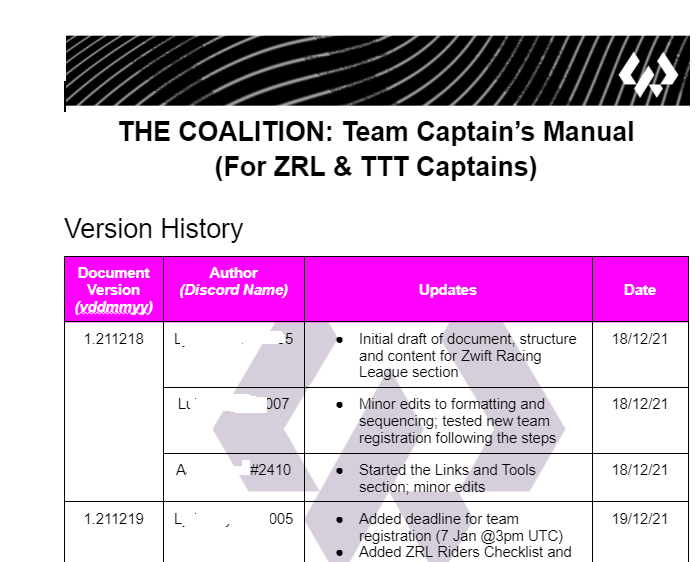
The Captain Manual is a document regularly updated with version tracking to make sure nothing is left unattended. From weigh-in protocol to team naming convention to be COALITION compliant (how the names of COALITION teams originate is a secret I cannot reveal otherwise my fellow COALITION captains will have to remove me from the surface of earth).
I was given access to the origin of Universal Truth, to the source of good on Earth.
I felt like Newton being hit by the apple. I was finally seeing the Matrix.
Phase 1: Building the Team
This whole myth of a very coordinated captain community fell apart when it was time to allocate riders to teams.
If you want to imagine it as a steering group that closely monitors each team assignment, bearing in mind balance and cohesion, don’t read the next paragraph.
The reality is that the only place where I have faced a fiercer negotiation than “I give you Joe and Jack to Sonar if you give me Robert for Telepathy” is bargaining for a Persian carpet in the Zouk of Istanbul back in 2012.
I am joking. With the excellent coordination of the EMEA regional captain, Andreas, all teams were quickly created. A week before the start of ZRL, the Sonar team was definitive, and from the first exchanges with the teammates I knew we would be a fantastic team.
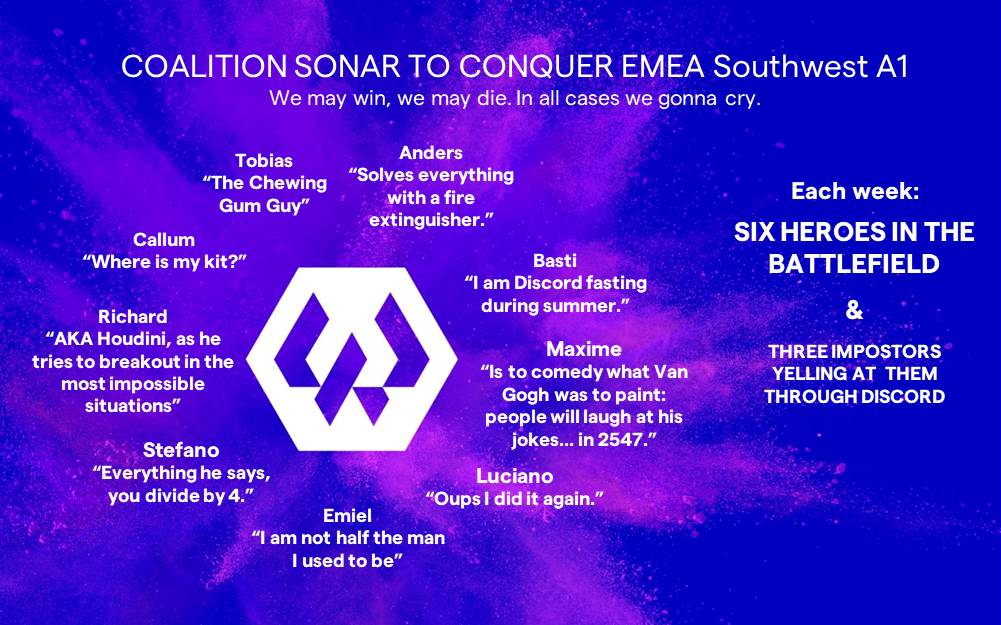
A basic introduction of the felons:
Getting the team to feel like a team was easier than anticipated.
I have to say I started with an advantage. The guys were great, I knew four of them from previous ZRL seasons, and I have a natural tendency to overwhelm the Discord server with nonsensical tirades which at best make me sympathetic, at worst make others feel sorry for me. In both cases I had something to build on.
Phase 2: Managing the Emotion Rollercoaster
What I could not anticipate is that being captain was a little bit like eating an entire jar of fortune cookies, every single day. Each fortune cookie contains a different kind of curse or unrealistic challenge. “Life is a continuous Internet dropout”, followed by “you will find a miscalibrated home trainer on your pathway to happiness”, and eventually the more down to earth “you should appropriately feed your dog if you don’t want him to eat the ethernet cable during the race”.
For every single race I was sure something unexpected would happen, but would not know what until the very last minute.
And those misfortunes made me actually wanna cry. Not joking.
I felt every single detail was the most important thing in the world. From the moment I would announce the composition of the team racing the following Tuesday, to the moment when the WTRL results page displayed our ranking after 5 minutes of frantically pushing the F5 key.
As a team captain, you need also to develop unlimited patience and/or project management skills and/or hunting skills:
I had to chase some of them to get a proper weigh-in video.
Remind some of them that there is no advantage to clicking the racepass link at the last minute. That the only thing you get by doing so is to have your captain’s heart going as arrhythmic as the cadence of a sticky watter.
Repeat that the race is at 8PM CET time. CET time. CET time. CET time…. (this is not a mistake, CET time is repeated many times. CET time. Seems that some do not understand the notion of time zones, they live in their own time zone 🙂 )
Remind that COALITION kit is pink, and that if you are very dogmatic about the Bike & Beer jersey, we’ll have a problem.
Phase 3: The Competition
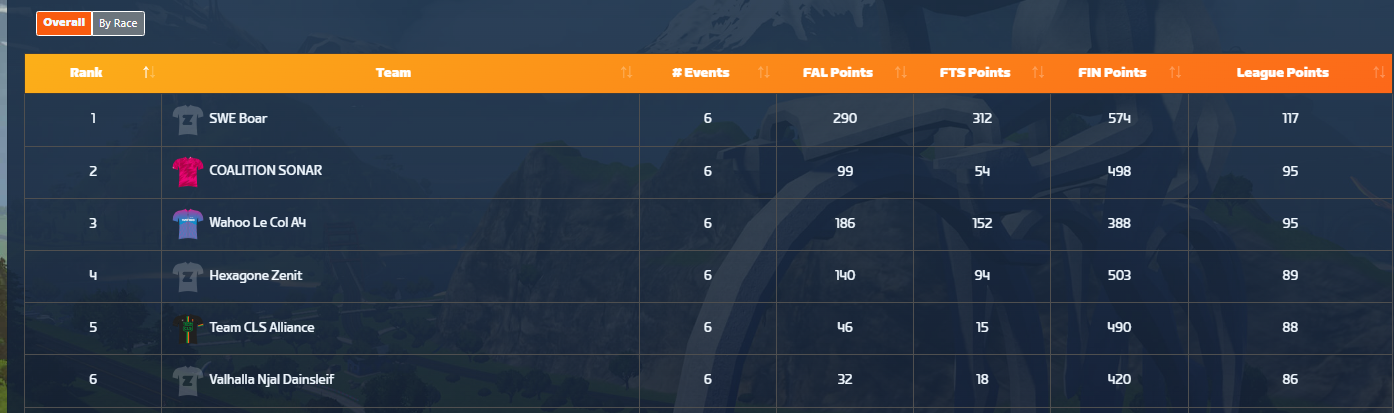
Least importantly, we finished 2nd in our Division. I am proud, I am not going to deny it, though I would have been as proud if we had finished 7th or 10th. (From 10th downwards maybe I would have been less proud…)
What is way more important are the incredible moments we lived together. And the most intense ones were not when Callum won the Volcano Stage, or the day Emiel scored points at all FTS and FAL.
Two anecdotes are still giving me goosebumps when I narrate them.
First one: Last stage. 54km. Emiel has a calibration issue just before the start of the race and only manages to start 6 minutes after the pack left the pen. He rides a 54km iTT. Those 4 points he gets finishing across the line made us maintain our 2nd overall ranking in the general classification. The team waited in the audio channel until he finished, laughing and joking at the misadventure of Emiel, but at the same time so thankful for his effort.
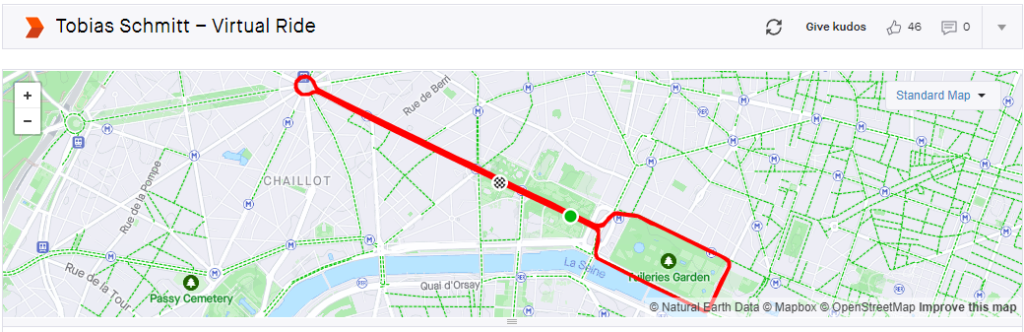
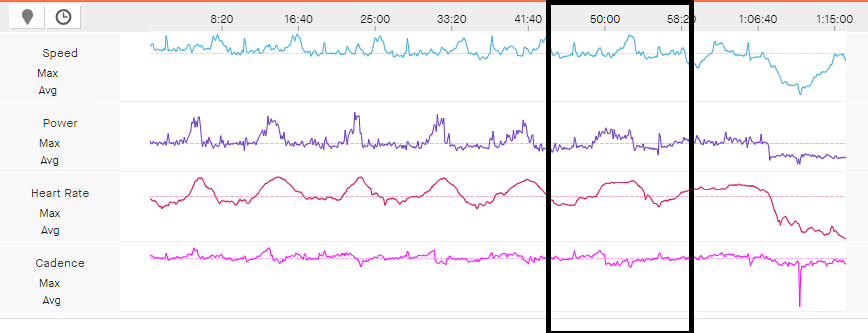
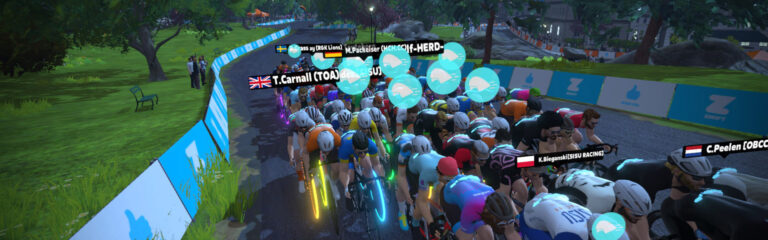
Second one: Champs-Elysées stage. The day Tobi earnt his “chewing gum guy” nickname. Tobi was giving it all at the end of each lap so as not to be distanced by the front pack of around 50 riders. In the fifth sprint his HR goes nuts. He is obviously going beyond his limits. I am DSing, and despite all the energy I put in trying to get him to suck the wheel of the guy before him, Tobi is dropped and crosses the lap line alone with 8 seconds delay on the pack. A landslide.
I announce it to the team and all congratulate him for the effort through the audio channel. At this point he had already gone way beyond the call of duty. Tobi remains silent, does not say a word. While I focus on Richard trying to break away for the 700,000th time, I notice that the delay between Tobi and the pack has now been reduced to 6 seconds, and soon 5 seconds.
Tobi would simply refuse to get dropped. Period. He knows, or better said, I know it is impossible for one guy to come back on a pack of 50 riders in a flat like Champs Elysees. Still that word, “impossible”, by all means is not in Tobi’s dictionary nor catalog of acceptable behaviors. So he continues permanently pushing more and more.
4 seconds. That’s when I put myself on Tobi fan view, and start mildly encouraging him again “come on, great effort, you rock…”. I was not totally sure what was happening though.
“Guys, I am witnessing something crazy, Tobi is battling by himself and is now only 3 seconds behind the pack.” I immediately get 4 guys shouting and saturating the line, hysterically rooting for Tobi. And Tobi pushes even more. “2 seconds guys!!!! 2 seconds!!! Come on you are going to make it!!! Dig deep you are making it!!! Tobi you are CRAZY CRAZY but you are going to make it!!! One second!!!! One freaking second!!!! YEEEEEEEEEESSSSSSSS!!!!!! You made it!!!!! OMG you made it!!!! WTF!!! You are freaking crazy!!!!”
A friend of mine once told me, “If Elon Musk and I meet in an elevator, on average we are billionaires.” It is kind of the same with Tobi and craziness. If the entire team and Tobi meet in the pen, on average we should all be sent to a psychiatric emergency facility.
Because in my 32 months at Zwift, I had never seen something like that. Just imagining it might be possible is crazy. If I would have calculated the probability of making it I would have instantly dropped the idea.
The celebration from the other teammates while Tobi rejoined the pack was one of the most beautiful moments I have experienced as a Zwifter. This is another perfect illustration of what it means to be a team. To fight and explore new limits to be 30th instead of 50th, just motivated by the commitment to others and your refusal to abdicate. Do you know something more fulfilling, more rewarding as a group than this?
Well, that was exactly the mindset of every single one of us during the entire season. Fighting at the front or at the back of the pack, we would all refuse to abdicate.
Richard, Callum, Stefano, Maxime, Emiel, Tobi, Basti, and Anders: you all rock big time!
Therefore, my selfish advice is super clear: don’t do it. Don’t ever be a ZRL Captain.
Because the fewer of you who are willing to be captain the more chances I have to keep my spot as SONAR’s. What a privilege to be part of this magic team!
Tiny Race Series – October 29 Rules Changes, Pack Dynamics 4, Routes, and Results
Once again racers turned out in force for last week’s Tiny Races, dashing pell-mell down Pot Bank with anvils flying and heart rates high. (I hit 120 kph with a little help from an anvil powerup.) Definitely a (type II) fun mix of races!
This week we’re relaxing our rules a bit, and testing Zwift’s experimental Pack Dynamics v4. Details below…
Rule Changes
We’ve had an anti-sniping rule in place for the past two weeks, requiring riders to complete all 4 races or be disqualified from any races they did finish. In the first week, ~20% of all results were DQ. In the second week, ~12% of results were DQ.
That’s progress, but we’re still not happy with having to DQ so many riders. So after backtesting past weeks’ data with new rules, we’re softening the rules a bit. Based on our testing, these rules should reduce DQs by 25-50% without significantly impacting the fairness of results.
No skipping and returning: our previous rule said you had to finish all 4 races in your zone, and if you didn’t, you got disqualified from any races you did finish. This week, the rule has been relaxed: now you cannot come back after missinga race. That means you can race just race #1 and be done, and your single race result will stand. But if you only race (for example) #1, #2, and #4, that #4 result will be removed, because you skipped race #3 and therefore have an unfair advantage (fresher legs) over those who are racing each race.
HRM required for podiums only: Riders lacking heart rate monitor data will only be DQ if you podium in a race. Previously we required HRM for all riders, but we think HR data is rather subjective, rarely scrutinized, and basically not something that should be required just to show up in the final results. That said, if you’re strong enough to podium, you’ll need to provide HR data.
Note: these rules are not set in stone, and may change in subsequent weeks as we dial in our ruleset. As always, be sure to read the event description or the week’s Tiny Race post for details.
Pack Dynamics v4 Testing
We love testing new Zwift stuff, so we’ve volunteered to use Zwift’s experimental new Pack Dynamics v4 in this week’s Tiny Races!
The goal of PD4 is to create a more realistic racing experience. The main changes focus on reducing the forward and backward movement of cyclists in the pack while also reducing the overall speed of larger groups.
This should encourage a more “aggressive” approach, allowing for more breakaway opportunities and thus more dynamic racing.
James Bailey of ZwiftHQ is requesting that racers share their feedback on this forum thread.
A: Mairen Lawson (Twenty24) B:none C: Carly Graham (CrushPod) D: Jadene White
This Week’s Routes
Three new routes this week, and two routes we’ve used before. It’s a mix of route types from flat to rolling to a leg-snapping finish up Alpe du Zwift.
Here are photos so you can see the precise location of the custom finish lines for race 2:
Approaching Road to Sky finishRoad to Sky finish
Race 1: Seaside Sprint (5.676 km, ends at Volcano Circuit arch)
This one is a bit of a roller coaster, starting on The Esses, down across the JWB sprint reverse, down the Dirty Sorpressa, then finishing inside the Volcano on one of Zwift’s most technical and challenging finishes. Lots of aero boost powerups will keep this fast and encourage attacks.
Powerup: Aero Boost
Race 2: Road to Sky (5.5km, ends partway up Alpe du Zwift)
This will be interesting. A jungle dirt lead-in followed by 400m of Alpe du Zwift climbing. Do you choose a gravel bike, or a road bike? Depends on where you want to attack…
A rolling counterclockwise circuit of Central Park’s inner loop, this route has an uphill finish up Cat’s Paw Hill that requires timing and punch for the win.
Covering only the lead-in from the pens to The Mall Sprint banner, this route is quite flat apart from quick Northumberland Ave climb taking you up to Trafalgar Square.
Zwift displays preliminary race results in game when you cross the line, but points are computed after all four races are finished, with final results on ZwiftPower. (We have to do some data processing on our side to compute results, so if your rankings don’t show up right away, just be patient.)
Riders will earn points based on finish position in each of the 4 Tiny Races. The category winner of each week’s series is the rider with the most points across their timezone’s 4 races. Here are the links for each timezone’s results on ZwiftPower:
Tiny Race rules are simple. Four races, four rules:
You must have a ZwiftPower account, because final results are processed by ZwiftPower (learn how to sign up)
No skipping then returning. These races are meant to be raced as a set of 4. If you need to leave early, that’s fine… but once you miss a race in your hour’s set of 4, don’t come back and race another or you’ll be disqualified from that race since you rested while others were racing! (Example: racing only races 1 and 2 is fine. Racing 1, 2, and 4 is not.)
Heart rate monitors are required for podium finishers
ZPower/Virtual power is not allowed. Smart trainer/smart bike or power meter required.
Join a Chat & Chill Cooldown
Immediately following each hour’s racing, we’ve scheduled 30-minute “Chat & Chill” events where riders from all categories can spin out their legs together and have some fun chatting about how it all went down. Find them at zwift.com/events/tag/tinyraces.
How the Season Was Lost: the Roosters Extended Victory Tour
My Zwift Racing League team, the DIRT Roosters, has had quite a fairytale racing story. Illogically placed in Division B5 of the EMEA W zone, we set our sights on winning each round so we could be promoted up to the division we felt was appropriate (B1, of course).
And that’s exactly what we did, taking first place in our division in successive rounds, working our way from B5 to B4 to B3 to B2 to B1, then winning B1 in 2021/22 Round 3. It was glorious, and I documented many of those races in my “How the Race Was Lost/Won” series here on Zwift Insider.
Once you’ve won B1, though, there’s no automatic promotion to a higher division. You just stay in B1, unless your team opts to go into the A divisions. So the Roosters returned to EMEA W B1 for Round 1 of the 2022/23 season. And we immediately discovered things wouldn’t be like the previous round. Specifically:
Our team wasn’t as strong
The other teams had grown stronger
Let’s unpack those a bit…
Weak Roosters
I hadn’t been in close communication with the Roosters during the summer, but as we started talking about racing again it became clear we weren’t all at the high levels of fitness that saw us win B1 the previous round. What had happened between the end of 2021/22 Round 3 (May 2022), and the start of 2022/23 Round 1 (September 2022)? I asked our team members to summarize their summers…
Antoine (our team captain): Due to a football injury that kept me away from cycling during several weeks at the start of the summer, my fitness shape consistently decreased. On top of that, the arrival of a third baby and an additional mental burden due to new side activities dropped my weekly cycling from 150+ km to +-60km. All this clearly set back my fitness level to square 0 at the start of season 1, which resulted in a shame season with nearly no points scored.
Clem: I just had a lot of private and professional things to do…. I didn’t take the time to get on my home trainer to get in the shape I needed. Combined with that, there was the rapid arrival of the competition and the hot summer weather still present. No motivation to ride in the garage.The icing on the cake… a very strong field this year compared to last season.
Sean:It turns out that taking a month off of cycling over the summer while focusing heavily on other sports isn’t ideal race prep for ZRL.
Dean:My goal this year is to ride 10k km and with only 800km left, my fitness level is a little on the + side.
Arjen:I maintained my form throughout the summer, and was pushing close to or sometimes over my best watts ever in every race in season 1. However, in this past season, this resulted in finishing positions somewhere around 20-30th place, in contrast with the previous season where I was competing for top 10 and lots more FTS and FAL points. Still, it motivated me to keep pushing and got me fitter at the end of R1.
Thomas:(Thomas didn’t send in a summary, but he has been battling some potentially-serious health issues and has been off the bike for months.)
Myself: I’ve been riding and racing consistently, and I’d say my fitness is right around where it was in the previous round. Which is to say, if you’re relying on me to take lots of points against the other B1 riders, you’re going to be sorely disappointed…
While Arjen performed admirably and Dean and I held our own, we clearly lacked the firepower of past rounds. Captain Antoine typically had a lot of useful punch on short to longer climbs, but he had lost so much fitness that he came in nearly dead-last each race. Clem, our strongest sprinter, was getting dropped from the front of most races. Sean, a TTT workhorse and all-around strongman, didn’t have the endurance to stay with us in the TTT. And Thomas, always reliable for a long attack, wasn’t even in the picture.
It wasn’t looking good. So I flipped the script.
I began consoling myself partway through Round 1 by changing my mindset. The Roosters had won it all in the previous round, and now we were on the Roosters Extended Victory Tour!
That’s right. We were sitting up, riding down the road in zone 2 holding champagne glasses to celebrate our victory. Some teams would have kept the tour quite short, but we decided to extend it for several months.
We still did our best to win each race, but we also didn’t feel any pressure to perform particularly well. Go out, smash ourselves, and have fun. That’s what Round 1 became.
And now that Round 1 has finished, the Roosters have agreed to end the Victory Tour. It’s time to train in earnest and work hard to regain our former glory. Cock-a-doodle-doo!
Stronger Competitors
On top of our weakened roster, the competition level in EMEA B1 had ratcheted up significantly. There are some “super-B” riders in this division who actually race quite competitively against A riders (one of them actually won one of my A Tiny Races last weekend)!
I’m not going to accuse anyone of sandbagging. But I’ll say the ZRL/Zwift structure encourages riders to stay below category limits so they can keep racing as a B. Add to that the fact that when you win B1 you don’t get promoted to a higher division, and you end up with a B1 division full of crazy strong riders!
Race Summaries
I won’t bore you with detailed writeups of every Regrettable Round 1 Roosters Race, but I’ll summarize them quickly:
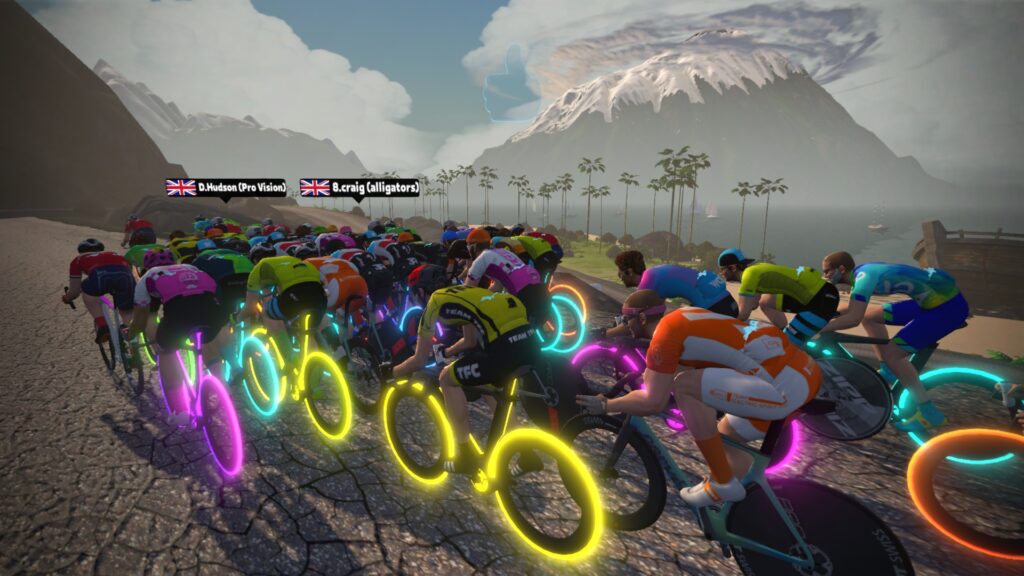
Race 1 (Climber’s Gambit): this is where I knew we had a problem. Because I was the second-fastest finisher on our team, in a race that ended up the Epic KOM. In past seasons I would have been the 5th or 6th Rooster across the line. 8th place
Race 2 (Park Perimeter Loop): I was out of town for this one, which broke my heart since it was probably the best chance I had at a good result in Round 1. Substitute DIRT rider K. Mckenna rode in the open slot, but we scored a grand (or less-than-grand) total of 6 intermediate points. 11th place
Race 3 (Wandering Flats TTT): in past seasons we’ve excelled at the TTT, but this time around it was ugly. We finished 85 seconds behind the first place team. Factors included Clem blowing up after foolishly agreeing to take 1-minute pulls, Sean getting dropped on the climb, and a general lack of hard pulls in good formation. 9th place
Race 4 (Champs-Elysees): Jimmeny Christmas, somehow only 4 Roosters finished this race! It was my best placing of the season (8th) but that doesn’t mean much when you only get 4 riders across the line. 11th place
Race 5 (Legends and Lava): once again I was the second Rooster across the line, which doesn’t mean I performed well. It means other Roosters have slowed down! It’s not a good sign for our team when I’m finishing 2nd on a race that ends on the Volcano climb. 11th place
Race 6 (Eastern Eight): I had hoped to do better in this race, thinking the longer distance would work in my favor. It did not. But Clem had his best race of Round 1, and Arjen and Dean grabbed some solid points too. Progress! 9th place
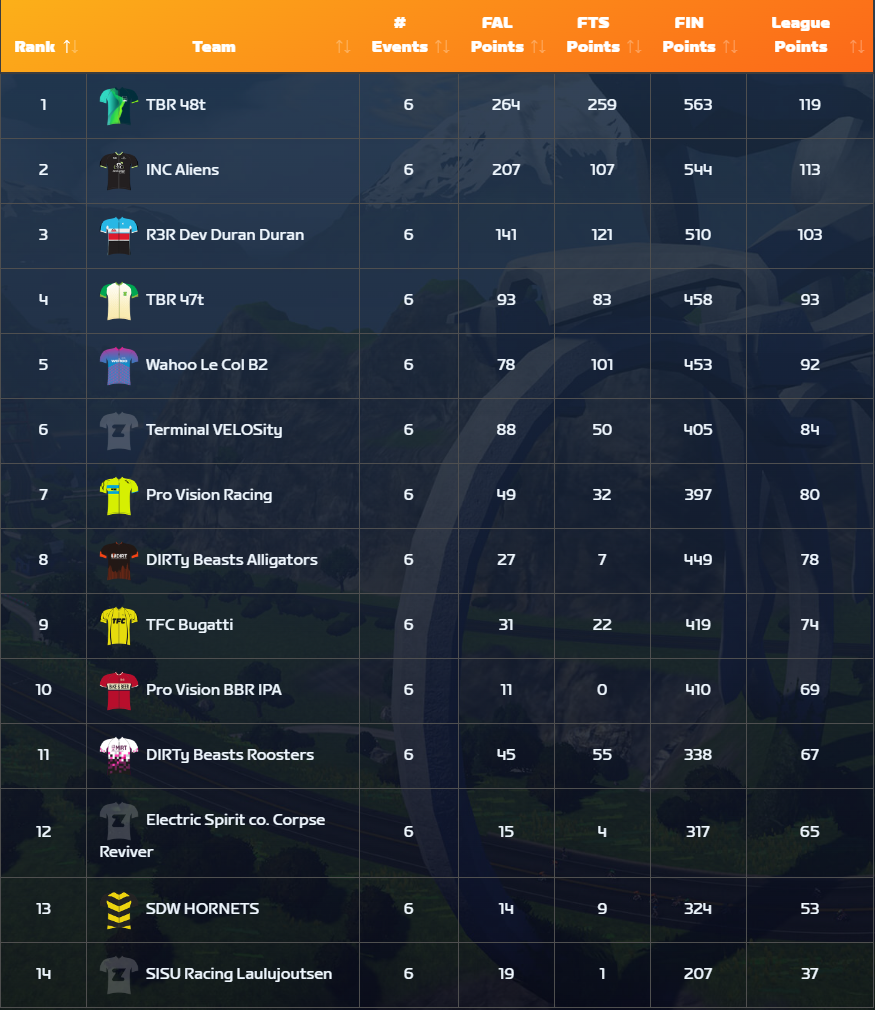
We finished the season in 11th place overall. With 14 teams in the division, this means we won’t be one of the two lowest teams that get relegated to B2. Is that a good thing? Yes. No?
Final results for the EMEA W B1 division
Your Thoughts
How did Round 1 go for you? Ready for Round 2 in November? Share below!
If you’ve watched the Tour de France or any major cycling event, you’ve seen the products created by Nopinz… probably without realising it. You see, the core product of Nopinz is their SpeedPocket™, a patented and unique product that makes attaching your race number easier, whilst simultaneously improving aerodynamics and performance.
From its humble beginnings the company has expanded from manufacturing their trademark SpeedPocket™ to developing state-of-the-art clothing for cyclists of all disciplines, including a specialised line designed for indoor cycling called the “Sub Zero,” addressing the issue of “how to remain cool.”
If creating innovative products and clothing wasn’t enough, Nopinz are hugely active in the Esports arena, including sponsoring the Saris Nopinz Team who describe themselves as a “team of athletes driving the development of a new discipline of cycling; pushing the boundaries and expanding cycling’s accessibility worldwide.”
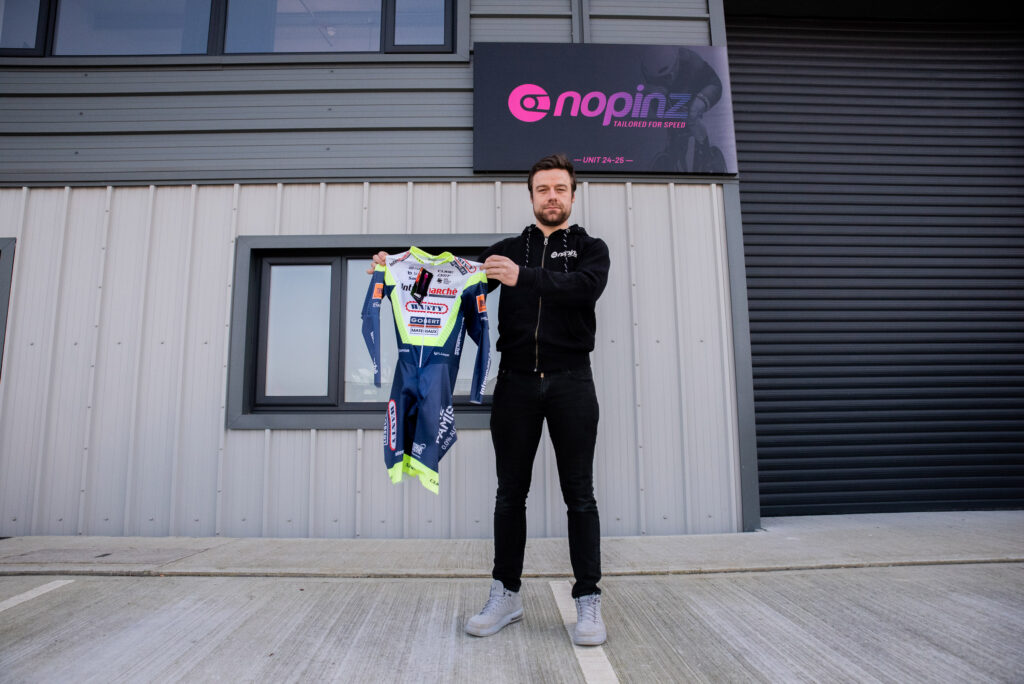
Founder Blake Pond with speedsuit for UCI WorldTeam Intermarché Wanty Gobert
The History of Nopinz and the SpeedPocket™
The development of this brand makes for a fascinating story. Founder and CEO Blake Pond and Sales Director Gary Chambers were avid racers and often found themselves pinning their race numbers onto their cycling jerseys whilst sat in their car, prior to a race, often stabbing their fingers with the safety pins which are used to hold the numbers in place and damaging their expensive apparel in the process. Blake questioned if there was a better way and went about solving the age-old problem of pinning your race number to your jersey, without using safety pins. And from his kitchen table in Barnstable, Devon, UK “Nopinz” was born. The name “NoPinz” literally means “No Pins” in reference to not using safety pins.
Early designs saw the production of adhesive wallets, where you could put your number in, which was a revelation from using pins, but it presented challenges around a suitable adhesive to use that was environmentally friendly, as well as the issues of using plastic. However, testing saw positive feedback that led to the invention of the SpeedPocket™ which resulted in the number being installed from the inside of the suit to maximize aerodynamic efficiency. Then followed the SpeedPocket™ Easy, where the number is installed from the outside of the suit, ensuring it is aerodynamic and fundamentally no more pinholes, a different option for the customer. In fact, there are several different versions of the SpeedPocket™ now, all catering for the different number sizes required for different events and race organisers. These include:
RTTC AERO – Used for Cycling Time Trials (UK) events
RTTC EASY – Same as RTTC Aero but the number entry is external rather than internal, slightly less aero but more practical.
UCI SINGLE – Used for UCI TT events
UCI DOUBLE – Used for UCI or British cycling road races
TRACK X2 – Used for bunch track racing
The early iteration of the SpeedPocket™ saw Blake sewing these into skinsuits based from his kitchen table. His setup was small but simple: there was one machinst, one sewing machine, and one computer. However, in the climate of “marginal gains” what Blake was doing was noted and soon people were sending him their skinsuits to have the SpeedPocket™ installed. Before long, the company took off and subsequently expanded, moving into their first premises. That was 7 years ago.
Over the last 12-18 months, the company has expanded exponentially, recently relocating into their second new premises, where they now develop their own skinsuits. Their innovative clothing is still being handmade, and the company has expanded to 22 employees to keep up with demand.
In April 2022, Nopinz launched their new website showcasing their products and offering a “Club Shop,” yet another innovative service where you can get your own cycling apparel designed and manufactured without the need for a “minimum order” or adhering to certain times when orders can be placed.
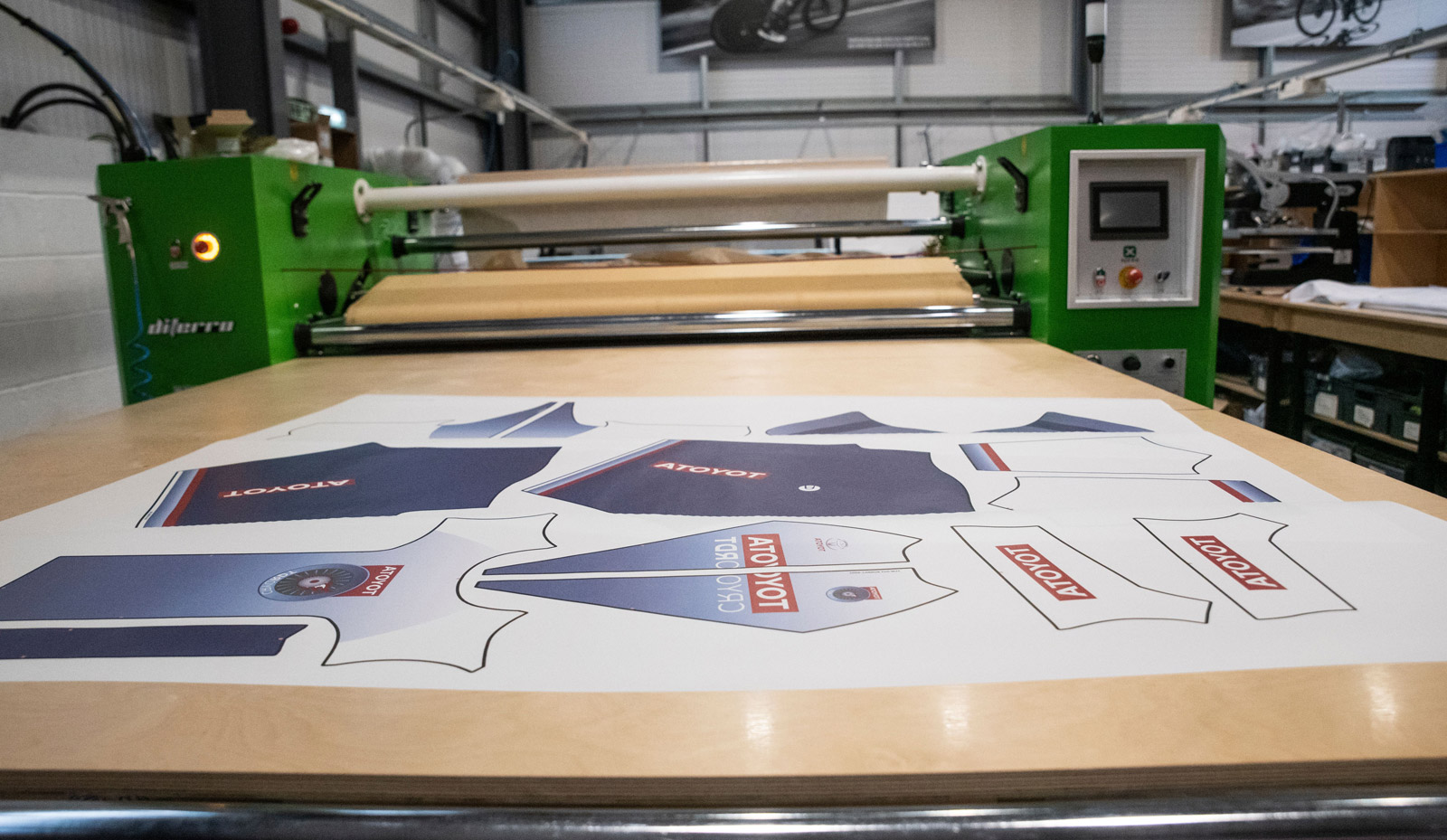
Kit in production for esports team Toyota Cryo RDT
Subzero – As Blake explained “Subzero is a range of kit that has been optimised for indoor use. It is made from highly breathable fabrics and there are pockets that are built in where you can insert specially designed ice packs to keep you cool.”
The range is diverse and developed because there is a need for specialised indoor cycle clothing. The line includes sweatbands for the arms, allowing you to insert cooling gel packs. There is an all-in-one suit where gel packs can be inserted across your lower back and in between your shoulders. And there are bib shorts that have a compartment for the frozen gel pack situated in your lower back.
The locations where the gel packs sit are all key cooling areas of the body and like all Nopinz clothing, it is fully customisable. When used, the gel packs required changing every 20-30 minutes to help prevent overheating. This will optimise performance which is vital because as Blake noted “once you overheat, there is no coming back.”
This innovative product, like all Nopinz products, is designed and manufactured in their factory in Barnstable, UK.
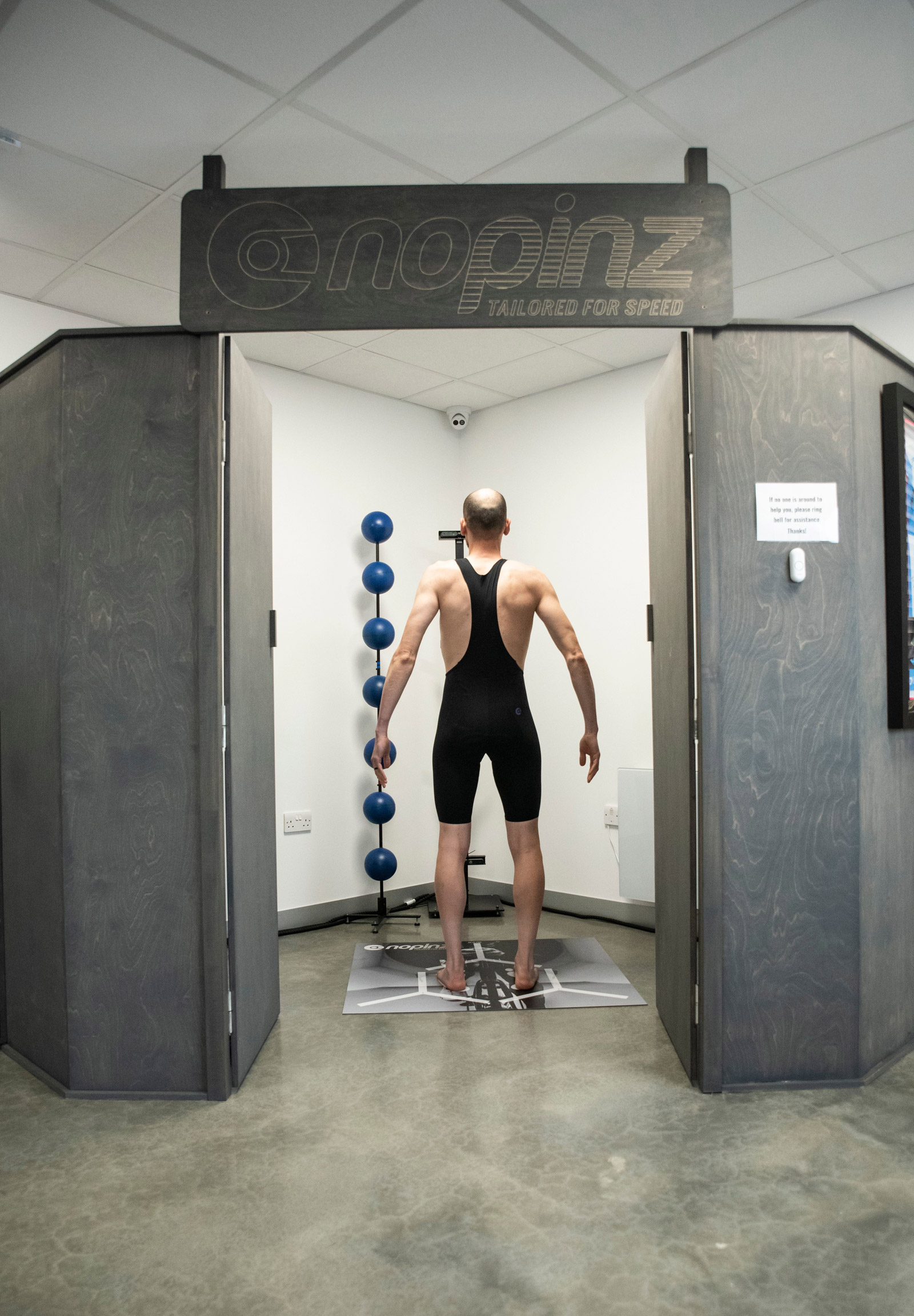
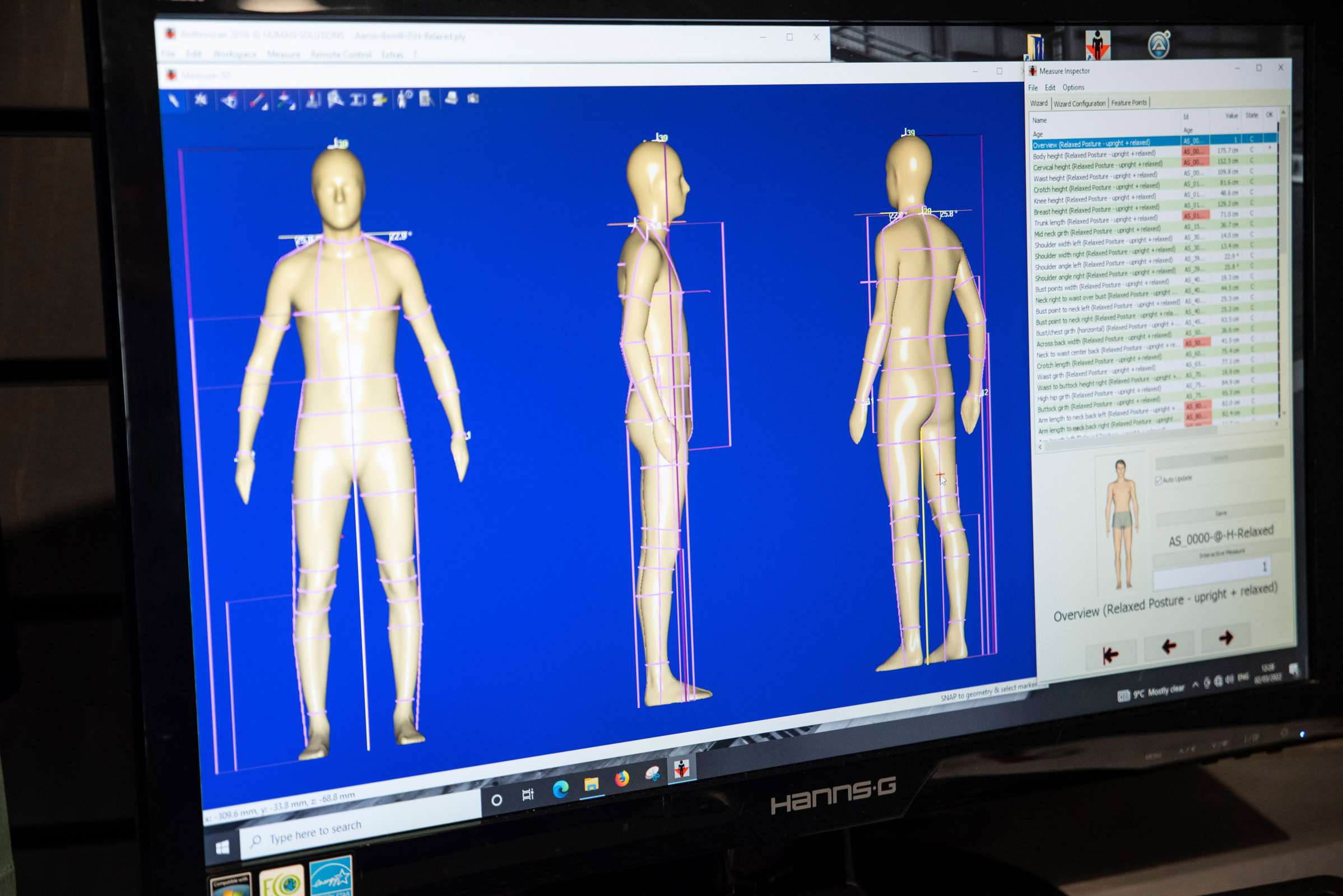
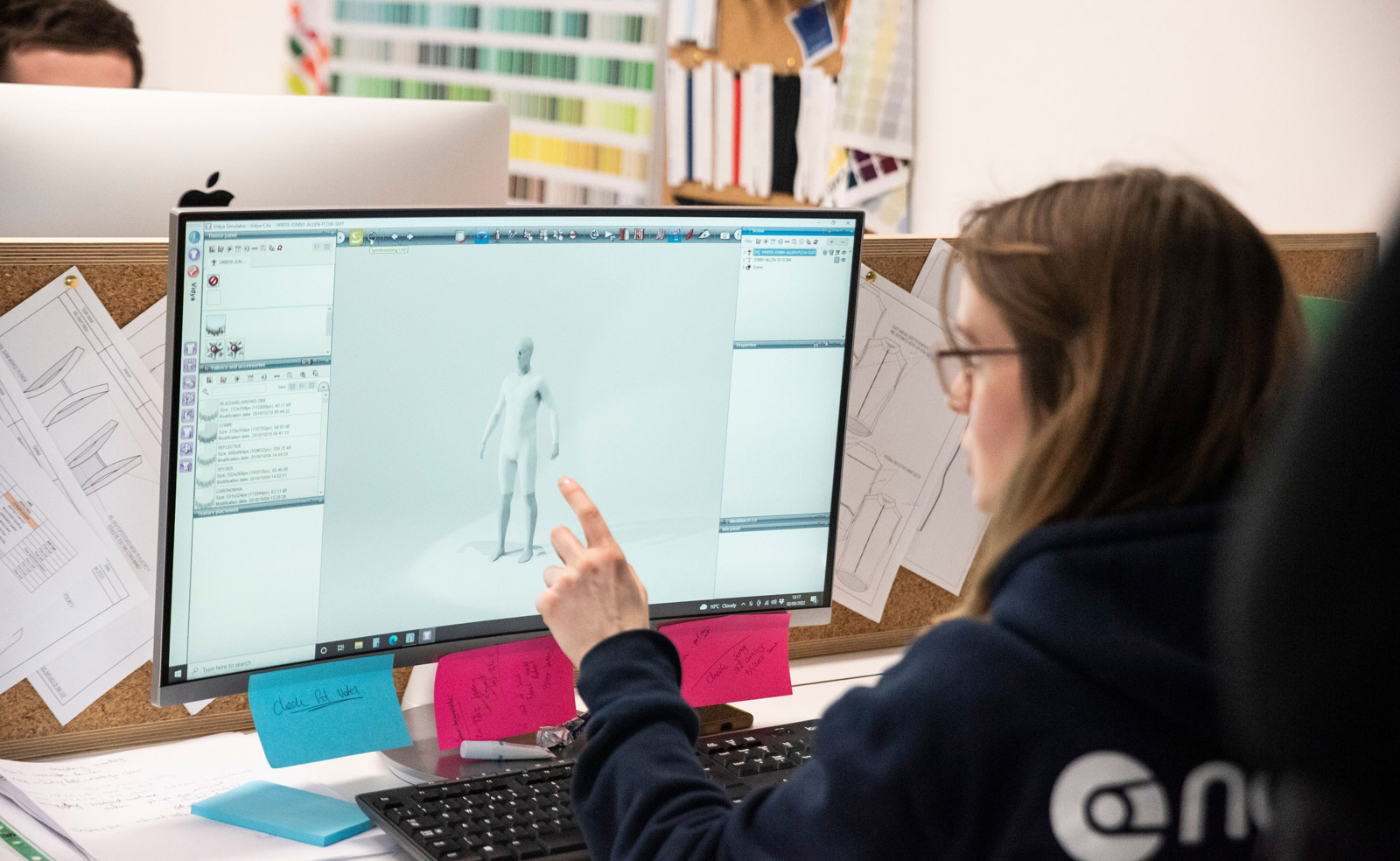
“Made to Measure” service – This is another innovative option that is not widely offered to customers. This service enables even the amateur rider to get skinsuits designed to their own body shape, a service usually reserved for pro riders which is becoming increasingly popular with amateur riders as they look to push their own personal boundaries. This service involves a full body scan and takes a Patent Maker a minimum of 3 hours to put together a skinsuit.
Nopinz’ 3D scan systemA rider’s scanMade-to-measure creation
Club Shop – This offering by Nopinz is something special. Despite being around for several years, its website has recently undergone a redesign and was merged with the central Nopinz website, giving it a more uniform and integrated feel with the overall brand.
If you have your own club or team, and have previously had kit produced, you may have experienced issues such as large minimum order quantities and reordering during certain windows. However, the “Club Shop” feature by Nopinz removes that. Other bonuses include:
No minimum orders.
Industry short lead times.
A simple online ordering process for your members.
Delivered straight to the customer.
Reorder at any time with no restrictions or order windows.
If you are fortunate to have a custom jersey in Zwift, this is your opportunity to get it produced and wear it in real life! Given that I have just produced a jersey for my Mountain Massif events (which can be obtained by completing one of my events), Nopinz offered to get my in-game jersey produced in real life, showcasing the process and allowing those who enjoy and support my event to have the opportunity to obtain a jersey to wear in real life. Currently, Race3R utilise this facility to great effect.
The Club Shop process works as follows:
Pay the Club Nopinz setup fee online.
Nopinz designers will contact you to discuss your needs and help set up your designs.
Once club designs are approved, they will be uploaded to Club Nopinz.
Nopinz send you a unique access code for your club shop.
Order online, with the added benefit of no minimums, short lead times, and delivery direct to your door!
Challenges
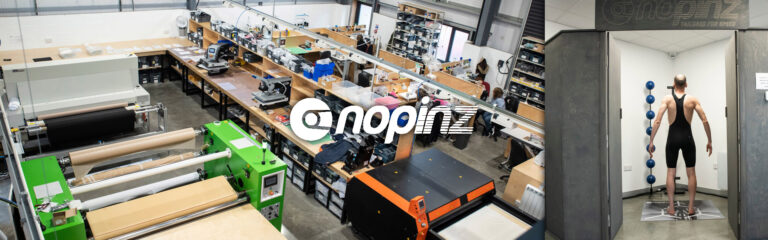
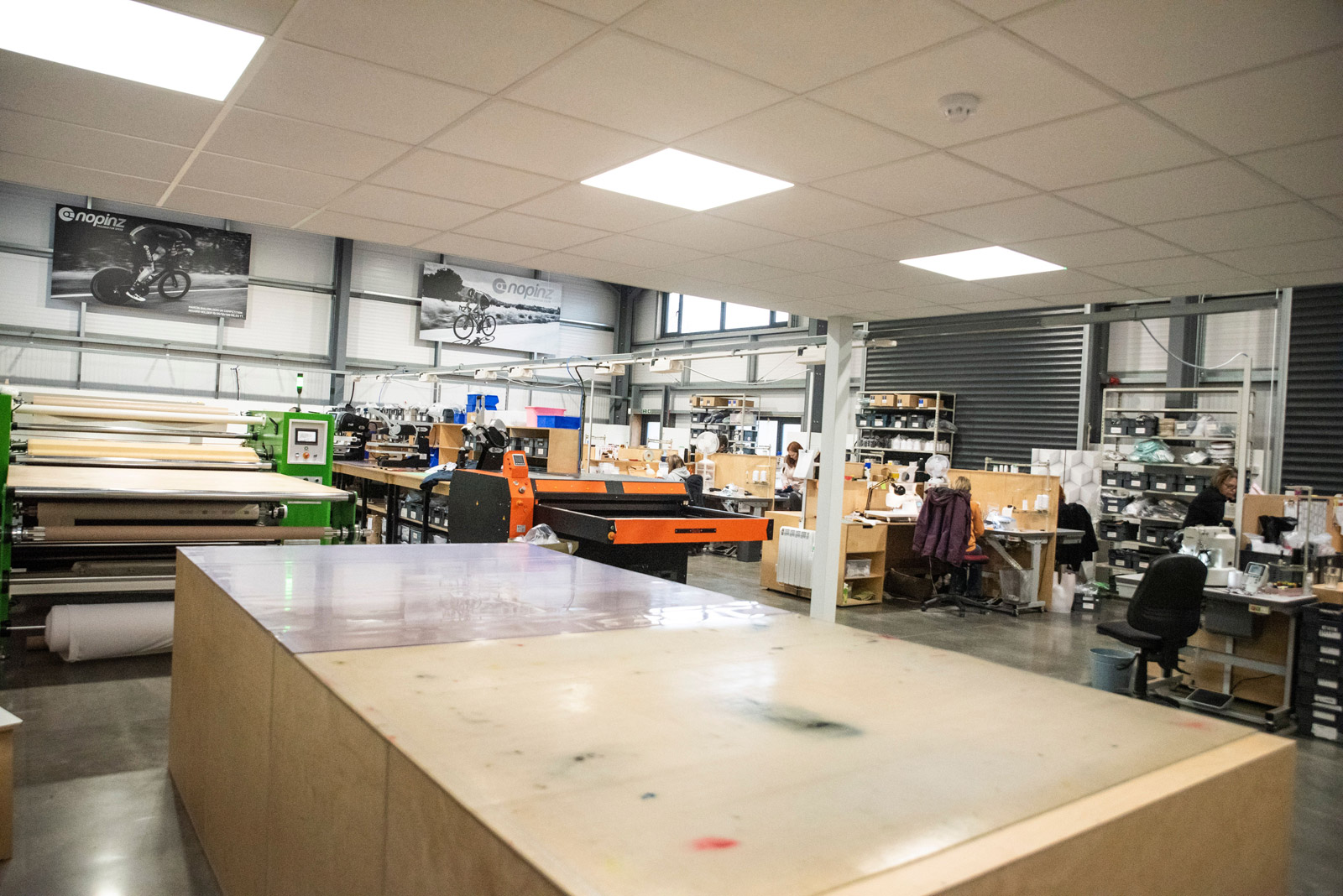
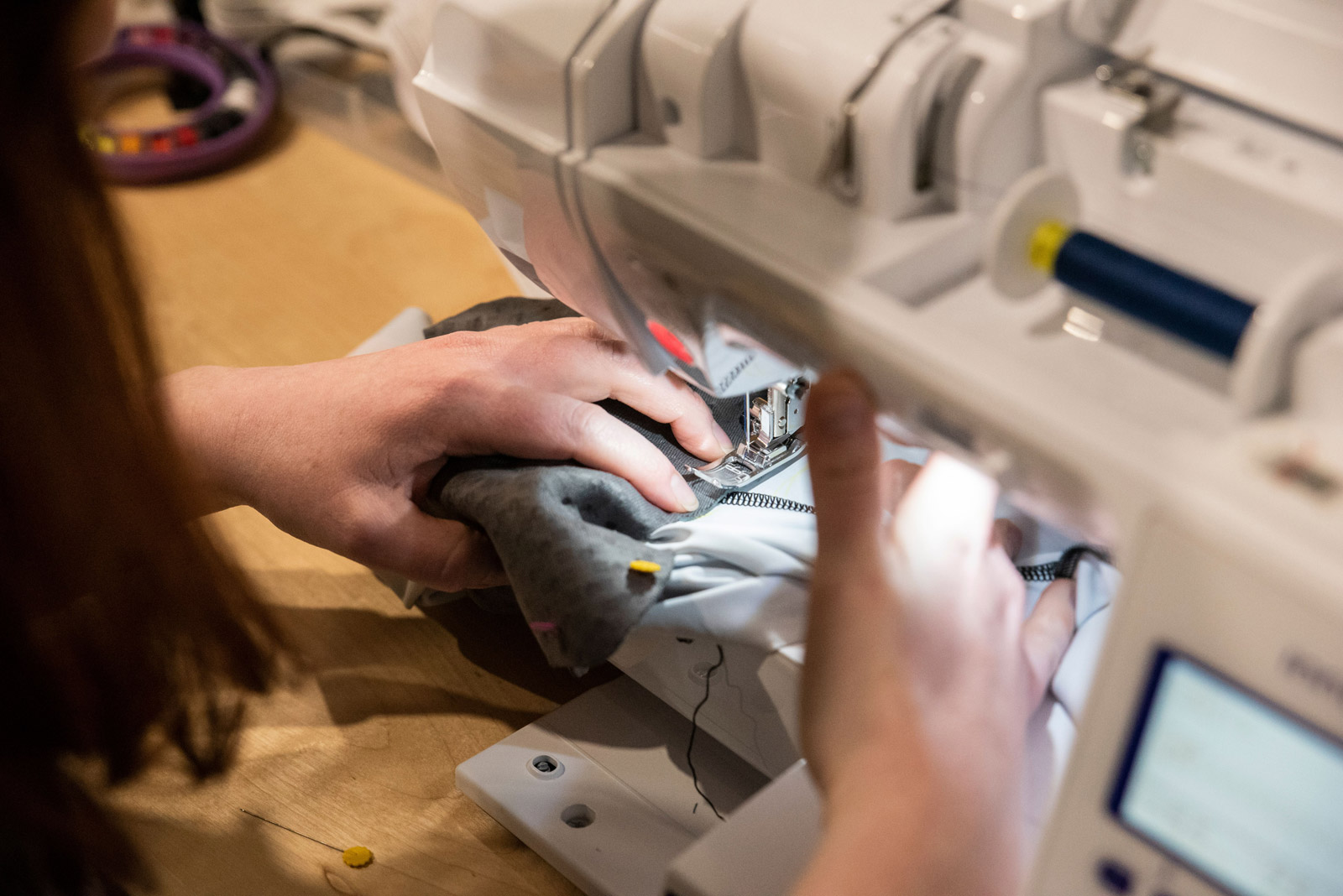
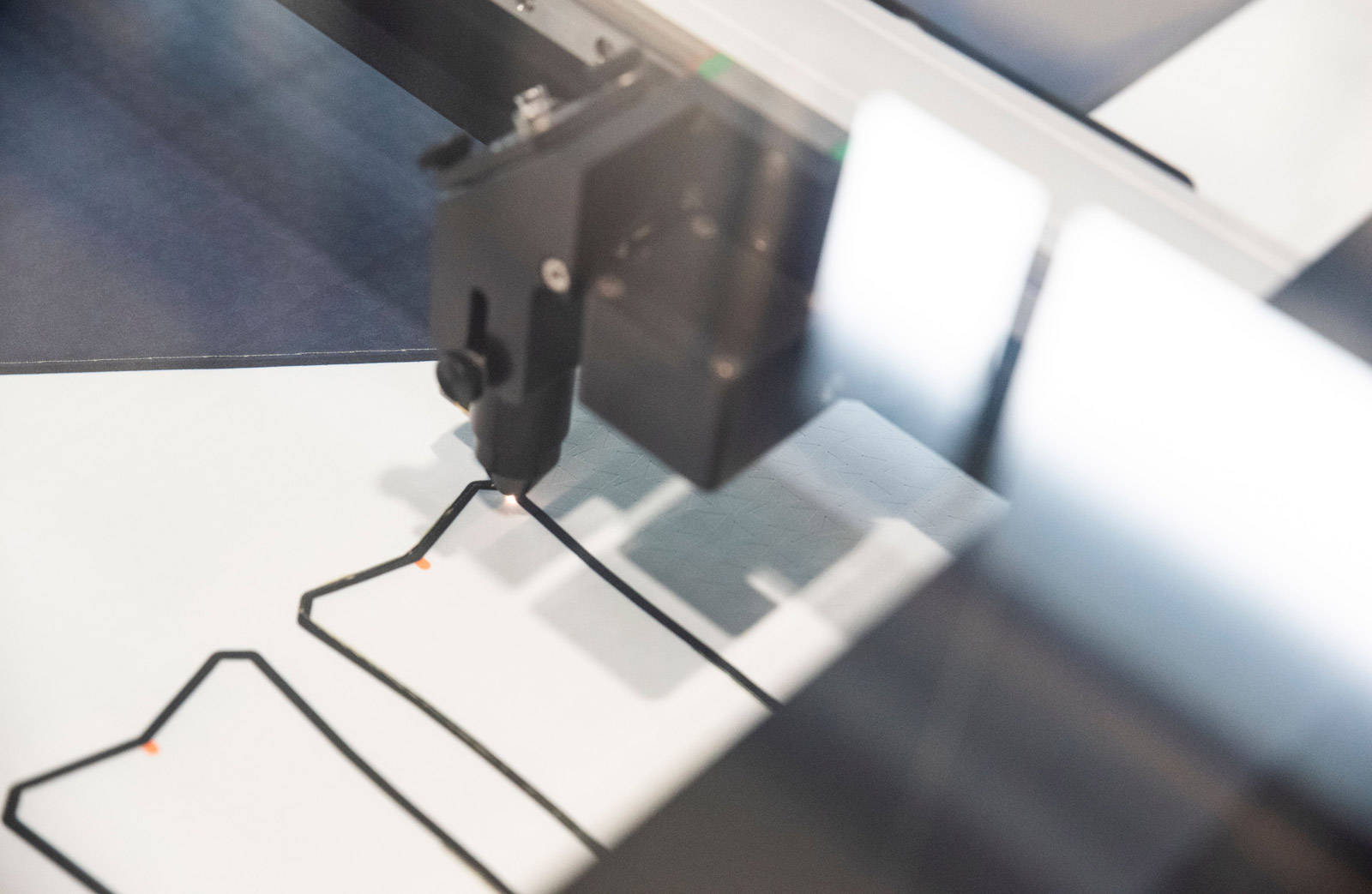
The Nopinz factory floorAll kits are made by handLaser cutter
Being innovative comes with a set of challenges that I did not fully appreciate until speaking with Gary, the Sales Director.
Gary noted that with the expansion of the brand, the ongoing challenge is their capacity in terms of working space and resources. They have already moved to a new site 18 months ago and have acquired additional storage to help resolve that issue but the ongoing challenge of ensuring acceptable lead times for products means there is a need to recruit machinists to meet the demand. Everything is handmade, and the manufacturing process is skilled and labour intensive (particularly the “Made to Measure” apparel), thus skilled workers are at a premium.
Another challenge is the continual testing that is required. This is both time-consuming and costly. As this is a performance brand, new pieces of equipment need to be continually validated and tested. Gary explained “to develop the ‘Flow suit’ took months of effort, because different fabrics were trialed and even developed. There is endless research and development that people are unaware of.”
Gary went on to note that due to developing new and innovative products and materials, there is a need to patent the designs and to secure the copyright and trademarks. This is both time-consuming and costly. In addition, you have to protect your design and this may require challenging those who seek to copy the design by taking legal action, which is expensive.
There are competitors who try to circumvent the patent, particularly in relation to their number pockets, by creating inferior designs. This resulted in the UCI requesting that these were not used during this year’s Tour de France, quoting UCI Regulations Article 1.3.029: “No item of clothing may hide the lettering on the jersey or the rider’s identification number, particularly in competition and at official ceremonies.” and Article 1.3.076: “Riders shall ensure that their identification number is visible and legible at all times. The identification number shall be well fixed and may not be folded or altered.”
This news was disappointing and shows the difficulties that the team at Nopinz face as they had previously worked with the UCI in 2016 and were named in the rule book as being approved. They were first used in the Tour de France in 2015 by Lotto-Jumbo. Inferior designs were therefore creating negative perceptions. It’s important to note that the UCI’s SpeedPocket™ request not to use the pocket was only for this year’s Tour and no other race has been told to stop using them. Talks are ongoing with the UCI to resolve this.
Saris-Nopinz
Given Nopinz’s innovative approach within the cycling world, it’s no surprise to learn that Nopinz have partnered with Saris and have the Saris-Nopinz Esports team. They are “a team of athletes driving the development of a new discipline of cycling; pushing the boundaries and expanding cycling’s accessibility worldwide.”
As well as being a strong team within the Premier Division on Zwift, it is stacked with strong riders including former pros such as Dan Fleeman. In July 2021, they were instrumental in the completion of the first Sub-2 hour 100km ride on Zwift.
Summing Up
There is no disputing that Nopinz as a company have impacted the cycling scene in a positive way with their innovative approaches. They continue to challenge the conventional ways by producing cutting-edge products and tackling the challenges this brings, head on. Ride On!
ZRL Round 2 routes were released and that means special guest Si Bradeley, the recon master, was on the show to talk through tactic possibilities, fav powerups, and course nuances. A must-listen for anyone wanting to take their ZRL racing to the next level.
Anna and Nathan summarise ZRL Round 1 with some special awards given to the team with the best tactics (ATP on the Champs-Elysées course) and best kit of the season (Team Velo).
Garage-pick is the amazing rear-view helmet mirror, with jersey of the week the Fuego Flats segment jersey. Anna is busy ranking all segment jerseys in Zwift… Fuego is currently #0, Leith Hill is #1… is there one that is worse than Fuego?
The Wrap is all about showcasing the awesome Zwift community, from upcoming events to must-have tech to community guests to the all-important avatar fashion segment. The live nature of the show means that hosts Nathan Guerra and Anna Russell can interact directly with those watching, gaining valuable insights and opinions across a wide range of topics.
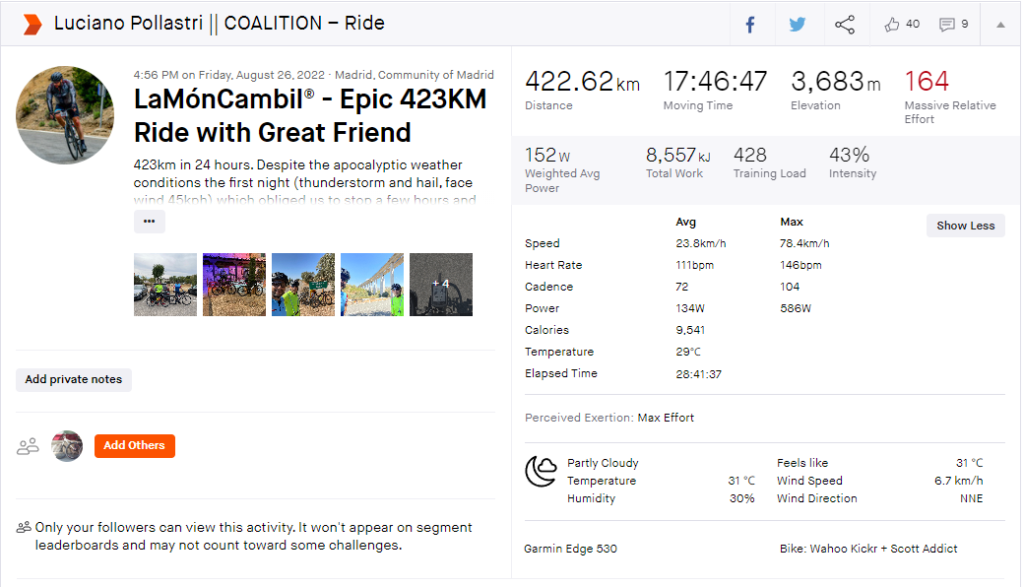
I joined Món in his challenge to do a ride from his current home and his hometown village, Cambil. A 425km and close to 4000m D+ ride. We called it LaMónCambil®. In the middle of the night, we got struck by a thunder/hail storm and after fighting the apocalyptic weather conditions for hours we found ourselves at 2AM on the side of the road, freezing, a little scared, and reassessing if we should abort the challenge.
Checking our phones we identified a lousy hotel 17 km away. That would do it. We decided to wait there until the thunder/hail storm passed. It took us another hour to ride those 17 km.
I would like to be able to describe to you the face of the concierge when he saw us totally soaked at the entrance of the hotel at 3AM, but for once I am out of words. Given my chronic verbal diarrhea, you can see just how severe the situation was.
Món and I agreed we would have a shower, rest for two hours, and meet back in the lobby to decide if we would continue the adventure or not. I think neither of us really believed we would start again. We looked like zombies.
Nevertheless, at 7AM the sky was blue, and we decided to give it a shot. To start pedaling again and see what happened. We did not think about anything else other than the next hour.
Gaining Back Some Hope and Then Blackout
My legs were hurting, but warming up little by little we finally reached that cruise ship speed of 30 km/h we were supposed to maintain in the flats. We became slightly more optimistic.
Around 10AM, very suddenly and without prior notice, my legs decided to go on strike. It was the first time ever I felt my legs were cotton-made, unable to pull more than 140w. I went down big big time. Massive black-hole feeling. I guess it was the consequence of all the emotional hazards of the night. The body clearly said stop. If during the night Món was the one in worse shape, it was now my turn to raise a white flag being ready to abort.
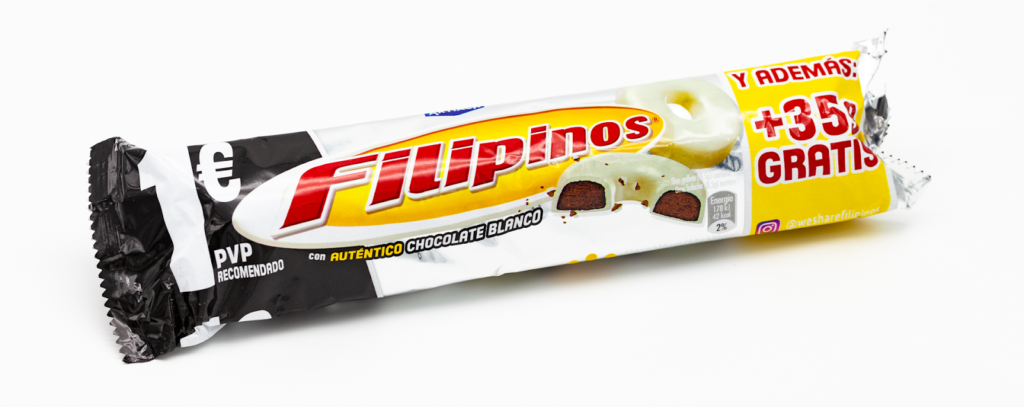
We stopped at a cafeteria. In a desperate move to regain some energy I ate some cookies called Filipinos. They are absolutely awful however they are super sweet and, almost as a miracle, brought my muscles back to life. Sometimes there are small details that can change the destiny of a ride. Filipinos were one of those and will forever remain the symbol of my resurrection.
But with 200km still to go, we were far from done. With the misadventures of the night, we were now obliged to go through the most difficult part of the ride at the highest temperatures.
Roasting in Jaén
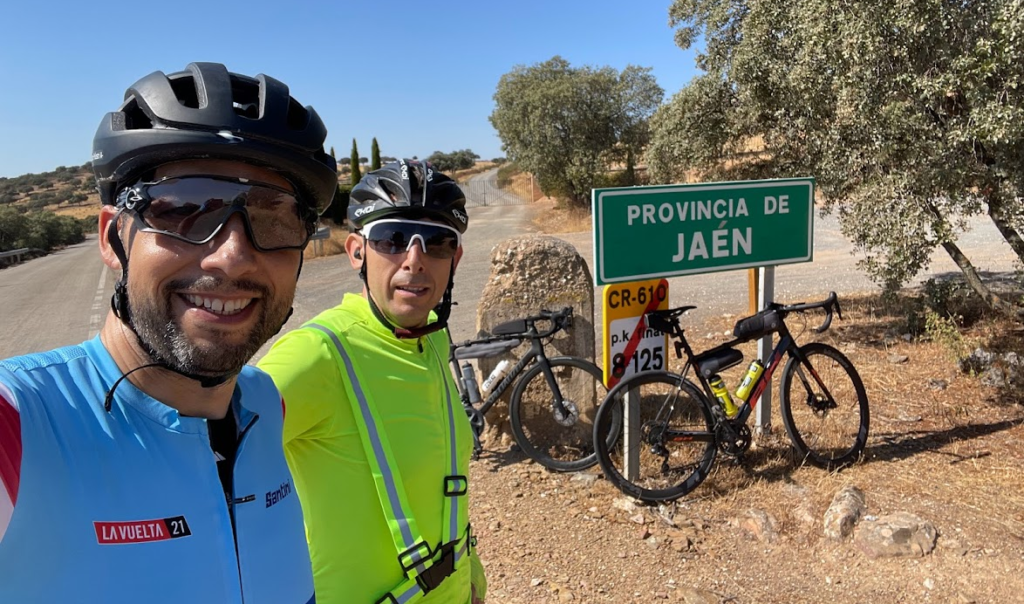
The province of Jaén would be as hostile during the day as the Ciudad Real province was during the night.
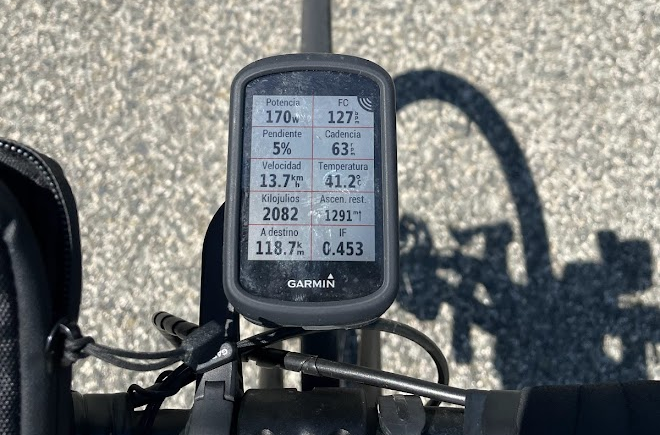
Up to 41 degrees we managed to keep a certain amount of dignity in our behavior.
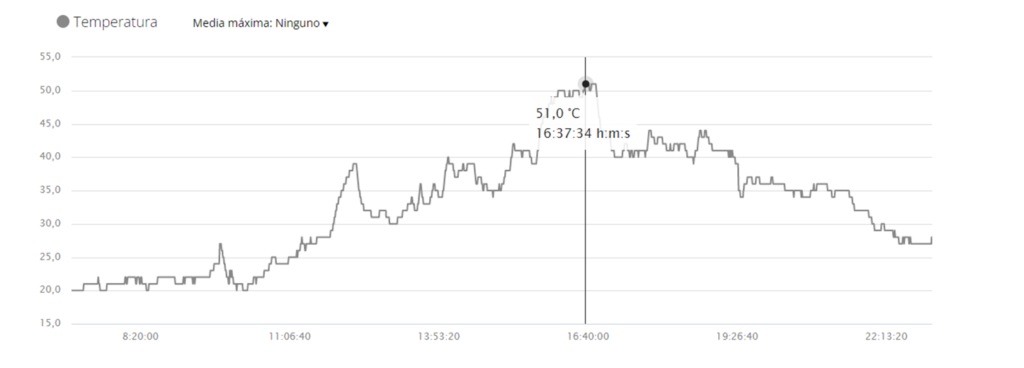
You are not reading wrong. My Garmin 530 reached a whooping 51ºC.
But as the temperature was heading towards 50ºC and we physically experienced what melting means, we understood we would need to forget about all manners and education, and go wild into refrigeration techniques, involving all types of ice cubes and all sorts of liquids being thrown at all parts of our bodies. I’ll stop here. Believe me, you don’t want further details otherwise your entire framework on the theory of evolution would be altered.
But Nothing Would Stop Us Now
With the help of Lorena who was waiting for us at many gas stations throughout the path, we managed to survive the desert after having survived the deluge.
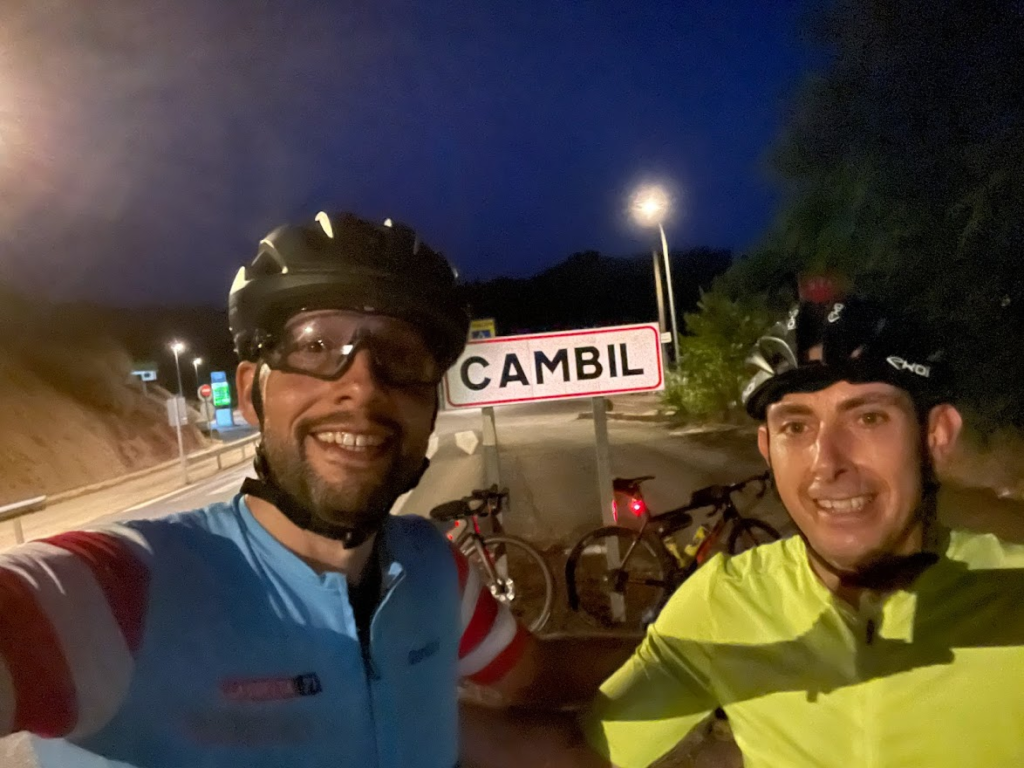
And just like that, totally exhausted, almost 9 hours after the expected time of arrival, we finally reached the promised land, Cambil, where Món’s family was waiting for us and gave us the warmest of welcomes.
Post Mortem
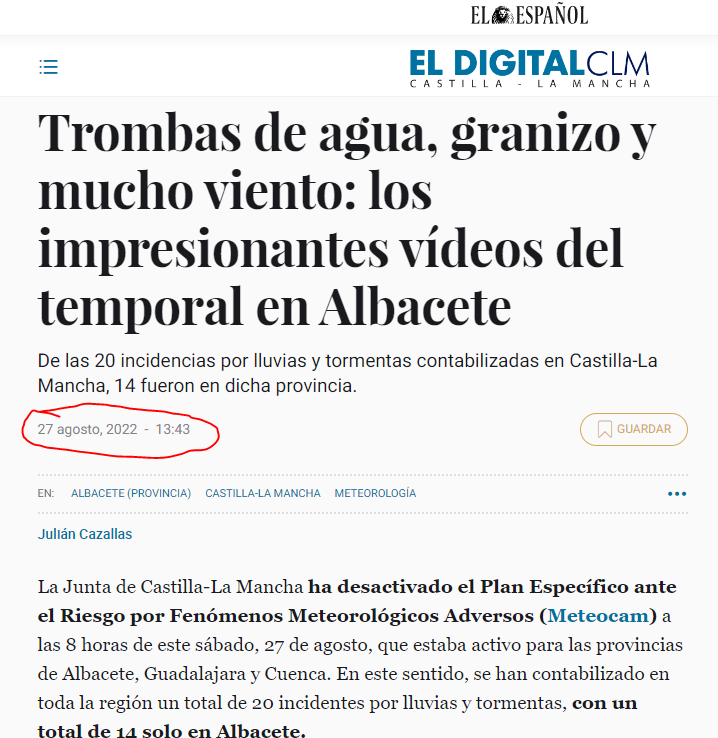
It was only when we arrived that we understood that the storm we endured during the night was one hell of a storm, as per the newspaper’s reports. Firemen were called in many villages totally flooded. We should have been more scared than we were.
(Translation: Waterspouts, hail and a lot of wind: the spectacular videos of the storm in Albacete)
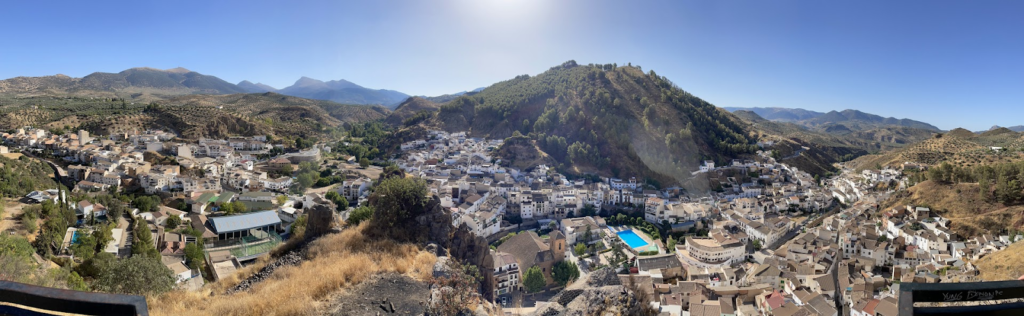
Huge thank you to Món’s mother and father for their incredible hospitality in Cambil, and to Lorena. Without Lorena we would not have made it. By the way, if you are around, you need to visit Cambil. Món was nowhere near reality when he said that his hometown was wonderful. Hidden in the middle of the mountains close to Granada, Cambil is something you cannot take for granted, you need to deserve it.
Panoramic view of Cambil, from the Castle
Sorry guys, Zwift is not just a game. It brings people alike together. I would have never imagined that I would make so many really meaningful friends at 46. Through COALITION, through Jerbos, through ZwiftInsider, the breadth and depth of the community is astonishing and it makes me feel super proud to be part of it.
Finally, a special word for Món. I can proudly say that what we have lived together is unique and something I will never forget. Thank you for allowing me to be part of something that you ideated and was so personal. I anticipate you maybe blushing when I say that I am so thankful for having shared all those long rides together, exchanging our past and current miseries, but also our hopes and expectations. You have become someone very special to me and I can’t wait for the next challenge together.
Going to bed, every single inch of my body was hurting. I swore to all deities that I would never engage in another crazy ride in my entire life.
I woke up at 7AM with an email confirming that I was registered for Les Cinglés du Mont Ventoux for September 24th 2022, meaning in 4 weeks I would be climbing Mont Ventoux from its three sides on the same day. But that is another story…
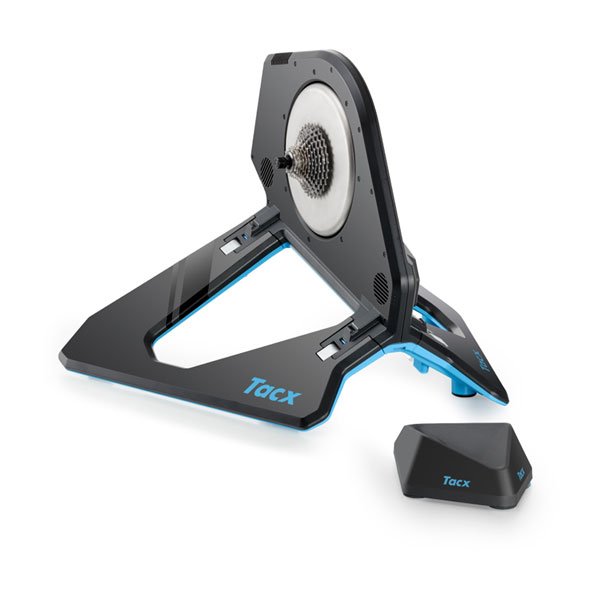
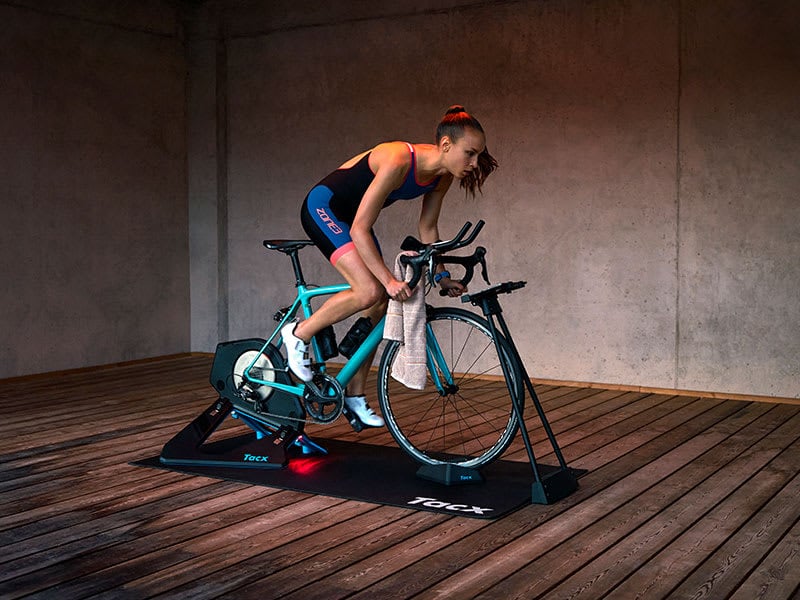
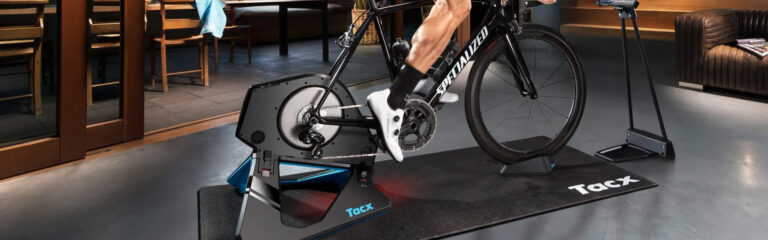
Despite being released in September 2019, the Tacx NEO 2T is still regarded as one of the best direct-drive smart trainers on the market and remains Tacx’s flagship trainer. It is one of the most respected products in the industry, which isn’t surprising since Tacx has a rich history in the indoor training space.
The evolution of Tacx’s best trainer has been steady, and it is in fact a brand I know well. My first indoor training was on a Tacx Ergo Flow trainer, purchased in 2007. At the time, I viewed this as “cutting edge” as its handlebar-mounted computer let me see my power output for the first time.
As Tacx released new models utilising virtual reality technology, I upgraded accordingly, acquiring the Tacx Cosmos which was a head unit and software that allowed the Tacx Flow to connect to a PC and ride Tacx’s groundbreaking “Real Life Videos.” These were videos of real-life routes which you could ride (as you pedaled, the video would move). At the time, this was revolutionary and saw me ride the legendary Col du Telegraph and Col du Galibier long before I was able to tackle them in real life. This has evolved into the current Tacx Training app with over 300 streamable training films from all over the globe.
As technology evolved, so did the trainers that Tacx engineered. There were incremental improvements year on year, with trainers such as the Tacx Bushido and the Tacx Genius, both wheel-on trainers.
As the “Direct Drive” revolution in turbo trainers commenced, Tacx released the NEO (correctly spelt using capitals) in 2015 and 3 years later, the NEO 2. These trainers had a virtual flywheel with magnets, differentiating them from competitors. A year later, the NEO 2T was released.
Did you know: the name “NEO” comes from the Neodymium magnets used in its design.
This Tacx indoor trainer is used by multiple teams within the pro peloton including INEOS Grenadiers, Trek Factory Racing, Jumbo-Visma, Quick Step-Alpha Vinyl, SD Worx, and SCOTT-SRAM MTB Racing Team.
Design
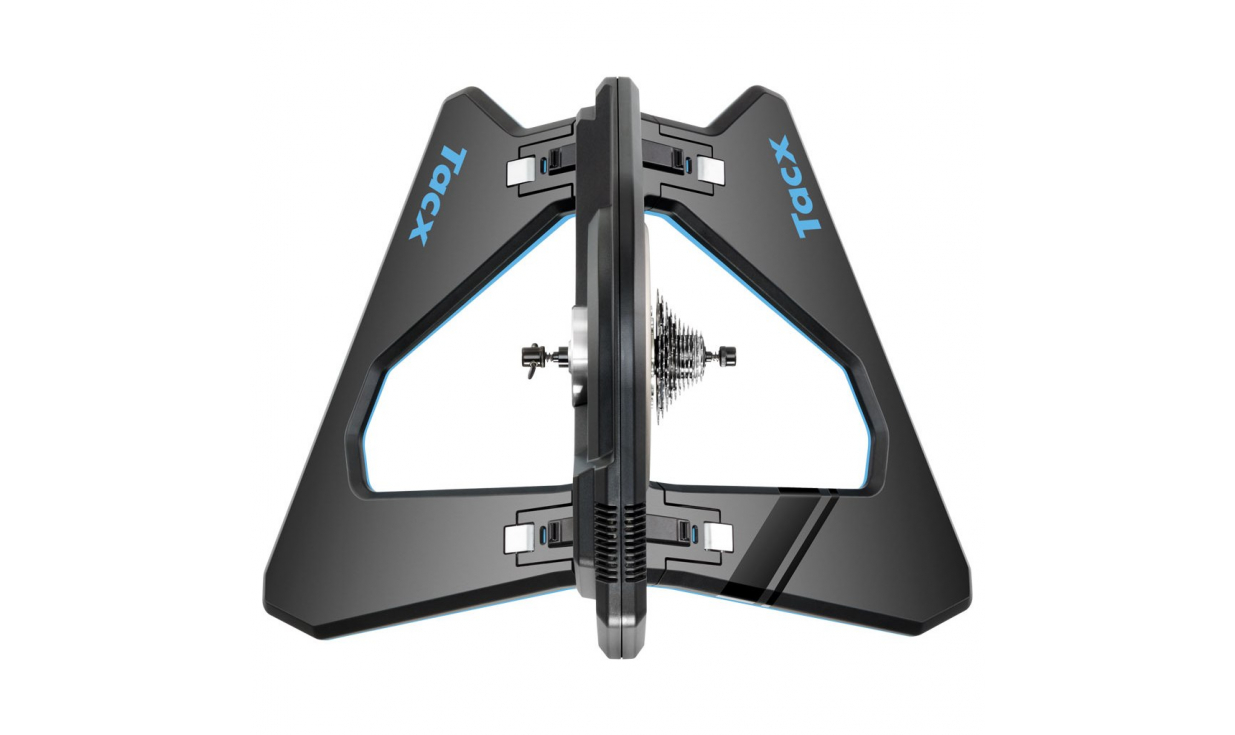
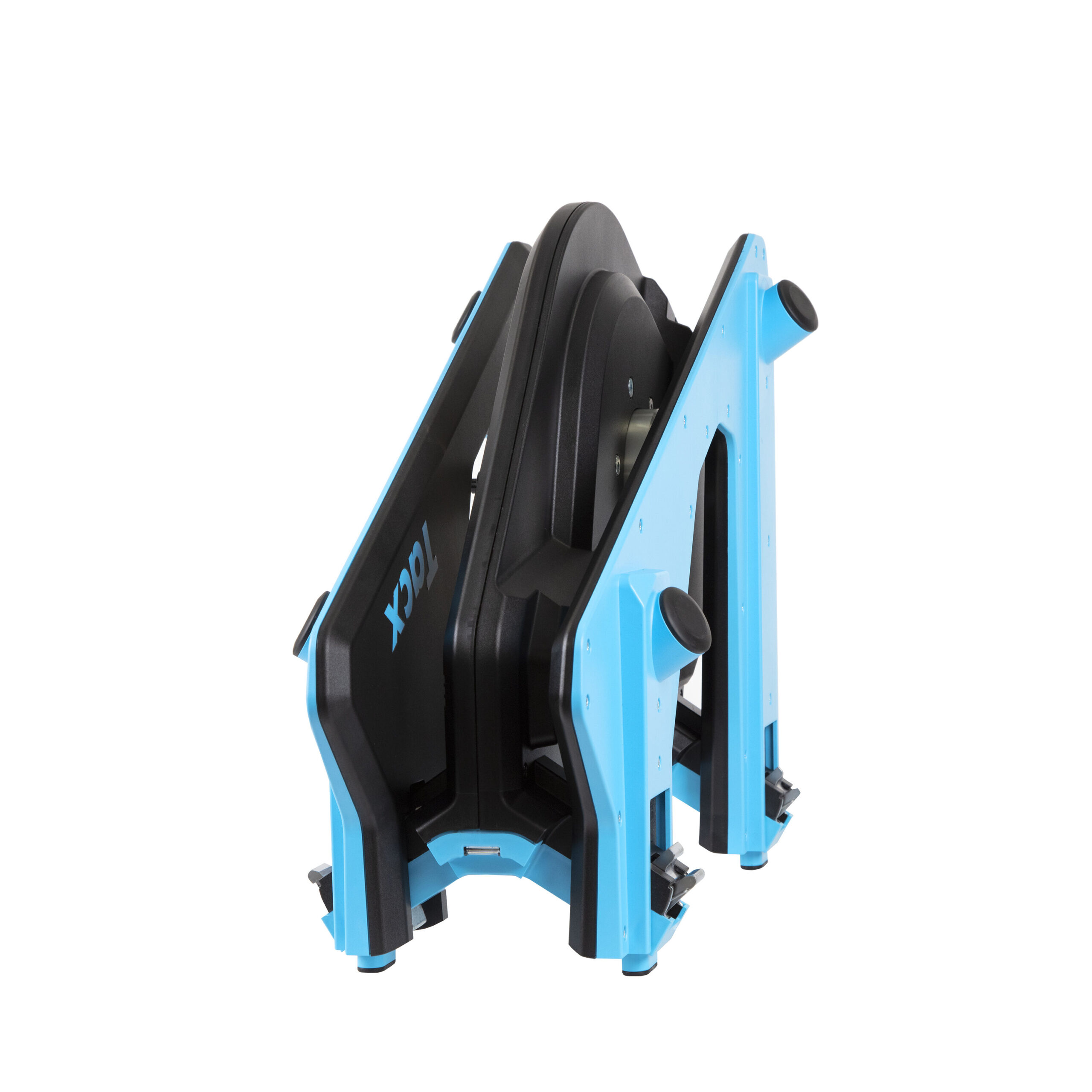
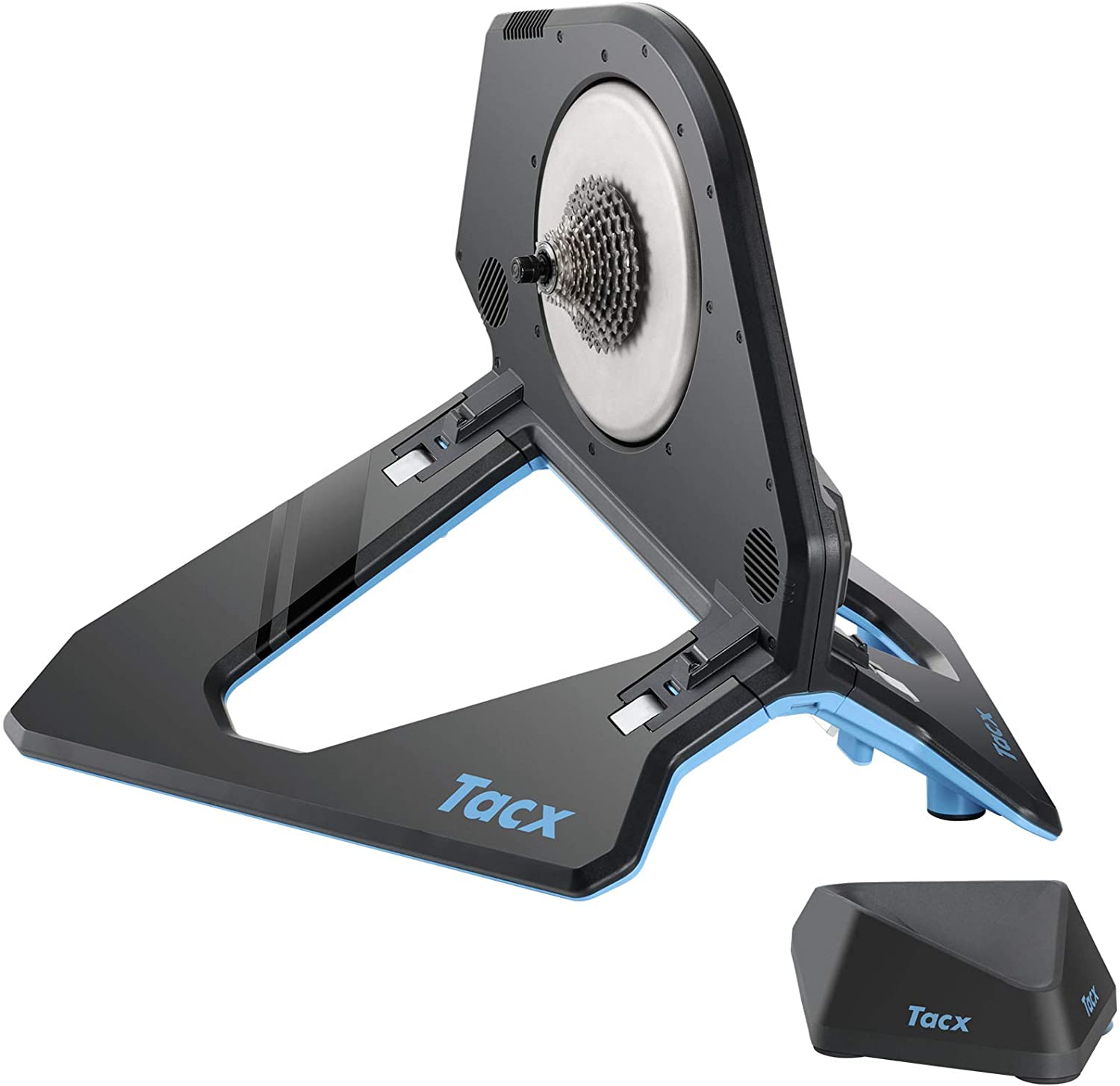
The Tacx NEO 2T is a technologically advanced trainer housed inside a robust, sleek, black plastic casing shaped like an arrowhead. It has foldable legs, enabling you to pack the trainer up when not in use. There are no handles to physically hold to manoeuvre the trainer into place and it is heavy, but the consequence is that the overall appearance is streamlined and aesthetically pleasing.
Unlike its competitors in the same price bracket such as the Wahoo KICKR and Elite’s Justo, it has a virtual flywheel, generated by 32 integrated Neodymium magnets, which are the strongest permanent magnets commercially available, up to 125kg, which is the largest of any trainer on the market. (Do not confuse this with the weight of the entire unit, which is 21.5kg).
What this means is that it simulates the virtual flywheel and you can change the resistance instantly, just like in the real world. With a standard flywheel, it takes a bit of time before it can change the resistance. Furthermore, this means on Zwift, when you descend, the flywheel will continue turning. The consequence of this is that compared to the Wahoo KICKR and Elite’s Justo, the trainer has a different “ride feel” and this I noticed, particularly when climbing, which is discussed in greater detail below. This resistance according to Tacx is due to their motor brake. As Tacx explains “Motor brakes use an electromotor to calculate resistance. The motor can both hold back (brake) and drive the wheel or chain. For a simulated descent, it will keep spinning — just like it does when you stop pedaling outdoors. The motor brake is the most powerful brake Tacx offers, and can generate high resistance at low speeds. This makes the motor brake perfect for simulating steep climbs. Tacx trainers with a motor brake are ideally suited for training on mountain stages.”
The arrowhead shape of the design means there is not a significant amount of clearance near the bottom bracket, chainstay, and the trainer. As a consequence Tacx have not released a device to replicate climbing gradients (like the KICKR Climb or Elite RIZER) as there would be a risk that your bike would hit the trainer when in the descent position. Instead, to provide that more interactive experience Tacx chose to release the NEO Motion plates that are designed to sit underneath the legs, allowing some fore-aft movement.
Overall, the trainer is elegantly designed and packed with technology. It has clean lines and the outer casing is made from plastic that feels sturdy. The one downside is that the foldout legs do create a wide footprint, but this ensures that you feel secure when riding and offers a sturdy platform when sprinting and accelerating out of the saddle.
Setup
Setting up the unit is simple. As mentioned, there is no handle to hold to lift the trainer from the box, which would help, but I also appreciate that it would detract from its clean design.
Steps to setup the NEO 2T:
Remove from the box
Unfold the legs and click them into place.
Install cassette – the trainer does not come with a cassette pre-installed, in contrast to the Wahoo KICKR, so you will need to install your cassette, and consequently you will need the required tools such as a chain whip and locking ring tool.
Attach the correct axle adapter for your bike. All types are included.
Attach your bike and use the wheel block that comes included to raise the front of your bike, if required.
It is worth noting that you don’t need to plug in the trainer for it to operate. It operates without the need for power, as power is generated when you start pedaling and it will connect as required. This means the trainer can be used without wires. Power is only used to operate the ‘downhill drive’ capability, so if you’re riding unplugged and you don’t pedal when descending on Zwift, the unit will stop. I recommend plugging in the power to use all its functionality when connected to Zwift.
The unit auto-calibrates, so there is no need to worry about any of that. In summary, it’s a simple setup process.
Ride Experience
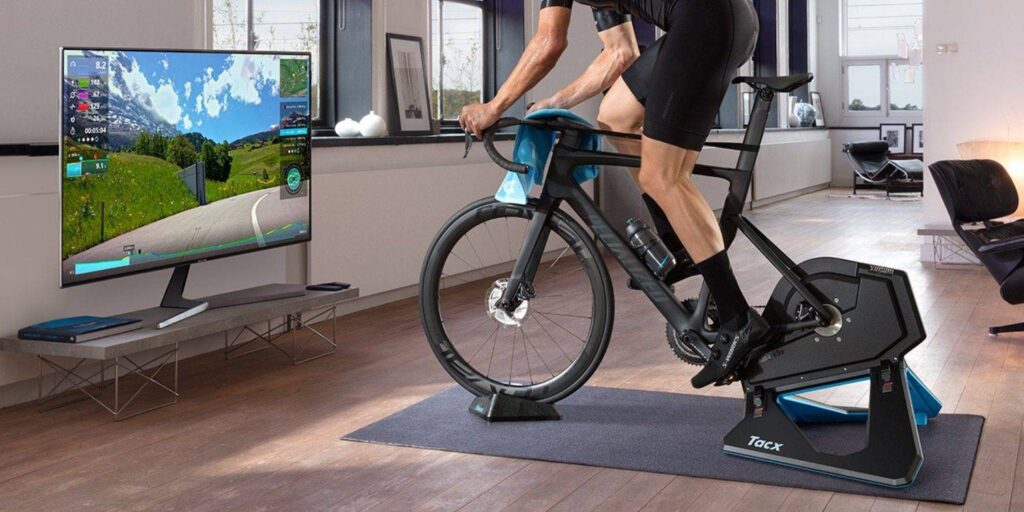
Due to the virtual flywheel, the NEO 2T has a different feel to other trainers that I have used. It is really responsive but it “feels” harder to ride than others and I have been unable to generate the performances that I have previously with other different trainers, notably when I look at my watts per kilo over a 20-minute period.
This was a point that I discussed with Tacx directly. I spoke to one of the technicians about my experience and they eloquently noted that “each trainer has a unique feel and you need to find the one best suited to you.”
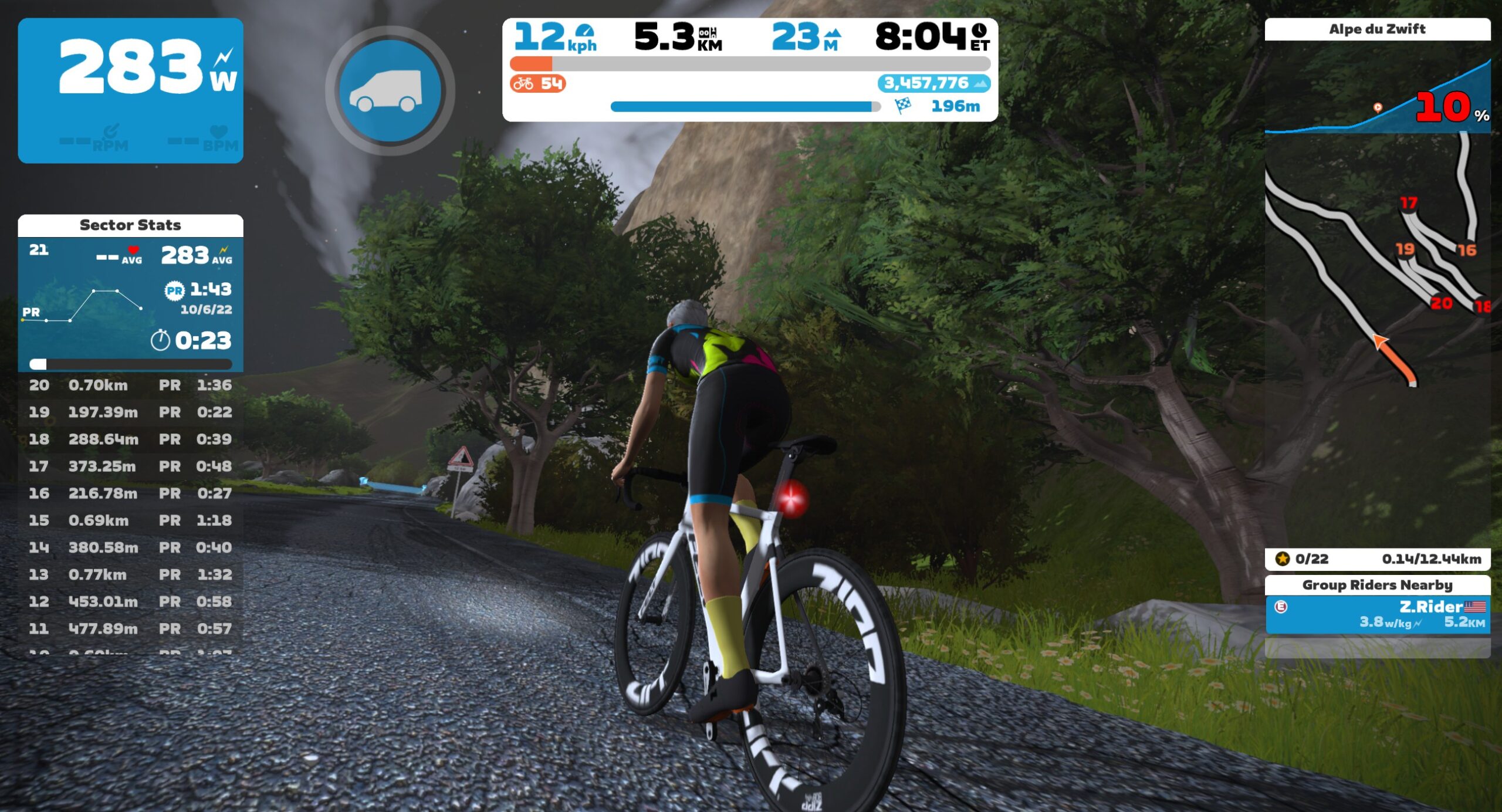
The simple way to explain the difference is that the NEO 2T “feels” more difficult than cycling outside and climbs feel more challenging, as witnessed by the fact that I need to change to my smaller front cassette when climbing on the Alpe du Zwift, which isn’t the norm for me. This is because I found the resistance is harder, which was set to 100% in Zwift. The advantage of this is that when you do ride outside, you will find it easier.
Despite the more challenging ride, the trainer does offer a smooth experience and is responsive when power is applied. Being Tacx’s most advanced trainer, you will expect it will have a few extra features which its lesser models don’t have that impact your experience. The three to note are:
“Road feel” – As Tacx state themselves “this feature works with Tacx software or the Zwift app to make the trainer vibrate and simulate the feeling of riding on different road surfaces such as cobblestone and gravel.” There are no other trainers on the market at the moment of writing that do this. The effect is achieved through the magnets which create vibrating patterns in the NEO, so other indoor trainers are not able to replicate this. I personally didn’t like this and turned it off. I don’t think that it adds much to the experience, but appreciate some might like it and this is purely down to personal preference.
Rocking motion – To replicate the natural movement of cycling in real life, there is a slight side-to-side, rocking motion. The advantage of this is that it does ensure a comfortable ride. If this is a feature that you like, then as mentioned previously, Tacx have released the NEO Motion plates which extend this experience.
Effort lights – To denote the effort you are expending, LEDs change colour accordingly, lighting up your “Pain Cave” like a disco during long and dark winter training sessions. These are extra LEDs at the bottom of the trainer.
Reliability
The question many people ask about smart trainers is, “How reliable are the connections?” And the answer is simple. Very reliable.
This has been an area that I have paid close attention to because my previous Tacx trainer, the Flux S, would occasionally drop my Bluetooth connection, usually at crucial moments (notably when I was attempting my sub 1-hour Ven-Top climb). With the NEO 2T I have not experienced any connectivity issues, no dropped connections. It has been a solid and reliable performer.
Accuracy
The trainer is accurate, and this is clearly seen in my test where I rode the Volcano climb on Zwift. The largest discrepancy between my Garmin Vector 2S pedals and the NEO 2T was 1.22% (or 4 watts) over a 5-minute period, which is marginal at best. Data can be viewed here.
It is also worth noting that the slight discrepancy may be because the power measurement is taken from another section of the drive train.
Time
Tacx NEO 2T
Garmin Vector 2S Pedals
Difference
1 Second
415 watts
417 watts
0.48%
5 Seconds
406 watts
403 watts
-0.74%
15 Seconds
378 watts
376 watts
-0.53%
30 Seconds
363 watts
364 watts
0.27%
1 Minute
356 watts
359 watts
0.84%
5 Minutes
325 watts
329 watts
1.22%
10 Minutes
289 watts
290 watts
0.34%
One observation worth commenting about is that my ascent was the slowest of the three main trainers, by some 33 seconds. This relates back to my point about the difficulty of the trainer.
Trainer
Time
Difference (whole number)
Elite’s Justo
6.54.7
0
Wahoo KICKR V%
7.12.3
18 seconds
Tacx NEO 2T
7.27.7
33 seconds
In contrast to the steadier state ride, when undertaking tests to see how well the trainer handled sprints, the accuracy compared to my Garmin Vector 2S pedals shows a range in its results, indicating over short bursts, with high energy, the readings may vary. Data can be viewed here.
Time
Tacx NEO 2T
Garmin Vector 2S Pedals
Difference
1 Second
764 watts
793 watts
3.66%
5 Seconds
731 watts
763 watts
4.19%
15 Seconds
663 watts
689 watts
3.77%
30 Seconds
478 watts
489 watts
2.25%
1 Minute
370 watts
379 watts
2.37%
5 Minutes
243 watts
242 watts
-0.41%
10 Minutes
192 watts
189 watts
-1.59%
In terms of the power that I could generate, the Tacx NEO2T was the most “unforgiving,” being able to only hold 663 watts for 15 seconds. When sprinting, I felt that I was battling the resistance of the trainer.
5sec
15sec
Wahoo KICKR v5
806w
756w
Justo
757w
687w
Tacx NEO 2T
731w
663w
Noise – The trainer is quiet. Tacx noted that the “redesigned magnets have significantly improved the stillness of NEO 2T. Internal air displacement and vibrations are reduced, resulting in a remarkably silent trainer.”
Noise levels have been recorded at 57.8 dB. What does that mean? Well, it basically means that unless you have a state-of-the-art fan, or air conditioning unit, then the fan will be louder than the trainer. The key takeaway is that if you partake in early morning rides on Zwift, then you won’t need to worry about waking sleeping family members and/or the neighbours.
Erg Mode
My only negative observation with Erg mode is that there were fluctuations when trying to hold power at a lower wattage. For example, in the warm-up, when trying to hold 170 watts, I would easily fluctuate 15 watts over, then under. That said, when the resistance increased, the trainer was noticeable more stable and I was able to complete the designated workout without issue.
Tacx App
It is worth mentioning the Tacx App. The key feature of the app is that it gives you access to their library of “In Real Life” cycling videos, which was once their unique selling point and a cornerstone of their offering. This is a subscription-based service, but if you want a bit of variety apart from Zwifting then this is a genuine option and well worth using their 10-day trial.
If you already have a Garmin Connect, account, your login details work here. This app is only available for use with Tacx Smart trainers.
Cost
Being Tacx’s premium product comes with a price. It is one of the more expensive smart trainers on the market, retailing at £1,199.99 / $1399.99 USD.
Axels: Width of rear fork: Race 130 mm, MTB 135 mm, 142 mm and 148 mm. Adapter for 135 x 10 mm available
Calibration: No calibration needed
Summing Up
The rocking motion of the bike ensures a comfortable ride, making longer hours in the saddle not something to fear. Having the ability to have access to Tacx’s vast library of “In Real Life” cycling videos is a nice bonus and means that if you are training for a specific sportif, then there is every chance that you will be able to find the roads associated with it and try them before you go.
This is a top-end trainer with top-end specifications that comes with a top-end price tag. It is quiet, reliable, and accurate, and if you are prepared for a more challenging ride then this is the smart trainer for you.
Over 96,000 riders took part in Zwift Academy Road 2022. Most participants were there simply to build fitness, but a smaller group was vying for the big prize: a pro cycling contract for the 2023 season!
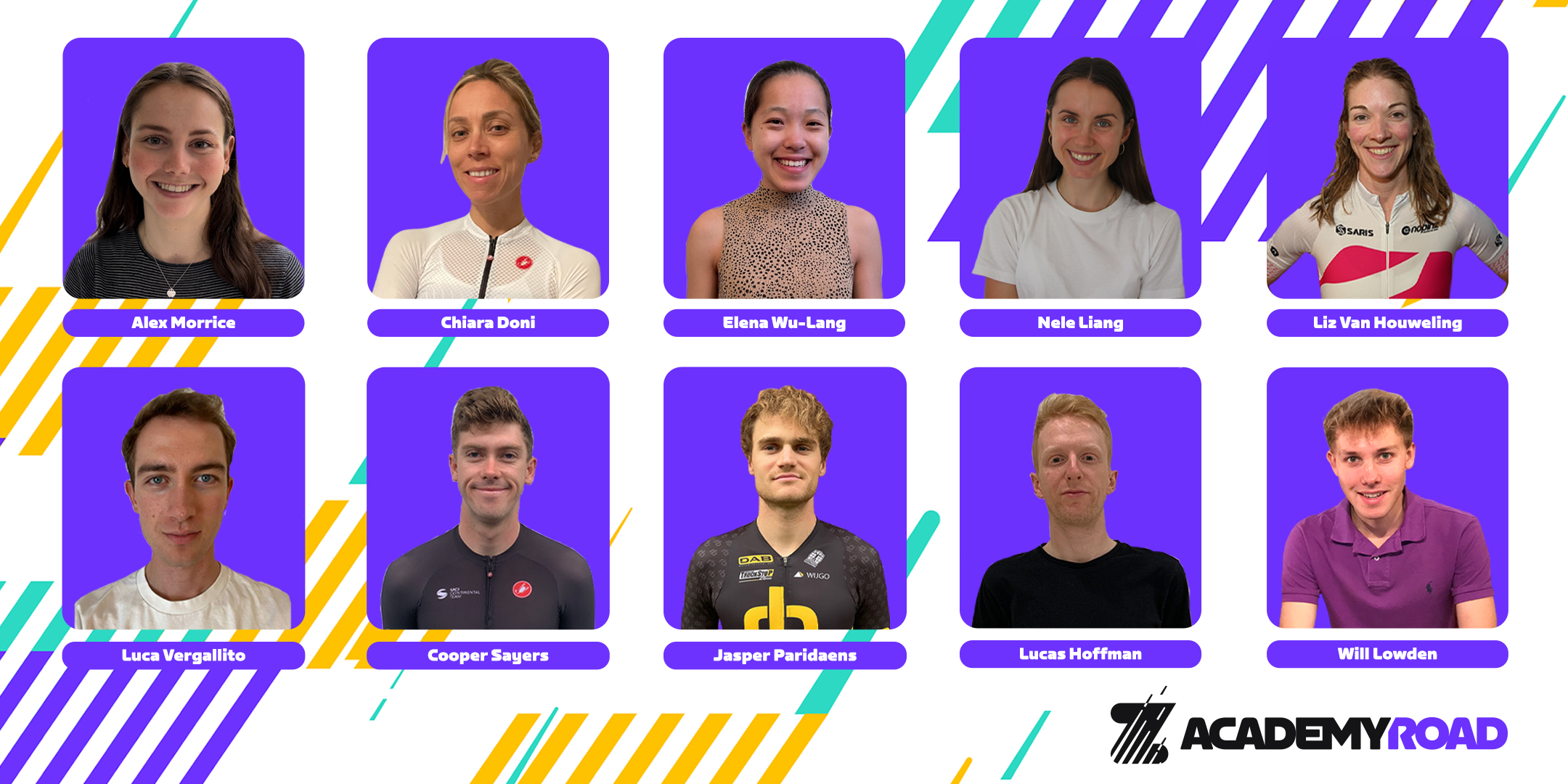
This week Zwift announced the 10 finalists for Zwift Academy Road‘s 2022 “Pro Contender” program:
CANYON//SRAM Finalists
Alex Morrice (Great Britain)
After graduating this summer with a first-class degree in chemistry and physics from the University of Bath, Alex is committed to pursuing a cycling career. “Sport has always been at the center of my life, and I have found my immense passion and enjoyment for cycling, for which I work hard to achieve my goals, always looking to learn and improve. I thrive from strong relationships with a team and coaches,” she explains.
Chiara has chased down her goals since day one. “I started dreaming when I was a child and never stopped,” she says. That led the scientist to marine biology, medicine, the world of medical devices, and racing bikes. She’s new to competitive cycling: she started about six years ago. Pedaling took over her heart and led her to chase her biggest dream: becoming a pro cyclist.
Nele Laing (Germany)
Born in Darmstadt, Germany, Nele lives in Cologne where she studies sports science. Relatively new to cycling, she started riding 2.5 years ago and racing this season. “I love being outdoors in nature, cooking and baking, reading books, and discovering new places,” she says.
This former college rower lives in New York City. She caught the endurance bug as a walk-on to the lightweight crew team. She bought a used road bike when the pandemic hit, and quickly fell in love with the sport. She began training more seriously in 2021, and started racing on Zwift and IRL on the road in 2022. “I’m definitely a very determined person and athlete who thrives off hard work,” she says., When not cycling, she can spend more time outdoors, hanging out with friends, eating ice cream, or some combination of these.
A mother of two, who lives in Iowa in the United States, Liz focuses on indoor racing but still rides and races outdoors when the opportunity presents itself. She loves all types of riding, including road, cyclocross, mountain, and track cycling. “I’m grateful for everything that cycling has brought me in my life, including my husband, countless friends in the virtual riding community, a world championship experience, and an incredible amount of joy!” she says.
A student from Milan, Italy, Luca, is finishing his Master’s degree in sports science. A passionate cyclist, his studies help him “bridge the gap between science and practice.” Luca uses himself as a test subject, applying what he studies—training strategy, nutrition, and more—to improve his performance. Zwift Academy has already changed his life. “Until a few weeks ago, my goal for the future was to work in a professional cycling team as a coach. Then I decided to give Zwift Academy a try….”
Jasper lives in the municipality of Pepingen in Belgium. “I have been passionate about cycling from an early age and have been competing in this sport since I was 12 years old. It has always been a dream to make this sport my profession,” he says. The college grad studied chemistry and works at a university hospital in Jette (Brussels).
Lucas lives in Adelaide, Australia, and works full-time as a 4th year electrical apprentice. He started cycling when he was 16 on an outdoor concrete velodrome. Since his job makes weekend travel challenging, he focuses on state-level races. “Away from cycling, I like to spend time with my cat and doing projects in the workshop,” he says.
Sometimes one dream has to replace another. Just 19 years old, this cyclist from Suffolk in the United Kingdom just put his med school studies on hold to pursue a career in cycling. Off the bike? “I love being outdoors, especially in the mountains or on the moors and the odd clean wave for surfing never goes amiss,” he says.
Currently residing in Cornwall, England, Cooper spent the last six months racing in Europe and was also a finalist last year. “I have represented Australia three times, and I am a super motivated and hardworking person who strives for only the best in everything I do,” he says. His goal is ambitious: to become a pro athlete.
What’s Next?
Zwift Academy Road Finals will be held at Syncrosfera, a health and performance center in Denia, Spain. The finals, held in mid-November, will see all ten finalists complete certain training tasks as a group, while others will be performed with their prospective teams. Team riders and staff from CANYON//SRAM and Alpecin-Deceuninck will be present to evaluate the finalists and assist in selecting the two winners.
The finals will be broadcast by GCN, with five films being released starting on Deceember 13. Winners will be announced on December 17.
Power Numbers and Picks
Based on the ZwiftPower profiles linked above, the average women’s FTP is 4.6 w/kg, and the average men’s is 4.84w/kg. (This is calculated by taking 95% of each rider’s 20-minute power.)
Having beaten out thousands of pro contenders, all of these riders are clearly exceptional athletes. Here are two we’ll be watching closely in the finals:
Liz Van Houweling: currently the 4th-ranked female Zwifter in the world, Liz rides for the Saris-Nopinz team and easily outranks all other ZA 2022 finalists on ZwiftPower. She’s the most experienced Zwift racer of the 10 finalists, and looks to be the most experienced outdoor cyclist of the 5 CANYON//SRAM finalists.
Jasper Paridaens: the top-ranked Zwift racer of the five men, Jasper is also a keen outdoor rider. He’s got a well-balanced power profile for longer outdoor races, and has put in the work doing long rides.





 (53 reviews)