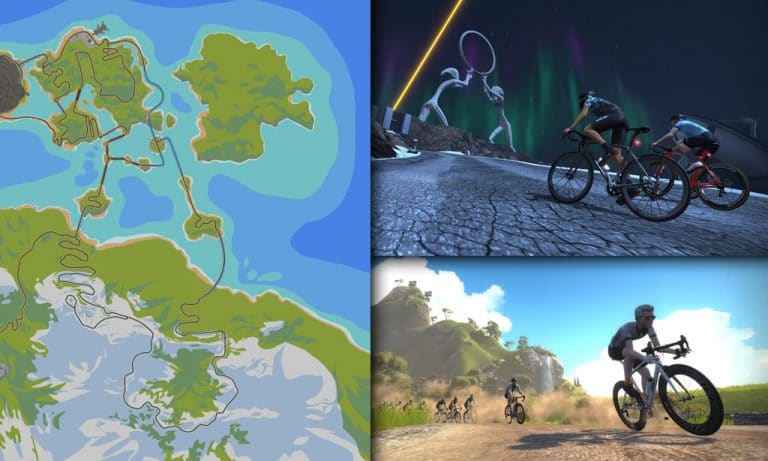
This page includes basic details for all routes on Zwift’s Watopia world. For additional route details, click the corresponding link to access that route’s home page.

By far the climbiest of the eight routes released with Zwift’s October 2023 southern coast expansion, this point-to-point route is quite flat… until it hits the base of Alpe du Zwift!
Route Basics
Length: 41 km (25.5 miles)
Elevation: 1153 m (3,783‘)
Lead-In: 2.3 km (1.4 miles)
Map: Watopia
Restriction: none
Achievement Badge: 825 XP
By far the climbiest of the eight routes released with Zwift’s October 2023 southern coast expansion, this point-to-point route is quite flat… until it hits the base of Alpe du Zwift!

Introduced in Zwift’s December 2020 update, Beach Island Loop is the first route to use the new Bridge/Islands Bypass – a short stretch of road connecting the JWB Bridge to the 360 Bridge.
This route is a slightly modified version of the event-only Volcano Flat Reverse route, placing riders on a more northerly segment which adds a quick trip through the Italian Villas and a chance for green glory in the forward sprint.
Route Basics
Length: 13.1 km (8.1 miles)
Elevation: 44 m (144‘)
Lead-In: 0.2 km (0.1 miles)
Map: Watopia
Restriction: none
Achievement Badge: 255 XP
Introduced in Zwift’s December 2020 update, Beach Island Loop is the first route to use the new Bridge/Islands Bypass – a short stretch of road connecting the JWB Bridge to the 360 Bridge.
This route is a slightly modified version of the event-only Volcano Flat Reverse route, placing riders on a more northerly segment which adds a quick trip through the Italian Villas and a chance for green glory in the forward sprint.

Originally created as a Rebel Route in November of 2021, the Big Flat 8 was created because we wanted a long, flat route on Watopia without riding over the same tarmac repeatedly. At 3.5 meters of climb per kilometer of distance, this is Watopia’s flattest route apart from Tempus Fugit and Tick Tock. And it’s much more scenic!
This route was added to the Zwift canon in January 2024 to host the final stage of Tour de Zwift 2024.
Route Basics
Length: 29.2 km (18.1 miles)
Elevation: 103 m (338‘)
Lead-In: 2.3 km (1.4 miles)
Map: Watopia
Restriction: none
Achievement Badge: 580 XP
Originally created as a Rebel Route in November of 2021, the Big Flat 8 was created because we wanted a long, flat route on Watopia without riding over the same tarmac repeatedly. At 3.5 meters of climb per kilometer of distance, this is Watopia’s flattest route apart from Tempus Fugit and Tick Tock. And it’s much more scenic!
This route was added to the Zwift canon in January 2024 to host the final stage of Tour de Zwift 2024.

One of five routes rolled out with Zwift’s Titans Grove expansion, “Big Foot Hills” takes you on a meandering journey over the lower peaks of Watopia, including Titans Grove in both directions.
This longer route is perfect for a ~2-hour free ride and includes 5 different KOM sections of short to medium length. A nice choice if you want to do some VO2 max hill training!
Route Basics
Length: 67.5 km (41.9 miles)
Elevation: 708 m (2,323‘)
Lead-In: 2.3 km (1.4 miles)
Map: Watopia
Restriction: none
Achievement Badge: 1340 XP
One of five routes rolled out with Zwift’s Titans Grove expansion, “Big Foot Hills” takes you on a meandering journey over the lower peaks of Watopia, including Titans Grove in both directions.
This longer route is perfect for a ~2-hour free ride and includes 5 different KOM sections of short to medium length. A nice choice if you want to do some VO2 max hill training!

Watopia’s “Big Loop” was added with the Mayan jungle expansion in late October 2017. It includes the Epic KOM, Mayan jungle roads, and a portion of the Volcano Flat route.
Route Basics
Length: 42.1 km (26.2 miles)
Elevation: 661 m (2,169‘)
Lead-In: 0.5 km (0.3 miles)
Map: Watopia
Restriction: none
Achievement Badge: 840 XP
Watopia’s “Big Loop” was added with the Mayan jungle expansion in late October 2017. It includes the Epic KOM, Mayan jungle roads, and a portion of the Volcano Flat route.

As one of the longest of the eight routes released with Zwift’s October 2023 southern coast expansion, “The Big Ring” is a big ring that lets you stay in the big ring. It’s the longest flat route in Watopia!
Route Basics
Length: 48.9 km (30.4 miles)
Elevation: 269 m (883‘)
Lead-In: 2.3 km (1.4 miles)
Map: Watopia
Restriction: none
Achievement Badge: 977 XP
As one of the longest of the eight routes released with Zwift’s October 2023 southern coast expansion, “The Big Ring” is a big ring that lets you stay in the big ring. It’s the longest flat route in Watopia!

“Bigger Loop” is a modified version of Zwift’s “Big Loop” which basically adds ~11km of flat road to the start of the route. Released as part of Zwift’s Fuego Flats desert expansion, this route features the new desert roads as well as the Epic KOM, Jungle Circuit, and portions of Volcano flat.
Route Basics
Length: 52.7 km (32.7 miles)
Elevation: 691 m (2,267‘)
Lead-In: 0.5 km (0.3 miles)
Map: Watopia
Restriction: none
Achievement Badge: 1060 XP
“Bigger Loop” is a modified version of Zwift’s “Big Loop” which basically adds ~11km of flat road to the start of the route. Released as part of Zwift’s Fuego Flats desert expansion, this route features the new desert roads as well as the Epic KOM, Jungle Circuit, and portions of Volcano flat.

This route has the toughest lead-in of the eight routes released with Zwift’s October 2023 southern coast expansion, but once you finish the lead-in you can almost say, “It’s all downhill from here…”
Route Basics
Length: 22.6 km (14.0 miles)
Elevation: 124 m (407‘)
Lead-In: 5.1 km (3.2 miles)
Map: Watopia
Restriction: none
Achievement Badge: 444 XP
This route has the toughest lead-in of the eight routes released with Zwift’s October 2023 southern coast expansion, but once you finish the lead-in you can almost say, “It’s all downhill from here…”

Added to the game in August 2025 as an event-only route to host events for Zwift Camp: Baseline, this route begins at the southern coast start pen and travels across to the Jungle for two dusty laps.
Route Basics
Length: 23.7 km (14.7 miles)
Elevation: 191 m (627‘)
Lead-In: 0.3 km (0.2 miles)
Map: Watopia
Restriction: none
Achievement Badge: 475 XP
Added to the game in August 2025 as an event-only route to host events for Zwift Camp: Baseline, this route begins at the southern coast start pen and travels across to the Jungle for two dusty laps.

Launched in Zwift’s August 2021 update, this route was created to host Zwift Academy Road 2021‘s “advanced” Baseline and Finish Line rides. It went from event-only to free ridable in Zwift’s December 2021 update.
Route Basics
Length: 27.7 km (17.2 miles)
Elevation: 670 m (2,198‘)
Lead-In: 0.2 km (0.1 miles)
Map: Watopia
Restriction: none
Achievement Badge: 600 XP
Launched in Zwift’s August 2021 update, this route was created to host Zwift Academy Road 2021‘s “advanced” Baseline and Finish Line rides. It went from event-only to free ridable in Zwift’s December 2021 update.

One of the longer routes released with Zwift’s October 2023 southern coast expansion, “Coast Crusher” is the only route covering the new road in both directions, hitting all eight sprint segments.
Route Basics
Length: 34.7 km (21.6 miles)
Elevation: 174 m (571‘)
Lead-In: 8.1 km (5.0 miles)
Map: Watopia
Restriction: none
Achievement Badge: 684 XP
One of the longer routes released with Zwift’s October 2023 southern coast expansion, “Coast Crusher” is the only route covering the new road in both directions, hitting all eight sprint segments.

Beginning on Watopia’s southern coast and making its way over to Jarvis Island for a single counterclockwise lap of the circuit, Coast to Coast is the only point-to-point route among the six released in Zwift’s November 2024 Jarvis expansion.
Route Basics
Length: 24.1 km (15.0 miles)
Elevation: 154 m (505‘)
Lead-In: 2.6 km (1.6 miles)
Map: Watopia
Restriction: none
Achievement Badge: 480 XP
Beginning on Watopia’s southern coast and making its way over to Jarvis Island for a single counterclockwise lap of the circuit, Coast to Coast is the only point-to-point route among the six released in Zwift’s November 2024 Jarvis expansion.

Climb the Mayan Mountainside and Itza KOMs, then fly down The Grade. This short loop includes two timed sprints and two timed KOM segments!
Route Basics
Length: 15 km (9.3 miles)
Elevation: 185 m (607‘)
Lead-In: 8.6 km (5.3 miles)
Map: Watopia
Restriction: none
Achievement Badge: 300 XP
Climb the Mayan Mountainside and Itza KOMs, then fly down The Grade. This short loop includes two timed sprints and two timed KOM segments!

Are you a snake charmer? Put yourself to the test on Danger Noodle! With no major climbs, the elevation here comes in bite-sized pieces.
Designed by Mark Brzezinski (ZSUNR), this route won the ZRL 2024/25 Round 3 design contest, earning it the right to be added to the game to host the final race of the round.
Route Basics
Length: 32.1 km (19.9 miles)
Elevation: 413 m (1,355‘)
Lead-In: 0.2 km (0.1 miles)
Map: Watopia
Restriction: none
Achievement Badge: 645 XP
Are you a snake charmer? Put yourself to the test on Danger Noodle! With no major climbs, the elevation here comes in bite-sized pieces.
Designed by Mark Brzezinski (ZSUNR), this route won the ZRL 2024/25 Round 3 design contest, earning it the right to be added to the game to host the final race of the round.

By far the longest route released in Zwift’s November 2024 Jarvis expansion, Deca Dash is sort of a mini PRL Full. It derives its name from the 10 laps of Jarvis Island you must complete before earning the achievement badge.
Route Basics
Length: 48.2 km (30.0 miles)
Elevation: 484 m (1,588‘)
Lead-In: 4 km (2.5 miles)
Map: Watopia
Restriction: none
Achievement Badge: 1000 XP
By far the longest route released in Zwift’s November 2024 Jarvis expansion, Deca Dash is sort of a mini PRL Full. It derives its name from the 10 laps of Jarvis Island you must complete before earning the achievement badge.

Released for Zwift Games 2025, Downtown Eruption keeps riders in Watopia proper while taking them up two climbs: the Volcano KOM mid-route, and the Hilly KOM to finish things off!
Route Basics
Length: 19.4 km (12.1 miles)
Elevation: 275 m (902‘)
Lead-In: 0.5 km (0.3 miles)
Map: Watopia
Restriction: none
Achievement Badge: 400 XP
Released for Zwift Games 2025, Downtown Eruption keeps riders in Watopia proper while taking them up two climbs: the Volcano KOM mid-route, and the Hilly KOM to finish things off!

Originally published as a Rebel Route by Zwift Insider in March 2020, “Downtown Titans” is the brainchild of Zwifter Shawn McAfee. The thinking behind this route was to cover the newest (Titans Grove) and oldest (Hilly) KOMs in Watopia.
Zwift’s February 2022 update included this route as an event-only route that awards an achievement badge. The April 2022 update then made this route free ridable.
Route Basics
Length: 24.6 km (15.3 miles)
Elevation: 292 m (958‘)
Lead-In: 0 km ( miles)
Map: Watopia
Restriction: none
Achievement Badge: 490 XP
Originally published as a Rebel Route by Zwift Insider in March 2020, “Downtown Titans” is the brainchild of Zwifter Shawn McAfee. The thinking behind this route was to cover the newest (Titans Grove) and oldest (Hilly) KOMs in Watopia.
Zwift’s February 2022 update included this route as an event-only route that awards an achievement badge. The April 2022 update then made this route free ridable.

One of five routes rolled out with Zwift’s Titans Grove expansion, “Dust In the Wind” covers Titans Grove twice, as well as Fuego Flats, part of Ocean Boulevard, and a Mayan Jungle out and back.
Along the way you’ll encounter a fair amount of virtual dirt/gravel road, so you might consider swapping to a gravel bike so you can move to the front of the pack and make everyone else eat your dust!
Route Basics
Length: 52.1 km (32.4 miles)
Elevation: 582 m (1,909‘)
Lead-In: 0.3 km (0.2 miles)
Map: Watopia
Restriction: none
Achievement Badge: 1080 XP
One of five routes rolled out with Zwift’s Titans Grove expansion, “Dust In the Wind” covers Titans Grove twice, as well as Fuego Flats, part of Ocean Boulevard, and a Mayan Jungle out and back.
Along the way you’ll encounter a fair amount of virtual dirt/gravel road, so you might consider swapping to a gravel bike so you can move to the front of the pack and make everyone else eat your dust!

Originally published as a Rebel Route by Zwift Insider in February 2020, “Eastern Eight” covers the easternmost roads of Watopia (Fuego Flats, Titans Grove, and most of Ocean Boulevard) in both directions.
Zwift’s February 2022 update included this route as an event-only route that awards an achievement badge. The April 2022 update then made this route free ridable.
Route Basics
Length: 51.7 km (32.1 miles)
Elevation: 406 m (1,332‘)
Lead-In: 2.3 km (1.4 miles)
Map: Watopia
Restriction: none
Achievement Badge: 1345 XP
Originally published as a Rebel Route by Zwift Insider in February 2020, “Eastern Eight” covers the easternmost roads of Watopia (Fuego Flats, Titans Grove, and most of Ocean Boulevard) in both directions.
Zwift’s February 2022 update included this route as an event-only route that awards an achievement badge. The April 2022 update then made this route free ridable.

If you’re looking for a single route that includes The Grade for an FTP test, this is it. While Oh Hill No begins right at the bottom of The Grade, Elevation Evaluation begins around 3km from the start of The Grade (if free riding) or around 6km from the start if you ride it in an event. This should provide ample warmup time before taking on The Grade as an FTP test.
Route Basics
Length: 24.6 km (15.3 miles)
Elevation: 396 m (1,299‘)
Lead-In: 3.1 km (1.9 miles)
Map: Watopia
Restriction: none
Achievement Badge: 490 XP
If you’re looking for a single route that includes The Grade for an FTP test, this is it. While Oh Hill No begins right at the bottom of The Grade, Elevation Evaluation begins around 3km from the start of The Grade (if free riding) or around 6km from the start if you ride it in an event. This should provide ample warmup time before taking on The Grade as an FTP test.

Watopia’s “Figure 8” route covers the entire hilly and flat routes in both directions. If you’re looking for a ride around an hour long that includes some short climbs and a nice mix of flats and rollers, this is a solid choice.
This route is popular with racers since its nice mix of punchy climbs, flats, and rollers keep the race interesting and allow for strategic attacks from a variety of riders.
Route Basics
Length: 29.7 km (18.5 miles)
Elevation: 254 m (833‘)
Lead-In: 0 km ( miles)
Map: Watopia
Restriction: none
Achievement Badge: 580 XP
Watopia’s “Figure 8” route covers the entire hilly and flat routes in both directions. If you’re looking for a ride around an hour long that includes some short climbs and a nice mix of flats and rollers, this is a solid choice.
This route is popular with racers since its nice mix of punchy climbs, flats, and rollers keep the race interesting and allow for strategic attacks from a variety of riders.

Watopia’s “Figure 8” route covers the entire hilly and flat routes in both directions. If you’re looking for a ride around an hour long that includes some short climbs and a nice mix of flats and rollers, this is a solid choice.
The reverse Figure 8 route is popular with racers since it doesn’t start with a tough climb out of the box, and has a nice mix of punchy climbs, flats, and rollers to keep the race interesting by allowing for strategic attacks from a variety of riders.
Route Basics
Length: 29.7 km (18.5 miles)
Elevation: 254 m (833‘)
Lead-In: 0.2 km (0.1 miles)
Map: Watopia
Restriction: none
Achievement Badge: 580 XP
Watopia’s “Figure 8” route covers the entire hilly and flat routes in both directions. If you’re looking for a ride around an hour long that includes some short climbs and a nice mix of flats and rollers, this is a solid choice.
The reverse Figure 8 route is popular with racers since it doesn’t start with a tough climb out of the box, and has a nice mix of punchy climbs, flats, and rollers to keep the race interesting by allowing for strategic attacks from a variety of riders.

Added to the game in August 2025 as an event-only route to host events for Zwift Camp: Baseline, this route is second only to Tempus Fugit in overall flatness (measured in meters of climb/kilometers of distance). Which makes sense, since this route is essentially Tempus Fugit with a longer, slightly uphill lead-in!
Route Basics
Length: 21.4 km (13.3 miles)
Elevation: 46 m (151‘)
Lead-In: 0.9 km (0.6 miles)
Map: Watopia
Restriction: none
Achievement Badge: 430 XP
Added to the game in August 2025 as an event-only route to host events for Zwift Camp: Baseline, this route is second only to Tempus Fugit in overall flatness (measured in meters of climb/kilometers of distance). Which makes sense, since this route is essentially Tempus Fugit with a longer, slightly uphill lead-in!

Route Basics
Length: 10.2 km (6.3 miles)
Elevation: 61 m (200‘)
Lead-In: 0.1 km (0.1 miles)
Map: Watopia
Restriction: none
Achievement Badge: 200 XP

When it was released in March 2018, the “Four Horsemen” covered all of Watopia’s timed climbs: the original Hilly KOM, Volcano KOM, Epic KOM, and Alpe du Zwift. Along the way it also covered (nearly) every bit of Watopian road.
The Fuego Flats and Titans Grove extensions were released after this route launched, so Four Horsemen is no longer a nearly complete tour of Watopia.
Route Basics
Length: 88.7 km (55.1 miles)
Elevation: 2113 m (6,932‘)
Lead-In: 0.5 km (0.3 miles)
Map: Watopia
Restriction: Ride Only
Achievement Badge: 1780 XP
When it was released in March 2018, the “Four Horsemen” covered all of Watopia’s timed climbs: the original Hilly KOM, Volcano KOM, Epic KOM, and Alpe du Zwift. Along the way it also covered (nearly) every bit of Watopian road.
The Fuego Flats and Titans Grove extensions were released after this route launched, so Four Horsemen is no longer a nearly complete tour of Watopia.

Up up up! After a flattish lead-in, this loop front loads lots of climbing, beginning with the Itza KOM, progressing to the upper half of The Grade, and finishing on the final portion of the Epic KOM! A long descent follows, but the loop ends on a climb, finishing at the Mayan Mountainside KOM banner.
Route Basics
Length: 25.3 km (15.7 miles)
Elevation: 537 m (1,762‘)
Lead-In: 8.6 km (5.3 miles)
Map: Watopia
Restriction: none
Achievement Badge: 510 XP
Up up up! After a flattish lead-in, this loop front loads lots of climbing, beginning with the Itza KOM, progressing to the upper half of The Grade, and finishing on the final portion of the Epic KOM! A long descent follows, but the loop ends on a climb, finishing at the Mayan Mountainside KOM banner.

Sort of the “desert version” of Temple Trek, this is one of the shorter routes released with Zwift’s October 2023 coastal road expansion. It’s a very flat route, beginning at the desert arch in Fuego Flats and takes you partway down the new coastal road.
Route Basics
Length: 16.5 km (10.3 miles)
Elevation: 63 m (207‘)
Lead-In: 2.3 km (1.4 miles)
Map: Watopia
Restriction: none
Achievement Badge: 308 XP
Sort of the “desert version” of Temple Trek, this is one of the shorter routes released with Zwift’s October 2023 coastal road expansion. It’s a very flat route, beginning at the desert arch in Fuego Flats and takes you partway down the new coastal road.

Released in April 2025, this route is the first to let Zwifters do hill repeats on The Grade. (It may not a hugely popular feature request on Zwift, but you could turn this into a solid route-based workout for sweet spot or threshold intervals!)
Route Basics
Length: 13.6 km (8.5 miles)
Elevation: 336 m (1,102‘)
Lead-In: 2.7 km (1.7 miles)
Map: Watopia
Restriction: none
Achievement Badge: 275 XP
Released in April 2025, this route is the first to let Zwifters do hill repeats on The Grade. (It may not a hugely popular feature request on Zwift, but you could turn this into a solid route-based workout for sweet spot or threshold intervals!)

As the very first route on the Zwift’s Watopia island, “Watopia Hilly Route” is still a favorite among racers. It includes timed KOM climbs and sprints in both the forward and reverse directions.
Route Basics
Length: 9.3 km (5.8 miles)
Elevation: 109 m (358‘)
Lead-In: 0 km ( miles)
Map: Watopia
Restriction: none
Achievement Badge: 180 XP
As the very first route on the Zwift’s Watopia island, “Watopia Hilly Route” is still a favorite among racers. It includes timed KOM climbs and sprints in both the forward and reverse directions.

This route is largely flat/rolling for the first 24km, but the final ~6km are uphill, making for a spicy finish.
Route Basics
Length: 29.1 km (18.1 miles)
Elevation: 291 m (955‘)
Lead-In: 0.9 km (0.6 miles)
Map: Watopia
Restriction: none
Achievement Badge: 600 XP
This route is largely flat/rolling for the first 24km, but the final ~6km are uphill, making for a spicy finish.

Is it a party? Not exactly, although most of the route’s roads could be described as “rolling”. The one-way route begins with a climb, ends with a climb, and has one more thrown into the middle just for fun!
Route Basics
Length: 45.7 km (28.4 miles)
Elevation: 505 m (1,657‘)
Lead-In: 0.5 km (0.3 miles)
Map: Watopia
Restriction: none
Achievement Badge: 920 XP
Is it a party? Not exactly, although most of the route’s roads could be described as “rolling”. The one-way route begins with a climb, ends with a climb, and has one more thrown into the middle just for fun!

Launched in September 2025 as an event-only course for the final race of ZRL round 1, Jarvis Seaside Sprint combines a clockwise loop of Jarvis Island with a lap of the Seaside Sprint route… hence the name.
Route Basics
Length: 12.5 km (7.8 miles)
Elevation: 95 m (312‘)
Lead-In: 2.8 km (1.7 miles)
Map: Watopia
Restriction: none
Achievement Badge: 250 XP
Launched in September 2025 as an event-only course for the final race of ZRL round 1, Jarvis Seaside Sprint combines a clockwise loop of Jarvis Island with a lap of the Seaside Sprint route… hence the name.

Watopia’s “Jungle Circuit” was added with the Mayan jungle expansion in late October 2017. This is a lollipop route, meaning you start with a lead-in then remain on the circuit portion until your legs fall off.
Route Basics
Length: 7.9 km (4.9 miles)
Elevation: 82 m (269‘)
Lead-In: 5.7 km (3.5 miles)
Map: Watopia
Restriction: none
Achievement Badge: 260 XP
Watopia’s “Jungle Circuit” was added with the Mayan jungle expansion in late October 2017. This is a lollipop route, meaning you start with a lead-in then remain on the circuit portion until your legs fall off.

Created to support the inaugural Zwift Games, this rolling route begins in Titans Grove and ends with a sprint on Watopia’s southern coast. It’s basically a shortened version of the Canopies and Coastlines route.
Route Basics
Length: 19.5 km (12.1 miles)
Elevation: 212 m (696‘)
Lead-In: 0.2 km (0.1 miles)
Map: Watopia
Restriction: none
Achievement Badge: 386 XP
Created to support the inaugural Zwift Games, this rolling route begins in Titans Grove and ends with a sprint on Watopia’s southern coast. It’s basically a shortened version of the Canopies and Coastlines route.

Launched in Zwift’s August 2021 update, this route was created to host Zwift Academy Road 2021‘s “standard” Baseline and Finish Line rides. It went from event-only to free ridable in Zwift’s December 2021 update.
Route Basics
Length: 24.6 km (15.3 miles)
Elevation: 352 m (1,155‘)
Lead-In: 0 km ( miles)
Map: Watopia
Restriction: none
Achievement Badge: 490 XP
Launched in Zwift’s August 2021 update, this route was created to host Zwift Academy Road 2021‘s “standard” Baseline and Finish Line rides. It went from event-only to free ridable in Zwift’s December 2021 update.

Created to support the inaugural Zwift Games, this short route is a new take on Watopia’s oldest roads.
Route Basics
Length: 12.4 km (7.7 miles)
Elevation: 144 m (472‘)
Lead-In: 0.2 km (0.1 miles)
Map: Watopia
Restriction: none
Achievement Badge: 246 XP
Created to support the inaugural Zwift Games, this short route is a new take on Watopia’s oldest roads.

Loopin Lava is the climbiest of the six routes released with Zwift’s November 2024 Jarvis expansion, taking riders up and over the Jarvis KOM as well as the Volcano KOM.
Route Basics
Length: 14.3 km (8.9 miles)
Elevation: 196 m (643‘)
Lead-In: 4.1 km (2.5 miles)
Map: Watopia
Restriction: none
Achievement Badge: 285 XP
Loopin Lava is the climbiest of the six routes released with Zwift’s November 2024 Jarvis expansion, taking riders up and over the Jarvis KOM as well as the Volcano KOM.

This shortish route is two different loops, connected by a bit of flat road. The upper loop is a Jungle half-loop, and the lower, larger loop takes in the southern coast road and Mayan Mountainside + Itza KOMs.
Route Basics
Length: 23.1 km (14.4 miles)
Elevation: 241 m (791‘)
Lead-In: 3.1 km (1.9 miles)
Map: Watopia
Restriction: none
Achievement Badge: 460 XP
This shortish route is two different loops, connected by a bit of flat road. The upper loop is a Jungle half-loop, and the lower, larger loop takes in the southern coast road and Mayan Mountainside + Itza KOMs.

This challenging figure eight route begins and ends flat, but everything in between is quite pitchy. Bring your climbing legs, but also your supertuck!
Route Basics
Length: 34.6 km (21.5 miles)
Elevation: 756 m (2,480‘)
Lead-In: 3.1 km (1.9 miles)
Map: Watopia
Restriction: none
Achievement Badge: 700 XP
This challenging figure eight route begins and ends flat, but everything in between is quite pitchy. Bring your climbing legs, but also your supertuck!

Winning the award for the best route name in recent Zwistory, “Mayan San Remo” is presumably titled as such because the route profile roughly matches the final kilometers of the famous Milan-San Remo classic. (Check out this Strava segment starting with the Cipressa descent and then climbing the Poggio before descending to the finish in San Remo.)
Route Basics
Length: 21 km (13.0 miles)
Elevation: 219 m (719‘)
Lead-In: 0.3 km (0.2 miles)
Map: Watopia
Restriction: none
Achievement Badge: 420 XP
Winning the award for the best route name in recent Zwistory, “Mayan San Remo” is presumably titled as such because the route profile roughly matches the final kilometers of the famous Milan-San Remo classic. (Check out this Strava segment starting with the Cipressa descent and then climbing the Poggio before descending to the finish in San Remo.)

Watopia’s “Mega Pretzel” was released with Zwift’s February 1, 2018 update as the longest available route for Zwift’s iconic course. At the time of its release it covered every segment of the course except the radio tower climb, and in fact covered nearly all segments in both directions. The Alpe du Zwift climb is notably absent from this route since the Alpe was released after the route was created.
Route Basics
Length: 107 km (66.5 miles)
Elevation: 1640 m (5,381‘)
Lead-In: 3.7 km (2.3 miles)
Map: Watopia
Restriction: Ride Only
Achievement Badge: 2140 XP
Watopia’s “Mega Pretzel” was released with Zwift’s February 1, 2018 update as the longest available route for Zwift’s iconic course. At the time of its release it covered every segment of the course except the radio tower climb, and in fact covered nearly all segments in both directions. The Alpe du Zwift climb is notably absent from this route since the Alpe was released after the route was created.

This route is simply a loop up to the radio tower, then back through the Italian Villas and the Esses to the downtown finish line. This was the “main” route created to showcase the Epic KOM when it was released in March 2016 as the largest climb in Zwift.
Route Basics
Length: 29.6 km (18.4 miles)
Elevation: 682 m (2,238‘)
Lead-In: 0 km ( miles)
Map: Watopia
Restriction: none
Achievement Badge: 580 XP
This route is simply a loop up to the radio tower, then back through the Italian Villas and the Esses to the downtown finish line. This was the “main” route created to showcase the Epic KOM when it was released in March 2016 as the largest climb in Zwift.

The “Mountain 8” route on Watopia similar in distance to “Figure 8“, but with substantially more climbing since it takes you over the reverse Epic KOM and up the radio tower climb. The strongest riders can complete this route in under an hour, but mere mortals will need 75 minutes or more.
Route Basics
Length: 32.1 km (19.9 miles)
Elevation: 691 m (2,267‘)
Lead-In: 0 km ( miles)
Map: Watopia
Restriction: none
Achievement Badge: 640 XP
The “Mountain 8” route on Watopia similar in distance to “Figure 8“, but with substantially more climbing since it takes you over the reverse Epic KOM and up the radio tower climb. The strongest riders can complete this route in under an hour, but mere mortals will need 75 minutes or more.

Created to support the inaugural Zwift Games, this mountain route takes you straight up the Epic KOM Reverse. Bring a lightweight climbing bike!
Route Basics
Length: 5.7 km (3.5 miles)
Elevation: 335 m (1,099‘)
Lead-In: 0.2 km (0.1 miles)
Map: Watopia
Restriction: none
Achievement Badge: 116 XP
Created to support the inaugural Zwift Games, this mountain route takes you straight up the Epic KOM Reverse. Bring a lightweight climbing bike!

One of five routes rolled out with Zwift’s Titans Grove expansion, “Muir and the Mountain” takes you on a loop which includes the Titans Grove “Watopia Preserve” and the Epic KOM. Fittingly named for John Muir, “Father of National Parks”, this route’s in-game description is an adaptation of Muir’s famous quote: “The mountains are calling, and I must go.”
The route’s length and profile make it a nice choice for an hour-long session which includes a hard climbing effort.
Route Basics
Length: 33.9 km (21.1 miles)
Elevation: 793 m (2,602‘)
Lead-In: 5.1 km (3.2 miles)
Map: Watopia
Restriction: none
Achievement Badge: 680 XP
One of five routes rolled out with Zwift’s Titans Grove expansion, “Muir and the Mountain” takes you on a loop which includes the Titans Grove “Watopia Preserve” and the Epic KOM. Fittingly named for John Muir, “Father of National Parks”, this route’s in-game description is an adaptation of Muir’s famous quote: “The mountains are calling, and I must go.”
The route’s length and profile make it a nice choice for an hour-long session which includes a hard climbing effort.

Added to Watopia in September 2024, Navig8 isn’t so much a figure 8 as it is two loops connected by a long stretch of road.
The larger upper loop is Watopia’s Waistband, while the smaller, hillier lower loop is a common one we’ve seen in other routes: the western portion of the southern coast road plus the Mayan Mountainside and Itza KOMs, ending with a descent on the bottom half of The Grade.
Route Basics
Length: 63.9 km (39.7 miles)
Elevation: 417 m (1,368‘)
Lead-In: 2.3 km (1.4 miles)
Map: Watopia
Restriction: none
Achievement Badge: 1280 XP
Added to Watopia in September 2024, Navig8 isn’t so much a figure 8 as it is two loops connected by a long stretch of road.
The larger upper loop is Watopia’s Waistband, while the smaller, hillier lower loop is a common one we’ve seen in other routes: the western portion of the southern coast road plus the Mayan Mountainside and Itza KOMs, ending with a descent on the bottom half of The Grade.

Introduced in Zwift’s December 2020 update, Ocean Lava Cliffside Loop is the first route to use the new Epic KOM Bypass – a twisty, rolling, narrow stretch of cliffside road connecting the lower sections of the Epic KOM and Epic KOM Reverse.
A wonderful choice for anyone seeking a scenic Watopian sightseeing spin, this route should also make for fun racing, as it gives lightweight riders a chance to get away on a short, steep climb halfway through. Heavier, more powerful riders can spend the back half of the loop trying to chase any breakaway down before the finish!
Route Basics
Length: 19.1 km (11.9 miles)
Elevation: 157 m (515‘)
Lead-In: 0.2 km (0.1 miles)
Map: Watopia
Restriction: none
Achievement Badge: 380 XP
Introduced in Zwift’s December 2020 update, Ocean Lava Cliffside Loop is the first route to use the new Epic KOM Bypass – a twisty, rolling, narrow stretch of cliffside road connecting the lower sections of the Epic KOM and Epic KOM Reverse.
A wonderful choice for anyone seeking a scenic Watopian sightseeing spin, this route should also make for fun racing, as it gives lightweight riders a chance to get away on a short, steep climb halfway through. Heavier, more powerful riders can spend the back half of the loop trying to chase any breakaway down before the finish!

If you’re looking to directly access Zwift’s “The Grade” FTP test climb, this is the route to do it. But you’ll want to be warmed up beforehand, because the test begins as soon as you start pedaling!
Route Basics
Length: 7.9 km (4.9 miles)
Elevation: 306 m (1,004‘)
Lead-In: 0.2 km (0.1 miles)
Map: Watopia
Restriction: none
Achievement Badge: 160 XP
If you’re looking to directly access Zwift’s “The Grade” FTP test climb, this is the route to do it. But you’ll want to be warmed up beforehand, because the test begins as soon as you start pedaling!

“Out and Back Again” is a route which is quite flat… until it isn’t. Released as part of Zwift’s Fuego Flats desert expansion, this oddly-named route isn’t an out and back at all, but rather two loops connected in a figure 8-style course.
This is a popular race route given its length and mostly-flat profile punctuated by two distinct climb sections.
Route Basics
Length: 40.3 km (25.0 miles)
Elevation: 329 m (1,079‘)
Lead-In: 2.3 km (1.4 miles)
Map: Watopia
Restriction: none
Achievement Badge: 840 XP
“Out and Back Again” is a route which is quite flat… until it isn’t. Released as part of Zwift’s Fuego Flats desert expansion, this oddly-named route isn’t an out and back at all, but rather two loops connected in a figure 8-style course.
This is a popular race route given its length and mostly-flat profile punctuated by two distinct climb sections.

Want a long warmup before taking on The Grade FTP test? Peak Performance is a large loop route beginning in downtown Watopia, giving 23km of rolling terrain as a lead-in to The Grade before continuing on over the Epic KOM and back to downtown.
Route Basics
Length: 45.7 km (28.4 miles)
Elevation: 726 m (2,382‘)
Lead-In: 0.9 km (0.6 miles)
Map: Watopia
Restriction: none
Achievement Badge: 920 XP
Want a long warmup before taking on The Grade FTP test? Peak Performance is a large loop route beginning in downtown Watopia, giving 23km of rolling terrain as a lead-in to The Grade before continuing on over the Epic KOM and back to downtown.

Added to the game in August 2025 as an event-only route to host events for Zwift Camp: Baseline, Power Punches takes riders from downtown Watopia through The Esses and the Volcano before completing three clockwise loops of Jarvis.
Route Basics
Length: 23.5 km (14.6 miles)
Elevation: 205 m (673‘)
Lead-In: 0.2 km (0.1 miles)
Map: Watopia
Restriction: none
Achievement Badge: 470 XP
Added to the game in August 2025 as an event-only route to host events for Zwift Camp: Baseline, Power Punches takes riders from downtown Watopia through The Esses and the Volcano before completing three clockwise loops of Jarvis.

Power to the Tower is perhaps the most inventive of the new routes announced July 2024 for the inaugural Zwift World Series. It features three tough climbs: the Epic KOM Reverse, The Grade, and the Epic KOM forward with the Radio Tower KOM as the finish line!
As of July 2024 this is, in fact, the only route in Watopia ending at the Radio Tower KOM.
Route Basics
Length: 43.8 km (27.2 miles)
Elevation: 1494 m (4,902‘)
Lead-In: 0.9 km (0.6 miles)
Map: Watopia
Restriction: none
Achievement Badge: 900 XP
Power to the Tower is perhaps the most inventive of the new routes announced July 2024 for the inaugural Zwift World Series. It features three tough climbs: the Epic KOM Reverse, The Grade, and the Epic KOM forward with the Radio Tower KOM as the finish line!
As of July 2024 this is, in fact, the only route in Watopia ending at the Radio Tower KOM.

When this route was released it was the longest and most challenging on Zwift, covering all segments in Watopia at least twice. With new roads and routes added since its creation, The Pretzel is no longer the longest or toughest route. But it still packs a punch at 44.8 miles (72.1km) in length with 4,375′ (1333m) of elevation gain.
Route Basics
Length: 72.9 km (45.3 miles)
Elevation: 1362 m (4,469‘)
Lead-In: 0 km ( miles)
Map: Watopia
Restriction: Ride Only
Achievement Badge: 1440 XP
When this route was released it was the longest and most challenging on Zwift, covering all segments in Watopia at least twice. With new roads and routes added since its creation, The Pretzel is no longer the longest or toughest route. But it still packs a punch at 44.8 miles (72.1km) in length with 4,375′ (1333m) of elevation gain.

One of five routes rolled out with Zwift’s Titans Grove expansion, “Quatch Quest” is by far the most challenging, with more than twice the elevation gain of Muir and the Mountain, the next most mountainous route.
Zwift teases us in the description of this route: “If you keep your eyes open, there’s no telling what you might see.” What are they referring to? We know a large, bluish Yeti has been spotted on Alpe du Zwift. But Sasquatch is an entirely different creature. Perhaps one is hiding in Titans Grove?
Route Basics
Length: 46.7 km (29.0 miles)
Elevation: 1710 m (5,610‘)
Lead-In: 0 km ( miles)
Map: Watopia
Restriction: none
Achievement Badge: 920 XP
One of five routes rolled out with Zwift’s Titans Grove expansion, “Quatch Quest” is by far the most challenging, with more than twice the elevation gain of Muir and the Mountain, the next most mountainous route.
Zwift teases us in the description of this route: “If you keep your eyes open, there’s no telling what you might see.” What are they referring to? We know a large, bluish Yeti has been spotted on Alpe du Zwift. But Sasquatch is an entirely different creature. Perhaps one is hiding in Titans Grove?

Added in Zwift’s September 2024 update, this route features The Grade as its central climb. But it doesn’t stop there, as the route continues up the Epic KOM and finishes atop the dauntingly steep Radio Tower KOM!
This route is actually a solid option if you’re looking to complete The Grade as an FTP test, but want a route that offers a nice warmup prior to the max effort.
Route Basics
Length: 20.4 km (12.7 miles)
Elevation: 728 m (2,388‘)
Lead-In: 3.1 km (1.9 miles)
Map: Watopia
Restriction: none
Achievement Badge: 410 XP
Added in Zwift’s September 2024 update, this route features The Grade as its central climb. But it doesn’t stop there, as the route continues up the Epic KOM and finishes atop the dauntingly steep Radio Tower KOM!
This route is actually a solid option if you’re looking to complete The Grade as an FTP test, but want a route that offers a nice warmup prior to the max effort.

A new steering test course to replace Repack Ridge, Repack Rush is a twisting, paved route with boost strips, time bonuses, and hazards. Steering your way into the helpful elements, steer to avoid the hazards, and see where you’re ranked on the leaderboard!
Route Basics
Length: 2.76 km (1.7 miles)
Elevation: 27 m (89‘)
Lead-In: 0 km ( miles)
Map: Watopia
Restriction: Steering required
Achievement Badge: 56 XP
A new steering test course to replace Repack Ridge, Repack Rush is a twisting, paved route with boost strips, time bonuses, and hazards. Steering your way into the helpful elements, steer to avoid the hazards, and see where you’re ranked on the leaderboard!

Watopia’s “Road to Ruins” was added with the Mayan jungle expansion in late October 2017. It begins just like the Jungle Circuit, but takes you to the Volcano Flat and back home to the start/finish banner instead of leaving you riding jungle laps.
Route Basics
Length: 29.6 km (18.4 miles)
Elevation: 276 m (906‘)
Lead-In: 0 km ( miles)
Map: Watopia
Restriction: none
Achievement Badge: 580 XP
Watopia’s “Road to Ruins” was added with the Mayan jungle expansion in late October 2017. It begins just like the Jungle Circuit, but takes you to the Volcano Flat and back home to the start/finish banner instead of leaving you riding jungle laps.

Watopia’s “Road to Sky” route is the shortest route which includes Alpe du Zwift, a massive climb modeled after the iconic Alp d’Huez.
Route Basics
Length: 17.3 km (10.7 miles)
Elevation: 1045 m (3,428‘)
Lead-In: 0.1 km (0.1 miles)
Map: Watopia
Restriction: none
Achievement Badge: 380 XP
Watopia’s “Road to Sky” route is the shortest route which includes Alpe du Zwift, a massive climb modeled after the iconic Alp d’Huez.

The simplest of five routes rolled out with Zwift’s Titans Grove expansion, “Sand and Sequoias” is aptly named since it includes the Fuego Flats desert plus the rolling road of Titans Grove sequoia forest.
Route Basics
Length: 20.1 km (12.5 miles)
Elevation: 175 m (574‘)
Lead-In: 2.3 km (1.4 miles)
Map: Watopia
Restriction: none
Achievement Badge: 400 XP
The simplest of five routes rolled out with Zwift’s Titans Grove expansion, “Sand and Sequoias” is aptly named since it includes the Fuego Flats desert plus the rolling road of Titans Grove sequoia forest.

Introduced in Zwift’s December 2020 update, Serpentine 8 is the first route to use the new Mayan Bridge road – a twisty stretch of dirt/stone/wood road crossing the jungle waters and bisecting the Mayan Jungle Circuit. This is a figure 8 route in terms of road layout, but it is ridden in such a way as to cover all roads (the Jungle Circuit and Mayan Bridge) in both directions. It also features a substantial lead-in which includes your first trip over the bridge.
Route Basics
Length: 19.4 km (12.1 miles)
Elevation: 206 m (676‘)
Lead-In: 7.5 km (4.7 miles)
Map: Watopia
Restriction: none
Achievement Badge: 385 XP
Introduced in Zwift’s December 2020 update, Serpentine 8 is the first route to use the new Mayan Bridge road – a twisty stretch of dirt/stone/wood road crossing the jungle waters and bisecting the Mayan Jungle Circuit. This is a figure 8 route in terms of road layout, but it is ridden in such a way as to cover all roads (the Jungle Circuit and Mayan Bridge) in both directions. It also features a substantial lead-in which includes your first trip over the bridge.

This is one of the more difficult routes released with Zwift’s October 2023 coastal road expansion… a much spicier version of the Sugar Cookie. “Shorelines and Summits” begins near the Jungle start pens, then takes you on a loop along the coastline and up the Epic KOM, including the Radio Tower climb!
Route Basics
Length: 46.1 km (28.6 miles)
Elevation: 776 m (2,546‘)
Lead-In: 4.1 km (2.5 miles)
Map: Watopia
Restriction: none
Achievement Badge: 924 XP
This is one of the more difficult routes released with Zwift’s October 2023 coastal road expansion… a much spicier version of the Sugar Cookie. “Shorelines and Summits” begins near the Jungle start pens, then takes you on a loop along the coastline and up the Epic KOM, including the Radio Tower climb!

This route is made up of three stacked loops (hence the name) taking rides through sections of Watopia proper, the Epic KOM, the Mayan Jungle, and The Grade.
Route Basics
Length: 43.9 km (27.3 miles)
Elevation: 577 m (1,893‘)
Lead-In: 0.2 km (0.1 miles)
Map: Watopia
Restriction: none
Achievement Badge: 880 XP
This route is made up of three stacked loops (hence the name) taking rides through sections of Watopia proper, the Epic KOM, the Mayan Jungle, and The Grade.

Launched in September 2025 as an event-only TT course to kick off round 1 of ZRL, Southern Coast Cruise is a rolling route that covers the eastern portion of Watopia’s southern coast road in both directions.
Route Basics
Length: 23.6 km (14.7 miles)
Elevation: 137 m (449‘)
Lead-In: 2.7 km (1.7 miles)
Map: Watopia
Restriction: none
Achievement Badge: 475 XP
Launched in September 2025 as an event-only TT course to kick off round 1 of ZRL, Southern Coast Cruise is a rolling route that covers the eastern portion of Watopia’s southern coast road in both directions.

Announced as a Rebel Route in May 2019, Spiral Into the Volcano was created because we were looking for a longer, flat route with a spicy finish. If you follow this route on a map you’ll see how it was named: an ever-tightening counter-clockwise spiral which culminates in the spiral climb up the volcano.
This route was added to the Zwift canon in January 2024 to host the final stage of Tour de Zwift 2024.
Route Basics
Length: 55.8 km (34.7 miles)
Elevation: 336 m (1,102‘)
Lead-In: 0.2 km (0.1 miles)
Map: Watopia
Restriction: none
Achievement Badge: 1030 XP
Announced as a Rebel Route in May 2019, Spiral Into the Volcano was created because we were looking for a longer, flat route with a spicy finish. If you follow this route on a map you’ll see how it was named: an ever-tightening counter-clockwise spiral which culminates in the spiral climb up the volcano.
This route was added to the Zwift canon in January 2024 to host the final stage of Tour de Zwift 2024.

One of the eight routes released with Zwift’s October 2023 southern coast expansion, this loop is the sweeter, shorter sister to Shorelines and Summits.
Route Basics
Length: 33.6 km (20.9 miles)
Elevation: 251 m (823‘)
Lead-In: 5.6 km (3.5 miles)
Map: Watopia
Restriction: none
Achievement Badge: 660 XP
One of the eight routes released with Zwift’s October 2023 southern coast expansion, this loop is the sweeter, shorter sister to Shorelines and Summits.

Designed by Zwifter Bryan Culliford (CLS), this route won the ZRL 2024/25 Round 2 design contest, earning it the right to be added to the game and raced for the final race of the round.
Here’s how Bryan describes the route:
Tair Dringfa Fechan (translated from Welsh as Three Little Climbs) is a route determined to test riders before reaching the finish at the mighty Titans Reverse segment banner. The route tackles two short climbs first. The first climb is a tough one without any powerups, but a long downhill offers chasers a chance to catch up. The second climb follows, where you might receive a feather or an aero helmet powerup, depending on your luck – one for the breakaway or the chase. For the final climb, you’ll have three chances to get a feather powerup. Do you gamble and use it early, or save it for the push to the finish?
Route Basics
Length: 31.5 km (19.6 miles)
Elevation: 349 m (1,145‘)
Lead-In: 0.5 km (0.3 miles)
Map: Watopia
Restriction: none
Achievement Badge: 625 XP
Designed by Zwifter Bryan Culliford (CLS), this route won the ZRL 2024/25 Round 2 design contest, earning it the right to be added to the game and raced for the final race of the round.
Here’s how Bryan describes the route:
Tair Dringfa Fechan (translated from Welsh as Three Little Climbs) is a route determined to test riders before reaching the finish at the mighty Titans Reverse segment banner. The route tackles two short climbs first. The first climb is a tough one without any powerups, but a long downhill offers chasers a chance to catch up. The second climb follows, where you might receive a feather or an aero helmet powerup, depending on your luck – one for the breakaway or the chase. For the final climb, you’ll have three chances to get a feather powerup. Do you gamble and use it early, or save it for the push to the finish?

Looking for an easy route badge? The shortest of the eight routes released with Zwift’s October 2023 southern coast expansion, Temple Trek is also the most downhill route in game. It begins with a descent through the Jungle, then levels off for the second half.
Route Basics
Length: 6.5 km (4.0 miles)
Elevation: 25 m (82‘)
Lead-In: 4.1 km (2.5 miles)
Map: Watopia
Restriction: none
Achievement Badge: 128 XP
Looking for an easy route badge? The shortest of the eight routes released with Zwift’s October 2023 southern coast expansion, Temple Trek is also the most downhill route in game. It begins with a descent through the Jungle, then levels off for the second half.

“Tempus Fugit” is Latin for “time flees (or flies)”, and this is certainly a flat, fast route. Released as part of Zwift’s Fuego Flats desert expansion, it is designed as an out and back TT race course, with the lead-in from the desert start pens making the course come in right around 20km in length for one lap.
Route Basics
Length: 17.3 km (10.7 miles)
Elevation: 26 m (85‘)
Lead-In: 2.3 km (1.4 miles)
Map: Watopia
Restriction: none
Achievement Badge: 380 XP
“Tempus Fugit” is Latin for “time flees (or flies)”, and this is certainly a flat, fast route. Released as part of Zwift’s Fuego Flats desert expansion, it is designed as an out and back TT race course, with the lead-in from the desert start pens making the course come in right around 20km in length for one lap.

The route that started it all! When Zwift launched its initial beta on September 30, 2014, the only road in game was Jarvis Island. And we could only ride in one direction!
“The Classic” brings back this original road, in the original direction, but this time as part of Watopia. (Curious about the original road? Here’s the Strava segment which saw just over 120,000 attempts before Jarvis closed.)
Route Basics
Length: 4.7 km (2.9 miles)
Elevation: 49 m (161‘)
Lead-In: 4.1 km (2.5 miles)
Map: Watopia
Restriction: none
Achievement Badge: 100 XP
The route that started it all! When Zwift launched its initial beta on September 30, 2014, the only road in game was Jarvis Island. And we could only ride in one direction!
“The Classic” brings back this original road, in the original direction, but this time as part of Watopia. (Curious about the original road? Here’s the Strava segment which saw just over 120,000 attempts before Jarvis closed.)

“The Magnificent 8” route was rolled out with Zwift’s October 29, 2019 update, and was used as the route for the Halloween dinosaur costume scavenger hunt. It was released as an event-only route, and became an open route in January 2025. It’s a mostly-flat route, with the only significant climb being the reverse Hilly KOM.
Route Basics
Length: 28.9 km (18.0 miles)
Elevation: 156 m (512‘)
Lead-In: 0.2 km (0.1 miles)
Map: Watopia
Restriction: none
Achievement Badge: 580 XP
“The Magnificent 8” route was rolled out with Zwift’s October 29, 2019 update, and was used as the route for the Halloween dinosaur costume scavenger hunt. It was released as an event-only route, and became an open route in January 2025. It’s a mostly-flat route, with the only significant climb being the reverse Hilly KOM.

The “Three Sisters” route covers Watopia’s three oldest climbs (Hilly KOM, Epic KOM, and Volcano KOM) in a forward direction. While not as punishing as The Pretzel and some of Watopia’s toughest routes, it’ll still put you in the hurt locker with almost 3000′ of climbing!
Route Basics
Length: 48 km (29.8 miles)
Elevation: 897 m (2,943‘)
Lead-In: 0 km ( miles)
Map: Watopia
Restriction: none
Achievement Badge: 950 XP
The “Three Sisters” route covers Watopia’s three oldest climbs (Hilly KOM, Epic KOM, and Volcano KOM) in a forward direction. While not as punishing as The Pretzel and some of Watopia’s toughest routes, it’ll still put you in the hurt locker with almost 3000′ of climbing!

Originally published as a Rebel Route by Zwift Insider in February 2020, “Three Little Sisters” was suggested by Zwifter Gene Kruger. He named it in homage to Zwift’s official “Three Sisters” route which takes us over the Hilly, Volcano, and Epic KOMs. Three Little Sisters, in contrast, takes us over the Hilly, Titans Grove, and Volcano KOMs – in that order. Each new climb is longer than the one before, and we take the shortest possible route to get from climb to climb. Zwift’s February 2022 update included this route as an event-only route that awards an achievement badge. The April 2022 update then made this route free ridable.
Route Basics
Length: 37.8 km (23.5 miles)
Elevation: 434 m (1,424‘)
Lead-In: 0 km ( miles)
Map: Watopia
Restriction: none
Achievement Badge: 755 XP
Originally published as a Rebel Route by Zwift Insider in February 2020, “Three Little Sisters” was suggested by Zwifter Gene Kruger. He named it in homage to Zwift’s official “Three Sisters” route which takes us over the Hilly, Volcano, and Epic KOMs. Three Little Sisters, in contrast, takes us over the Hilly, Titans Grove, and Volcano KOMs – in that order. Each new climb is longer than the one before, and we take the shortest possible route to get from climb to climb. Zwift’s February 2022 update included this route as an event-only route that awards an achievement badge. The April 2022 update then made this route free ridable.

The third in a series of “Three Sisters” Watopia routes (see Three Sisters and Three Little Sisters), Three Step Sisters takes us on a progressive journey over three climbs the other two routes don’t touch: the Jarvis KOM Reverse, the base of the Epic KOM Reverse, and The Grade.
This was added to the game as an event-only route in early December 2025, for use in Zwift Games 2026. If Zwift sticks to recent patterns, this route will become free-rideable soon after that series ends.
Route Basics
Length: 37.9 km (23.5 miles)
Elevation: 586 m (1,923‘)
Lead-In: 0.2 km (0.1 miles)
Map: Watopia
Restriction: none
Achievement Badge: 755 XP
The third in a series of “Three Sisters” Watopia routes (see Three Sisters and Three Little Sisters), Three Step Sisters takes us on a progressive journey over three climbs the other two routes don’t touch: the Jarvis KOM Reverse, the base of the Epic KOM Reverse, and The Grade.
This was added to the game as an event-only route in early December 2025, for use in Zwift Games 2026. If Zwift sticks to recent patterns, this route will become free-rideable soon after that series ends.

“Tick Tock” is a clockwise loop covering Fuego Flats and portions of the Ocean Boulevard tube. Released as part of Zwift’s Fuego Flats desert expansion, this route is flatter than Watopia Flat or Volcano Flat, with the only pitchy bits being in and out of Fuego Flats, and in and out of the ocean tunnel.
Route Basics
Length: 16.8 km (10.4 miles)
Elevation: 53 m (174‘)
Lead-In: 2.3 km (1.4 miles)
Map: Watopia
Restriction: none
Achievement Badge: 388 XP
“Tick Tock” is a clockwise loop covering Fuego Flats and portions of the Ocean Boulevard tube. Released as part of Zwift’s Fuego Flats desert expansion, this route is flatter than Watopia Flat or Volcano Flat, with the only pitchy bits being in and out of Fuego Flats, and in and out of the ocean tunnel.

Start flat. Climb. Descend. End flat. Even though the roads themselves twist and turn through a variety of landscapes, this route’s overall profile is pretty straightforward and could make for good racing. Can the climbers get away on the mountain? And if they do, can they stay away to the finish?
Route Basics
Length: 36.5 km (22.7 miles)
Elevation: 460 m (1,509‘)
Lead-In: 2.6 km (1.6 miles)
Map: Watopia
Restriction: none
Achievement Badge: 730 XP
Start flat. Climb. Descend. End flat. Even though the roads themselves twist and turn through a variety of landscapes, this route’s overall profile is pretty straightforward and could make for good racing. Can the climbers get away on the mountain? And if they do, can they stay away to the finish?

Watopia’s “Tour of Fire and Ice” begins in the lava and ends in freezing snow above the treeline. It’s a tour of Watopian extremes!
The route begins at the Volcano banner, then takes you to where the Road to Sky route begins. Therefore, this route is basically Road to Sky with ~7 miles and a few hundred feet of climbing added.
Route Basics
Length: 25.3 km (15.7 miles)
Elevation: 1167 m (3,829‘)
Lead-In: 2.7 km (1.7 miles)
Map: Watopia
Restriction: none
Achievement Badge: 500 XP
Watopia’s “Tour of Fire and Ice” begins in the lava and ends in freezing snow above the treeline. It’s a tour of Watopian extremes!
The route begins at the Volcano banner, then takes you to where the Road to Sky route begins. Therefore, this route is basically Road to Sky with ~7 miles and a few hundred feet of climbing added.

Originally published as Zwift Insider’s first Rebel Route in April 2019, “Triple Flat Loops” covers all three of Watopia’s “flat” routes, including Fuego Flats’ Tick Tock, Volcano Flat, and of course the classic Flat route.
Zwift’s February 2022 update included this route as an event-only route that awards an achievement badge. The April 2022 update then made this route free ridable.
Route Basics
Length: 33.9 km (21.1 miles)
Elevation: 134 m (440‘)
Lead-In: 2.3 km (1.4 miles)
Map: Watopia
Restriction: none
Achievement Badge: 680 XP
Originally published as Zwift Insider’s first Rebel Route in April 2019, “Triple Flat Loops” covers all three of Watopia’s “flat” routes, including Fuego Flats’ Tick Tock, Volcano Flat, and of course the classic Flat route.
Zwift’s February 2022 update included this route as an event-only route that awards an achievement badge. The April 2022 update then made this route free ridable.

Released in Zwift’s November 2024 Jarvis expansion, Triple Twist gets its name from the three loops you complete as you ride around Jarvis Island, the Volcano, and the downtown/Hilly KOM area.
Route Basics
Length: 19.8 km (12.3 miles)
Elevation: 180 m (591‘)
Lead-In: 4.5 km (2.8 miles)
Map: Watopia
Restriction: none
Achievement Badge: 400 XP
Released in Zwift’s November 2024 Jarvis expansion, Triple Twist gets its name from the three loops you complete as you ride around Jarvis Island, the Volcano, and the downtown/Hilly KOM area.

Introduced in Zwift’s December 2020 update, Two Bridges Loop is the first route to use the new KOM Bypass – a short stretch of road which connects the Hilly KOM forward with the Hilly KOM reverse approximately halfway up each climb, effectively shortcutting both KOM segments. This route is simply an abbreviated version of the event-only Hilly Route Reverse, since we remove 2.1km of road and 20m of elevation gain by taking the KOM bypass.
Route Basics
Length: 7.1 km (4.4 miles)
Elevation: 81 m (266‘)
Lead-In: 0 km ( miles)
Map: Watopia
Restriction: none
Achievement Badge: 140 XP
Introduced in Zwift’s December 2020 update, Two Bridges Loop is the first route to use the new KOM Bypass – a short stretch of road which connects the Hilly KOM forward with the Hilly KOM reverse approximately halfway up each climb, effectively shortcutting both KOM segments. This route is simply an abbreviated version of the event-only Hilly Route Reverse, since we remove 2.1km of road and 20m of elevation gain by taking the KOM bypass.

First came The Pretzel at 72km long and 1,333m of elevation. Then the Mega Pretzel arrived, 107km long with 1,642m of elevation. Now there’s a new king of the hill: “The Über Pretzel”.
Released as part of Zwift’s Fuego Flats desert expansion, this route covered every bit of tarmac available in Watopia at the time of its release – sometimes in both directions. It is most similar to the Mega Pretzel, but adds the Fuego Flats desert roads, the Radio Tower climb, and an Alpe du Zwift finish. Wow!
Route Basics
Length: 128.3 km (79.7 miles)
Elevation: 2335 m (7,661‘)
Lead-In: 0.5 km (0.3 miles)
Map: Watopia
Restriction: Ride Only
Achievement Badge: 2560 XP
First came The Pretzel at 72km long and 1,333m of elevation. Then the Mega Pretzel arrived, 107km long with 1,642m of elevation. Now there’s a new king of the hill: “The Über Pretzel”.
Released as part of Zwift’s Fuego Flats desert expansion, this route covered every bit of tarmac available in Watopia at the time of its release – sometimes in both directions. It is most similar to the Mega Pretzel, but adds the Fuego Flats desert roads, the Radio Tower climb, and an Alpe du Zwift finish. Wow!

Watopia’s “Volcano Circuit” route takes you around and through the volcanic island in a clockwise direction.
Route Basics
Length: 4.1 km (2.5 miles)
Elevation: 20 m (66‘)
Lead-In: 2.7 km (1.7 miles)
Map: Watopia
Restriction: none
Achievement Badge: 80 XP
Watopia’s “Volcano Circuit” route takes you around and through the volcanic island in a clockwise direction.

Route Basics
Length: 4.1 km (2.5 miles)
Elevation: 20 m (66‘)
Lead-In: 4.8 km (3.0 miles)
Map: Watopia
Restriction: none
Achievement Badge: 80 XP

Route Basics
Length: 23.1 km (14.4 miles)
Elevation: 203 m (666‘)
Lead-In: 0 km ( miles)
Map: Watopia
Restriction: none
Achievement Badge: 460 XP

Watopia’s “Volcano Flat” route is similar to the “Flat Route” except it turns at the Italian Village, bypassing the Esses and taking you around half of the volcano circuit clockwise.
Route Basics
Length: 12.3 km (7.6 miles)
Elevation: 50 m (164‘)
Lead-In: 0 km ( miles)
Map: Watopia
Restriction: none
Achievement Badge: 240 XP
Watopia’s “Volcano Flat” route is similar to the “Flat Route” except it turns at the Italian Village, bypassing the Esses and taking you around half of the volcano circuit clockwise.

This route gets its name from Watopia’s Waistband since both routes cover the “waistband” encircling Watopia’s Volcano, Downtown, and Fuego Flats areas.
Waisted 8 traverses this loop in the opposite direction, though, and includes a loop of Jarvis Island for good measure.
Route Basics
Length: 30.7 km (19.1 miles)
Elevation: 144 m (472‘)
Lead-In: 0.2 km (0.1 miles)
Map: Watopia
Restriction: none
Achievement Badge: 615 XP
This route gets its name from Watopia’s Waistband since both routes cover the “waistband” encircling Watopia’s Volcano, Downtown, and Fuego Flats areas.
Waisted 8 traverses this loop in the opposite direction, though, and includes a loop of Jarvis Island for good measure.

Originally created as a “rebel route”, Watopia’s Waistband was launched in game as an event-only route, then became an open route in the December 2022 update. It’s called “Watopia’s Waistband” because it’s a perimeter route that nicely encircles key landmarks in Watopia proper including downtown Watopia, Fuego Flats, the Italian Villas, the Volcano, and the Fishing Village.
Route Basics
Length: 25.4 km (15.8 miles)
Elevation: 96 m (315‘)
Lead-In: 2.3 km (1.4 miles)
Map: Watopia
Restriction:
Achievement Badge: 555 XP
Originally created as a “rebel route”, Watopia’s Waistband was launched in game as an event-only route, then became an open route in the December 2022 update. It’s called “Watopia’s Waistband” because it’s a perimeter route that nicely encircles key landmarks in Watopia proper including downtown Watopia, Fuego Flats, the Italian Villas, the Volcano, and the Fishing Village.

Released in October 2025 to host Zwift Unlocked events, Watts of the Wild maps out as three interconnected loops encompassing Jarvis Island, Fuego Flats/Titans Grove, and Watopia proper.
Route Basics
Length: 42 km (26.1 miles)
Elevation: 309 m (1,014‘)
Lead-In: 0.2 km (0.1 miles)
Map: Watopia
Restriction: none
Achievement Badge: 840 XP
Released in October 2025 to host Zwift Unlocked events, Watts of the Wild maps out as three interconnected loops encompassing Jarvis Island, Fuego Flats/Titans Grove, and Watopia proper.

Watopia’s “Whole Lotta Lava” began as an event-only route on Zwift, meaning it was only available for use in events and could not be ridden on a freeride or individual workout. But that changed around May 11, 2019, when Zwift released an update which made this challenging route available in-game.
Route Basics
Length: 12.3 km (7.6 miles)
Elevation: 160 m (525‘)
Lead-In: 4.8 km (3.0 miles)
Map: Watopia
Restriction: none
Achievement Badge: 240 XP
Watopia’s “Whole Lotta Lava” began as an event-only route on Zwift, meaning it was only available for use in events and could not be ridden on a freeride or individual workout. But that changed around May 11, 2019, when Zwift released an update which made this challenging route available in-game.

Released as the final route for Zwift Games 2025, ZG25 Queen is certainly the Queen stage for the series, boasting a length and elevation much greater than the other four Zwift Games 2025 routes.
Route Basics
Length: 44.6 km (27.7 miles)
Elevation: 896 m (2,940‘)
Lead-In: 0.2 km (0.1 miles)
Map: Watopia
Restriction: none
Achievement Badge: 895 XP
Released as the final route for Zwift Games 2025, ZG25 Queen is certainly the Queen stage for the series, boasting a length and elevation much greater than the other four Zwift Games 2025 routes.

Created to support the “Epic Championships” in the inaugural Zwift Games, this long route includes 5 KQOM and 5 sprint segments!
Route Basics
Length: 79.6 km (49.5 miles)
Elevation: 821 m (2,694‘)
Lead-In: 1.9 km (1.2 miles)
Map: Watopia
Restriction: Ride Only
Achievement Badge: 1594 XP
Created to support the “Epic Championships” in the inaugural Zwift Games, this long route includes 5 KQOM and 5 sprint segments!
Event-Only Routes
The following routes are only used for events. You cannot choose these routes from your ride screen, but instead must join an event using the route in order to ride it.

The Bambino Fondo is one of three fondo routes Zwift unveiled in January 2019 for its Zwift fondo series. Currently these are event-only routes, meaning they are only available for use in events and cannot be ridden on a freeride or individual workout.
Route Basics
Length: 52.1 km (32.4 miles)
Elevation: 581 m (1,906‘)
Lead-In: 0.5 km (0.3 miles)
Map: Watopia
Restriction: Event Only
Achievement Badge: none
The Bambino Fondo is one of three fondo routes Zwift unveiled in January 2019 for its Zwift fondo series. Currently these are event-only routes, meaning they are only available for use in events and cannot be ridden on a freeride or individual workout.

Route Basics
Length: 42.5 km (26.4 miles)
Elevation: 663 m (2,175‘)
Lead-In: 0.2 km (0.1 miles)
Map: Watopia
Restriction: Event Only
Achievement Badge: none

Route Basics
Length: 10.2 km (6.3 miles)
Elevation: 61 m (200‘)
Lead-In: 0.2 km (0.1 miles)
Map: Watopia
Restriction: Event Only
Achievement Badge: none

The Gran Fondo is the longest of the three fondo routes Zwift unveiled in January 2019 for its Zwift fondo series. These are event-only routes, meaning they are only available for use in events and cannot be ridden on a freeride or individual workout.
Route Basics
Length: 97.3 km (60.5 miles)
Elevation: 1196 m (3,924‘)
Lead-In: 0.5 km (0.3 miles)
Map: Watopia
Restriction: Event Only
Achievement Badge: none
The Gran Fondo is the longest of the three fondo routes Zwift unveiled in January 2019 for its Zwift fondo series. These are event-only routes, meaning they are only available for use in events and cannot be ridden on a freeride or individual workout.

Introduced for Tour of Watopia 2022, this route covers the upper half of the Jungle Circuit and is one of the few routes in Zwift which offers a route badge while being event-only.
Route Basics
Length: 6.1 km (3.8 miles)
Elevation: 75 m (246‘)
Lead-In: 4.1 km (2.5 miles)
Map: Watopia
Restriction: Event Only
Achievement Badge: 125 XP
Introduced for Tour of Watopia 2022, this route covers the upper half of the Jungle Circuit and is one of the few routes in Zwift which offers a route badge while being event-only.

Watopia’s Hilly Route was the only loop that existed when Watopia launched. Hilly Route Reverse was later added, but as an event-only route. It’s still event-only for riders, but open for runners.
Route Basics
Length: 9.3 km (5.8 miles)
Elevation: 109 m (358‘)
Lead-In: 0.2 km (0.1 miles)
Map: Watopia
Restriction: Event Only for Riders, Open for Runners
Achievement Badge: 180 XP
Watopia’s Hilly Route was the only loop that existed when Watopia launched. Hilly Route Reverse was later added, but as an event-only route. It’s still event-only for riders, but open for runners.

Released in November 2025 to support stage 3 of Zwift Camp: Build, this route is simply four laps of the well-known Volcano Circuit with a finish up the Jarvis KOM.
Route Basics
Length: 23.3 km (14.5 miles)
Elevation: 149 m (489‘)
Lead-In: 0.2 km (0.1 miles)
Map: Watopia
Restriction: Event Only
Achievement Badge: 465 XP
Released in November 2025 to support stage 3 of Zwift Camp: Build, this route is simply four laps of the well-known Volcano Circuit with a finish up the Jarvis KOM.

This is a lollipop route, meaning you start with a lead-in then remain on the circuit portion until your legs fall off. This is the event-only reverse version of the popular Jungle Circuit route. (It’s event-only for riders, but open for runners.)
Route Basics
Length: 7.9 km (4.9 miles)
Elevation: 83 m (272‘)
Lead-In: 6.3 km (3.9 miles)
Map: Watopia
Restriction: Event Only for Riders, Open for Runners
Achievement Badge: none
This is a lollipop route, meaning you start with a lead-in then remain on the circuit portion until your legs fall off. This is the event-only reverse version of the popular Jungle Circuit route. (It’s event-only for riders, but open for runners.)

The Medio Fondo is one of three fondo routes Zwift unveiled in January 2019 for its Zwift fondo series. Currently these are event-only routes, meaning they are only available for use in events and cannot be ridden on a freeride or individual workout.
Route Basics
Length: 72.9 km (45.3 miles)
Elevation: 1010 m (3,314‘)
Lead-In: 0.5 km (0.3 miles)
Map: Watopia
Restriction: Event Only
Achievement Badge: none
The Medio Fondo is one of three fondo routes Zwift unveiled in January 2019 for its Zwift fondo series. Currently these are event-only routes, meaning they are only available for use in events and cannot be ridden on a freeride or individual workout.

This event-only, reverse version of Road to Ruins still takes you out to the Mayan Jungle on the same road, but has you loop the Jungle Circuit in the other direction.
Route Basics
Length: 29.6 km (18.4 miles)
Elevation: 276 m (906‘)
Lead-In: 0.2 km (0.1 miles)
Map: Watopia
Restriction: Event Only
Achievement Badge: none
This event-only, reverse version of Road to Ruins still takes you out to the Mayan Jungle on the same road, but has you loop the Jungle Circuit in the other direction.

Watopia’s “Seaside Sprint” began as a Rebel Route in August 2019. Zwift made it an official (albeit event-only) route in its February 2020 update. In September of 2026, it became a free-rideable route.
At only 6.3km (3.9 miles) this is the shortest Watopia loop which includes a sprint segment, making it perfect for races that include sprint points or for group rides with interval efforts like Sprintapalooza. As a route, this is the smallest loop on Watopia apart from Volcano Circuit and Volcano Circuit CCW.
Route Basics
Length: 6.4 km (4.0 miles)
Elevation: 46 m (151‘)
Lead-In: 2.8 km (1.7 miles)
Map: Watopia
Restriction: none
Achievement Badge: 130 XP
Watopia’s “Seaside Sprint” began as a Rebel Route in August 2019. Zwift made it an official (albeit event-only) route in its February 2020 update. In September of 2026, it became a free-rideable route.
At only 6.3km (3.9 miles) this is the shortest Watopia loop which includes a sprint segment, making it perfect for races that include sprint points or for group rides with interval efforts like Sprintapalooza. As a route, this is the smallest loop on Watopia apart from Volcano Circuit and Volcano Circuit CCW.

Route Basics
Length: 45.5 km (28.3 miles)
Elevation: 884 m (2,900‘)
Lead-In: 0.2 km (0.1 miles)
Map: Watopia
Restriction: Event Only
Achievement Badge: none

Watopia’s “Volcano Climb After Party” is a custom route introduced for stage 4 of January 2019’s Tour de Zwift.
Route Basics
Length: 40.3 km (25.0 miles)
Elevation: 287 m (942‘)
Lead-In: 0 km ( miles)
Map: Watopia
Restriction: Event Only
Achievement Badge: none
Watopia’s “Volcano Climb After Party” is a custom route introduced for stage 4 of January 2019’s Tour de Zwift.

Route Basics
Length: 12.3 km (7.6 miles)
Elevation: 50 m (164‘)
Lead-In: 0.2 km (0.1 miles)
Map: Watopia
Restriction: Event Only
Achievement Badge: none

This event-only route is basically 1.5 laps of the Mountain Route. It begins in downtown Watopia and heads straight to the Epic KOM, including the lovely “bonus climb” to the radio tower. Then we descend down to Watopia, and come up the Epic KOM again, ending at the KOM banner.
Route Basics
Length: 43.4 km (27.0 miles)
Elevation: 1118 m (3,668‘)
Lead-In: 0 km ( miles)
Map: Watopia
Restriction: Event Only
Achievement Badge: none
This event-only route is basically 1.5 laps of the Mountain Route. It begins in downtown Watopia and heads straight to the Epic KOM, including the lovely “bonus climb” to the radio tower. Then we descend down to Watopia, and come up the Epic KOM again, ending at the KOM banner.

Released in Zwift’s December 2021 update, the 2022 Bambino Fondo route was created to host the monthly Zwift Fondo Series 2022. It’s similar in length to the original Bambino Fondo route, but with around 30% less elevation covering a very different set of roads.
Route Basics
Length: 53.1 km (33.0 miles)
Elevation: 398 m (1,306‘)
Lead-In: 0.2 km (0.1 miles)
Map: Watopia
Restriction: Event Only
Released in Zwift’s December 2021 update, the 2022 Bambino Fondo route was created to host the monthly Zwift Fondo Series 2022. It’s similar in length to the original Bambino Fondo route, but with around 30% less elevation covering a very different set of roads.

Released in Zwift’s December 2021 update, the 2022 Medio Fondo route was created to host the monthly Zwift Fondo Series 2022. It’s similar in length and elevation to the original Medio Fondo route, but covers lots of new roads along the way.
Route Basics
Length: 79.2 km (49.2 miles)
Elevation: 922 m (3,025‘)
Lead-In: 0.2 km (0.1 miles)
Map: Watopia
Restriction: Event Only
Released in Zwift’s December 2021 update, the 2022 Medio Fondo route was created to host the monthly Zwift Fondo Series 2022. It’s similar in length and elevation to the original Medio Fondo route, but covers lots of new roads along the way.

Released in Zwift’s December 2021 update, the 2022 Gran Fondo route was created to host the monthly Zwift Fondo Series 2022. It’s very similar in length and elevation to the original Gran Fondo route, but covers lots of new roads and ends on the Epic KOM Reverse instead of Epic KOM Forward.
Route Basics
Length: 92.5 km (57.5 miles)
Elevation: 1116 m (3,661‘)
Lead-In: 0.2 km (0.1 miles)
Map: Watopia
Restriction: Event Only
Released in Zwift’s December 2021 update, the 2022 Gran Fondo route was created to host the monthly Zwift Fondo Series 2022. It’s very similar in length and elevation to the original Gran Fondo route, but covers lots of new roads and ends on the Epic KOM Reverse instead of Epic KOM Forward.
Run-Only Routes

Route Basics
Length: 11.15 km (6.9 miles)
Elevation: 0 m (‘)
Lead-In: 0.5 km (0.3 miles)
Map: Watopia
Restriction: Run Only

Route Basics
Length: 5 km (3.1 miles)
Elevation: 0 m (‘)
Lead-In: 0.3 km (0.2 miles)
Map: Watopia
Restriction: Run Only

Route Basics
Length: 7.95 km (4.9 miles)
Elevation: 0 m (‘)
Lead-In: 0.3 km (0.2 miles)
Map: Watopia
Restriction: Run Only

Route Basics
Length: 7.3 km (4.5 miles)
Elevation: 46 m (151‘)
Lead-In: 0.2 km (0.1 miles)
Map: Watopia
Restriction: Run Only, Event Only

Route Basics
Length: 1.92 km (1.2 miles)
Elevation: 11 m (36‘)
Lead-In: 0.8 km (0.5 miles)
Map: Watopia
Restriction: Run Only, Event Only

Added to the game in August 2024, Epic Run begins at the top of The Grade and takes runners up to Radio Tower KOM and back through the Epic KOM banner for the finish.
Route Basics
Length: 6.2 km (3.9 miles)
Elevation: 296 m (971‘)
Lead-In: 0 km ( miles)
Map: Watopia
Restriction: Run Only
Added to the game in August 2024, Epic Run begins at the top of The Grade and takes runners up to Radio Tower KOM and back through the Epic KOM banner for the finish.

“Jon’s Route” is named after the game’s creator/head developer Jon Mayfield, who is an avid runner himself. At 12.5km it is the longest run route available at the time of the September 30, 2018 update.
Route Basics
Length: 12.53 km (7.8 miles)
Elevation: 0 m (‘)
Lead-In: 0.3 km (0.2 miles)
Map: Watopia
Restriction: Run Only
“Jon’s Route” is named after the game’s creator/head developer Jon Mayfield, who is an avid runner himself. At 12.5km it is the longest run route available at the time of the September 30, 2018 update.

Originally designed by Zwift Insider as a Rebel Route, the Mayan Bridge Loop became an official run-only route in February 2022.
Route Basics
Length: 5.27 km (3.3 miles)
Elevation: 47 m (154‘)
Lead-In: 5.7 km (3.5 miles)
Map: Watopia
Restriction: Run Only
Originally designed by Zwift Insider as a Rebel Route, the Mayan Bridge Loop became an official run-only route in February 2022.

Route Basics
Length: 0.4 km (0.2 miles)
Elevation: 0 m (‘)
Lead-In: 0 km ( miles)
Map: Watopia
Restriction: Run Only

Route Basics
Length: 5 km (3.1 miles)
Elevation: 0 m (‘)
Lead-In: 0.3 km (0.2 miles)
Map: Watopia
Restriction: Run Only, Event Only
Achievement Badge: none

Route Basics
Length: 5.92 km (3.7 miles)
Elevation: 26 m (85‘)
Lead-In: 0.323 km (0.2 miles)
Map: Watopia
Restriction: Run Only

This run-only route began life as an event-only route but became an open route in the December 2022 update.
Route Basics
Length: 9.77 km (6.1 miles)
Elevation: 43 m (141‘)
Lead-In: 0.19 km (0.1 miles)
Map: Watopia
Restriction: Run Only
This run-only route began life as an event-only route but became an open route in the December 2022 update.

Route Basics
Length: 6.43 km (4.0 miles)
Elevation: 0 m (‘)
Lead-In: 0.3 km (0.2 miles)
Map: Watopia
Restriction: Run Only

Route Basics
Length: 7.4 km (4.6 miles)
Elevation: 0 m (‘)
Lead-In: 0.1 km (0.1 miles)
Map: Watopia
Restriction: Run Only, Event Only

Added to the game in August 2024, Titans Run covers a good portion of the northern section of Titans Grove, including climbing and descending the Titans KOM Reverse.
Route Basics
Length: 5.9 km (3.7 miles)
Elevation: 122 m (400‘)
Lead-In: 0 km ( miles)
Map: Watopia
Restriction: Run Only
Added to the game in August 2024, Titans Run covers a good portion of the northern section of Titans Grove, including climbing and descending the Titans KOM Reverse.

More info coming soon…
Route Basics
Length: 6.1 km (3.8 miles)
Elevation: 22 m (72‘)
Lead-In: 0.5 km (0.3 miles)
Map: Watopia
Restriction: Run Only
More info coming soon…
Looking for route details of other Zwift worlds? Jump to: