Home Blog Page 257

The Importance of Bike Selection in Zwift Sprints

The Importance of Bike Selection in Zwift Sprints

We talk a lot about Zwift bike frame and wheel choice here on Zwift Insider. Many Zwifters find it useful that our frame and wheel performance charts present very precise data about how each item in the Drop Shop performs relative to other items in game, helping us all make smart choices for races.

Note: some Zwifters spend lots of time obsessing over their bike choices, while others will tell you it really doesn’t matter. The truth is actually somewhere in between, as explained in “Does Bike Choice Matter On Zwift?”

One topic we haven’t unpacked much here on Zwift Insider is bike choice for sprinting. How much does bike choice matter at sprint speeds? And if it does matter, how should this impact the bikes we choose for races?

Let’s dig in, and ride smarter.

Sprint Test Results

We ran several popular frame+wheel setups through repeated steady-wattage solo sprints on Watopia’s classic Forward Sprint, then averaged the results. Our test bot held 1050W steady (14 w/kg) heading into and throughout the sprint. Results for each particular setup only varied by 2 hundredths of a second or less, meaning test results were precise, with very little variance.

Here are the results:

  • Specialized Venge S-Works + DT Swiss Disc: 19.88s
  • Tron: 19.95s
  • Scott Addict RC + ENVE 7.8: 20.03s
  • Canyon Aeroad 2021 + DT Swiss 62: 20.07s
  • Specialized Aethos + Lightweights: 20.31s

So you can see that the difference between the two most popular setups for flat/rolling races (Specialized Venge and Tron) is 0.07s, while the difference between the fastest aero setup vs the fastest climber (Specialized Venge vs Specialized Aethos) was 0.43s.

Aero performance in our steady-state flat tests at 300W is an accurate predictor of sprint performance. That is, the most aero bikes at 300W are also the most aero bikes at 1050W.

We did some test sprints at lower power as well (600W, or 6 w/kg). Time gaps between each setup grew a bit due to slower overall speeds, with the Specialized Venge and Tron being 0.09 seconds apart with sprint times of 26.61 and 26.7 respectively. The math is fairly simple here: if sprint length increases by X%, the time gap between setups also increases by X%.

Sprint Time Gaps

Now that we know the basics of time gaps between bike setups, we need to know how much those time gaps matter. Or to put it another way: how much does bike choice factor into winning or losing crucial race sprints?

First, we looked at sprint segment data from a recent set of ZRL races. The Alley Sprint Reverse segment was analyzed since it is similar in length to Watopia’s forward sprint. We looked at the time gap between 1st and 5th place in the segment times for all four categories in Division 1 of three different timezones. Here are the results:

1st Place5th PlaceAVG GapRace
A25.0726.4730.35075EMEA W D1
B24.49325.5440.26275EMEA W D1
C26.37228.2440.468EMEA W D1
D29.97431.4410.36675EMEA W D1
A24.84226.550.427AMERICAS CENTRAL D1
B25.87827.0910.30325AMERICAS CENTRAL D1
C27.20828.930.4305AMERICAS CENTRAL D1
D30.833.7410.73525AMERICAS CENTRAL D1
A24.59625.8760.32EMEA S D1
B23.88924.9660.26925EMEA S D1
C27.59128.3590.192EMEA S D1
D29.8631.8390.49475EMEA S D1

The average gap between each place for all races and categories above was 0.38s.

Next, we picked a handful of scratch races that ended in pack sprints, and analyzed the average gaps between the top 5 finishers in each race. Here are those results:

AVG GapRace
0.085ZwiftPower Link
0.186ZwiftPower Link
0.3355ZwiftPower Link
0.1475ZwiftPower Link
0.24575ZwiftPower Link

The average gap between each place for the scratch races was 0.2 seconds.

Losing Sprints Due To Bike Choice

Based on sprint speed test results and our admittedly lightweight analysis of ZwiftPower data, we can say that, on average, bike choice is only going to cost you at most one place in a sprint ranking.

That is, assuming you have a decently fast race bike (not a pure climber), the amount of time lost with a slower race bike compared to a faster one is less than the average gap between each place in a sprint finish.

And while one place may not seem like much, keep in mind in races like ZRL, the difference between places can be worth up to 5 points!

Of course, this is only talking about averages, since this is the only way we can sensibly talk about the data. In actuality, sprints can be won or lost by 1/1000th of a second, and thus it’s possible that running a slower bike setup could cost you more than 1 place. Of course, the opposite is also true: you may lose a sprint by several seconds, meaning a faster bike wouldn’t have helped you one bit.

Implications for Bike Choice

How should these sprint findings impact our Zwift bike choice? I would summarize my thoughts this way: if you think the race is going to come down to a sprint, and you’re going to be in the mix, then you want a bike and wheelset that sprints well.

When I choose an aero bike for a typical drafting road race on Zwift, it’s usually not because of the watts it saves me while sitting in the pack’s draft for 95% of the race. I choose an aero bike because of the edge it gives me in sprints.

On the other hand, if I’m in a race that includes tough climbs, I need to balance the importance of climb performance vs sprint (aero) performance. And that’s a very personal, situational choice.

Conclusions

There are many factors that combine to determine the outcome of a race sprint. You’ve got your own power, of course, and even that is being read from a power meter that probably has a margin of error of 1-2%. But also how you time that power matters, as well as what sort of powerup (if any) you use, other riders’ behavior, and your choice of bike frame and wheels.

Based on the numbers above, I would say bike frame and wheelset selection are definitely a factor in sprint finishes, but they are one of the smallest factors. I would rank the key factors in order of importance thus:

  1. Your raw power
  2. Your timing
  3. Other riders’ behavior
  4. Your powerups
  5. Your frame and wheelset choice

Your Thoughts

Have you considered sprint performance in bike choice on Zwift? Do you agree with my ranking of sprint performance factors? Share below!


All About Zwift’s New Scott Spark RC World Cup Frame

Zwift’s April update included the fifth frame in game from Switzerland-based Scott. Named the “Scott Spark RC World Cup“, this is Scott’s second MTB in game, making them the first brand to have more than one MTB in Zwift.

Here’s how it’s described in the Drop Shop:

The all-new Spark RC World Cup is the perfect blend of top-notch carbon engineering, never before seen levels of integration and just the right amount of secret sauce. Scott has created the cross country race bike of all cross country race bikes.

The Scott Spark RC World Cup in real life

This frame is priced at 745,400 Drops and level-locked at 21. It is rated 1 star for aero and 1 for weight, the same as all other MTB frames in Zwift. That said, we still ran it through our normal tests to learn exactly how it performs.

Here’s everything you need to know about the performance of the new Scott Spark RC World Cup frame in Zwift.

Aero (Flat/Rolling) Performance

The original Scott Spark is already a fast MTB frame in Zwift, so we expected the newer, higher-end World Cup version to be at least a bit faster. And we weren’t disappointed! It came in first place on our flat test, beating out the Trek Supercaliber by just 1 second.

Margins aren’t huge, though. Its test time of 55:40 is just 5 seconds faster than the slowest name-brand MTB frame, the Canyon Lux. By comparison, the current fastest road frames in Zwift turn in time of 51:17 on our test course, which is two laps of Tempus Fugit, totaling 34.6km.

Climb Performance

Climbing is where the Spark RC World Cup really shines. It turned in a first-place performance on our climb test up Alpe du Zwift, besting the next-closest contender (Trek Supercaliber) by 4 seconds.

The Scott Spark RC World Cup turns in an Alpe time of 55:21, which is 21 seconds faster than the slowest name-brand MTB on Zwift, the Canyon Lux. Of course, both of these are much slower than the lightweight road frames, just like you would expect IRL. The fastest overall climber in game (Specialized Aethos) completes the test is 48:50.

Note: all test results above are from a 75kg, 183cm rider holding 300W steady using Zwift’s stock 32mm carbon wheelset.

Conclusions

The Scott Spark RC World Cup is clearly the new king of hill for mountain bike performance on Zwift. It’s also beautiful – the multicolor paint job is easily the best of any MTB on Zwift (even if the color slider is broken).

The only question is: when would you use it? Because even though it turned in slightly faster flat and climb test times than any other MTB, its Jungle Circuit time simply matches that of the Trek Supercaliber, which means today’s gravel bikes with their new fancy wheels can outpace this and all other mountain bikes in the Jungle (and other) dirt.

We would really like to see Zwift create some lumpy virtual singletrack where mountain bike frames roll faster than gravel or road. That way each frame type has a “home” in Zwift.

But for now, the Scott Spark RC World Cup may just be the sweetest virtual mountain bike nobody buys.

The Spark RC World Cup’s numbers have been added to the following posts, and it can also be found on our Master Zwift Frames List:

Questions or Comments?

Share below!
Important note: this post contains speed test results for Zwift frames or wheels. These results may change over time, and a bike's performance relative to others may also change. We don't always revise posts when performance rankings change, but we do keep current, master versions of our speed test results which are always available. See the frame charts, wheel charts, and Tron vs Top Performers for current performance data.

All About Zwift’s New Allied Able Frame

Zwift’s April update included the first frame in game from Allied Cycle Works, a road and gravel bike builder based in Rogers, Arkansas. Named the “Able”, this bike is made for gravel and dirt.

Here’s how it’s described in the Drop Shop:

The Able begs to be ripped around on chunky gravel, hardpack dirt, fire roads and singletrack. Purpose-built for wider tires, but with a shorter rear end for telepathic handling. The Able is a high-performance off-road machine that tilts more towards the “mountain skinny” side of the gravel segment.

The Allied Able in real life

In Zwift, this frame is priced at 721,000 Drops and level-locked at 15. It is rated 2 stars for aero and 3 for weight, which would indicate that it is lighter weight and should climb better than most of the gravel frames. That said, we still ran it through our normal tests to learn exactly how it performs.

Here’s everything you need to know about the performance of the new Allied Able frame in Zwift.

Aero (Flat/Rolling) Performance

Rated only 2 stars for aero (like almost every other gravel frame in game), we didn’t expect much speed from the Able. In the end it came in 4th against the other 7 gravel frames currently in game, coming in just 1s behind the Specialized Crux.

Its test time of 53:51.5 is just 4.5 seconds slower than the most aero gravel frame, the Cervelo Aspero. By comparison, the current fastest road frames in Zwift turn in time of 51:17 on our test course, which is two laps of Tempus Fugit, totaling 34.6km.

Climb Performance

Since the Allied Able is rated at 3 stars for weight, we expected it to outclimb at least all of the 2-star rated gravel frames. And it did, coming in 3rd place against the other gravel frames.

The Able turns in an Alpe climb time of 51:35. By comparison, the fastest gravel frame (Specialized Crux) comes in at 51:18, and the fastest overall climber in game (Specialized Aethos) completes the test is 48:50.

Note: all test results above are from a 75kg, 183cm rider holding 300W steady using Zwift’s stock 32mm carbon wheelset.

Conclusions

The Allied Able performs, well, ably given its price and level lock. Still, it’s hard to recommend it over the Specialized Crux available for just a few more drops two levels higher, since the Crux outperforms the Able in our tests.

But if you like the unique angular look of the Able and its funky elevated right chainstay, or are just a fan of Allied, this may be the virtual gravel frame for you.

Note: the Able also comes with a color slider, but it’s not currently working – an issue that has popped up with other new frames recently. Hopefully Zwift gets it fixed quickly.

The Allied Able’s numbers have been added to the following posts, and it can also be found on our Master Zwift Frames List:

Questions or Comments?

Share below!

Important note: this post contains speed test results for Zwift frames or wheels. These results may change over time, and a bike's performance relative to others may also change. We don't always revise posts when performance rankings change, but we do keep current, master versions of our speed test results which are always available. See the frame charts, wheel charts, and Tron vs Top Performers for current performance data.

Turbo 200 Challenge: Grace Brown (Zwift PowerUp Cycling Podcast)

0

In this special run of weekly episodes, 18 pro riders will be taking on the Turbo 200 Challenge, where they had 2 minutes to answer as many 200 random, quick-fire questions as possible. In this week’s episode, it’s FDJ rider Grace Brown!  

About the Podcast

The Zwift PowerUp Cycling Podcast features training tips from host Matt Rowe (Rowe & King), with regular co-hosts Greg Henderson, Rahsaan Bahati, Dani Rowe, and Kristin Armstrong.

Marten Van Riel on the Olympics and Middle Course Racing (Zwift PowerUp Tri Podcast)

0

Matt Lieto and Sarah True are joined by Marten Van Riel to discuss juggling Olympic distance racing and 70.3 racing until the Paris 2024 Games, as well as Matt’s next gluten-free baking adventure!

About the Podcast

The Zwift PowerUp Tri Podcast is hosted by former pro triathlete Matt Lieto and Zwift Academy Tri mentor Sarah True. Both are passionate about lending their in-depth knowledge of the multisport to the Zwift Tri audience.

Zwift Academy Tri Team Announced for 2022

0

Zwift Academy Tri Team Announced for 2022

The Zwift Academy Tri Team has just been announced. The team of six is made up of three men and three women from around the world, and they will be training and preparing together to qualify for and compete in the 2022 IRONMAN World Championships in Kona.

The full text of Zwift’s press release is below:


Zwift, the online global fitness platform, has today announced the six members of the Zwift Academy Tri team competing in 2022. Over 150,000 people signed up for Zwift Academy. All those that completed the program’s 10 structured workouts and 4 progress rides and runs, graduated with a chance to make the final team selection process. The final six members were selected based on their Zwift Academy performance, past race results and team fit.

Hailing from across the globe, the Zwift Academy Tri Team competing in 2022 is:

Gro Henge Jermstad, Norway. Gro’s first ever triathlon was Norseman in 2013 and she’s gone from strength to strength from there.

Lars Wichert, Germany. Lars is a former Olympic rower and topped the podium on his first triathlon in Hamburg. 

James Martin, Australia. James works in the financial industry and is hoping to take the leap to the pro ranks.

Neil Eddy, UK. Neil is based in Cornwall where he works in getting kids involved in sports. 

Emily Freeman, UK. Emily comes from a swimming background and currently works in the hospitality industry in Dorset. 

Karrie Stewart, USA. Karrie is a small business owner in Seattle, with her first triathlon race only in 2019.

The team for 2022 will benefit from incredible support from some of the sport’s best known-brands as they build towards the IRONMAN World Championships in Kona. Specialized will be supplying the team with bikes, race kits, shoes, helmets, and money-can’t-buy performance experiences. Wahoo is providing the full Wahoo ecosystem. WHOOP joins as the performance and recovery partner. Each team member will be receiving eyewear and swim apparel from ROKA with Precision Fuel & Hydration joining to provide the team’s sport nutrition. Returning as Zwift Academy Tri team mentors and ensuring the team get invaluable guidance are Tim Don and Sarah True.

The Zwift Academy team competing in 2022 will meet for the first time at their team camp held in the USA in May. From here there will be more updates on the team as we follow their journey to qualify for Kona. 

In the meantime, the Zwift Academy team that had been due to compete at last year’s canceled IRONMAN World Championships in Kona is currently ramping up preparations for the IRONMAN World Championships in St George on 7 May 2022. You can catch up with all their preparations and progress, with these videos here.

The team selected in 2021 preparing for IRONMAN World Championships in St George.


#NEWRULES 100K Mission Announced

#NEWRULES 100K Mission Announced

Today Zwift launched their #NEWRULES Mission in game, celebrating Tour de France Femmes avec Zwift (TDFFaZ) happening in 100 days, Paris-Roubaix Femmes avec Zwift happening tomorrow, and the beginnings of a new era for women’s cycling.

Almost a year ago it was announced that Zwift had signed a four-year deal as the title sponsor for Tour de France Femmes, followed by news just last month of a four-year title sponsor deal for Paris-Roubaix Femmes avec Zwift. This new Mission is celebrating and publicizing the big events as well as the #NEWRULES campaign.

Completing the Mission

To complete the Mission, first sign up from the homescreen (top left).

Then simply ride at least 100km on Zwift between April 15-May 15. The full distance does not need to be completed in one activity.

Why 100km? Because as of April 15th we’ll be 100 days from the start of TDFFaZ!

Series Events

The #NewRules series includes Ride with a Pro and Watch Party Podcast events.

“Watch the Femmes” Podcast Rides feature episodes of the Cycling Tips Freewheeling podcast covering the women’s WorldTour with ex-pros Abby Mickey, Loren Rowney, Gracie Elvin, and journalist Amy Jones. These rides are 50 minutes long and scheduled every weekend during the Mission.

“Get to Know a Pro” Rides let you work towards your 100km goal alongside some of the best female cyclists in history. Rotating ex-pros will interview surprise UCI Women’s WorldTour pro guests, and you can ride with them and follow the conversation. The superstar lineup of ex-pro leaders includes Kristin Armstrong, Gracie Elvin, Loren Rowney, and Alison Tetrick. Rides are 45 minutes long and happen every Tuesday, Wednesday, and Thursday at 4 separate time slots.

See upcoming events at zwift.com/watchthefemmes

Prizes

Two grand prize winners will be chosen, each receiving an all-expenses-paid dream trip to the TdFFaZ with Thomson Bike Tours in July. The trip includes live race viewing and legendary rides in the Alps, including Alpe d’Huez and the Col du Galibier. More about the trip >

Completing the Mission earns you one entry into the prize drawing. Completing a series ride plus the Mission earns you a second entry! See terms and conditions >

Unlocks

Completing the Mission will unlock the Mission badge.

Complete a series event (“Watch the Femmes” Podcast Ride or “Get to Know a Pro” Ride) to unlock the #NewRules cap and socks.

More about #NEWRULES

The #NEWRULES campaign is launching in conjunction with this Mission, with “Watch the Femmes” being the first rule. Here’s the full set of five #NEWRULES:

  • Watch The Femmes. The more people that watch the sport, the faster it will grow, helping inspire new generations. 
  • Always keep it fun. The power and personality of the women’s pro peloton is infinitely entertaining. Let’s keep racing fun.
  • Rethink what pro cycling looks like. Think of a pro cyclist. Now think again. Let’s aim to place the stars of the female peloton on an equal footing.
  • Ride like the entire sport depends on it. Because it does. This is the biggest opportunity to grow cycling.
  • The finish line is just the beginning. These racers are in it for the long journey, and so is Zwift.

The cycling community will be encouraged to create their own New Rules and share them across their social channels with the hashtag #NEWRULES.

Learn More/Sign Up

Learn more about the Mission and sign up for events at zwift.com/newrules-mission.

Got questions? See the #NEWRULES Mission FAQ.

Questions or Comments?

Share below!


Notable Zwift Events for the Weekend of April 16-17

2

Considering it is Easter, we were expecting the calendar to be awash with big branded events. But surprisingly it’s not, which gives us the opportunity to highlight some great community-led events!


LEQP Provence Badge Hunter Series

When I first started on Zwift and was finding my feet in terms of group rides, I attended many led by LEQP Provence. They were well-led group rides then and are equally as good now. 

I am highlighting this event as they are leading a badge hunt on the challenging Four Horsemen course which is 90.4km in length and includes an ascent of the Alpe du Zwift.  If you haven’t got this badge and you fancy it, I recommend joining this ride.  It will be fun and inclusive.

Sunday, April 17 @ 7:30am BST/8:30am CEST
Sign up at zwift.com/events/view/2947940


10 Horsemen by PETA-Z & MoC®

If 4 horsemen isn’t tough enough, how about 10?

This may very well be the most difficult race ever attempted on Zwift. It’s 2+ laps of the Four Horsemen course, covering a total of 192 kilometers and 4,450 meters of elevation gain. With those numbers, this isn’t so much about racing as it is surviving to the finish.

Saturday, April 16 @ 7am BST/8am CEST
Sign up at zwift.com/events/view/2946154


UNBOUND Endurance Rides

The only branded sponsored ride I am highlighting this weekend, these Saturday UNBOUND events are longer endurance rides that get longer each week. You can ride the new Eastern Eight route that was released during the recent Tour of Watopia and is 54.1km in length, or you can try the slightly shorter 2 laps of the R.G.V route, a favourite from France at 49km.

More about the UNBOUND series >

Saturday, April 16 – Multiple timeslots
See upcoming events at zwift.com/events/series/garmin-unbound-gravel


Z Badge Hunt – Big Loop

For the second week in a row, I am promoting the Badge Hunting ride, this is because it is hosted on a route not as frequently used as it should be, given that it has everything from mountains to a jaunt in the jungle, that route of course is  “Big Loop!”

With a distance of 43.1km, and 663 meters of elevation gain, it’s a solid ride.

Saturday, April 16 – Multiple timeslots
See upcoming events at zwift.com/events/tag/zbadgehunt


Seattle Baby Steps 1.0-1.3 w/kg

I’ve identified a gap that there are not enough group rides on Zwift, aimed at those who are new to cycling, or those who are wanting to ride in the 1.0-1.5 w/kg range.  I am therefore keen to highlight this event which caters for this audience.

Sunday, April 17 @ 4:15pm BST/11:15am EDT/8:15am PDT
Sign up at zwift.com/events/view/2948080

Your Thoughts

Got other events that stand out this weekend? Share below in the comments!

Zwift Racing League 2021/22 Round 3 Week 3 Guide: Chasing the Sun (Giant Tips)

8

The third race of Zwift Racing League 2021/22 Round 3 is Tuesday, April 19th. For the first time in ZRL history we’ll be racing the rather complex Makuri Islands Chasing the Sun route. Lots of sprints, with a big KOM to break up the pack – it’s going to get interesting!

We’ve put together a complex race guide including tips for bike choice, powerups, and crucial segments. Ride smarter… ride harder. Let’s dig in!

Looking at the Route: Chasing the Sun

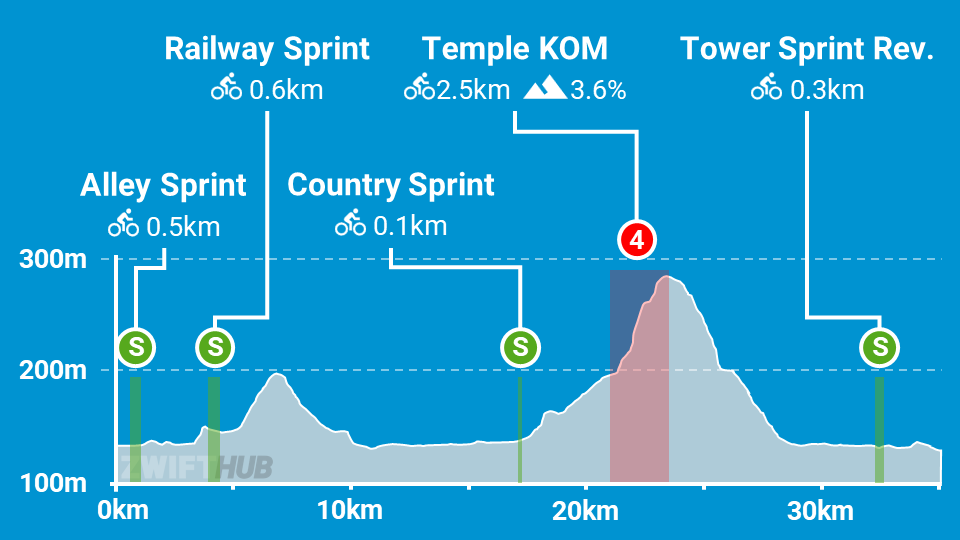
Makuri Islands’ Chasing the Sun route begins in the Neokyo’s harbor, climbs to its rooftops, then heads to the Yumezi countryside for a trip up the Temple KOM before heading back to Neokyo for the finish.

All riders will be racing a single lap of the route for a total of 35.1km with 279m of climbing.

Let’s discuss the key parts of this route, beginning just after we blast out of the start pen:

Alley Sprint: starting less than 1km into the race, this flat sprint is fairly long at ~400m. Its effect will be to lengthen and magnify what is already a high-powered race start, stretching the effort for another minute or so before riders ease after the sprint banner. Strava Segment >

Railway Sprint: after a short climb up to the Railway level, this long sprint (~500m) is going to hurt! Thankfully it’s mercifully shortened by being slightly downhill. Strava Segment >

Rooftop KOM Reverse: this is not an official timed segment, so no FAL or FTS points. But it’s 1.3km long at a 4% average gradient, so expect attacks to happen and efforts to be higher than on the flats. You will get a powerup at the top!

Country Sprint: after a longer flat section, the Country Sprint marks the start of the longest uphill portion of our race. The sprint itself is flat and around 100m long, but expect the pack to stretch out afterward as the road tilts up.

Temple KOM: the only climb awarding intermediate points on this course, the dirt Temple KOM (2.5km at 3.6%) will prove the key selection point in many races. Riders gapped off the front group may be able to chase back in the remaining 12km, but if the front pack is large and/or strong enough they will stay away to mop up Tower Sprint and finish points. Strava Segment >

Tower Sprint Reverse: at ~300m and flat, this medium-length sprint holds an enticing pile of extra intermediate points for any riders chasing the front pack after the Temple KOM.

Lastly, the finish. It’s a flat finish, but you can’t see the arch until the hairpin turn with ~300m to go. Timing and powerups will be crucial here.

Read more about the Chasing the Sun route >

PowerUp Notes

Riders will be awarded a powerup at each banner, which means 7 powerup opportunities during the race (at the end of each timed sprint and KOM, as well as the Yumezi lap banner and Neokyo Rooftop KOM).

Every rider will receive one of these powerups at each arch:

A simple white helmet with a visor, shown in profile with three lines behind it to indicate speed, centered on a turquoise circle with a gray and white border.

Aero Boost (helmet): makes you more aerodynamic (reduces your CdA by 25%) for 15 seconds.
Use at higher speeds (flats and descents), especially when no draft is available (although it is still useful when drafting.) Highly prized for sprints!

Draft Boost (van): increases the draft effect you are experiencing by 50% for 30 seconds.
Use at higher speeds (flats and descents) when you are already drafting off another rider (since this powerup only helps when you are drafting.) Useful when you’re looking to conserve a bit of power as the pack speeds up in the final kilometer of a race, or if you just want to sit in with less effort on a fast section.

Cloaking (ghost): makes you invisible to other riders for 10 seconds. Disabled within 100m of the finish line.
Use when you want to get away from one or more riders. Deploy then hammer, in hopes that you will create enough of a gap that your opponents can’t grab your wheel.

Bike Frame + Wheel Choice

The Tron bike

This route features flat sprints but also longish climbs, making bike choice a less-than-straightforward matter.

An aero bike will maximize your sprint speeds and let you sit in most easily on the flat roads that make up half of your overall mileage. A climbing bike would give you a slight edge on the two climbs where efforts are sure to be high. A gravel bike will give you a huge advantage on the Temple KOM, but a huge disadvantage during the rest of the race.

We think the Tron bike is the best pick here, given that it’s the strongest all-arounder now that Zwift nerfed the Chapter2 TOA.

To Swap Or Not to Swap?

Any time a route includes the Temple KOM, consideration should be given to the idea of bike swapping. Especially now with the new gravel wheelsets giving an even bigger advantage to gravel bikes on the climb, does it make sense to swap before starting the KOM?

Our timings show the Specialized Crux with ENVE G23 wheels climbing the Temple KOM 35 seconds faster than the Tron bike at 4 w/kg. The question is, how fast can you swap?

It makes good sense to swap if you’re only targeting FTS points for the KOM. But if your swaps take 15s or more, it probably doesn’t make sense to swap if you want to stay in touch with the pack you’re already in at the start of the climb, since you’ll want to swap back to a road bike at the top.

That said, lower, slower categories (D and C) will find the bike swap strategy more effective. A and B racers will find it less effective, as pack speeds are higher and gravel bike advantages thus reduced.

More Route Recon

Many events are now being planned each weekend on the upcoming ZRL route. If you’re not familiar with this course, jump into one of these events and do some recon! Here’s a list of upcoming Chasing the Sun events.

Looking for a video recon, with lovely British commentary to boot? Check out Si and Sherpa’s recons below:

Si Bradeley

See Si’s recon notes >

Sherpa Dave

Strategic Options

Points Distribution, Week 3

The maximum points a team of 6 could earn in this race.

There’s something for everyone in this week’s race, so there’s no clear team strategy that applies to all riders. Here are some predictions of strategies we’ll see on Tuesday:

  • All-In For the Sprints: riders who won’t survive the Temple KOM slog may go all-in for the first three sprints, and even contest the final Tower Sprint for FTS points.
  • Chasing the Final Points: riders who aren’t strong sprinters may plan to save themselves for the Temple KOM, attacking hard to grab FAL/FTS points then staying away with a reduced front pack to grab Tower Sprint and Finish points.
  • Sprinters Pushing Post KOM: the Temple KOM may see strong sprinters spit out the back of the front group, but watch for those wattage bazookas to put the hammer down in a bid to catch the front group and contest maximum Tower Sprint and Finish points.
  • Secret Sprints: we haven’t seen the ghost used much in ZRL, but it may prove useful for riders chasing FAL sprint points.
  • Bike Swaps: some riders will attempt a swap to the gravel bike before the Temple KOM begins. Due to pack speeds, this is more advantageous for D riders than C, and it’s a questionable strategy for B. A riders probably won’t be doing much of it at all. But C and D teams with strong climbers may consider the value of a TTT approach to gravel swapping, which worked for some in week 1’s Road to Ruins race.

Your Thoughts

Any insights or further thoughts on this race? Share below!
About This Series

The Giant Tips ZRL series is sponsored by Giant Bicycles and delivers helpful tips for upcoming Zwift Racing League stages so you can unleash your full potential.

Giant is the world’s leading brand of high-quality bicycles and cycling gear. Part of the Giant Group founded in 1972, the brand combines craftsmanship, technology, and innovative design to help all riders unleash their full potential. Learn more at giant-bicycles.com, or visit one of their 12,000+ retail stores around the world.

How the Race Was Lost: Greater London Flat TTT (ZRL Week 2)

2

How the Race Was Lost: Greater London Flat TTT (ZRL Week 2)

The first TTT of Zwift Racing League 2021/22 Season 3 was held last Tuesday, and it was a flat(tish) and fast one. My team (the DIRT Roosters) was missing our powerhouse Clem, but we were still confident in our TTT abilities and excited to get out and suffer for virtual glory.

It was our first TTT in the B1 division, though, and we didn’t know how we’d fare against the competition in the top-tier “meat grinder” category. Only one way to find out!

Race Prep

This race didn’t require much in terms of course recon or team planning. There were two key climbs to hammer, but it was mostly about steady power on the flats, and bumping up your wattage on short climbs to keep speeds high.

We had a bit of hassle trying to put together our 6-man team, with powerhouse Clem out for the week on vacation and Arjen recovering from sickness. Eventually Arjen decided he could race, so Captain Antoine put together our pull order:

  1. Sean: 30sec around 400w
  2. Eric: 30sec around 380w
  3. Thomas: 30sec around 370w
  4. Dean: 30sec around 350w
  5. Antoine: 30sec around 350w
  6. Arjen: Joosse around 360w

We had our marching orders. I did what I could to be fresh and prepared for the race:

  • Recovery ride the day before
  • Plenty of sleep the night before
  • A clean, carby oatmeal breakfast
  • Beet juice two hours before the race
  • Caffeine gum – three pieces (300mg), one hour before the race
  • PR lotion on my legs about 45 minutes before the race. More bicarb=less burning.
  • A fast virtual bike setup (Specialized S-Works Venge + DT Swiss disc wheels)
  • A 30-minute warmup with the C. Cadence crew which included a few efforts to get the heart rate up into the threshold zone

My legs felt fresh, and as we chatted on Discord I clicked to join the pens with 10 minutes to go.

And Zwift crashed. Just disappeared from my PC screen entirely. Yikes!

I quickly booted it up again (a solid state drive makes booting into Zwift so much faster), then clicked to join the pens. It worked the second time. Whew. I just hoped things would stay stable for the race.

J. Fussell fighting the knowledge war in the pens (our delay was only 2.5 minutes)

The Lead-In

After waiting 2.5 minutes, it was the Roosters’ turn to launch off the start line.

The first few minutes of a TTT are always a bit crazy. Who’s pulling in those first seconds, anyway? What is the rider ahead of me wearing, so I know whose wheel to sit on? And on the London course you have the added difficulty of a few rollers right at the start, making it hard to stick together efficiently.

But we settled in quickly enough. Our formation has the front rider calling out their pull start and stop time, with the on-deck rider sitting behind while the rest of the team is bunched on third wheel. I even got a feather powerup, perfect for use on the short Northumberland climb.

Lap 1

I scored an aero powerup through the Classique banner, and used it on my next pull, not realizing until afterward that this wasn’t the smartest use of the powerup. (I would have been better off using it to help me keep my speed high when the legs were more tired further into the lap.)

Looking at the rider list on the right, we could see we were getting closer to the team ahead of us TFC Bugatti) and pulling away from the team behind (WLC). This was a good sign. (While Zwift’s interface makes it hard to see where you’re at in relation to all the teams in the middle of the race, being able to see those ahead and behind gives you some idea how well you’re doing.)

I got the dreaded “connection disconnected” alert on my screen somewhere in the middle of lap 1, and promptly disappeared from my teammates’ screens. There was definitely some internet weirdness going on: my Discord screen showed it attempting to reconnect, and I could still hear my teammates talking while they couldn’t hear me. I could also see them just fine on my Zwift screen, but they weren’t seeing me!

This led to some chaos, with me thinking I was taking a pull, while they thought nobody was there to pull. This is the kind of thing that can really burn some legs out and cost a team valuable seconds, but they handled it like champs, rotating to the front and taking pulls until I magically reappeared 20m ahead.

We hit Piccadilly, the largest climb of the route, and hammered through a painful ~1 kilometer. I was surprised to find myself riding at or near the front of our team on the climb, which was a good sign (for me) but probably also a sign that others weren’t feeling particularly strong today.

One lap down. One to go.

Lap 2 + Finish

I got a draft powerup on the second Classique banner, and held onto it this time, figuring I could use it near the end of the lap when I’d be suffering the most.

Arjen had begun skipping pulls, and it was clear we were all suffering. Even Captain Antoine had some issues, shouting that he was putting out 6 w/kg but not being able to hold our wheels. Somehow we all magically stayed together, though.

One last time up Piccadilly, and Antoine was shouting at us to give it all we had. The suffering was real, and the finish line was so close! I used my draft powerup for a bit of relief, then it was an all-out, empty-the-tank dash to the line.

We usually have a rider or two take a suicide pull near the end of a TTT, but this week we all finished within 1 second of each other, each of us completely spent.

See activity on Strava >
See ride on Zwift.com >
See results on ZwiftPower >

Watch my race video (apologies again for the audio mix):

Team Result

As soon as we finished, we began looking at ZwiftPower times and doing the math to calculate where we placed. “How much of a time gap did the Alligators have? Why aren’t the Aliens listed in ZwiftPower?” It’s a confusing science, but we usually end up figuring out pretty well how we rank, before WTRL displays the final results on the site.

We finished third this week, just 1.5s behind second place. Congrats to INC Aliens, who hammered their way to a solid victory with some huge power numbers (average wattage of their top 4 riders: 326.5W!)

The best part is, this week’s result puts us in a three-way tie for first place in our division, with two teams just one point behind the top three. That’s some tight competition! This will be a thrilling season for sure:

Takeaways

With such a narrow margin separating us from second place, it’s easy to start second-guessing yourself. What if I hadn’t disappeared from my teammate’s screens? What if I’d pulled just a bit harder? What if we’d kept a tighter formation?

For me at least, once I’ve cooled down, showered, and eaten lunch I tend to feel like I could have pushed harder in the race. But my racing hindsight wears rose-colored glasses.

Looking at my numbers, and those of the other Roosters, I think we raced to our limits today, which is exactly what you’re supposed to do in a well-planned TTT. A couple of images to illustrate:

My Strava power curve for 2022: I set new PBs between 14 minutes and 40 minutes in this race!

XERT MPA (maximum power available) chart, showing my MPA steadily dropping each time I took a pull.

What About You?

How did your TTT go? Share your story below!