Home Blog Page 409

Watopia “Big Foot Hills” Route Details

Watopia “Big Foot Hills” Route Details

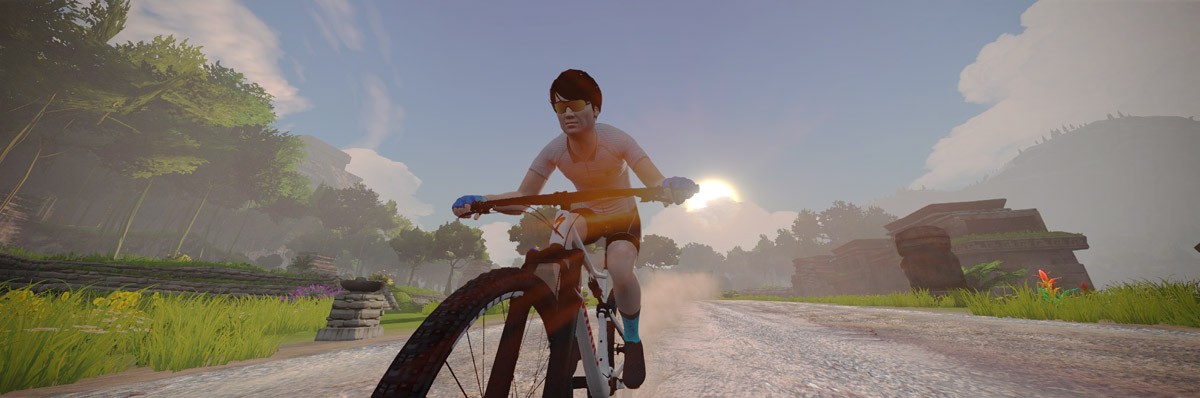
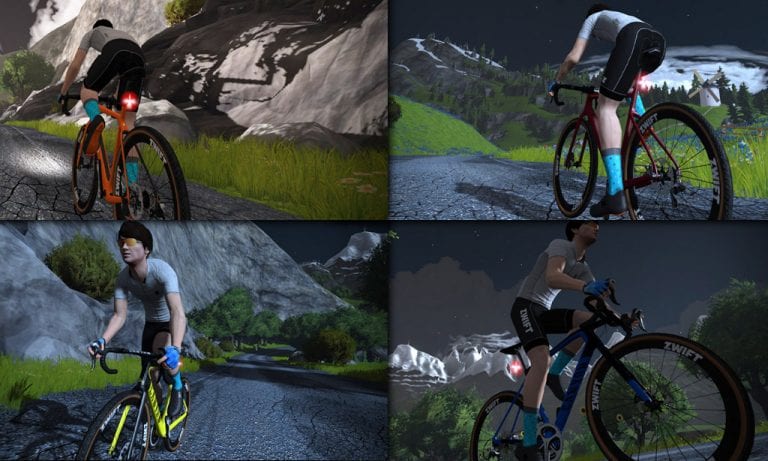
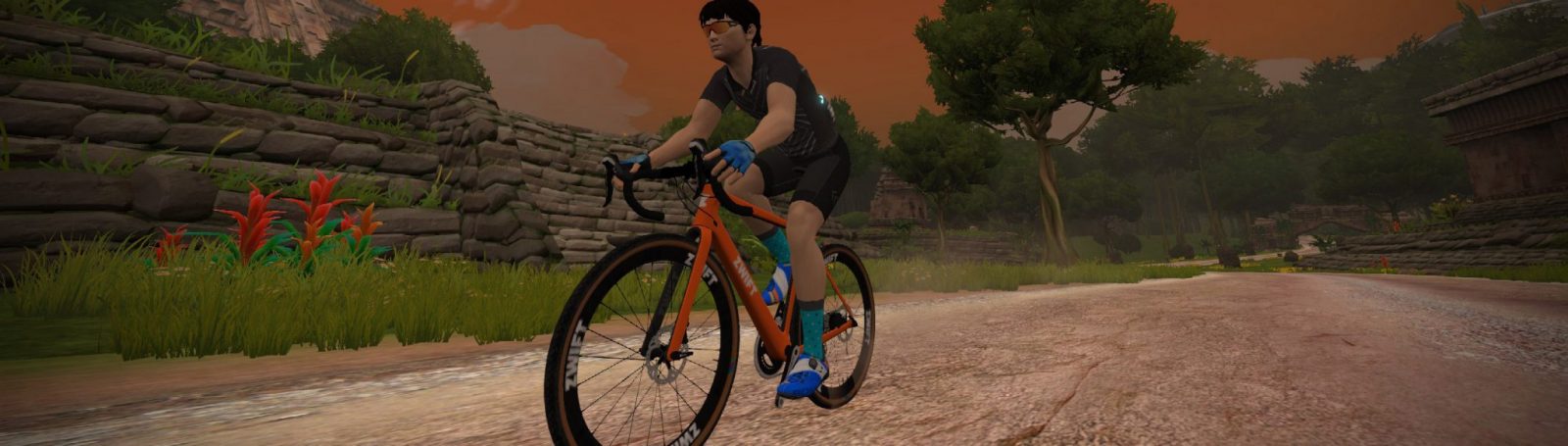
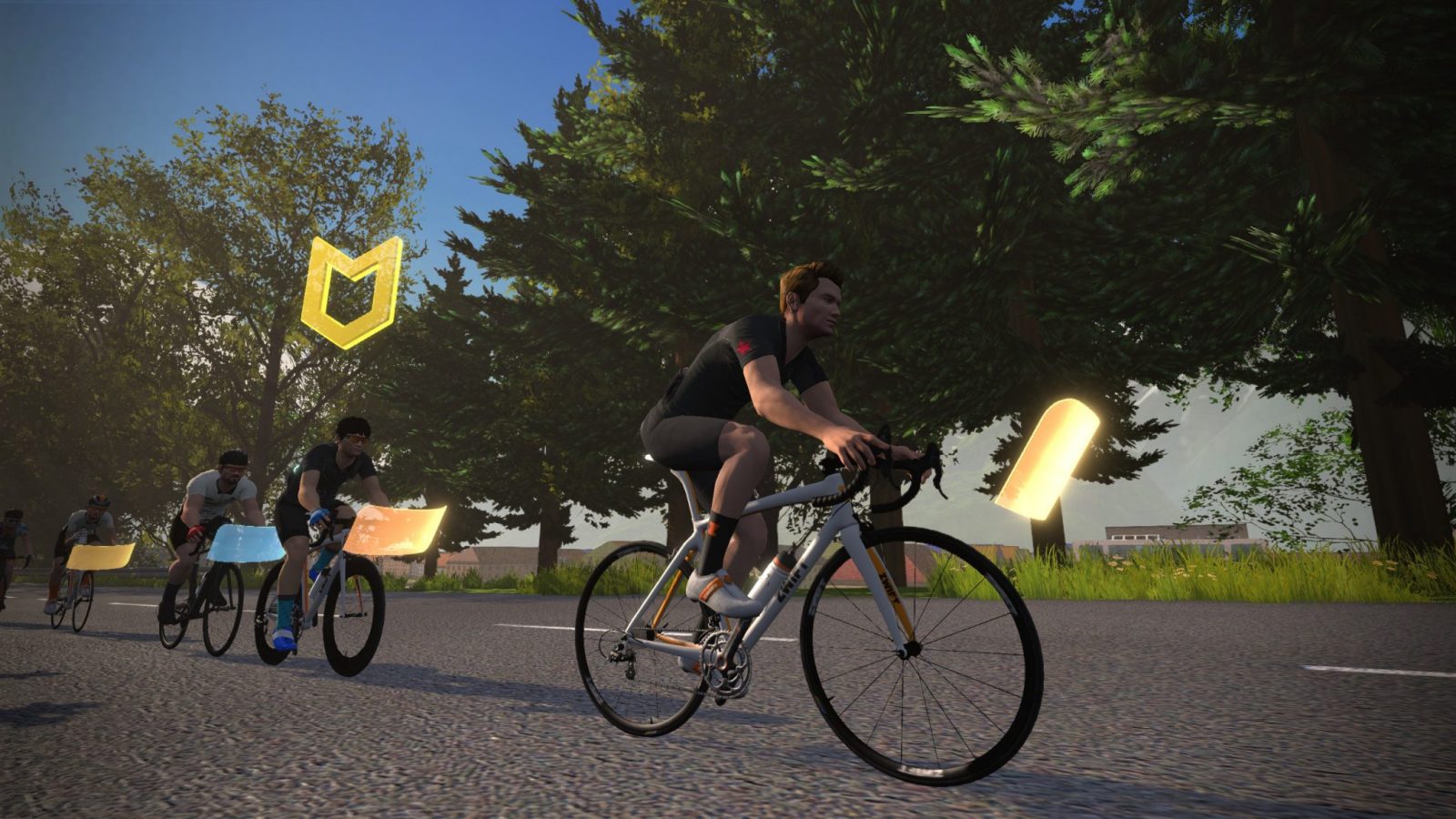
One of five routes rolled out with Zwift’s Titans Grove expansion, “Big Foot Hills” takes you on a meandering journey over the lower peaks of Watopia, including Titans Grove in both directions.

This longer route is perfect for a ~2-hour free ride and includes 5 different KOM sections of short to medium length. A nice choice if you want to do some VO2 max hill training!

Route Description

Begin just before the Fuego Flats start pen and hit the flat, fast desert roads to start. This is as flat as your journey will get! You’ll hang a right into Titans Grove (forward direction) after leaving Saddle Springs, ride through Titans Grove, then turn left to head toward downtown Watopia.

At the intersection near downtown, turn left to head up the original Watopia KOM, then descend down and turn left onto the gravel at the Italian Villas toward the volcano.

At the volcano, you’ll take the first right for a CCW circuit around (and through) our favorite magmatic mountain. But before you complete a full circuit you will turn left to head up the Volcano KOM–the largest climb on the route.

Once you’ve finished that climb, zip down the volcano and ride to downtown Watopia, through the main start/finish banner and back out toward Fuego Flats. But before you hit our original starting point you’ll hang a right into Titans Grove, covering that road in the reverse direction.

After Titans Grove turn right to get onto Ocean Boulevard, through the fishing village, and onto the original KOM in the reverse direction. After descending from the KOM turn right onto Ocean Boulevard, then a quick left toward Fuego Flats to finish near the same place you began.

Profile

Once you’ve covered the initial 10km of Fuego Flats, this course is rarely flat. That said, none of the climbs are particularly long, with the Volcano KOM (3.7km, 3.2%) being the largest.

Route details:
Distance: 67.5km (41.9 miles)
Elevation Gain: 637m (2090′)
Strava Segment

Start and Finish Points

Since this route does not begin near a start/finish banner and your actual spawn location will vary a bit, we had to choose logical start/end point for our Strava segments. For now, the Zwift Insider verified segment begins/ends at the Fuego Flats start/finish rock arch.


Watopia “Dust In the Wind” Route Details

Watopia “Dust In the Wind” Route Details

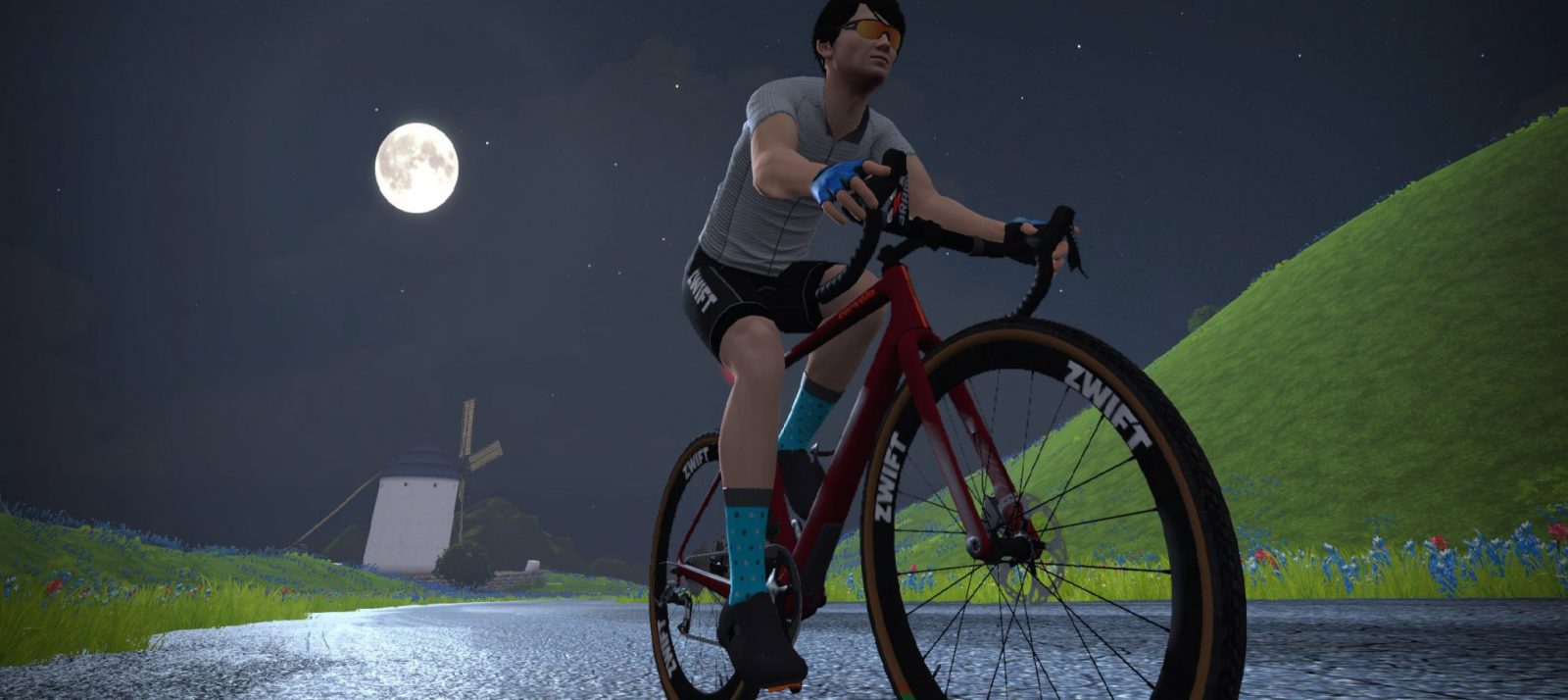
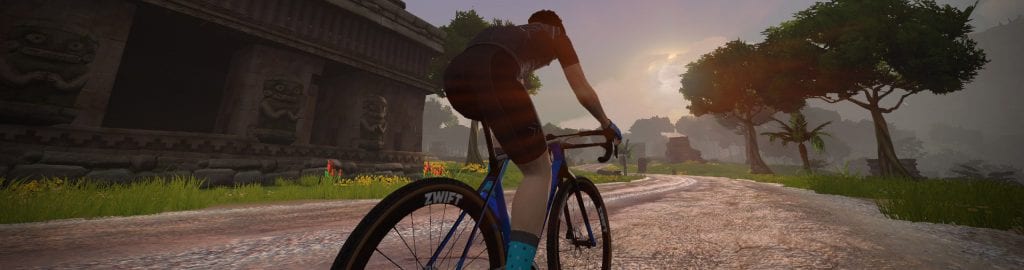
One of five routes rolled out with Zwift’s Titans Grove expansion, “Dust In the Wind” covers Titans Grove twice, as well as Fuego Flats, part of Ocean Boulevard, and a Mayan Jungle out and back.

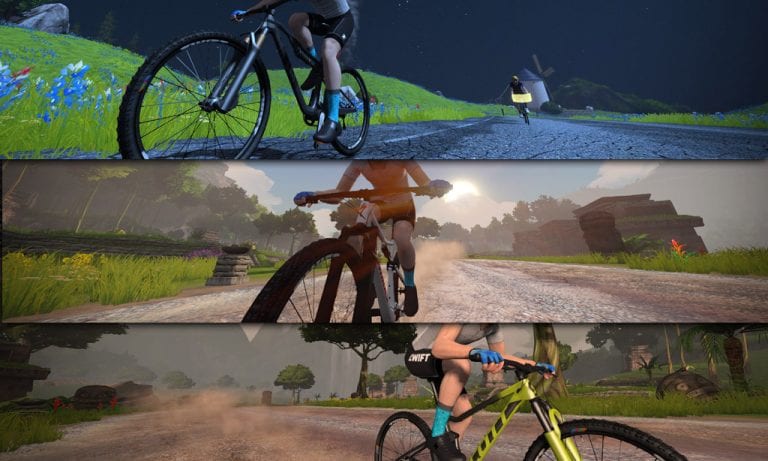
Along the way you’ll encounter a fair amount of virtual dirt/gravel road, so you might consider using a gravel bike so you can move to the front of the pack and make everyone else eat your dust!

Route Description

Begin by turning left off of Fuego Flats into Titans Grove reverse. You’ll ride through Titans Grove (north to south), and our Strava segment begins at the top of the Titans Grove KOM.

Descend from the KOM, finish your ride through the redwoods, then turn right and descend down to Ocean Boulevard. Take Ocean Boulevard until you hang a left at the windmills to head to the Mayan Jungle.

Ride the Jungle loop (clockwise), then climb out and return the way you came. Turn right when you hit Ocean Boulevard at the windmills, riding toward downtown Watopia. But you’ll hang a right toward Fuego Flats before you reach downtown.

After crossing the bridge you’ll turn right into Titans Grove to ride it once again in the same direction as before. But at the end, you will turn left and head into Saddle Springs then into the desert to finish your ride at the rock arch finish.

Profile

None of the climbs here are particularly long or steep, but you will accumulate a fair amount of elevation over the full route.

Route details:
Distance: 47.3km (29.4 miles) + 5km (3.1 miles) lead-in
Elevation Gain: 413m (1354′)
Strava Segment

Start/Finish and Achievement Badge Notes

Since this route does not begin near a start/finish banner and your actual spawn location will vary a bit, we chose the first banner you ride through as the start point for our Strava segment.

This banner is the Titans Grove reverse KOM banner, which means you have a 5km lead in with a bit of climbing before the official Strava segment begins.

The route ends (and you will receive an achievement badge) the first time you ride through the desert start/finish arch.

Changelog

Dec 16, 2019: updated segment to begin at the Titans Grove KOM and end at the desert arch. Updated text descriptions accordingly.


Getting Competitive Again (Never Going Pro Podcast #3)

Getting Competitive Again (Never Going Pro Podcast #3)

I’ve just gotten an upgrade and gone from near top of one cat, to near bottom of the next…how can I get competitive again?

We also chat it up about donuts, cafe stops, and le Tour de France!

Show Notes

Performance Management Chart (PMC) background + Differences in training between athlete levels:

TSS = Training Stress Score = Developed by Dr. Andy Coggan + Hunter Allen: Allows athletes to objectively quantify their workouts based on their relative intensity, duration, and frequency of workouts. Example – 100 TSS at 100% FTP at 60 minutes. Using RPE – Think of intensity as an RPE value on a scale of 1-10, 10 being the hardest. If you exercised at a level 5 for two hours, then you would accumulate 50 TSS/hour or 100 total points.

CTL = Chronic Training Load = Fitness = an exponentially weighted average of your last 42 days of training stress scores (TSS) and reflects the training you have done over the last 6 weeks. However, the workouts you did 15 days ago will impact your Fitness more than the workouts you did 30 days ago.

ATL = Acute Training Load = Fatigue = An exponentially weighted average of your training stress scores from the past 7 days which provides an estimate of your fatigue accounting for the workouts you have done recently.

TSB = Training Stress Balance = Form = Yesterday’s Fitness (CTL) – Yesterday’s Fatigue (ATL) represents the balance of training stress. A positive TSB number means that you would have a good chance of performing well during those ‘positive’ days, and would suggest that you are both fit and fresh. They’re “On Form Today!” means high fitness + low fatigue.

Long story short, there is no short cut to fitness and becoming competitive ‘quickly’. “It never gets easier, you just go faster.” ~Greg LeMond

Personal Insights:

  • The more fit you are, the greater the training stimulus needs to be to continue to improve. Also, the more fit the athlete is, they typically have a better handle on nutrition, hydration, sleep, recovery, etc. i.e. if you want to get to the “next level” you can’t be living the “dad bod” lifestyle.
  • Higher level athletes tend to become more specialized and hone in on a certain discipline, then again at a class in that discipline, and more importantly they train what makes them good in that class. I.e. a IM triathlete wouldn’t do well against a track pursuiter (typically), and vice versa. VERY FEW athletes are good at everything – and they can thank their Mom and Dad for that ability.

Helpful Links:

Show Transcript

Ken: You know, I got a story I wanted to tell you guys.

Shayne: Oh yeah?

Chris: I’m all ears.

Ken: Yeah, did you hear about the time I overdosed on Viagra?

Chris: Gosh, no.

Ken: That was the hardest day of my life, man. All right and here we go.

Shayne: [inaudible 00:00:21] that’s perfect.

Chris: Now there’s only six people listening.

Ken: Now there’s only six people left. Welcome to the never going pro podcast by dads inside riding trainers featuring GC coaching. It’s a podcast about riding bikes and parenthood and trying really, really hard at both. I am your host Ken the badger [Knowles 00:00:47] and with me is Shayne Gaffney owner of GC coaching and Chris Gorney fellow team dirt made passionate cyclist and all around outstanding dad. So how is everybody doing this week?

Shayne: Doing well man, doing well how about you?

Ken: Good. Going through Tour de France withdraw. What an exciting year it was to watch the tour.

Shayne: For sure. That mudslide was insane the last one on the ultimate climb-

Chris: The act of God clause in the contract.

Ken: Not sure it really would have changed the outcome much, but still it made for some good dramatic television and some good debates among my cycling friends.

Shayne: And the French don’t win again, unfortunately.

Chris: Hey man the French have not won in my lifetime.

Ken: Yeah it’s been 33 years, you’re a youngen.

Chris: I know. It’s close, it’s barely but now I’m kind of rooting for that. I want to see how long they go without winning now.

Ken: I mean pretty good at putting the race on. You think they could win it every now and again.

Shayne: I’m from the Boston area so I went through the Red Sox not winning the World Series for however many years that was. So we’ll see if they can maybe match or beat them.

Chris: The curse of the Bambino.

Shayne: That’s right, the curse of the Bambino, yep exactly right.

Chris: This is the curse of the, I don’t know.

Shayne: Galla Phillipe or something.

Chris: Yeah.

Ken: Who knows man.

Chris: We’re all idiots.

Ken: Chris you were telling us that you went to Bentonville, Arkansas to go mountain biking.

Chris: Yep, rode with some people from my office there. We have a little satellite office in Bentonville and one of the guys was riding a hard tail and crashed on his way to the trails and got terrible road rash down his arm and his leg.

Shayne: Oh, no.

Chris: Ironically rode the trails wonderfully and just tore it up, but tore himself up on the turn on a sidewalk. He looked like he powerslid into home with his bike. He just hopped right back up.

Shayne: Yeah, yeah.

Chris: So anyway.

Ken: So for those of you in our listening audience, Bentonville, Arkansas has become a mecca for mountain biking. The Walton family, the Walmart people they’ve put like 80 million dollars into the trails down there?

Chris: Something silly.

Ken: Yeah something ridiculous like that and it has become pretty incredible.

Chris: One of the guys I rode with said that Slaughter Penn is trash and you should ride the new trails at [Koler 00:03:24].

Ken: Okay. So you’ve all heard it.

Chris: Well it’s not my opinion. I’ll blame, I’m going to leave his name out of it. But it was not me. So anyway.

Ken: Well I’m glad you got some trail time in.

Chris: Just so fun.

Ken: Yeah that’s a good deal. So a couple things that we’ve got going on this week. We’ve got a dad interview with one of our teammates, his name is Graham [Partaine 00:03:52] he lives down in Florida and he’s a guy I met online. As a matter of fact what he did is he gave me a PC to set up in my shed, a very nice gift from him and we’re going to put him on here in a few minutes and listen to what he gets out of training inside with a big group of like minded people. So I hope you enjoy that. We also have our focus question for the week. Shayne would you like to introduce our focus question?

Shayne: Sure. Let me just find it quickly. Oh, there it is. So the focus question is, I’ve just gotten upgrade and gone from near top of one catch to near bottom of the next. How can I get competitive again quickly? Competitive again quickly? So you can’t, but I’ll explain why.

Ken: You can’t get competitive again quickly.

Chris: I reject your answer immediately, podcast done.

Shayne: More donuts for Chris Gorney that’s what you need.

Chris: Dude, I had some amazing ice cream last night that replaced, anyway keep going.

Ken: So it’s a conundrum and for one a lot of us feel ourselves tickling up against the edge of the next cat up and it just feels like we will get lost in the bottom of the next wrung and I went through that. When I started racing C and I started winning some races and I got categorized up and and it was Zwift power and here I am. I’m at the bottom of B and I suck all over again.

Shayne: Yep and we should define categories for Zwift too before we go further. So there’s A through D, so D is one to 2.4 watts per kilo. C is 2.5 to 3.1. B is 3.2 to four and then A is four to five. There’s also an A+ category on Zwift power which I believe is-

Chris: What? I did not know that.

Shayne: Five plus. It’s either 4.5 or five plus I can’t remember.

Ken: I think it might be 4.5 and above. I don’t remember. But yeah you’re right.

Chris: All right we need to call confess what grouping we are in so people can know that and judge us about it and then look us up later and see if we’re lying.

Shayne: Okay. You go first.

Chris: Ken what are you?

Ken: Come on man.

Shayne: I will if you will.

Chris: This is good. I’m upper B towards the lower of A. That’s where I’m at.

Ken: Okay.

Shayne: I am the same. I am upper B towards low A. Previous A+ though.

Ken: No kidding, you made it all the way up there?

Shayne: I did, I did but then I had a kid.

Ken: Yeah baby will knock you back a couple of categories.

Chris: Think you’re a dirty, dirty liar.

Ken: Yeah I’m starting to race in the upper level of the B as well. Haven’t quite made that consistent 4.0 watts per kilogram.

Chris: I have a friend who was racing Mr. Dustin Elliot out of Philadelphia to give him a little shut out, shut out and shout out, both of them. It’s been a long day. A little shout out. He is the guy I’ve had in mind as we’ve been talking about this topic for the last week because I … well it was probably about six months ago he went from B and got into A and started just like racing against a whole other class of guys and he was kind of demoralized. He was winning races all over the place and then all of a sudden we’re rolling with these guys that were putting out 4.8 watts a kilo for an entire race and he’s just gassed. So it was pretty frustrating. He actually kind of worked himself into a hamstring injury.
Ken: No kidding.

Shayne: Oh, that’s not good.

Chris: Yeah. So his legs just fell straight off.

Ken: Wow. I was wondering what happened to Dustin.

Shayne: You only have a span of six watt per kilo in C. Eight watt per kilo in B and then a whole, sorry I should say .6 watt per kilo in C, .8 in B and then you have a full watt per kilo in A. That four to five is a humongous difference in talent and ability versus 3.2 to four isn’t that much difference. But four to five is like going from a cat three to a cat one. So that’s a different category too so maybe we should define those two. So the road category is USS cycling has cat five which is entry level beginner to cat one and then they have continental pro and then they also have world tour pro. World tour pro is the Tour de France guys you see on TV. So those guys are the best of the best.

Chris: That’s like the badger.

Shayne: Just like Ken the badger.

Ken: Pretty much. Yeah when I was younger five years ago. So one thing that I found interesting is the disparity between the different categories and how much training volume they’re putting in. So what Shayne does every week for our audience is he puts up some notes and some case studies and we get to look through it and pick out and decipher as much of it as we can. I was just amazed. These cat one, two guys are training what are we seeing, 14 to 20 hours a week annual training stress of a lot. Yeah.

Shayne: Yeah.

Chris: Does anyone else hope that those guys just have no friends? When I hear that people ride that much I’m like I just want there to be one thing wrong with them. They can’t be great people, they can’t be great dads and they can’t be freaks on a bike. They need to at least be the guy who doesn’t mow his lawn or something you know what I mean?

Ken: Yeah.

Chris: He’s got to be something.

Ken: Yeah well this podcast isn’t for them.

Shayne: Yeah I would probably argue not dads of young kids.

Chris: That’s true. If you’re an A+ rider please stop listening right now.

Shayne: I do work with one A+ rider now with a kid, but he’s a genetic superstar and he’s got a huge volume of training in his history. So he can get away with six to 12 hours a week.

Chris: He can keep listening.

Shayne: But yeah, most of those guys or gals are typically kidless or older kids and they have the time to actually train those hours. So if we run through the hours quickly, so a cat five which again entry level you’re talking three to eight hours per week on average. A cat four is six to ten. Cat three nine to 14 and then as Ken was saying cat one/two is 14 to 20. Then typically what I’ve seen is continental pro is 25 and the world tour is 25 to 35 per week give or take. So as you need to increase your fitness you have to increase your training density like we’ve talked about a couple times not on this podcast. So the easy way to do that is just by making more time to train. So that’s why you should see that disparity between the categories.

Ken: Sure and I guess the thing that amazes me is that you could even ride a bike and absorb anymore training at 25, 30 hours a week or more.

Shayne: For sure, yeah.

Ken: What is going on? What is the nuancy stuff going on with the body at that point that is even yielding any sort of benefit from riding that much?

Shayne: Yeah. That’s when you get into nature versus nurture argument.

Ken: Okay.

Shayne: So a lot of those world tour guys are genetically designed to ride a bike where the average person wouldn’t be able to A, tolerate and absorb that much training stress and B, they’re response to that training wouldn’t be nearly as good. So which we can get to later in the podcast because I have research on this too. But trainability is a big thing where if you give 10 athletes the same program you’ll get one athlete that responds ridiculously well, one athlete that responds not at all and you’ll get six or eight that respond somewhere in that bell curve even though they’re all doing the same amount of training and the same training stress. So you have to have a good setup to that.

Chris: Where would you if you were saying we’re taking cat five through pro, where would you say the line per, this is going to be purely subjective I’m sure. Where do you think the average line if you’re going to compare that to Zwift categories. Clearly the upper one, two pro all those guys are going to be A+. But in your opinion where do you think B lands? Is that cat four do you think?

Shayne: I think that’s cat four and bottom three. Then A is like you were saying one, two. Then C, D is typically four, five.

Ken: Sure.

Shayne: That’s what I would say. ‘

Ken: Sure.

Chris: So let’s come up with a case study here. So you are let’s say a guy is C category and he’s been doing pretty well, been winning some races, feeling good at it. He gets online and goes, oh, surprise I’m now looking at Zwift power and I’ve been bumped to B and now he’s in the B races getting up early, racing those he’s just dogged. What do you say here? He’s like how do I get back to the top of the heat?

Ken: Lose some weight.

Shayne: That might help yeah. Lose some weight. But to a point because Zwift tends to penalize people that are lightweight, at least in my experience where most of Zwift races are relatively flat. So you want to have semi-weight behind you so you can keep the momentum going. So for me I’m only 142 pounds, so if I do volcano flat I have to put out four watts per kilo plus to stay with a guy that’s putting out 3.2 watts per kilo that’s 60 pounds heavier than I am.

Chris: You only weigh 142 pounds?

Shayne: I do, yep.

Chris: You’re like a small little, very cute.

Ken: For our international audience what’s that in kilos?

Shayne: 64 kilos I think.

Chris: Ken, how much do you weight? What’s your kilo?

Shayne: Yeah 64.4.

Ken: Just a few tenths below 70 kilos right now. So 154, 155 and I’m carrying a little extra weight right now. I’m trying to get back to that race weight which is closer to 150.

Chris: Well I am the Clydesdale of this group. So that’s good.

Shayne: How much do you weigh?

Chris: I’m like a buck 60, buck 65.

Shayne: That’s not bad. That’s not bad.

Chris: I like to think I’m more powerful than both of you though, so.

Shayne: Yeah you’d probably smoke us in a flat race you know?

Chris: Yeah we’ll see, we’ll see. That’s a weird conversation. A bunch of men talking about how much they weigh.

Shayne: Well that’s very appropriate for cycling though.

Chris: Very appropriate.

Shayne: More [inaudible 00:15:09].

Chris: So what do we do here? I’m 160 pounds, I just got into B and everything is terrible.

Shayne: Yep.

Chris: So losing weight is not really an option.

Shayne: Yeah losing weight’s okay but it depends if you have weight to lose honestly. The most hard part is what we’ve already spoken about is just don’t let the psychology of losing races get to you because you’re at a new category and a new level of fitness. So that’s probably number one, don’t beat yourself up about it if you’re getting dropped consistently. Then number two is as you get more fit, as you get to and the cream continues to rise people will typically specialize in their role for a team or what events they compete in. So that’s why you have domestiques, you have rollers, puncher, you have the GC guy, you have the climbers, the sprinters. You have those guys that train for their ability and that’s really what they specialize in. So as you get closer to B and A you may want to start to target and actually train your strengths and actually race the races that will adhere to those strengths best, as opposed to be 160 pounds and doing Alpha Zwift you’re probably not going to do very well there. But you may do really well at volcano circuit or something like that.

Chris: I’d like to tell the world that when I got married to my wife I weighed 145 pounds and she made a comment that I was scrawny. So I started doing CrossFit for like four years just to gain weight. So I feel less scrawny, but I’m a little slower on a bike.

Ken: Yeah well you can throw your bike a lot farther than you used to.

Chris: Yeah that’s true when I get mad it’s perfect. I just crush my bike in half.

Ken: So Shayne one thing I’m looking at here is I’m looking at these volume guidelines for cyclists and I think that there’s probably some wisdom that can be gained from this. You probably got up to a category C by riding your three to eight hours a week and now you’re tickling at the bottom of a cat B and you’re frustrated. Well one thing that I did when I first did my first couple of mountain bike races and I just got hammered by these guys is I peeked at all of their Strava profiles and I was like, huh every single person that beat me rides a bike more than I do. Yeah so I think that this specialization is certainly one piece of it, but also getting right sized with how much training volume you’re doing. I feel that it’s realistic if this is important to you and it’s a hobby you find worth pursuing, I feel that the average parent can find six to ten hours a week if they’re dedicated, if they’re willing to turn Netflix off and get into bed a little bit early to set the alarm a little bit earlier and just to make training a priority.

Ken: You can do that without taking away from the other important things in your life, but there’s almost always slack and fluff in everybody’s lifestyle that they can get rid of to find something more meaningful.

Shayne: That’s the thing too. This podcast is geared toward parents that tend to be time crunched. So it may just not be in the cards right now for you to actually train that nine to 14 hours per week which is okay. You may just have to deal with being at that category for a little bit longer, or just maybe expect the gains and the changes to happen a little bit slower, not as rapid as they did when you first started training which I think is true for everybody. The more fit you get, the slower the changes become and the more you have to work for those changes.

Ken: Gotcha. So we talked about the volume piece here from going from category from a category C to a category B. Well what about the intensity factor?

Shayne: Mm-hmm (affirmative). You mean the training stress?

Ken: Right. So in other words so maybe you take a good look you’re like okay I’ve been a cat C and I’m already riding eight hours a week, now I need to take a look at what I’m going within those eight hours and seeing how can I make that eight hours more fruitful?

Shayne: So yeah intensity factor is one where you can generate more TSS per hour. But like we’ve talked about I think the first episode where if you’re just grinding yourself down day in, day out that’s not really good for longevity in training and also in the sport where you tend to see more burn up that way. So typically I’ll see once athletes get to a .85 to .87 IF average for the week that’s basically all the intensity that they can tolerate. Very few can tolerate a .90, .92 IF average for eight hours per week. That’s basically doing VO2 max intervals every time you get on the bike which are horrible. So it takes a very special person to do that.

Ken: Right, right, right.

Chris: That’s the only way I ride. Just get out of my house, I just sprint as hard as I can until I pass out. That’s all I do.

Shayne: So intensity if one way to do it, but it’s okay to do it. But it’s not going to be able to maintain for awhile because you’re just going to get burnt out because VO2 max intervals are horrible. That’s why people do them usually once a week, not five days a week.

Ken: Gotcha.

Shayne: So you know the true best way to do it is by increasing volume.

Ken: So we’ve talked quite a bit about training stress and we’ve defined it, or TSS and we’ve defined it as your training stress score. But you actually broke it down further in your notes for this week’s podcast and explained exactly what that is relative to FTP and I never knew this. So if you wanted to tell our audience about just exactly what it is I think it was definitely illuminating for me to read it.

Shayne: Sure so TSS is an important metric to understand if you are looking to get a little more serious and train with power especially. So TSS like Ken said is training stress score. It was developed by Andy Coggan and Hunter Allen. You probably all know Hunter Allen from Peaks coaching group. He’s a celebrity type coach and Andy Coggan you may not know. If you don’t know him he’s a great google. He’s done a lot of the grunt work and the science behind the cycling. So he’s a great google. But anyways TSS is a way for athletes to objectively quantify their workouts. So you do this based on intensity, duration and also frequency. So if you were to ride 100% FTP for 60 minutes that would be 100 TSS for that hour. You can also think of it as rate of perceived exertion or RPE where if you exercise at level five for a couple hours you would accumulate 50 TSS per hour or about 100 TSS in total.

Ken: Gotcha. So simply put the 100 TSS is one hour at FTP. Yeah, good luck with that right? It’s much easier to do a 90 minute or two hour long workout and try to accumulate that same training stress. I don’t know anybody that can really hold their FTP for an hour. We spoke about that earlier. You’re like wait a minute functional threshold power, you should be able to do that for an hour, but that’s not exactly how it works.

Chris: Right.

Shayne: Correct, correct. Yeah so the true definition is FTP is your maximum power you can maintain in a semi-quasi steady state for approximately one hour. That’s the true definition. So the other thing is time to exhaustion or TTE. So that’s how long you can truly hold your FTP for. So you can do that through WKO with the model say, or you can see what you’re FTP is and then see how long you can hold it for. That’s truly what your TTE is at FTP. Some athletes are 30 minutes, some athletes are 45 minutes. Like you said very few athletes are over an hour.

Chris: That’s crazy. That just makes me want to … just remembering doing FTP tests is the worst thing in the world.

Ken: So coach Shayne how do you test your athletes? I think I’ve seen you basically say that there are shortcomings with doing a ramp test and a 20 minute power test like the 20 minute power test it’s hard to pace it. With a ramp test it may benefit certain physiologies more than others. So how do you run somebody through? So say for instance I call you up, I’m like, “Shayne let’s do it. I’m going to sign up to have you for the next three months. What’s day one look like?”

Shayne: So day one will be typically an FTP test if you haven’t done one in awhile. So I like to test one minute, five minute and 20 minute power all in the same session. So the one minute power gives me an idea of what the athletes anerobic capacity is, or their FRC which is their functionally reserved capacity. The five minute power gives me an idea of what their VO2 max is and then the 20 minute power is at the end on purpose because I’m trying to reduce their anerobic contribution to FTP which is what I spoke about in my article is what I’m testing and things like that. So you’re trying to pre-exhaust the athlete a little bit that way their FTP test is being generated aerobically as much as possible. So reducing anerobic capacity or sorry reducing anerobic contribution doing FTP is crucial.

Ken: So that’s similar to I think I’ve seen that the suffer fest does something along those lines.

Shayne: Very similar.

Ken: Gotcha. So with that data, so you’ve got the one minute, the five minute and the 20 minute power test. Like how do you determine the FTP from there?

Shayne: So I plug it into WKO and then WKO plugs me a modeled FTP.

Ken: Okay.

Shayne: Then I judge that against other charts and other models in there and then if that looks all good and it all jives then that’s what the athlete’s modeled FTP is. Like I said WKO also gives me what their TTE is or their time to exhaustion. So I’ll know approximately how long they can hold their FTP for. So I think that the question is going to be if they can’t access their WKO what would they do?

Ken: Gotcha.

Chris: Right that’s what I was going to ask.

Shayne: So if they don’t access the WKO then you want to do an either longer duration FTP test. So that was my next thing. If I have athletes that are doing iron man or doing really aerobically based stuff, I won’t test one minute power because I don’t really care too much about the FRC and if anything I’m trying to reduce their FRC because I’m trying to up regulate their aerobic capacity. So I’ll do five minute and then I’ll do a 30 or even 40 minute long FTP test and then vice-versa for the track athletes I don’t really care too much about what their FTP is. I care about what their pursuit is or their sprint is or whatever. So I’ll do a 15 second test, I’ll do a 30 second test. I’ll do more testing in the short ranges to build up power duration curve better. So the testing has to meet the demands of the athlete. But most athletes can get away with one minute, five minute and 20 minute tests.

Shayne: If the athlete doesn’t have access to the WKO then make sure you’re doing a hard effort before you do the FTP test. I think Zwift has a three minute effort at 115% FTP before the FTP test and that effort is there to basically decrease the inter contribution you have to the FTP test.

Chris: Interesting. I’ve always wondered that because the first time I did one of those I just looked at the profile and saying bad words to myself. Like I’m about to do this 20 minute effort but that actually is trying to give you a more honest 20 minute effort.

Shayne: Exactly yep. So your FTP is comprised of anaerobic and aerobic energy sources. So you might have on one minute 80% anaerobic and 20% aerobic and then as it goes out you’re going to get less and less anerobic contribution and more aerobic contribution. So the key with FTP test is making it as aerobic as possible. So that’s why you do that initial effort that is quite challenging because you’re trying to fatigue that anerobic system. So you want to start the effort slightly tired, but that’s good because that means you’re going to get a more accurate FTP test.

Chris: Well that’s what we’re here for is accuracy.

Ken: Right and some ways do you think that in the cycling world that it seems to me that we’re falling short by not spending more time talking about time to exhaustion.

Shayne: Yeah I mean it depends on the goal. If the goal is to do time trialing then TTE is really important. But if your goal is to increase your 20 minute power then that’s totally fine. Some athletes goal is to make their FTP higher and what’s wrong with just basing FTP off of just the 20 minute number? So that’s when you get into the argument of how serious do you want to get into this whole ecosystem? How far down the rabbit hole do you want to go? You can go really far down the rabbit hole or not.

Chris: Really what you’re doing is based on the athlete’s priorities. You’re saying let’s come up with a standard unit of measure, use that and judge everything against that. If you’re just trying to get stronger on Zwift with FTP it’s okay to listen to everything you say, say hey that’s really interesting, put it on a shelf and go take a 20 minute FTP test and just use that as your comparative. And yeah see I’m thinking about our audience and what people are talking. If I’m saying I’m going from C to B and my FTP is I don’t know, my FTP is 300 or whatever, I have no idea what my FTP is right now. You’re saying well hey as long as you know that’s your standard and you’re seeing that go up appropriately than it’s fine to use that even though that’s not super accurate. If you’re a professional but for us dads that’s fine.

Shayne: Yeah exactly. I mean I’m not going to train my pros the same way I train my cat fives. That would be kind of foolish. So the different strokes for different folks and I try to mold myself to the needs of the athlete not the other way around. So I try to treat everybody as individual as I can because if I gave a cat five a 45 minute FTP test they would not work with me very long, and also it wouldn’t be worth it. It would be just way too much … you can get away with a much fun way to test it which is one minute, five minute and 20 minute power.

Ken: Right and that’s the whole point of having individual coaches because they drill down exactly on what you need rather than the commodity style downloading a training program online or which works well for some. But not well for everybody.

Shayne: Yeah I’d say it works well for the majority of the population.

Ken: Sure.

Shayne: Then you can just critique it or tweak it if you need to see something different.

Chris: Or skip the hard workouts is what I just heard you say.

Shayne: Yeah, right.

Ken: So Shayne when you work with the pros are they mainly … I mean do a lot of these folks have day jobs or just jobs that have a lot of flexibility or they’re getting paid just to ride bikes or do triathlons?

Shayne: A little bit of each. Some you’re getting paid just to ride a bike. Some are getting paid to ride bikes and also work and some have very flexible jobs. So a little bit of each.

Ken: Right so I know a lot of fast, competitive runners that they might be considered pro but I’m not sure. But they work in running shops and stuff like that or they work as running coaches and that seems to be they’re always in that ecosystem. They have something to do with the fitness industry that keeps them close to the ability to train.

Shayne: They’re more ingrained and down the rabbit hole you go, typically the more you absorb the culture and you become totally enthralled with it. Kind of like Zwift, people get obsessed with Zwift and they become enthralled by it. So it’s the same thing with the IRL guys too I guess.

Ken: Sure.

Shayne: But typically the athletes that are getting paid to do their sport are technically professional and the level of when you get paid to do it is I guess different. But technically if you’re getting paid to do it then you’re a pro, you know?

Ken: Right. Right, I guess for all of us that have read cycling on $10 a day by Phil Gaimon just the brutality of working from the college ranks all the way up to the pro ranks and that he was at one point making a few hundred dollars a month and I don’t know how he was feeding himself. But it was just insanity. He got free bikes and kits which would be amazing, but definitely not enough to live on.

Shayne: No. It’s not a sport you want to make your millions off of unless you’re the top one percent of the world tour guys. Otherwise you’re not getting paid much money. But one of my favorite sayings ever is it never gets easier, you just go faster. So it’s true. It never gets easier. Each category upgrade or each workout or each FTP bump it never gets easier, you just go faster. So it’s the same amount of work if not more work.

Chris: That’s a good life motto also.

Shayne: Yeah for sure.

Ken: Yeah that was Greg Lemond if I’m remembering.

Shayne: Yep.

Ken: Well thank you for all your feedback and research on that stuff. I think that you’re seeing how it plays out and I’ve seen folks that have become masterful in staying just within their category. So there’s definitely some tricks around that and the main thing that I can tell you is stay in the pack. If you want to win without busting category then learn how to sprint.

Chris: Or just continue to change your weight and never get high enough where they have to actually test your weight in person, which I have for sure seen some people who’s weight … you look at their weight listing you’re like how did that change so quickly? You’re seeing it go up and down just a little bit. I think we’ve all probably seen that on there. It’s a little shady. A little dirty Zwifting.

Shayne: Yeah for sure. My favorite recent one is the height thing. Did you see that? People were adjusting their height.

Chris: Really?

Ken: So tell me about how height plays into the algorithm? I was talking about this earlier but it makes a big difference in your drafting doesn’t it or aerodynamics?

Shayne: Huge difference, yeah. The shorter you are the more aerodynamic you get on Zwift and then vice-versa. The taller you are the more drag you experience. So people were instead of changing your weight because weight has been tracked on Zwift power for a long time, they would just change their height and get away with it Scott free. So people would be like two feet shorter for some races than they were other races.

Ken: Yeah that’s a big difference. So it looks like a bunch of five foot tall body builders that are all 160 pounds.

Shayne: Yeah.

Chris: Well that is one advantage that I have.

Shayne: Now they’re all being tracked on Zwift power.

Chris: I am short. I might not be as light as you guys, but I am short and compact.

Ken: Well there you go, you’ve got the draft advantage.

Chris: I love it. That’s good, so summarizing. If I went from C to B not going to get any easier, I’m just going to have to keep working harder, take my time, be patient if I don’t have more hours.

Shayne: Yeah that’s right.

Ken: Yep.

Shayne: Then ideally increase your hours first and before you increase intensity because intensity is a little bit of a fickle beast where you can do it, but you can’t do it for a long time and it stinks doing VO2 max workouts every day of the week or races every day of the week. So try to increase volume first if you can.

Ken: Right. Gotcha and I think for a lot of folks out there and I think racing all the time you just getting the same stimulus over and over again and eventually you’re just not going to make those improvements. So for me when I took a step back from racing three days a week to doing three training workouts a week I started to just see big improvements in my fitness.

Shayne: For sure.

Ken: Yep.

Shayne: That’s where a sweet spot comes in which is my favorite thing for our time crunch guys and gals.

Ken: Yeah and that’s mainly what I do sweet spots and over/under and that’s about it.

Shayne: I love it. So I will link all those articles and pretty charts and stuff to the show notes like I did last week.

Ken: Great.

Shayne: If anybody is curious and wants to learn more about it.

Ken: Sounds good.

Chris: Does this put us into the dad story Ken?

Ken: All right. So this is the never going pro podcast and we are interviewing one of our team dirt members and his name is Graham Partaine, he lives in Florida. So Graham and I met on Zwift and we’ve done a lot of racing together and we’ve become pretty good friends. One of the reasons I wanted to reach out to Graham is because we’ve talked a lot about balancing work and fitness, family, business. Graham has his own business and often times keeps regular hours, has some travel involved too. So we’re going to get Graham to join us and tell us a little bit about himself. So Graham hello where you joining us from today?

Graham: Hey, yeah in my office at home in Gainesville, Florida.

Ken: Fantastic. So I hear you got the day off today?

Graham: Well I’m running into vacation. We’re getting ready to leave for a trip to head up to Atlanta to go to the Atlanta Aquarium and then Great Wolf Lodge.

Ken: Awesome.

Graham: So preparing.

Ken: So basically Great Wolf Lodge is a giant indoor waterpark and hotel right?

Graham: Yeah it is one heck of a workout too.

Ken: Yeah I think I remember after you said you felt like you had done a triathlon the last time you went.

Graham: Yeah you got to run up and down stairs all day and there’s really not any lines, so there’s no break and the kids are so excited that they don’t slow down. I don’t know where they get their fitness from but they challenged me.

Ken: Sure. Well so how old are they?

Graham: My girls are nine and 11.

Ken: Nine and 11, man I bet they are wide open.

Graham: It’s such a fun age, it’s the best.

Ken: Yeah gotcha. Well so I guess some of my questions for you are so how did you get into riding Zwift and what does it add to your lifestyle?

Graham: You know it’s funny. I’ve always been into the gaming stuff a little bit. I mean growing up and I always thought it was interesting. So I remember seeing on Strava some guys I know it looked like they were riding in the middle of the ocean somewhere on this island and I was trying to figure out what’s going on and where are they? This is when Strava, I mean Zwift was still really new and was still in Beta. So I got in touch with one of the guys and he started telling me about it. I was like man, I got to try that. So I had a dumb trainer with a power tab wheel set up this funky rig in my garage and started doing it. It just fit and I was at a time in my life, you know this was probably five years ago when I was trying to figure out how to stay fit, how to get rides in, how to work and be a dad and it was this awesome thing. I just started having fun with it. Been there ever since.

Ken: Yeah I think I feel part of the same thing. Part of my story was I was always a gym rat, I did a lot of CrossFit and after an elbow injury it just left me so I couldn’t go to the gym. The summertime wasn’t a problem. I would ride my mountain bike before work and then after that happened and it started getting dark and cold outside here in North Carolina I was just really struggling looking for something to do and that’s when I got set up on Zwift. But for me a lot of it has been about meeting this group of people, most of them obviously dads inside riding trainers and it became this huge and unexpected support network for guys that are really going through a lot of stuff. Whether it’s changing jobs, newborn kids, going through a divorce. I mean we see a lot of it.

Graham: Oh, for sure and that was part of it for me. I’m on my second marriage and my first marriage ended I would say is my selfish attitude about my fitness. I was doing iron mans and training like crazy and there’s a lot that went into it. But it was a big blow going through that and I realize now this opportunity I’ve been with my wife now 12 years. But five or six years ago I was running into the same problems and I realized if I go down that path again I cannot imagine going through that with my girls and being responsible maybe with my selfish attitude which I tend to have. So I was not only going through refocusing on my marriage, but I was spiritually trying to refocus myself in a way where I could be a better dad and this all fell into line. It was interesting, when I ran into [inaudible 00:41:10] riding around on Zwift, like “hey man join our team. Bunch of dads riding bikes.” All of a sudden this community came around me that were all trying to do the same thing. We’re imperfect people trying to stay fit.

Graham: We do want to stay fit, it’s great. We want to ride our bikes, but also man being a dad is like the hugest privilege and a lot of work and I found this community that they are doing it with me and I got all kinds of cool support and met great people, met you. It just grew from there. I immediately became attracted to the group.

Ken: That really I think has been the story I’ve heard over and over again. It’s funny to me when you say you were selfish in any way because I’ve never seen that side. I mean you’ve always been willing to put it all on the line for the sake of the team and have always been in that helper role in a lot of ways even though you’ve got the engine, you can definitely win some of these B races. You’re often taking one for the team and I think that is a really cool thing, even if it is just a video game. It is fun to have that opportunity.

Graham: You kind of forget it’s a video game sometimes.

Ken: Yeah, right I know.

Graham: We get so serious. We’re on our headsets, my wife comes out of the garage and talking to each other and it sounds really weird from her side of it. But it’s really great, you know? It’s a lot of fun and it’s definitely made me stronger on the bike. I mean it’s no doubt. It’s up to my fitness level because we’re burying ourselves for each other trying to win races in this awesome game.

Ken: So it is true. So I have a couple of questions for you. What is your next big fitness endeavor? I hear you’re doing some running.

Graham: Yeah there’s some guys that are runners. It was funny when they discord they started a running channel on our discord channel I was like this is a horrible idea. Nobody is going to be okay with that and all of a sudden we had an opportunity to start conversing about the running side of our fitness. I’ve always wanted to run a sub 25 5k and I came three seconds close to it 15 years ago. I was like you know what I want to do this. I started talking with a couple of the guys and one of the guys is a running coach and I was like I really want to try to do this. I’ve actually lost some weight thanks to your help and some of your advice on nutrition. Down 15 pounds.

Ken: Wow.

Graham: Was like this is an opportunity to really go for it. So my goal is this winter to run a sub 25 k. I just got done with some intervals this morning, it’s hard.

Ken: Well if you stick with it you certainly have the aerobic base from all your Zwift training.

Graham: Let’s hope.

Ken: So well Graham best of luck with your 5k and thanks for jumping on with us today and we will see you in Watopia.

Graham: I’ll look forward to it, thanks buddy.

Ken: All right thanks Graham. Thank you again Shayne and Chris for joining us tonight. Shayne really appreciate all the research that you do for these articles and also again thank you for dirt dad Graham Partaine for sharing a little bit about what his experience is like training indoors. I also want to give a shout out to a gentleman named David who is on our team. He put a lot of work into getting our dirt in real life kits put together. We now have a pack Temo store. I think I’m pronouncing that name right. Anyway you can go to indoorspecialist.com/store and pick out all kinds of variety of different branded clothing with our dirt team name on it. Anything from arm warmers to nice cycling bib shorts and jerseys. So check that out. We need to get an order in by August the 5th, so a little bit of urgency there. Check it out. I think you’ll like what we have to do. Thank you everybody again for tuning into the never going pro podcast and we will talk to you again in two weeks. See you in Watopia.

About the Podcast

Never Going Pro is a new podcast about riding bikes, being parents… and trying super hard at both. Hosted by Shayne Gaffney, Ken Nowell, and Chris Gorney. See all episodes on Soundcloud. Also available on Sticher and iTunes.


Getting to Zwift’s New Titans Grove Road (Swift Zwift Tip)

Getting to Zwift’s New Titans Grove Road (Swift Zwift Tip)

Here’s a quick tip from our favorite down under Zwifter Shane Miller, who explains how to ride Zwift’s newest stretch of Watopian tarmac.

For quick reference, here are the 5 routes which will take you through Titans Grove. Just click “Watopia” from the startup screen, then click “Routes” to choose a route:


Ella Harris on Life in the Pro Circuit (Zwift PowerUp Cycling Podcast #33)

0

Ella Harris on Life in the Pro Circuit (Zwift PowerUp Cycling Podcast #33)

With Zwift Academy just around the corner, Kev chats with 2018 Zwift Academy winner Ella Harris about the program and her new life as a pro cyclist. Plus, the podcast has a new guest host: 3x Olympic Gold Medalist Kristin Armstrong!

About the Podcast

The Zwift PowerUp Cycling Podcast features host Matt Rowe (Rowe & King), with regular co-hosts Greg Henderson (Coach Hendy) and Kev Poulton (Powerhouse Cycling). The hosts share tips on how road races can get faster in-game and outdoors.


Detraining (Never Going Pro Podcast #2)

Detraining (Never Going Pro Podcast #2)

Catch up with Ken, Shayne, and Chris as they focus on the struggles of returning to fitness after a period of deconditioning. Ken and Chris are surprised to learn from Coach Shayne just how quickly fitness drops for athletes who started from a point of lower conditioning.

We also chat it up about donuts, cafe stops, and le Tour de France!

Show Transcript

Ken: So, you guys like jokes?

Chris: I like jokes.

Ken: Okay, cool. Well I got a joke I’m about to drop on you. So a thief … It’s so bad.

Chris: It took everything inside of me not to click on that link you said do not click on.

Ken: I know, don’t click on the dad jokes link. A thief broke into my house last night looking for money.

Chris: Oh yeah?

Ken: So I got up to join him.

Shayne: What? Wow.

Ken: That’s a classic dad joke.

Chris: Yeah, yeah, that’s a classic dad joke. So it just sort of reflects everything about dads inside riding trainers. Just a bunch of cheap dads cobbling together systems like this is not your peloton photo op when you look at the photos of where these guys are getting it on with their trainers every morning.

Ken: Getting it on with their trainers every morning.

Shayne: Yeah, I get it on with my trainer every morning.

Ken: Yeah, that’s great. All right. Welcome everybody to the Never Going Pro podcast featuring dads inside riding trainers featuring GC Coaching. It’s a podcast about riding bikes and parenthood and trying really, really hard at both. I’m your host Ken the badger [Nowell 00:01:10] and with me is Shane Gaffney owner of GC Coaching and also Chris [Gorney 00:01:15] fellow dirt team mate and our marketing consultant. So let me just take a few minutes to catch up with everybody, see how everyone’s week is going. So guys, how is everyone?

Shayne: Everyone’s good here man.

Ken: Kids good?

Shayne: Chris has a sick one at home.

Chris: Yeah my daughter is a champ until things don’t go her way. Then it’s like two legos that don’t connect the right way. It is the world ending. So no, she’s got a fever. She’s fine. I think she’s smart and realizes that when she’s sick she gets to eat all the cheese crackers and blueberries she wants.

Shayne: Oh, boy, yeah.

Chris: She’s not dumb. But no she’s fine. A sick kid at home is often worse on the parent who is watching said sick kid, than it is for the kid.

Ken: I tell you I never minded it too much when I would call in sick and my daughter, she was the most cuddly thing all day. We would just cuddle up on the couch all day and watch silly shoes and maybe the occasionally mountain bike video. So anyway, how old are your kids guys? I’m sure our audience would like to know.

Chris: That’s great, go ahead Shayne.

Shayne: I have an almost three year old named Finn. He’ll be three in September and I have a five month old, well almost five month old named Grace.

Chris: that’s great, I actually thought your kids were older.

Ken: Yeah five months old already. I remember when you were going on paternity leave there for a little bit.

Shayne: Yeah that was back in February, so that was awhile go.

Chris: Ken, you were there at the birth right? You caught the child?

Ken: I wasn’t so lucky. I was down here in North Carolina. I missed the whole event. How about you Chris, how old are your kids?

Chris: I have kid.

Ken: Kid?

Chris: I have a nearly two month, two month old, way off. Terrible father. Nearly two year old little girl named Charlotte.

Ken: Awesome.

Chris: We call her Charlie.

Ken: Okay.

Chris: We live on Charlotte Street, which was an accident but is not everyone the joke they tell us is if they’re the first people to say it. So that’s our thing now. Oh, Charlotte on Charlotte Street. We’re like yeah that stinks. That’s like dad joke number 11484118910 now or whatever.

Ken: Yeah well I’ve got a little girl. She’s almost six years old. So we kept her for an additional year in a five preschool class. So she’ll be starting Kindergarten here soon. Got a birthday in two weeks and yeah, just living the dream man.

Chris: Hey can we briefly, I know this is a podcast about dads, parents, moms which we’re all equipped to talk about of course. Featuring, well we’ll have moms on here soon and training. But can we talk about the Tour de France?

Ken: We can talk about the Tour de France for a few minutes, assuming everyone’s seen today’s stage. Congratulations to Caleb Ewan his first time in the tour I believe.

Shayne: Yeah, yeah.

Chris: Huge. Inches, inches.

Shayne: That is very unfortunate. I haven’t watched one second of the tour this year.

Chris: That’s because you don’t know anything about cycling.

Shayne: Not too much.

Ken: I mean that’s actually a good question is Shayne, are you a big cycling fan or it’s just work to you these days?

Shayne: I’m a huge cycling fan and yeah it’s just work between GC Coaching, Zwift and then obviously two very young kids. I just don’t have a lot of free time on my hands to watch the tour. So I’m hoping to catch up on it this weekend if I can.

Ken: Cool. Well-

Shayne: There’s this sports gold app and it’s really nice because it has a lot of nice recaps of episodes.

Chris: Well it’s not actually nice. Here’s the thing. Here’s my opinion on that which everyone needs to know. It’s not that it’s good, it’s that this year it sucks slightly less than it has.

Shayne: You mean the app?

Chris: Than in previous years. And so, the app. I mean NBC has got to have money, right? They just need to hire one good app developer who’s hopefully not listening right now. Anyway, every time I put it on my sole goal is to not have the stage ruined.

Ken: The first year they came out with that app I actually sent a message to NBC. It was the year where I was like yeah, as soon as … like most of us can’t watch this until we get off of work if you’re in the United States and I jumped on and saw that on the front page or on the home page Wiggins won the time trial with Froome in a close second and they were one and two and I was like, thanks. Good job.

Chris: Thanks guys. Well hey full confession, I have watched nearly every minute of the tour so far. I realize how boring that is, but what I do is I put it on in the background while I’m working and I listen for the words attack or crash and then I go back over to it and back it up 15 seconds and it is an amazingly soothing way to watch the tour.

Ken: Yeah, that’s true. It is a good way to watch the tour and I did that in year’s past. But being the cheap dad that I am, obviously you’ve heard my sense of humor. I now use a different app called Reddit where I go on the peloton community, ourpeloton and just watch the highlights everyday about an hour after the stage ends. That’s it.

Chris: That’s probably a much better use of your time.

Ken: Yeah I actually get stuff done in July now.

Chris: Yeah actually when we got married we didn’t have a TV for a bunch of years because we just wanted to give that a shot. Then my wife got tired of me being sad every July. So one July I got a surprise gift and we have a TV solely so that I can watch the Tour de France.

Ken: That is awesome.

Chris: Which shows you how awesome my wife is and how unhealthy I am. Cool, well it is a good tour. It’s like a changing of the guard. You’re seeing some guys, some older guys seemingly final performances maybe and then some new guys. A lot of cyclo cross guys that are just monsters.

Ken: Yeah I’m seeing a lot of that. But I think the really exciting thing for me is to see how exciting cross country racing has gotten watching the let’s get France race last week and Andora I guess one or two weeks before that and this woman Kate Courtney if you’re not familiar is just probably the most dominant American cyclist right now and maybe one of the most dominant cyclist in the world.

Chris: She’s a phenom.

Shayne: For sure.

Ken: Yep she is amazing. She came out of the NICA system which is basically a high school mountain bike league and it’s proliferating throughout the entire United States. It’s National Interscholastic Cycling Association. So if you are looking to get involved I’ve been coaching as a NICA coach for a local high school for the last season. It was a very rewarding experience and I just love it.

Chris: That’s why you’re always posting stuff with high school students going mountain biking? Makes a lot more sense now.

Ken: Yes.

Chris: I just thought maybe you didn’t have anybody else to ride with.

Ken: Yeah I don’t just show up at the high school and you know.

Shayne: You guys want to go ride bikes?

Ken: It’s a volunteer position but I love it. I pay to do it. It’s awesome.

Chris: I’m sure they would let you pay.

Ken: Oh, they do. Well cool, so this week, so last week we talked about a couple of topics. I can’t remember the exact questions or I want to say two weeks ago. But the focus question for this week is when you’re training schedule gets derailed by work or family commitments, what is the best way to get back on track? So I know that Shayne has done quite a bit of research on this and he’s about to drop the knowledge on us. So Shayne we’re going to turn it over to the brains of the outfit, hear what you got to say.

Shayne: All right.

Chris: We have research. You did research and have citations, is that right?

Ken: Yes.

Shayne: I do. Yeah I try to make sure I can back up what I can hopefully say.

Chris: One of us should.

Shayne: When I read that question I thought of two forks, I guess one fork. One prong of the fork is to talk about detraining and the other prong of the fork is to talk about how to get yourself back on track again.

Chris: Could we call that detraining and retraining?

Shayne: You could, yeah.

Chris: Or is that just stupid?

Shayne: No, not at all. I would say that’s retraining or getting back into shape again. However you want to say it.

Chris: I like the alliteration.

Shayne: So detraining is essentially you’re losing aerobic, anaerobic sprint, endurance, strength. Basically all the things you’re trying to build up with training you’re slowly and steadily losing that. So long story short is as you detrain you lose your high end performance first and you lose your strength and endurance typically last. So that’s why you may have noticed if you do a Zwift race after a long time off you get completely smoked out the gate but you can go out and ride for a couple hours without too much of an issue.

Chris: Okay just to clarify your high end performance, are we talking our one or three second sprint wattage here or something a little longer?

Ken: That’s a good question.

Shayne: I would say something a little longer. So I would say somewhere between the 30 second to five minute range.

Chris: Hm, okay.

Shayne: You actually maintain your strength and your sprint fairly well, the short sprints like five to ten seconds. But once you start to extend that out into the VO2 max range that’s when you really start to see the differences between the detraining.

Chris: So how would I know I have entered, because I’m always thinking every man terms and things like that. How would I know if I have entered a VO2 max effort when I’m out on the bike so I even know if I have it or don’t have it?

Shayne: So typically VO2 max is something you can sustain for five to eight minutes and by the time you get to that five to eight minutes you are completely smoked. So you literally can’t turn the pedals any further.

Chris: What if that’s everyday I get on my bike and I feel it? Is there a problem? Am I doing something wrong?

Shayne: I don’t think so, no.

Chris: Good.

Shayne: Typically you can establish what your VO2 max is in a lab doing a ramp test or you can also use things like WKO software models think your VO2 max is. What your VO2 max is that power, you can sustain that for like I said, five to eight minutes typically depending on your level of training. With the more trained you are, you can sustain it for longer and then vice versa. The less trained you are you sustain it for less. So the big change is in the VO2 max. So VO2 max changes happen because you have decreased blood volume which is essentially your blood plasma, your red blood cells. So you lose your ability to carry your oxygen throughout your body. You also lose your leg strength and your heart can actually shrink in size too, which means the muscles don’t pump as efficiently. You also lose your fat utilization during your training and you become more reliant on carbohydrate which is a big issue because you have a very finite supply of carbohydrate on board and you have practically limited the supply of fat on board.

Shayne: So we train to become … it’s a buzzword to become fat adapted. So we train to ideally increase the amount of fat we use in substrate and then we ideally try to reduce the amount of carbohydrate we use just to maintain it for longer.

Chris: Okay I want you to create me a training manual.

Shayne: Okay.

Ken: Good you just earned another client.

Chris: Hired.

Shayne: You also become less insulin sensitive which means you lose the ability for your muscles to uptake glucose in your bloodstream. It’s like a double-edged sword where you burn more carbohydrate for every pedal stroke, but you also absorb less carbohydrate that you’re intaking.

Chris: Wait, say that again.

Shayne: You become reliant on carbohydrate and then you also reduce your insulin sensitivity which means that your muscle’s ability to uptake glucose into them decreases.

Chris: Oh, so it’s really a two-fold thing. So you can’t get the glucose, which is carbohydrate into your cells.

Shayne: Right.

Chris: But your body is now requiring that you burned more carbohydrate to fuel your efforts. So now it’s like oh, no man your body is basically saying I’m going to burn through these carbohydrates super fast and there’s nothing stored in the tank to keep me going. Okay, okay got it.

Shayne: You got it.

Chris: So donuts is the answer?

Shayne: Donuts is great, yeah. As long as your stomach can tolerate them when you’re going at full gas for sure.

Chris: It’s interesting. As I’ve gotten older my ability to go out and just eat crap food has for sure gone down as it does.

Shayne: Yeah.

Chris: But I think because I’ve both been training on a bike, but also including so many café stops with pastries over the years, that I’ve also been training my body to be able to continue to eat tons of trashy pastries. So I might not be able to go eat fast food anymore, but I can still hammer a ton of donuts without getting a stomachache and I think it’s because of cycling.

Shayne: Sure.

Chris: Which is an amazing joy.

Ken: Yeah that’s good. So I guess Shayne what are your thoughts on fueling with stuff like donuts? Is the fat content too high in them to be really ideal?

Shayne: Yeah the fat content would be too high and it’ll be more-

Chris: Don’t ruin this for me jerk.

Ken: You’re adapted, this doesn’t apply to you.

Shayne: How heavy the food is. The more heavy, the more rich, the more dense the food is the harder it’s going to be for you to digest it. So, that’s why things like easily absorb foods like gels or shoplocks things like that have become popular and also just eating bananas, kind of a more easy to digest foods are popular too. But I think a donut is fine or a pastry is fine or whatever if you’re at a rest stop because it’s something that you’ll enjoy to eat and something that’s going to be absorbed relatively quickly because it’s pretty high in sugar, then I don’t see any problem with it you know? But for a race, probably not good.

Chris: Plus café stops. I know it’s not riding indoors on trainers like we do.

Shayne: For sure, yeah.

Chris: But café stop I think is a crucial part of outdoor cycling and I think everyone’s got their mileage. Ken do you have a mileage minimum you have to ride before you allow yourself to have a café stop?

Ken: Man, no not really. Usually my bike rides being a dad with a tight schedule I rarely get the luxury of doing the café stop. I usually have just enough time to … and for me it’s not road riding anymore. I can tell you a little anecdote about why here in a minute. But I threw my bike in the back of the truck and go to the trail and I ride for as long as I can and then drive back and fortunately I’m close to having some really close single track trails to my house. I’m mainly just a mountain biker or riding on Zwift. I can ride my bike straight to the trail head from here. But yeah, one morning about it was almost two years ago I was out mountain biking. Had just hit a whole bunch of PRs and was segment seeking for Strava and got some top tens and just cruising back through town in a bike lane and somebody pulled out in front of me and sent me over their hood.

Ken: You know ever since that day I just have not had the desire to go out on the road and I’ve only been on the road maybe a half a dozen or ten times since then and that was two years ago.

Shayne: I can’t blame you at all for that one.

Chris: Those are scary things man.

Ken: This is not for anybody, I’m not trying to use scare tactics. That’s just my reality and my risk assessment. I haven’t missed it. Once I got onto Zwift it was so engaging the way dads inside riding trainers or DIRT had set it up with the voice chat and we started creating our own races and it’s such a rich community that it’s very engaging. Then I get my outdoor fix by going out on my mountain bike when I can.

Chris: What a funny ad to the discord, like the target audience. They started this thing and they’ve got it all built around video game chats and all of a sudden thousands and thousands of strangely and awkwardly fit middle aged people all of a sudden get on discord to talk about cycling at five in the morning. I’m sure they’re just sitting in their office going, “I mean okay I don’t know what this is about maybe it’ll make me more money sure.”

Ken: Yeah this is fantastic. Who are these guys? Yeah.

Chris: Yeah seriously.

Ken: No that would be great. So Shayne I was looking under your notes and there’s some really shocking things that I saw that what you mentioned you typically see a fitness decrease two to three times as fast as it is regained in sedentary people?

Shayne: Yeah sedentary people.

Ken: Okay, so tell me a little bit more about that versus somebody like you mentioned Miguel Indurain later in the article and so explain the difference between your couch potato that’s just been riding for the summertime and has gone back to the couch versus Miguel Indurain.

Shayne: Sure. Yeah so I wanted to take two different athletes types because Zwift is very encompassing and hopefully the podcast listeners are too where some athletes are going to be very highly trained and some athletes are going to be more of a summer fair-weather type riders. So the big thing with detraining is the more fitness you have the less the detraining is going to affect you and the slower the decreases are going to be. So this one study I found published by Nolan he took a group of sedentary individuals and he had them do a 13 week training routine and then he separated it out into two groups, one group didn’t do anything for a month and the other group did a decreased amount of exercise for a month. So both groups lost a considerable amount of fitness because I think, I can’t remember the exact number, but it was a 60% decrease in training for the group that still trained. But what was shocking was the group that didn’t do any training after just one week of doing no exercise, all of their response training was abolished completely. So it was almost like they never had never trained before a day in their life.

Chris: Wow that is crazy.

Shayne: Remember we’re talking sedentary. So, if you’re the kind of rider that rides from June to September and then you put your bike away, you’re going to lose all that fitness you’ve gained in about a week or two weeks believe it or not.

Chris: Damn.

Shayne: That’s why it’s really key to, which we’ll get to later, is to keep yourself going ideally all year around doing something. It doesn’t have to be necessarily cycling, it could be cross training, but something that’s going to be cardiovascular demanding for you to do.

Ken: So did you say there was a second group that just trained less, like they lowered their volume down?

Shayne: They trained 60% less than they did during the 13 weeks and they also had decrease in VO2 maxes, things like that. But their diminishes were nowhere near as bad as they were for the group that did one week of nothing at all.

Ken: Gotcha. So the key is just don’t go back to the couch completely, just keep doing something.

Shayne: Exactly. Yeah, especially if you are a sedentary type where you’re getting into things because by the time you get to the 13th, 14th week you’ll have some decent fitness built up. But the fitness is going to be very fleeting where you only have about a week before you lose it all if you don’t do anything at all.

Chris: So essentially if you’re someone who’s relatively fit and staying active in some way then you’ll maintain a decent base is really the terminology we could maybe use?

Shayne: Sure, exactly. The more fit you are and more importantly the longer you’ve been fit the better it’s going to be for your longevity in terms of fitness where you’ll lose fitness a lot slower than the average person that is more sedentary, more sitting for work, things like that.

Chris: I tried to pull up some of the graphs you sent us while you were talking but then I quickly gave up because I know absolutely what none of this means. So I mean I feel like we could do a podcast on you describing how to read these graphs, but no one would listen to that.

Shayne: Yeah I don’t want it to be like that either. I want to give the information in a digestible and understandable format. I know when I get into physiology, biology all that stuff because that’s kind of boring.

Chris: Would you say that your description of this study would be like a simple carbohydrate that you could digest easily for quick absorption, not a donut.

Shayne: Not a donut yeah.

Chris: Perhaps.

Shayne: But like I said too, I mean if you like donuts then live life man, enjoy it.

Chris: Okay, I should be clear. I’m using donuts as a cloak wheel, shorthand for pretty much all pastries. But, that’s a different podcast.

Ken: Yeah okay so tell us what happened. Tell us the story about Miguel Indurain, we’re dying to know.

Shayne: So the other side of this coin is an elite athlete and Miguel Indurain is obviously a freak of his time. So just to give you some-

Ken: And for our audience he won the Tour de France five times.

Shayne: Right.

Ken: He’s one of three people that have ever done that.

Chris: Mm-hmm (affirmative). It’s like ’90 or ’91 to ’95 or something like that.

Shayne: Yeah.

Ken: Right, right.

Shayne: So I’m going to give you numbers from testing he did in 1996 and then I’ll compare that to testing he did with this test which was I should know that number. What year that was done. It was 14 years after his retirement. So he’s 46. So let me pause here just so I can get what that year was.

Chris: I also want to share with you because I wanted to pull it up and look at photos, he and I have the same birthday.

Shayne: Oh, you do?

Chris: Miguel Indurain and I have the same birthday, which was yesterday.

Ken: Oh, man that’s awesome.

Shayne: There you go.

Chris: Put that on the fun facts for the podcast.

Shayne: Let me start that over again. So on the other side of that coin you have professional athletes and I found a very interesting study of Miguel Indurain which was produced by [Moochica 00:25:32] I don’t know how you say his last name. Sorry if I’m butchering that. But he compared his testing from 1996 to a testing he did 14 years after his retirement in 2012. So just to give you an idea of the differences. So his VO2 max in 1996 was 80, which is off the scale freakish.

Chris: Sure.

Shayne: His FTP, which this scientist measured it for the onset of black lactate which is about four millimoles was a 505 watts which put his-

Chris: Oh, my god.

Shayne: Which put his-

Chris: So that would be 20 minutes. 20 minutes of that.

Shayne: Well we’ll get into that later, but FTP isn’t necessarily 90% of your 20 minute power, but we can go into that later.

Chris: Sure.

Shayne: So 505 was his FTP, that put his watt per kilo at 6.23.

Chris: Geez.

Shayne: We talked before the carbohydrate to fat reliance. So, his FTP as a percentage of his max power was 88% in ’96 which means he can work 88% up to threshold by burning primarily fat, which is huge.

Chris: Wow.

Shayne: So he can work up to very high zone three tempo zone, almost into low threshold with burning primarily fat or carbohydrate. Then his last minute for his ramp test was 572 watts. So you can tell just an absolute freak.

Chris: That is a freak man.

Shayne: The testing basically said that he did … you know he still rode during the 14 years between the tests and the current test but it was obviously nowhere near what it was before. So the test he did in 2012, his VO2 max went from 80 to a 57, but a 57 is still superior for his age. His FTP went from a 505 to 360 and his watt per kilo went from 6.2 to 3.9. So even with relatively low training, being detrained he’s still a very solid B, if not A racer.

Ken: Right so that would still put him at, you said that was 92 kilos which I believe is about 200, 205 pounds. So he’s not a little dude.

Shayne: No. He was 81 kilos during his test in ’96. So he’s about 11 kilos bigger.

Ken: Wow he’s a big boy.

Chris: So I mean part of that was with him eating some more cheesecake and drinking a little bit more wine between those two times.

Shayne: Sure.

Chris: Wow.

Shayne: The big thing I said was the carbohydrates. So his FTP as a percentage of max power went from 88 to 80% FTP. So now you’re talking 80% FTP that’s when the transition between fat and a carbohydrate starts. So he’s burning primarily fat at 8% less than he was in ’96.

Chris: Gotcha.

Shayne: So just less “fat adapted.” But the point being he didn’t do jack nothing, well he did. I can’t say he did jack nothing, but he did way less training for over 14 years and he’s still a solid B+, A- racer relative to a sedentary individual who does three months of training and they take one week off and they lose everything that they’ve gained.

Ken: Right, right. He was probably training 20, 25 hours a week for a decade.

Shayne: At least. Probably, if not more.

Chris: You know he could still dig and find a gear and just hammer for a few minutes.

Shayne: For sure. Yeah I mean his last minute of the ramp test was still a 450 watts. So there was 572 in ’96.

Chris: That’s just stupid.

Shayne: It was still a 450 in 2012.

Chris: A couple weeks ago I was on a group ride and there were these two older guys whose names I won’t share, but they, wow they were probably both 60 plus, both of them were Olympic medalists in different cycling events from years gone by and holy crap. It’s exactly what you’re talking about. These guys were just leading the train and I mean they were working hard, but even if you didn’t know … I mean if you would have just joined the group and you didn’t know that these guys were Olympians you’d be asking like who the heck are these guys? It was just a different-

Shayne: It’s a different animal.

Chris: It’s just a different level.

Shayne: Yes, absolutely.

Chris: Yeah it’s unbelievable.

Ken: So Shayne let me ask you this, so I’m somewhere in the middle between Al Bundy and Miguel Indurain-

Chris: Yeah just like everybody else.

Ken: … right exactly. So I’m detrained. So let’s say I’ll give you an example. A couple years ago I got the flu and then I got a sinus infection and then I had a reaction to Penicillin it took me out for like a month. What does getting back on track for our typical listener look like?

Shayne: Before we do that let’s talk a little bit about the differences in zero to two weeks, four weeks, nine weeks and 12 weeks. So for a trained athlete the first two weeks he really won’t lose much of anything and if anything, you’ll actually probably absorb and adapt to the training you’ve done before as long as you were coming into that illness or that time off pretty fatigued. So you’re almost using that.

Chris: Almost like a taper?

Shayne: Exactly, almost like a taper.

Ken: Yep.

Shayne: So the biggest changes I see with the research is two to four weeks where VO2 max can decrease anywhere from six to 20% in two to four weeks which is crazy. That’s where you lose all the blood values. You start to lose your ability to carry oxygen, your stroke rate decreases, all those really unfortunate bad things change. So zero to two weeks you’re in the clear. Two to four weeks is where everything really start to cap and go downhill. Then nine plus weeks that’s when you’re talking a 20 to 25% loss in VO2 max.

Chris: Wow.

Shayne: So it’s almost like if you can salvage it within two weeks you’re pretty good and you definitely want to try to salvage it within four weeks. After four weeks you’re going back, not to ground zero like the sedentary group would, but you’re losing about 25% of your aerobic capability at that point. It’s going to take about two to three times the time you were off to rebuild what you lost.

Ken: Wow.

Chris: Wow. That’s depressing.

Shayne: So everybody don’t take a four week break.

Ken: Right, don’t take a four week break by choice. Obviously things happen.

Shayne: Right, sure. Don’t take it by choice if you can predict it. As far as getting back on track, yeah I like to first take a step back and reevaluate how long have you been off for? What were you off for? I had an athlete this year who got the flu in February and he literally wasn’t able to breath deeply until about May. So even though he could train, he really couldn’t dig because the flu attacks your lungs. So he couldn’t breath deeply because he just had scratching in his lungs from the flu. So it depends on what you had going on, why you took that much time off. Then once you do that then come up with a plan to rebuild the fitness that you lost. Again the plan depends upon how long the break was. The biggest issue I see is people try to jump right back into where they were before their time off and that typically can lead to injury or really burnout because if you can’t hit the same numbers you were hitting six weeks ago and you come back and try to do a workout you could do six weeks ago and you fail it over and over and over again, that’s not going to really be great for the psyche and the overall motivation.

Chris: I was going to say I’ve heard it said many times and Ken, you and I were texting back this yesterday or the day before. If you’re trying to ramp back into a training plan maybe been at rest or whatever and you start finding that you’re failing workouts, isn’t the smart thing to do to decrease your percentage and finish well rather than redline it and fail every time. That’s kind of what you’re saying. If you’re entering back into it, maybe you need to say take a long term perspective and say my goal is fitness not just some sort of idle inside my own heart about feeling a certain way or I’m the hard cyclist. But saying actually I want to get stronger the right way, smart.

Shayne: Right.

Chris: And maybe that means riding less hard for awhile.

Shayne: Yeah I would agree. Ideally you want to rebuild volume first and then intensity second. But, if you’re time crunched then you’re going to have to do what you have to do. But typically I like to rebuild volume first if I can with my athletes and depending how much time they have available to train and maybe zone two, three for the first couple weeks to a month and then maybe throwing in some sweet spot and then maybe going up into more of a VO2 max type efforts after that. But typically I like to play with the train load based off training stress core or TSS, which we talked about last week. Typically you want a TSS decreased by about 50% of what you could tolerate before. So if you were tolerating 800 TSS per week and you took a month off, I would probably come back around 400 to 500 TSS the first week you come back. I actually did this with Eric [Slain 00:35:38] he was another DIRT member, linked this into show notes too as long with the articles.

Shayne: But he went on a two week holiday and his CTL which is his fitness was an 83 and he came back. He left the week of March 18th. He came back the week of 4-8 and his CTL dropped by 20 points. He was tolerating 700ish TSS per week in March and I started him off at a 530 the first week he came back and then you want to slowly rebuild the CTL that you lost.

Ken: Let’s just give a quick shout out to Eric. He is the founder and I guess editor and chief of Zwift Insider.

Shayne: That’s right, he’s my man.

Ken: An awesome Zwift blog, probably the most popular one. So that’s our guy.

Chris: He’s going to write all kinds of great articles about this podcast.

Shayne: Yeah let’s hope.

Ken: He did. He posted an article about our first one. It was a good article.

Chris: So you were talking about TSS score and these guys they talk all the time about peaking and being in good form and why some guys, they’re saying well if they’re going to ride the Giro they’re not going to ride the tour and all the things like this. Why the Dauphine is so important. Is that a metric of them doing a ramp up and they probably have this all graphed out and mapped out of them trying to peak and then not lose because you said that two week window. So that just starts to overlay a beautiful complexity to these training plans. It’s like wait, even me as a normal guy I can apply some of that to my life too. You’re demystifying it a little bit, which I appreciate.

Shayne: Absolutely. Yeah so typically an athlete will have one or two A races that they’ll want to be in quote, “peak form” for. Typically it’ll be one in the early season, one late season just so you have some time to do a little bit of rebuild and transition in between events. Some athletes just have one event per season that they want to peak for. So like we said last time, when you’re on form you have high fitness and low fatigue. So you want to be overloading the body during the base and build phases to ramp up that CTL or that chronic training load which is your fitness based on training peaks. You want to slowly ramp that up over the course of months and then the last week or two weeks that’s your taper phase where you want to try to maintain the CTL as best you can, but let the fatigue drop off so that your form rise. So high form is again low fatigue and high fitness.

Shayne: So you can do that by planning out an ATP or annual training plan and you can do that by year, you can do that by event, whatever you want to do. But it’ll give you a little bit of a roadmap on how much TSS you want to hit per week and then when your taper will be, when your transition will be. So like we talked last week about planning your yearly versus a weekly. It’s always I think better to plan yearly because you get a better idea where the hard weeks will be, where the easy weeks will be and just get a better idea of where you’ll be for your event that day.

Ken: I can see that being beneficial especially with what I’ve been tackling with structured training programs this year. Some of my goals. So I went on vacation just for a week and just ate terribly, put on like six pounds and had a race. I got back on Friday and had a race on Saturday or maybe on Sunday, but I just felt terrible. I had failed a couple of workouts. I had decided to take my old wheel on trainer to the beach with me and do workouts with a power meter instead of erg mode and it just, I lost my confidence from failing all those workouts. Then coming into that race I just wasn’t in a good head space and just got shellacked. But what I’m hearing is I probably in real life hadn’t lost any fitness. It was just a variety of other factors. Maybe bad sleep, bad eating and getting in my head with losing a few or failing a few workouts and that was a big factor.

Shayne: Yeah I think confidence is definitely an under talked about thing in endurance sport which we can talk about at another podcast too. But having confidence and having motivation and drive is I think as important as having good fitness is.

Chris: well they say bonking is as much between the ears as it is in your legs, so they say, whoever they are.

Ken: I can definitely believe that. A friend of ours did a 100 miler, Jason [Muchler 00:40:31] you may have read about him. He was wounded really badly in action and he found Zwift and it’s been really life changing in a positive way for him. But he had a solo 100 miler and one of our friends pointed out like your head is going to give up before your legs do. He suffered it out and he’s one of your clients, Shayne.

Shayne: He is, yep. He averaged 21.2 miles an hour and did it in four hours and 45 seconds. Sorry, four hours and 45 minutes, excuse me. So yeah he crushed it compared to what he was doing last year which is great. I’m stoked for him.

Ken: Yeah that is pretty amazing. So I think this week what we decided to do is really unpack this question in a lot of detail because it applies to so many of us whereas last week we tried to touch on multiple questions. I think we are starting to run a little bit short on time. I was going to get into some of the DIRT origin story, but we can save that for our next episode and have a little fun with telling the story behind that.

Chris: We’re going to start doing dad stories too, right?

Ken: Yep, we’re going to start doing some dad stories and we’re going to pick out one of our members and profile that person and so we’ll really put a human face on what we have going on with dads inside riding trainers.

Chris: Ken, can we ask for stories from dads?

Ken: For sure.

Chris: Are we allowed to do that?

Ken: We are allowed to do that.

Chris: That’s great.

Ken: As a matter of fact on the indoorspecialist.com you can already read quite a few stories about some of the members of our team. Just fascinating people from around the world and they’re all just like us. They’re all doing the deal, trying to stay fit and balancing life, parenthood, work.

Chris: All of the above.

Ken: You know how it is. All of the above. Well guys it’s been an excellent episode. Thank you both for joining in. Shayne thanks for all the hard work and the research putting into this and Chris Gorney again for his marketing efforts and our logos. We will see you all again in two weeks. So everybody ride on and have a good week and we’ll talk to you soon.

Chris: Perfect, thanks guys.

Shayne: Bye everyone.

About the Podcast

Never Going Pro is a new podcast about riding bikes, being parents… and trying super hard at both. Hosted by Shayne Gaffney, Ken Nowell, and Chris Gorney. See all episodes on Soundcloud. Also available on Sticher and iTunes.


Gwen Jorgensen: Triathlon to Marathon (Zwift PowerUp Tri Podcast #12)

Gwen Jorgensen: Triathlon to Marathon (Zwift PowerUp Tri Podcast #12)

Where do you go after winning an Olympic Gold Medal in triathlon? If you’re Gwen Jorgensen, you make the jump to marathon. With Gold in mind, she’s shifted gears during her training for the Tokyo 2020 Olympics. Gwen chats with us about the change, plus we catch up on recent tri news!

About the Podcast:

The Zwift PowerUp Tri Podcast is hosted by former pro triathletes Matt Lieto and Jordan Rapp, lending their in-depth knowledge of the multisport to the Zwift Tri audience.


Watopia “Sand and Sequoias” Route Details

Watopia “Sand and Sequoias” Route Details

The simplest of five routes rolled out with Zwift’s Titans Grove expansion, “Sand and Sequoias” is aptly named since it includes the Fuego Flats desert plus the rolling road of Titans Grove sequoia forest. 

Route Description

This loop begins just before the Fuego Flats start pens, taking you out to the desert for a flat and fast first half of the route. Leaving the town of Saddle Springs around 6 miles into your ride, the road ramps up a bit then begins to descend through the sequoia grove. The landscape is changing!

Hanging a right on your descent through the trees puts you on the road through Titans Grove, and this section has a completely different feel from the desert. With tight twists and constantly changing gradients it can feel like a roller coaster at high speeds–so take a moment to slow down and enjoy the scenery. There’s lots of it!

The reverse version of this route is functional. Simply flip a u-turn to take it all in the opposite direction.

Profile

This loop divides neatly into two halves: the first half in the desert is flat, while the second half through Titans Grove is rolling with three small climbs, including a timed KOM.

Route details:
Distance: 20.2km (12.6 miles)
Elevation Gain: 147m (482′)
Strava Forward Segment Strava Reverse Segment

Start and Finish Points

Your actual spawn location will be before the start pens, but the actual route doesn’t begin until you’re up the road a bit, crossing the rock arch start/finish line. This is also the end of the route.

For our reverse segment, we start/end when you turn left toward Titans Grove.


“Titans Grove” Watopia Expansion Released

“Titans Grove” Watopia Expansion Released

Zwift opened a new section of Watopian tarmac today, and it’s a feast for the eyes!

Dubbed Titans Grove, this section of road has been visible but blocked off in-game since April’s Fuego Flats release. Zwift’s artists have obviously been hard at work since then, creating what may be the most visually stunning section of Watopia to date. Here’s Zwift’s promo footage:

The landscape (and “Titans” name) is inspired by the giant Sequoia trees of the Sierra Nevada, just a short day’s drive from Zwift’s own Southern California HQ. In stark contrast to the nearby desert roads, Titans Grove is a twisty road with continuously rolling terrain. You never know what’s around the next bend! Here are some pictures (click to enlarge):

There are three gradual climb sections, with the largest including a timed KOM in either direction.

Here are Strava segments for the KOM:

KOM Forward Segment
KOM Reverse Segment

Lots of Wildlife

There are many new creatures to see in Titans Grove, including a bear who climbs a tree looking for honey, bald eagles, a rubber ducky in the geysers, and… well, you need to see it to believe it!

Made for Exploring

Unlike the flat and fast Fuego Flats, Zwift’s emphasis in Titan’s Grove is exploration. Spin easy on the undulating road, explore your surroundings, and just enjoy the virtual ride! You may even find a few easter eggs that harken back to the days of Jarvis.

New Routes

Zwift has added five (yes, five!) new routes to the Watopia route list, and we’re hard at work creating route detail pages for each. Here’s a quick summary:

  • Big Foot Hills – A journey across the lower peaks of Watopia, including the Volcano KOM.
    67.5 km (42 miles) long, 706 m (2316′) elevation
  • Dust in the Wind – Travel through Watopia’s two forests (Titans Grove and the Mayan jungle) as well as Fuego Flats.
    54.6 km (34 miles) long, 585 m (1920′) elevation
  • Muir and the Mountain – Begin through Titans Grove, then climb the Epic KOM and descend back down to do it all again.
    34.5 km (21.4 miles) long, 792 m (2600′) elevation
  • Quatch Quest – Take on the Titans Grove then climb the Epic KOM, finishing atop Alpe du Zwift.
    46 km (28.6 miles) long, 1708 m (5600′) elevation
  • Sand and SequoiasTour the desert and the forest in one loop.
    20 km (12.5 miles) long, 173 m (567.5′) elevation

See It in Action

We love Shane Miller’s “First Look” ride throughs of Zwift routes. Stuck at the office and can’t ride the new roads yourself? Watch him spin through Titans Grove:

What Do You Think?

Have you ridden the new road yet? Post your feedback below!


Watopia Expansion Teaser Shared on Strava

Watopia Expansion Teaser Shared on Strava

Zwift CEO Eric Min has traditionally posted a Strava “teaser” ride just prior to the launch of new routes, and he’s just done it again.

Expansion Details

This is the much-anticipated “Watopia National Forest” segment which connects the ends of the Fuego Flats desert expansion released back in April.

This 8.4 km (5.2 mile) section of tarmac is nothing like the desert roads, though! While those roads are flat and fast, this expansion is never flat.

Total elevation gain over the segment is 121m (396′), so this isn’t a massive climb–but it will certainly hurt in a race!

It’s a winding road as well, with none of the straight sections we see in nearby Fuego Flats.

New road shown in blue, Fuego Flats in red

Beautiful!

Based on Min’s single shared screenshot, this new section of road is going to be gorgeous. Check it out (click to enlarge)!

Early Access?

The “Watopia National Forest Reverse” segment Min rode already has 32 other Zwifters on the leaderboard, from dates as early as April 23rd. How did this folks get into the blocked roads? Did they sneak in Zwift Hype style? Were they routed there incorrectly? Perhaps we’ll never know…

When Will It Release?

While Zwift never promises release dates, Eric’s Strava post means the release is just a day or two away. My guess is we’ll see it released late tonight, as Thursday nights are popular days for Zwift updates. See you on course!