Tired of scrolling through lots of Strava segments to find the ones you care about? Or maybe you just think it’s silly to get 50+ “achievements” on an easy ride?
Here’s how to hide useless Strava segments so you never see them again!
Why Hide Strava Segments?
Keep it Clean
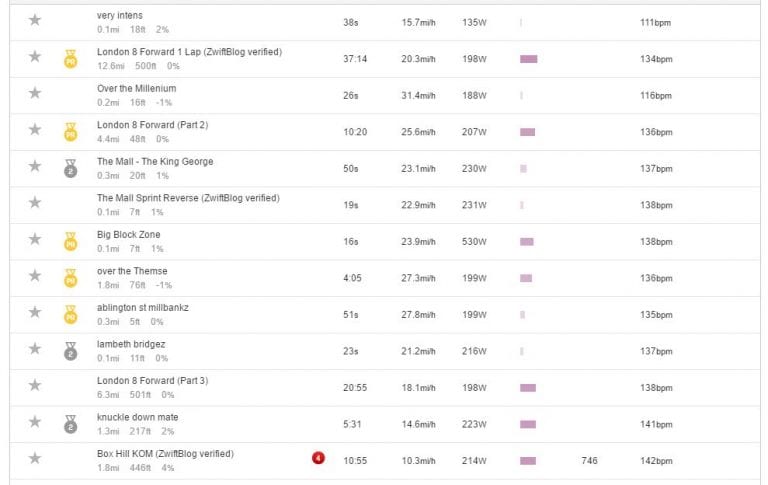
Hiding segments keeps your list neat and tidy, so you can view data on segments that make sense. I don’t care if I got a PR on a random .2 mile section of London titled “your mom smells like donuts”!
Show Real Achievments
Hiding segments reduces the number of achievements which show up for your ride, since achievements aren’t calculated for hidden segments. Make those cups mean something, people!
Do a Good Deed
Hiding a segment trains Strava to automatically hide that segment for others. Eventually, if enough people hide a segment, it will be automatically hidden for other users. Your segment hiding is a public service… nice work!
Simple Steps to Sequester Segments
Sign into strava.com on your computer (the Strava mobile app currently does not support hiding/unhiding segments)
Click on one of your rides to view segments
Mouse over the segment you want to hide, and “hide” will show up on the right. Click it–done!
Which Segments Should I Keep?
We may be a bit biased, but I recommend unhiding any segment labelled (Zwift Insider verified). These are logical segments based on precisely-measured Zwift routes, KOMs and sprints. If you “star” the segments in Strava this ensures they will remain on your list, and it also “trains” Strava to keep these segments visible for others.
Episode 20 of Zwiftcast has been released. Here’s the full episode description:
Thanks for making the last two episodes the most downloaded ever! And we’re back with more Zwiftchat and features.
Simon, Shane and Nathan kick off with a short discussion on whether too much Zwifting makes you rusty once you get back outside. Then it’s onto dissect the implications of the rider who slipped through a glitch in the matrix and made it onto the obviously unfinished London course extension.
The chaps briefly chat through the merits of the Volcano extension then move on to analyse an intriguing statement from the boss of Tacx, Simon Tacx, on their possible plans for a Smart Bike.
Is Zwift becoming less social as it grows? The trio are pretty much agreed that it is and wonder if the growth in teams on Zwift is the community’s way of countering the “big city” feels that Zwift can assume at times.
Damon McKay from Team TFC talks to Simon about the community benefits that team membership can bring.
Simon has the first of his features from his visit to the Tacx factory – and inevitably, given some of the early difficulties with the Flux trainers, there’s a big focus on the company’s QC processes.
Finally, veteran Zwifter Chad McNeeese explains his seemingly counter-intuitive decision to “downgrade” from a smart trainer to a dumb turbo – and offers hope to Zwifters who may feel shut out of the full experience if they can’t run to an expensive smart trainer.
The chaps finish off with a look ahead to upcoming highlights on the burgeoning ZwiftCommunityLive channel hosted by Nathan.
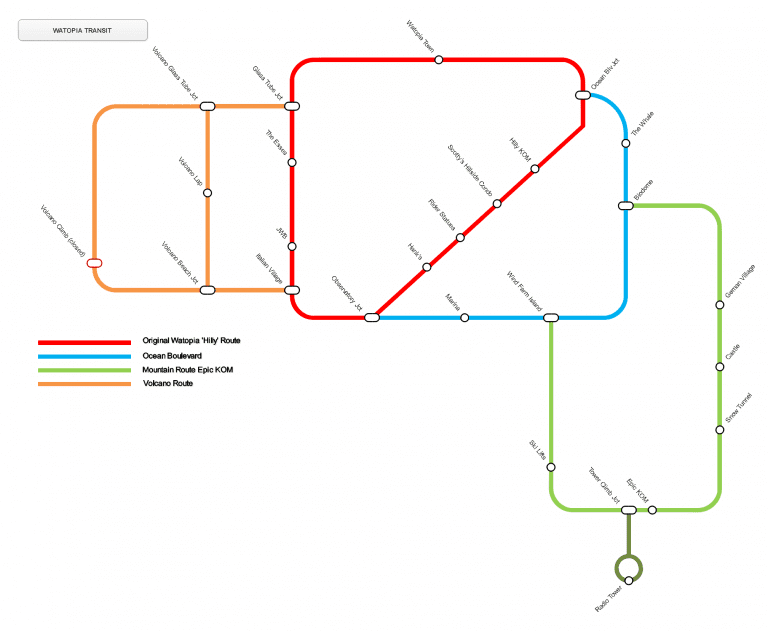
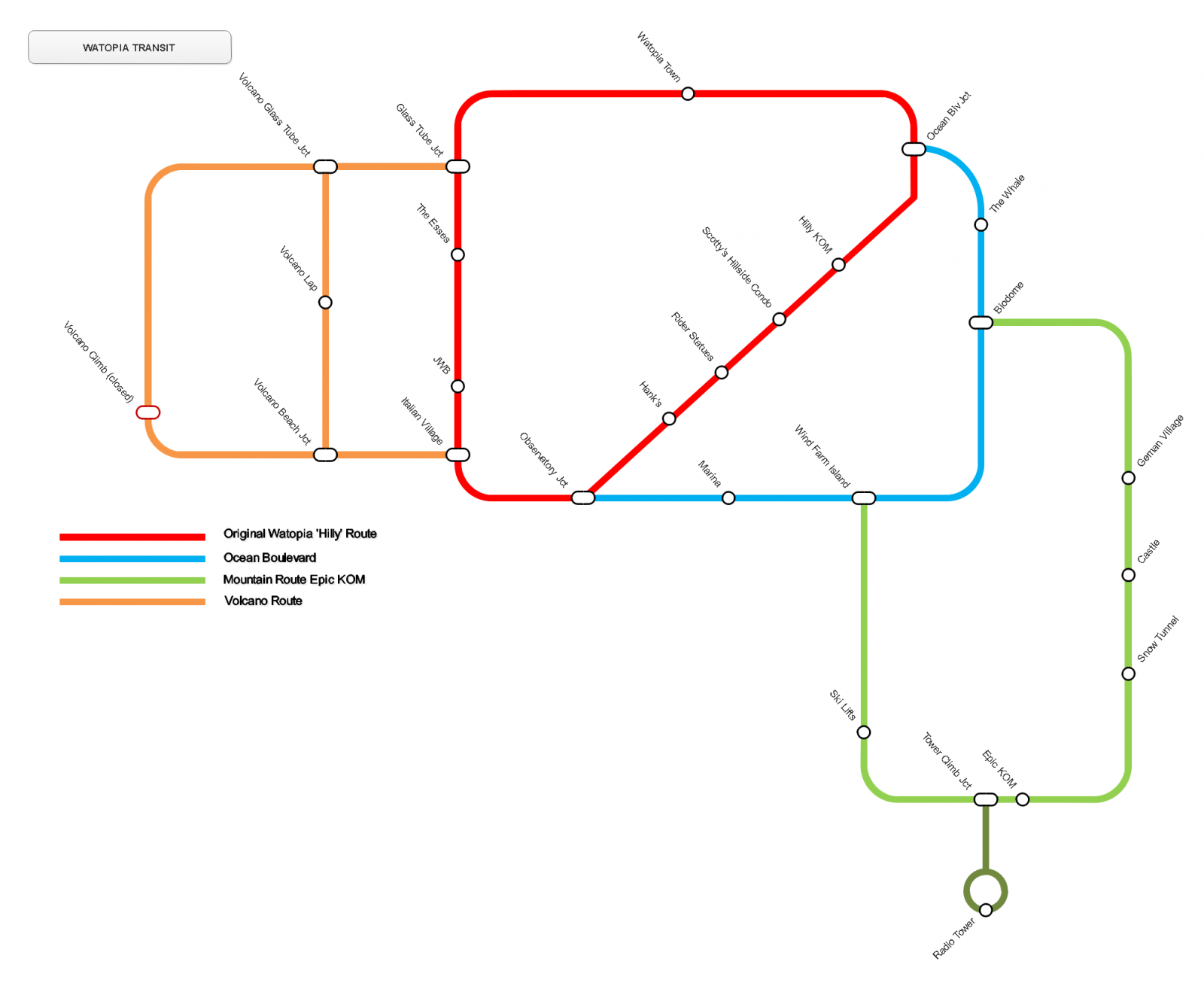
UK-based Zwifter Mark Hewitt has created a “tube map” version of Zwift Insider’s Watopia map which delivers a simplified view of the various routes and landmarks in Zwift’s virtual world. We’re sharing it here with his permission.
The map is based on the London Underground map which was first devised by Harry Beck in 1933. (This style of map may not be familiar to everyone, but they are quite common in Europe where transportation by train is common.) Nice work, Mark!
Coach Rob Manning is a racer, recreational rider, home bike mechanic, cycling coach, the owner of Tailwind Coaching, and host of the Tailwind Coaching Podcast. On top of that he’s Rob Manning, D.C.: a Chiropractic Physician with a degree in Exercise and Sport Science and Pharmacology.
It is clear that Rob has a deep, hands-on understanding of the complexities of human physiology. At the same time, he’s able to distill that knowledge down for his coaching clients so they can apply them in training and see real results. Read below to learn more about Rob’s experience and the philosophies used in his coaching.
Tell me about your cycling background. What sort of riding have you done, for how long, etc? I’ve been riding for more than 15 years and racing for about 10. I’ve ridden and raced mountain bikes, cyclocross, road races, criteriums, circuit races, stage races and track races. I’ve ridden gran fondos, centuries and everything in between.
When and why did you begin coaching? I started coaching in 2011 after getting poor results from a traditional USAC educated coach. With my background and training in exercise science and chiropractic medicine, I realized I could apply most of those principles to make a more efficient training plan to work better with my busy schedule.
Every coach has particular philosophies which define their methods. How would you describe yours? My methods are based on high intensity training, solid fundamentals and efficient use of your training time. I integrate cutting-edge scientific principles into my programs to give people a huge bang for their buck.
Do you use Zwift personally, and if so what for? I use Zwift all the time during the winter as my primary training mode, and during the summer when I need a short, highly effective workout.
How is Zwift a useful tool from a coach’s perspective? Zwift is an incredible tool from a coach’s perspective because allows me to build a workout for a client and know that they were guided in completing it. I also love it for the motivation it can provide an athlete and the ability to ride with my athletes around the world.
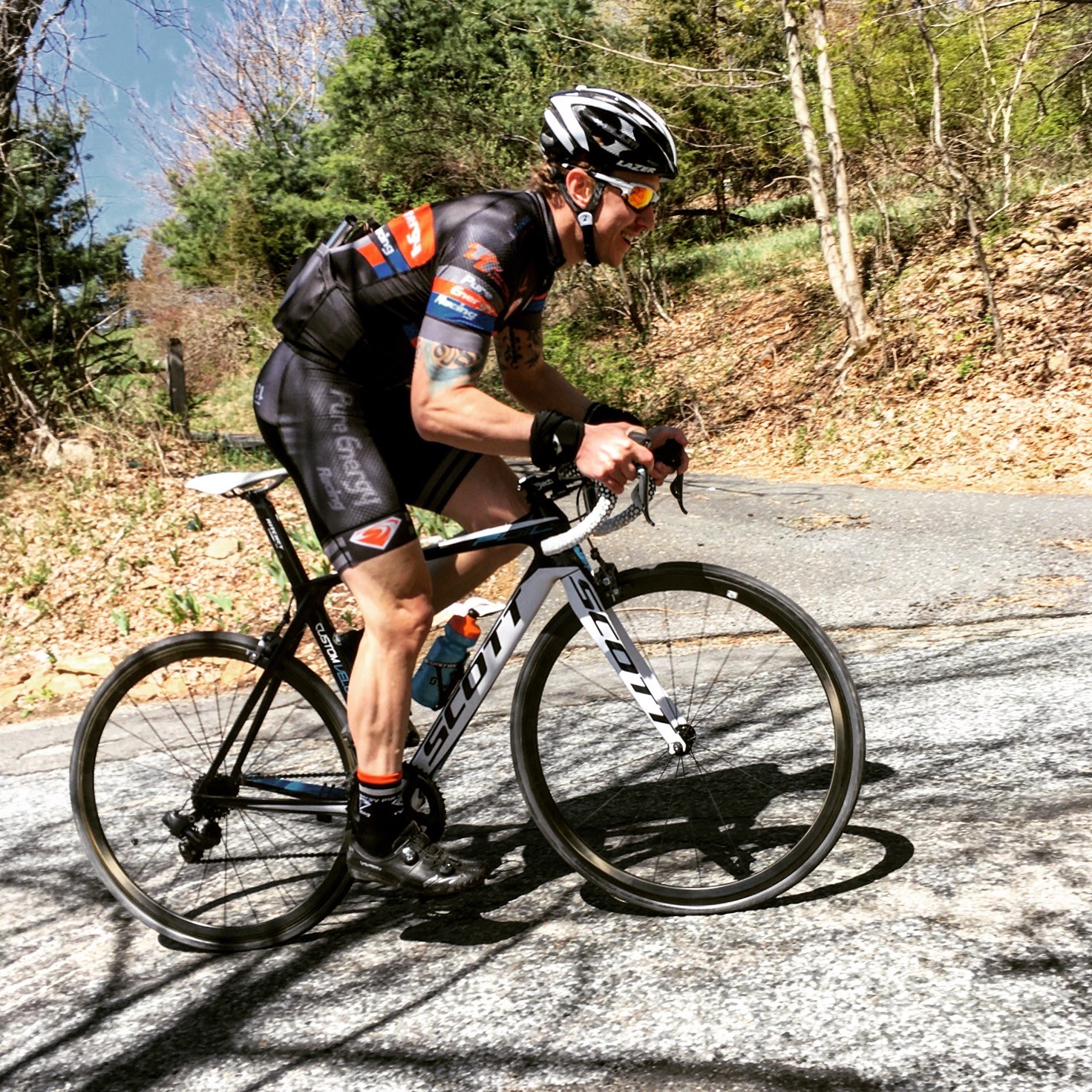
Rob hitting the climb
If you had just one piece of advice you could share with all Zwifters, what would it be? Zwift is so much more than just a way to ride with your friends. It has the potential to be one of the best training tools you’ll ever use! Get creative with your training and use every part of Zwift to improve your fitness.
Coach Rob’s Battenkill training plan took me to a 2nd place at Battenkill last year…hoping to take it one more step this year! Coach Rob’s podcasts and training plans are easy for me to relate to and just make common sense.
Listening to the Tailwind Coaching podcast helped me move my way up the peloton this season. The keys to effective training are thoroughly covered, and each podcast covers one or two specific topics in training, so it’s easy to find what interests you specifically. It’s a must listen if you’re serious about training to achieve your potential!
Due to various combinations of massive traffic increases, service provider problems, and much-needed code/database updates Zwift has experienced several planned and unplanned outages in the past few months.
Here’s a quick email conversation I had with Zwift CEO Eric Min about what Zwift is doing to reduce outage issues, and what the Zwift community can do to help.
Zwifters experienced a big “outage” on Tuesday, January 17 right as the KISS Europe/GCN Takeover race was starting at 8PM UTC. I know I personally wasn’t able to pull up the login form to even get into Zwift around that time, while others said they suddenly found themselves alone on course partway into the race, which had over 1100 participants. Can you tell me more about what caused the outage? We experienced massive delays accessing our database from our cloud service provider, which under normal circumstances would have been fine but Tue also happens to be our busiest day. We suspect our service provider was moving around storage at the worst possible time. The delays caused users to get queued up and in many cases timed out their sessions. This was just bad service timing but we are putting in measures (this week) to combat this scenario in the future.
I know you use Amazon cloud services for most or all of your computing/hosting architecture. Can you give us any more details about how that is set up, so people get a better understanding of what it takes to power something like Zwift? I can’t go into great detail about our Amazon services but our setup is nothing out of the ordinary. If you know AWS, it’s highly configurable and comes with its own set of headaches! But I will tell you that every aspect of our architecture can scale with more servers.
There have been a few outages in the last few months–a few unplanned, and a couple that were announced beforehand. What is your view of planned and unplanned outages? Are they bound to happen in an environment like Zwift, do you think they can be eliminated entirely, etc? No one likes unplanned outages! In the past, the planned outages were needed to update our database or because there is a risk of a service disruption but we’re quickly moving to an architecture that allows Zwift to be updated without the service ever being unavailable. This is our goal.
What is Zwift doing to try to reduce or eliminate unplanned outages in the future? We believe Zwift is already scalable. We’re now working to ensure that it’s also highly available. This is our current focus.
Zwift is a growing company, but still not huge in terms of its support team. When outages happen, what should Zwifters do to make sure the situation is being taken care of without overtaxing Zwift support? We’ll be pushing out a status.io page so everyone can go to one place to get the service status. The Zwift Riders administrators have been very supportive in managing the discussion threads when we do experience issues. This helps enormously to help streamline the information on Facebook.
Anything else you want to add? We are still a small company and while we may have recently raised investor capital, it takes time to grow the team but it is our second highest priority. While we all are excited about the new features on our roadmap, our immediate priority is to ensure that Zwift is always available.
This is a TOUGH workout, but perfect for the Base phase and for utilizing Zwift as it provides a great amount of training stress in a short amount of time. This workout is all about improving your FTP.
Workout Summary
We start with a gradual warm-up that includes a few fast spins to wake the legs up. Then, for the main set, we get into 3×3 minute VO2 efforts with decreasing rest periods to get the aerobic system pumping, and we finish with a long over/under interval at Sweet Spot wattages that feature cadence changes to really hammer the legs and hopefully push you to your limits, but not over! After all the fun is over, do an easy spin to cool down and finish with some stretches.
Get Training!
To use this custom workout file, click the link below and save the .zwo file to your computer’s /Documents/Zwift/Workouts directory. Now when you start up Zwift you will see this workout (called “FTP Booster (VO2 + SST) Base 2”) under the Custom Workouts category in the workout picker.
This workout is appropriate for all riders looking to improve their FTP, but should be done towards the middle to end of your Base phase as it is quite a challenge. I recommend doing workouts like this 2-3 times per week with an easier day between to allow the body to recover.
If you have years of training and/or are a very fit athlete, you may do this type of workout more frequently as your body will recover faster, however, always listen to what your body is telling you and take rest days as needed.
ZwiftHQ pushed out a small update last weekend for all platforms. According to Game Master Jon Mayfield:
It addresses an issue that could cause workouts to ‘freeze’ and enables support for having events go in the reverse direction. We’ll be cautiously rolling reverse events out so please let us know if you see anything out of the ordinary if you happen to participate in one.
The reverse events functionality is exciting, as this should make races feel much less “crowded” by other riders on course. Since Zwifters tend to ride in the forward direction by default, running races and group rides on reverse courses will reduce the number of non-participant riders who interfere with the rider group.
It should also reduce instances of Zwifters getting “swallowed” as they are passed by large group rides.
HIIT stands for High Intensity Interval Training and is a way for time-poor cyclists to get the most bang for their training buck.
Make no mistake though: these sessions aren’t easy, nothing worthwhile ever is… right? They hurt (repeatedly) and are only interspersed by periods of time trying to suck more air into the lungs!
It is perfectly possible to undertake this type of session alone: there are many options built into the fantastic Zwift training modules but, as I have said before, #sharethatpain – undertaking this type of session as part of a group will drive you further than you ever previously thought possible.
HIIT sessions use short periods of high intensity, anaerobic exercise followed by shortish periods of recovery. The length of a high intensity interval can range between 10 seconds and eight minutes. HIIT offers both aerobic and metabolic benefits, bringing about similar physiological adaptations to a more traditional endurance-based training program but without the necessary time commitment.
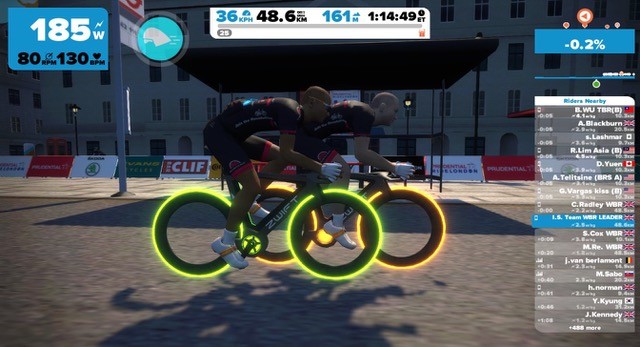
The key with HIIT is that the periods of intensity need to be above Functional Threshold Power whereas the periods of recovery should be around 50 – 60 per cent of FTP power (Team WBR Leaders always work hard to slow the herd and regroup between intervals). HIIT stimulates muscle and lung capacity. With real focus one hour of HIIT could produce a similar training effect as a two hour sweet-spot session. Interestingly for those monitoring their sessions via Training Peaks you will notice that the TSS may well be very similar however the former will have a significantly higher IF.
The inclusion of a HIIT training session in a weekly program is something that all riders should aim to do. Team WBR have many such sessions incorporating a range of exercises and intensities to suit riders of many different capabilities. Here are specific weekly WBR rides which include HIIT training:
The counter attack (Skillz and Drills – January 25)
Great races are often defined by a bold move by one of the participants. In many of the great cycling monuments, that move usually follows someone else’s “foolhardy” move. At the end of the day, the only difference is that one racer’s move was caught, and the other’s was not. More often than not, we, as racers, have only a little control over the success of our moves, so we should do our very best to ensure that the odds are in our favor as best as possible.
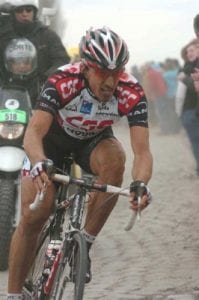
Cancellara on the cobbles
That, my friends, brings us to the lesson for today and the theme for the next couple of weeks, the counter attack. One of my favorite races to watch is Paris-Roubaix. Sure, I love watching guys fly off into the ditches on the cobble sections as much as anyone else, but it is such a tactical race. My favorite editions include wins by Stuart O’Grady, Tom Boonen, and Fabian Cancellara. They didn’t roll everyone in a sprint finish. For those not paying close attention, it is easy to say that they simply attacked off the front. That is simply untrue. They all won by successfully counterattacking at the most opportune time. We’ll get back to that in a minutes.
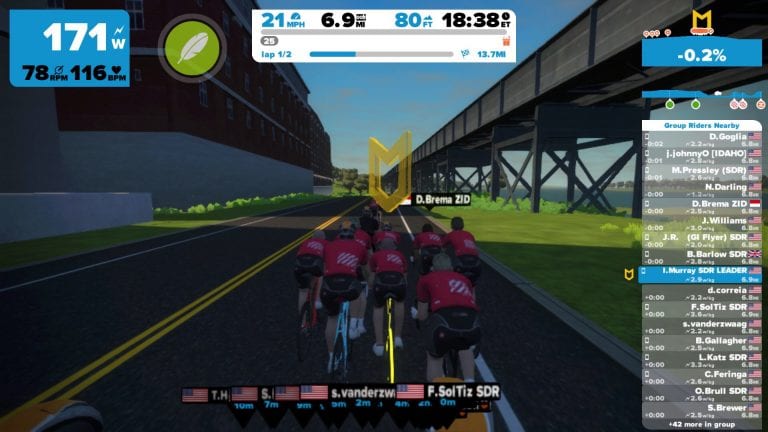
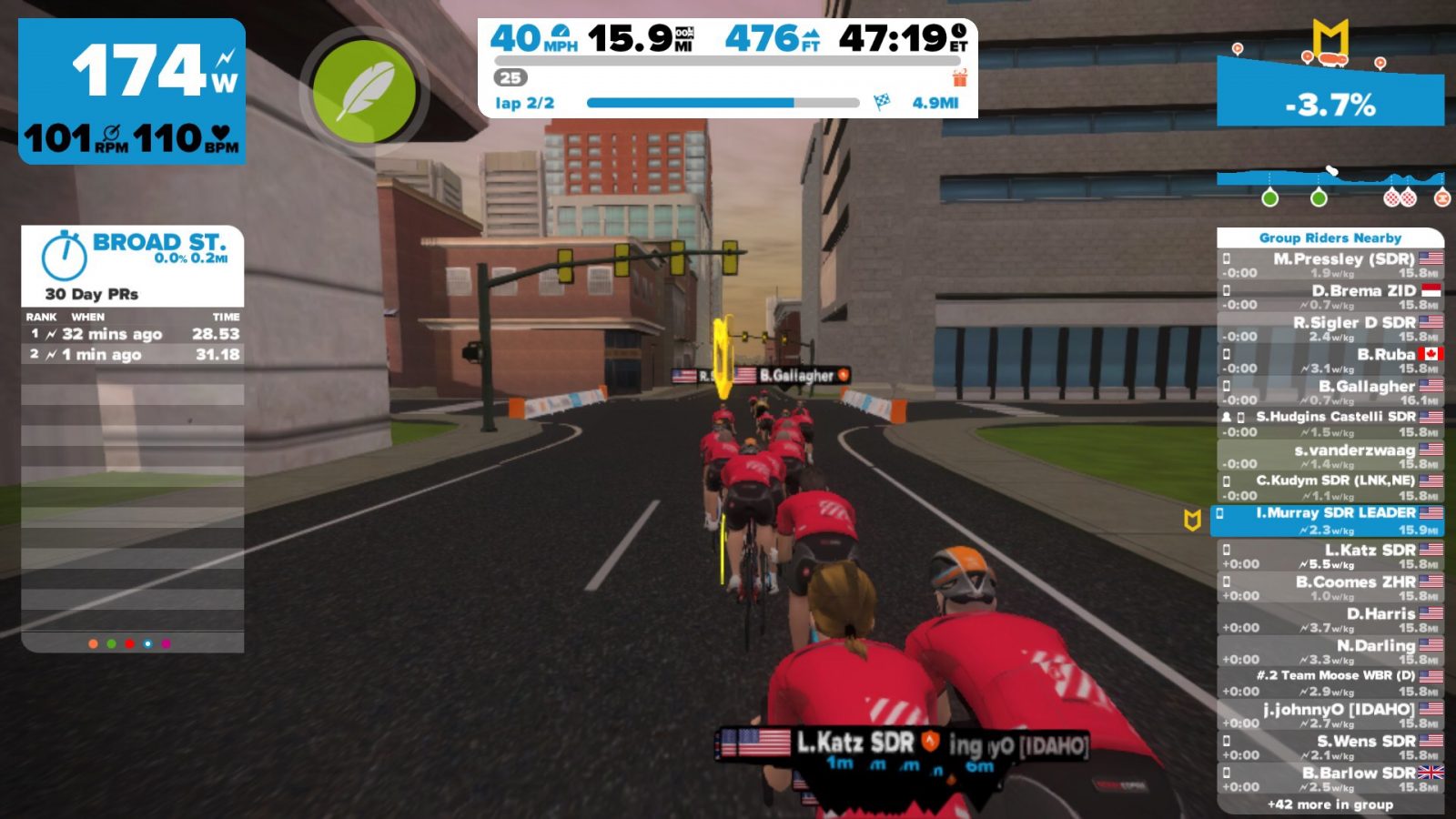
We had a pretty solid group today of around 60 people, all decked out in our stylish Castelli kits, and I have to say that I was pretty impressed with the way nobody bolted out of the starting pen. So, I have to give my thanks for that. Like normal, we departed at 1.5 W/kg out on the course of the day, which happened to be the Richmond UCI course. Over Discord (which if you are not on, you should be. Check out http://TeamODZ.com/discord for instructions), we went over the plan of the day and discussed the importance of working through the difficulties of maintaining your position in the peloton. We finished up our warm-up and group dynamics portion and got to the meat of the class.
Iteration One: Common Scenarios
The plan for today was simple. One rider would go off the front. Not very far or very hard, but enough to allow us to chase. I also placed a 3.0 W/kg threshold cap on everyone to prevent a few stronger riders from blowing up the group, limiting the participation of the riders with a lower power output. Additionally, I was able to use that cap to highlight the appropriate times to launch a counterattack. The first iteration was very straightforward. The solo attacker surged for 30 seconds off the front and then sat up to a 2.0 W/kg pace, simulating a fatigued rider. The group chased at a 2.5-2.7 W/kg pace, simulating a high-tempo chase but below a threshold effort. Just as we caught up to the attacker, I instructed the group to attack over the top of the “fatigued” rider. After attacking for just long enough to get a gap, we all sat up and regrouped.
This iteration simulated two separate types of race scenarios…
Scenario One
First, when a small group chases down a single attacker or other small group that has been away for a while, it is often advantageous to immediately dispatch the caught rider(s), preventing them from sitting on and recovering enough to attack you later in the race. Unless you really believe that you need additional riders in the group to stay away from the main field, it is better to get rid of them. Remember, those breakaway riders are not likely to contribute to the group due to fatigue (with the exception being that he/she sat up to join the group on purpose). Having extra passengers is not useful, especially if they are just recovering to beat you in a sprint finish. Only keep them around (assuming that you can drop them) if you believe that the rider(s) will contribute to the work.
Both Cancellara and Boonen perfected this tactic during their Spring Classic campaigns. As the field split up, they would use small groups, usually including one or more teammates to chase down the break of the day. Almost immediately upon making contact, they would unleash their fury and go nuts. The key was that they limited the amount of work they did during the chase and timed the counter to perfection. While there was no lull in the pace, the mentality of the chase group was one of a brief pause. This created the opportunity for riders who were clearly on top form and able to dig into the depths of pain to summon a tremendous surge.
Scenario Two
Channel your inner Cummings!
In the second scenario, catching a break often has a psychological effect on the bunch. If the chase has been long and hard, there may not be much desire to chase down another break right away, or there may be sufficient distance left in the race that the group is willing to let another break, perceived as possibly less dangerous, to get up the road. Either way, an immediate counterattack, done at above threshold level, may be sufficient to get a sizable gap for the main field to not chase right away. I am not going to lie, the second scenario is not very common and is very difficult to pull off. You will likely need teammates to disrupt the chase from the outset, or you better have done almost no work during the previous chase. If you want to pull scenario 2 off, you will need to channel your inner Steve Cummings from Dimension Data, as he is a prolific tail gunner with impeccable timing on his counters.
Iteration Two: The Lull
Iteration 2 focused on counterattacking at the “lull.” The lull often happens after a catch and is similar to scenario one in Iteration 1, but it is different. Watch any pro race where the break is caught with more than 15 to 20 kilometers to go. The peloton goes from being strung out or arrow shaped to being spread across the road. Sometimes, the entire peloton is content to take a breather and wait for the final fireworks. More often than not, the wiley opportunists take the chance to have a go and get some camera time. The key to the lull counterattack is to identify the lull as it begins, rather than waiting until the entire peloton is looking around. Once the pace has dropped and settled, you have lost the element of surprise, and your counterattack is likely doomed to fail. If you can identify the lull as it happens, you can jump the group while the pace is dropping, limiting the reaction time, and increasing the odds that the counterattack will result in success.
Our faithful attacker launched again on another 30-second surge before settling in to a 2.0 W/kg while the group chased at 2.5-2.7 W/kg. As the group closed on our attacker, he picked up the pace to just below that of the group, raising it to the group’s pace as the catch was made. I instructed the group to hold off on the counterattack until they identified our attacker’s lull. Since our group wouldn’t lull on its own, we used the attacker as the cue. Once our attacker dropped his pace, the counterattack was on. Recognition of the lull was a little slow, but I knew that we would have more practice later in the ride.
Iteration Three: Don’t Counterattack
Iteration 3 can be best described as the “Don’t Counterattack” counterattack. Basically, it can be summed up by two words: angry peloton. It’s pretty simple. If the group catches the break and keeps the pace high, e.g. near your limits, that’s a good sign that any counterattack is pointless, and you will be punished for your insolence. Seriously, I have seen it a number of times, and it never ends well. The group is completely strung out, and some idiot tries to counterattack, anticipating a lull. The rider will go off the front for a few seconds, as the entire matchbook gets lit and burned up quickly.
The futile attack is usually caught within a minute or two, and the attacker is subsequently spit out the back of the group, left to his/her own suffering for the remainder of the race and completely blown to bits.
To simulate this situation, we launched our attacker off of the front and began our chase. Similar to Iteration 2, the attacker stepped up the pace when the group closed in on him. As the group closed to within two seconds, the attacker picked the pace up to 2.8-3.2 W/kg. Remember, we had a cap of 3.0 W/kg, so nobody was able to launch a counterattack without significantly going over the limit.
We finished off the class with a few minutes of me going to the front to simulate an attacker just off the front of the bunch. I kept the tempo between 2.7-3.0 W/kg and instructed the group to counterattack when they felt/saw my pace dropping, creating an opportune time to do so. Each rider only attacked long enough to get a gap and then returned to the bunch to practice again. We rolled like that for a few minutes until we came to the big climb.
There, we had a little fun, lifting the pace for each third of the climb. At the top, we sent our attacker off the front one more time with the instructions to “implode” on the 23d Street climb. This last treat simulated the opportunities for a counterattack that happen on courses that end with punchy climbs, think Liege-Bastogne-Liege and Amstel Gold. Often, the original attacker is too fried to hold a hard effort up the steep climb because the matchbook got emptied trying to get away. Our group rode steady, but hard, into the climb and then hit the gas. Almost everyone was able to pull our attacker back and drop him. It hurt, but it was successful.
As we wrapped up, I tried to highlight the tactical importance of the counterattack. Too often, the counterattack is mislabeled as merely an attack. Tactical patience is a valuable skill that becomes all the more valuable when you do not have teammates around. It is not possible to cover every attack, so you have to pick moves that offer the greatest efficacy or chance of success.
On our next session, we will be covering the second part to the counterattack, and it is the part that sucks the most. It’s the actual effort. We covered this briefly a few weeks ago, but that focus was simply the attack. We’ll switch it up a little bit this class, and it’s going to be a little tougher of a class. Make sure you hydrate ahead of time and come a little warmed up. Until then, Ride On!
The “Watts up with Power?” ride is likely the slowest group ride you’ll find on Zwift, because it focuses on learning the basics of power based training while riding together on Zwift. Each ride is streamed live to Zwift LIVE on Facebook and focuses on teaching specific principles of power based training. Each teaching is made available for all to review afterwards.
Many people dig through the workout library in Zwift and see terms such as SST and VO2Max and have no idea what these terms mean, or why somebody would do an SST or VO2Max workout. This episode of Watts up with Power talks about the fundamentals behind each of the most commonly used power zones in workouts and explains why you would pick each particular style of workout.
Of particular note in this episode is a graphical illustration of why SST or “Sweet Spot Training” is called that, when many people who do the workouts think, “Oh boy, this is more like Sour Spot Training!”
This week’s lesson was based on Chapter 5 of “Training and Racing with a Power Meter” by Hunter Allen and Andrew Coggan, PhD, titled “Using Power for Optimal Workouts”

 Simple Steps to Sequester Segments