Home Blog Page 384

Haute Route Watopia – My Experience

46

Haute Route Watopia – My Experience

The Haute Route events have been described as the closest you get can to being a pro without actually, well… being a pro cyclist. Renowned as much for their top organization and experience as their difficulty, Haute Route events are the ultimate test for many amateur riders. The traditional events are usually held over 3 or 7 days, although for the bravest it is possible to undertake the Alps, Pyrenees, and Dolomite tours back to back for your own Grand Tour experience.

Like many cycling companies, Haute Route saw a valuable opportunity in pairing with Zwift to promote their product and unveiled the first virtual 3-day Haute Route event on the platform. True to the real-world events, there would be plenty of climbing and it would be no stroll in the park.

Prep

Launched to much fanfare back in February, the event had fallen off my radar until a few days before. As someone always keen to push myself I signed myself up to all three stages and began a few days of prep. Due to the lockdown, my fitness wasn’t a problem, so my preparation actually meant tapering for a few days beforehand. To give my legs a little test I undertook the Tour of Watopia Stage 5 Long Ride up the volcano on Thursday, the day before Haute Route Wataopia. I felt in good shape but as I went to bed I wondered if I had overdone it.

Stage 1

The stages were being run on Friday, Saturday, and Sunday, over three different routes and with multiple start times per day. I opted for the first event of the day at 8am Friday. This worked well with my normal routine and would give me the maximum rest time before stage 2 the following day. I joined the event as soon as I could, due to wanting to be near the front of the pier pens – with over 4,000 signed up I didn’t want to spend 5 minutes getting to the course!

I went into the event with fairly high expectations, as a B rider I have had some good results recently and according to my race ranking on ZwiftPower I was in the top 50 entrants. This was a fool’s metric, though! Most of those ranking points had come in shorter, flatter races where my 80kg of weight is less of an issue and raw watts at the finish can make a big difference. So, bearing this in mind, I set myself a target of finishing in the top 10%.
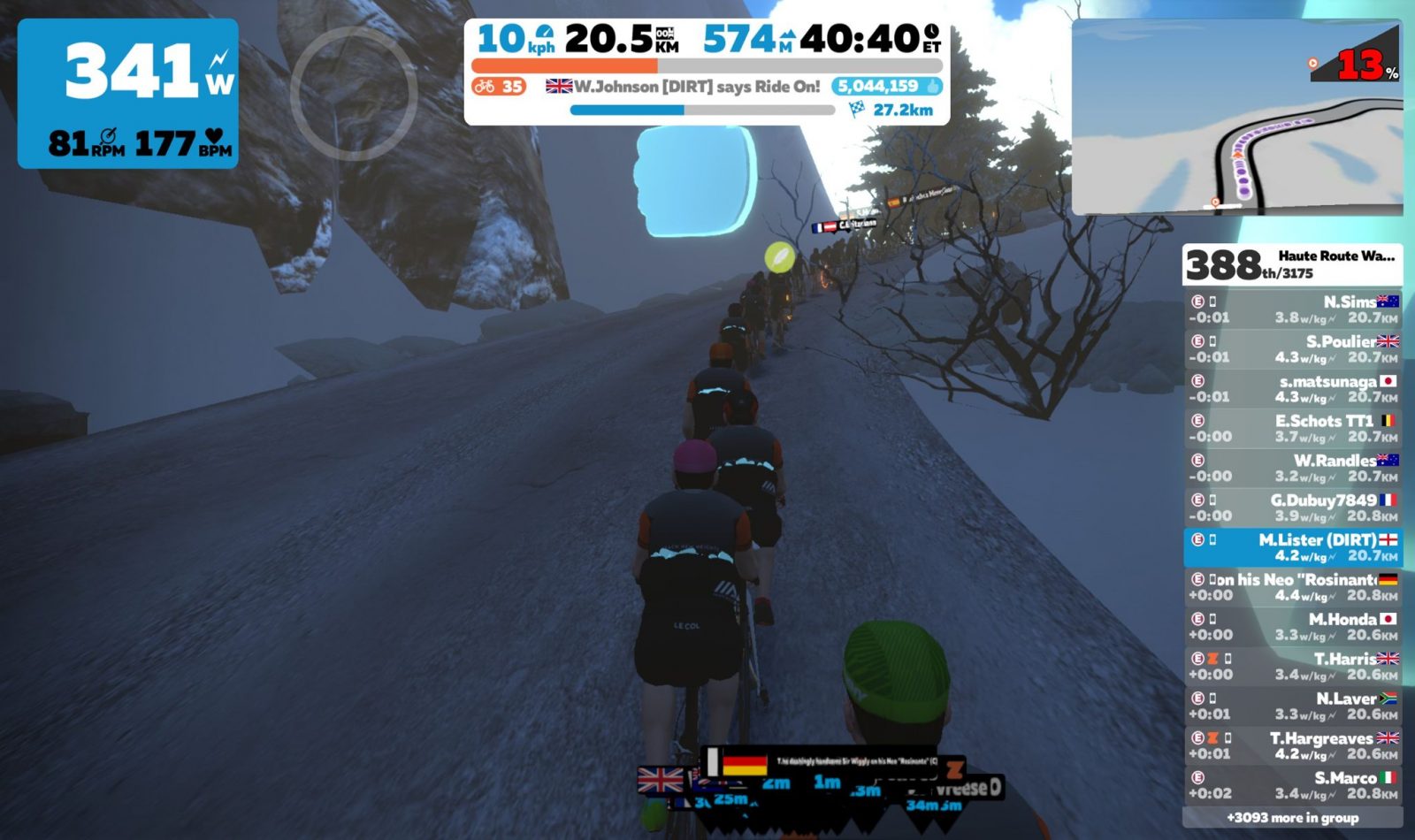
The Friday course was Three Sisters, a punchy 47.8km route over the original three Watopian climbs; the KOM, Epic KOM, and Volcano Climb for a total of 879m of climbing. As expected, the start was fast, frenetic, and straight up the KOM! No lead-in, just boom straight up. Sure, it’s just a little bump in the scheme of things but I didn’t want to ruin my legs in the first couple of clicks so I paced myself but made sure I stayed in a small bunch for the descent to the base of the Epic KOM.

I crossed the start of the climb in around 200th position but as the route ascended, my position descended, down to 400th and outside of the top 10%. Not feeling despondent I reminded myself this was a marathon, not a sprint and we were less than 20km into a 150km event. I also didn’t know how many of the riders around me were targeting all 3 days – as a free to enter, virtual ride there would no doubt be those just doing 1 or 2 of the stages due to other commitments so I reminded myself this was about my time at the end of the event, not my position on the day.

As I descended the Epic KOM, I made it into a nice blob which worked together to keep the speed high until we reached the volcano climb. Having completed the climb, the day before I knew this would be around 8 minutes of climbing. As we went up, I lost touch with my group. With one eye on the next two days this didn’t worry me. In hindsight, I could have been better positioned going into the climb and maybe pushed over the top with the group. This would have allowed me to be in a larger, quicker group for the final run-in to the line. As it happened, I finished 30 seconds back on this group with a final time of 1:19:00. This gave me a position of 239th out of 1,624 on Zwiftpower, not quite the top 10% but I expected this to whittle down over the weekend.

On a real Haute Route, riders are presented with access to top nutrition and massages after each stage but I had to settle for a protein shake and cookie and hope that would be enough to recover me for stage 2.

Stage 2

At 27.6km, stage 2 was shorter than the previous day but featured barely any descending and plenty of climbing, with a jaunt up Alpe du Zwift on the agenda. Like the previous day I got into the pen nice and early and then got swamped by riders speeding off as the lights turned green.

The ride to the foot of the climb was very fast, essentially one long train. I have only completed the Alpe twice before and knew there would be very little respite. Prior to the stage I checked out my average power from my PB – 284W – so as we started the climb, I set this as a target. (This might have been optimistic as I was concerned it might leave me fatigued for the final stage.) Regardless, I smashed out the first few sectors at around 320W. This soon caught up with me and I found myself in the middle third doing everything I could to keep each sector’s average above 284W.
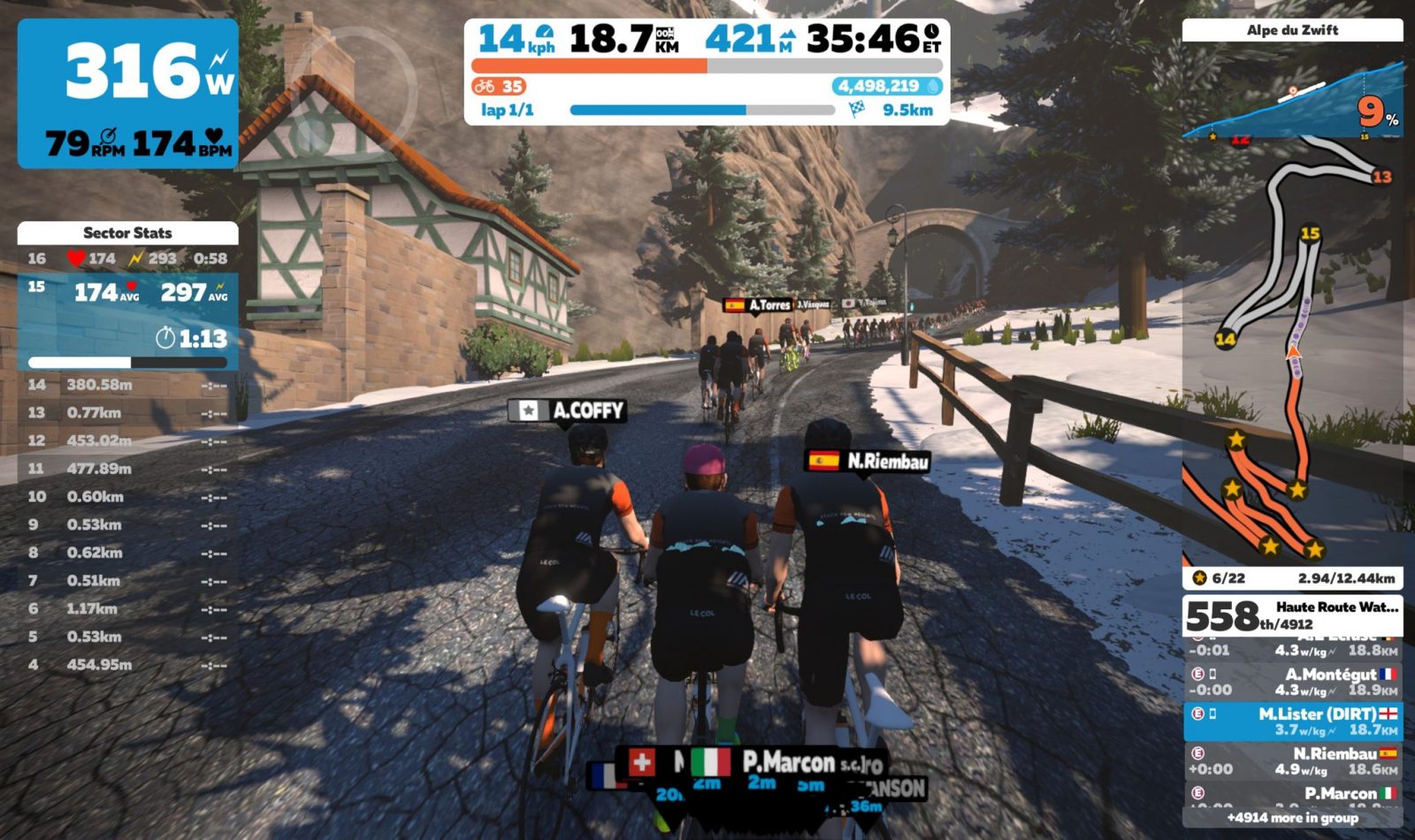
Once again, I was being passed by a stream of riders but I wasn’t racing them, I was racing myself and my time. As I neared the top, I realized that my earlier efforts meant I was on course for a PB and this buoyed my efforts, giving me the lift needed to push on for the last couple of kilometers, raising my output back up to the 300W mark.

I crossed the line in 1:15:39 for the stage but more importantly I had taken 3 minutes of my Alpe PB. I was cautious though: was this just down to the draft from all the riders on the course? Later inspection showed that my power was 14W high for this effort so it was a genuine improvement.

As I rolled back down the 10minute descent, my thoughts turned to Stage 3. At 73km, this was as long as the first two days combined and featured the Epic KOM in both directions. I had my usual protein shake and cookie before fully intending to put my feet up and rest my legs all day. Unfortunately, my wife remembered my promise to mow the lawn and assist with the garden, not what my legs needed!

Stage 3

The final day filled me with a few nerves as I got set up for the 2pm ride. I plumped for a slightly later ride, giving my legs just a few extra hours of rest – my version of marginal gains. I’ve not ridden the Pretzel before but looking at the profile I estimated it would be a 2-2:15 ride, so filled up two water bottles plus a backup pint glass and placed them with some snacks on the workbench next to me.

Whether it was adrenaline, excitement, or stupidity I set off at speed making the most of the draft and raced towards the foot of the Epic KOM. Having completed the climb a couple of days earlier, I expected this to take around 23-24 minutes and for my early position to drop like a stone. To my surprise I managed to hold steady! Perhaps there was a general feeling of fatigue in the pack or I suspect those who had gone all out on day one hadn’t lasted the distance. Regardless, this was once again a race against myself and I felt good, powered up the climb and knocked almost a minute off my PB.
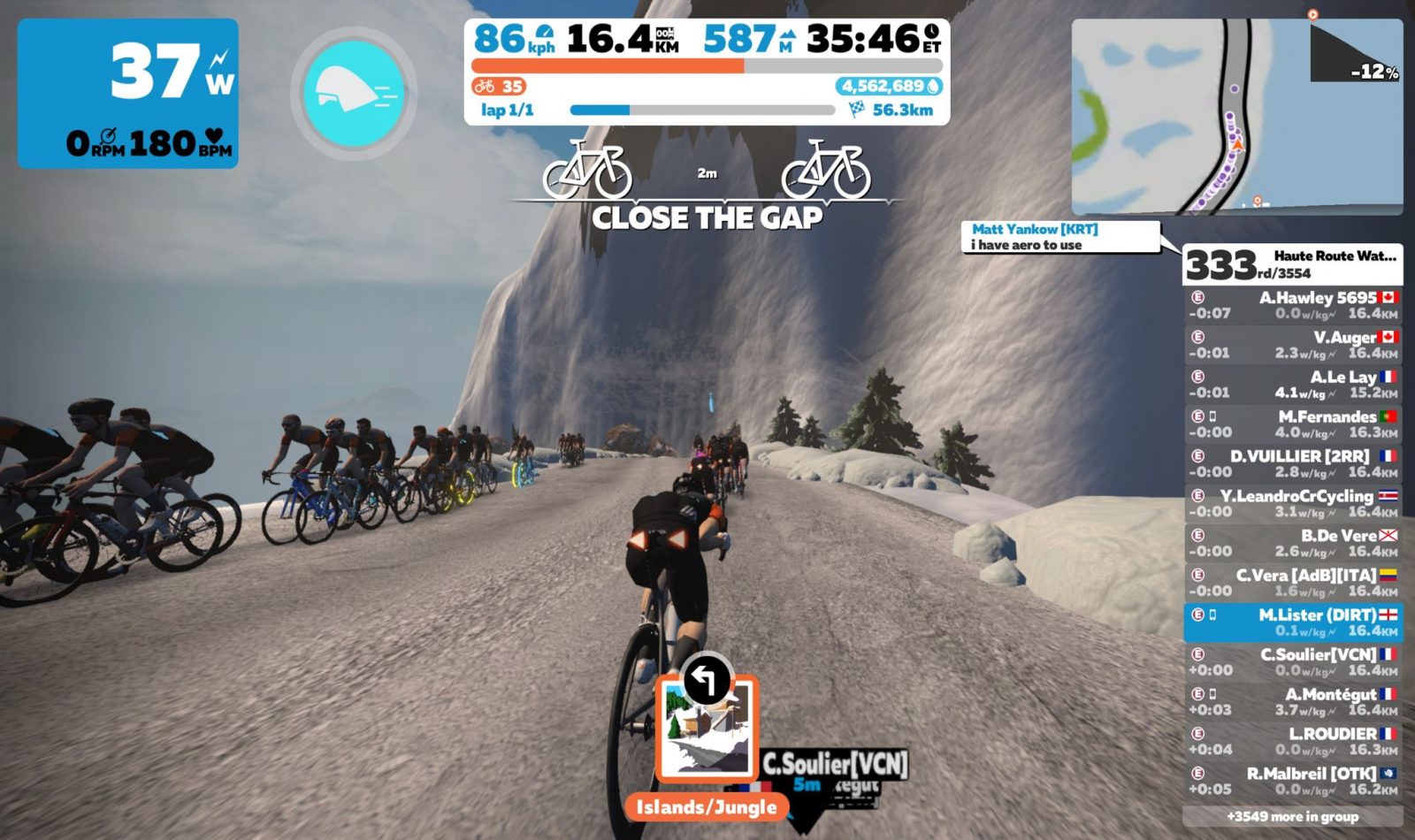
Had I just blown it? Am I going to regret this very soon? Time would tell. First I had to get back down the mountain. After learning from the first stage I pushed hard to catch a decent-sized blob which I knew would make good time around the main island and two ascents of the original KOM.

Initially, I found a nice rhythm but after an hour of riding I started to struggle and as we made our way down the switchbacks on the approach to the Epic KOM reverse I was not feeling good. I attacked my snacks, some Haribo and several digestive biscuits. I was not looking forward to the next 45-60 minutes and felt like I had blown it, angry at myself for attacking too hard early on.

The first switchbacks up to the bridge were a struggle. My power was around 250W – respectable, but below the 300W marker I set myself for the climbs. But by the time I had crossed the bridge, the biscuits had started to work their magic! My legs awoke and I found the missing watts and pushed myself on. A quick water refill from the team car (aka wife) kept me going and despite my slow start I bagged another personal best.

Secretly I had hoped for sub 2 hours for this ride and that target was on a knife-edge right know. I can’t remember the exact numbers but I had around 16km to ride and 19 minutes to do it. It was time to find some eager riders and blob up. We started well, the descent giving us a fantastic speed boost and the riders around me got on board with the idea of sub-2. Time and distance checks were announced, this was going well but it was all downhill!

Soon we were on the flats and the switchbacks. The slight incline felt like the Alpe again but we pushed on – this was going to be touch and go. The kilometers ticked down, I nearly lost contact on the cobbles in the Italian village – mentally I hate those cobbles but amazing through it all we stayed together. One final climb out from the sprint bridge and through the Esses before the descent to the line. Unlike Stage 1, the finish was at the banner but those extra 250m didn’t matter as we crossed the line with 19 seconds to spare. A fantastic effort from Team Sub-2 as we had named ourselves.

Closing Thoughts

What a great three days of racing this was. Highs and lows, determination, stubbornness, and personal bests. In the end, I finished 895th out of 7,506 finishers. A little outside my top 10% target but as I discovered on the Alpe this wasn’t really about everyone else, it was about me. With personal bests on the three biggest climbs in Watopia I had plenty to be happy about.

A few days later my legs were still feeling the effort I had put in, and I was still feeling pleased with my performance. There were lots of positives to take-away and where there were a few issues Zwift acted quickly to address them, including staggered starts and more start times. It would have been nice to see the results broken down by category so I could see how I did against other Cat B’s but that’s my only real (small) complaint. (I’m sure there will be more multi-day events, so hopefully this is something that could be included in the future.) All in all, a great event that pushed me mentally and physically.

What About You?

Did you complete the Haute Route series? Share your experience below!

How to Get Over 40XP Per Mile On Zwift

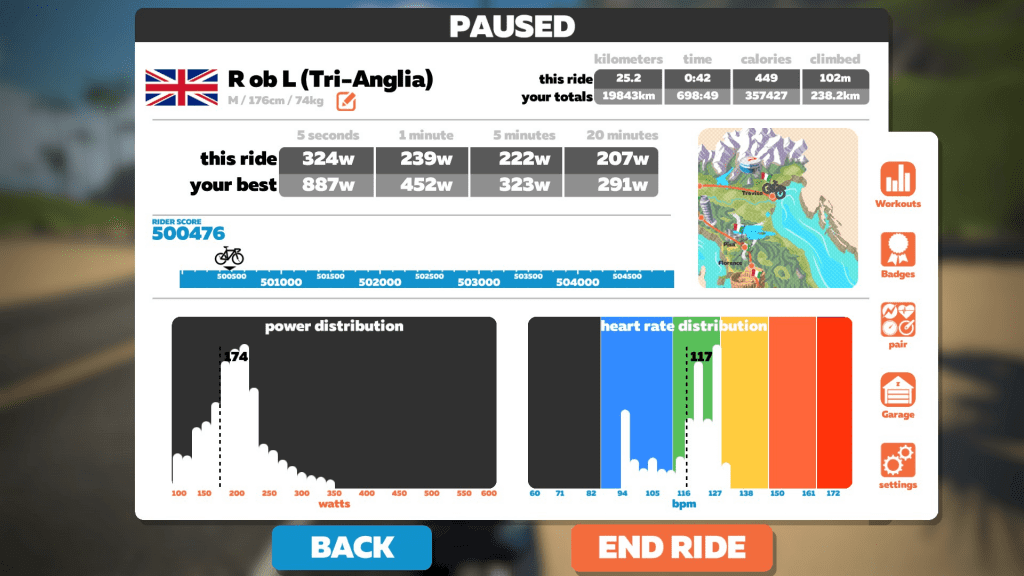
We all know that a mile in Zwift is worth 30XP and a kilometer is worth 20XP. So how did I reach Level 50 with less than 20,000km of riding?

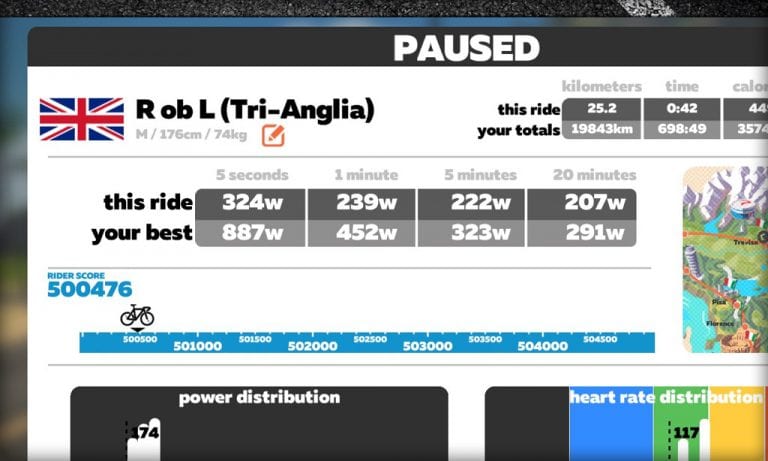
With 500,000XP being needed to reach level 50, surely one needs to ride 25,000km at 20XP per km or 16,667 miles (26,816km). Or do they? I’m Zwifting proof that it’s entirely possible to reach 500,476 XP with 19,843km of riding. That’s 25.22 XP/km (40.58 XP/mile)!

A good number of approaches to gaining extra XP are covered in 8 Ways to Earn more XP and Level Up Faster on Zwift. And the screenshot above, like a good weight-watchers case study, proves it.

So, what tips does someone who has gained 25% extra XP over 20,000km give?

  • Put yourself into km rather than miles (you’ll get 7.3% more XP this way).
  • Get gamified and go seek achievement badges. Throw a U-turn, do a workout, be a fan, watch people and complete a workout are pretty easy ways to get a little XP bonus.
  • Tour the courses and get the route achievements. You pretty much get double XP for the first time you ride a route. Ensure you select it as you start up Zwift and keep riding until you get the success banner!
  • Look for events giving double XP (they are very rare). The 2020 Tour of Watopia was a prime example of this, giving 40XP per km rather than the normal 20XP. If you get a route achievement on one these stages, that’s as good as triple XP.
  • Ride the Alpe. Ride it a lot. Yes, it’s slow XP on the way up, but the XP on the way down is pretty easy. 13km 260XP in 10 minutes. Plus, there is an XP bonus at the top once you have the gloves or don’t get the wheels.
  • Ride a time trial bike – you’ll get XP bonuses through each arch instead of powerups.
  • Get into a pack in a group ride. Ok. It doesn’t earn any extra XP per km, but you will cover more distance within a set time if you’re traveling faster thanks to the increased draft.
  • Do some workouts. Feel free to craft your own if you want, but you do get more than 20XP per km.

But the biggest keys to gaining XP are to ride your bike, have fun and be social in the Zwift community.

Think it’s going to be a quick trip to Level 50? Whilst it’s proven possible to gain 25% extra XP over 20,000km, it will still take you ~700 hours to do so. Enjoy. Ride On!

What About You?

Have you managed to reach level 50 with less than 20,000km of riding? Share your experience and tips below!

5 Zwift Events Not To Miss This Weekend

28

5 Zwift Events Not To Miss This Weekend

With more big events than ever happening in our virtual cycling paradise, it’s easy to miss some really cool rides! Here are 5 events this weekend which we think are especially important to share with the community.

If you find this post useful, please comment below. We may make it a weekly habit if there’s enough interest.

See you on course!

Michael Knudsen’s 1000km in 24 Hours Attempt

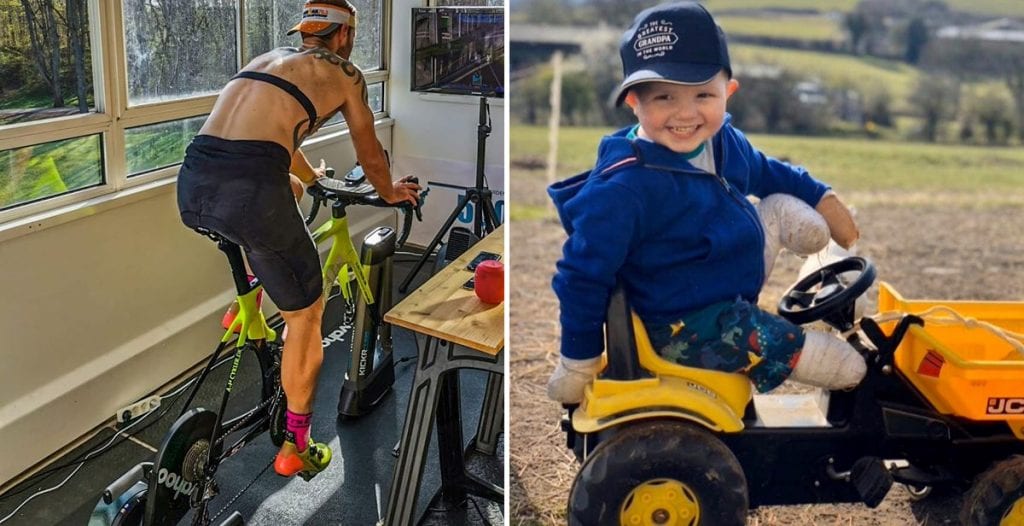
You may remember Michael from his crazy 5000km ride on Zwift back in November 2019. Now he’s taking on a new Zwift ultra-endurance challenge, for a great cause:

I will attempt to smash the 1000 km mark in 24 hours next Saturday and fundraise some money for fellow zwifter, Phil Reckless’ nephew on 3 years, William who earlier this year suffered from a sepsis shock and had both legs and multiple fingers amputated The little hero is exactly same age as my son so it hit me a little hard.

I’ll start out at 0830 with a 200 km group ride and then free ride the rest. I’m gonna need the Zwift community to rally behind again like they did for the 5000 km indoor RAAM project in the mall to keep my average on + 42 kmh.

Join Michael when you hop on to ride (follow him in the Companion app, then click to join him). Let him benefit from your draft as he tries to ride 1000 km in 24 hours! His attempt begins at 8:30am his time (Copenhagen, Denmark), which is 6:30am GTM Saturday, 2:30am ET Saturday, 11:30pm PT Friday.

Want to donate to help William? Here’s the fundraiser link.

Hells 500 World Lycra Party

Hells 500, the keepers of the Everesting and vEveresting rules and hall of fame, are holding a “World Lycra Party” on Zwift Apr 10 at 12:30 AM – Apr 13 at 11:30 PM UTC+10. They’re trying to stake a claim on a new vEveresting world record (most vEverestings) and you can be a part of it!

Learn more at facebook.com/events/3100332533320261

Ride with Some Pros

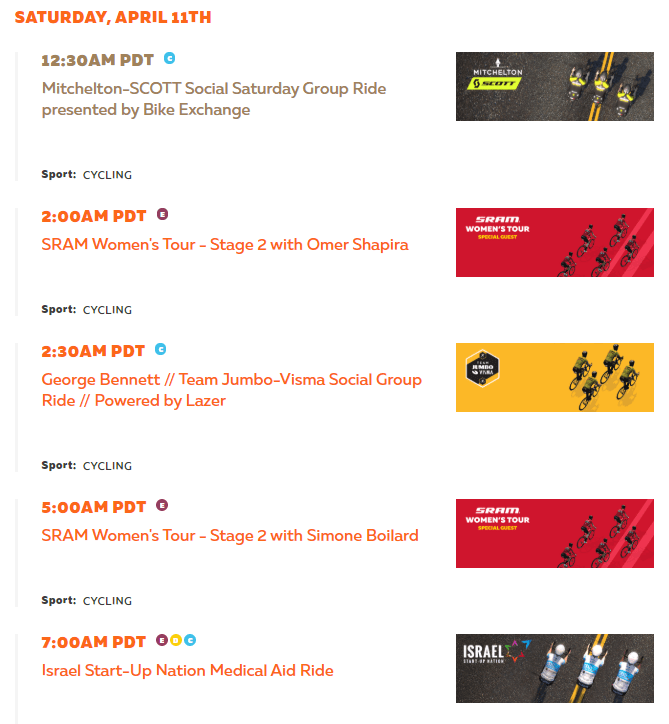
There are 12 accounts on the calendar this weekend with the #ridewithpro tag. Want to ride with some top of the top men and women in the cycling world? Hop into one of these rides! See full #ridewithpro ride list >

The most popular #ridewithpro events this weekend are with Team INEOS, who are hosting their first major team event on Zwift! Three different group rides scheduled for Sunday, with almost 9,000 riders already signed up!

Watch INEOS Race the Alpe

Speaking of INEOS, we’ll get the chance to see the team’s riders go head-to-head as they aim to win the inaugural Team INEOS eRace at 5pm BST on Sunday. The riders will duke it out on Alpe du Zwift and Eurosport’s Rob Hatch and Matt Stephens will guide you through the action, with exclusive rider interviews throughout the live broadcast.

Watch it here:

Jan Frodeno Tri At Home 180km

Jan Frodeno is the current Ironman World Champion and course record holder, an Olympic gold medalist, and a 2-time 70.3 World Champion. Join him Saturday as he completes the second leg of his home challenge to swim 3.8km, ride 180km and run 42km. He’ll be riding between 3-3.5 wkg for the full distance and he is looking for some company on his long day.

Throughout the day Jan will be fundraising for the fight against Coronavirus. You can follow along by tuning in to his live stream on his Facebook page.

Learn more at zwift.com/events/view/532546

Found this Useful?

Comment below if you’d like to see a sort of “events not to miss” post before every weekend. If even people find it useful, perhaps we’ll make it a habit!


Couch to Route Hero, Week 11 (+1) Done

Couch to Route Hero, Week 11 (+1) Done

Editor’s note: Monica has undertaken the “Couch to Route Hero” challenge of riding all 67 “free-ridable” Zwift routes (and getting all the badges) in 11 weeks. Each week she shares her story of the previous week’s struggles and accomplishments. Follow along on her journey, take the challenge yourself, and be sure to give her a Ride On if you see her on course!


This week was a bit of a let down mentally. I don’t know if it’s the Shelter-in-Place orders getting to me (we’re on day 20-something), or the fact that the challenge was already supposed to be done but isn’t. Either way, it was a blah sort of week, to be sure.

The Week Lined Up

I rode three routes this week, making my badge total 64. So close! I rode 62.9 miles with 5,413 ft of climb in 5 hours and 6 minutes.

Routes Completed:

How the Week Played Out

After the high of finishing London’s PRL Full last week I really had no interest in riding my bike ever again. This is how it’s been every time I do some amazing feat on my bike. “Okay, I’ve done a lot. Now I’m done!” I couldn’t stand the thought of not having anything to write to you all though so I forced myself to ride one route on Tuesday and two routes on Saturday. 

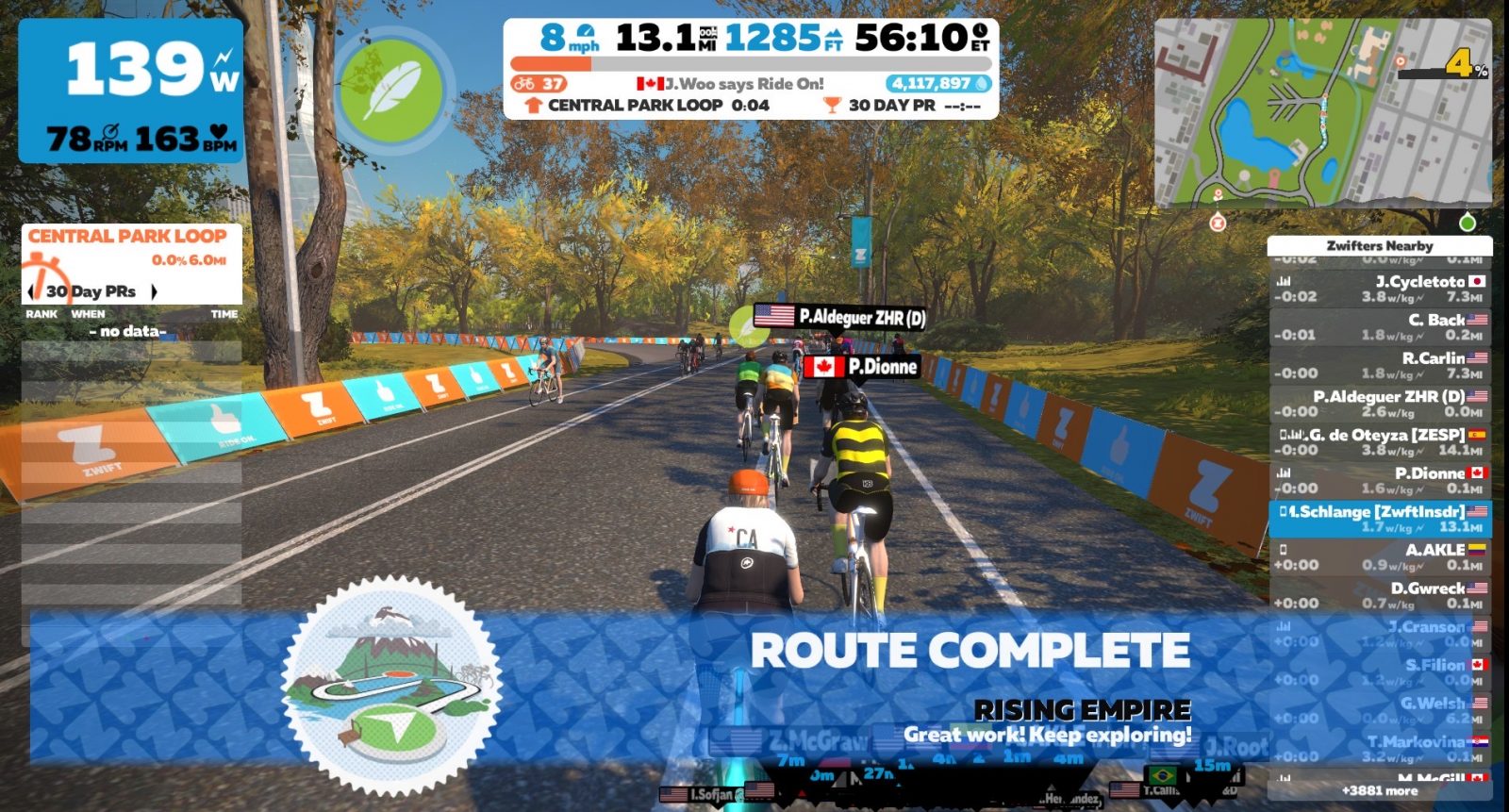
Rising Empire

It felt great to ride this at my full capacity. I pushed myself up the climbs and sailed through the flats. And it’s funny, because now that I’ve done much bigger things it wasn’t so daunting to go up both sides of the KOM in New York. 

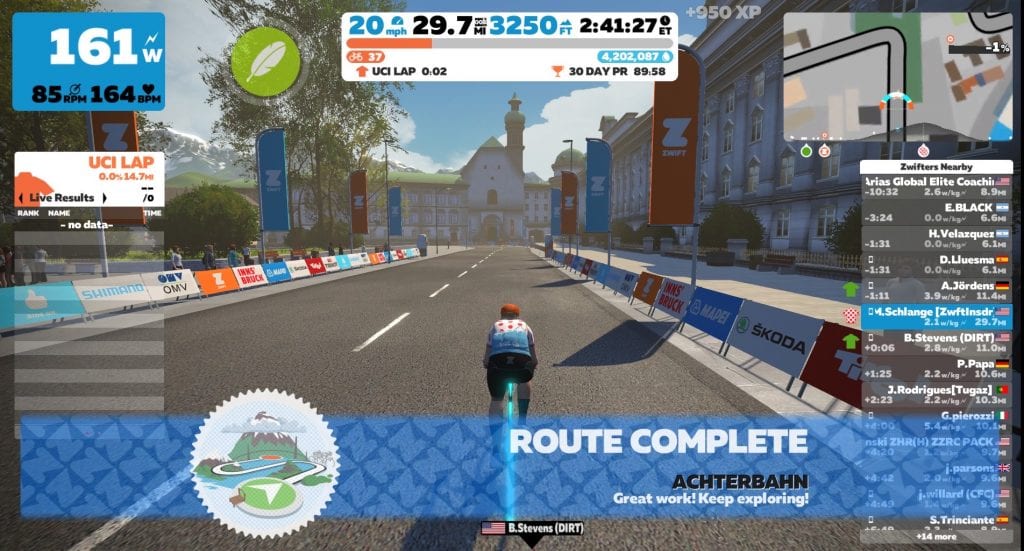
Achterbahn

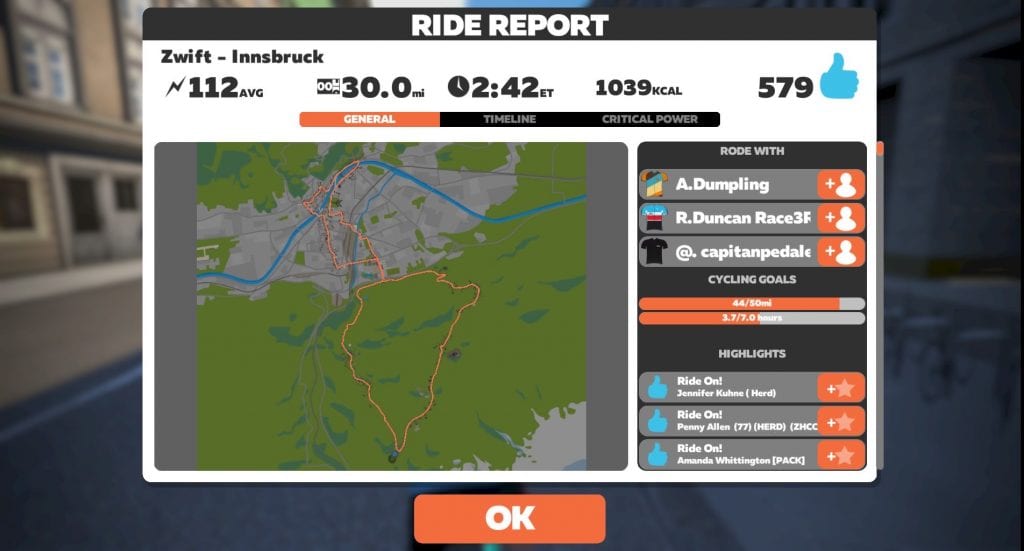
For the first time in this challenge, I had to do the world hack to get a route done. This was pretty much inevitable, even though I had carefully planned out each day before the real world stopped. There just aren’t a lot of days where Innsbruck is available, even now with the choice of 2 guest worlds

The downside to a world hack is not having a lot of company out there. At the beginning of my ride there were only 34 of us in Innsbruck. I’ve realized more and more that these routes go by so much faster when others are riding… even if they’re not riding specifically with me! So, if you can do an Innsbruck route while it’s on the calendar, do it. It may be far more interesting! 

Figure 8 Reverse 

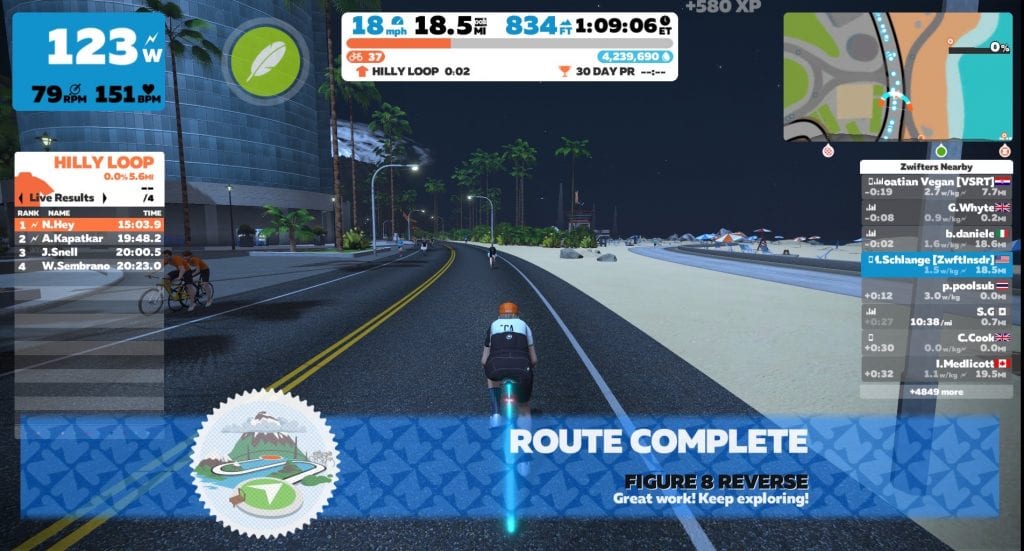
I didn’t want too many rides looming over my head on my last week so decided to do a second ride after Achterbahn and some lunch. Someone told me later that it was amazing I did two rides in one day. It didn’t seem like some amazing thing at first but then I thought about this journey I’ve been on. Monica on week 3 would have been hard pressed to do a 4 bidon and a 2 bidon on the same day. But Monica on week 11+1 isn’t the same gal! A 4 and a 2 ain’t no thang! And gosh, am I proud of that! 

Next week

I have three routes left! Watopia’s Out & Back Again, Innsbruck’s Lutscher CCW, and Watopia’s Road to Ruins. Let’s be real: your girl here, the one who did the Uber Pretzel is NOT looking forward to Lutscher CCW and doing that KOM Reverse climb twice. Haha. Silliness. I’ve done much more difficult things!

Another Open Invitation

I invite you all to join me after this whole Route Badge Quest is done to get another badge: the “On Fire.” Check out the April 25th event info here!

How About You?

What routes did you do this week? And if you’ve ridden Lutscher CCW do you have any tips?


Strava Announces Major Changes to Virtual Segments

109

Strava Announces Major Changes to Virtual Segments

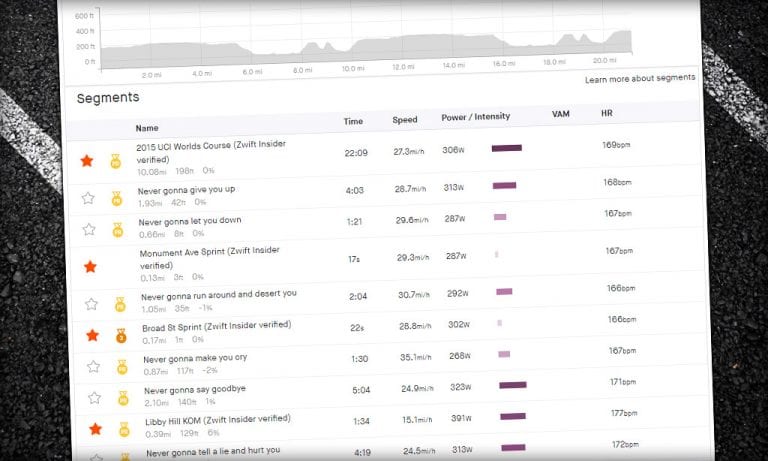
In a support post this morning, Strava announced big changes that will drastically reduce the number of segments showing on Zwift activities. Here is how Strava summarized the changes:

  • The least popular virtual ride segments have been made private, but none have been deleted. Any segments you’ve created can be found on the Strava website by selecting Dashboard > My Segments > Created Segments.
  • Any newly created virtual segments will be private.

In Strava’s words, these changes should “… remove clutter and noise so athletes can experience the segments that matter the most.” Let’s dig into this a bit more…

Some Background

Virtual segments, and specifically Zwift virtual segments, have been putting a strain on Strava’s systems for years. Strava was designed with real-world segment traffic in mind, and that is very different from the sort of traffic Zwift brings. In the real world, riders are spread out and so are the segments. On Zwift, riders are concentrated into small areas, with tens (hundreds!) of thousands riding each day.

This strain has become clear in recent months, when we haven’t been able to create Zwift Insider verified segments for routes of any substantial length due to Strava timing out in the “Check for Duplicates” step of its segment creation workflow. It appears there are simply too many public segments for Strava to compare against.

Additionally, the sheer the number of Strava segments for Zwift courses is just silly. And Strava’s automated systems for choosing which segments to display or hide have never worked well on Zwift.

New Segments=Private Segments

With this change, all newly-created virtual segments will be private, meaning only the creator can see the segment.

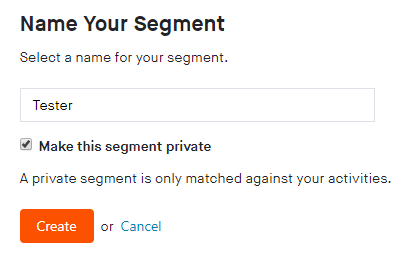
Note: at the time of this post, this change doesn’t appear to be fully implemented. There was still a checkbox in the segment creator tool to “Make this segment private”.

Existing Segments Made Private

Strava says “The least popular virtual ride segments have been made private”. They aren’t disclosing just how many segments were switched to private with this change, but from what I’m hearing it’s a “significant portion of existing segments.” When I asked Strava what sort of “signals” they are using to decide which segments stay public and which ones are switched to private, they said:

We’re reviewing segments based on engagement post-activity upload and understanding whether athletes look at the segment analysis and leaderboards. Segments with lowest engagement are made private.

Sounds sensible to me. Odd that they didn’t mention whether or not people have starred a segment, but my guess is this is included in their engagement metrics as well.

Private segments are only visible to a segment’s creator, meaning they aren’t matched against the activities of other riders. So switching many public segments to private means two good things: less processing required in terms of segment matching for Strava, and fewer segments showing up in activities.

Of course, Zwifters can still see their own results on any segments they’ve created on their ride activity details page.

What About Zwift Insider Verified Segments?

Strava and ZwiftHQ reached out to me at Zwift Insider with news about this change, because they recognize that our large set of “Zwift Insider verified” Strava segments are important to the community and should be kept public. I was grateful for that! So it sounds like our segments will be kept public.

In the short-term, creating new Zwift Insider verified segments will require an extra step or two of reaching out to Strava to get the segment made public. But I can deal with that.

What About My Segments?

In my chats with Zwift, it is clear they are well aware that the community has created many bespoke segments that are used to track various events. It is unclear how many (if any) of these segments will be switched to private, but hopefully between Strava’s automated triggers and Zwift’s communication with Strava the useful community segments will stay public.

When I asked Strava what the process was for “forcing” a segment to be public, they said:

…if the Zwift team recognizes a segment as important or significant and lets Strava know, then Strava will make it public.

Wrapping It Up

A few weeks ago, Strava rolled out new algorithms to catch impossible efforts upon uploads. They say today’s change is the next step in “making the segment experience better for athletes”. I agree!

As I said over 3 years ago, “I don’t care if I got a PR on a random .2 mile section of London titled ‘your mom smells like donuts’! Reducing the clutter will make it much easier for athletes to track their progress on segments they actually care about.

My only concern is that useful, community-created segments will remain public. I’m sure we’ll hear from the Zwift community if that doesn’t happen, but I’m hoping Strava has implemented the auto-privatization of existing segments so it’s all quite painless.

What Do You Think?

Does this change seem like a good one? What are your thoughts? Share below!


Testing Zwift’s Beta Anti-Sandbagging Controls

Testing Zwift’s Beta Anti-Sandbagging Controls

This morning I used my test account to hop into a ZHQ Beta Crit City race as a D rider. Zwift has begun using these races to test their still-beta anti-sandbagging controls, and I wanted to see them in action!

My plan: click around and watch riders until the green cones started flying. See how much the green cone affects their speeds, and see if I can get a green cone myself. Then see what the final results look like after riders have been coned.

Before we begin, I want to make a couple things clear:

  1. Zwift’s anti-sandbagging controls are in early beta. They’re testing the feature in ZHW Beta Races currently, but the feature is being fine-tuned. The final product will certainly be more polished and precise than what we’re currently seeing.
  2. My test account ride was done in such a way as to not interfere with the actual race in any significant way.

Here’s a quick video I cobbled together so you can see portions of the race live:

Starting Up: the Out of Category Alert

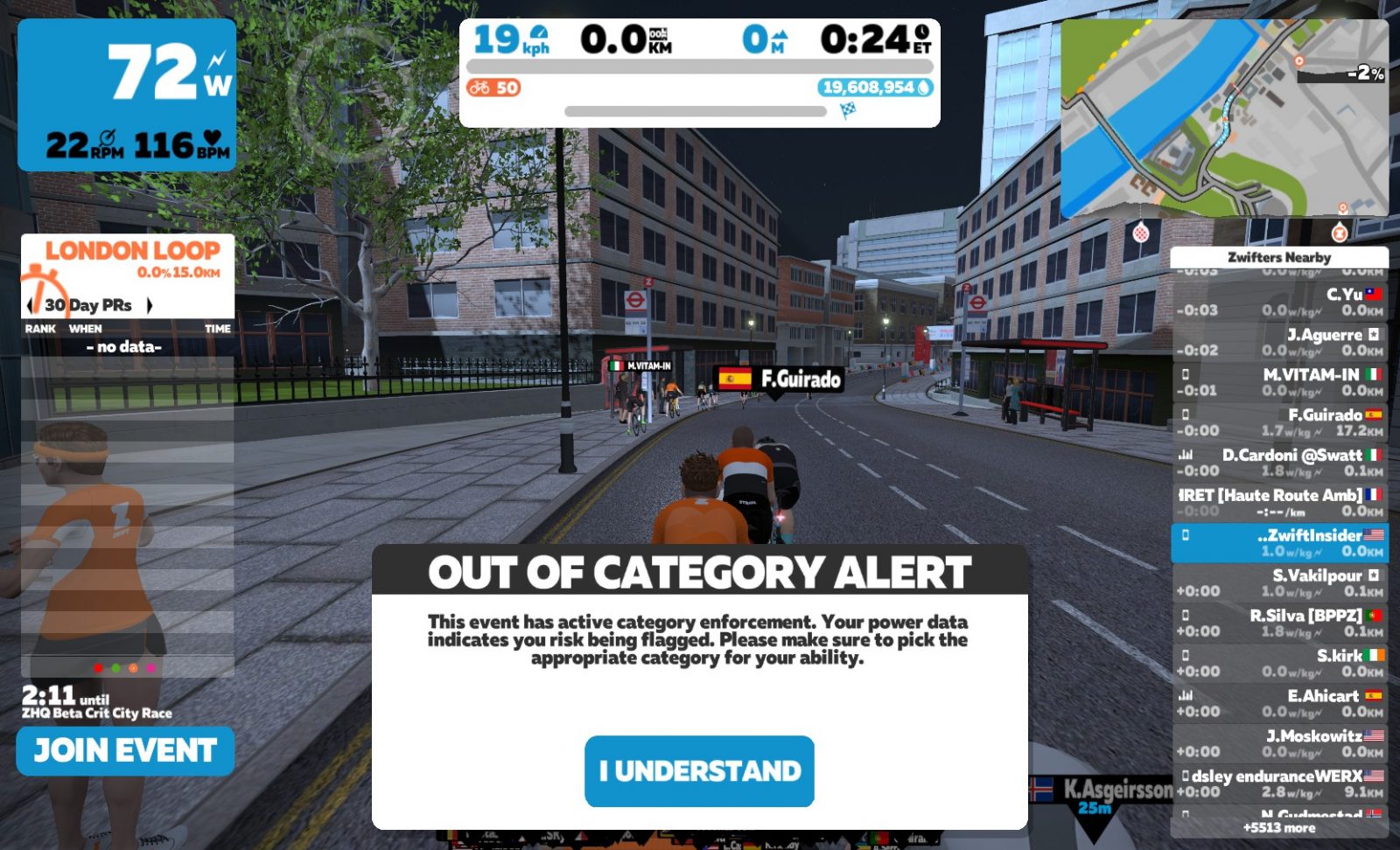
I signed up for the event from within the game itself, and when I clicked to join the event the following popup appeared:

This alert is better than nothing. But it’s also far from ideal! This won’t change signup behavior much, if at all, because there’s no way for me to easily join the correct category from this popup. I would have to exit the game and restart, or use the Companion app to change my category signup, in order to make the swap. Nobody will do that. Or at least, almost nobody.

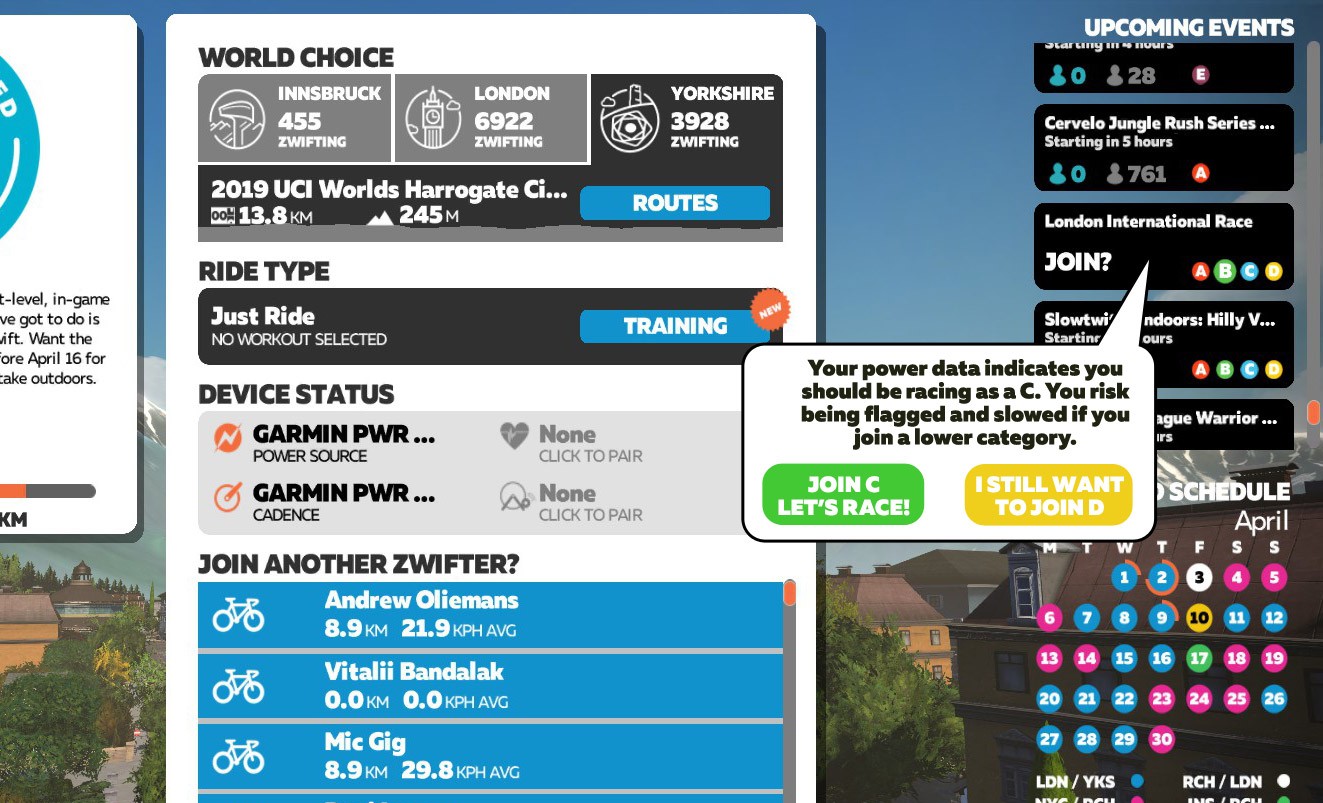
Instead, I should see a popup when I click to sign up, and that popup should drive me toward joining the category I should be in. Something like this (excuse my terrible UI design, it was a quick job):

Some would say that Zwift shouldn’t even allow riders to join a too-low category. I’d be OK with that, but I also understand Zwift’s position of not wanting to be too heavy-handed in this first iteration.

The Green Cone of Shame

Once the race began, everything was “normal” for the first ~4 minutes or so. Then the green cones began to fly! The first cones were given to two riders in the group of three off the front. Perfect! Zwift race sandbagging legend Bath Salts was one of these riders, and I was happy to see him (or her?) coned.

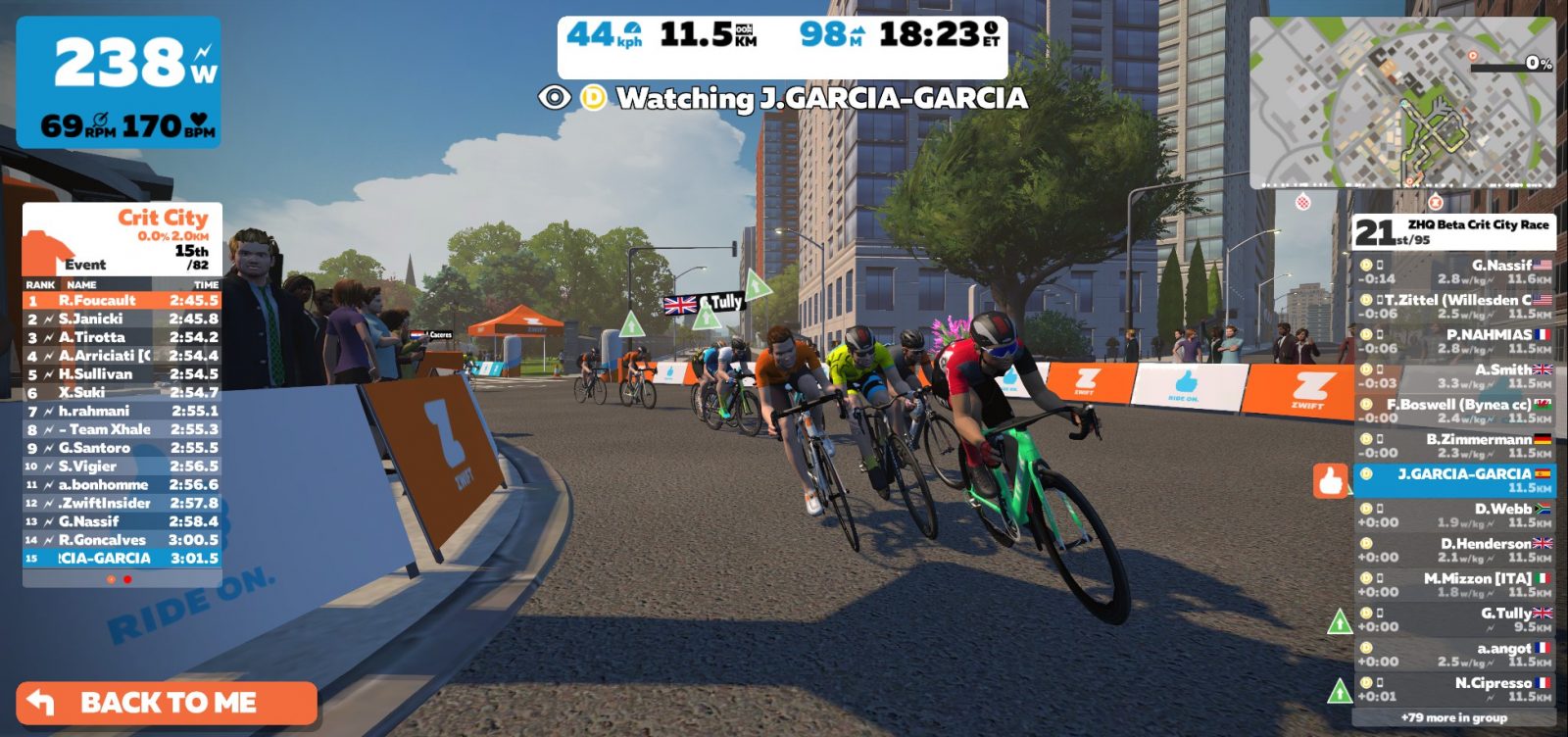
Cones began to pop up in the main peloton behind the leaders as well. Eventually there were probably 10 coned riders in a field of 95 – but it was hard to keep track because the riders were scattered all over the course. Here you can see what the cone looks like – it floats over the rider’s head, and shows up in the rider list as well.

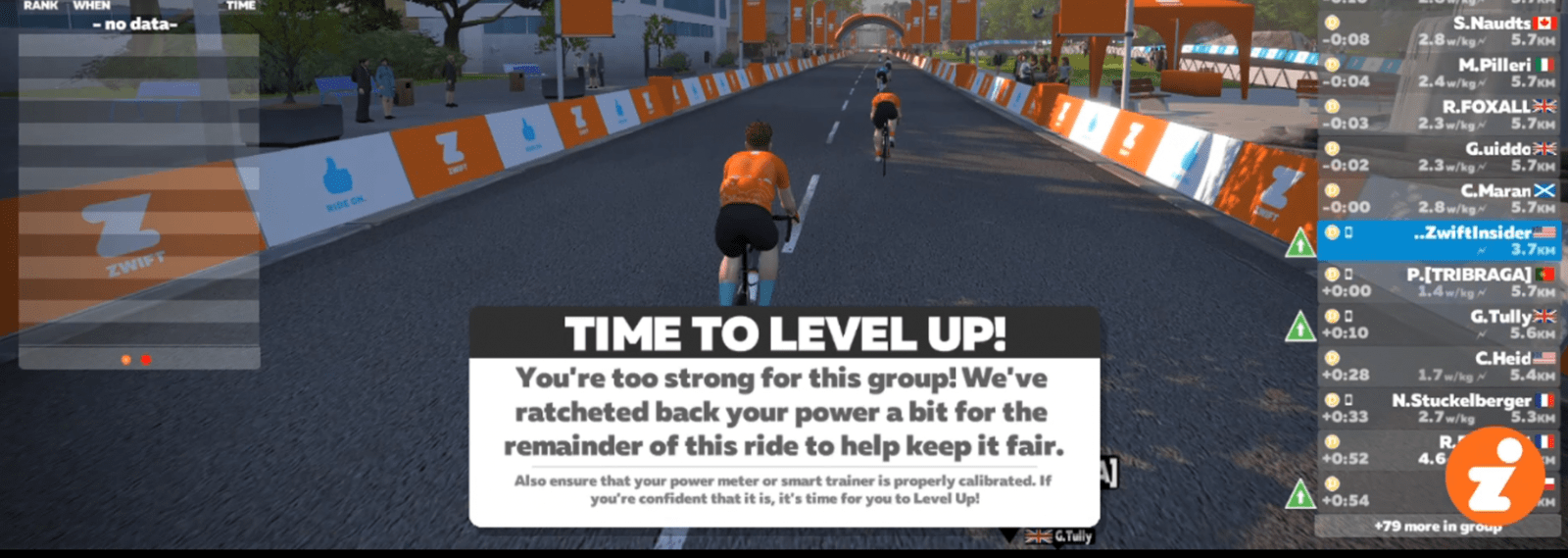
What does the green cone look like from a rider’s perspective? I pushed my one-minute power up to 500 watts and got the cone in short order – here’s what popped up:

The message says “We’ve ratcheted back your power a bit”, but my wattage readout didn’t change at the top-right. My w/kg number in the rider list was hidden, which seems odd to me. Is Zwift actually reducing my power? Or are they just artificially slowing me down? The answer is unclear.

What about Throttling?

My rider definitely slowed after receiving the Green Cone of Shame, but it wasn’t an extreme slowdown. I would estimate it knocked ~5kph off of my speed at 300 watts (4 w/kg). But that’s just a guesstimate.

The riders who were off the front and received the cone were able to stay away from the much larger chasing group, despite being coned and slowed. My conclusion here, based on this one limited test, is that the cone isn’t slowing people down quite enough. They shouldn’t be able to stay off the front, or even hang with the front pack, after getting coned. There needs to be more of a performance penalty.

Race Results

Lastly, I wanted to check the race results screen. Would coned riders not be included in the list? Would they show up as being coned? Unfortunately, neither of those is currently the case. Coned riders show up just like other riders in the rankings (several of the riders in this screenshot were coned, but you can’t tell be looking at it):

An Anomaly

The rider who “won” this particular race (R. Foucault) certainly must have exceeded the triggers for the Green Cone. But he was never coned. Was he running an outdated version of Zwift, or was there some other issue?

Conclusion

Again, I want to stress that this is an early beta of Zwift’s anti-sandbagging features. It feels a bit unfair to even write about the features in their current state, but at the same time, the racing community is wondering what the feature looks like, how it works, and what the current state of implementation is.

I think there’s a lot of promise here – it just needs some fine-tuning. And that’s exactly what beta testing is for! So keep up the good work, HQ. We’re all rooting for you!

Your Thoughts

Have you tried one of the beta races yet? Seen any green cones? Been coned yourself? Share your experience below!

How the Race was Won: Tour of Watopia, Stage 4

5

How the Race was Won: Tour of Watopia, Stage 4

I joined Zwift in November 2019 after picking up a Wahoo Kickr Core during Black Friday sales. A series of knee surgeries over the last few years have put an end to any team sports or running aspirations I may have had. I have been riding on and off for the last 10 years, but my competitive edge brought me to Zwift racing!

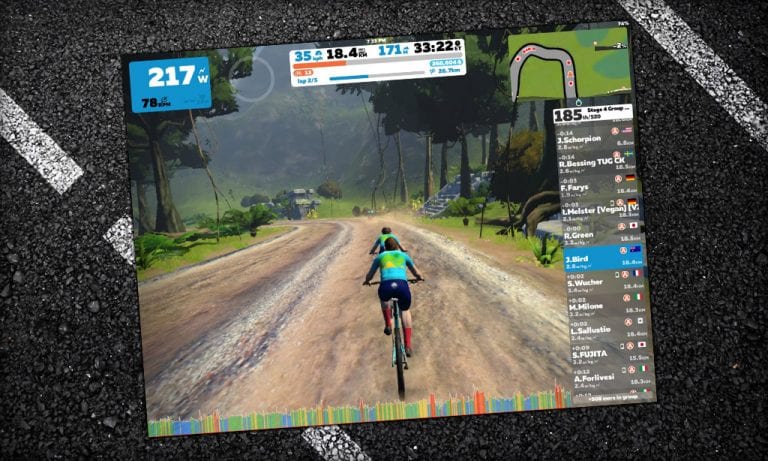
Stage 4 of the Tour of Watopia headed to the dirt of the Jungle Circuit – a part of Watopia I had never actually explored. During the first three stages, I found that the pace was quite high and never really considered racing. I prefer handicapped races like ADHR’s Chop ride, but I really enjoyed the Jungle Circuit ToW group ride and thought it might be a fun but tough race as I felt the course suited my rider phenotype. According to my Zwift Power profile, my strengths are short/uphill sprints… which is just what this circuit has!

My ZwiftPower phenotype chart

Route & Bike Choice

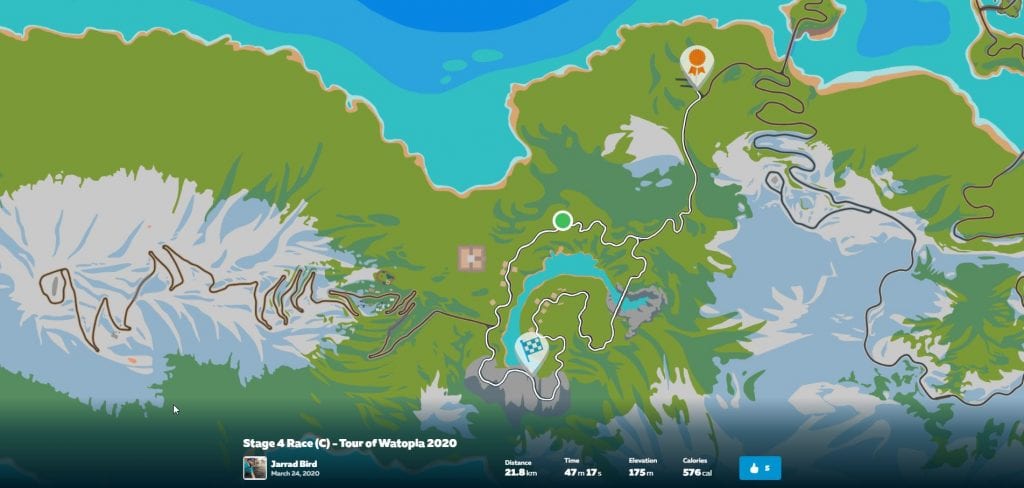
Two days later I headed into my pain cave ready to race. The Stage 4 race consisted of two 8km laps of the Jungle circuit, with a lead-in of 5.6km from the Jungle start pens.

Zwift levelled the playing field when it came to bike and wheel choice for this race, which was appreciated as a relative beginner at level 13, competing in my seventh race.

The Warmup

I’ve always preferred racing in the afternoon or evening – early starts are just not my thing! My usual routine consists of a late lunch at work, then a piece of toast about an hour before jumping on the bike. Nothing fancy, but it works for me.

I chose the Grand Central Circuit in NYC for my warm-up, a 7km 15-minute roll with a decent hill to get my climbing legs ready for the race ahead. Warming up for any longer than this usually results in me blowing up before the end of a race.

The Start

As an avid reader of the “How the race Was Lost” series, I have learned a lot (in theory) about Zwift racing but I’m still learning and slowly improving. Prior to this event, I put in the time to come up with a race strategy, and it felt like I had race director “Coach ZwiftInsider” in my internal race-radio…

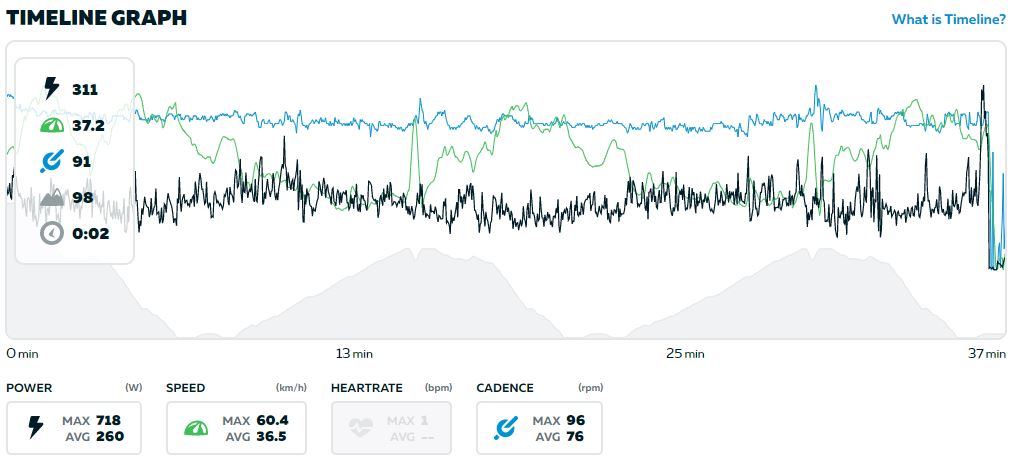
The starting pen held a group of 88 riders in today’s C Grade event. I joined the ride about 15 minutes before the starting time to secure a spot in towards the front (thanks Coach). The start was fast as expected, 40 seconds of 280 – 360w with a peak of 400w was enough to form a group of about 25 riders off the front. Goal number one for today’s race achieved – get in the front group.

The Middle

The bunch settled into a fast but manageable pace descending towards the start of the main part of the course. The jungle climb has an average gradient of 2% with a couple of pitches at 4% so the pace was always going to be high enough that drafting would be important. I managed to stay with the first 10 riders until about 500 meters before the suspension bridge. I settled into a rhythm for the rest of the climb and joined the second group for the descent, figuring that the front group probably contained a good number of sandbaggers anyway.

A key strategy for me this race was to conserve as much energy as possible during the two descents to finishing banner. In my reconnaissance ride earlier in the week I was able to save at least 1-2 w/kg compared to other riders by positioning myself in the middle of the group. I recovered as best I could but needed to deploy my aero powerup after getting stuck behind a rider who was struggling to hold on to the wheel ahead. Was this going to hurt me, burning a useful powerup on lap one? Thankfully the powerup gods smiled on me a gifted me a drafting bonus.

The second climb was slightly slower than the first, 6:26 at 280w compared to 6:11 at 297w, mostly due to being in the second mix of riders with everyone on their limit causing several splits. A couple of 400w+ efforts kept me in touch with 3 other riders as we hit the suspension bridge and the lumps before the descent.

The Finish

The pace increased on the second descent to the finish, which made it challenging to hold on and tempting to deploy my draft power-up. But it also brought a group of 10-12 riders together by the bottom. As the road flattened out managing my position was a challenge, trying to maintain good rhythm and power but keeping my nose out of the wind was the aim.

Powerups started flying as soon as we hit the cave with about 1km to go, and then again on the wooden bridge at about 500m to go! But I held back as I kept hearing Coach ZwiftInsider telling me to wait until the last minute – so I did. I waited until 200m to go, just as the slight rise starts to hurt. Coming from the middle of the pack I put the hammer down and tried to catch as many wheels as possible to really maximize my draft. It worked perfectly! Jumping ahead of 8 or 10 riders in our group I finished a few seconds behind the small bunch ahead of us, placing 9th according to Zwift.

I was excited that I was able to execute a race plan well, and while I waited for ZwiftPower results to load, I thought I might have a chance at a top 5 or even podium finish. What I wasn’t expecting was that little gold trophy next to my name as a number of sandbaggers and non-ZP riders were removed. The race was won!

See my activity on Strava
See my ride on Zwift
See race results on ZwiftPower

Takeaways

  • Ride smarter not harder. Conserve energy wherever possible but especially on descents! Mid-race recovery can provide a huge physical and mental boost. The how the race was lost series really got me thinking about the strategic aspects of racing on Zwift, rather than going full gas the whole way and trying to hold on to the end.
  • Know the course, know your strengths. Knowing when to sprint/hold back/chase a wheel can make or break your race. Knowing your rider phenotype can help you find courses or events best suited to your strengths.
  • You don’t have to win to win. The confidence I gained from planning my race well and winning the sprint in my group was just as great as winning the race. Zwift is an amazing platform to improve as a rider both on and off-screen.
A picture containing text, map

Description automatically generated
A screenshot of a map

Description automatically generated

What About You?

Have you raced in the Jungle lately? How did it go? Share below!


Covid-19 Host Check-In with Kristin Armstrong (Zwift PowerUp Cycling Podcast)

0

Covid-19 Host Check-In with Kristin Armstrong (Zwift PowerUp Cycling Podcast)

Matt catches up with Kristin to talk about juggling life as a cycling coach, an entrepreneur, a mom and a school teacher! Plus, Matt and Kristin chat about the latest Zwift feature—Clubs!

About the Podcast

The Zwift PowerUp Cycling Podcast features training tips from host Matt Rowe (Rowe & King), with regular co-hosts Greg Henderson (Coach Hendy) and Kev Poulton (Powerhouse Cycling).


Tony Kanaan: Why Pro Drivers are Turning to Tri (Zwift PowerUp Tri Podcast #25)

1

Tony Kanaan: Why Pro Drivers are Turning to Tri (Zwift PowerUp Tri Podcast #25)

Fast cars and TT bikes are life for Brazilian IndyCar driver Tony Kanaan. We learn why the Indy 500 Champ leans on Zwift to support his racing career – the answer will surprise you.

Plus, how coronavirus is affecting the season, and more insight into the onion that is Jordan Rapp.

About the Podcast:

The Zwift PowerUp Tri Podcast is hosted by former pro triathletes Matt Lieto and Jordan Rapp, lending their in-depth knowledge of the multisport to the Zwift Tri audience.


Dear pro cyclists: this is why you’re losing Zwift races

82
Hi Lawson!

Anyone who’s been paying attention to cycling lately knows that riders worldwide are joining Zwift in droves. This mass indoor migration includes pro riders in the upper echelons of the sport on WorldTour teams like Mitchelton-Scott, Bahrain McLaren, Trek-Segafredo, Ineos, Jumbo-Visma, Cofidis, EF Pro Cycling, Israel Start-Up Nation, NTT, and Team INEOS. As a huge cycling fan, it puts a smile on my face whenever I spot one of my favorite pros spinning around Watopia!

While you pros have historically stayed away from Zwift races, we’re seeing you jumping into these competitive events in increasing numbers. This is fun to see! But here’s the weird part: you’re not winning! (Well, not very often at least.)

I’ve been thinking about writing this “letter to the pros” for a while, then a recent race made me decide to pull the trigger. Mathieu Van der Poel and his Alpecin-Fenix team raced the Richmond UCI route against some top community teams in a one-off race titled “Ronde van Zwift”. And even though Alpecin-Fenix brought 18 team riders to the event (the community teams each brought 7), they still neglected to place a single rider in the top 10, with only a couple of riders holding onto the main pack through to the finish!

Watch Lionel Sanders’ view of the race:

This isn’t an edge case, either. Pro teams have historically performed poorly in Zwift races against top community teams. What’s happening here, pros? Why are the world’s top road racers being beaten by amateurs?

Here are the reasons, as I see them. With a few tips along the way.

Insufficient Course Knowledge

You wouldn’t go into an outdoor race without a course recce, and this is also true on Zwift! But when I’ve spoken with pros before races, it’s clear they have very little knowledge of the route they’re about to take on. It’s not a difficult job – most race routes are quite short, the route details are readily available online, and you can hop into Zwift at any time to pre-ride your race route.

When you research your route, start by paying attention to just a few key things:

  • Length and elevation: this is obvious. You need to know how long the race will last, and what sort of profile it has.
  • Climbs: whenever the road turns up, wattage will jump as well. This is where attacks and selections happen.
  • Banner locations: you will need to know the location of any sprint and KOM banners, especially in points races. But even in simple scratch races, the banners are where you get powerups, so knowing their location is an important part of knowing when to use or hold a powerup.
  • Finish: ride the final kilometers several times, because chances are your race will end in a pack finish. You need to know how best to strategically ride the final minutes of your race.

Wimpy Setups

I laugh every time I see a pro rider trying to race on Zwift while squinting at an underpowered laptop screen set on a table off to one side. (I only laugh to keep from crying… it’s a sad situation indeed). The vast majority of top Zwift racers do so with a large monitor or TV so they can clearly see what’s going on.

Worse yet, recently I’ve seen many pros riding outdoors with no fans. My guess is they will only make this mistake once, because pros know that overheating results in reduced power. Unless the winds are high outside, you will need a fan! Outside air doesn’t move enough to dissipate the superheated pocket surrounding your body. And of course, if you’re indoors a fan is even more essential.

Working Too Hard

Mastering the draft on Zwift is not difficult, but it does take a little practice since it doesn’t “feel” anything like drafting IRL. Drafting out on the road is intuitive because when you’re not drafting you feel the wind and the increased effort. Plus, you can steer yourself back to an ideal drafting position whenever you’d like, unless there are teams working some wicked echelons in the crosswinds.

On Zwift, being in the draft saves you 30% or more. But you don’t feel the draft – that is, resistance doesn’t drop when you enter the draft, or increase when you leave it. So you have to pay attention to your location in the pack on screen. Again and again I’ve seen pro riders killing themselves on the front of the pack, only to get shelled off the back on the first climb. (This may be a team tactic, but I doubt it.)

Smart racers on Zwift know to shelter themselves in the pack and conserve energy so they have it when it matters. Yes, at times you may have some domestiques whose only job is to keep the pace high by pinning it at the front of the pack – but pros new to Zwift should probably work on just hanging with the front pack first!

Not Your Typical Road Race

Zwift races are nothing like the 5+ hour road races enjoyed by pros during a typical season. In terms of effort level, Zwift races are most comparable to cyclocross or short TT races. Here are a few key things that characterize most Zwift races:

  • The start will be fast. There are no neutral starts on Zwift! Instead, the peloton will push hard from the gun in order to establish a selection. Be pedaling hard when the clock hits zero.
  • You should never stop pedaling, except perhaps on a steep descent. Doing so will get you spit out the back, never to return.
  • Expect to be riding near threshold for the entire event… except when you have to go harder!
  • If you’re dropped, you won’t return. There are no team cars to help pull you back to the pack, and your teammates dropping back probably won’t help, either. When you get dropped from the front of a Zwift race, chances are you’re not coming back.

Serious Business… for Some

As a top pro accustomed to racing and training outdoors, you may think Zwift racing is a bit silly. And that’s understandable. But here’s what you need to know: the community teams you’re competing against take it very seriously. Not only are they stacked with super-strong athletes, but they’ve also been racing on Zwift 2, 3, 4 times a week… for years!

They know the routes like the back of their hand, and they’ve got big screens, strong fans, and high framerates. If you think you can just pop open your laptop, log into Zwift, and beat these teams – you’re probably in for a rude awakening.

In a typical year, at this point in the season, a pro could be excused for not giving Zwift races any serious thought. But this isn’t a typical year. Zwift racing is (arguably) the only serious indoor platform in town, and cycling is only indoors for the foreseeable future. In an industry where camera time leads to sponsor money and fan engagement is paramount, pro teams would be well-advised to avoid “doing a Cofidis“.

We all want to see you pros competing in Zwift races, but it’s going to take some practice and homework if you want to perform well.

And we hope you do, because it’ll be fun to watch.

See you on course!