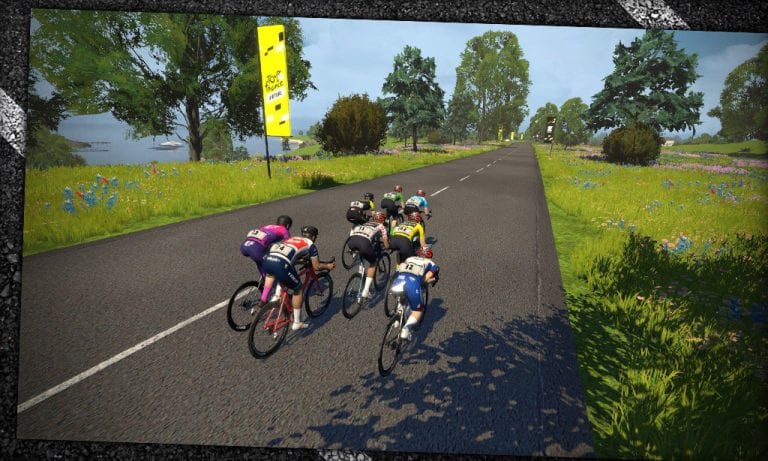
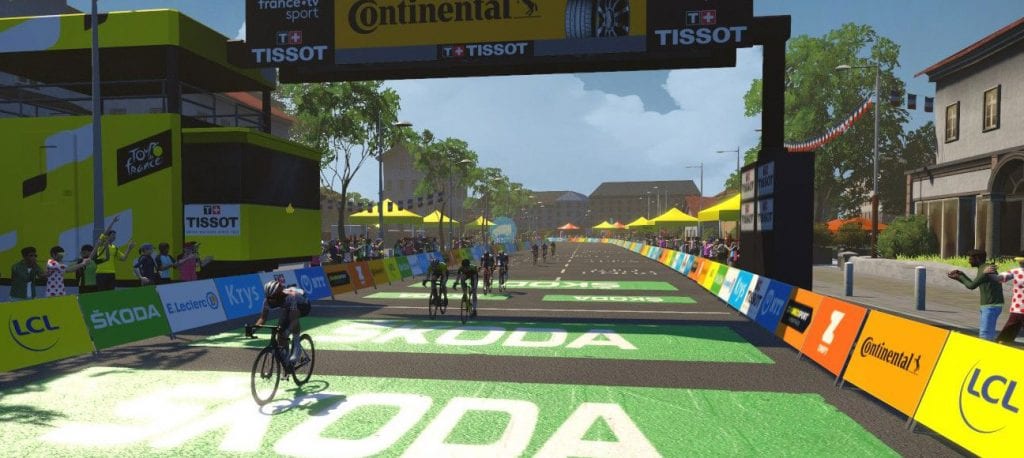
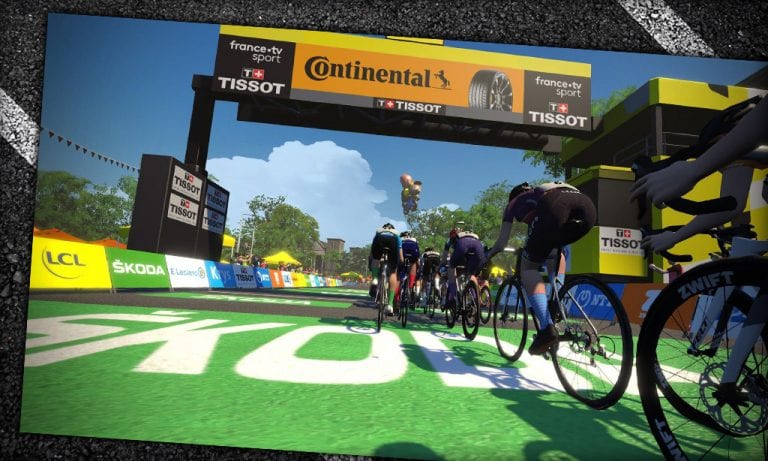
After a weekend of amazing racing, it’s only fitting that the PowerUp hosts sat down with the 4 stage winners of the middle weekend of the Virtual Tour de France. Greg Henderson chatted with Tanja Erath (CANYON//SRAM RACING) and Matteo Dal-Cin (RALLY CYCLING) to see what tips the pros could offer listeners. Then Dani Rowe grabbed some time with returning stage winner April Tacey (DROPS) and Freddy Ovett (ISRAEL START-UP NATION), who was vying for a win after his close second place in last week’s Stage 2. Plenty of tips, stories, and laughter to be had!
Catch post-race interviews every Monday and mid-week updates every Thursday until the end of the Virtual Tour de France.
The stage 4 finish in the men’s Virtual Tour de France was a thrilling finale to a hard-fought race. With a reduced pack of only eight riders which included two pairs of teammates, the final kilometers probably would have played out differently if the race was outdoors where these top-level pros have much more experience. But here on Zwift things are a bit different – powerups come into play, physics are tweaked, and you don’t have the precise positioning and immediate feedback afforded to outdoor racers.
What makes this finish interesting is the interplay between riders as some execute their finish perfectly and others make missteps. Let’s dig into an analysis of the final minutes of Sunday’s men’s stage 4.
As expected, the final climb up the Petit KOM was the decider for many riders, thinning the herd from ~30 racers to just 8. This front pack of riders crested the top of the climb with a 6-second lead on any chasers, and they would stay away for the rest of the race:
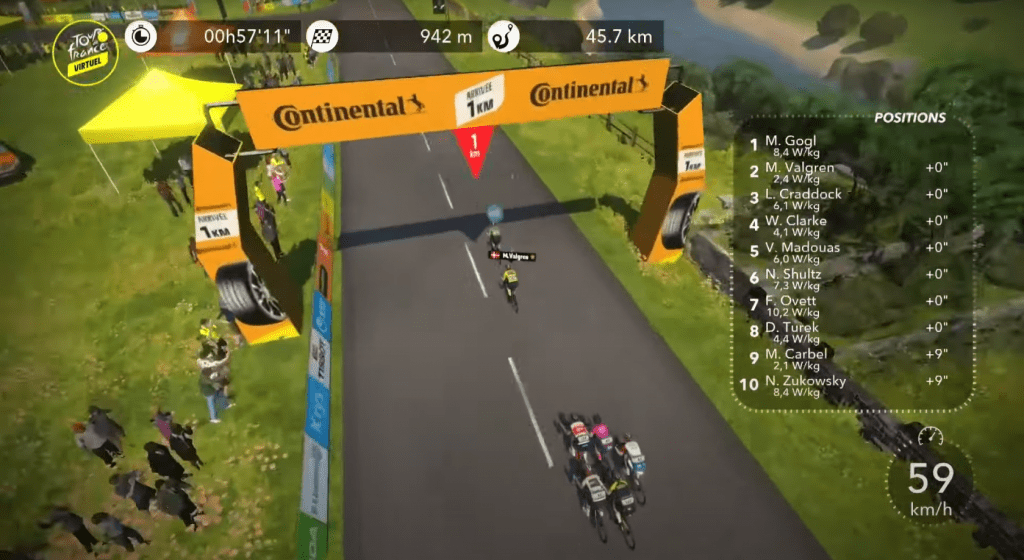
1000m: Gogl activates his draft boost powerup from the back of the group and powers off the front of the group at 8+ w/kg with Valgren on his wheel. They quickly gap the group by perhaps 15m, although Ovett responds quickly, coming around the group to grab Valgren’s wheel. Then almost as quickly as it started, both Valgren and Gogl “sit up” and rejoin the group.
Gogle’s strange powerup attack, with teammate Valgren following
758m: Turek activates his burrito powerup from the back of the group, then powers through the pack to the front.
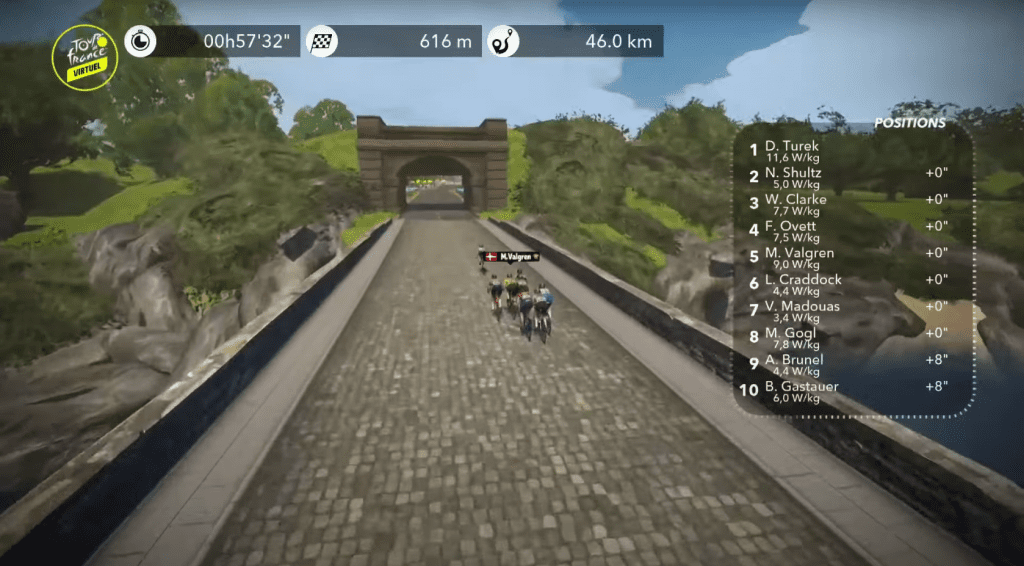
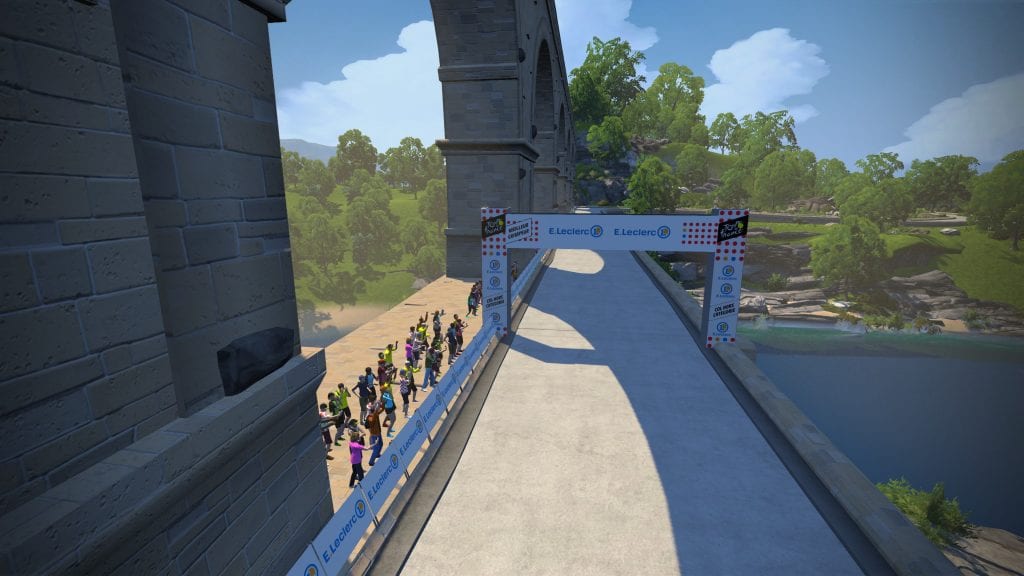
Turek attacking on the bridge cobbles
658m: Turek, with his burrito powerup still active, is the first rider to hit the cobbles of the bridge, attacking off the front at 11+ w/kg. (It’s marginally easier to put time into your opponents with an attack on cobbles, since rolling resistance is higher on Zwift cobbles than tarmac. Cobbles or other slow-rolling surfaces in Zwift behave like a false flat in terms of attackability.)
He manages to create a small gap by the 600m mark. His teammate Ovett wisely sits in the pack, making the others put in the work to reel him in. Turek’s move here is a smart one, softening the legs of his competitors heading into the final sprint so his teammate Ovett has a better chance at a win.
508m: Clarke activates an aero powerup, powering off the front and creating the biggest gap so far. But can he stay away to the line?
430m: Madouas activates his draft boost powerup. This is a smart move, but he could have activated the powerup around 8 seconds earlier and still had it active all the way to the line. Every little bit counts, and the draft boost gives 30s of increased draft – a big help in a pack sprint!
300m: (Somewhere around here, Ovett and Shultz activate their aero powerups. They aren’t visible on-screen when they do so.)
150m: Clarke is on the front but flagging as his aero boost runs out. Valgren is ~30m behind him and still pushing hard, but with no powerup.
75m: Ovett with his aero boost active comes around Valgren, passing Clark just a split second later. Shultz is in 4th with an aero boost active.
40m: Shultz passes Clark. He’ll pip Valgren at the line as well, taking 2nd on the day.
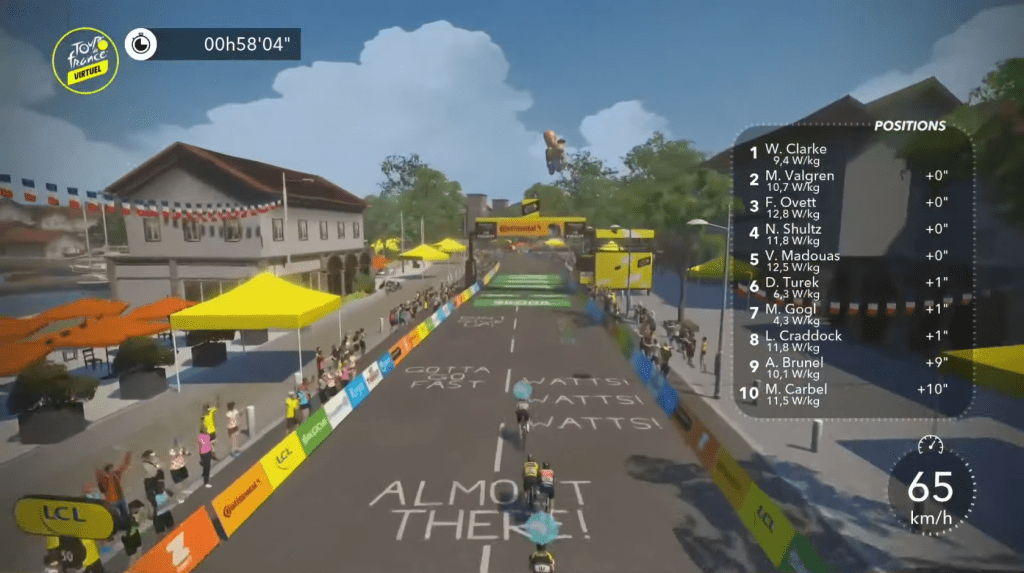
Ovett powering off the front as Shultz comes from behind and Clarke fades
0m: Ovett crosses the line ~15m ahead of the next contender. His perfectly-timed aero boost powerup runs out just as he crosses the line.
Ovett played this finish perfectly, chasing down the initial attack from NTT, then sitting in and conserving until just the right time. Shultz also rode the finish smartly, sitting in the wheels then activating his powerup to maximum effect. Valgren put in a massive effort, and even used his teammate Gogl for a bit of a leadout in the final seconds – but he jumped early, and had no powerup to help him in those crucial final seconds.
Ovett taking the win!
What Might Have Been
Sprint finishes in top men’s races on Zwift often start from way out, and this after a hard run-in in the final kilometers. (Today’s sprint for the men began ~100m earlier than the women’s sprint on the same course.) Did Clarke jump first and go long on purpose? Both his legs and his powerup ran out early, suggesting he mistimed the finish.
The rider who jumps first rarely wins. It’s the cagey, patient riders like Ovett and Shultz who are usually able to take the win with a well-timed powerup and burst of sprint power in the final ~200m.
Could NTT have played this differently, with better results? Probably. Gogl’s odd abbreviated attack at 1km seemed like a slipup on his part. Did he mistake his van powerup for an aero boost? Both he and Valgren may have been better served if Gogl had used this powerup in the final sprint, chasing down whoever jumped first in the sprint, keeping Valgren on his wheel for the sprint leadout. Nevertheless, NTT finished strong in this stage, building on their commanding lead in the overall team GC as well as other classifications.
Stage 4’s finish, like many sprint finishes in cycling, was a lesson in timing – both in terms of sprint power and powerups. And while it’s easy for me to watch the replay and make comments in hindsight, it is also fair to say that one team in particular could have played their cards differently in order to change the entire outcome of the race. Here is my analysis of the final minutes of Sunday’s stage 4 of the women’s Virtual Tour de France.
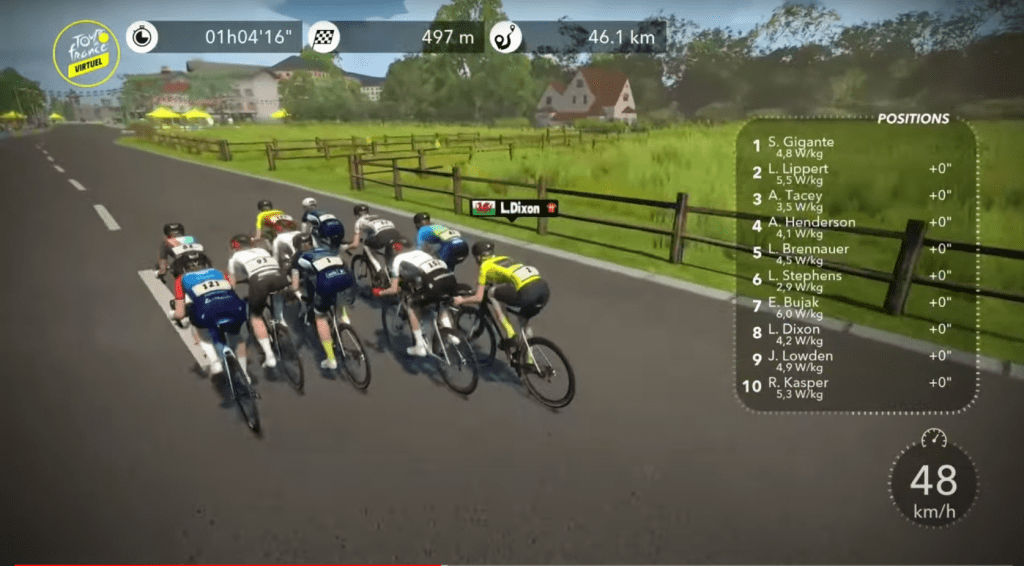
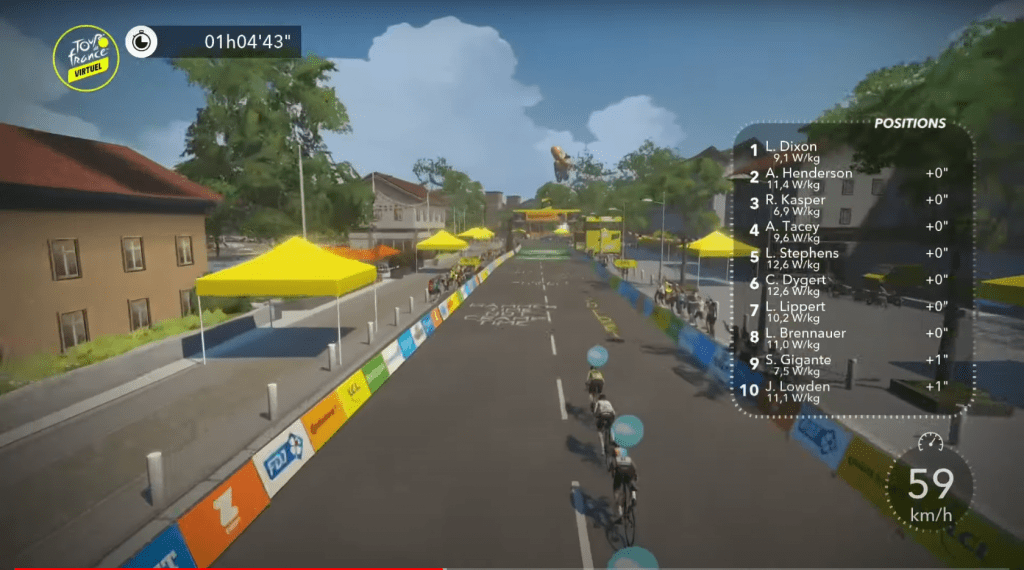
Riders had fought to stay on the front as the initial pack of 63 starters was whittled down mile after mile. Coming over the top of the final climb up the Petit KOM we had Lowden (Drops) first, with Stephens (Tibco), Henderson (Sunweb), Gigante (Tibco), and Dixon (Tibco) quickly catching her. With just 3.8km to go, this group had a 4-second lead on a chasing group consisting of Brennauer (WNT Rotor), Kasper, Tacey (Drops), Dygert (Twenty20), Bujak (Alé BTC Ljubljana), Lippert (Sunweb).
With three riders in the front group of five, Tibco would have been well-served to work hard to stay away from the chasers. But that didn’t happen, and the chase group closed the gap, forming a finishing pack of eleven who would contest the final sprint for stage 4 honors:
Stephens (Tibco, #1)
Dixon (Tibco, yellow jersey, #2)
Gigante (Tibco, #3)
Lowden (Drops, polka-dot jersey, #64)
Tacey (Drops, #62)
Dygert (Twenty20, #41)
Henderson (Sunweb, #92)
Lippert (Sunweb, #93)
Brennauer (WNT Rotor, #121)
Bujak (Alé BTC Ljubljana, #143)
Kasper (Parkhotel, #152)
Meter by Meter
1000m: Lippert activates her burrito powerup and moves through the pack to the front, but never attacks. This move doesn’t help her at all, and perhaps even hurts as now her opponents know that she has no powerup left. Perhaps she thought the burrito lasted longer than 10 seconds, and she intended to attack off the front?
The final eleven, heading into the finishing sprint
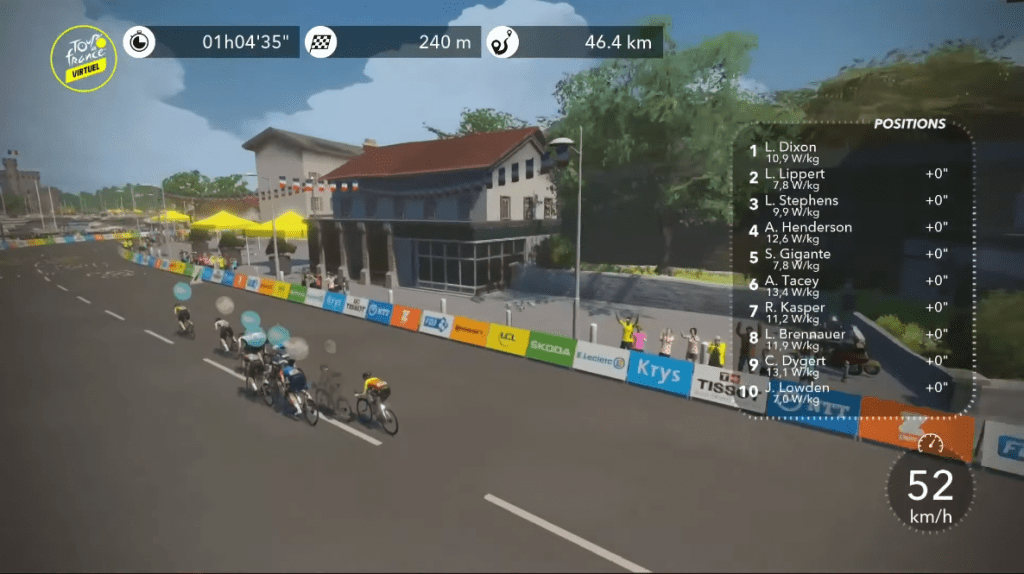
339m: Burrito dropped by Henderson, who is on the front of the group. (This is the first powerup dropped for the final sprint, and it begins a cascade of powerups. Within 4 seconds of Henderson dropping her burrito, all riders who have powerups will have activated them.)
333m: Brennauer activates her burrito. Dixon’s avatar gets out of the saddle and begins to sprint.
299m: Kasper activates her aero. Dixon comes around the front (Henderson) and activates her aero.
269m: Tacey activates her aero along with Stephens. There are now four riders with active aero powerups. Two of them will finish on the podium.
240m: Lowden activates ghost from near the back of the pack.
Dixon off the front with Henderson and her burrito just behind
150m: Dixon is off the front, and Henderson 5m back has used a burrito powerup, so the riders 5m behind Henderson are working with a decreased draft effect. This is a big chance for Dixon and Henderson, if they can stay away to the line.
100m: Tacey powers around a rider and onto Henderson’s wheel. Riders are now strung out single file, charging toward the finish in this order: Dixon, Henderson, Tacey, Kasper, Dygert, Stephens. Dixon’s power is beginning to fade, dropping from ~11.5 w/kg to ~9.5 w/kg.
Strung out for the finish
50m: Henderson comes around Dixon as Dixon’s aero runs out. But Dixon’s sprint effort had already run out, so slightly better powerup timing probably wouldn’t have helped here. Super strong effort from Henderson here – remember, all she had was a burrito, and it’s long gone!
15m: Tacey passes Dixon, then Henderson. Her aero powerup is still active.
5m: Tacey’s aero runs out – perfectly timed. Her momentum carries her further past Henderson and Dixon for the clear win.
0m: Stephens passes Dixon at 12 w/kg to take third at the line. Her aero powerup runs out perhaps 15m after crossing the line. Could she have activated her powerup a bit earlier, and gone a bit earlier, for a better result? Quite possibly. (In the video at 269m you can actually see Stephens’ avatar stand up to sprint, then sit down and activate her aero powerup, then stand up to sprint again. Perhaps she had to activate it herself, and couldn’t do it while sprinting. This may have cost her a placing!)
Finishing Order
Tacey (Drops, #62)
Henderson (Sunweb, #92)
Stephens (Tibco, #1)
Dixon (Tibco, yellow jersey, #2)
Dygert (Twenty20, #41)
Kasper (Parkhotel, #152)
Brennauer (WNT Rotor, #121)
Gigante (Tibco, #3)
Lippert (Sunweb, #93)
Lowden (Drops, polka-dot jersey, #64)
Bujak (Alé BTC Ljubljana, #143)
Tacey should be commended for her well-timed sprint. Henderson was super-powerful, getting second with no aero powerup. And Stephens came from behind to nab third, but may very well have gotten second with slightly better timing.
Three riders went into the sprint with no powerups: Gigante, Bujak, and Dygert. Dygert’s fifth place shows that she is more than just a TT champion – she can sprint!
What Might Have Been
By my calculations, if Tibco had worked together to stay away from the chasing group after the Petit KOM, they would now be in first place in the Team Overall General Classification, having garnered 9 more points (worst-case scenario) than they actually came away with in this stage. They would also have extended their lead over Drops for the General Time Classification, since Tacey wouldn’t have caught the front group and taken the win.
Why they didn’t do this is the confusing question. It appeared up the Petit KOM that they were working hard to beat up their opponents’ legs and split the pack, so it seems sensible to capitalize on that break once it happened.
The inaugural Tour de France Virtuel, itself a landmark in the history of the platform, has coincided with lots of new tarmac – always a good moment for Zwifters. The Zwiftcasters pick out their favourite bits as well as giving their overall impressions of the new roads to ride.
We have an interview with Zwift marketing grand fromage, James LaLonde to get some insight into the importance of the vTDF and later in the episode, ASO, the owners of the Tour de France talk about why this deal made sense to them.
Simon, Shane and Nathan play a silly game – assigning marks to the various new road painted slogans that have sprouted in Zwift – with the award of a Yellow Jersey and a Lanterne Rouge.
And we have an interview with Freddie Ovett, the Israel Start Up Nation rider who has lit up the racing so far in Stages One to Four. Getting the narrowest of second places on St 2 and a great win on St 4, Ovett discusses Zwift, PowerUps… and his dad.
The Zwiftcasters chew over the big improvements in race coverage, with new broadcast tools getting their debut in the vTdF.
And of course there’s always room for more teasing of Simon over his continuing Tron Bike Fail.
Velonews just released episode 60 of their PYSO podcast, and it features a wide-ranging interview with Zwift CEO Eric Min.
The hosts chat with Eric on a variety of topics including:
The history of Zwift in terms of both functionality and brand development
The evolution of gamification in Zwift – leader jerseys, powerups, and more
Racing: how to ensure fair competition
Zwift’s involvement with organizations like the UCI, IOC, and others
How Zwift dealt with the COVID influx, including interesting facts like:
New user growth is still 3x higher than it was a year ago
Meetups have increased by 8x over peak in January
Usage numbers: Eric explains that less than 1/3 of customers are actually racing. The rest are distributed evenly between training activities and free-riding or social rides
How the virtual Tour de France came about
For the Zwift veterans and addicts, the most interesting part of the interview may come towards the end, when Eric mentions some things that are coming up next! Those include:
Big races: Eric mentions that he forsees Zwift races being into the UCI calendar – if not next season, then soon. He also mentions that “World champs is still out there” – indicating that the planned virtual UCI World Championships for 2020 are still going to happen this year.
Rowing release imminent: Eric says “Rowing is coming out in a few weeks”
Race results in Meetups: Eric indicates that “Meetup results” (showing the finishing order of Meetup riders) is “scheduled for this month”
The news of Zwift planning to finally add rowing to the platform is a big deal – it would be the third sport supported by Zwift (cycling and running being the other two). Eric mentions rowing’s release in the context a discussion on Zwift becoming a training platform for athletes in other sports – tennis players, nordic skiers, etc.
We’re not sure what Zwift has planned for those sorts of athletes, but rowing is certainly a natural fit since, as Eric says, rowing and cycling have a lot of crossover. Rowing is a very leg-driven sport, requiring a lot of leg and hip strength. And of course, both rowing and cycling require a massive cardiovascular engine in order to excel at the top levels of the sport. Good rowers make good cyclists.
More than 2-1/2 years ago, we published a post about How to Use Your Concept2 Rower on Zwift. It’s a bit of a hacky approach, and your avatar is on a bike, not in a boat… but it works, and many people are doing it! Having rowing properly supported by Zwift, though, should allow rowers to easily connect and row together in the waters around Watopia and other Zwift maps.
Meetup Results
For most Zwifters, the bigger news from Eric’s interview is the impending release of Meetup Results functionality. Why does this matter? Because it means anyone can organize a race on Zwift. Thanks to recent Meetup changes (particularly Meetup-Only View), Zwifters just need an official results sheet in order to organize one-off race events. And that’s what the Meetup Results feature would add. Bring it on, we say!
The Coronavirus crisis has certainly refocused minds at Zwift HQ. The sudden surge in users came at a time when the platform typically becomes a little quieter, which also tends to be the point in the year that Zwift release their larger updates. They had to focus not just on ensuring the platform was robust enough to cope with 40,000 concurrent users, but the typical use case was also shifting, with more users using Meetups as club riders moved their usual IRL sessions to Zwift.
We assume that with the Olympics postponement, the rumored Tokyo course release was put on hold. The UI update was also delayed as it was considered too big a change to introduce with so many new riders on board. Instead, Zwift has put all of their efforts into getting the Tour De France worlds created – a huge marketing opportunity with pro riders racing through July.
The result of this marketing drive on long-term Zwift subscriber numbers will not be known for some time, but it feels like once the TdF races are done, there is a big opportunity to focus on elevating the core platform to a higher standard. Undeniably, there are a number of feature requests that have been in the ether for some time, so in my opinion, this is the opportunity to tick these off and lay the foundations for the longer-term Zwift future.
Here’s my list of what I’d like to see Zwift work on next. This is basically a list of refinements rather than revolution. Most of this is not blue sky stuff – it’s getting the basics right.
Worlds / Roads
No new worlds needed for a while (with Tokyo also ready). Instead focus on:
Expanding existing worlds – Watopia and France are especially open to development, but New York also has half-created roads. Put meat on the bones of these worlds to add density. This should be less developer-resource intensive than creating new worlds.
Add in mountain bike and gravel tracks that interweave with existing tracks – for multiple additional route options that give reason to use the mountain and gravel bikes.
Improve assets and fix graphical errors throughout existing worlds – continuous improvement. For example, there is currently a tree growing through part of the New York Highline track, and a boulder in the middle of the jungle. Sometimes riders sink 6 inches into the road. The worlds can become more immersive slowly over time.
*A Velodrome would still be an awesome addition but is reliant on significant other changes listed below.
UI
The new UI is incoming so there are a number of things that we can assume will be fixed – like not having to restart the game to switch routes. Ideally the UI should also include:
A clearer gradient profile and position on route
Distance left on route
Route builder – design your own route. For example, could design a 90km time trial route through Watopia. These could even be shared in the community and the best ones incorporated into the core game.
Customisable HUD – let us choose the elements that matter. For example, power or speed may not be necessary if using the Companion App.
Racing
Additional race formats could be enabled which are supported by the UI and require no 3rd party service. Examples include:
Elimination races – cull the lowest X% each lap – show you if you are at risk coming up to the lap banner
Points races – show points totals and highlight where the Primes are
Chase races
Team time trials managed in-game (on TT bikes, able to draft your teammates)
Other racing improvements:
Category structure (auto-assigned) – work up through categories. Use the big data of power profiles to make races as fair as possible. Results at the end of a race should be valid without relying on 3rd party services
Allow event organisers finer control – e.g. no zPower riders
Post-event, all riders should enter a ‘clubhouse’ or coffee shop, where you can analyse the results and chat with the people you rode with, give Ride Ons, etc
Accuracy – server winner should correlate with visual winner. This looks terrible in pro races when the winner is not the one that everybody saw cross the line first.
Physics
Increase the draft to allow for realistic recovery
Remove sticky draft
Cornering – slow down through corners. This works well in RGT Cycling, which is currently some way ahead of Zwift for physics accuracy.
Downhill – pack speeds are unrealistic and stop attacks over the top being effective. Limit pack speed downhill, and slow through corners. The bigger the pack the slower it should move through tight corners. 80km/h through a hairpin is a long way from realistic. A lone rider on a technical course typically descends faster than a pack
Other
Clubs – arrange meetups (which can include race formats). Use a generator for a club kit (clubs above 30 members?). Enter races as a team.
Proximity audio – ability to talk to riders nearby to plan an attack, or limit audio to team members.
Wider range of avatars and kit (bikes, helmets) – make it simple for brands to get their kit in game.
Levels above 50
More challenges and badges – it is clear that Zwifters love achievements, such as gathering all the route badges.
Companion app – access to everything other than riding. Badges, Garage, Drop Shop, etc. Ability to configure the display like a bike computer, so you can remove metrics from the main screen.
This list is by no means comprehensive, and there is always value in adding features that people were not aware that they wanted (like Boost Mode or new powerups). However, if the majority of this list was achieved in the coming months I think Zwifters would be a lot more comfortable seeing some of the wilder and broader stuff being added!
Your Thoughts
What key features do you think are missing from this list? Is Zwift focusing on the right things? What are the top priority changes? Let me know in the comments below!
Heading into stages three and four of the Virtual Tour de France we’ve got another star-studded startlist including Egan Bernal (Team Ineos), Lizzie Deignan (Trek-Segafredo), Elia Viviani (Cofidis), Chloé Dygert (Team TWENTY20), Yves Lampaert (Deceuninck-Quick Step), and Ashleigh Moolman-Pasio (Team CCC-Liv).
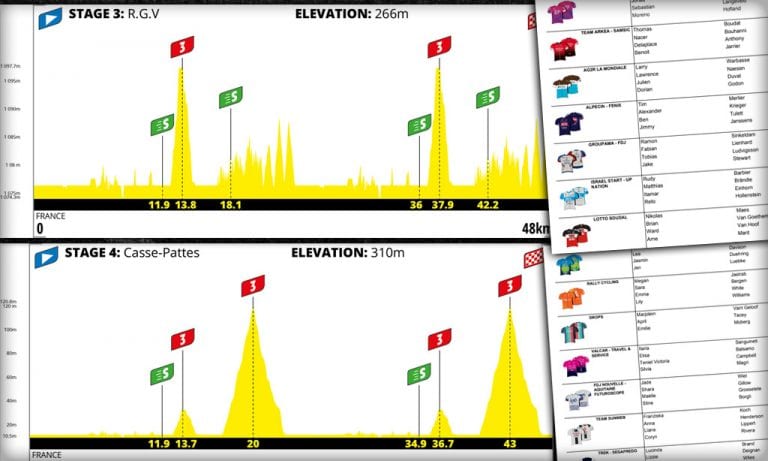
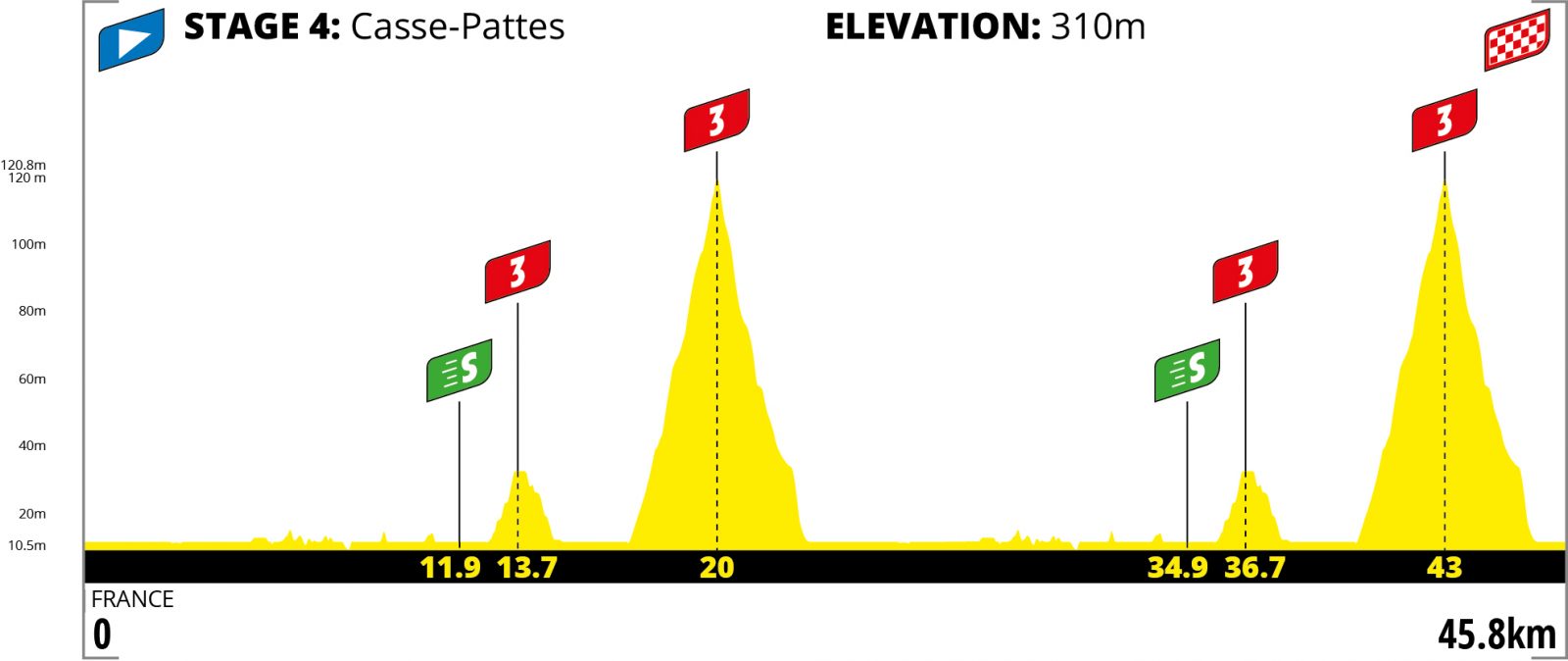
While both stages this weekend are fairly flat, expect a lot of action on stage 4’s Petit KOM, especially on the second lap where the climb ends just 2.8km from the finish line. (The Petit KOM is around the same length as last week’s Hilly KOM Reverse, but twice as steep!)
Here are more details for each of this weekend’s stages including start lists, race times, and more.
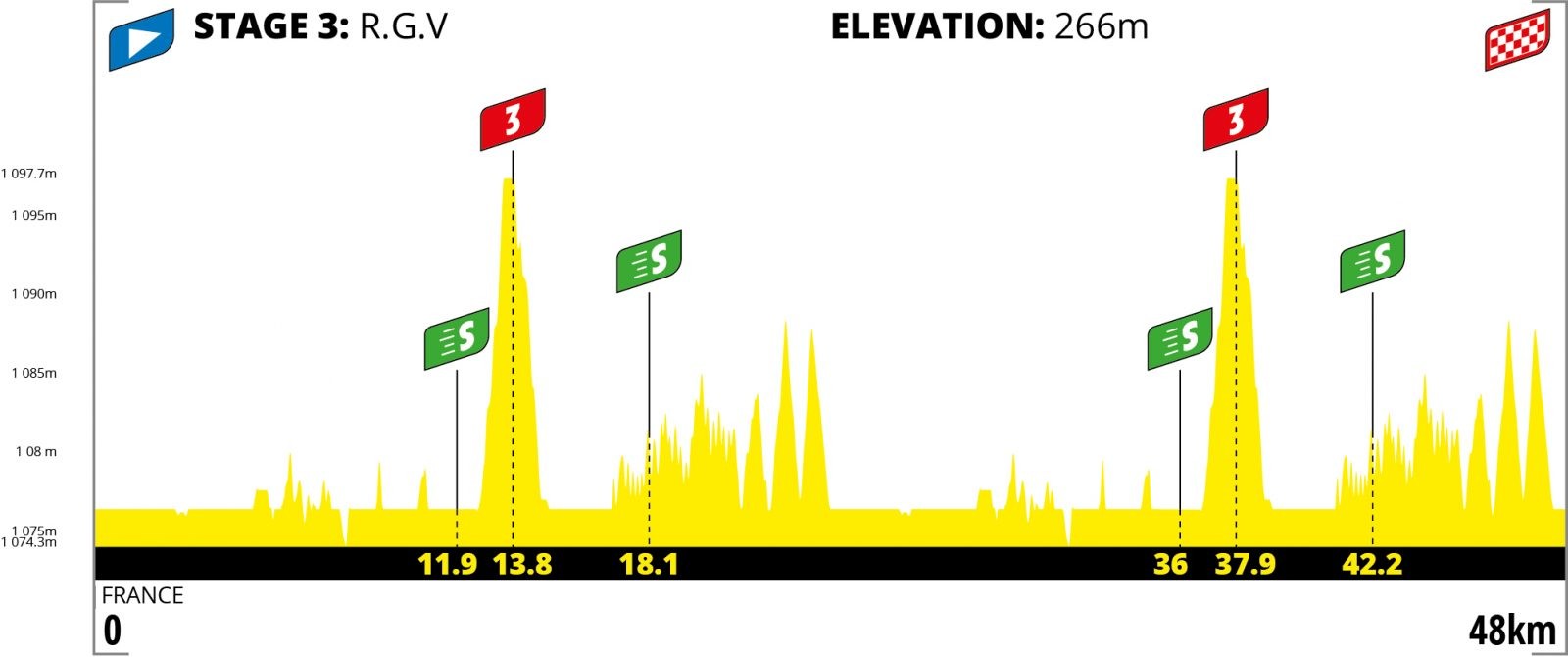
Stage 3: France’s R.G.V.
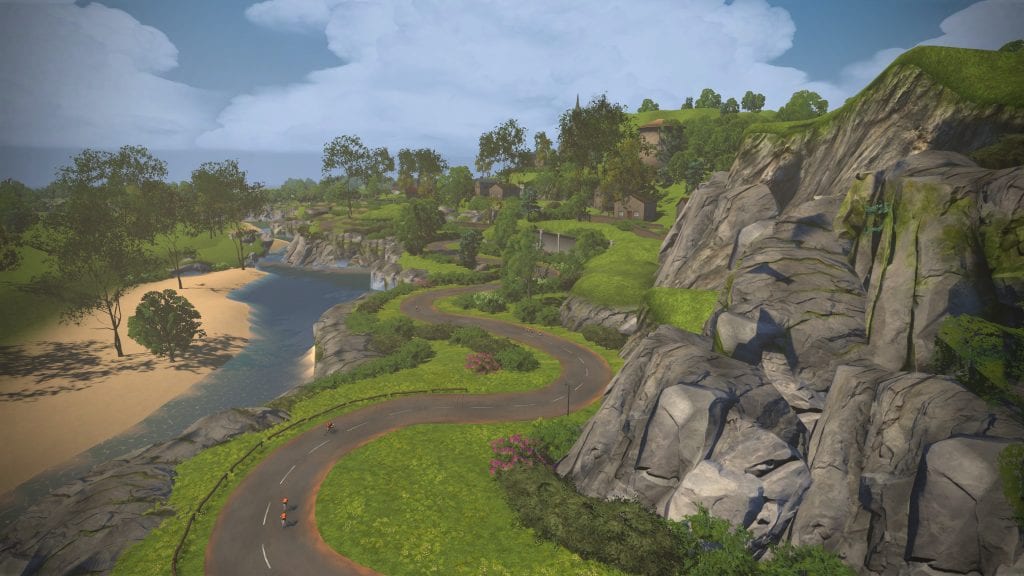
This week the peloton leaves the virtual world of Watopia and heads to a newly created ‘native’ virtual France, a debut course created by Zwift especially for this historic event. Racers will tackle two laps of the fast R.G.V. circuit. Starting in the flatlands of virtual France there will be plenty of opportunity for the sprinters to test their legs and pick up green jersey points with two intermediate sprints up for grabs per lap, the first coming 11.9km in with the Pavé Sprint Reverse.
But sprinters will need to recover fast as the first Q/KOM point opportunity comes less than 2km later with the Category 3 climb: ‘Aqueduc Reverse‘. The second Skoda green jersey sprint point comes next with the Ballon Sprint Reverse. The race finishes at the R.G.V marina at the end of the second lap. Expect to see Team Tibco-Silicon Valley Bank and NTT Pro Cycling working hard during the day’s stage to protect their green jerseys.
Date: Saturday July 11
Timings:
Women’s: 14:47 CET // 05:47 PDT // 22:47 AUS Men’s: 15:52 CET // 06:52 PDT // 23:52 AUS
Stage four sees the race move from the virtual French flatlands to slightly more challenging terrain. This day will be a day for the puncheurs. If you loved the castles and quaint French town of R.G.V., then there’s more of that in store during Casse-Pattes. This route starts off on the flat with a brief opportunity for the sprinters to score points in the green jersey classification at the Pavé Sprint Reverse. Following this, the racers will tackle two Category 3 climbs, the Aqueduc KOM Reverse followed by the longer Petit KOM. Racers then descend quickly back to the R.G.V. marina finish line where they will begin their second and final lap.
The rolling terrain of Stage four could provide the perfect opportunity for the breakaway specialists but expect Drops Cycling and Israel Start-Up Nation to be ready to fight to the top of the climbs as they attempt to keep their polka dot jerseys.
Date: Sunday July 12
Timings:
Women’s: 14:47 CET // 05:47 PDT // 22:47 AUS Men’s: 15:52 CET // 06:52 PDT // 23:52 AUS
The opening stages of the Virtual Tour de France might be over but Matt Rowe, Dani Rowe, and Greg Henderson have all the racing analysis to help you race like a pro. Looking back at stages 1 and 2, they reflect on what the riders said in their post-race interviews (see previous episode) and how to master the supertuck. But with stages 3 and 4 looming, the hosts can’t resist talking about the next two courses on the brand new France routes!
Catch post-race interviews every Monday and mid-week updates every Thursday until the end of the Virtual Tour de France.
This weekend continues the Virtual Tour de France along with the massively popular l’Etape du Tour series. You’ll want to participate in those events, but there are other standouts as well – here are our picks!
Special thanks to Jesper at ZwiftHacks with his Events app which provides powerful event filtering tools that help us create this list each week.
Watch the Virtual Tour de France, Stages 3 & 4
Tomorrow is our second weekend of Virtual Tour de France action, and you don’t want to miss it! World tour pros from 23 men’s and 16 women’s teams will meet up to battle it out in teams of four across the roads of Zwift’s new France map. Stage 3 will be on the R.G.V. route, and stage 4 is on Casse-Pattes.
Stage 3: Saturday at 2pm BST/9am EDT/6am PDT Stage 4: Sunday at 2pm BST/9am EDT/6am PDT
L’Etape du Tour, Stage 2
With over 50,000 riders riding last weekend’s stage 1, it’s clear the L’Etape du Tour series is massively popular. Come take on 2 laps of the Casse-Pattes route – the flattest L’Etape du Tour stage of the series. Race and see how you stack up against others, or just make it a personal challenge to finish.
This monthly century ride is one of the most popular of its kind on Zwift, and now it has expanded to include shorter B (60 miles) and C (20 miles) options.
The weekend is a wonderful time for a long run. There are several longer run events scheduled for this weekend – here’s one! Find an event that fits your schedule and get some endurance work put into those legs.
Ready for a long effort? The Sunday 100km KISS races are a long-standing, popular weekly community event. With two time slots to fit the schedules of EU and Americas-based riders, you should be able to find one that works! This week’s races are on Watopia flat Tick Tock route.
The latest Zwift update is now available on all platforms. The update is a very minor one, mostly consisting of minor tweaks to Zwift’s new France and Paris maps. Let’s dig into the details…
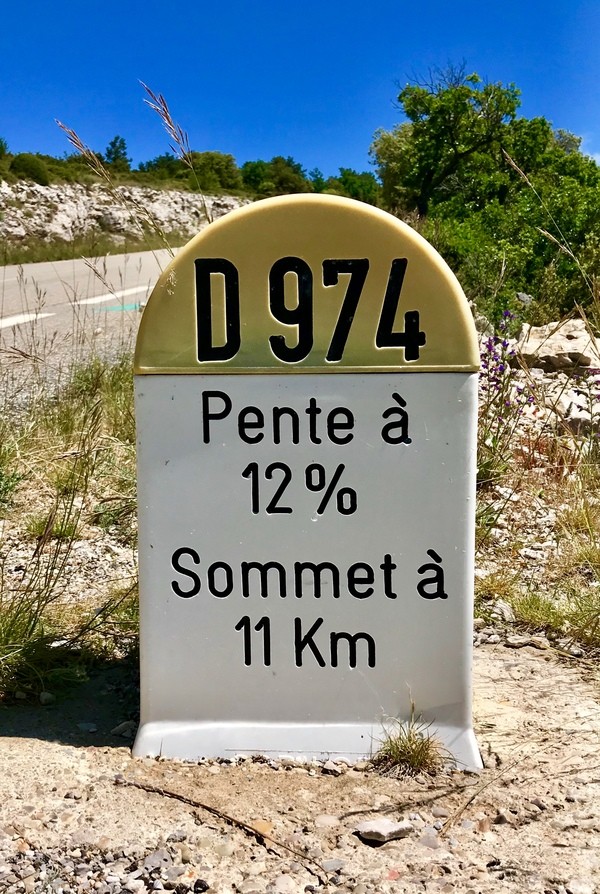
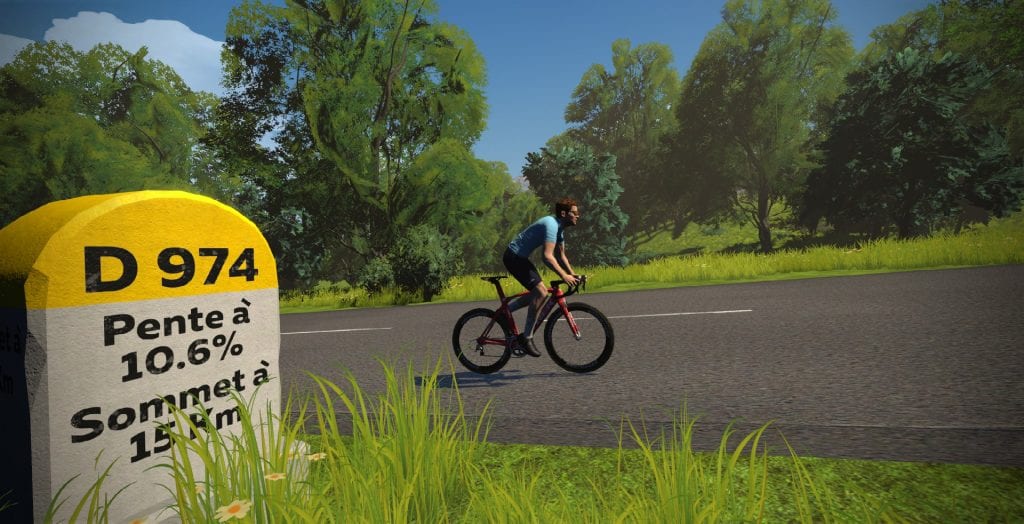
The update includes “Tweaks to the new France and Paris maps including distance markers for Mont Ventoux as well as adding running paddocks.”
Zwifters have been a bit spoiled by Alpe du Zwift’s segment tracking and custom minimap, and early feedback from riders has consistently said it would be nice to have some sort of progress meter on the way up Mont Ventoux, especially since it takes approximately 50% longer than the Alpe to conquer!
Zwift has added the iconic Mont Venoux distance markers in-game at every kilometer. Strangely, we couldn’t spot one at the summit, which is the marker most photographed by riders IRL! But the important thing is the progress markers on the way up.
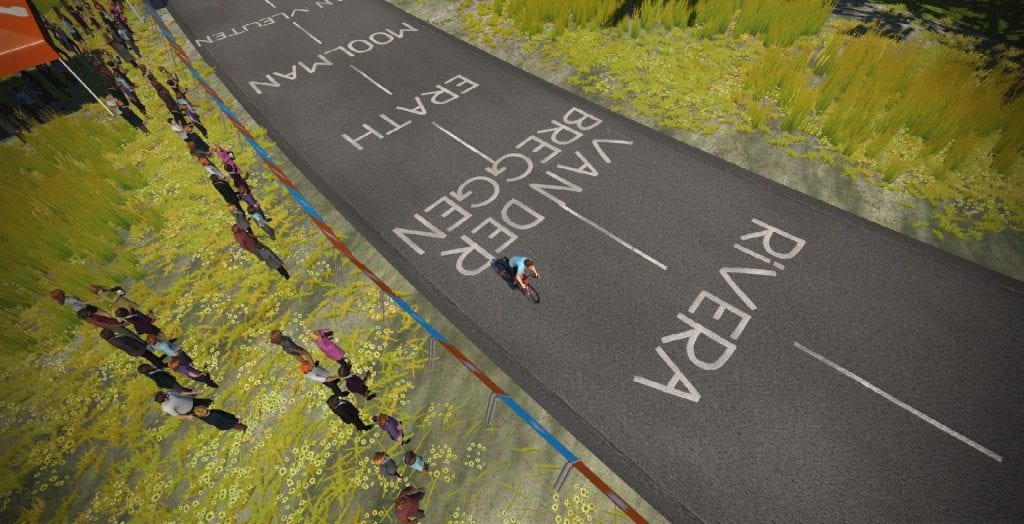
There were certainly some visual updates to the routes, and although we haven’t had a chance to take a close look, we noticed some new text on the road up Mont Ventoux! Here’s one example, calling out the names of some top women racers:
L’Etape Jersey Fix
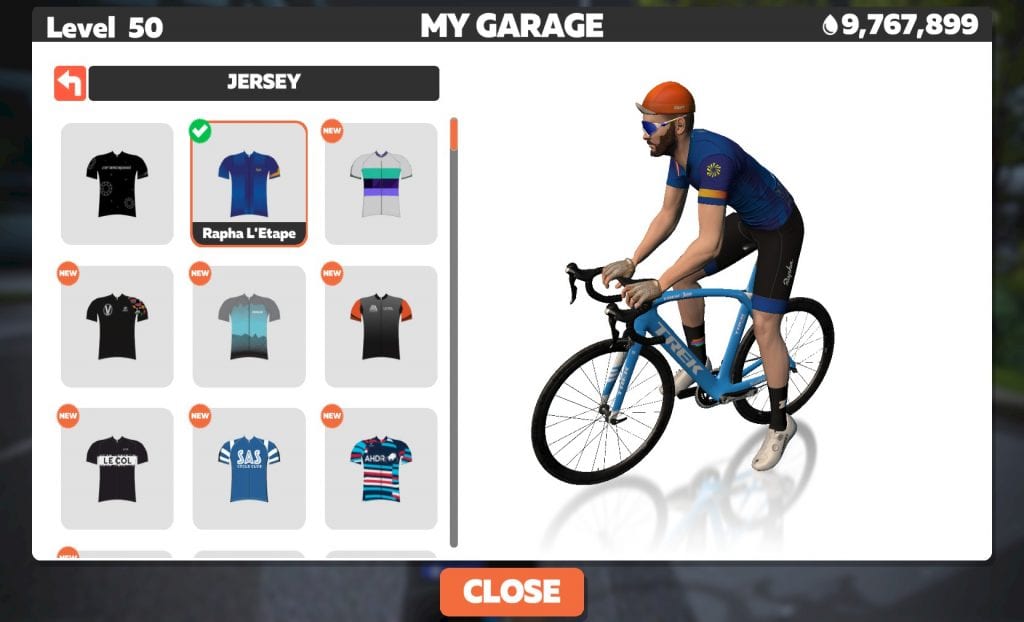
This update also “Fixed an issue with the Virtual L’Etape du Tour de France 2020 jersey not appearing correctly.” Last week’s L’Etape finishers noticed that the jersey they unlocked didn’t match the jersey shown in the event screenshots. This has now been fixed.
Old (incorrect) kit
New (correct) kit
Android Improvements
On Android, the update includes a few additional notes:
Enable high-quality graphics for newer Android GPUs:
Samsung S20 worldwide models (Adreno & Mali)
Google Pixel 5
LG Velvet
Huawei MediaPad M6
Stability improvements
The high-quality graphics note is good news for some Android users – we’ve already seen some comments from Zwifters on Android who have said the graphics look much nice after this update.
Other Updates
Update notes included these two minor notes as well:
Fixed a bug where other riders would swerve on the road or ride in circles in some situations.
Fixed an issue with Japanese text in the Drop Shop.