

Zwift recently rolled out Yumezi Grit, a new Makuri Islands route featured in the Pas Racing Series. The route is an almost 50/50 mix of dirt and tarmac, creating a bike choice quandary: do you go with a road bike for top performance on pavement, or a gravel bike so you’re fast in the dirt?
Let’s dive into that question. First we’ll look at how different bikes perform on this route in controlled solo tests. Then we’ll discuss how your strengths and the nature and location of the different road sections might affect your bike choice.
Related: Rolling Resistance on Zwift: Crr and Power Savings of Various Wheels

Solo Test: Road vs Gravel Bike
For the first test, I’m using Strava’s Comparison graph to compare the times of a fast road bike setup (S-Works Tarmac SL8 with DT Swiss 65 wheels) with a fast gravel bike (Cannondale SuperX LAB71 with Roval Terra Aero CLX wheels). These are basically the two fastest setups for this course.
A few notes to help you understand the chart:
- These tests were performed in an isolated environment: solo 75kg, 183cm riders holding a steady 300W.
- I tested using un-upgraded versions of both. If I compared the fully-upgraded versions of both, both frames would be faster overall, but the gaps between them wouldn’t change.
- I marked the dirt sections of the route in Strava’s chart below, so you can easily see how relative performance changes between dirt and tarmac.
- The purple line charts the time gap between the gravel bike and the road bike (which is the black line).
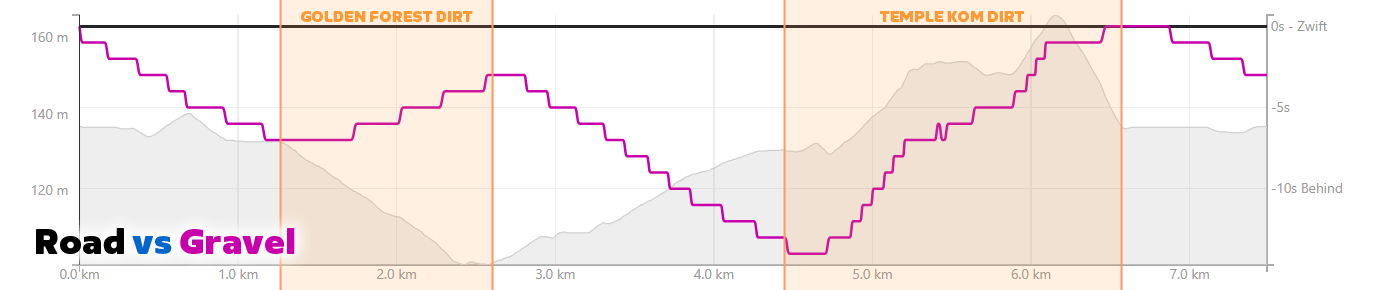
You can see that on the initial paved section, the road bike steadily grows a gap on the gravel bike. By the time they hit the dirt, the road bike is 7 seconds ahead.
Then they hit the Golden Forest descent, and the gravel bike pulls back 4 seconds. But as soon as we turn onto the pavement and begin the paved, slight climb up through the Fishing Village, the road bike gains another 11 seconds. By the end of this section, the gap is the largest it will be on the entire course: 14 seconds between the two bikes.
We turn a hard left onto the start of the Temple KOM, the road turns to dirt, and the gravel bike begins to quickly claw back time. Notice how (and this is important!) when the climbs get steeper, the stronger bike pulls ahead faster. This is true on paved roads and dirt.
By the time we leave the Temple KOM dirt, the two bikes are tied.
But the route ends with just under 1km of paved, flat road. During that time, the road bike gains another 3 seconds on the gravel bike, finishing 3 seconds ahead.
Solo Test: TT vs Gravel Bike
Out of curiosity, I ran the same test, but swapped out the road bike for the fastest TT setup available (the Cadex Tri with DT Swiss 85/Disc). This really doesn’t relate to the Pas Racing Series (or most Zwift races) at all, but it is interesting data if you’re racing a time trial on a mixed route!
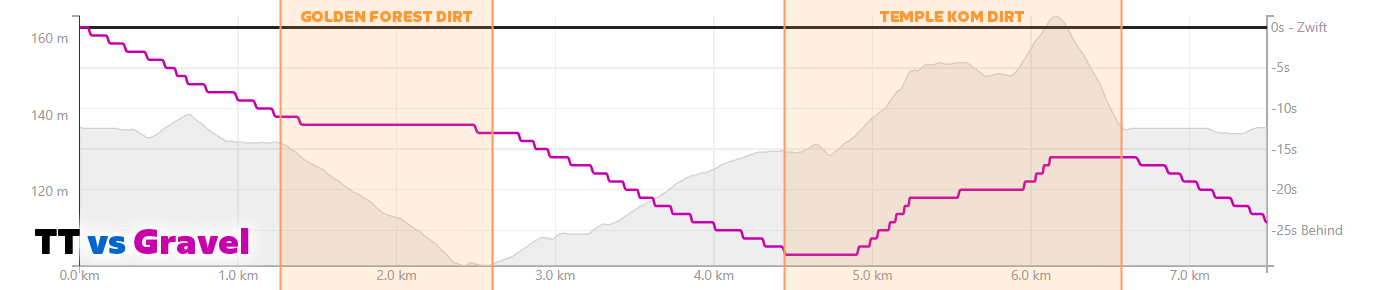
Here, you can see the TT bike is much faster than the gravel bike on paved sections, gaining 11 seconds on the first paved segment.
Then, on the dirt descent through the Golden Forest, the TT bike actually gains 2 more seconds! Chalk this up to the TT bike’s higher weight and greatly superior aero performance.
The gravel bike loses more time (15 seconds) to the TT rig on the paved climb through the Fishing Village. Then we turn onto the Temple KOM, and the gravel bike pulls back a handful of seconds, but only on the uphills.
After losing more time on the paved finish, the gravel bike finishes 24 seconds behind the TT bike.
The simple takeaway here is this: a TT rig is around the same speed as a gravel bike on flats and descents. More precisely, the gravel bike is slightly faster on flats, while the TT bike is slightly faster on descents. On dirt climbs, the gravel bike is faster. And if the road is paved, the TT bike is faster.
Other Considerations for Yumezi Grit
Of course, the tests above were done in isolation. What happens when you take on Yumezi Grit in a pack of 50-100 riders, with some on road bikes and some on gravel? And which type of bike will deliver the best result for you?
That’s a more difficult question to answer. But here’s how I’d look at it…
The race begins with a 4.1km lead-in from the village start pens. That means riders have a bit of paved climbing, then the Temple KOM dirt section followed by a bit of flat pavement, before lap 1 begins. (And here’s where I’ll note that, if my test charts above included the lead-in, the gravel bike would come out ahead by a few seconds!)
If there are enough gravel riders in the peloton, the lead-in could prove to be crucial. Gravel riders could attack the Temple KOM, create a gap on the roadies, and never be seen again.
Alternatively, the lead-in may be a big nothingburger, with gravel riders not pushing hard enough to create those gaps because they are wary of breaking away so early in the race.
Will fortune favor the brave? Hard to say.
I consider the first two sections of each lap to be sort of a wash: roadies get a slight advantage on the first ~1.2km of pavement, then gravel riders get a bit of rest in the Golden Forest.
The paved climb up through the Fishing Village is where the gravel riders will suffer most, because road bike riders will be attacking, knowing they have to hurt or drop the gravel riders before the Temple KOM. Fortunately for gravel riders, this is a very draftable climb (averaging just 1.6%). If gravel riders can sit in the wheels and stay in touch with the peloton to the Temple KOM turnoff on lap 2, they’ll be in a great position to win the race.
The Temple KOM dirt section on lap 2 is where gravel riders must push and create a gap on the road riders in order to have a shot at the win, since road riders will have a big speed advantage on the paved finish.
Gravel riders’ attacks will bear the most fruit on the uphill portions of this segment. But keep in mind, road riders may hit the Temple KOM dirt fresher than gravel riders, having just come off a paved climb!
If gravel riders can hit the final paved section with 5+ seconds on the road riders, they can take the win. But if road riders survive the Temple KOM in the front group, they’ll be heavily favored to win.
The Pas Normal race is 2 laps long, and my guess is that the lead-in and first lap will be muted versions of the second lap. Riders will be more concerned about staying in touch with the front group on the first lap, while they know they need to create actual gaps on the second lap.
So what’s the best bike for this race? As someone who suffers on climbs but sits in easier on the flats, I’m leaning toward the gravel bike, as I want the advantage on the final key climb.
But here’s the thing: if I were a stronger climber, I might lean toward a road bike and plan to attack hard on that climb up through the Fishing Village, pushing to hang with any surviving gravel bikes on the Temple KOM dirt so I hit the flat, paved finish in the front group with the fastest bike available.
Your Thoughts
Zwift has set us up with a real bike choice quandary with Yumezi Grit. It will be interesting to see how the races unfold.
What are you going to use for the race? Share your thoughts below, and after you’ve done the race… share how it went!


Is there any sprint advantage on the last stretch of tarmac at the end if you have a road bike? Assuming the the lead groups sticks together, the road bikes would have a stronger sprint advantage at the end. Unless you consider the extra energy road bikes must spend on the last dirt climb.
From the article above: “But the route ends with just under 1km of paved, flat road. During that time, the road bike gains another 3 seconds on the gravel bike, finishing 3 seconds ahead.”
Thanks, so then yes, if there is a 3 second advantage at 300W, I assume at 600W+ that advantage grows even more.
Once riders are going fast enough that aerodynamics dominates, the advantage is a fraction of distance or time, so seconds per hour will be similar, but seconds per distance will be less, since the distance takes less time. So the advantage in time is less at 600 watts, but the advantage in distance will be similar.
Don’t forget that Eric’s bots keep to the same 300W everywhere.
Anyone capable of 300W for 20-odd minutes will likely be doing something like ~360W up the tarmac/dirt climb, ~300W on the flat and ~240W on the downhill before the 1Km sprint at the end.
Gravel bike riders will have to drop road bike riders before the top of Temple KOM on lap 2 to have any chance of the sprint win.
What about changing from road to gravel before the long gravel climb?
You’d definitely lose more by switching bike than you’d gain (even if you had to only change once but you’d have to change twice per lap)
Another question: if I have a fully upgraded Aeroad and a level 0 Zwift Gravel bike, does the Aeroad upgrades erase enough advantage on the dirt climbs to make it a better choice?
It still wouldn’t beat the gravel bike on the Temple KOM section, but it would be lose by less. 😜
Looks to me like it would lose by less *on the gravel sections* to the gravel bike but gain more on the tarmac sections, so theoretically it shouldn’t be tied with the gravel bike but ahead of it at the top of the final gravel climb. More so versus Zwift gravel than the Cannondale that Eric tested.
With a fully upgraded S-Works Tarmac SLR8 bike essentially bike choice has become a no-brainer over the last year, for me it’s great fun to have this kind of speculation/gamble back again. Although I still think it’s the legs not the bike that win races.
Because I ended up leveling up to Cat B for this race and I was at the bottom of the category, I used the level 0 Zwift Gravel frame over the Level 5 Aeroad based on a recon video that suggested this strategy if you weren’t at the top of the category. I figured I wouldn’t be able to hang with the leaders (and I was right!) so I hoped the advantage on the dirt would help. After struggling to keep in the draft on the initial tarmac, I started clawing my way back and in the last uphill section on the dirt, I got back on the tail of the lead group. I promptly lost the group on the downhill & tarmac and never saw them again, but it was obvious the gravel bike helped. In the little groupetto that formed later, I would lose time on the tarmac but make it up on the dirt sections. On the last lap, I made up 20 seconds on the two riders in front of me, but we hit the tarmac together and I wasn’t going to outsprint them to the line…
But it does make me wonder if I had been in Cat C if the Aeroad would have been the right way to go because I know that I can keep up with those leaders and could probably gut my way through the dirt to stay in contact
I chose my fully upgraded Aeroad over my newly purchased, non-upgraded Cervelo gravel bike. I had no issues staying with the lead group in the C races and won the sprint to get the W.
Better a tron, or a fully upgraded Aeroad, or a SuperX LAB71 cannondale at the third upgrade level
A very interesting predicament in these races is trying to figure out what group to push to out of the pens based on yours and their bike choice.
For sure! I like interesting.
“Notice how (and this is important!) when the climbs get steeper, the stronger bike pulls ahead faster”
Is this just because you spend more time on the steep sections? Plotting with the x-axis as time would confirm. I bet the slopes are constant.
Thanks a lot for these detailed information. Will be very interesting to watch the advanced category and what bikes they choose on this route.
I thought the gravel bike would lose by less. Interesting and useful to see such numbers.
I have done few solo rides and I have both bikes. But the road bike is at level 5 and gravel was at level 3 . Gravel was behind before the dirt and came back closed the gap . And back on the pavement road bike opened the gap again as it should be .
And then you also have to consider a fully upgraded race bike versus standard gravel bike. It’s a mindf*ck. I guess I have to ride 2 races next week 🙈
It’d be cool if there was a map that showed which sections are gravel/dirt and which are regular tarmac crr. Not obvious to me where it begins and ends on the map.
Would be cool if Zwift introduced a second bike configuration you could set up before hand that allowed you to ‘quick’ swap to during the race.
Not sure why this has been downvoted. If it was good enough for Pogi in ’23 …
No matter what bike you choose, it’s just full gas everywhere. On a gravel bike you push hard to minimize the damage on tarmac and push harder to punish the roadies on the gravel and vice versa on a road bike 😀
What we need in Zwift are “All-Road” bikes…some of the newer ones have room for gravel tires and just as fast as most road bikes (Enve and Allied just to name a couple).
Would be interesting to see how an extra 25 kg of rider weight affects the results. Inquiring fat old guys (like self) might be interested.
Thanks for the insight, and all your work! Considering I may increase my chances to still be in a group at the end of the first downhill with a road/Tron bike… I’m going with this choice. After that, well, I’ll struggle whatever ;oP That said, I miss the time w/ 50 guys on the line (and still do not understand why all races are not opened to all cat. — even w/ separate leader-board/results… if anyone see the advantages, I’ll be happy to be educated!).
Mass start races are still available. Epic Races for one. As you’ll know, if you have Cat C power in an all-cats race it’s a *very* different dynamic to a race where you race only people with similar(ish) power. Oftentimes, the Cat C podium becomes a “who can hang on to the B’s the longest” test.
Not necessarily better or worse, but definitely different.
Sure you’re right but Epic Races are ~2h long and at best 60ish people onboard nowadays… I’m okay to loose against (C) or (D) if the terrain suits them better but less prone to ride half of a race by myself with 4 (B) 30″ ahead and 2, 40″ behind. Well I know I’m little bit picky but I have way more fun with populated events.
It’s a pity that a supposedly gravel series (where they pull the one route that’s actually all gravel!) sets us this conundrum. Not too sure why I’m bothering with upgrading my Aspero when there’s no actual advantage in doing so!
I upgraded one lvl and a half before it increased the distance. Without an actual gravel course.. I’m just going to ride my SL8 or P74
I am baffled why zwift didn’t just set up the gravel series races to require a gravel bike. Not seeing why that would be a bad idea, but definitely seems like a big mistake to include a route where the gravel bike is not the (clear) favorite as part of the series where they hope to promote gravel bikes. If people choose a gravel bike and lose the race to people on road bikes, it may dissuade them from riding a gravel bike in other races as well.
Amen to that!
The key to me is that the “cost”or producing power gets higher the higher the power. So going from 3 W/kg to 3.1 W/kg lacks the fatigue impact of going from 6 W/kg to 6.1 W/kg.
This means when in doubt, pick the bike which is stronger in “crunch time” — when the riders are going the hardest. When will the most attacks happen?
From my experience, this will likely be in the final dirt climb. Splits will happen before, with riders getting dropped, but the race will be won on that last climb. So to me, the gravel bike is the best choice here.
There’s limits. In Paris-Roubaix, riders don’t use the bikes which would be fastest on the cobbles, because so much more of the race is on the road. But when the surface is evenly split, pick the one where the key decisions will be made.
As a heavy lump who is currently struggling to ~2.5W/Kg for 10-15mins, my hunch is that using my stage 5 SL8 S-Works with either the DT Swiss 65s or white Princeton Wakes will be quicker than my stage 2 Crux with Zipp gravel wheels.
Unfortunately, https://zwifterbikes.web.app/ has not updated to include Yumezi Grit, or the recent equipment additions like the Cannondale gravel bike.
PAS Racing Gravel Series
Would have been nice if there was a restriction to only use gravel bikes for this series. It was just a thought. I’m still a noob, i still have a lot to learn when it comes to Zwift.
I just raced the 500-650 stage three on a level 2 Aspero 5. I got utterly destroyed by the pack which was on mainly road bikes. Definitely ride your road bike.
Some youtubers that used gravel bikes mentioned that it took a lot out of them just to keep up on the tarmac, by the time they got to the gravel portion, they only have enough to recover and stay with the pack. Been watching some streams on this particular course, seems like the road bike might be the right choice.
Yep, fully agree! Dropped out of the gate pretty much, managed to keep close enough to catch up on the first gravel section but that effort meant I couldn’t take proper advantage on the gravel and had to push again when back on the tarmac. Keeping up on the tarmac gradient was too much by the time we got round to the second lap🤯
I guess there’s a reason the pros don’t race on gravel bikes in Strade Bianche 😆
My 160-270 race didn’t go to plan, I pushed too hard (especially on the tarmac flat and Spirit Forest dirt descent) trying to help my group catch the leading group after they went off like a rocket at the start and I blew up approaching the dirt climb for second time.
I was on stage 5 SL8 with Princeton Wake white wheels (thought they might be the better choice over DT Swiss 65s given all the climbing).
A disappointing 42mins20secs.
~27mins30secs climbing, of which ~16mins was on the dirt climb at average ~2.2W/Kg, on average it was ~2.1W/Kg on the tarmac drags but the final lap drag was a dire ~5mins ~1.6W/Kg.
I might have another go midweek, trying to pace myself better and trying my stage 2 Crux and Zipp gravel wheels, purely out of curiosity as I have no GC aspirations… Although I do have just enough drops to buy the Cannondale gravel bike and wonder if that would be the better option!
Agree with the others. I was exhausted by the end of the lead in which is tarmac just trying to keep up with the pack, so any possible advantage was lost at the start.
Going to have another go later in the week on my road bike and see what the difference is.
Joe, I am going to wait till sunday to do my race. Just gathering info right now to make sure I’m on the right bike frame come sunday. I’m leaning more towards a road bike based on what i’ve gathered so far. Your feedback on your 2nd race will be greatly appreciated.
So, just finished the race again on road bike, mostly upgraded. Finishing position was 15/54 (28%) vs 28/72 (39%) on gravel and I finished nearly 1 minute quicker, with both laps being quicker than on the gravel bike. Also, it felt much easier – rather than constantly feeling like I was hanging on, I was able to catch up after getting dropped on a climb and felt much stronger at the end. Not definitive, as obviously a different group of riders, but certainly felt easier to me on the road bike.
Despite arriving in pen late (thought I’d missed it), just improved my time by over 2mins on Crux stage 2 and Zipp wheels, better paced and didn’t blow up… Albeit right at my limit from final dirt ramp while trying in vain to finish under 40mins.
Pack behavior favours the road bike. Road bikes have the advantage on the tarmac and can use the Steamroller PU on the dirt. Packs will let up on the downhills and the draft at high speed allow the road bikes to keep up if the gravel bikes are pushing at the front.
So the only place the gravel bikes can get ahead is on the uphill dirt section which is about 1.5 minutes until the flat bypass. The downhill dirt sections did not allow the gravel bikes to gain any advantage. I used the steamroller on the flat dirt bypass and had no problem keeping with the front group. At the finish of our race the pack of 15 at the front were all road bikes except 2.
Agreed. I just finished the B race and everyone in the ton 10 was riding a road bike.
570-725 group. I was on a Lvl 1 Cannondale SuperSix gravel bike and got absolutely smoked by all the Lvl 5 road bikes. I had to push too hard to stay with them on the pavement, so I couldn’t return the favor on the dirt. In fact, I got dropped that last, steep portion of the bypass as I still hadn’t fully recovered. I made it to the back of two riders heading onto the tarmac (who in turn made it back to the lead group), but then I was dropped by them and it was game over.
TLDR; use a fully upgraded road bike.
On another note, it’s too bad this series has gone the way it has. Stage 1 wasn’t fully tested, so we got bumped to the Jungle (and again for Stage 4). And not requiring gravel bikes mean Stage 3 is for road bikes. Feels like a huge missed opportunity.
I’m reconsidering putting in the work to upgrade my new gravel rig now…
Same result in the 450-570 range : road bikes owned it and dictated the pace. Against my initial feeling, I decided to ride my lvl 2 SuperX with Zipp XPLR wheels, hoping to launch strong attacks on temple KOM, but that did not happen. I suffered hell just to keep up with the roadies. By the time web reached the first gravel segment in the lead in, a 10-rider breakaway had already formed, and we were only 2 gravelers in the bunch. The gravel segments throughout the race didn’t provide opportunities to attack : they just gave a short, much needed respite to be able to stay with the group on tarmac. On lap 2, the breakaway split in two before the sprint banner and even though I managed to bridge the gap with my group on the Golden Forest’s descent, I had taken a heavy toll. I stayed with the lead break until the last Temple KOM segment, at which point the final, decisive attack was launched by road bikes using the steamroller (which benefits roadies a lot more!) uphill, never to be seen again. I ended up 6th, with everyone in the top 5 being on road bikes!
In my category, I am usually part of those driving the pace. Now, I was just in reaction & survival mode through the whole race.
Bottom line : pick a road bike and aero wheels. You won’t regret it!
Personally, I think one of the problems with this race is competing on gravel bikes with minimal improvement against level 5 road bikes. I ran the race, and in the top positions, I was the only one with a gravel bike (level 5).
It would have been better if they’d made the race accessible only to gravel bikes – IMHO
I’m going to stay with my old Specialized Crux frame for the gravel rides and use the upgrades i,first one is aero ,120 minutes riding to get,not too bad,and longer for the rest of the upgrades I guess.
Reserve 25 GR,tyres for the Gravel,.
Im not going to ride many gravel rides ,so I’ll spend my time on upgrading my top end bikes.
My experience. I tried a fully maxed out SL8 as I didn’t have a fully maxed out gravel bike to test against. I’m a upper middle C rider and there were several stronger B riders in the C race.
People in the race did comment that there seemed to be more roads than dirt, however the hills that mattered the most were on dirt.
As expected on the road from the start those with road bikes were out front but no one was able to build a large gap. The temple KOM was where all the moves happened. In each lap those with gravel bikes built a lead. In the first lap after the summit, the road bikes were able to easily group back up. On the second lap the stronger riders with gravel bikes build a 20-30s advantage on the template KOM and it was too little road left to gain that back.
The road uphill before the template KOM on the last lap I attempted an attack to gain time but it ultimately only ended in a few seconds which was easily surpassed on the dirt hills.
One important thing is regarding the steamroller powerup. That really did help keep the roadbike with the gravel bikes up the KOM. The problem is the KOM is broken into 2 climbs and you have to choose which to use it on. The second hill is steeper but shorter so I used it on the first each time.
Out of 75 riders or so, a group of around 12 survived the last lap together going into the KOM. I ended up in 9th, around 30s off the lead.
“(And here’s where I’ll note that, if my test charts above included the lead-in, the gravel bike would come out ahead by a few seconds!)”
Isn’t this what they call burying the lede?
I thought I noticed on climbs that the higher te watts and the lower the RPMs the worse my roadbike performed on gravel roads. Is it fair to conclude that higher RPMs distribute the power better on gravel so you don’t get bogged down as quick as you would with lower RPMs?
Your cadence (RPM) doesn’t affect your speed in Zwift.
maybe unpopular opinion, but I like that they included a race where bike choice wasn’t clear. It adds a layer of strategy for each rider based on their strengths and weaknesses.
If everyone is on a gravel bike it’s essentially the same as a road race but with different scenery (and with a bigger advantage to anyone who’s had time to upgrade to level 5). Mixing road and gravel gives some different dynamics.
For havier ridrts its better to choose the gravel or ? Because u can roll faster the the gravel uphill and the paved downhill?
Just rode stage 3, 0/17 gravel bikes. Glad I left my stage 5 Aspero I worked so hard to upgrade in time for this series (albeit at the old rate) in the garage. If you’re thinking gravel bike give your head a wobble. Someone used a steamroller on the road. That didn’t work either.
It is interesting how that works… that when more people use road bikes, it’s harder to win with a gravel bike.
It’s crazy. Maybe gravel races need to be fixed to allow gravel bikes only.
thanks for the insight! I WON MY FIRST ZWIFT RACE LAST NIGHT. I was riding a new, level 1 Cannondale SuperX lab71 with the ZIPP gravel tires. I was promptly dropped on the first pavement climb. I clawed my way back up to lead group on the gravel climb. after catching up, I focused on just trying to stay attached to the back of the group. on the penultimate gravel climb, I pushed ahead just to see how much effort it required to get a gap on the road bikes I was racing against. the pack caught me, and we stayed together until the final climb. just before the climb leveled out, I attacked HARD (hard for me). one other rider (riding the exact same bike) was able to come with me. between that attack and the last gravel kicker, we were able to put 10 seconds on the chasers. we rode at a moderate effort through the gravel downhill, and then when we hit the pavement I was riding at ALMOST full gas to try and maintain the gap. the roadies did close the gap on us, but it was too late. the two of us in front had a short sprint for the finish.
As a heavier rider, I had absolutely no chance with my Level 5 road bike (390–510 cat). I already lost contact in the first gravel section and ended up 7 minutes behind. I lost a ton of Zwift Racing Points. Worst race experience ever for me.
Did a lightly attended advanced (650+) race just now where it was basically 1v1. I was on my L1 Cannondale gravel, opponent on L5 SL8. I had to dig to stick with his attacks on the road climbs, but was able to put 20+ seconds into him on the first lap up the gravel climb. He caught me, but the same thing happened the second lap. He got within 20 meters of me on the road before the finish but I held him off. Super fun and tactical and I hope Zwift does more mixed surface races like this in the future.
I’m curious if anyone else would be interested in gravel pacer groups to help upgrade our new gravel bikes faster? I certainly would!