

We’ve recently completed an expansion of our ZIMetrics data, and are now using it to show precise metrics for all bike frames, wheelsets, and routes in Zwift.
On top of that, we’ve just launched detailed homepages for every frame and wheelset in the game! (See them by selecting a frame from our master frames list, or a wheelset from our master wheels list). While we’re still entering data and images for some frames and wheels, the basic info is in place and quite useful.
If you have questions about how ZIMetrics work, read on for details.
Route Ratings
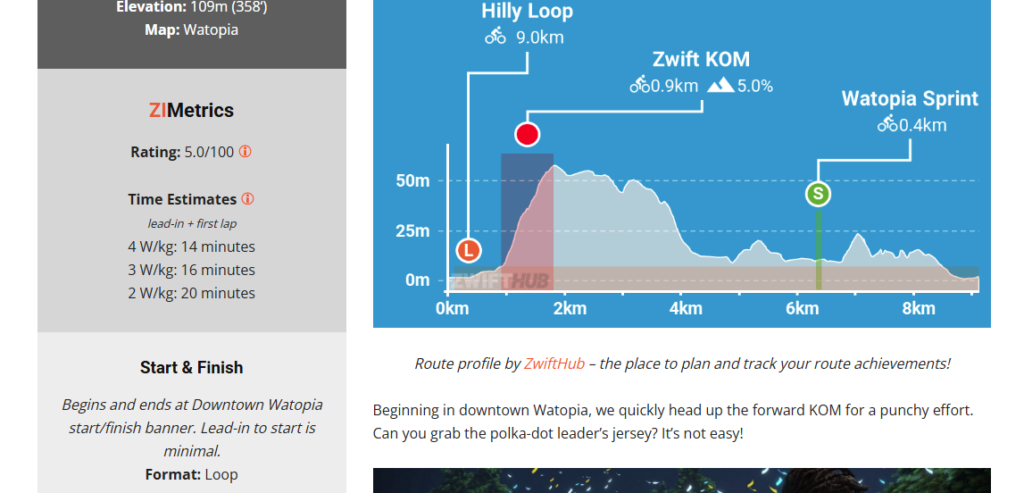
Each route also has an objective “Rating” score between 0 and 100. This is simply a normalized version of the time estimates (more on those below). For example, if ZIMetrics estimates that a route will take 40 minutes to complete, that means it will have half the rating of a route estimated at 80 minutes.
Yes, it’s not a perfect metric. But I’m not sure such a metric exists. The ZIMetric route rating is a simple way to rank routes against each other.
The current highest-rated (that is, the toughest) route – London’s “The PRL Full” – is rated at 100. If a tougher route gets released all scores will automatically be recalibrated based on the new maximum.
Route Time Estimates
First, let’s acknowledge that there’s no way to estimate a perfectly accurate completion time on Zwift, unless it’s a TT race and you’re perfectly following a particular “power plan” à la BestBikeSplit.
Our goal with these time estimates is to predict how long it would take a semi-experienced rider, riding efficiently in a group, to finish one lap of the course, including any lead-in. The algorithm assumes you’re a 75kg, 183cm rider drafting on the flats, on a decently fast bike, and pushing harder on climbs than on flats and descents.
Basically, the algorithm is based on a typical Zwift group ride or race situation.
Of course, draft conditions vary widely, as do rider height/weight, choice of bike, and power variability. To keep it simple and avoid requiring people to enter height, bike choice, etc, we made certain assumptions, and it doesn’t seem we lost much accuracy in doing so. In our backtesting, we found that the ZIMetrics estimates are almost always within 3% of the actual completion time. That’s certainly close enough for our purposes.
Bike Frame Performance Ratings
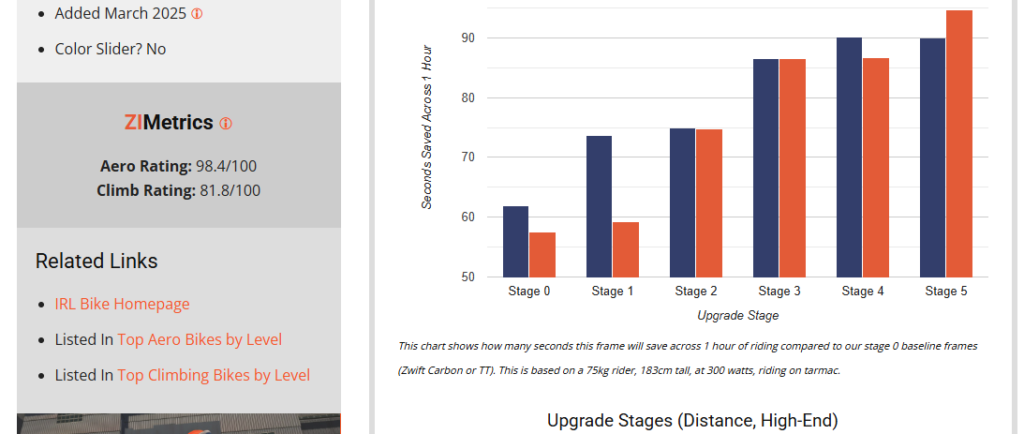
One common complaint from Zwifters (at least, the nerdier racers) is that Zwift’s 4-star rating system for aero and weight isn’t granular enough. That is, two bikes could both have the same rating, but perform quite differently.
With our performance ratings for bikes and wheels, we’re bringing a much higher level of precision to measuring the aero and weight characteristics of each piece of in-game equipment. Instead of 4 stars based on the frame/wheel’s in-game CdA and weight settings, we’re using a 0 to 100 scale based on the frame/wheel’s actual in-game performance.
See frame ratings by clicking a frame on our master list >
The metrics are quite straightforward for road bikes: an aero rating of 100 means it’s the most aero road frame in Zwift, while a rating of 0 means it falls below the performance of our baseline road frame, the Zwift Carbon.
There are a few details worth clarifying when it comes to frame metrics:
- Stage 5: The performance metrics assume you’re using the max-upgraded version of the frame, not the stage 0 version. This is important to note because, while most road frames maintain the same performance gaps between each other from stage 0 to 5, a few road frames – notably the Specialized Aethos S-Works – follows a different upgrade path, and thus becomes a much better climber when fully upgraded.
- TT Bikes: Ratings for TT frames are based on the performance of other TT frames. So a rating of 100 means it’s the fastest TT frame in Zwift, while a rating of 0 means it has the same or worse performance than our baseline TT frame, the Zwift TT.
- Example: If the fastest TT frame has an hour time gap of 93.4, while our baseline Zwift TT has an hour time gap of 45.6 seconds, a frame directly between those two times (69.5 seconds) would earn an aero rating of 50/100.
- Gravel Bikes: Ratings for gravel bikes work similarly to TT bikes – they’re based on the performance of other gravel bikes, not the performance of other road bikes.
- Halo Bikes: Halo bikes are a bit tricky, because they include a wheelset, so you can’t exactly separate the performance of the frame from the wheels like you can with other bikes. Therefore, we compare Halo Bikes to the fastest road bike frame+wheel combos in the game. And even still, the aero rating is over 100, because fully-upgraded Halo Bikes are faster than any road frame+wheel combo (see Specialized Project 74 as an example).
- The Pinarello Espada is an exception to this, since it’s a Halo TT Bike, not a road bike. For the Halo TT Bikes, we compare the bike to the fastest TT frame+wheel combo in game.
- Recumbents: Like Halo bikes, Zwift’s recumbents (the Handcycle and Recumbent Trike) include a wheelset. So we compare recumbents to the fastest road bike frame+wheel combos in the game. The Handcycle’s aero rating is over 100 because a fully-upgraded Handcycle is faster than any road frame+wheel combo.
Wheelset Performance Ratings
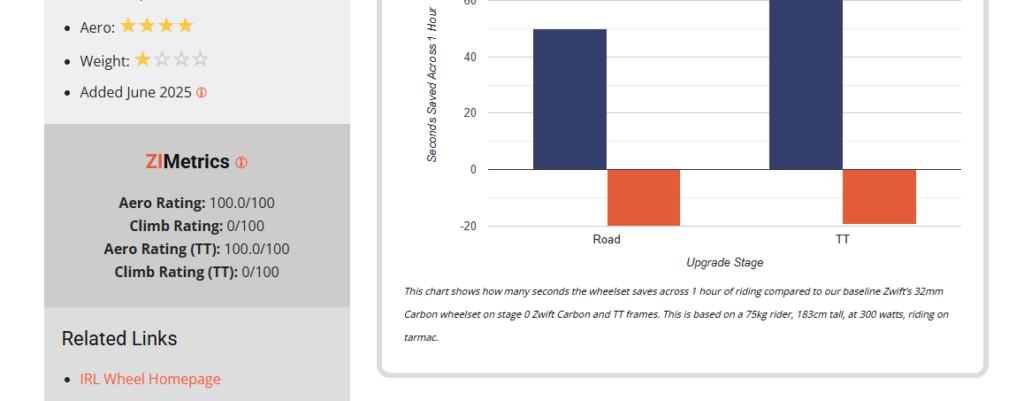
We have the same sort of 0 to 100 ratings now in place for all wheelsets in Zwift (see example above). Wheel ratings have a few details worth noting as well:
- TT and Road Ratings: Road wheels include aero and climb ratings for use on road bikes as well as TT bikes (see screenshot above). This is because some wheelsets – particularly disc wheelsets – perform differently on TT frames than road frames, because Zwift sets them up with a CdA bonus on TT frames to discourage their use on road bikes and encourage their use on TT bikes.
- Gravel Ratings: Since Gravel wheels can only be used on gravel frames, we’re only comparing gravel wheels to each other for our metrics. So a gravel wheelset with an aero rating of 100/100 means it’s the most aero gravel wheelset available, but that doesn’t mean it’s as aero as a 100/100 road wheelset.
See wheel ratings by clicking a wheelset on our master list >
Questions or comments?
Hopefully Zwifters will find these metrics useful as they research routes to ride, and which virtual bike frame and wheelset to use for those rides.
Got questions or comments? Share below!

Amazing work as always for us Nerds
I guess this was scripted to run on all of the items. But it still must have taken a while to get that script written and debugged. That must have taken some serious time,
The frame ranking charts (https://zwiftinsider.com/charts-frames/) are focused on riders holding 300 watts (4 W/kg) over a full hour. Only one chart is provided for riders for whom 2 W/kg is more realistic for an hour. But that chart is for un-upgraded (stage 0) bikes. Will there ever be a chart for fully upgraded (stage 5) bikes, for riders holding 2 W/kg over an hour? It’s hard to know which bikes to upgrade, and which ones to use for various routes, without the kind of chart made available for only the strongest riders in Zwift.
The good news is that it doesn’t change the chart in any meaningful way. The margins get stretched out a bit, for climbing a lighter bike has a slightly bigger advantage, but the best bikes really don’t change.
The Sworks SL8 is still the best all-rounder, the Aethos is still the best climber, the Cadex is still the best TT etc.
I’m not sure what you’re basing your comment on, other than assumptions. The site doesn’t have a chart for how bikes perform when fully upgraded, for riders holding 2 W/kg. That data isn’t in the spreadsheet, either. I’m not looking for assumptions or assurances that the information I’m looking for isn’t “meaningful.” Why have the charts at all, then? There are differences, and many riders want to know about them, not just the strongest riders in Zwift. (Judging by the “Riders Nearby” list, riders rarely achieve 4.0 W/kg, much less for an hour.) Obviously, slower riders fight less air resistance, so lighter bikes move up in the rankings. I want to know the specific tradeoffs for different types of routes and competitions.
This site treats riders holding 4.0 W/kg as the default, treating weaker riders as if they’re not welcome or in need of useful information. I’ve made this point here repeatedly, but it’s fallen on deaf ears. Women generally hold 0.5 W/kg less than men with similar training experience. (https://roadmancycling.com/blog/age-group-ftp-benchmarks-2026.) Getting to 4.0 W/kg even momentarily is a struggle, and not sustainable, for many other riders, too: handbike users, people with heavier body weight, people living with chronic illness, seniors, etc. Many of us still want to achieve advantages (marginal though they may be — just as they are for the strong riders) in races or on long routes, to make informed decisions on which bikes to level up or to use, and, in general, to be treated as if we’re normal, welcome users of Zwift and of this website.
Being a rider in his 60’s I hear what you’re saying. I think we need to remember though that Zwift has an almost limitless demographic of riders. Producing data to suit each and everyone would be monumental. You’re quite right in saying for all but a few the data is not totally accurate. It’s a better place to start though than nowhere at all. I take on board your frustration as it sounds like you’re wanting to be the best you can. Don’t be so hard on Eric though. The guy does a huge amount to make Zwift a better place for us. Drop in a race with him and his enthusiasm shines through.
One day maybe we’ll have the data we need but until then we’ll just have to figure some things for ourselves. As you rightly say, the data isn’t perfect but it gives us something to work from for now. Ride on 👍
I’m not asking for data for limitless rider profiles, just for data at 2 W/kg and, more broadly, awareness that many riders aren’t holding 4 W/kg. On the frame ranking charts page, Eric wrote, “Some readers have asked us to compute time gaps at lower power numbers, which is a perfectly reasonable request.” But then he did only half the job (focusing only on un-upgraded frames) and called it a day. The message he’s sending is, “despite saying this is a reasonable request, I don’t think it is.” Or maybe, “I doubt that weaker riders will upgrade their bikes, or care about competitive advantages, or like to save time on long routes.”
Also, it’s not hard to write in a more inclusive way. For example, Eric describes the Big Foot Hills route as as taking about two hours, and he says, “none of the climbs are long or steep enough” to merit using a lightweight bike. That’s not true for a rider holding 2 W/kg, though. He doesn’t always need to do more calculations, just disclose his assumptions: “Assuming that you can hold 4 W/kg….” That would make clear what kind of riders he’s talking to, and what kind of riders aren’t covered by his predictions and bike advice.
Not assumptions, extrapolations from published data. There are plenty of tests that show how zwift physics behave over various powers and weights, and using different frame and wheel combinations.
For one bike to be faster than another it must be either (or both) more aero or lighter. There are only a handful of bikes that aren’t immediately ruled out by this.
Aethos, SL8, Dogma, Venge, Aeroad.
A slower rider, whose ideal bike shifts slightly towards lighter weight rather than aero, should then focus on upgrading the SL8. Unless they only care about climbing, then it’s the Aethos.
Zwifterbikes allows you to plug in your own power, weight, and height to see how different bike and wheel combination perform on different courses.
Hey Eve! This is exactly the kind of thing I write about each week on OWL.Bike.
Coincidentally, last week’s article was “Zwift Bike Upgrades: Do Smaller Riders Get the Same Gains?” It includes data for the rest of us — riders lighter than the “standard” 75 kg, 183 cm rider, including most women and riders around 2 W/kg.
Check it out when you have time. https://owl.bike/zwift-bike-upgrades-smaller-riders-same-gains/
Zwift should add more routes for the endurance guys. Done the PRL Full twice and all the others too. Could need some more in the 4-6 hrs range.
id love to see some connections between the worlds. That would be epic. By portals or whatever.
Amazing work and very handy to use.
Thx for all the work you’ve put in this!
Amazing work. Thank you.
Amazing work Eric.
This is awesome. Thank you for all the hard work Eric and Team. Takes the guess work out of finding the best frame/wheel combos for different race/road types. ZwiftInsider is my go-to place for all things Zwift.👍
Would you consider adding the route difficulty data to the master list of routes, as a sort field. Thanks.