Home Blog Page 496

Don’t get a big head… but we’ve ridden 100 million miles

0

Don’t get a big head… but we’ve ridden 100 million miles

First of all, Happy April Fool’s Day to Zwifters everywhere. ZwiftHQ always does something fun for this day, and this year it’s big heads! (2016 was the old-timey effect, and 2015 was big wheels on Jarvis). So be sure to get a spin in today and enjoy a good laugh watching avatars on super bikes churning away in an aero tuck with huge noggins.

Along with April Fool’s fun, yesterday ZwiftHQ announced that our community has ridden over 100 million miles since Zwift began. How impressive is that? That’s 161 million kilometers… or 419 trips to the moon! Read more here >


My trip to the Radio Tower

0
I’m sitting in my living room drinking tea and folding laundry while listening to myself being interviewed on Zwiftcast. To say this is surreal would be an understatement. The last week of my life has been a bit of a whirlwind and my head is still trying to process it all. It began in February, really, when I decided that my depression wouldn’t keep me from riding to the Epic KOM in Watopia. I wrote about the journey and the lessons learned and the community came to life over it!

A Group Ride Is Formed

Al Clewley, a gentleman Eric and I only knew from one of the Zwift-specific facebook groups we’re in, asked if he could organize a group ride to help me push myself further… to the Radio Tower. We discussed what that would look like. It would be the slowest ride up the mountain for Eric and Al. It would push me beyond what I thought I could do. Others might join but would need to know this was all about just getting there, not getting there by a certain time. Al was very kind about it. Making sure he wouldn’t break me as he seemed to be just learning how to help someone with depression. I was honest with him and I think it helped us both understand depression a little better. I needed the accountability and motivation to go beyond my own limits, but in a safe place where I felt supported. This ride would do that. I was excited! As the weeks went by and we continued to notify the Zwift community of the ride people started adding the ride to their schedules. We were doing this, and others were joining us. Many to support me, others because they felt it was a safe place for them as well to get to the radio tower at their own speed. As we got a week out from the ride I began to feel more nerves and less excitement. But knowing others were rearranging their schedules to ride with me and cheer me on meant I was doing this regardless of how I felt about it.

ZwiftCasting Call

I was then contacted by Simon Schofield, the voice of the ZwiftCast. He asked if I would be up for an interview pre- and post-ride. I was thrilled to speak out on what it looks like for me to use cycling and Zwift as a way to combat depression. You can hear that interview on Episode 23 at ZwiftCast.com. He’s a lovely fellow and we had a great conversation. He was very encouraging.

Two Days Out

Two days before the ride depression hit me harder than it has in a long time. To be clear, I’m always dealing with it to some degree or another, but most days it’s fairly manageable. This was not one of those days. I slogged through the day, trying to do at least the bare minimum. Make the kids breakfast. Make the kids lunch. Pick the kids up from school. I sat slumped on the bathroom floor near dinner time and had decided I’d just stay there until bed. My body and mind were telling me I couldn’t press forward, I was physically exhausted, nothing was worth doing. I wanted to fight anyone who came into the room, punch the floor until my fist bloodied. This is the worst I’ve been in a long while. But as I sat there I thought of all the people who would be meeting me on Saturday morning to ride up the mountain on Zwift. “There’s gotta be at least 30 who will be there. And if I don’t ride my bike today I’ll have not ridden for 3 days before a long, tough climb.” Talk about accountability! I dragged my cycling gear on, trudged to the garage, and started some volcano circuits. Before you know it I was trying to get a PR on a circuit. It was nice to take my feelings out on something that was helping me be a better me. After 4 circuits (some of which were awfully slow) Eric suggested I go up the volcano. I gave him the evil eye…and then I went up the volcano. About two-thirds the way up I started crying uncontrollably. I didn’t want to have depression. I didn’t want this to be a painfully hard ride. I wanted to freak out. So I just cried. Which I must say, does NOT help in the effort to climb a mountain. And I came back down the mountain, barely pedaling, staying on just long enough to get a few more points. I felt some relief and knew I could keep moving forward.

The Morning Arrives

Me and my domestique, getting ready to ride.
The morning of the ride came fast and early! Up at 5am, ride started at 5:55. I was equally nervous and excited. I was also getting a migraine. My body likes to throw those at me in times of stress. When I logged onto Zwift there were 63 people ready to start the ride with me! As we rode I tried to balance texting messages to those who were writing to me, with talking to a couple of friends on Discord, all while climbing the mountain. That was overwhelming and I couldn’t do it all. So my dear husband, who had planned to ride to the top twice to see how fast he could do it, instead became my domestique. He’d reply to the messages for me as he pedaled alongside. He’d then jump off his bike and run upstairs to get my migraine meds, bring those to me, then pedal hard to join the group again. Everyone really should have a domestique at their house while they ride Zwift! Before I knew it time had flown by and we were at the Epic KOM! Everyone was so entertaining, hilarious and kind, going at my pace while in their part of the world. I didn’t even realize I hadn’t taken a single break up the mountain! I beat my previous time by 11 minutes!
I beat my previous time up the mountain by 11 minutes!
Next came the new part for me. The climb to the radio tower. At 14% grade I can honestly say it was the toughest time I’ve had trying to keep those pedals moving. I was moving at 3 mph, for a bit it was only 2. At the hardest part I had to look down and only think about pedaling. Sweat was pouring into my eyes and I told Eric, “I can’t.” But I kept pedaling. I knew if I stopped I wouldn’t start again. Eric, the great domestique that he was, started reading aloud the words of encouragement everyone was sending. I’d love to tell you what they were, but my head was so fuzzy that I used them to power me at the moment and have no recollection of them now.
Just keep pushing!
I was SO relieved to finally get to the top! Elated! Exhausted! I wanted to cry, throw up, and sleep right there. We hung out at the top for a bit. Some people kept on, others hadn’t quite made it up yet. Everyone just as important and doing just as brilliant a work as everyone else on the ride!
The real me, with all my real (virtual) friends at the top!
After a bit some of us started riding again to finish the entire mountain route. The downhill bits were glorious! My head was feeling a bit like it would explode again so as my avatar dutifully tucked herself on the descents I did my own “cradle my head” sort of tuck. Relief. Pain. Exhaustion. At one point I nearly fell off my bike as I leaned too far to the side. I made it back down the mountain and through the banner. I completed the entire mountain route and I never, ever would have been able to do it so well without every one of those 63 people rallying me along! After thanking everyone for joining me even as it was probably the slowest they’d ever gone up the mountain, one new friend, Pat Cryan put it this way: “that was my absolute worst time up the mountain and easily the best time.” I love that! In the hour to follow the event I threw up and did some crying. It felt like too much emotion to handle in one body. I didn’t know what to do with myself. And the rest of the day was spent eating and sleeping and taking my kids to opening day of little league baseball. The world goes on and I walk through it a little taller knowing I’m strong! If you struggle with depression and are a cyclist I strongly encourage you to do three things: Get involved in a community of people who hold you accountable to riding and pushing yourself. Speak out about your depression, as shedding light on it makes it less dark. And Ride On!

Here’s a gallery of shots Eric snapped throughout the ride. The ZVA humor kept it hilarious!

Zwift Study results part 1: How Zwift influences performance and motivation

Zwift Study results part 1: How Zwift influences performance and motivation

After introducing the Zwift training study in early February, the participants have been busy training and suffering. They are more than halfway into the 16-week period and we are able to present some interesting preliminary results.

Let’s sum up first what is investigating:

  • How effective Zwift can be as a training tool for cyclists to make significant performance gains
  • How does it affect motivation for indoor training, which is traditionally perceived as very tedious & is training with Zwift enjoyable?
  • How is Zwift rated by frequent users at the moment?

The Results – so far

After a week of testing, the first complete training block consisted of four weeks of long-interval Sweetspot training and a few sessions with intensities around their Functional Threshold Power (FTP). The majority of riders also competed in Zwift races once a week and the occasional group ride. The main goal of the training programs is to steadily improve FTP, fatigue resistance and endurance over the course of the study – turning the now 20 participants (Age: 38,35 ± 8,2; only males) into stronger cyclists overall. During each 4-week block, training load and intensity slowly increases followed by a transition week with reduced volume/intensity to allow the body to adapt. So how has performance developed after the first training cycle?

The outcome was quite stunning, even to me. An increase in FTP from 251w (± 38w) to 272w (± 40w) in four weeks! Not one single rider that did not improve his performance – and a few individual evolutions that were just fantastic – 245 to 270w – 265w to 292w – 250w to 320w! It is important no note that none of the participants come from completely sedentary periods. All of them had been riding and training in some way or another before the study for a while. Most had even been using Zwift for a while. Some of the increase might be due to an improvement ability to exercise at an intense level, but the general trend is clear: The training – on Zwift – was very effective!

But how does Zwift fit into this calculation? The best training is worthless if it burns out the riders and enjoyment is non-existent. To investigate the role of Zwift, mentally as well as physically, the participants complete a 15-question survey after every training block. Here are some of the highlights assessments from the first round:

“Do you feel your performance has improved over the course of the study?”

The observed improvements were very much in line with the feeling of the riders. About 95 percent think that they are better now than before.

Then there is the matter of fatigue – do the riders feel the stress of the training programme?

“Fatigue (before) vs. Fatigue (now)”

The fatigue increased very slightly from 2,22 average to 2,33, generally remaining “low” to “somewhat low.” A good indicator for the sustainability of the training intervention and the miniscule danger of overtraining.

A very important factor that supposedly gives Zwift an advantage compared to other indoor training apps are the “gaming” and the social aspect. They should provide long-term motivation AND enjoyment while doing something that his traditionally viewed as an inconvenient duty.

First the motivation to train:

“Before the study, my motivation to train and improve was…” vs “Right now, my motivation to train and improve is…”

This has been one of the most significant results so far! The motivation jumped from “somewhat high“ (3,89 average) to “very high” (5,56 average). After the first block, ALL participants answered with either “high” or “very high”. And that following a training routine that was conducted almost entirely on an indoor trainer.

Enjoyment was only measured after the first training block:

“Do you enjoy training with Zwift?”

The training seems to provide joy and entertainment and in combination with the motivation, training with Zwift appears to be not only effective but also a very satisfying experience:

“Regarding Zwift as a training tool, the positives are that there are so many ways to stay active and get fit outside of just staring at block training grids – racing, group rides, free rides, and workouts. The racing and group rides are particularly motivating.”

Additionally, participants rated Zwift as a training tool: 42 percent rated it “very high”, 40 percent “high” and 12 percent “somewhat high”. There was a bit criticism here too:

  • The design user interface is perceived as “clunky” and not very well designed
  • The Zwift Workout Editor is another area that seems to require improvements. Particularly a “copy-paste” feature for individual blocks and the ability to use it offline.

Summary

All in all the investigation has been a large success so far. All the key factors saw significant improvements after only one third of the study. Besides the obviously great results (from a Zwift user standpoint), we have developed a great community around the study with a very active Facebook group. The long-term goal here is to open it to the public after the study and turn it into a general group for discussions and guides about training for Zwift users! With the rapidly growing number of Zwifters you find many riders doing a lot of ineffective tempo riding. The presented results show that Zwift can be used in a more time-efficient way that yields great results while being enjoyable at the same time.

Until then, if you want to try some of the training the participants have suffered through, you can try all the key sessions. Get them at WhatsOnZwift.com >


Zwift v1.0.17198 released with Ride Report feature

0

Zwift v1.0.17198 released with Ride Report feature

Zwift has released its next major update on all platforms (version 1.0.17198 on PC/Mac, version 1.0.17159 on iOS). The most notable feature included is the new “Ride Report” which is displayed at the end of your ride.

The ride report will show you the basic stats of your ride such as a map of the route you took, notable things that happened, who you rode with, who gave you a ‘Ride On’, and allow you to even befriend those riders directly from the notification.   Additionally, for the data geeks who are interested in details, there is 2nd tab full of second by second ride data for power, cadence, and heart rate; as well as a 3rd tab which includes your ‘critical power curve’.

The ride report feature is a great idea–being able to easily follow riders you interacted with will help to build the community, and the additional ride data is always fun as well. I personally want to get a better look at the map, since I’ve got my own map I’ve designed and I’m sure the one used in the game is more accurate, especially in the places that are hard to see in game (distant shorelines and the like).

Additional updates include bug fixes on a variety of fronts–read the official release notes for details.

Included in the release notes from Game Master Jon Mayfield is this little teaser, which I like:

On the near-term future roadmap we have some exciting things planned, one of which is the ability to join an event for a short period after it has already begun.

Read official release notes >


Cycligent e-sports World Cup announced

0

Cycligent e-sports World Cup announced

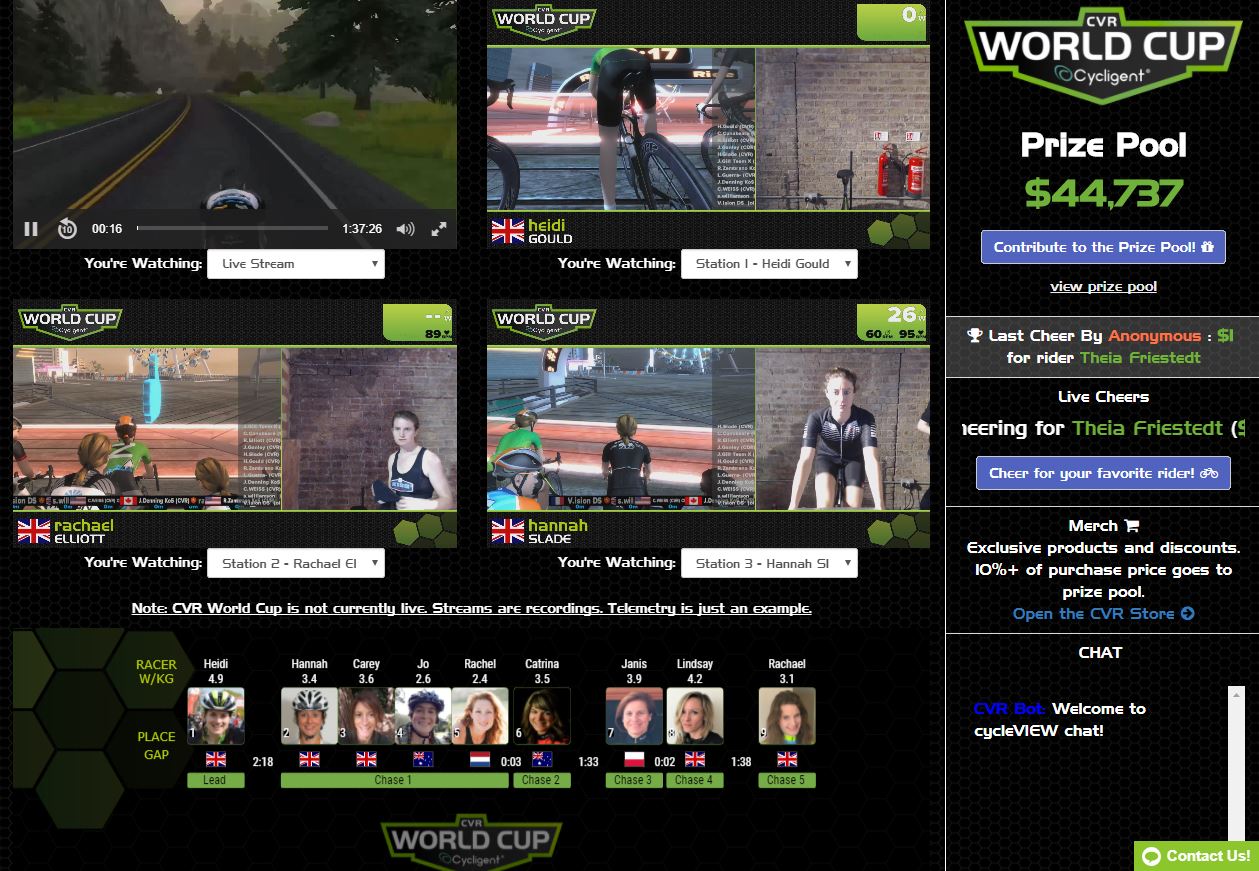
Vegas’ First Certified Virtual Racing at Millenial Esports on April 8 Cycligent is thrilled to announce Las Vegas’ first live virtual racing cycling World Cup, showcasing world-champion cycling superstars from 10 countries to compete against one another in Zwift’s online course environment. Fans and online viewers will be able to watch and cheer on incredible cycling talent representing their countries, like current Master World Road and TT Champion Scottie Weiss.

On Saturday, April 8, 2017 beginning at 3:00 p.m. at Millenial Esports thE Arena, located at the Fremont Street Experience, 450 Fremont Street, Las Vegas, NV 89101. Cycling fans and E-Sport enthusiasts are invited to cheer on our riders as they fight for the win for their country and experience virtual racing, where real sport and effort is put into gaming competition. Riders from the US, UK, Australia, Mexico, Netherlands, France, Switzerland, Canada and Asia will be competing. Tickets to attend in-person can be purchased here.

Virtual cycling using Zwift.com has been gaining fandom across the world, where participants of all levels race on a real-life bike set up on an indoor trainer with power metrics designed to simulate riding through elaborate 3D courses.

This event is a kick-off for a series of Future World Cup events. Friendlies, Qualifiers and the World Cup Finals 2017 Event will be coming soon! Frank Garcia, founder of Cycligent, says “Given the sharp increase of recent viewership and participation of esports events, the opportunity to bring these events into a live setting feels really exciting and fun. The energy of a race is always exhilarating, and sharing the online setting with the public will only enhance the race experience for both the cyclists and spectators alike.” Future teams and nationalities who want to participate are encouraged to send us an e-mail us at [email protected].

Races are officially sanctioned by Cycligent Virtual Rankings (CVR), who ensure the CVR Racing Regulations are adhered to. All measurement and transmission equipment is calibrated and certified by CVR officials. Competitors are weighed and measured, assuring a fair and accurate competition.

The event will be broadcast live in HD and emceed by Nathan Guerra, 2016’s #1 ranked USA Cycling MTB pro and Zwift Broadcaster through Zwift Community Live to an expected 30,000 viewers across the world via twitch at twitch.tv/zwiftcommunitylive.

The event will also serve to benefit World Bicycle Relief, a non-profit organization that serves to address the great need for reliable, affordable transportation in rural areas of developing countries, and is sponsored by Cycligent.


Attacking and Defending (Skillz and Drillz)

Attacking and Defending (Skillz and Drillz)

As a race unfolds, you have to be cognizant of where you stand in relation to the group in which you are riding. Riders have different strengths, and you have to play to yours. If you are a strong rolleur but not a great sprinter, you have to think of places where you can attack the group to try to get rid of the sprinters or simply get away. If you are a strong sprinter, you have to focus on responding to attacks well before the sprint to remain in contention. In today’s class, we covered the basics of attacking and defending. Part of the class can be watched below.

.
Attacking and defending is a tricky thing. Do it too often and you won’t have enough gas left in the tank for the finale if you can’t escape. Do it too little and risk bringing people who otherwise may not have made it to the finish. Likewise, defending is equally as tough. You cannot chase down every attack, or your matchbook will be empty very quickly. But, miss one move, and the race is over.

So that begs the big question: how do we do it?

Beginning Exercises

In today’s class, we covered the basics of attacking and defending in a very controlled environment. The group was divided into three based on the first letter of the last name. This was done to keep things from getting too stretched out and make the small groups more manageable. To kick it off, we rode at 1.5 W/kg after finishing our warm-up. When instructed to do so, each group accelerated to 2.5 W/kg and held it for a period of 30 seconds before settling back into a 1.5. The idea was to accelerate to 2.5 as quickly as possible in an effort to create a gap. After the groups came back together, we repeated the exercise two more times, each with a progressively more aggressive acceleration to a higher W/kg before settling back at 2.5.

Remember, this is an attack, so the changes have to be quick and violent. Otherwise, it is simply a ramping up of the pace that allows your opponents to ride comfortably in your slipstream. The goal is to create a gap as quickly as possible to force others to work to go with you, reduce the field, and/or try to escape. Once the gap has been opened, it is no longer necessary to keep drilling the pace at a supra-threshold effort, so the attackers can ease back into a pace equal to or slightly higher than that of the chasers behind…until the next attack, that is. The key part to setting the post-attack pace is simply having a good understanding of how much you have left in the tank and how long you have left in the race. This year’s E3 Harelbeke was a great example of measuring the attacks. The winning move came from one decisive attack launched from a distance that was manageable at a hard effort. Prior to that move, a number of the other pre-race favorites had launched a series of unsuccessful attacks, causing them to burn that one match too many and unable to respond to Gilbert’s move to bridge to the break. Only GVA and Oliver Naesen could go with him in the end, as he executed a string of short attacks that whithered the legs of the front group. While Gilbert ended up with second, his moves put him in a much better position in the finale than had he gone to the sprint up against Boonen and Sagan in addition to GVA.

Attack and Defend

After finishing up the first set of exercises, we moved in to the attack and defend portion of the class. Like in the first round, we kept our three groups but designated a group leader who would initiate all moves. Additionally, we established some rules about attacking and responding to keep the exercise from devolving into chaos. Group 1 would initiate the first attack, accelerating to max power and then settling to 2.5 for 40 seconds followed by a return to 1.5. Group 2 would respond in a similar fashion, keeping the 2.5, though, until making contact with Group 1. Group 3 immediately followed Group 2. However, upon making contact with Group 1, Group 3 attacked with Group 1 defending. As such, we had a never ending cycle of attack and defend. After a few minutes of this drill, riders were allowed to launch the attacks and responses at a higher W/kg and respond as soon as he/she identified an attack without waiting for the group leader. This process rounded out the remainder of the class, providing ample opportunity to recognize attacks and judge the response.

As I mentioned earlier, responding to an attack is a tough job. Mental math on the fly while lactic acid courses through your leg muscles and your heart beats out of your chest is a difficult task to accomplish. Therefore, the best way to conserve without being caught out is to have a good situational awareness and maintain a good position in the group. Recognizing the attack as it begins allows you to get in the draft of the attacker without having to commit to an intense bridge over a bigger gap. Remember, your attacker doesn’t necessarily want you to come across. It is much easier to win the sprint finish if you are by yourself than of you have a breakaway partner. At the same time, not every move can stick. If a mid-level rider makes a big move off the front early in a race, chances are there is no need for a big response, as the group will likely pull the rider back over time with relative ease. Like I said, though, it is mental math which means that there is a risk. Check out the last few kilometers of Gent Wevelgem on 26 March. Man-beast Peter Sagan sat up when GVA pressed the pace. Sagan wanted Niki Terpstra to cover the attack, as Sagan had covered the previous three. Terpstra politely declined, and the gap opened, never to be closed. Sagan’ decision, right or wrong, cost him a chance at the win.

There is no easy answer to the question of whether you should attack or cover the attack. A solid understanding of your fitness level, the course, and your opponents go a long way towards influencing your decisions. If and when you decide to go, you need to commit. Anything less than a full-on attack or response will likely turn into failure. Give it all you can, and your chances of success grow exponentially.

That’s it from this week’s SkillZ and DrillZ. Thanks to all who participated and to Castelli and Zwift for sponsoring the ride. On 29 March, we will be back with another class where we will focus on launching attacks on the short, punchy climbs of the Volcano route. Until then, Ride On!

Strava Smackdown Series, week 6: Volcano KOM

0

Strava Smackdown Series, week 6: Volcano KOM

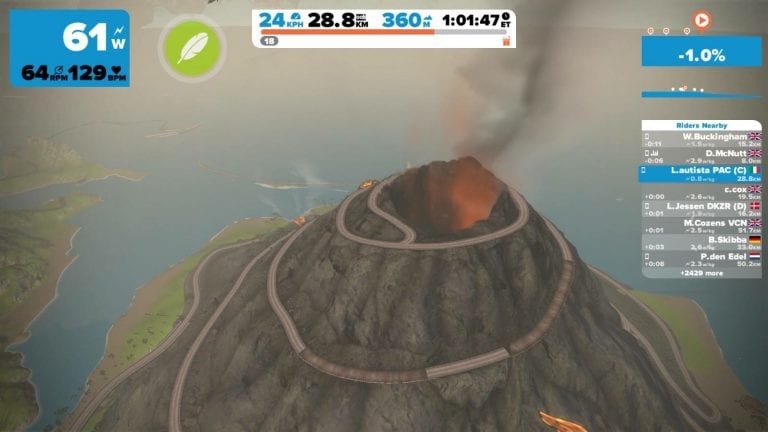
This week’s Smackdown covers Watopia’s new Volcano KOM, which corkscrews up (and thru!) Watopia’s newest land feature. At 3.7km (2.3 miles) and 126m of elevation gain it’s a medium-length climb that’ll get you working. The Strava segment is titled “Volcano KOM (Zwift Insider verified)“.

See week 6 round live standings >

Prizes this Week

First place for men and women will each receive a swag bag from our friends at World Bicycle Relief.

Three other random finishers will receive a Zwift water bottle from ZwiftHQ! These high-quality Specialized Purist 22oz bottles will make an excellent addition to anyone’s indoor setup.

How to Enter

Entry is easy–the ride is the hard part! Simply join the Zwift Insider Strava Smackdown league on Strava Leagues. Click to join >

Then select one of the volcano routes and manually turn onto the climb section. The segment begins when you see the timer begin at the top of your screen, and ends at the top of the mountain at the KOM banner.

You must enter between March 27-April 2 (UTC) to be eligible.


Helicopter view of the volcano KOM

Strava Smackdown Series week 5 winners

0

Strava Smackdown Series week 5 winners

For our fifth Strava Smackdown week, 21 riders hit the forward Flat Route. Here are the podium finishers.


All finishing times can be seen on this round’s page at stravaleagues.com.

Water Bottle Winners

Along with World Bicycle Relief swag bag prizes for our first place finishers, three random entrants will also get a water bottle from ZwiftHQ. Those three winners are:

Claim Your Prizes

Since we have no way of directly contacting entrants, prize winners must email [email protected] by April 4th with their full name and mailing address so we can get your prizes shipped out.

What’s Next?

This week we’re taking on the new Volcano KOM. Stay tuned for the official announcement!


Sign up to test Zwift on Apple TV

0

Sign up to test Zwift on Apple TV

Back in January we wrote about how Zwift would be available soon on Apple TV, and yesterday ZwiftHQ put out the call for beta testers!

If you have a 4th generation Apple TV and are able to provide helpful feedback you can sign up here. (3rd generation and earlier do not use 64-bit chips, so they are not compatible with Zwift.)

Given ZwiftHQ’s timeline with its iOS beta test and final release, I would estimate that Zwift will be officially released for Apple TV some time in the next 2-3 months. This is great news for our community, of course, because it further lowers the barrier to entry and expands the possibilities for current and potential Zwifters. The 32GB Apple TV, available for $149 in the US, should provide the best quality gameplay available at this price point.

What Quality Can We Expect?

4th-gen Apple TV is powered by the same A8 processor and graphics found in the iPhone 6, so performance should be comparable. Zwiftalizer shows the A8 runs using Zwift’s “720 Basic” profile at just under 30 frames per second.

At this performance level, graphics quality on a large-screen TV could be described as decent. Quality is noticeably lower than a high-level gaming PC setup, but the framerate is high enough that gameplay is still feels smooth even if the overall graphics aren’t as crisp.

Here are two screenshots which show the sharpness of an iPhone 6 (click for full size).


Zwiftcast Episode 23

Zwiftcast Episode 23


Episode 23 of Zwiftcast has been released. This episode is extra special to us here at Zwift Insider since it includes an interview with Monica Schlange, wife of Zwift Insider editor Eric Schlange and contributor to Zwift Insider.

Here’s the full episode description:


Simon, Shane and Nathan are back together to discuss all the latest happenings in Zwift. The trio kick off with a discussion about Nathan’s recent visit to Zwift HQ. Whilst he can’t be specific, Nathan reveals his excitement at upcoming developments by responding to Simon’s quiz questions.

Next is a feature with Frank Garcia, the veteran Zwifter and architect of the Cycligent ranking system, who talks candidly about his bid to “own” e-sports on Zwift. Fresh from a test event in the USA, where top Zwifters raced each other in front of a live audience, Frank is now taking the idea of live, validated, certified racing in front of a live and online global audience, to the next level with a big event in Las Vegas.

The Zwiftcast trio chew over the implications of this – and Shane talks about his hopes as a competitor in Vegas.

Monica Schlange has written movingly on Zwift Insider about her battle with depression and how her efforts to conquer the illness with cycling seem somehow tied to the Zwift Mountain and Monica’s ambition of getting to the top. The Zwift community has pitched in to help her with a group ride to get Monica to the summit. Monica talks about cycling, the illness and what the community means to her.

The FTP test is now a familiar fitness tool to many Zwifters – but is the protocol used in game to assess fitness the correct and most suitable one for beginner or casual cyclists? Dr Alex Mitchell isn’t convinced – and he comes on the Zwiftcast to explain why and talk about his fitness tool which can provide an FTP figure using a much shorter test duration than the arduous 20 minute period used by the established test. Simon, Shane and Nathan discuss Dr Mitchell’s findings.

The boys finish with another brief discussion about the promise of Frank Garcia’s event in Vegas – and whether Britney Spears might be acting as Shane’s soigneur!