

Club Ladder, also known as “5v5”, has now been running for more than three years, with more than 16,000 races contested by 7,500+ unique riders. By sheer volume, it may be the largest community team racing series on Zwift, but its scale isn’t really what makes it interesting.
The unique thing about Ladder is how much control it gives the teams themselves. Two captains agree to race, they find a time that works for both teams, and they get on Zwift and race. There is no fixed weekly schedule, no central race organizer deciding who races whom, and no requirement that every team participates every week. Teams can take it as seriously as they like, build rivalries, race with the same group of mates every week, or simply jump into whatever challenge looks interesting.
In that sense, it is perhaps the most team-empowering series on Zwift.
Over the years we’ve added a few things around that core format to give teams extra motivation:
- Rungs give teams a smaller group of nearby opponents to compete against
- Belts allow teams to challenge for some extra bragging rights
- We’ve also experimented with different race formats, including 5v5v5 racing and Points Races
But we’d never really tried taking the teams and flexibility that make Club Ladder unique and building something completely different around them.
In 2026, we decided to try a tournament.
The Road to a Tournament
This wasn’t our first attempt at doing something different. As mentioned above, in late 2023, Club Ladder introduced one-off 5v5v5 races, and in 2025 we introduced Points Races, adding segment scoring to the standard Ladder format.
For 2026, we wanted to go a little further and create a completely separate competition using the teams and infrastructure we already had.
The opportunity was sitting right in front of us. More than 200 teams were already configured on the Ladder site, captains were actively engaged on Discord, and thousands of riders were already familiar with the format. We didn’t need to create a new racing community from scratch. We just needed to ask whether those teams wanted to try something different.
The answer wasn’t universal. Some teams weren’t able to participate, while others were perfectly happy carrying on with normal Ladder racing. That was fine. The tournament was designed as an additional competition, not a replacement for the format that had already brought thousands of riders to Ladder.
For those who did want to participate, we still had to figure out exactly what they were signing up for.
Designing a Tournament With 200 Cycling Teams
We considered plenty of possibilities, from an FA Cup-style knockout to smaller rung championships, mass-start races, relays, and large multi-team races.
The challenge was finding something that worked with Ladder’s greatest strength: flexibility.
A traditional knockout tournament doesn’t fit that model particularly well. If two teams have to arrange a race themselves, a single round can easily take a week or more. Multiply that across several rounds and the tournament could stretch for months.
There was also the rest of the Zwift racing calendar to consider. Ladder’s flexibility has always allowed it to coexist with ZRL, DRS and the many other competitions taking place throughout the year. A tournament with fixed dates and times would remove some of that flexibility, so we wanted to keep the experiment contained.
We settled on three weeks. We needed a format that could take all the participating teams down to a clear champion(s) in only three races, with everyone racing on the same night.
The 2026 Ladder Tournament
Rather than trying to crown one global champion from 200+ teams, we used the existing Rungs to create groups of roughly 10 teams and let each group race down to a champion.
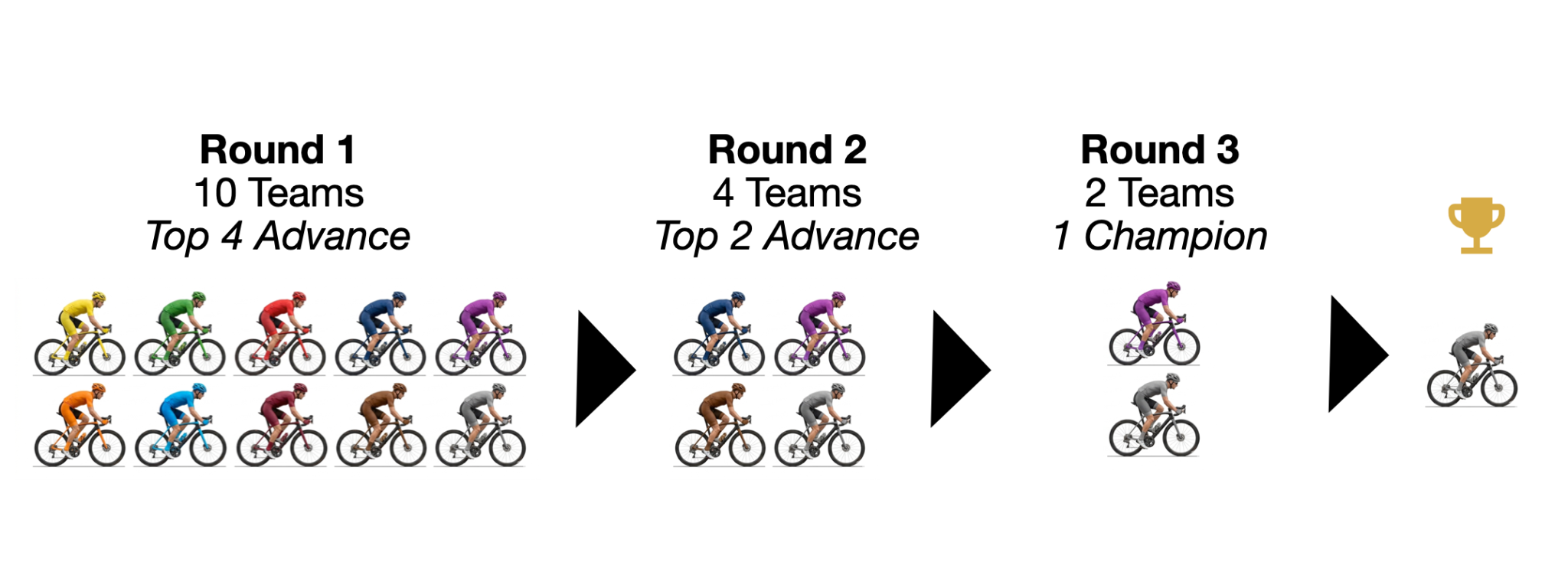
Rounds 1 and 2 would be mass-start races, with as many as ten teams competing together. But we didn’t want to simply run a normal mass-start race and add up finishing positions. One of the things people love about Club Ladder is its tactical, team-oriented nature, so we wanted the scoring to reward teams for working together.
A New Concept: Team Cohesion Bonuses
The basic idea was that the team’s score would start with the finish time of its third rider. You need at least three riders to finish, and that third rider establishes the team’s base time.
From there, teams could reduce their time by demonstrating cohesion by keeping the riders around that third rider close together.
In Round 1, if the first rider finished within five seconds of the third, the team received a 20-second bonus. A gap of less than ten seconds earned ten seconds, and less than 20 seconds earned five seconds.
The same scale applied between the third and fifth riders, provided the team had five finishers.
So a team with five riders finishing within five seconds of each other could take as much as 40 seconds off its third rider’s time.
Third rider’s time − cohesion bonuses = team time
Lowest time wins.
For example, if a team’s third rider finished at 30:08 and both the first and fifth riders were within five seconds, the team would receive two 20-second bonuses and finish with a score of 29:28:
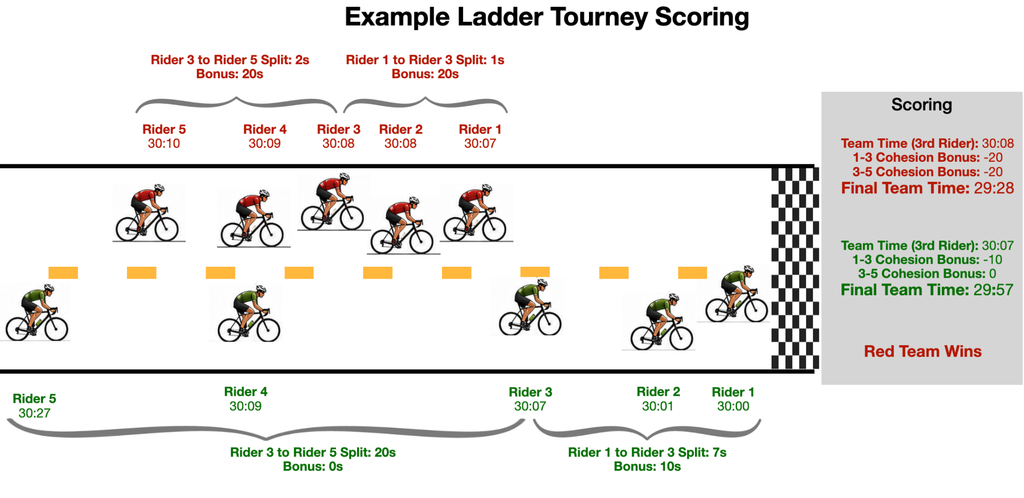
The deliberately large bonuses were intended to create strategic decisions. If your fifth rider was dropped, was it worth slowing down to bring them back and recover the 20-second bonus? We wanted the answer to be “often, yes.”
The format is somewhat similar to Team Time Trials in ZRL and Team Time Races in the Dirt Racing Series, but with an important difference: this was still a mass-start race, and we were explicitly rewarding team cohesion.
Round 1: A Live Experiment
Teams figured out the basic strategy surprisingly quickly. Getting across the line together was important, but preventing other teams from doing the same was arguably just as important.
Round 1 featured Triple Twist, with decisive climbs over Jarvis and the Hilly KOM. Most races became tactical affairs, with teams saving their powder for attacks on the climbs. Teams that lost their fifth rider were almost immediately in trouble because they could no longer earn the second cohesion bonus, and most of the teams that kept five riders together eventually came down to a bunch sprint.
There were some genuine heroics, though. Several teams used their team time trial skills to regroup after riders were dropped, with their strongest riders sometimes sacrificing their own finishing position to keep the team together.
Team TFC provided perhaps the best example. After the KOM, the team regrouped around riders who had been dropped and deliberately stayed together rather than chasing individual finishing positions. Under this scoring system, that was exactly the right decision.
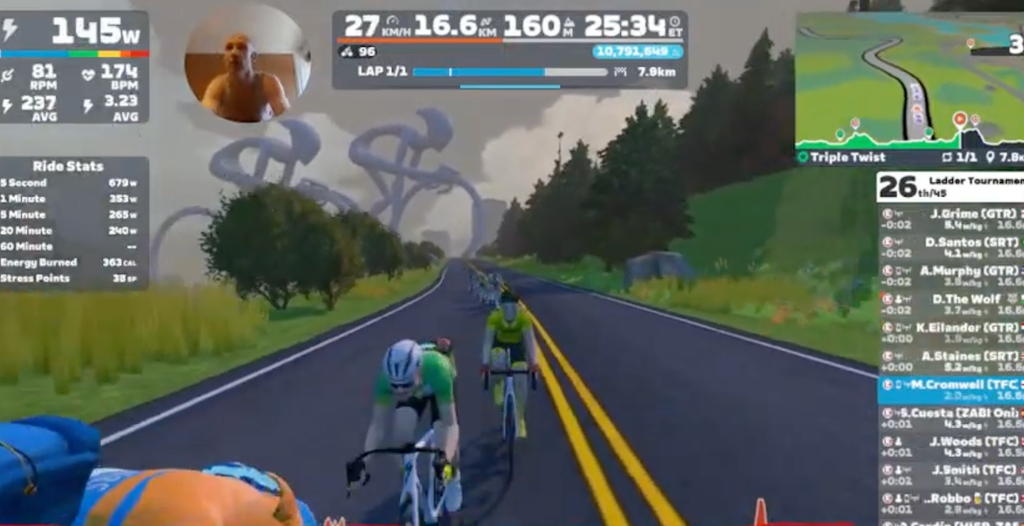
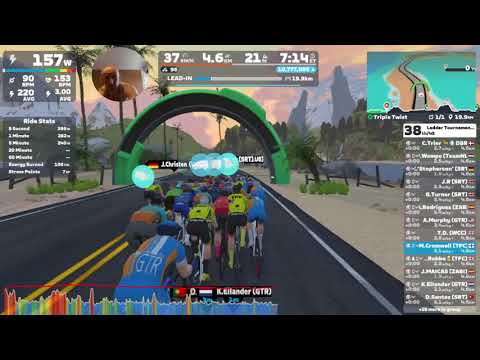
Round 1 also exposed a flaw in the scoring. Because the back-end cohesion bonus depended entirely on the fifth rider, once Rider 5 was dropped, Rider 4 effectively stopped mattering to the team’s score. Some fourth-place riders ended up soft-pedaling or even DNFing, which was the opposite of what we wanted.
The goal was for all five riders to have a reason to stay together, so we changed the scoring for Round 2.
Round 2: Tighter Scoring
For Round 2, Riders 4 and 5 could each earn their own cohesion bonus based on their gap to Rider 3:
| Gap from Rider 3 | Rider 4 bonus | Rider 5 bonus |
| Less than 5 seconds | 10 seconds | 10 seconds |
| Less than 10 seconds | 5 seconds | 5 seconds |
| Less than 20 seconds | 2 seconds | 2 seconds |
The bonuses were smaller, but keeping the fourth rider close still mattered even if the fifth rider had already been dropped.
We also changed the course topography, with Round 2 finishing uphill on the Rooftop KOM on Makuri’s Electric Break. The climb punished teams that had saved everything for a final sprint, while the tight final corner produced several very close finishes. Several teams missed out on cohesion bonuses by mere tenths of a second.
In the end, only two teams remained in each group.
The finals were set.
Round 3: 5v5 Finals
For the finals, we went back to what Club Ladder does best: a traditional 5v5 race.
This time we abandoned the experimental time-bonus scoring and returned to finish-position points. The course was The Muckle Yin, offering two climbs of more than two minutes, sprint climbs, rollers and a flat sprint finish.
After some heroic catches, tactical attacks and close finishes, the points were tallied and our first Ladder Tournament champions were crowned:
- Americas: Coalition Akkadium, TFC X-Force, OTR RED_PELOTON, SISU Meno
- APAC: 4STAR Apollo
- EMEA: Cryo-Gen Handlebar Heroes, Foudre Picodon, TeamNL VacMasters, SZR Delta Force, KLUB Smarties, Dunking Teabags, SZR G-force, SZ Loki, DIRTy Pyrites, WCC The Spinning Discs, Fellowship Shadowstep
- Women’s: LEVEL Krakens, Coalition Galaxium
Huge congratulations to all of the winning teams, who now have the coveted virtual trophy on their team page and the rarified Club Ladder Kit in their garage to wear for the balance of the year.
What Did We Learn?
The tournament is now over, but the experiment isn’t really finished.
We sent a feedback survey to participants to find out what worked, what didn’t, and whether they would do it again. We received 130 responses from a mix of riders and captains.
The headline numbers were encouraging:
- 83% said they would personally race in a future tournament, with another 15% saying maybe.
- 69% said the different scoring format made the tournament more interesting.
- 62% wanted to see one or two tournaments per year, while another 35% would happily race three or more.
The comments also highlighted three themes.
Theme 1: The Tournament Was a Welcome Change of Pace
The clearest message from the feedback was that people liked the idea of a tournament. Several riders described it as a great way to shake things up, while others offered ideas for how future editions could build on it.
One recurring criticism was that the tournament ended too quickly for teams eliminated in Round 1. A double-elimination or “loser’s bracket” format could give those teams something to keep fighting for, even after missing out on the main prize.
Theme 2: Scoring Was Interesting, But Difficult to Follow In-Race
The feedback on the scoring was generally positive. Sixty-nine percent of respondents said that having a different scoring system from regular 5v5 made the tournament more interesting, and 73 of the 130 respondents rated the scoring as easy or very easy to understand.
The bigger challenge was understanding what the scoring meant during the race. Because the result depended on the third rider’s time and the gaps to the other riders, it wasn’t always obvious which teams were currently ahead or whether a few seconds of separation had gained or lost a valuable cohesion bonus. Several riders suggested that better in-game or third-party tools showing the live team score would make the format much easier to race.
There was also some debate about the racing the scoring encouraged. Some teams enjoyed the emphasis on keeping five riders together, while others felt the large cohesion bonuses could discourage attacks and lead to races being decided by a final sprint. Several riders suggested keeping the team-cohesion element but adding additional ways to score during the race, such as intermediate sprints or KOMs.
We seem to have succeeded in making team cohesion an important part of the race. The next challenge is finding ways to add more tactical opportunities without losing that team element.
Theme 3: A Tournament Can’t (And Shouldn’t) Replace Ladder
One of the things that makes Club Ladder work so well is that teams have a surprising amount of control over their experience. In a normal Ladder race, captains can look at the teams around them, find an opponent that makes sense, and issue a challenge. If the team at the maximum challenge range (up to seven spots above you) is stacked with top-level riders and your squad availability is limited that day, you can save that challenge for another week when you’re able to put out your best team. The flexibility is built into the format.
The tournament necessarily changed that. Once the groups were drawn, teams couldn’t choose their opponents or race times, and a few respondents pointed out that some matchups were very uneven as a result, particularly in the smaller Americas and APAC time zones. Balancing competitive matchups with having enough teams in each race to make the tournament viable is a real challenge when numbers are low.
This reinforced something important for us: the tournament isn’t intended to replace regular Ladder racing. Some teams wanted to compete for a tournament championship, while others either couldn’t participate or simply preferred the normal Ladder format. Both are perfectly valid. The tournament gives teams another way to use the Ladder community and infrastructure, while the regular week-to-week Ladder competition remains the flexible, team-driven format that has worked for thousands of riders.
What Would We Change?
There were some lessons from the organizer side, too. We’d improve the time zone support and communication up front, and we’d pressure-test the rules more thoroughly with practice races before experimenting in a live tournament.
We also didn’t account for adding the races to ZwiftPower, which turned out to be something people really did want. That required quite a bit of manual effort to get right.
But overall, we’re pleased with the results. The vast majority of respondents said they would do it again, and that’s probably the best test of a community racing experiment.
So, How Would You Do It?
Club Ladder gives us a pretty unique opportunity. We have more than 200 teams, an established community, active captains, and thousands of riders who already know how to race together.
We tried one way of turning that into a tournament in 2026. It worked well enough that we’d like to do it again, but there are plenty of ways we could make the next one better.
Would you run a knockout? A round-robin? Mass-start races? Relays? Keep the Rung structure, or throw it away completely?
How would you balance the teams, keep the racing competitive, and still preserve the flexibility that makes Club Ladder unique?
Give us some suggestions in the comments below!


If you’re looking for a race format with 5 riders that keeps everyone involved, look no further than last season’s FRR Super 6ix. Each rider had a role, GC, Climber, or Sprinter and possibly Wildcard. It was very tactical both before the race (who gets which role?) and during the race (should the GC rider lead out the sprinters/climbers on their segment?). I loved ladder racing but 6ix is much more tactical and never suffers from riders not mattering. I hope there will be a great second season of 6ix later this year.
Years ago TT1 did a series where it was 4 weeks – teams of 4 – each rider was designated scorer for that week and everyone else just had to be a domestique. Each week was a different type of race, Kom, sprint, first to finish and how many laps you could do in a set time.
It works but there is a lot of coordination and setup and you have to have the same riders week-on-week.
There would be a lot of great formats for really committed and available riders, but real life sadly isn’t like that.
The end of the first video was exactly what we were looking for!
’I’ve never heard that before’
in reference to scoring better by dropping out the front group to help the rider that had been dropped by a few seconds!
My idea of a new scoring style would be to race 5v5 but scoring slightly changed from current 10,9,8… model. Teams #1 (based on ZRApp velo score) fight and winner (the one that finishes ahead of the opponent) get +1. Teams #2 the same etc, so the max points for a team would be 5. Can never be a draw, unless teams agree on a 4v4. Then every rider have his opponent. Then it would be equally important for rider#5 to beat his opponent, as for the #1 to beat his. This would also engage team work/tactics and many other exciting aspects. Often the #5 rider in a team, feels weak and “might not be strong enough” This way he focus on beating opponent #5 and his own team can help him/her with that, depending on the total situation. just my $0.02
This may be a personal choice, but I would prefer a larger knockout tournament. It could be a zrl type race for round 1, with 4 teams, and the top 2 go through (or you could configure it based on the number of entries). This could continue till, say, 8 or 16 teams where it would be a traditional 5v5 knockout to a grand final which could be a major event.