

The fourth race of Zwift Racing League 2025/26 Round 3 happens Tuesday, January 27, and it’s a TTT on France’s Roule Ma Poule route. With a sizeable climb bookending the race, this route presents particular pacing predicaments for team time trialists!
Let’s dig into crucial segments, bike choice tips, and more…
Looking at the Route
We last raced Roule Ma Poule as a ZRL TTT back in September of 2023, but even if you didn’t race it back then, these roads are probably familiar to you.
The route totals 26.1km including the lead-in, and all categories will race the same distance. It is largely flat, apart from the climb up the backside of the Petit KOM, which will be done twice (once on the lead-in and once at the end of the race).
Here’s the route profile of Roule Ma Poule:
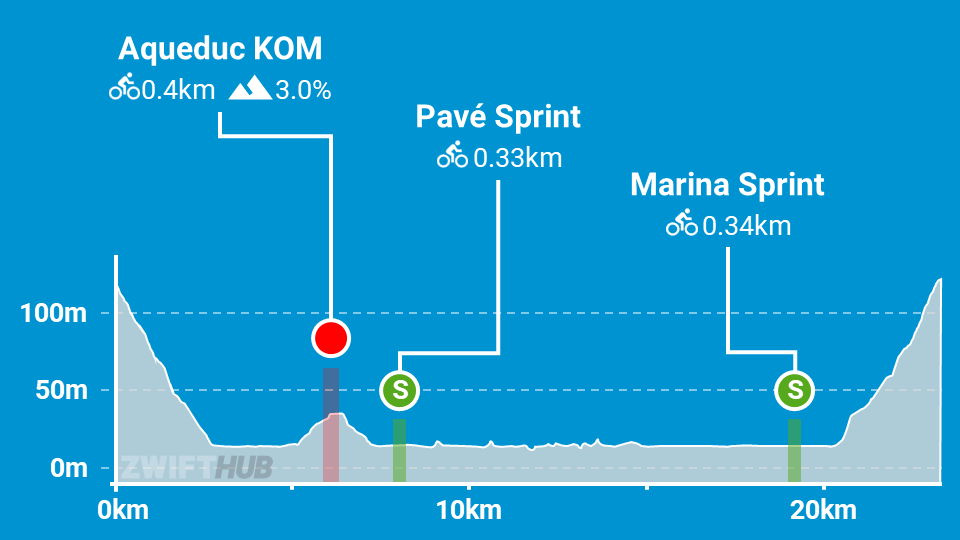
This profile doesn’t tell the whole story, though, because it doesn’t include the lead-in! The lead-in is almost entirely uphill, and in fact, we made a Strava segment for it:
The lead-in is 3.11km long, averaging 3.4%. It takes you from the start pens up the backside of the Petit KOM (or the foot of Ventoux, if you want to think of it that way) and dumps you off at the Petit KOM banner, which is the official start and finish line for Roule Ma Poule.
After finishing the climb for the first time, you get a bit of recovery on the Petit KOM descent before settling into your TTTrain for the flat portion of the event. Yes, you’ve got the Aqueduc KOM (0.42 km, 0.9%) to tackle, but it’s more of a sprint than a climb, with only a ~200-meter length of uphill road.
Following 17.4 flat kilometers, you will pass the start pens and arrive at the foot of the final climb. This is where teams may wisely choose to drop slower climbers as the four fastest go all-out for the line. But don’t drop your riders too soon – this is a very draftable climb, so it may make sense for them to do one last “suicide pull” before falling off.
Read more about the Roule Ma Poule route >
Bike Frame + Wheel Choice
Bike choice here is simple: go aero. (Looking at our TT performance charts, a climbing frame like the Felt IA 2.0 will save you less than 1 second on the climb vs the top aero frames, while a more aero frame like the CADEX Tri will save you ~3 seconds on the flats of this race.)
The best setup by far is the CADEX Tri frame paired with the DT Swiss Disc wheels, but you’ll need to be at level 40+ to access this sweet rig:
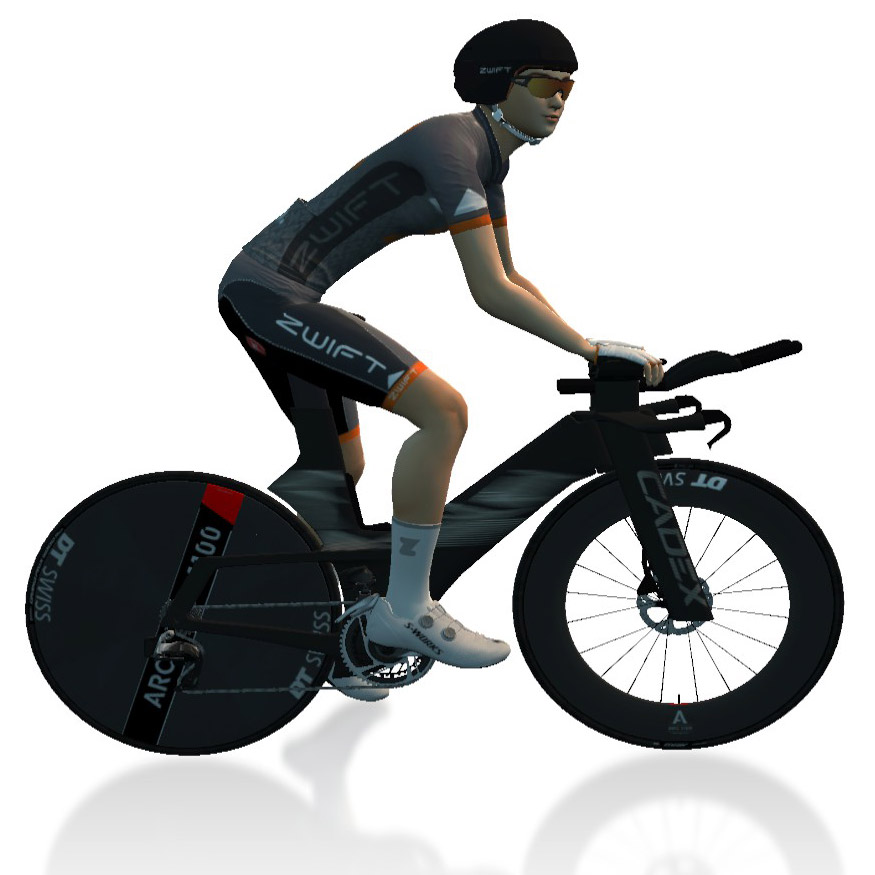
If you don’t have access to this setup, check out “Fastest TT Bike Frames and Wheels at Each Zwift Level” and use the fastest TT frame and wheelset available at your level.
One more note on bike choice: upgrading your frame makes a big difference. A fully upgraded frame saves around 13 watts, or ~48 seconds per hour of riding. Read all about the performance improvements you receive from upgrades here.
More Route Recons
Many recon rides are planned each week on the upcoming ZRL route. If you’re unfamiliar with this course, jump into an event and familiarize yourself with the route! Find a list of upcoming ZRL recon rides at zwift.com/events/tag/zrlrecon.
Additionally, riders in the Zwift community do a great job every week creating recon videos that preview the courses and offer tips to help you perform your best on the day. Here are the recons I’ve found (comment if you find another!):
J Dirom

John Rice
Nathan Krake

TTTips
Successful team time trialing on Zwift requires a challenging combination of physical fitness, proper pacing, and Zwift minutiae like picking a fast bike, understanding drafting in a TTT context, and getting your frame fully upgraded.
Most ZRL TTTs are on flatter routes than this week’s, allowing teams with big pure-power riders keep speeds high straight onto the podium. While it’s still vital to ride efficiently on all the fast flat roads in this race, properly pacing the climb, especially on the lead-in, is of utmost importance. You want to push as hard as you can while still retaining all of your team members over the top!
On a course like this week’s, consider having all team members set their Trainer Difficulty to the same value so you’re all feeling the gradient changes similarly. (When one rider has it set to 100% and another 25%, the first rider may ramp up power much more than the second when a climb hits, which can make a mess of your team formation.)
Your goal in a ZRL TTT is to get four riders across the line in the shortest time possible. That means every team’s pace plan will differ based on each rider’s abilities. I highly recommend having an experienced DS on Discord directing your team, especially if your team contains some inexperienced TTT riders.
Lastly, if you want to go further down the TTT rabbit hole and plan your race more precisely, check out Dave Edmond’s popular Zwift TTT Calculator tool.
Questions or Comments?
Share below!

Are bike upgrades “Neutralized” in ZRL Racing? In other words does WTRL in ZRL allow the advantage of a fully upgraded bike? They haven’t allowed steering. Is allowing upgrades an option when setting up “Normal” events?
No, bike upgrades are active in ZRL racing.
@Eric Schlange
Just thinking about the new drafting indicator for the TTT
Before a 2 (3) m gap was ideal for a good draft without pushing the person in front of you out of the draft.
Do you have an idea how “large” the new indicator should be for the perfect distance between the riders in a TTT? I am a little bit afraid that the full indicator would be to much an you would push others out of the line.
In my experience, 2-3 meters is still a good gap to leave. You can try it yourself in today’s race and see! The meter doesn’t start shrinking until you’re further back than that…
Does the lead-in count towards time for TTT or does the time start at KOM banner?
Lead in counts, for sure!
Why call it a lead-in? It makes it confusing.
In many cases, a lead-in is the road you would take to get to the route from the starting point (which may be a set of pens or a corral just off-route.) This really shows in routes can be start-to-finish circular laps. So, think of the Volcano flats in Watopia – you start at the downtown pens, and then you would race to the volcano and then do X number of laps per the event.
For roule ma poule, the finish is intentionally the top of the reverse KOM, so if it were to be a a multi-lap race, you’d first have to race from your starting pens to the top of the reverse KOM (i..e, the lead-in) before your laps would start to count. So, a 2-lap RMP event would have 3 climbs – the lead-in, the climb at the end of lap 1, and the climb at the end of lap 2.
(Thankfully, ZRL is only 1 lap…) i hope that helps!