

If you’ve been watching Zwift news lately, you know there’s a Watopia expansion releasing this week (tomorrow, actually). We’ve talked about it repeatedly here on Zwift Insider as Zwift has revealed more and more details: first with this TSOZ post, then another teaser, then a more detailed press release.
Last week, Zwift granted access to Shane Miller (GPLama), Nathan Guerra (Zwift Community Live), and myself to ride The Grade and livestream the experience. Shane couldn’t ride it with us due to his travel schedule, but you can watch his video here. Nathan and I (along with Nathan’s wife Gabi) livestreamed our ride up The Grade one day later – see my video below:
The Grade: How It Works
The Grade is a 3.5km-long climb that is fairly steady (8.6% average), apart from short flat bits at the start, middle, and finish. It’s a KOM segment like other KOMs in Zwift, but The Grade is special in that it also functions as an FTP test!
How does that work? Well, Zwift looks at your average power and time up The Grade, then computes your FTP estimate based on those two figures. Zwift says they can do this with reasonable accuracy because they’ve analyzed the results of over 700,000 FTP tests on the platform and computed a curve which, when combined with an average power number and time value, lets them compute your FTP.
(I was going to create a sample chart here to illustrate, but I don’t want to confuse people who may think this is the actual curve from Zwift. So I’ll wait to do that until I’ve run enough tests to publish an actually accurate chart).
The curve Zwift put together would have percentage on the Y (vertical) axis, and time on the X (horizontal) axis. Time (X axis) would begin at 8 minutes (Zwift says they can’t compute accurate FTP for times shorter than that, but don’t worry, since you’d have to hold 8 W/kg to do The Grade in 8 minutes). Percentage (Y axis) would be maybe 85% at the lowest, all the way up to 100%.
This is basically a “lookup curve”, with the charted line climbing from left to right as time gets longer. If you were doing this manually you’d go to the spot on the X axis that matches the time it took you to climb The Grade, then look at the percentage value (Y axis) at that spot. Then you’d multiply your average power for the segment by that percentage to compute your FTP.
For example: it’s generally accepted that your FTP is equal to 95% of your best 20-minute power. (This is how Zwift has automatically detected FTP game-wide since the early days, in fact). So if it took you exactly 20 minutes to finish The Grade, and you averaged 200W during that time, Zwift would calculate your FTP as 200W x .95 = 190W.
Based on Nathan, Gabi, and my results, we can calculate at least three points on Zwift’s curve. But more on that below…
My Strategy
Heading into this FTP test, I wasn’t really sure where my FTP was at. I hadn’t tested it in months, hadn’t been doing any structured training, and my performance in recent races had been a bit erratic (not helped by swapping on and off various trainers/setups I’ve been testing).
My guess was that my FTP was between 300 and 310W. So, I decided to start by trying to hold 320W, then when I reached the halfway point, I would bump that up if possible.
Why this strategy? Well, because starting a bit conservatively is the best way to approach an FTP test if you’re unsure about your current FTP. But also, and perhaps more importantly, I didn’t want to blow up early and embarrass myself on a live stream!
What that plan in place, I headed out to warm up for about 30 minutes while I chatted on Discord with Nathan and Gabi and we got our livestreams set up. When the time arrived, we all picked the “Oh Hill No” route, and the fun began!
Ride Experience
The Oh Hill No route starts you just a few feet away from The Grade start line, so there’s no warmup here. (If you want to warm up first, do your warm up then pick this route and go. Or choose “Elevation Evaluation” as your route, which gives you a few km of warmup before starting The Grade.)
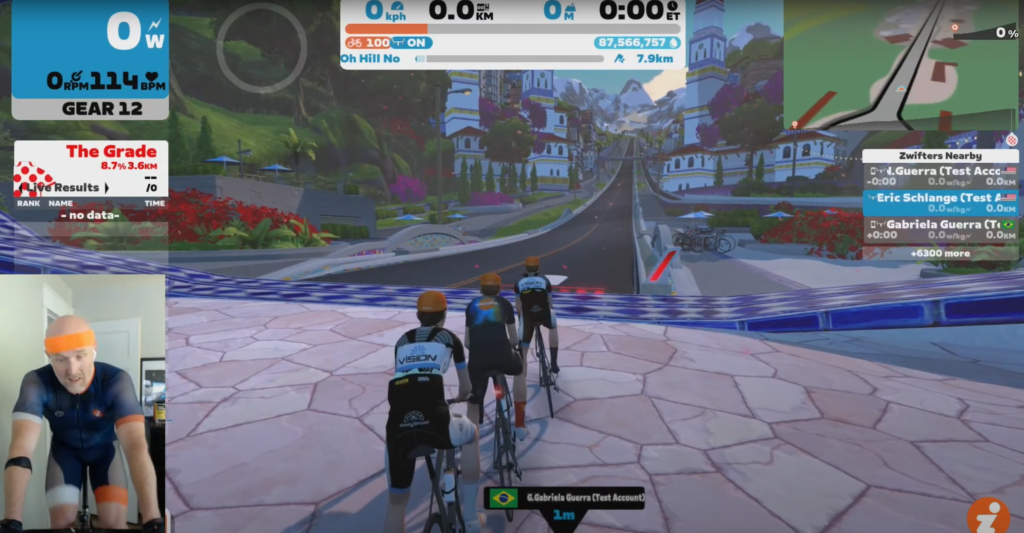
I hit the pedals hard to get up to speed, then tried to quickly settle into my target 320W pace.
A few minutes passed, and my legs were feeling pretty good. My average power (which is displayed on screen during the test) was holding right around 330W, but I decided not to ease up. I kept pedaling at what felt like a sustainable pace.
My power average read 328W as the road leveled out at the halfway point. I had to shift up two gears keep my power up on the short flat section, then the grade turned uphill again, and I finished sector 5. Halfway there!
I could hear Nathan doing his angry gorilla roaring, 70 seconds up the road. Gabi was 40 seconds up the road and silent. Both were putting out strong numbers in the 5 W/kg+ range, while I was barely breaking 4 W/kg. But this was no surprise, since both Nathan and Gabi are some of the best racers on Zwift!
My legs were feeling better than anticipated as I wound my way up the twisty second half of The Grade, so I increased my power to what I thought I could hold to the end. And I began doing the math in my head to estimate how much longer I had left.
I heard Nathan finish his test in 10:37, with an FTP detection of 335W. Spot on what he had guessed his FTP was currently at (4.97 W/kg based on his weight in ZwiftPower.)
A bit later Gabi finished in 11:46, with an FTP of 251W detected (4.54 W/kg based on her weight in ZwiftPower.)
(I should note here that Nathan and Gabi had done a 5-hour maximal effort ride 2 days earlier, so their legs weren’t exactly fresh for this effort.)
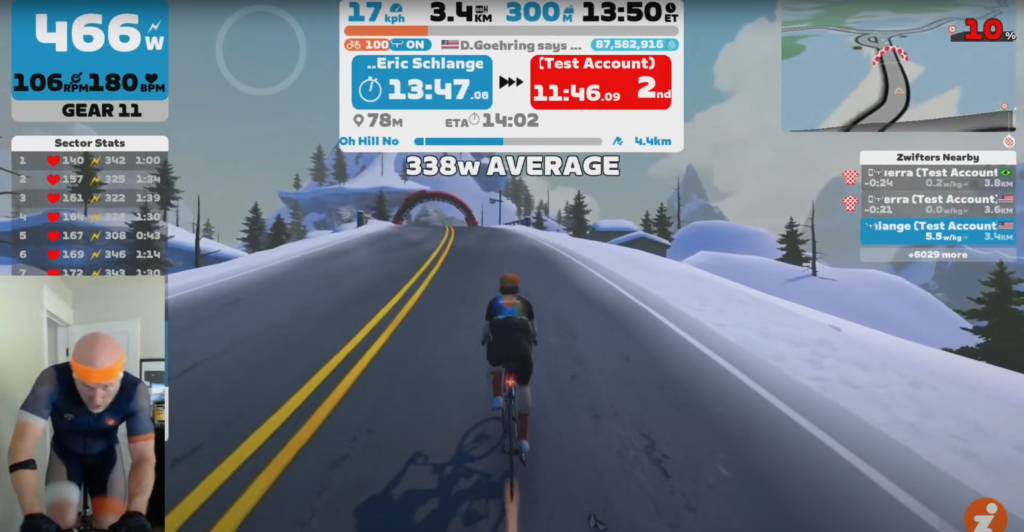
My average power was showing as 336W, but I was up over 370W now. Just one hairpin left! The gradient was 12%, but thanks to my 50% trainer difficulty plus virtual shifting, I had plenty of gears and was spinning at 95RPM. I stayed seated (is that still a rule for FTP tests?) and hammered my way up the final climb, spinning at 105RPM+ to keep my power high as the gradient slackened and I crossed the line:
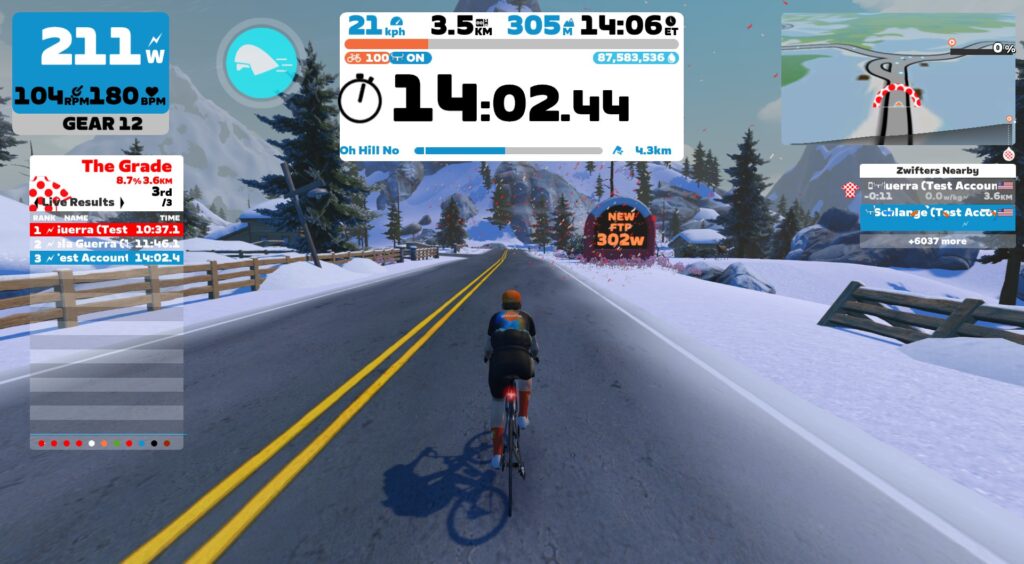
Final FTP test results from The Grade:
- Nathan: 388W average for 10:37, 335W FTP (86.34% of average)
- Gabi: 287W average for 11:46, 251W FTP (87.45% of average)
- Me: 340W average for 14:02, 302W FTP (88.82% of average)
Concluding Thoughts
My first thought when I crossed the line and saw the 302W FTP value was, “That seems too low.” Yes, my test had only lasted for 14 minutes, but I had averaged 340W! Heading over to intervals.icu, I saw that their system estimated my FTP from the effort at 317W. That made me feel better.
As I turned around on the top and began descending The Grade, my next thoughts were that the time had passed quickly, and the test wasn’t as terrible as I thought it would be. I think the passing scenery and chasing other riders helped. Of course, knowing people were watching my effort on the livestream also helped!
Pacing oneself properly is a big part of maximizing your FTP test results, but this isn’t a straightforward proposition your first time up The Grade. I didn’t know how long it would take me to get to the top, and the 10 segments (each 357 meters long) vary somewhat in gradient, so you can’t just estimate your time based on which segment you were on.
Now that I know the layout of the climb and that I did it in 14 minutes, I think I’ll be able to pace myself better next time and bump up my FTP result by at least a few watts. I may even turn my trainer difficulty to zero so I don’t need to worry about shifting as the gradient changes.
The Best FTP Test?
Surely, The Grade’s launch is going to reopen lots of debate about FTP testing. It’s already kicking off in various chats on Reddit, Facebook, etc! Many riders are confused by how Zwift can estimate FTP using a climb segment. Others say it’s not possible to accurately detect FTP with these shorter efforts.
Here’s where I land: I think all FTP tests are just estimates, since your results are based on imperfect pacing and results calculations that are estimates themselves. 20-minute tests and that 95% figure? That’s an estimate. Ramp tests? An estimate which delivers too high of a result if you’re anaerobically-gifted. The Grade? I’m not sure, but my result felt a bit low. (Nathan said his was right on.)
In the end, the best FTP test may just be the one you’re willing to take. And I’ll be taking The Grade again, because it didn’t suck nearly as bad as the standard 20-minute FTP test!
Your Thoughts
Are you looking forward to trying out “The Grade”? What do you think of its methodology? Share your thoughts below…


Shame the new routes won’t land on PC’s in the UK until the very last thing on Thursday night because phased rollout BS. I wouldn’t mind if there was a fair mix of timings but last every time?
Hardly life changing…
What would be the appropriate level of importance to meet your threshold?
@raymond I don’t know what Zwift’s thinking is, but this makes sense to me. Assuming PCs are your largest set of users, I would roll them out last. If Zwift runs into unforeseen problems, early in the roll out, they could roll back the changes having impacted a smaller set of users.
You could look at this as Zwift giving you the update last, because they think you are most important.
Haha @Jaja an impressively positive spin!
Why the flat bit in the middle do you think? Looks annoying and results skewing.
The scenery.
I think it’s a brief mental break allowing for a stronger finish. It’s psychological rather than physiological.
Stop annoying me with popups while I’m reading the article
LOL, I used a different browser to look at ZwiftInsider yesterday. Holy cow, possibly one of the worst websites I’ve ever seen for annoyingly stupid popups short of those cheap news clickbait sites. How anyone can use ZwiftInsider without running an adblocker is beyond me.
Personally I’m looking forward to trying this. 20 min tests are hard, ramp tests are boring. People get caught up on FTP tests. They are only ever an estimation. They would change day by day. If you want an accurate test, go to a lab. I’m looking forward to giving this a go because as we don’t know the curve, you currently can’t game it. Just go hard.
I’m less interested in the segment as an FTP test, and more in the potential to bring in an odd British tradition of the hill climb. The start pens are right at the bottom, so a TT up to the top could easily be done, most of the other big climbs on Zwift have too much of a lead in for it to be a proper “Hill climb” event.
Though I do think a more “segment based” FTP test sounds a lot more fun than a random Ramp or 20minute test, Zwift tends to uptick my estimated FTP whenever I ride the Innsbruck climb or do a lap of Yorkshire, and I don’t mind going back and giving either of those a full send.
With the test so short and therefore easily re-done, I think it isn’t that important how to approach the first try as long as you learn what to change for the next one.
But generally speaking, it’s easier to go out hard and try to hang on as long as you can. That guarantees a maximum effort. If you can’t hold on, just quit and try again a little slower next time.
Also, if you manage to keep roughly the same power and cadence throughout you don’t have to rely as much on the algorithm to normalize your power.
Really? I was taught the opposite. Start at current ftp and go harder every minute until you reach the top.
Well all I can say is tried the first way on accident today and it did result in a maximum effort, but perhaps negative split pacing would have gone better!
I thought I read that the FTP test was only calculated on the straight part of the Grade – and not the curving sections toward the top. If so, could you complete the FTP test and then turn left onto the new section of road that meanders over to existing coastal road near the entrance to the Mayan jungle (without having to go all the way to the top of the old KOM road)?
No – you have to finish the KOM segment, which ends at the top after the twisties.
Hw do you complete a route then change to another without ending ride and pairing again? Thanks
On AppleTV it always kicks you back to the login screen, which is an annoyance Zwift says they plan to fix.
But basically if you want to ride a second route you need to start a new activity or join an event (which become a new activity.)
Or create a meetup
Thank you🙂
Is bike choice going to influence the result? Will there be a Safety vs Tron vs Aero vs Atheos article soon?
It’s a steep climb so Aethos will clearly get you the quickest time up the KOM segment.
From this article, we can see that the quicker you do the segment, the less it counts toward your FTP. (86% with 10min time, vs 89% 14min time)
I would bet the few seconds time difference between Safety Bike and Aethos wouldn’t affect FTP. You’ll just suffer a bit longer on the Safety Bike.
Bike choice will influence the length of your climb, but shouldn’t influence your FTP result much… since in theory you’ll be able to have the same result whether the test is shorter (and your average power is a bit higher) or the test is a bit longer (and your average power drops a bit).
What about if your average power was the same but you used a heavier bike and took longer than using a lighter bike
If you average power is the same, but you took longer to complete the segment, that means your first effort wasn’t a maximal effort. Right?
Logically, if you give a maximal effort every time up the segment, and it takes you longer to go up than the last time you tried, your average power will have to decrease on the longer time.
Speed is determined by power, weight and equipment. If you are using a heavier bike, it will move slower for the same power. So if the ftp test is based on a power curve over time, it is possible that if the only thing that changes is the bike that you use to complete the segment, it will take you longer to complete using the same power. For example..I travel up a hill on a bike that weighs 10kg pushing 240 watts..it takes 10 minutes. I The next day I do the same watts but the bike weighs 15kg. It’s going to go slower and after 10 mins my watts drop to say 230 and 8 complete the segment in 12 mins. How will Zwift combat this is the difference is the in game weight of the bike?
Because the weight of the bike doesn’t matter. All that matters is what you averaged over the length of the segment. The weight of your bike doesn’t change how much power you can hold for how long.
Underneath all the marketing fluff, this reads as just a new pretty looking segment for people to enjoy. And don’t get me wrong, I find hunting for segment PBs extremely fun. But I really fail to grasp how this FTP curve would somehow be magic for The.Grade. One could – in principle – TT Tempus Fugit or PB any other 8+ min effort and do the exact same thing. Now funny enough, I bet a substantial portion of the userbase are going to need close to 20 minutes (or longer) to climb up this thing: a quick guesstimate would be around the 850VAM/h or ~1h10 Alpe ascent mark. Those around the 1h Alpe mark would finish this in just under 18 minutes. Still good fun of course, but it sounds fairly close to a standard 20min test to me.
So this makes me wonder if there is anything more to The.Grade.
– If you pace 12min all-out and then ride up casually, will it detect a new FTP based on only those 12minutes?
– If you need 14 minutes to complete just the straight section, will it only use this lower portion instead?
Or are you required to do the whole thing properly for it to work.
You have to do the whole segment for it to compute your FTP. And your FTP will be based on your average power on the segment.
I’ve spoken with Zwift folks who say yeah, you could compute FTP using any roads in Zwift using their time/percentage curve. They may expand things so this new curve replaces the standard 95% of 20-minute power detection currently in place across the game.
So, uh… it’s just a new segment of road then?
There are a lot of new climbing routes that hook into the Epic Kom. Great additions in my opinion.
I’m looking forward to this! Any chance you can update the article with time estimates (like on the portal climbs) to help with pacing? Example 5 w/kg = ?min
I spun up on the Tron at 3.5 and it was 15 mins
I went up by 3.25 W/kgs, took me 17:51. A bit strange to Frank’s result. I’m 66 kgs only. First half I did about 2.75, second about 3.75. Does that make such a difference? Rode the Tron, too.
So contrary to the other methods to determine your FTP, this one has a relation with your weight. If I would significantly increase my in-game weight, than it will take me more time to finish the climb for the same average wattage compared to if I had entered my actual weight. I will get a higher correction percentage and therefor a higher FTP. If I want to cheat myself it pays to reverse weight dope.
Not really. If you increases your weight it will take you longer to do the segment, which means (if it’s a maximal effort) your average power will be lower.
In theory, your detected FTP should be the same whether you do a maximal 12-minute effort or, say, a maximal 20-minute one.
So this sounds interesting, but will it also work for the lesser gifted like me with an estimate of 30min to complete this climb ? Or does it need to be within 20min ? I wonder 🙂
Sure, it’ll work fine for you! Basically any time from 8 minutes to 60 minutes should deliver an accurate result, as long as you keep the effort as steady as possible.
Did this test trigger a change to your ZFTP?
No, but I was using a test account that had a crazy-high zFTP stored, so that would make sense.
It did change the zFTP for. Interestingly I got 2 different new values for zFTP and FTP. 11w difference.
The standard CP model is : watts = CP + AWC / t, t is time in seconds, and AWC is the anaerobic work capacity, and CP = critical power. Assume AWC is proportional to CP: AWC = τ CP, where τ is a time constant. Then CP = watts / (1 + τ / t).
FTP is the power one can maintain for an hour, which by the CP model is slightly higher than CP. So the equations can be solved self-consistently using the model, since I need CP to get AWC, but I need AWC to determine CP from FTP.
This equation can be solved for τ = t (watts – CP) / CP. So plugging in your numbers, I get the following results:
Eric: 142 seconds
Gabby: 130 seconds
Nathan: 127 seconds
So to decent approximation the CP model seems to do a good job matching the Zwift algorithm with a time constant near 130 seconds. However, this implies for 20 minutes, you’d be at 90%, not 95%. So I’m guessing they have reevaluated their 95% for 20 minutes assumption.
So the approach is:
Correction: AWC = 130 seconds time CP implies that’s 93% for 20 minutes to FTP, not 90%.
Dan, notice that Golden Cheetah calls W’/CP “endurance,” and displays it in the “CP” model box.
A slightly more straightforward way to do this would be to collect some more observations at different durations and see what multiplier Zwift uses to get from observed average power and observed duration to their estimate of FTP. From the article above, we have (637, 706, 842) seconds and multipliers of (0.863, 0.875, 0.888). Then I did the climb in 1266 seconds and observed a multiplier of 0.951. Those four points have a linear correlation of 0.998, and the resulting linear regression is multiplier = 0.7746 + .0001387*seconds.
You give your times and raw wattage required to accomplish it, can you add what those wattages are in wkg?
Did that here: https://zwiftinsider.com/segment/the-grade-kom
I’m curious how cadence plays into this. My cycling phenotype is that of a time-trialist and I know from interval tests my ability to hold a certain wattage at 50-60 rpm is much lower than at 90-100 rpm.
I haven’t ridden The Grade yet but I would expect I’d ride it at a lower cadence than I could hold for an equivalent time on the flat. Normally I’ll do a 5 minute climb well over my FTP, at 70 RPM or lower, depending on the grade. But I don’t think I could hold my FTP for 20-30 minutes at <70RPM on a climb while I could easily hold it at 90+ RPM on the flat. Given Eric's posted wattages and my FTP I'd expect to be on the climb at least that long.
For FTP tests, the typical advice is to hold a comfortable cadence and not stand up. If you find The Grade too steep, and you can only do 70rpm, I would turn down trainer difficulty so you can do a higher RPM and thus get a more accurate FTP result.
Is there any guidance as to whether this FTP test should be done all seated as with the ramp test?
I’d definitely like to know this too. I stayed seated but really wanted to get out of the saddle for a few of the segments (and would’ve if I was “just” trying to PR the climb instead of doing an FTP test).
An FTP test should in theory always be seated, so that it’s purely muscular endurance, otherwise part of power generation comes from bodyweight on the pedals.
Thanks, makes sense. Certainly I could do the majority of a climb like this out of the saddle with a very different result. I might even try it just to compare the difference out of curiosity.
I took this today and had a similar result where my “Grade” was 243W, but my TrainerRoad AI FTP has been 255W and Intervals.icu emailed me from this activity a new eFTP of 254W…so while they’re all within 5% of each other I’m not sure which is more useful as an estimate for my power zones.
I also found it interesting that the *only* place that told me my “Grade” (official Zwift FTP estimate) was the sign on the side of the road. There was nothing post-activity nor any prompt to update my FTP on Zwift. What gives about that?
Found a partial answer: “If an FTP increase is detected you’ll see confetti fly, and Zwift will automatically update your in-game FTP setting.” Since my “Grade” was lower than my in-game FTP (which was my TrainerRoad AI FTP) it didn’t trigger. Which is honestly dumb, like yes my ego is a little hurt that it was lower instead of higher, but if it’s accurate, it should still prompt to update. (And heck it should celebrate with confetti no matter what, you did just complete an FTP test and that’s no joke!)
The problem is that you can ride the segment at whatever effort level you want, not necessarily as a max effort or FTP (estimation) test.
Bit silly to reset my FTP to 83 watts because I was noodling up on a recovery ride.
Yes it would be! But it’s a prompt that you can dismiss I think, is it not?
You answered your own question, it was too short to calculate 95%. If you drove at 700w for 15 seconds, would you also say that your FTP of 300w is too low?
I have been using my test for the ALPE driveway for a long time. It’s about 40 minutes and I know when I’m better or worse. The shorter the test, the more counterfeit it is. However, to compare yourself, you need to use not the calculation of % power, but the time for your regular route, nothing more.
The new climb is nice for a quick sprint comparison. BUT too short for stronger cyclists to see their ftp. This is my opinion.
I think they should have had two options. A longer climb and a shorter one. All one climb. This being the shorter one. Which either marks the half way point of the longer one or the ending of the shorter one. Giving two options for FTP testing or doing intervals on.
My math isn’t great so I’d appreciate how final FTP number of 302 watts you received vs 340 watts was calculated. Also, where did the percentage come from?
Here’s an explanation:
Zwift numbers can be quite amusing, honestly. Take my zMAP and VO2max for example, which are crucial for the Zwift Insider Tiny race. Initially, my 3min power was 320W and my 5min power was 300W. Zwift said my VO2max was under 48, so I raced in D. After some INSCYD testing, my 3min power improved to 350W and my 5min power to 320W. My 12 min power also saw a significant increase. Zwift then showed my VO2max just above 48, so I moved up to C for the next race. But my coach wanted me to redo the 3min effort because INSCYD suggested I had more to give. I pushed to 370W. Surprisingly, my Zwift VO2max dropped to 47. INSCYD and other software indicate my VO2max is well over 50, even Golden Cheetah agrees, but Zwift seems to think otherwise. The same goes for the Zwift FTP test. The 95% rule was set by Coggan for pros, but not for us amateurs. Climbing for 10 minutes in a Grade climb only reflects your 10 minute power, not your FTP.
I did the climb test, averaging 299 watts, telling me my FTP is now 268.
However, my zFTP updated to 279, up from 248. So the zFTP, which is used for category classification, isn’t the FTP Zwift calculates from this climb.
If your zFTP updated after the FTP test done in the Grade, then there definitely is some correlation. But I doubt you can hold 279w for one hour. These are just randomly generated numbers by Zwift.
“Randomly generated,” eh? Ha!
The Grade FTP and zFTP are calculated using two different formulas. Simple as that.
Same for me – new calculation from The Grade was 225, zFTP updated to 232.
I have a couple of basic questions (I’m trying to learn, so be kind!). When the article refers to percentage, percentage of what? And if Eric estimated his FTP 300-310, why would he try and hold higher with 320?
Andrew Coggan, the creator of FTP, also devised a method to calculate FTP based on a 20-minute power output at 95%. This means that instead of enduring a maximum power output for an entire hour, you can perform a shorter test and take 95% as your FTP. However, as pointed out by Friends of Sus, this formula is only applicable to professional cyclists and not amateurs. Each individual has a unique metabolic profile, and the way we burn fat and carbohydrates differs. If you have a high glycolytic profile, you have the ability to store a significant amount of glycogen in your muscles. This allows you to generate a high amount of power in shorter efforts lasting up to 20 minutes. As a result, traditional short FTP tests, including the ramp test, may not accurately reflect your true capabilities due to the significant difference between your Maximum Lactate Steady State (MLSS) and your VO2Max. This difference could be substantial, potentially exceeding 100W for some amateur athletes. For instance, you might be able to complete the Grade FTP test at 320W, but your actual FTP might only be 240W, even though Zwift indicates it’s around 280W. I encounter athletes daily in our lab who struggle to progress due to training in incorrect zones, often stemming from unreliable testing methods.
@eric do you know why zwift decided to add in the two flat parts? Feels very weird to me that theyre adding this pure clinb to test ftp but then add in sections that will distort the results. Is it a typical Zwift omission or was it intentionally to perhaps mitigate a bit of the anaerobic benefit that exist for riders with strong anaerobic capacity on shorter ftp tests?
They should save a foto at the moment your ftp shows, because I forgot mine by the time I came of te bike because I was assuming I would be able to read it somewhere afterwards.
And the flat part is killing. I lost at least 10 Watts at that part. I hope they ignore that part in the endresult.
I don’t understand what everybody is so worked up about. ‘The Grade’ only took me 7.4 seconds and got me the KOM jersey. Too short for an FTP update, but that should be a couple of mega watt 😂
Yep, I had the same 😁😂. Took me 8.8 seconds though.
I did the grade today as part of a new route. First half easyly, second half a good bit harder. Now my FTP is lower than before. I don’t care but that will be subject of some discussions, I guess. (My current FTP was within the last 90 days)
These new climbing routes are awesome! Very tough and diverse. I hope they break the mold and put a few in the Zwift Racing League this fall. They haven’t had a mountain route in a couple of years. The closest has been Climber’s Gambit forvthe first race of 2022.
Doesn’t work for zPower – 0 average power, questionmark at the top 🙁
Weird. I just did this route and the section info didn’t show up on the left. i kept wondering what the numbers painted on the road were!
I also wasn’t given an FTP estimate. I finished the full climb and went down and finished the route too.
Just finished. Now how do you find out what ftp was calculated?
It says it on the sign as you go through the KOM arch at the top. Then the game will update your FTP setting, if you tested higher than what you had set.
Gotta say that’s poor. So you’re on your knees when you finish. Looking for a tiny number that flashes by isn’t easy. The use case I needed it for was to determine my ftp after recovering from injury. It’s always going to be lower so only updating it when it’s higher is, as I say poor. Also, if it is lower and it’s not changed then all future workouts are being done at the wrong level. Would suggest some rethinking.
You can just manually change your FTP in Zwift settings based on the result if you’re trying to calculate a new FTP that is lower than previous. If it updated automatically every time you did the grade, then your FTP would “update” to a superficially low number if you did a zone 2 ride that went over the segment, for example.
You make a good point. My main objection is that you can’t read the number as it flashes bye. So it’s not fit for purpose. If it updated at least I’d know the number!!! Lesson learnt, won’t be using this protocol to determine ftp in future.
You’ve mention that Natan’s FTP was spot on. What was thr metthod used by Nathan to get his current FTP? I think it would br great to have a Methode that it’s known to be the most accurate and plot a curve with statistic points of different riders to comprare. Count on me if you need data :). Cherrs