

Zwift Camp: Baseline is now underway, with over 175,000 Zwifters taking part so far in this new style of assessment-oriented training program.
I’m one of those Zwifters, and plan to share my experience in three posts – one for each section of the program:
- Sprinting (read post)
- Attacking
- Endurance
As you may or may not know, each of these sections consists of two activities: first a workout, then a test. I cover the attacking workout and test below.
Attack the Bunch Workout
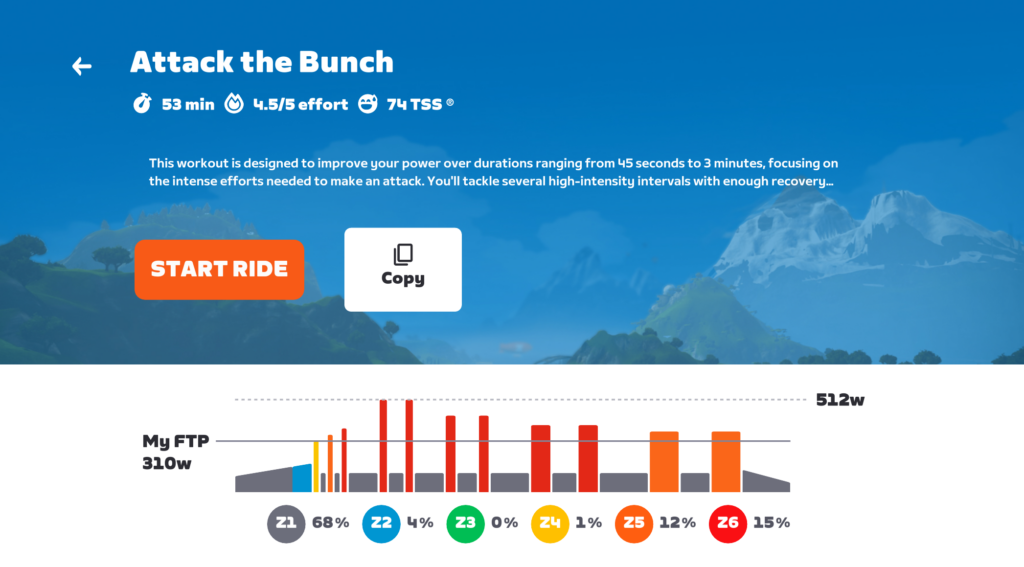
The Attack the Bunch workout has you tackle multiple high-intensity intervals ranging from 45 seconds to 3 minutes in length. The full workout is 53 minutes long with 8 hard intervals, while the lite version is 34 minutes long with 6 intervals. Here’s what the workouts look like with my FTP set at 310W:

I went with the full 53-minute workout, and did it as a group workout event. (You can do these as on-demand workouts by yourself as well, but I wanted to try the group workout experience.)
Watch me ride this workout:
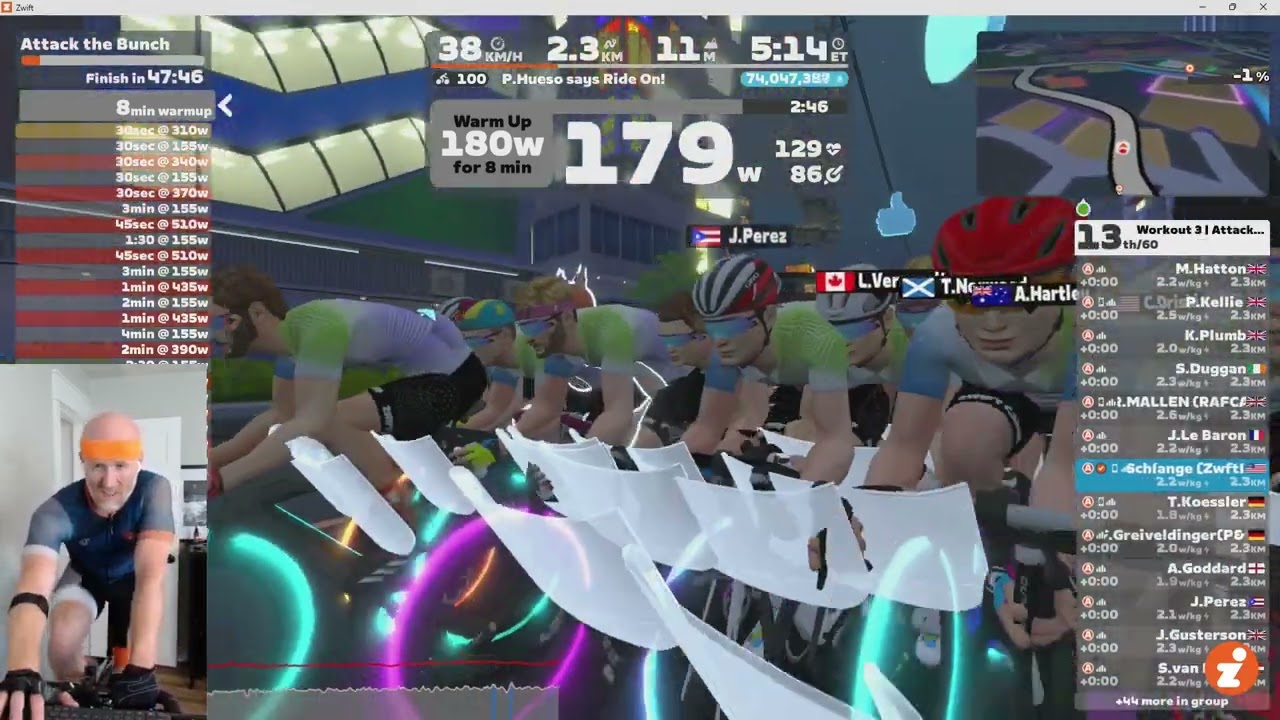
I went into the workout with a bit more fear and trepidation than I had with the Sprint Workout because I’d heard others say it was a tough one, and looking at its details confirmed this. My strengths are probably in efforts of 60 seconds or less, so I knew the later intervals in this workout would be the toughest.
After a warmup with three 30-second efforts to get your blood pumping, riders are tasked with completing 4 pairs of intervals. As the workout progresses, each pair of intervals gets longer, but the power target also drops. Here are my intervals:
- 2×45 seconds at 512W (165% FTP)
- 2×1 minute at 434W (140% of FTP)
- 2×2 minutes at 388W (125% of FTP)
- 2×3 minutes at 357W (115% of FTP)
There were 60 riders in my group, and after the first hard interval, one rider asked about how to avoid the situation where your cadence slows, forcing the trainer to ramp up resistance, which just causes your cadence to slow more, which causes resistance to increase… the ERG spiral of death.
It’s always worth mentioning, for workouts that include high-intensity work, that it’s helpful to spin up your cadence going into the hard interval so your legs don’t grind to a halt when the resistance hits. Zwift’s prompts in the workout help get this idea across nicely.

Cadence is a personal thing, on some levels, but I find for myself that a cadence of 100+ is helpful on hard intervals. I perform better when my cadence is high enough that it doesn’t feel like I’m mashing the pedals.
Each pair of intervals felt harder than the one before, but just barely. And my heart rate peaked slightly higher at each and every interval. Check out this progression:
- 165 bpm
- 169 bpm
- 170 bpm
- 172 bpm
- 179 bpm
- 182 bpm
- 183 bpm
- 185 bpm
I thought I might end up standing for part of the longer intervals toward the end of the workout, but once I got to 60 seconds left on the final interval, I decided I would do it seated because standing felt like a bit of a cop-out.
The group workout used the Turf N Surf route, which was another great choice for the event because many of the key intervals were done on climb sections where we would be attacking in races.
Takeaways from the Attack the Bunch Workout

I received an email from Zwift immediately after finishing the sprint workout, telling me I’d unlocked the Oakley Katos and inviting me to visit zwift.com/zwift-camp and sign up for more events.
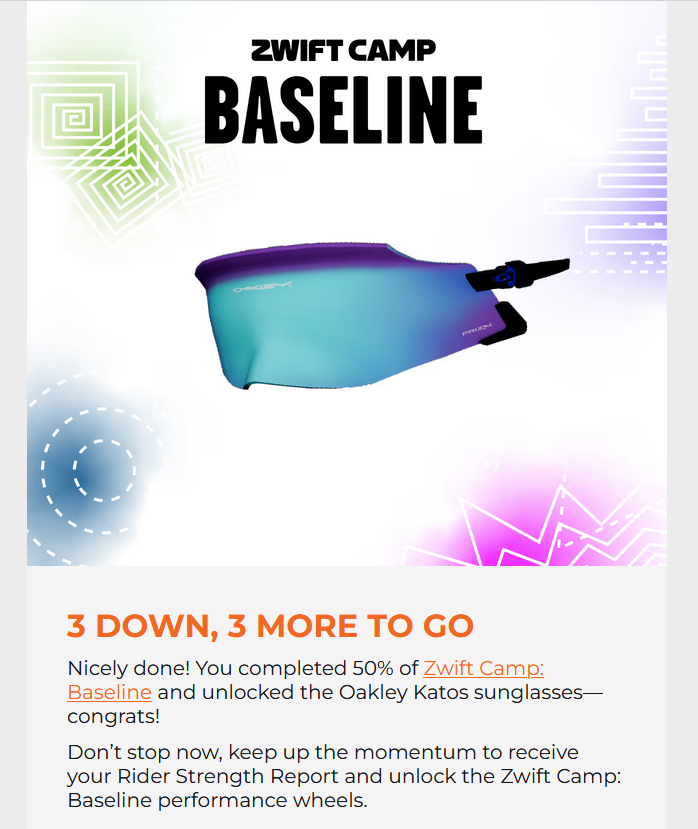
My only takeaway from this workout was that I would benefit from doing more workouts featuring intervals in the 1-5 minute range. As we age, in fact, doing this sort of high-intensity work becomes even more important, because if we don’t use it… we’ll lose it.
Attacking Test
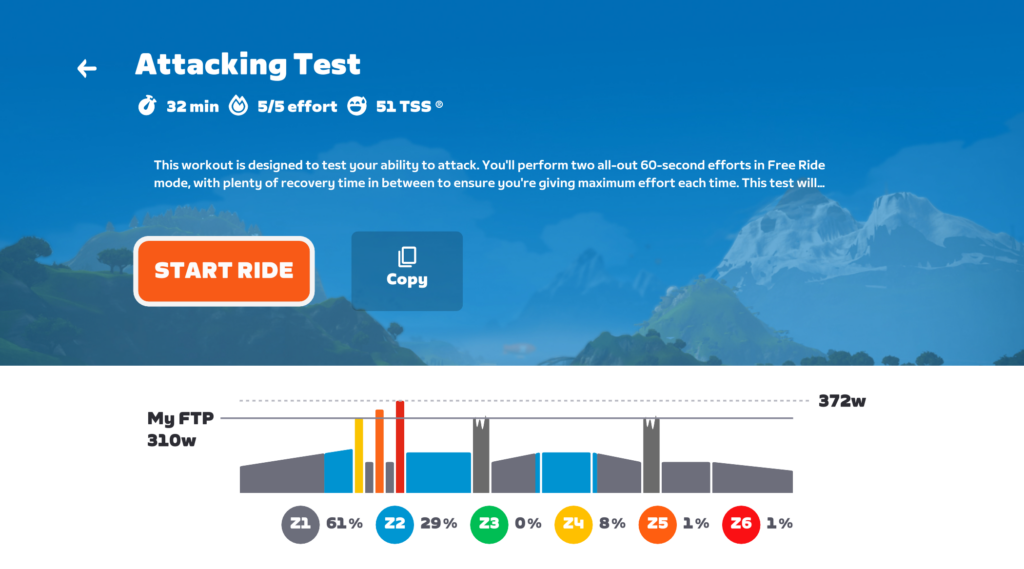
The Attacking Test has you complete two all-out 60-second efforts. Your goal is to get your best possible 60-second power in these segments so Zwift can accurately assess your attacking abilities. Here’s what it looks like with my FTP set at 310W (the power requirements will change depending on your personal FTP):
Two days after my Attack the Bunch workout, I started my Saturday morning with the Attacking Test.
This a simple workout in terms of layout: a standard warmup followed by two 60-second all-out efforts. The efforts are separated by 9 minutes of easy spinning to give your legs time to recharge.
Watch me complete the Attack Test:
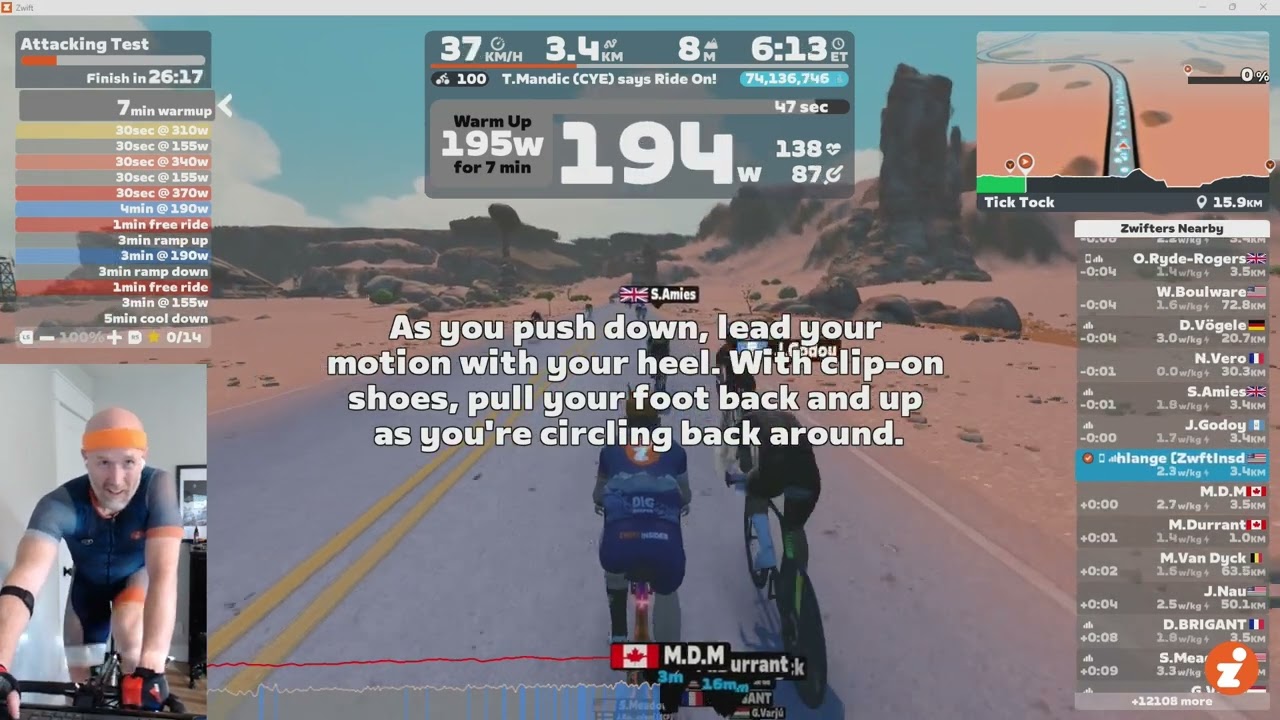
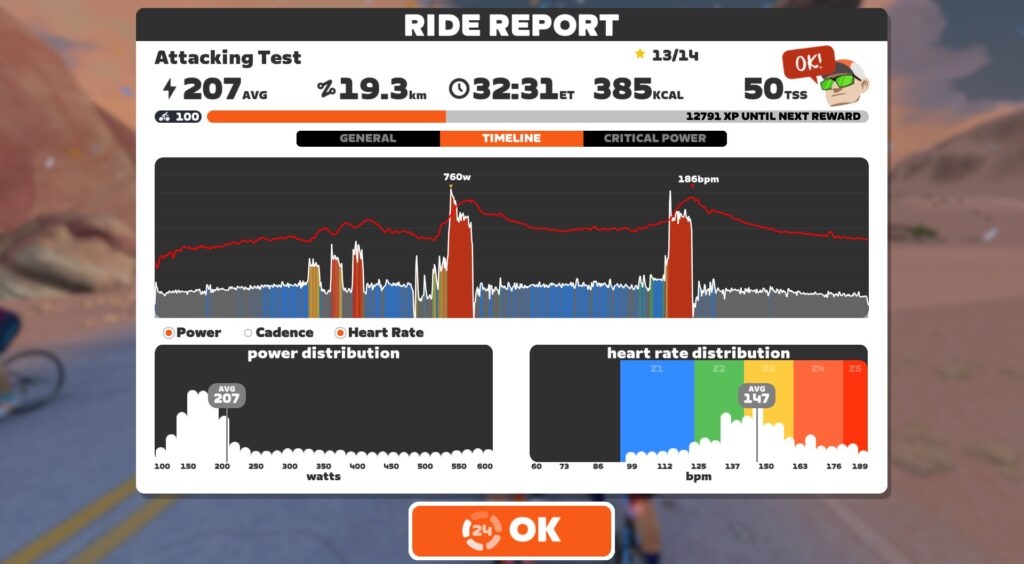
My first attack started pretty strong, but I really faded in the last 20 seconds. (Part of the challenge in these sorts of tests is proper pacing. It’s something you get better at the more you do it, unsurprisingly…)
My screen said I averaged 598W for the interval as I crossed the line. But Strava and Zwift said my 60-second best for the workout was 605W. How does that work? Well, what showed on my screen was my average wattage for the interval, while Zwift is actually taking your 60-second best across the entire workout, wherever it occurs. I hit my power a bit early, before the workout began, so there’s a bit of disparity between the numbers. No big deal.
Peak heart rate, hit just after this first segment ended: 181 bpm.
I could still feel the first 1-minute effort in my legs when I began the second one, even though I’d had 9 minutes of easy riding in between. For the second interval, I tried to start a bit lighter so I wouldn’t blow up early. My power chart was indeed a bit more consistent, but still, those final 10 seconds felt like an eternity, with the legs burning and feeling heavy and about to burst! I averaged 589W average for the interval.
Peak heart rate, hit just after this second segment ended: 186 bpm.
Virtual Shifting + Erg Mode Tip
If you use Zwift’s virtual shifting and Erg mode in this workout, here’s an important tip which I also shared for the Sprint Test: be sure to turn off Erg mode well before you hit each of the 1-minute efforts, so you can get your gearing correct before the effort begins!
With virtual shifting, Zwift will place you in the default gear (8) as soon as you enter a free-ride segment of an ERG workout. That’s not a big deal if the free ride section is a longer one and/or you’re not going for max power during the segment. But if you’re supposed to be holding maximal power for a short free-ride segment, this is a big problem because you’ll end up spending the first several seconds of the interval shifting from 8th gear to whatever gear works best for your target effort.
So you’ll see in my video above that I simply toggled Erg mode off around 30-60 seconds before the maximal efforts began, giving me time I get into a better gear. Then I completed the efforts and re-enabled Erg mode for the recovery block.
(I’ve shared this feedback with Zwift, and they’ve acknowledged that it’s a problem. Sounds like they’re working on a fix…)
Takeaways from the Attack Test
A few minutes after finishing the Attack Test, I received an email from Zwift:
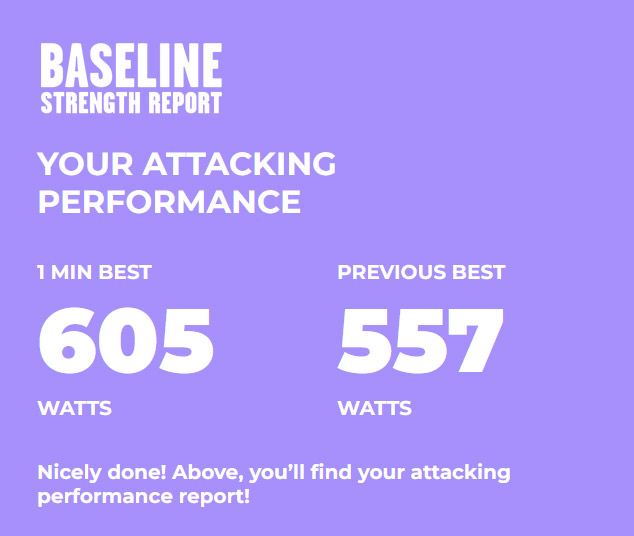
That 1-minute power number of 605 is 1 watt lower than my PR for 2024, so… at least I’m consistent. The previous best of 557 is my 90-day PR, which matches what my ZwiftPower phenotype chart shows. Always nice when data is consistent!
I don’t have any big takeaways from this test, as my performance was right in line with what I’d expected.
Questions or Comments?
Four down, two to go. How is your Zwift Camp: Baseline experience going? I see over 175k people are signed up as of today. Share your thoughts or questions below!

I might have missed it somewhere, but I wish Zwift released what the max power target time lengths were for each stage. For example: Stage 2 Sprint power 15sec max free ride. So, 15 sec max power? Nope 10 sec max power. Stage 4 Attack power 1-minute free ride. So, 45 sec max power? Nope 1 minute. Stage 6 Endurance on the Grade. So, FTP test up the grade? Nope, max 10minute power, nothing to do with an FTP test. Zwift should have released the time frame targets ahead of time and not find out by the email afterwards what the actual time targets were.
I agree that’s a key place where Zwift could improve the program. I’ve told them as much. They’re listening!
Thank you, Eric. I appreciate the time you spend giving us all the great information and trying to make Zwift better for all of us.
Eric, did your ZRS change atter doing the workout? I wonder if these feed the ZRS data and the workouts are a good way for Zwift to pull in more data for that scoring (which imo would be smart of them).
It did not. I wouldn’t expect it to, though, since ZRS seed score is based on 5-minute power now. All of your Zwift activities feed into your seed score, but unless you’re setting a 5-minute 90-day PB, they won’t change it…
100% agree with anyone saying this was a harder workout than the Sprint Workout was. I had to lower my trainer bias pretty significantly to get through some of those efforts. I’m guessing my FTP may be overstated, and I just need to reset it lower, and then let it come back to where it should be. But yeah, that was a tough workout.
the mail says “above you’ll find your attacking performance report!”. the “your attacking performance” text actually is a link, but it doesn’t bring you anywhere useful. at least for me it opens the membership page (https://www.zwift.com/eu-it/billing/membership). is there a performance report, is this a bug (maybe in eu) or is the mail all you get?
I’m not convinced that it’s possible to do two truly maximal efforts within the space of 10 minutes in the Test workout without some kind of compromise. I managed 657W for the first minute, but my legs folded after 20s when I tried doing it a second time (especially with the mental aspect of having already achieved a PB power). I chose La Reine to do the workout so that I could be sure that the measured intervals would fall on uphill terrain so I had some resistance to push against.
I’m also not really convinced that the Attack the Bunch workout’s 45s 165% FTP intervals are especially good practice for going that deep – 60s at 215% FTP is very very different! That said, Attack the Bunch is a great workout and will definitely be going into my rotation!
Muckle Yin not an ideal route for the test. My group had to do the second free ride coming over the peak of the Scurr, which made selecting and maintaining gearing really tough. Wouldn’t Fuego Flats lead to more consistent 60 second power numbers?
The free ride sections don’t simulate gradient, though. (Although it’s possible you may think so, due to your brain playing tricks on you). The free ride sections just offer consistent resistance, like you’re riding on flat ground, and it’s up to you to shift to the right gear to hit your cadence/power target. Route doesn’t affect the resistance at all in these workouts.
(That said, I prefer workouts where the visual gradient isn’t changing while my effort is supposed to stay consistent. Otherwise, it plays tricks on my brain. Sounds like the Muckle Yin may not be the best choice for this test.
Could it be that I noticed it when switching Erg mode off in the 15 seconds before the start of Free Ride?
I don’t think so. Even with ERG off I think the workout will just hold a steady resistance throughout.
I’m confused about the basics. I just resubed to Zwift and know that I have until Jan6 to complete everything. My questions are…
1) Do I need to do the workout AND the test?
2) Do I need to do these in order? Sprinting is first and that just feels backward to me.
3) Will all these give a more accurate FTP in the end or is this just for the achievements?
4) If I just want my FTP, is the climb test enough?
Thank you for any advice you can provide.
1) Yes.
2) You can do them in whatever order you want, just do the workout before the test for each of the three power types.
3) None of these are an FTP test, so no.
4) If you want your FTP, any maximal effort of 8 minutes or more will get it. This is a recent change in Zwift’s FTP detection – see https://zwiftinsider.com/update-1-79-0-136993/
Eric, thank you so much for the detailed response. It’s much appreciated and clears things up.