

BREAKING (Sept 22, 2026 @ 8am PT): Today’s races have been misconfigured, and TT bikes are being allowed, without penalty, into the events (see FB post from WTRL). You absolutely will want to use a TT frame for your races! I’ve revised bike recommendations below…
FOLLOWUP (Sept 22, 2026 @ 1:45pm PT): All remaining events for today have been set with TT bikes disabled, per the original plan.
The first race of Zwift Racing League 2025/26 is Tuesday, September 22, and it’s a race format we’ve never seen, on a route ZRL has never used!
That’s right: what makes this week most interesting is that it’s the first-ever Race of Truth, which is essentially a points race without drafting. This opens up lots of questions, which I’ll try to answer below. So let’s dig into the course, look at bike selection, talk strategy, and more!
Looking at the Route: Montmartre Mixer
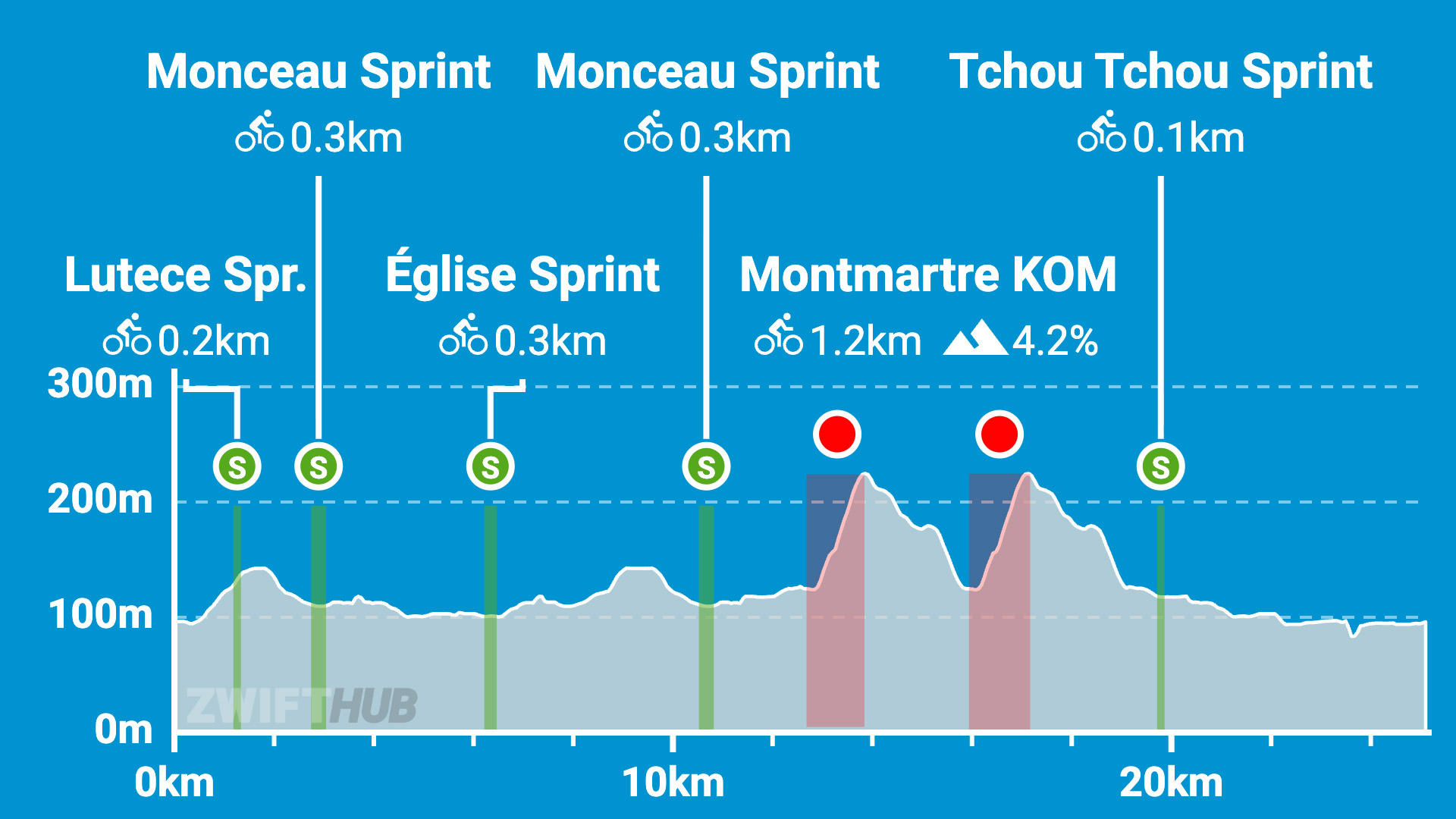
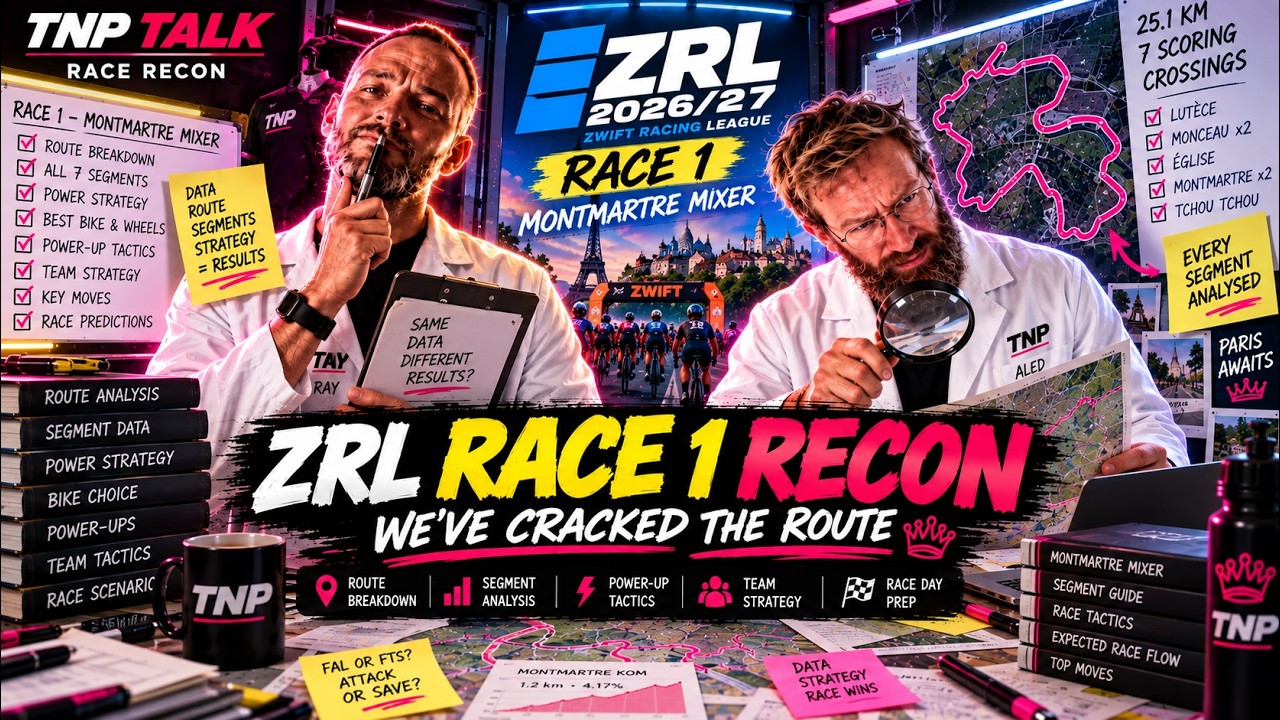
All riders will race one lap of Paris’ Montmartre Mixer, for a total race length of 27.6km with 198m of elevation gain.
Broadly speaking, this is a rolling route full of slight descents and ascents, with back-to-back ascents of the Montmartre KOM featuring as the centerpiece:
Let’s look at how the route unfolds from a Race of Truth perspective:
- Lead-In to Lap banner @2.4 km: Collect your 250 XP bonus as you ride through the lap arch to finish the lead-in, then up the power as you head into the slight climb to the Lutece Sprint. You will collect a 250 XP bonus at the arch.
- Lutece Sprint @3.6km (150 meters, 3.5%): This is the first points segment of the race, and it comes after a bit of slack climbing, so you can bet riders will push hard before the segment even begins, to get into position for FAL points. You will pick up an aero powerup through the arch.
- Monceau Sprint @5.1km (300 meters, -0.1%): Use your aero powerup to maximize segment points on the fast, slightly downhill sprint. Pick up a feather powerup at the arch, which can be used on the kicker section of the tiny loop you’ll ride not long after the sprint, or hold onto it to reduce your sprint time on the upcoming Église Sprint, if you’re contesting that sprint.
- Église Sprint @8.6km (250 meters, 0%): Use your feather powerup if you want to maximize segment points. You will pick up an aero powerup through the sprint arch, which you’ll want to save for the Monceau Sprint, you need points segment. Before that, though, you’ve got some light climbing to do on your way up to the Arc de Triomphe. Up those watts to put time into your competitors!
- Monceau Sprint @12.9km (300 meters, -0.1%): Use your aero powerup to maximize (well, minimize) your sprint time, and pick up a feather powerup through this arch. You’ll definitely want to hold onto that powerup for what’s coming next!
- Montmartre KOM @15.1km (1.2km, 4.2%): The first of two times up this climb will see you with your freshest legs, so you might consider hitting it extra hard to maximize segment points. Even if you don’t go all in, you’ll want to push over threshold here, because applying the most power when you’re going the slowest is the way to turn in your fastest TT time. Pick up an anvil powerup at the arch, then use it on the descent. You might even want to sprint into a supertuck! Make sure you carry good speed into the start of the next KOM.
- Montmartre KOM @18.3km (1.2km, 4.2%): Second verse, same as the first! Again, you’ll want to increase your power on this climb, regardless of what position you’re in. But if you’re chasing FAL or FTS points, you may want to kick it up even more. Pick up an anvil powerup, and use it again on the descent, perhaps with a cheeky supertuck. Keep your speed high into the final sprint.
- Tchou Tchou Sprint @22.1km (150 meters, -0.2%): Keep hammering to keep your speed high on this slightly downhill short sprint. Pick up an aero powerup at the arch, which you’ll want to use downhill when you’re moving fastest and air resistance is highest. Remember, there is no finishing sprint for you to win… you’re just trying to turn in the fastest time!
The course ends at the lap banner you rode through at the end of the lead-in, and if everything goes as planned, you should get another 250 XP bonus at the lap banner, as long as you aren’t holding onto a powerup when you cross it.
Diving a bit deeper, the Montmartre KOM can be visualized as a 2-part climb. Click the 2D button below to see this clearly, and read the Montmartre KOM detail page for a more precise breakdown of the climb.
Read more about the Montmartre Mixer route >
Powerups

Aero Boost (helmet): makes you more aerodynamic (reduces your CdA by 25%) for 15 seconds.
Use at higher speeds (flats and descents). Everyone will be using this on the sprint segments, so you probably don’t stand a chance of a good result without it!

Anvil: makes you heavier for up to 15 seconds, so you can descend faster. The amount of weight added is based on a percentage of your body weight, and that percentage increases as riders get lighter. It won’t hurt you, as it only adds weight when the road is at a -1.5% decline or greater.
Use this on the Montmartre descent for an extra speed boost as you recover a bit from the KOM effort.

Lightweight (feather): reduces your weight by 10% for 30 seconds.
Use on climbs, when weight matters the most. The first two feathers you receive should be used on short climbs you encounter before the next arch, but the third and final feather should be held and used on the Montmartre KOM.
Bike Frame + Wheel Choice
WTRL originally said TT frames would be disallowed in this race, but the events were misconfigured, allowing TT frames. Official word from WTRL (see their Facebook post) is that TT frames are now allowed.
So grab your most aero TT frame and disc wheelset. Because using a road frame is basically like giving yourself a ~60-second time penalty!

If you aren’t sure which TT frame and wheelset to use, see the fastest TT setups by level.
Also, a reminder that upgrading your frame makes a big difference, particularly with TT frames! The ~47 seconds of time savings across an hour for a fully upgraded TT frame translates to ~11 watts. Read all about the performance improvements from upgrades here.
More Route Recons
Many ZRL recon rides are planned each week. If you’re unfamiliar with this course, jump into an event and familiarize yourself with the route! Find a list of upcoming ZRL recon rides at zwift.com/events/tag/zrlrecon.
Additionally, riders in the Zwift community do a great job every week creating recon videos that preview the courses and offer tips to help you perform your best on the day. See those below…
Nathan Krake

Note: Nathan does a great job of outlining the various ZRL rule changes in this video, as well as discussing the new Race of Truth format. He also released a video entirely focused on this race, which I’ve included below:
Titanium Ben
J Dirom

John Rice
TacticalWatts
Strategic Options
Points Distribution: Montmartre Mixer, 1 Lap
How will these races unfold? What strategies will teams employ? Here’s what I predict:
- Steady, Targeted Efforts: This is what most riders will do… or at least try to do. Like any iTT, keeping your power steady results in the fastest times. Riders will drop their power a bit on descents, and increase it as the gradients get steeper. Riders who believe they stand a chance at FAL and/or FTS will also put in extra hard efforts on the segments that suit them best. I’ve seen teams talking about “assigning roles” to riders for this race, and that’s really what this is. Strong climbers go for segment points on Montmartre, while strong sprinters target a specific sprint or three. Meanwhile, those who are just good at steady TT efforts keep it steady and chase high finish points.
- FTS and Chill: I don’t think anyone will fully embrace this strategy, but it’s interesting, so I wanted to mention it here. Normally, in points races, it doesn’t make sense to ride “easy” then go for FTS, because you’ll lose the pack draft and be unable to set a fast segment time. But this is a draftless race, which means a rider could simply spin along at zone 2, then put in all-out efforts on the points segments to earn max FTS points.
- Bagging That Sand: Lastly, sadly, there will be some riders in the B-C-D categories who watch their average power numbers closely to make sure they don’t exceed the category’s limits and get forced into a higher category. We see you, sandbaggers. And we say, “Shame, shame, shame…”
- Steering: It’s no small thing that this is the first ZRL race where steering is allowed! Steering to shorten corners can trim valuable seconds off your overall time, which is all that matters in an iTT. So riders will be steering in this event, perhaps more than any other!
Questions or Comments?
Share below!

What about the P74 halo or Tron bike. Lose to much in the climb against the SL8/9.
I have the same question? Eric?
You can compare the Tron to other setups at https://zwiftinsider.com/top-performers/
Looks like the Tron is slightly slower on flats but climbs a bit better than the full aero setup (S5 and disc) I tested above.
Assuming equal levels and that this will effectively be a steady-paced iTT, the P74 will be your best option. While ZwifterBikes doesn’t have this exact route, choosing one similar (Green to Screen [NYC]) and doing the comparisons, it looks to be 2-3s faster.
Unfortunately for me, my P74 is only level 3 while my other options are level 5, making the difference nil. If I share my login/password can y’all help me get that 1700km I need today to get to level 4?
Basically being a TT, it’s just more points for the fastest riders. Maybe the FTS could be done by someone targeting just those, but most likely the winner will also score max points in all FAL banners. It should have been a scratch race.
yes seems a rubbish format to me. Glad to see the end of 2 x Ttt but they’ve just replaced it with another format that ensures riders with more raw watts win, minus the need to be able to ride in a team – so worse, possibly?
as you say, should’ve just been another scratch race
Increasing the FTS and reducing FAL would help to tip the balance.
as it is now I agree: points race format rather irrelevant.
Agreed. I see it going no other way. Why even bother with the segment points / added complexity? The FTS at least has some meaning, otherwise the FALs all go in order of fastest to slowest. I suppose there is a strategy in going out way too hard to capture a few?
This is wrong zwift, you should be able to use TT bikes, it’s all part of the game it just encourages people like myself to upgrade a TT bike.
Do you have to finish within a certain time to get FTS points?
Not that I know of, although I’d say doing something crazy like taking an extra hour could be an issue.
Is the Test at 4w/kg running as a constant effort or did you change the power for the climbs?
If not I guess the allround setup would turn in a significantly faster time in “real Zwift world” conditions, as you would push harder uphill than downhill/flat. Plus: 2 seconds is not a very big difference, could be margin of error, couldn’t it?
It’s a constant 4 W/kg (300W).
But why would the all-arounder setup turn in a faster time in “real world” conditions (that is, pushing higher watts on climbs than on flats/descents)? What’s your logic for that?
Yes, 2 seconds isn’t much of a difference. I didn’t do the tests to show there was a massive difference, but rather to show they’re pretty close, and you might pick one or the other depending on where you want your advantage. Our margin of error in single tests is around 1 second, but we’ve done lots of tests on the fastest bikes, which reduces that margin of error significantly.
I don’t get not using a TT bike… this is ZWIFT Racing League and levelling up bikes is part of ZWIFT. Why are we spending all our time levelling up bikes if we can’t use them in the flagship Racing Series? Riding a road bike in a TT is just naff.. c’mon Zwift and WTRL there are so many contradictions in a lot of the decisions being made.
Seems the main reason is they want to use powerups, and TT bikes don’t get them.
Seems the main reason is they want to use powerups, and TT bikes don’t get them.
If they’re worried about bike levels being unfair there’s already a way to lock them for an event.
Eric, the race route elevation graphic only shows the KOM once, but it does count as a segment on both ascents, yes?
Yes. Fixed!
Is steering now enabled in ZRL? Will it be enabled for this race? Can riders with steering save time and gain an advantage by riding the shorter line through corners?
Yes, and yes!
Seems a bit unfair on those without it, but I’ll take all the help I can get!
Same can be said for those with SL9 fully upgraded or someone doesn’t have the drops to buy wheelset or being 20-30 years older than some others. There is always something.
Anyone know why Zifterbikes doesn’t have Paris / France Montmartre Mixer???
ZwifterBikes has now been updated with Montmartre Mixer, along with every other route that was previously missing. The new route pipeline now pulls all routes and all associated Strava segments automatically, so coverage is 100%. See https://zwifterbikes.web.app/route/montmartre-mixer
Since upgraded TT bikes give an unfair advantage and many people don’t have upgraded TT bikes, that surely means that WTRL will be intellectually honest and consistent and ban TT bikes for TTTs, correct?
As soon as Zwift introduced bike ‘upgrades’ it was bad news. How exactly do you buy a top end bike and magically apply upgrades to make it significantly faster (with every new bike only getting faster)? CTT lets you ride any bike in their TTs and it is same speed – whilst a bit boring as kit choice is kind of fun – what other fair option did they have?
Meanwhile, I am tall and get automatically penalised no matter my cDA in real life, with no way to improve that other than lie …
There’s no drafting, but what about other pack dynamics? Can you still be blocked behind a group unless you put out significantly more power or steer around them?
No, there’s no stickiness without a draft.
It’s a shame that only the top 10 score points. Every position should score points; then there would be a battle on every segment. I don’t stand a chance of making the top 10 in any segment, so my only option is to fight for a good overall time.
Everyone scores in FAL. Top 10 is just for FTS.
What about fully upgraded s-works SL8 compared to SL9 (no upgrade)? Guessing the fully upgraded SL8 is faster ?
Use upgraded SL8.
Upgrades save you ~30 sec.
SL8 to SL9 is a difference of 1 or 2 sec.
Thanks Rob!
Any chance you’ve heard what will happen to those who’ve chosen tt bikes for the race. The race setup allows them and people have used them to great advantage.
Apparently no feather given in pen as well
TT bikes ARE allowed, due to an event misconfiguration. See edits above.
I have just raced in Pink League, and TT bikes can be used. Due to all the information stating otherwise, everyone in our race still chose to ride road bikes, but be aware TT bikes are NOT disabled for this race.
Correct, TT bikes ARE allowed, due to an event misconfiguration. See edits above.
Do TT bikes receive the same power ups?
But do you get the power ups if use a tt bike?
@Eric Schlange Will the TT bikes receive the power ups, and if not, is the recommendation than still to choose the TT bike? Anvil and feather do help a lot in de- / ascents.
Yes, TT bikes receive the same powerups as road bikes.
Were the TT frames receiving the power ups?
Yes.
Did not read the last minute announcement and went with a Road bike. Calculations say it cost me at least 60s probably more. Not great to figure this out afterwards.
So TT bikes or not? WTRL website and FB page don’t have this latest update
Used a level 5 TT bike and came in 37 out of 38. I’m still slow.
I decided to jump in on ZRL after boycotting this rubbish last year and already it is a mess. I get only a few people run it, but why is it consistently a disaster when other community events are run some much better?
I really enjoyed the individual non-drafting time trial. It was immediately apparent that the riders were capable of sustaining power over longer periods. Usually, it’s just muscular types stomping on the pedals on short climbs, followed by riding in the peloton.