There’s much to discuss, including crucial course segments, powerup usage, bike decisions, and strategic options. Let’s go!
Looking at the Route
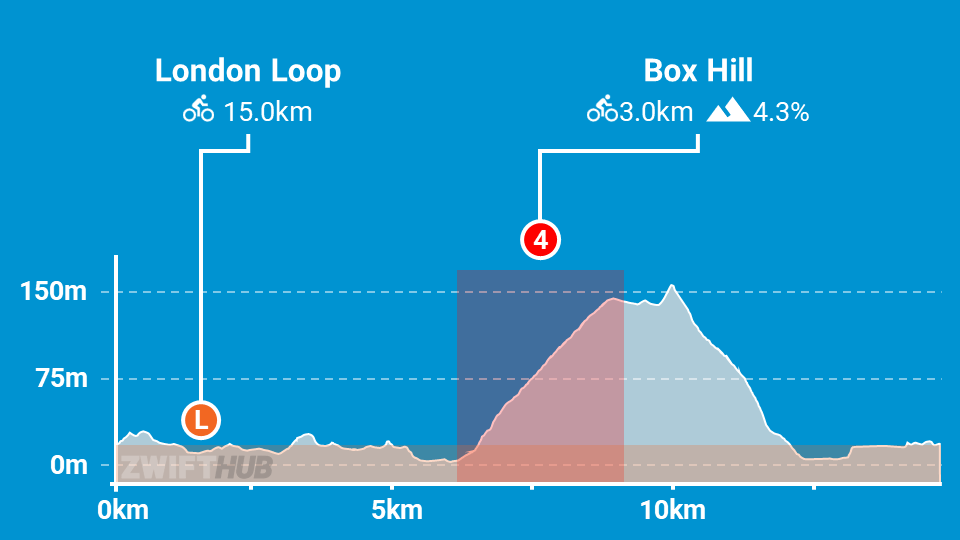
The London Loop is 14.9km long with 231m of elevation gained per lap. A and B teams will be racing two laps of the course for a total of 30.4km and 466m of elevation. Here’s the lap profile:
Clearly, there’s one big feature on this route: Box Hill! This is where the big selections will happen each lap.
Official stats for the leaderboard segment indicate it’s 3km long, with an average gradient of 4%, but that doesn’t tell the whole story, since the leaderboard segment doesn’t line up perfectly with the start and finish of the climb.
Box Hill is a fairly steady 2.7km grade, but the final 300-400 meters of the segment are flat or even slightly downhill, throwing off the stats. The steepest part of the climb, where the pack quickly stretches and elastic snaps, is on the early long stretch before the left hairpin. This section averages 7-8%, and most of the climbing apart from that is around 5%.
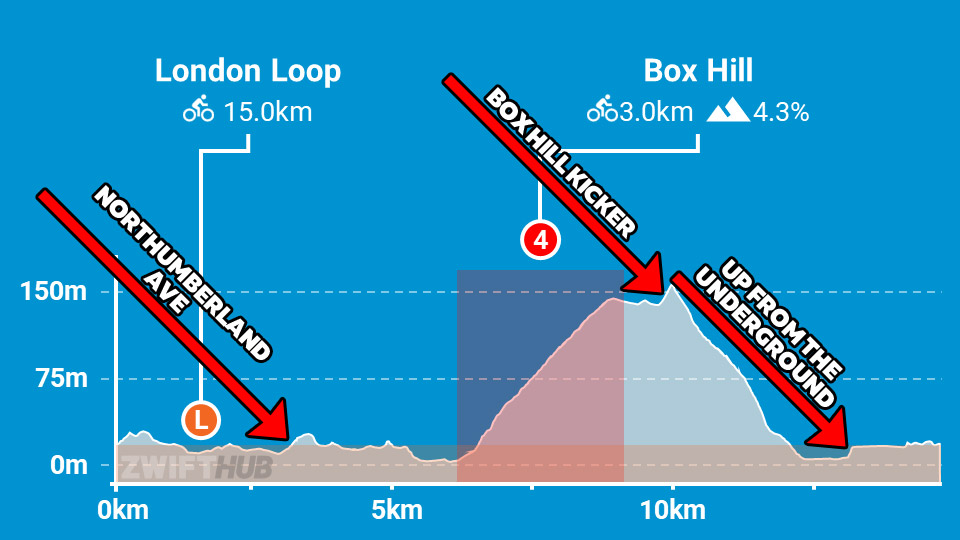
There are three kickers on the circuit that deserve a mention as well:
The first, Northumberland Avenue, comes early on as you turn right from the Thames and head up to Trafalgar Square. This is the first climb more than a few seconds long on the route, so expect the effort level to lift for ~30 seconds, even though big attacks probably won’t come in earnest.
The Box Hill Kicker comes just a few hundred meters after you ride through the Box Hill KOM banner. This one is short, but steep, and everyone’s legs are a big knackered. Pro tip: hit it hard and push across the top, and you can often close big gaps to riders ahead.
After the long descent (expect everyone to take a big rest here), you’ll enter the Underground tunnel and soon enough hit the plywood-covered ramp back into the London sunshine. At 14%, this is the steepest climb of your race. But it’s short! You’ll want to enter it fast, and keep your power high up and over the top.
From the top of the Underground ramp, you’ve got 1.6km to the finish line. Things often get cagey as riders cross Tower Bridge, and the final meters are slightly downhill and fast. It will take just the right mix of timing and strong legs to cross the line victorious. Good luck!
Specific powerups will be given at each arch: the feather at the lap banner, and the anvil at the Box Hill KOM banner. That means you’ll get two of each.
Lightweight (feather): reduces your weight by 10% for 30 seconds. Use on climbs, when weight matters the most. This is best saved for Box Hill, particularly on the lower slope where the pace will be high and the gradient is steepest.
Anvil: makes you heavier for up to 15 seconds, so you can descend faster. It won’t hurt you, as it only adds weight when the road is at a -1.5% decline or greater. Use this when descending the backside of Box Hill to make it even easier to sit in.
Bike Recommendations
This race’s big Box Hill climb definitely makes me steer away from pure aero setups and look at climbing bikes and all-arounders instead. Because while a more aero setup has a pure time advantage on laps of the full course, that time advantage evaporates if you get dropped on Box Hill!
Of course, your frame’s upgrade status should impact your decision. A fully upgraded Aethos will outclimb the other four frames, but that’s not the case when comparing un-upgraded versions.
Lots of recon events are scheduled on upcoming ZRL routes, led by various teams. See upcoming ZRL recons for this race at zwift.com/events/tag/zrlrecon.
Additionally, riders in the Zwift community do a great job every week creating recon videos that preview the courses and offer tips to help you perform your best on the day. Here are the recons I’ve found (comment if you find another!)
John Rice
J Dirom
Strategic Options
I predict riders will fall into three groups:
Climbers: Lighter riders who can sustain high W/kg will surf wheels on the flats, then light it up on Box Hill. Your goal: drop puncheurs/sprinters who have the pure watts to beat you in a pack finish.
Puncheurs: If your VO2 power lets you compete on Box Hill-length climbs, but you’ve also got some pure sprint watts, you are in the sweet spot to win this race. Pure climbers may try to rip your legs off on the KOMs, but if you can survive, you can roll them in the end.
Everyone Else: If you’re a pure sprinter, or simply a rider with lower fitness than most in the category, you’re going to struggle in this race, particularly up Box Hill. Your best bet is to pace yourself well on Box Hill, ride smart to bridge up to riders ahead, and simply finish as high in the list as possible. Remember: every point counts!
Your Thoughts
Any insights or further thoughts on this race? Share below!
Eric runs Zwift Insider in the spare time he finds between riding his bike and managing various business interests. He lives in Northern California with his beautiful wife Monica. Follow on Strava
I think the ZRL is becoming difficult for the heavier riders in the groups with the amount of hills, with the effort they put in to stay at the front almost guarantees a disqualification for exceeding power limits.
The category bands are mainly based on W/kg so if a heavier rider climbs at the same W/kg as a lighter rider to stay with them, they won’t be disqualified (or both will).
Plus the heavier rider will have the advantage in the downhill and the flats and sprints. So one could argue these rides are not biased towards lighter riders.
Except that there are many 50kg riders in Cat B whose limit is 4.2 W/kg OR 250 W. Meaning they can average nearly 5.0 W/kg while everyone else is limited to 4.2 W/kg, and if the course features any real climbs, like most of Round 3 did, it’s impossible to match them without getting DQ’d.
“Many” might be overstating it (there are zero riders under 60kg in my ZRL division, for example) but I get your point.
Still, though, my point is, if you can do the power to get upgraded, you should do that. That’s the whole point of power based categories. Not to cap your performance to gain an advantage. I’ve seen many riders do this for years, then when they finally get brave enough to upgrade, their fitness suddenly increases by leaps and bounds. I say, stop limiting yourself!
My B race had 11 riders under 60kg today, and several others just over. We had guys average 4.5-4.8 W/kg for the entire race without going over their 250 W limit.
I realize my first comment wasn’t super clear – I personally am not capable of doing the power to upgrade right now. But even if I could push the limits of Cat B, I’m getting dropped by these riders on every climb since they can race at an FTP of well over 4.2 W/kg.
It’s fine, each course will, and should, favor different types of riders. This was just a very climb-heavy round, and it was a little frustrating for bigger riders.
Mac J
8 months ago
Fully upgraded SL8 vs. fully upgraded Atheos. 93kg rider. Does the benefit of the Atheos on Box Hill outweigh (pun intended) the all around benefit of the SL8?
Last edited 8 months ago by Mac J
JMattis
7 months ago
I wish Zwift would change this series so that it counts towards your race score. I don’t race often, and am currently in my second round of ZRL. I upgraded from D to C in that time, but my score had been stuck at 234 since November, despite finishing with people with much higher scores. With the races being so often, I hadn’t been inclined to do any other ones but the ZRL races. I took off this week from it to do a TdZ race, and my score shot up 46 points to 280 (in one 12 mile race). I’m planning on dropping from my team as it just doesn’t seem worth the hassle with all the team coordination if it’s not going to also affect your race score.
Typically yes, although races can be set up to disallow racing up.
Jon
7 months ago
Has anyone ever explained why secret power ups sometimes appear on some courses? Like the feather near the end of the lap of London Loop. Or the ones we saw in Titan’s awhile back. Is it ZRL related or does it also happen in other races?






I think the ZRL is becoming difficult for the heavier riders in the groups with the amount of hills, with the effort they put in to stay at the front almost guarantees a disqualification for exceeding power limits.
The category bands are mainly based on W/kg so if a heavier rider climbs at the same W/kg as a lighter rider to stay with them, they won’t be disqualified (or both will).
Plus the heavier rider will have the advantage in the downhill and the flats and sprints. So one could argue these rides are not biased towards lighter riders.
If you can exceed the power limits, you should race in a higher category. Simple as that. Or am I missing something?
Except that there are many 50kg riders in Cat B whose limit is 4.2 W/kg OR 250 W. Meaning they can average nearly 5.0 W/kg while everyone else is limited to 4.2 W/kg, and if the course features any real climbs, like most of Round 3 did, it’s impossible to match them without getting DQ’d.
“Many” might be overstating it (there are zero riders under 60kg in my ZRL division, for example) but I get your point.
Still, though, my point is, if you can do the power to get upgraded, you should do that. That’s the whole point of power based categories. Not to cap your performance to gain an advantage. I’ve seen many riders do this for years, then when they finally get brave enough to upgrade, their fitness suddenly increases by leaps and bounds. I say, stop limiting yourself!
My B race had 11 riders under 60kg today, and several others just over. We had guys average 4.5-4.8 W/kg for the entire race without going over their 250 W limit.
I realize my first comment wasn’t super clear – I personally am not capable of doing the power to upgrade right now. But even if I could push the limits of Cat B, I’m getting dropped by these riders on every climb since they can race at an FTP of well over 4.2 W/kg.
It’s fine, each course will, and should, favor different types of riders. This was just a very climb-heavy round, and it was a little frustrating for bigger riders.
Fully upgraded SL8 vs. fully upgraded Atheos. 93kg rider. Does the benefit of the Atheos on Box Hill outweigh (pun intended) the all around benefit of the SL8?
I wish Zwift would change this series so that it counts towards your race score. I don’t race often, and am currently in my second round of ZRL. I upgraded from D to C in that time, but my score had been stuck at 234 since November, despite finishing with people with much higher scores. With the races being so often, I hadn’t been inclined to do any other ones but the ZRL races. I took off this week from it to do a TdZ race, and my score shot up 46 points to 280 (in one 12 mile race). I’m planning on dropping from my team as it just doesn’t seem worth the hassle with all the team coordination if it’s not going to also affect your race score.
Can you ride in higher grades on zrs even if your score is lower?
Typically yes, although races can be set up to disallow racing up.
Has anyone ever explained why secret power ups sometimes appear on some courses? Like the feather near the end of the lap of London Loop. Or the ones we saw in Titan’s awhile back. Is it ZRL related or does it also happen in other races?