

Back in March, Zwift launched their “bike upgrades” feature, allowing Zwifters to improve the performance of their in-game bike frames in 5 stages by logging time/distance/elevation on the frame before purchasing an upgrade.
To date, bike upgrades have been enabled in most community race events (including Zwift Insider’s Tiny Races) as well as Zwift’s major races (the ZRacing series). However, upgrades are disabled in the popular Thursday TTT events, as well as the Zwift Racing League Showdown wrapping up next week.
That’s going to change soon, though. We’ve received word from WTRL (organizers of the Thursday TTTs) that upgrades will be enabled starting in July (target date: July 3). Additionally, WTRL and Zwift have confirmed that, when Zwift Racing League (ZRL) spins up its first round in September, bike upgrades will be enabled for all events.
So today, I’m publishing this post as a public service announcement: if you’re racing on Zwift but haven’t started upgrading your bike(s), it’s time to get to work.
Why Upgrade?
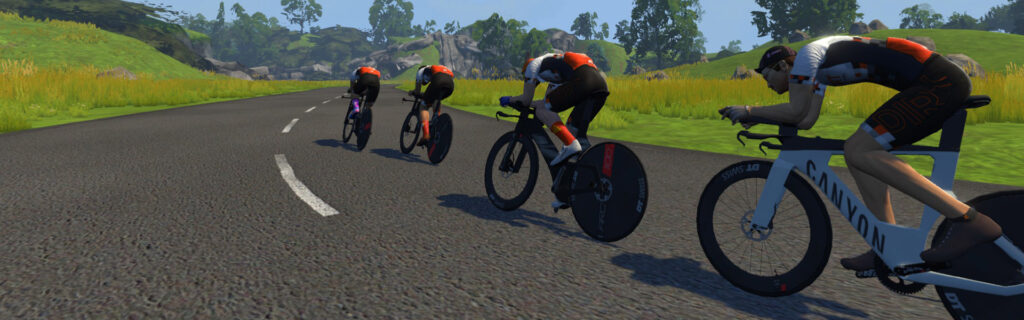
Simply put, riding a fully-upgraded version of a fast bike will give you a significant advantage over anyone riding a non-upgraded version of the same frame. This is especially true when it comes to time trials, where results are based purely on finishing time and there’s no hiding in the competition’s draft.
A fully upgraded TT bike will be approximately 50 seconds faster across an hour of flat riding vs the non-upgraded version, and anyone who has raced a TTT knows that’s a huge margin. If you look at that time savings through the lens of power savings, it works out to ~11 watts saved.
This time savings is so significant that I believe we’ll see team leaders choosing to exclude riders who don’t have access to a fully-upgraded TT frame once upgrades are enabled for Thursday TTTs and ZRL.
A fully upgraded all-around road frame will save you approximately 30 seconds across an hour of flat racing vs the non-upgraded version. It will also save you ~37 seconds across an hour of climbing. This works out to ~6 watts saved in flat races and ~3 watts on climbs. While these savings may not be noticeable when you’re riding tempo in the pack draft, racers know that saving power during the easier parts of a race allows you to have more in the tank when it’s time to go full gas.
Lastly, we have climbing frames, which improve by ~60 seconds across an hour of climbing when they’re fully upgraded. This works out to a ~5-watt savings, which will prove helpful for many riders who struggle on longer climbs in ZRL events.

Which Bikes To Upgrade?
So, which bike frames should you be riding and upgrading? If you want to dig into the data yourself and draw your own conclusions, see our detailed road bike frame performance charts and time trial frame performance charts.
Want to keep it simple? Here are my recommendations:
- All Around Road Frame: Choose from the S-Works Tarmac SL8, Cannondale SuperSix EVO LAB71, Pinarello Dogma 2024, or Canyon Aeroad 2024. These are the four fastest all-arounder frames in Zwift (in that order), and are in a performance class all their own – see our Tron vs Top Performers chart for details.
- You will need to put in 1600km and spend 1.9 million Drops to fully upgrade one of these bikes.
- Time Trial Frame: Choose the Cadex Tri, which is far and away the most aero TT bike available on Zwift (see TT frame performance charts).
- You will need to log 40 hours and spend 1.9 million Drops to fully upgrade this bike.
- (Optional) Climbing Frame: While a fully-upgraded S-Works Tarmac SL8 climbs very well, you may want a fully-upgraded Specialized S-Works Aethos in your garage for any race that involves a crucial longer/steeper climb, especially if it’s a mountaintop finish (see road frame performance charts).
- You will need to climb 15,000 meters and spend 1.9 million Drops to fully upgrade this bike.
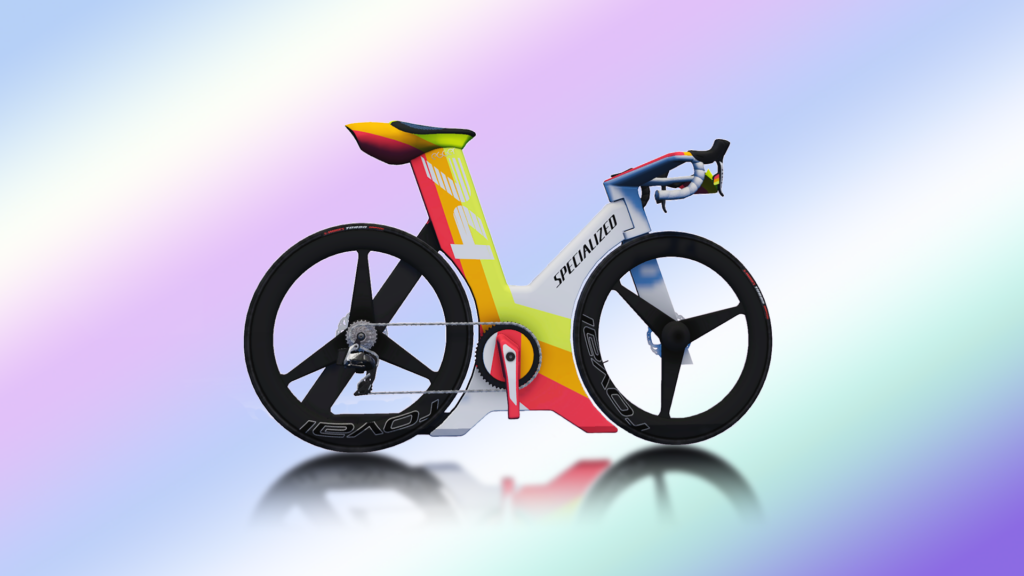
- (Optional) Halo Bike: Once you’ve upgraded your three key frames above, why not work toward a fully-upgraded Halo Bike? They aren’t great climbers, but they sure are aero! The Specialized Project ’74, in particular, is the fastest non-TT bike on Zwift, putting around 6 seconds into the Tron on flat ground (see All About Halo Bikes).
Upgrading Strategy
While some teams/riders are using, shall we say, less than admirable methods for achieving bike upgrades, there are definitely ways to ethically maximize your efforts as you work to upgrade your frames. Before you begin each Zwift session, give a bit of thought to which bike frame you should use for the session, as you’ll accumulate upgrade progress on which frame(s) you select.
Here are three simple tips:
- Time trial frames upgrade based on time spent, so these are best used when riding longer workouts, solo free ride efforts up big climbs, etc.
- Sitting in with pace partners, or participating in a social ride or race? You’ll want to use your road frame, since you’ll be racking up lots of kilometers in the draft.
- Once you’ve upgraded your TT frame, start using your climbing frame for any ride involving significant climbing, so you can make progress toward a fully upgraded Specialized S-Works Aethos.
Questions or Comments?
Where are you in your bike upgrade efforts, and what’s your overall strategy for upgrading? Share your thoughts below!

Any information on WTRL moving to ZRS over the current category system? 👀
Or Velo, please be Velo 🙏
Look at Eric Min’s IG username of “werkdodger”. It says a lot about the entire platform. ZHQ is moving to Oakland soon.
If there’s a racing league which just gives everyone’s bike the same performance and it’s just the rider performance which counts, I’ll go for that one.
I don’t want to bother with all this upgrades stuff – I just want to ride and race and have fun.
Have you looked into flamme.rouge racing? I think they’ve always neutralized bikes. Tough courses! Good community!
It’s still full of cheats and race control won’t do anything.
join Coalition! All of our racers are required to undergo and maintain verified weight/height video’s and equipment
“I just want to ride and race and have fun”…. then do just that and don’t worry about the upgrades some riders may have. Everybody is already using different trainers and some people are getting big benefits from inaccurate equipment. So you are already not racing on a level playing field.
Is there anything known about the use of steering in zrl from September?
Can we get a section on using e bikes and weight doping? I like to put my weight about 20 kg lighter than actual so I can really get competitive.
Yeah it’s easily trackable in zpower who is playing with weights.
I’ve been disappointed seeing so many using [ahem] alternative means to upgrade their frames. This violates the spirit of sportsmanship and what I think Zwift intended. Faster frames are most appreciated by those who rightfully earn them. I’ll get off my soapbox now. 😢
You are not wrong. There are even teams coordinating this behavior.
BMTR, Galaxy, DIRT, Enjoy Fitness, pretty much all of them.
Hilarious! Meanwhile they try to sell merchandise, I definitely would not wear that jersey knowing what they represent.
I’m happy to be on a team that does not do that. I’ve already upgraded the SL8 and the Venge by simply riding all terrain, not simply going for distance coz that’s boring, and I’m certainly not one of those high mileage weirdos. 😊
How about weight doping and stacking TTT teams with bad actors with leadership knowing about it.
The problem of such cheating methods used by some is that such training does not optimize their gains in fitness, strength and most importantly, character and fortitude. Thus please never fail to relish doing it the right way for yourself and trusting the true dividends you receive are truly priceless. I have found this mindset to completely release any angst I have felt towards others who game it in life, on Zwift or elsewhere.
I like that perspective, Ruth!
Although most community races have upgrades enabled (it’s on by default) any community organizer can request to have upgrades neutralized, and some have done so. If you search for the event tag disable_bike_upgrade_physics you will find some that are not WTRL events.
We shouldn’t have to jump through a million loop holes to find an honest race with decent people.
I assume aero socks are a valid option and hopefully soon, true aero helmets and skinsuits.
And bring back the Ceramicspeed OSPW!
Woo go BYU, BMTR.
Does running a fradulent team run in line with the values of morons? I guess so.
I am the king of bad actors, and the hill.😎
The performance data I can find is really useful for thinking about whole races or KOMs, but less so for sprint segments. Is there any testing/modelling done at time differences between bikes at say 1000W? Obviously the most aero bikes should get proportionally faster, but would be useful to get a sense of whether over a 300m sprint there’s enough distance for it to be worthwhile. (Or to put it another way, will we get to a point at which you have to have a Halo bike to be competitive for FTS?)
Two posts you might want to check out:
https://zwiftinsider.com/sprint-tests/
https://zwiftinsider.com/bike-choice-sprints/
So I’ve got only 600 km left to fully unlock the Specialized Project 74 and already have a fully unlocked Aethos for climbing. I guess the next upgrade to work on is the Cadex.Just wondering if there is any need to unlock any other road bikes when the fully unlocked Spec 74 is the fastest non-TT bike available.
I would work on unlocking one of the big all-arounders as a race bike, since the Project 74 is super aero, but not a great climber. The Tarmac SL8, Pinarello Dogma 2024, Cannondale SuperSix EVO LAB71 or Canyon Aeroad 2024 would be the bikes I’d choose from.
Compare Project 74 numbers here https://zwiftinsider.com/halo-bikes/#Specialized_Project_74_Details to those other bikes here https://zwiftinsider.com/top-performers/