

UPDATE: the test results below are now outdated, due to Zwift modifying their Pack Dynamics. See the latest version of these tests for accurate data.
Our original TTT speed test post from 2020 gave team time trial riders some very welcome guidance about how to most efficiently ride their races. Then last week, Zwift began rolling out “Pack Dynamics 3.0” (PD3) – an updated version of the code which controls how riders’ avatars interact with each other on Zwift’s virtual roads. This includes difficult-to-get-perfect issues like avoiding rider collisions, having realistic spacing between riders in a pack, and deciding how “sticky” the draft is.
PD3 is currently live throughout Watopia, London, and Makuri Islands worlds. So we figured it was time to revisit 2020’s TTT test on Tempus Fugit to determine if and how PD3 may change the game for TTT racers.
Test Goals
These follow-up tests set out to answer three questions:
- Has the benefit of drafting changed with PD3?
- Is it still possible to hold a single-file traditional TTT formation in PD3, where the stickiness of the draft has been reduced?
- Has anything changed which would affect the speed of a “churning” group?
Test Parameters and Methodology
All of the test riders were set to 183cm height, 75kg weight, and rode Zwift Carbon bikes with 32mm Zwift wheels.
Tests were done in Meetup-Only View on Watopia’s Tempus Fugit route because it’s the flattest on Zwift, and it has a timed section (Fuego Flats Reverse, 4.4 miles long) which could be used to precisely measure the speeds of each test formation.
All of the tests were done with four riders.
Tests and Results
Test 1: the Churn
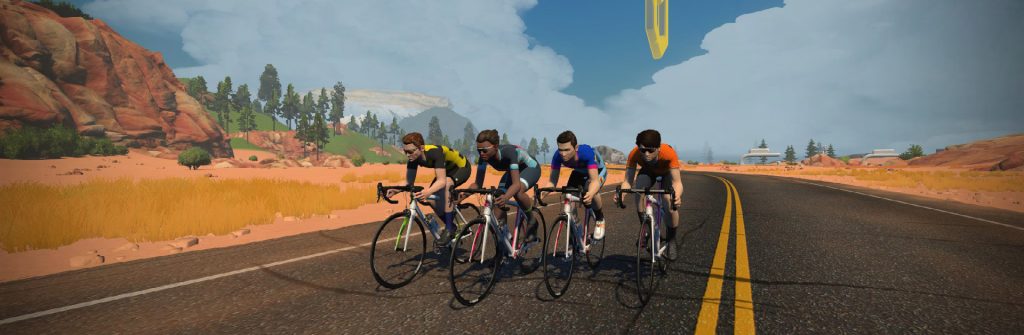
For our first test, we put all riders at the same 300W power setting. This resulted in a churning group of riders where one rider would surge from being in the draft near the back to being in the wind at the front, then dropping back to do it all over again. This “washing machine effect” is what you see at the front of many Zwift races. Our question was – has PD3 resulted in a change in the speed of a churning pack?
- All riders @ 300W
Segment time 10:13.4
Speed: 41.46 kph (25.76 mph)
Notes:
- Segment time was 1.4s faster than our original test from 2020. So just slightly faster (it works out to 120 meters further over an hour).
Test 2: Single File @300W
The second test had the lead rider holding 300W, with the other three riders in single file behind, holding the minimum wattage possible to stay in formation. This is what you would see in an outdoor team time trial:
- Rider 1 @ 300W, Rider 2 @248W, Rider 3 @ 225W, Rider 4 @ 212W
Segment time: 10:36.98
Speed: 39.9 kph (24.79 mph)
Notes:
- The “minimum wattages” stated for riders 2-4 on this test and other tests below should be considered approximations, as it is impossible to figure out the precise wattage required to hold formation due to Zwift’s dynamic physics engine and very small undulations in terrain, even on Fuego Flats.
- Riders received power savings of 17%, 25%, and 29%. As expected, the further back you are, the bigger the draft effect. But what we did not expect was that the draft savings has decreased somewhat in PD3. Our 2020 test showed a saving so of 23%, 32%, and 34% for the same three riders.
- In a TTT situation with all riders taking equal pulls on the front at these wattages, each rider would average 246W. This is an increase from our 2020 test which showed an average of 234W.
- Test 2’s segment time was 23.6 seconds slower than Test 1’s, despite riders holding no higher than 300W in both tests. This may seem odd at first, but it’s a result of the “churn”, riders are speeding up while in the draft, then shooting ahead into the wind, only to be slowed and have another rider shoot past them. This little speed boost accounts for a significant time difference, as we see here!
- Our 2020 test was 11.7 seconds slower, but with a lower overall average power. It’s hard to determine what exactly has changed between the pack dynamics of 2020 and PD3 to account for this time difference, but Zwift has said that the draft effect hasn’t changed. We do know that the stickiness of the draft has certainly changed, with PD3 being much less sticky. Perhaps the sticky draft actually let us stay on a wheel with a bit less power?
- It’s worth noting here that we did a solo rider test at 300W steady, because we were curious if there was any advantage to the front rider if there were riders behind. There is not. Our solo rider turned in the same time as this 4-rider group.
Test 3: Single File @350W
This test is similar to Test 2, except we bumped up the front rider’s wattage to 350W to make sure the group would be faster than the churning pack in Test 1.
- Rider 1 @ 350W, Rider 2 @297W, Rider 3 @ 270W, Rider 4 @ 241W
Segment time: 10:02.73
Speed: 42.15 kph (26.19 mph)
Notes:
- 1.5 seconds slower than the 2020 test
- Riders received power savings of 15%, 23%, and 31% (2nd, 3rd, and 4th rider respectively). Our test from 2020 showed a savings of 23%, 30%, and 33%.
- In a TTT situation with all riders taking equal pulls on the front at these wattages, each rider would average 290W. This is, not surprisingly, a bit higher than 2020’s result of 275W. This is crucial to understand: that even with Zwift’s “speed churning” from test 1, the four riders in this test significantly beat test 1’s time by riding efficiently in single file formation at a lower average wattage.
- That said, the difference between Test 1’s time and Test 3’s time is a bit smaller with PD3, even though the average power has increased by 15W for this test. So there’s definitely more power required to reach the same speeds in a single file TTT format with PD3.
Test 4: Single File @400W
This test was very similar to Tests 2 and 3, we just bumped the front rider up to 400W.
- Rider 1 @ 400W, Rider 2 @323W, Rider 3 @ 297W, Rider 4 @ 283W
Segment time: 9:33.93
Speed: 44.28 kph (27.51 mph)
Notes:
- 2 seconds slower than the 2020 test
- Riders received power savings of 19%, 26%, and 29% (2nd, 3rd, and 4th rider respectively). Again, less savings than 2020, where we saw a savings of 23.5%, 31%, and 35%.
- In a TTT situation with all riders taking equal pulls on the front at these wattages, each rider would average 326W. So just like Test 3, the average power is 15W higher than our 2020 test.
Test 5: Hybrid
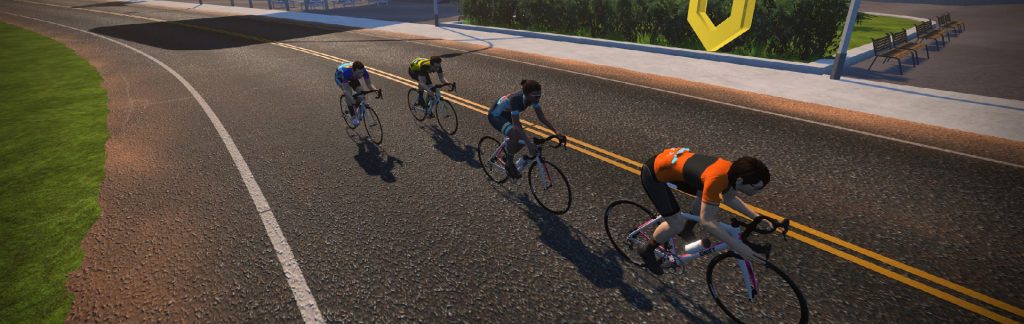
For our final test we wanted to look at a strategy that many TTT teams use, wherein there is one designated rider in front, and the riders behind simply churn in the front rider’s draft. This reduces the hassle of trying to maintain single-file positioning, while receiving some of the benefits. But how does it impact efficiency?
- Rider 1 @ 400W, Riders 2, 3, and 4 at @313W steady
Segment time: 9:33.52
Speed: 44.28 kph (27.51 mph)
Notes:
- 2 seconds slower than the 2020 test
- In a TTT situation with all riders taking equal pulls on the front, each rider would average 335W. So not as efficient as single-file riding (average wattage is 9W higher than the single file test). But a much easier formation to hold!
Conclusions
Let’s answer the three questions we stated at the top of the page:
Has the benefit of drafting changed with PD3?
While Zwift says the draft “shadow” put out behind riders hasn’t changed with PD3, something has made it less efficient to ride in a single-file TTT formation with PD3. Our guess is that the reduced stickiness of the draft makes it a bit more challenging to hold a wheel in PD3.
Is it still possible to hold a single-file traditional TTT formation in PD3, where the stickiness of the draft has been reduced?
It is possible. But it’s harder to do. PD3 feels like there’s almost no stickiness at all, so holding the wheel of another rider (whose power is also fluctuating, like yours) is even more challenging now than it was previously. TTT racers: consider yourselves warned.
Has anything changed which would affect the speed of a “churning” group?
With our test 1 time being only 1.4 seconds faster than the same 2020 test, clearly nothing has changed that significantly impacts the speed of a churning group.
Single File or Hybrid Formation?
While single file is still the most efficient TTT formation on Zwift (and IRL), it’s made much more difficult by the lack of draft stickiness in PD3.
We predict that more TTT teams will begin using a “looser” hybrid formation (1-2 lead riders with everyone else churning in the group behind) rather than single file in upcoming events. This is the logical result of the increased difficulty of maintaining a single file formation and the reduced advantages of doing so.
Your Comments
Got comments or questions? Share below!


Thanks for these great tests, Eric. It’s a pity Zwift don’t actually publish how their drafting algorithm works – it would take away the need for the reverse engineering. A few things I’d like to know along similar lines:
I usually try to ride a TTT with an approx <1 metre gap to the rider in front – is this the most efficient way to do it so that I get the maximum draft benefit, without throwing away excess sticky watts that have no speed benefit?
See you later today in Yorkshire in EMEA W B3!
do other tech companies publish their codes and algorithms?
They don’t, however, especially in video games, they often disclose how it works (or rather should work).
I get your point, but I guess it depends on how proprietary they are. There’s nothing particularly special or complicated about designing a rider speed model based upon input power, weight, CdA, gradient etc but there are a number of parameters you have to assign to these equations. Zwift chooses values for these parameters, but there’s nothing particularly correct or incorrect about them (within certain realistic ranges). Rider position in a pack affects the draft effect reducing the effective CdA which is also part of this, and shape and size of the draft field is another one of those choices Zwift makes. It could publish these values (or their net effects), without giving up key technology that differentiates them from competitors.
Nice work Eric. Not entirely related but, have you ever tested the impact of rider height on drafting?
At 1.90m I’m always amongst the tallest riders in a TTT and I honestly get nothing like the wattage savings you advertise above. I seem to be close to FTP even when I’m resting in the group. I’ve tried hanging on the back at lower watts but very easily get spat out.
I obviously can’t change my height but I’d be interested to know if there is a quantifiable effect so I can measure my efforts more accurately. Cheers
Interested in this at 194cm. Would seem that if this does has a significant impact it would be easier to be ‘loose’ with accuracy here than on weight as no events check height. I always seem to work harder to stay in packs on zwift than irl
Useful stuff, thanks for this. Must say that it would visually be a pity to see pace lines disappear.
It got me wondering, how would you predict things to change for a double-draft event? Does it give a greater edge to the pace line (better recovery), or would the churning style get an equal or even greater boost?
Being sticky-blocked by a team-mate can cost around 1kJ of kinetic energy. Reducing this effect should make life much easier in the draft, once riders are used to the subtlety. 1kJ means generating an extra 100W for 10s just to regain the speed you just lost…or 50W for 20s etc. It would be interesting to see what is the *max* power a following rider can put out while remaining entirely behind the rider in front, for both old and new dynamics.
Interesting – is this something you’ve heard from the mouth or seen written down by Zwift people, or something that you’ve been told or tested / approximated? I don’t think I’ve seen anything written down along these lines before (not by any means saying it isn’t correct, just interested in the source). This value seems a bit high to me, if it was the case. The other thing that would be interesting would be what causes rider A to engage in sticky draft behind rider B? Would guess it’s related to their relative speeds (maybe also momentum),
I’ve calculated it based on my own observations. I have lost around 5kph in speed near-instantaneously when meeting a team-mate who was drifting back, and that’s what the drop in kinetic energy works out to. I was possibly slowing slightly at the time anyway so I can’t be really precise but it’s definitely that order of magnitude. I don’t know the parameters of sticky draft but it definitely seems to relate to relative speed, maybe acceleration/power plays a role, rider weight, I dunno. Anyway it’s much better now 🙂
Great article as always Eric. TTT was hard enough already. This will ensure I have no time for checking my emails while racing. * I especially like how you set out to answer “just two questions” and then asked three questions. 😂 I can’t tell you how many times I’ve done that.
Was this comparing to Draft 1.0 pre Apr 21 Eric? Because there we have been going slightly slower in TTTs since Apr with more watts put out- so 3.0 has carried this over
tl;dr: drafting = nerfed?
seems like person at the front isn’t affected, but people behind now have to put out slightly more power to stick with the person in front of them?
will be interesting to see if this helps solo breakaways at all. in theory it should right? harder to chase (less benefit of chasing as a group?)
Darn. The churning group speed (with no conscious effort to increase the speed, i.e. choose to work hard at the front) is one on my zwift pet hates. I hope this gets fixed in a later update.
There is something very puzzling to me in the tests. If your line of 4 is exactly the same speed as a solo doing 300W, but your previous line of 4 was a different speed (by some 11.7s), then this implies that either the solo speed has changed under new dynamics or your previous line of 4 was *not* the same speed as a solo under old dynamics. Do you know which of these is the case? Ie, has the overall aerodynamics of a solo changed, or did the following riders previously affect the speed of the leader? Neither of these sound particularly likely to me, but unless I’ve misunderstood what you did, one must be true.
It’s a good question. I DO have a single rider test from November 2019 that shows the same segment time as the tests above, so it appears that nothing has changed between then and now in terms of single rider speed. Maybe the original 2020 test was inaccurate somehow?
James and Eric, this would suggest that there is now no advantage to having 8 riders vs 4 (for instance) in a TTT group. As long as there is SOMEONE pulling at 300W (for example) then what goes on behind is irrelevant. I was pretty confident in my assertions on zwift-ds that an extra rider was worth about 15-20s per hour, all things being equal, but your tests suggest that if a rider gets dropped, there is absolutely no advantage to waiting for them, assuming the others can still do their 130%+ pulls?
Sure seems that way, Paul. That’s why I specifically did that solo rider test, to compare those numbers.
Well, doesn’t the 5th, 6th, 7th and 8th rider still increase the draft effect for the ones that are behind them? The draft is better for the 5th rider than the 4th. Perhaps not worth waiting for a dropped rider, but if that rider can keep up (and not be last in the line allways) he/she can create more rest for the others.
Why oh why doesn’t zwift have wattage savings meter or display like a lot of other similar games have? Even if they don’t improve the dynamics, this would at least give you a better sense if you were actually in anyone’s draft..
I don’t get the point of that personally. A visual representation (rider sitting up) is more than enough. It should be intrinsically known by your position.
Because it should change dynamically based on the number of people in front of you, your position., just like IRL. You feel it in a real race, but you can only ‘see’ it here.
honestly, takes a lot of fun out of the game if you’re just sat there staring at some number that you would never have access to in an IRL race, rather than focusing more on your physical position in the pack etc. personally i prefer having it hidden. i’m suprised they decide to show your opponents w/kg in races too! you’d never have access to that info IRL!
There’s pros and cons to both. IRL you can very easily see, whether you are on the wheel or not and whether you are getting dropped or not. You can also put just a bit more effort to stay on the wheel, because momentum doesn’t play such a big role as it does on Zwift. On Zwift, you are on the wheel for 10 seconds and suddenly, seemingly without anything changing, you are not on the wheel and getting dropped, because your momentum has been decreasing for the past 10 seconds, but you couldn’t see that! Then you have to push hard (if you are not in a big group) to keep on the wheel and not get dropped, which mimics real life, but IRL you usually wouldn’t get into that position (what I wrote earlier).
TLDR: IRL you can very easily see very little changes in draft and change your power accordingly. In Zwift you can see only big (accumulated) changes in draft and have to change your power a lot to keep up/not ride off.
A draft indicator telling you what watts you need to stay in draft would help Zwift be more like real life.
I agree with Mattv – I like this information on RGT, as it replaces the info you get from “the wind in your face” in real life. Some kind of visual info could be helpful for beginners to learn better group riding.
Looking forward to the day when Zwift adjusts the trainer-resistance based on the draft, not only gradient. If you come into a riders draft then the resistance reduces and if you dont change your gear or cadence you actually experience the draft effect. When you move out of the draft the resistance increases again.
Totally agree! I wrote about that there over 2 years ago: https://zwiftinsider.com/feeling-the-draft/
This would make HUGE difference, IMO. With improved group dynamics and steering (maybe) this would bring Zwift racing to a whole different level.
And slowing you down in turns.
I wonder about some intangibles when it comes to TTT in PD3.0. The smoother movement could mean less gap closing than in PD2.0, especially when a rider in your line suddenly moves over into the wind. you may have to maintain a slightly higher output, but you could avoid some unexpected spikes in effort. In my experience, thats the part that really kills you in a TTT.
Has anyone noticed that the problem of significantly decelerating (up to 4km/h) when overtaking a rider has been greatly reduced with this update? It seems much better to me.
Long time lurker, infrequent commenter…
Interesting tests and results. What struck me was the difference in some group TTT and a large bunch ride. We know from other research that the least resistance in the bunch is near the back, which we see in Zwift in big bunches
https://www.sciencedirect.com/science/article/pii/S0167610518303751
Would you be able to repeat Test 5 Hybrid but at 350W to allow a more direct comparison of strategies? The time will likely be the same as Test 3, but what will the average power be? If it is about 9W more than test 3,(i.e. same delta from test 4 to test 5), then it will be 299W so about the same as test 1. It would make the churning strategy look pretty reasonable, especially on some courses