

Competitive Zwift Racing, at the nexus of video games, exercising, and competitive team sports, is pushing the boundaries of how we think about competition. In the first part of this series we looked at the population of 80,000+ riders that participate on the ranked ladder – a truly global audience, often racing weekly – and the most popular events. And in a follow-up article we looked deeper into the demographics of that population – it’s quite different than what you might imagine the typical “esports” competitor looks like.
But after all of that “context setting” I still had significant questions about the outcome of all that competition. Categories, sandbagging, and weight-doping are certainly some of the hot-button topics in the community (though, potentially not more so than other competitive esports where terms like “smurfing” are similar lightning rods).
The difference between Zwift and other esports is there isn’t currently any concept of matchmaking – when you click the “join race” button, there is absolutely no guarantee you have a fair shot at winning. Zwift has recently started experimenting with “category enforcement” where you might be excluded from some races based on previous performances. This is a solid half-step toward a level playing field.
But is a level playing field on every race the right end goal? Sure in other esports, competitive games are all about winning each match – but in Zwift, for many (most?) it is simply a great way to get a good workout in. One interesting direction to look at is the race ranking that ZwiftPower tracks for each rider which turns each race into a meta competition across all 80,000 racers, not just those lined up next to you.
There is a great overview of the mechanics here and strategies for improving it here, but I had some fundamental questions about the whole system:
- Should I care about rankings? Are the rankings actually predictive of performance? Are better ranked riders actually more likely to win?
- What is an appropriate rank goal for me? How would that change as my power curve improves?
- How should I think about Cat B riders that are ranked better than many Cat A riders? Should I be aiming to get to the top of my own cat rankings? Or just ignore category rankings and climb as high as possible?
Ranking Landscape Today
Based on the way rankings are calculated (best 5 races in the last 90 days), you really need to be racing at least 2x per month in order to have a rank that has a chance of accurately reflecting your performance. If you have fewer than 5 ranked races in the past 90 days, the algorithm assigns you a rank of 600 (the max) for the missing races which will tank your average.
Per my last post, almost half of the racing community races 1-2x per month, which leads to a huge chunk of ranked riders with a rank of 500-600 simply due to having missing data points. Beyond that, the distribution of riders by rank declines fairly linearly – this would suggest going from rank 300 -> 200 is harder, but not exponentially harder than going from 400 -> 300.
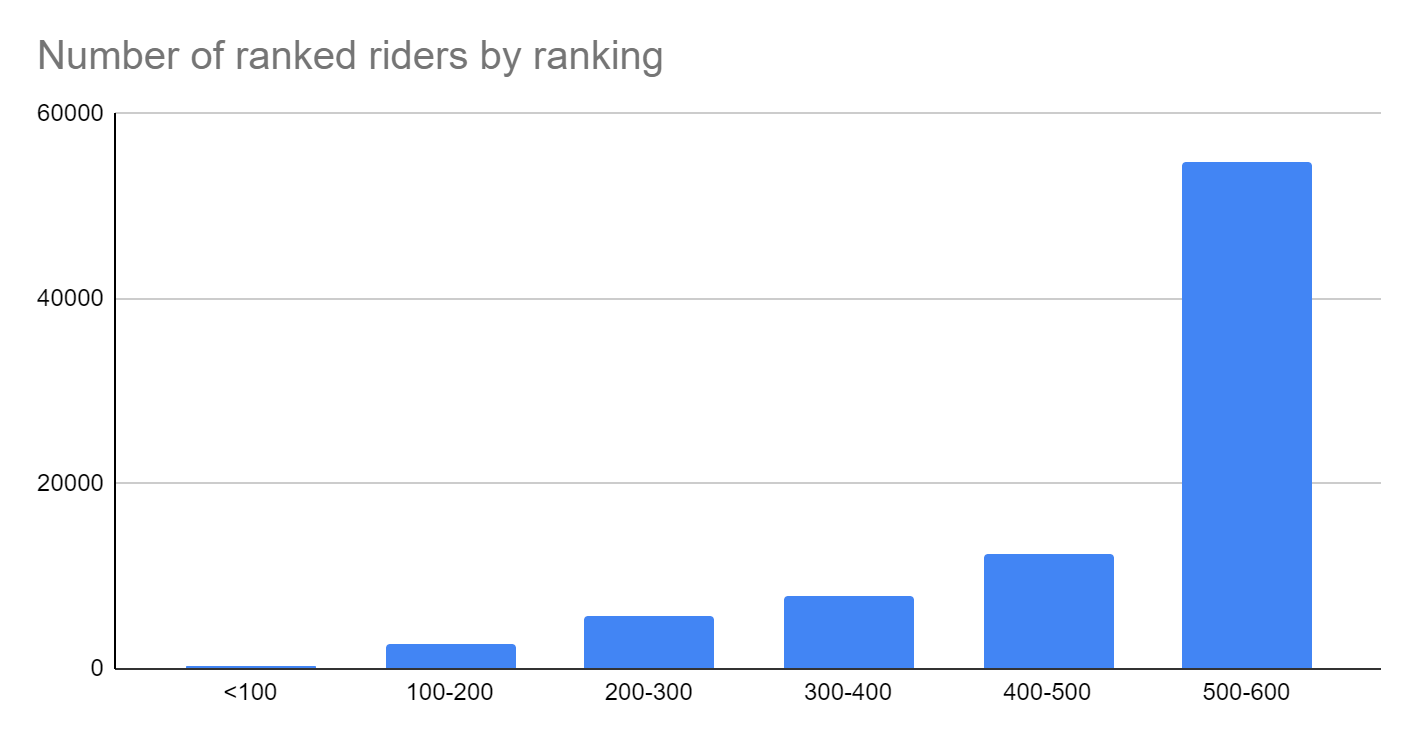
| <100 | 100-200 | 200-300 | 300-400 | 400-500 | 500-600 |
| 0.3% | 3% | 7% | 9% | 15% | 65% |
[Methodology note: similar to the last article, population at each ranking range was estimated by finding riders ranked exactly “300” and looking at what their overall position was (so a rank 300 rider is reported as “in 9,000th place overall” this means there are 9,000 riders ranked between 0-300. Similar methodology was used for the below category breakdown chart.]
The other thing to note is the significant overlap in rankings between categories. There are many category B riders ranked ahead of category A riders. Similarly for the line between A and A+ and the line between C and B.
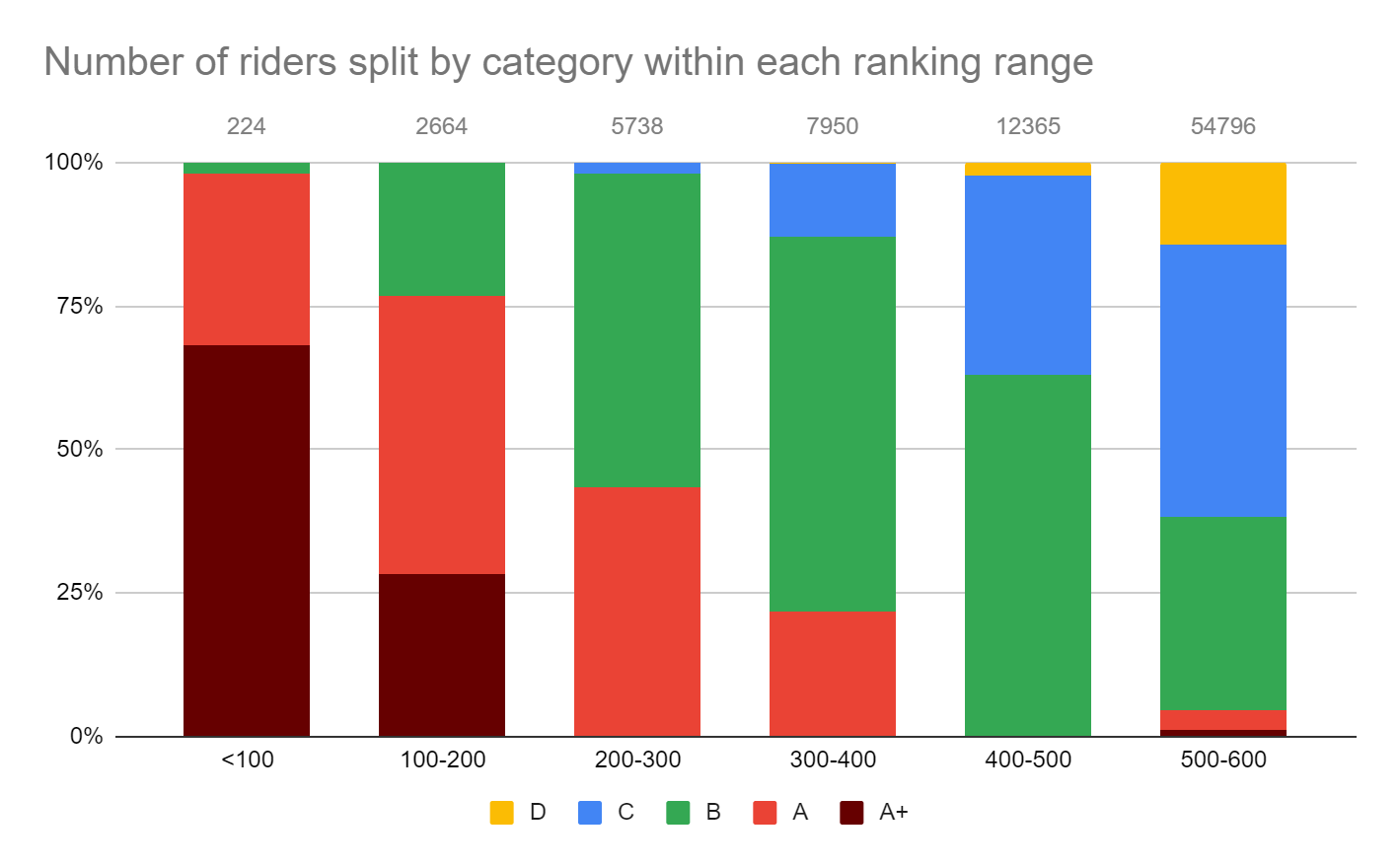
More on this overlap later, but my first question was around how important really are these rankings within a category (given folks usually race within their category)? How big of a deal is a 50pt difference? What about a 200pt difference?
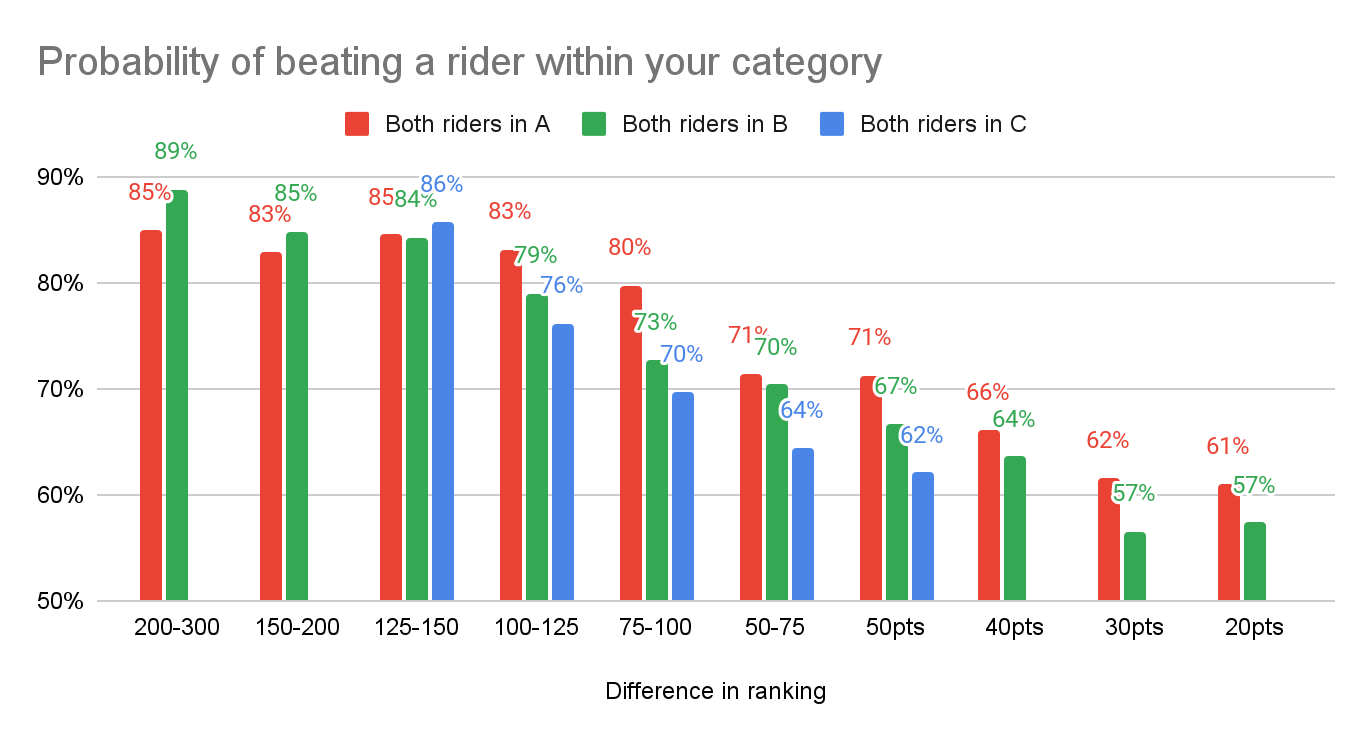
[Methodology note: in the above, I took a random sample of races, broke each race down into a bunch of 1v1 races between each of the participants within each category, and looked at how frequently a rider of a given rank finished ahead of a rider ranked XXpts below them regardless of their overall finish position – so the 2nd to last place rider “beat” the last place rider. I also excluded the 65% of riders from the analysis ranked 500-600 given they may not have the full 5 races of data so their rank is less indicative of actual strength. Because the C & D categories have significantly fewer riders ranked less than 500, we can see some partial data for C, but are missing D data entirely.]
It turns out rankings are relatively predictive of performance. If you line up next to a rider in your category ranked 100pts better (lower) than your own race ranking, you have ~80% chance of finishing behind them at the end of the race (though 20% of the time you will beat them!). As might be expected, small point differences matter a lot more in category A than in B & C where a <50pt difference only gets you a small bump.
So what is a good ranking goal to shoot for? To try and put some guardrails around a reasonably achievable goal, I looked at the average performance of riders with different rankings in actual races. This should give me a sense “if I wanted to ride like a rank 200 B rider,” what kind of power I would need to put out in a typical race.
| A | <100 | 100-150 | 150-200 | 200-250 | 250-300 | 300+ |
|---|---|---|---|---|---|---|
| 20min w/kg | 4.3 | 4.2 | 4.1 | 4.3 | 4.1 | 4.2 |
| 5min w/kg | 5.0 | 4.9 | 4.8 | 4.8 | 4.7 | 4.6 |
| 1min w/kg | 8.2 | 7.4 | 6.9 | 6.6 | 6.4 | 6.1 |
| 15sec w/kg | 12.2 | 10.8 | 10.2 | 9.1 | 8.7 | 8.1 |
| B | 150-200 | 200-250 | 250-300 | 300-350 | 350-400 | 400+ |
| 20min w/kg | 3.6 | 3.6 | 3.7 | 3.7 | 3.6 | 3.4 |
| 5min w/kg | 4.3 | 4.2 | 4.1 | 4.1 | 4.0 | 3.9 |
| 1min w/kg | 6.2 | 6.1 | 5.6 | 5.5 | 5.2 | 5.1 |
| 15sec w/kg | 9.9 | 8.9 | 7.8 | 7.4 | 7.3 | 7.1 |
| C | 300-350 | 350-400 | 400-450 | 450-500 | 500-550 | 550-600 |
| 20min w/kg | 3.0 | 3.0 | 3.0 | 3.1 | 3.0 | 2.9 |
| 5min w/kg | 3.5 | 3.4 | 3.5 | 3.4 | 3.3 | 3.2 |
| 1min w/kg | 5.1 | 4.5 | 4.6 | 4.4 | 4.1 | 4.0 |
| 15sec w/kg | 8.0 | 6.5 | 6.6 | 6.0 | 5.3 | 5.4 |
| D | 450-500 | 500-550 | 550-600 | |||
| 20min w/kg | 2.3 | 2.2 | 2.3 | |||
| 5min w/kg | 2.8 | 2.5 | 2.6 | |||
| 1min w/kg | 4.0 | 3.4 | 3.3 | |||
| 15sec w/kg | 6.0 | 5.4 | 4.6 |
A couple of interesting points:
- 20min w/kg is pretty consistent across rankings within a category – this is likely just the pace of the peloton, no reason to push harder than the front group is cruising. In reality, top-ranked riders very likely have higher max 20min w/kg numbers than lower ranked riders, but they arent hitting those in typical races
- You start to see a gradual ramp up in 1min and 5min power output as you get higher rankings, this is the “don’t get dropped on hills by the front group” power output needed
- And then lastly, the 15sec power output seems to be the real differentiator, as would be expected given the importance of the sprint to actually winning races.
The important takeaway for me here was, based on my race power outputs, I should be able to stick with better-ranked riders than myself. Just need to get after it! - Lastly, worth pointing out the overlap across categories. A rank 200 A rider is putting out higher 20min, 5min, and 1min power output vs. a rank 200 B rider (the “don’t get dropped” requirements of the cat) but actually fairly similar 15sec power. Same for the overlaps between B & C, and C & D.
So could a rank 200 B rider beat a rank 200 A rider? Are top-ranked B riders “just cruising” during most races and could actually hang with, and frequently beat Cat A riders when racing head to head? Said another way, when I think about the overall stack ranking of Zwift, should we put all cat A racers above all cat B racers – or just ignore categories all together and use race rankings? The answer is definitely “it depends” but we could at least look at some data to help.
To take a crack at answering this question, I narrowed in on races where all categories start together – in these races (largely hosted by 3R) while a category B rider isn’t officially competing for a podium spot with a category A rider, they are riding side by side, so comparing the finish times of riders across categories should allow us to do a similar analysis. In the below charts, I looked at instances where a Cat A and Cat B rider (and then Cat B and Cat C in the 2nd chart) both had the same race ranking in these races. For Cat A/B this overlap occurred with both riders ranked between 200-300 most frequently; for Cat B/C this ended up being in the 400-500 range.
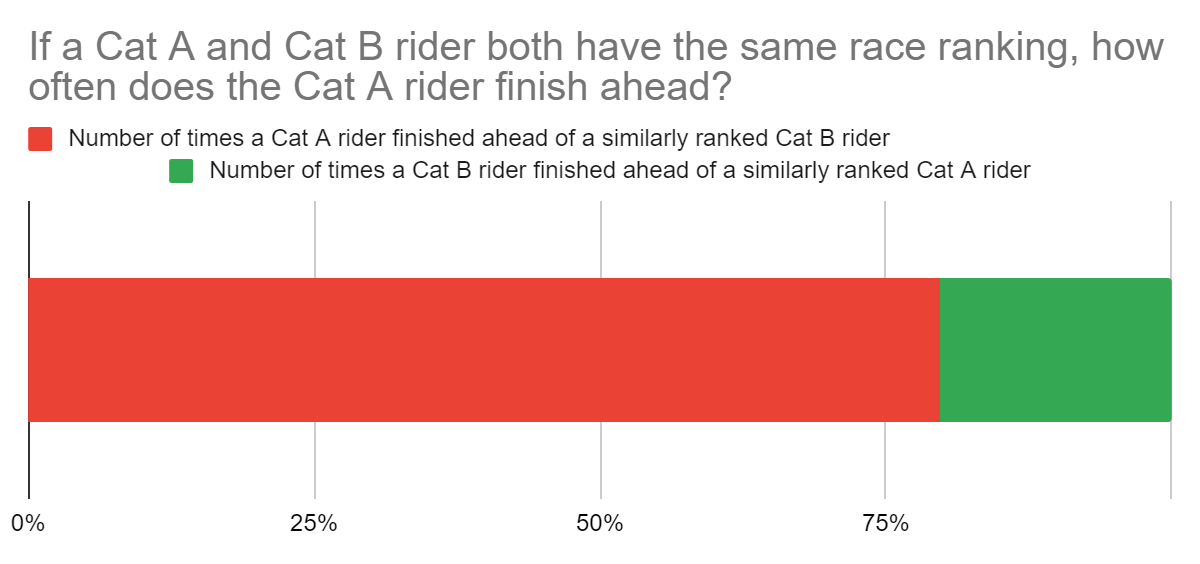
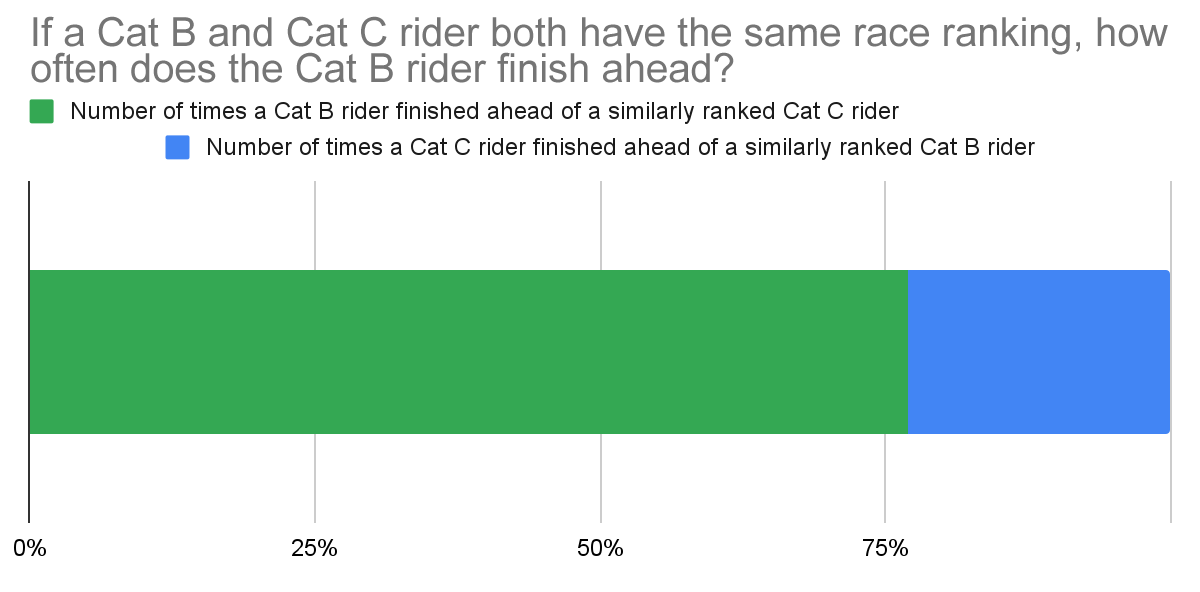
It turns out, the vast majority of the time (~80%), the higher category rider finished ahead. Looking back at our earlier win percentages within a category, an 80%+ likelihood of winning correlated to at least a 100pt difference in ranking, often even higher. So at a minimum, if you wanted to stack rank all of Zwift by race ranking alone, each higher category should get a 100pt+ bonus (e.g. a 300pt cat A should be ranked at least as fast as a 200pt B).
For the sake of completeness, I also looked at win probabilities of riders with different rankings across categories:
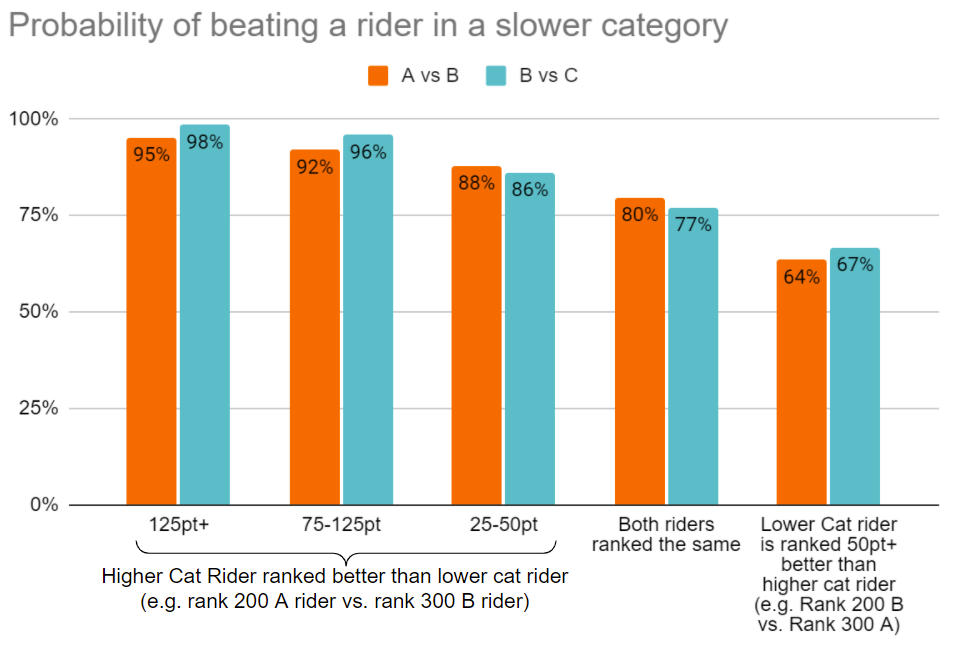
Maybe the most interesting bar is the far right bar where we look at riders in B (or C cat) actually ranked better than a rider in A (or B cat). Even in these situations, the higher category rider is more likely to win, even though they have a worse rank. This data, at least, would suggest that in the stack rank of all Zwift riders, category comes first, then ranking matters a lot within categories.
So where does this leave us, hundreds of thousands of data points and a few too many charts later?
- The competitive Zwift Racing Ranked population is somewhere around ~80k riders (maybe 10% of the total Zwift population), who each race about once a week, come from all over the world (though weighted toward Europe), and all age ranges (with the average somewhere in the 40s)
- Racing is clustered around ~4-5 major event organizers who are often hosting 100+ events a week, each with ~40 racers
- The vast majority or ranked racers compete in B and C categories
- The ZwiftPower race rank system does provide a fairly predictive way of stack ranking racers within a category
- However, despite the fact there is significant overlap in race rankings between categories, the data would suggest racers in a higher category are indeed faster than racers in the lower categories, even if the lower cat riders have achieved a stronger rank
Generally, I wish that last bullet was not true and we could develop an absolute measure of a racer’s relative strength that was predictive both within and across categories. That would take some of the pressure/importance off of the categorization system which is imperfect in many ways.
Your Thoughts
Share below!


It’s almost like they need a ranking multiplier based on your AVG wkg in each category and scoring is a combination of both who you beat but also the relative difference in power. Basically combine cat and ranking into one score but it makes cat continuous rather than large segments. I’m sure it wouldn’t be difficult for someone to code it. Although looking at zwift development speed it’d probably take a decade.
The final point is only true because of the category system that we use. A top B rider very rarely actually races a lower A rider, and hence the A rider doesn’t get the ranking “boost” from beating them. So instead you end up with a series of more or less independent ranking systems for each category. With a dynamic match making/categorization system these bubbles would overlap and ranking would be a much better predictor.
Not true. Many of the highest ranked B riders are often racing in the A cat. In fact, racing in the A cat can be the best way for a B rider to improve their ranking, particularly in large races or if the B rider has a strong sprint.
Do you know if a race ranking of say 300 a year ago is equivalent to a 300 today?
Just based on anecdote evidence, it seems like race ranking continue to decrease for the average B rider, for example.
I would answer by that by my own experience, Once you get to “your one true ranking” it won’t change much unless you get fitter or suddenly starting winning more races. I race about 3-4 times a week and once I got my ranking to about 190 It more or less just stays the same regardless of if you win a lot, because you are always beating riders ranked lower than you, your ranking won’t improve very much if at all. so it just sort of normalizes.
The algorithm used to create rankings causes rankings to slowly drift lower over time. If you study the formula that’s used, you don’t actually have to beat riders better than you to improve. Finishing middle of the pack in a large race with a strong top end can often offer significant points. The 2 key factors are the # of racers, and having 5 of the top 10 finishers with strong rankings. Having few to no poorly ranked riders that drag down the average helps as well.
My personal experience of this in B category of that no the rank is not the same now as it was a year ago. Around this time last year I got myself up to 74th worldwide in the overall B category rankings this year however it seems that the overall ranking is lower in B as my personal rank points are slightly lower than last year when I was 74th but I’m currently sitting in the 300’s of the worldwide ranking.
The categories are based on a 20-minute w/kg metric which may or may not be a valid ranking metric (at least singularly). Interesting that the more predictive success metrics (shorter-time power numbers) do not even figure in categories. 20-minute power doesn’t help when you get blown off in the first 5 minutes of craziness. Suppose the answer for those of us with flatter power curves is just don’t bother racing (or at least don’t ever expect the “level playing field” some keep talking about). oh, well, someone has to be DFL. LOL
The answer is hit the gym and boost that power curve 😉
Zwift is adding a shorter power metric in addition to 20min in the Category enforcement beta races.
I actually think what this shows is that the 20min w/kg is actually the biggest difference between the categories. The reality is in each category the lead group cruises at approximately the same pace every race – that is what you see in the 20min w/kg numbers. Who actually wins the race comes down to the higher end of the power curve, but I think we see that just because you have a great 15sec power, that doesn’t mean you would be able to beat riders one category up unless you can also match their 20min w/kg
90 days is absurd my rank varies by how often I race not how fast. Agree with other poster though about having general idea of my ‘true’ rank racing. I’m a mid power B (though with a lot of experience) and intermittently race in flatter A races. Bottom line though is to quote ‘the rider’ ‘some people think racing is about being fast (strong).’ It’s not a power contest it’s a crossing the line contest. If I had a massive sprint I’d win flat A races I hang in them if not lumpy. But I’d still be ‘minimum’ a B. Vast difference in A vs B with B races often having faster times as people pull without good reason while As strategically attack/bridge etc not pull. While 20 min power is a decent predictor or IRL results the ‘win (or get dropped) over and over’ having no effect on your category and the above to me means throw out power since it’s all about how you RACE. That couldn’t have been designed by experienced racers and lots of contradictions will quickly dissipate. 7 years now category enforcement pilots? Throw out the original premise there’s a system in place and real life racing is brutal lots of potential ways to handle new racers but for the rest the answer is already there (along with the lack of interest in the platform – and they are smart to focus on other things to get riders – in racing specifics.
I think the 15sec-1min powers are off for some reason. They should be way higher, especially for Cat A/B. It’s also odd that the Cat B 20min power is so low. I would have expected it to be closer to 4wkg. Maybe looking at last 90 days is not always representative of a riders best effort, bringing the averages down?
The power numbers are average power during the races I looked at, not best effort / power curve of the riders – if you look at the results of a typical B race (say this one from a few minutes ago: https://zwiftpower.com/events.php?zid=2821077) you see the average 20min power put out by B riders during the race was ~3.6.
are you just looking at podium positions, or all ranked riders taking part? is there a minimum number of participants required? if anyone gets dropped their numbers are gonna bring the average way down because they are likely to stop trying their best & races with less riders in are likely to be less competitive. doesn’t seem right if my 15s/1m power is “competitive” with lower ranked Cat A racers, but my 20min is firmly in Cat C xD
Are you looking at your avg 15s/1min power output during a race or you max 15s/1min. I think on average, people race a lot closer to max 20min w/kg but rarely hit their max 15s / 1min. E.g. if you look at the top Cat A racers, their max 15s/1min is way higher than what is shown here which is their average output during a race.
The data is looking at all riders who finished the race, regardless of field size. Given your point about people dropping out – you’re right we should probably think of the power outputs shown here as the “avg power output of riders in the lead group”
Exactly having a double digit w/kg 15sec sprint, obtained in training, is pretty worthless if you have had to race at close to your max 20min wkg throughout and have nothing left to give in the last 300 metres.
Interested to note you are considering output of riders in the lead group. Have you considered analysing various outputs, including HR difference and Av. Race Ranking across all the finishing groups in a race – provided of course that a large race splits into 4 or 5 groups.
I want to mention that many C and especially D riders can race regularly and never get a race result less than 600. This may be significantly changing your data on number of active racers.
I know of one D who started entering A races sometimes because last in A awarded a better score than winning D.
Great point. I don’t have a great solution to solving it other than just looking at a lot more individual riders (rather than the rank 599 “trick” I used to estimate population)
ZwiftPower ranking follows the USA cycling model. However I think one fairly important operation is missing, that being the allocation of a minimum 590 ranking points to anyone finishing a race. The effect of this is a Race Ranking of:
600 – No races at all in past 3 months
598 – 1 race placing very badly
596 – 2 races placing very badly in both
594 – 3 races etc
592 – 4 races etc
590 – 5 races and performed badly in each
If, in the, future Race Ranking is ever going to have any bearing and importance in a different categorisation system it may well be beneficial to tell the difference between racers with constant poor performance and those who have just not raced for 3 months.
I dont think the 590 thing is a thing on zwiftpower (though it may be in USA cycling).
If you look at a recent race result (e.g. this one: https://zwiftpower.com/events.php?zid=2838632 from an hour ago) and click “columns” and add the “rank for event” column, you can see the bottom 20-50% of B, C, and D finishers who do have a finish time did not receive a score for the event so effectively did receive a score of 600
The 90 day thing is sort of counterproductive to the categorization. For example many solidly A riders (4.5+ w/kg) who don’t Zwift during their actual IRL race seasons or who only use Zwift during the winter get automatically moved to B, and then are racing in B because Zwift/Zwiftpower put them there until they log enough races at 4w+/kg to get put back into A. I had to do this late last year. Happens to many As. So there’s As racing in B because Zwift put them there because of the 90 day thing.
They could always race in A even if Zwiftpower is saying their minimum cat is B… Anyone can join an A race, even in the recent category enforcement events.
Yes, but only after figuring that out. I guess if you’re used to following commissaires’ instructions you just blindly follow what you’re told until you have a “wait a second” realization.
I have not raced but my group riding results make me a 600 point Cat C rider, at the lowest 2.5 w/kg level. Riding the Rapha Rising challenge as a Cat C rider, I finished in my W/KG group which was at the end of the pack. This means that I am lucky to hang on in a Cat C race. So why? I would like to race but not if I’m just going to get shelled out the back then I might as well do structured training or just participate in group rides where I pace up.
I think there need to be more Category Groupings at the lower levels with strict anti-sandbagging enforcement. Maybe create some indoctrination events where each racer is categorized. Maybe a Sandbagger Jersey of Shame if a sandbagger is caught, take away ability to draft or earn powerups for a time period?
For me, I don’t get sandbagging? If I want to ride Zone 2 or AR, then do social group rides that have a pace goal.
Too me, races should be special events where you test yourself. As a Cat C, 2.5 w/kg, I don’t stand a chance against a 3.2 w/kg competitor. At my weight 2.5 W/KG is 181 watts for 1 hour versus a 3.2 w/Kg that can sustain 230 watts for 1 hour. Sorry but my sprint power is irrelevant. Give me a chance and I’ll participate!
I wouldn’t use the Rapha Rising challenge as a true indicator. First, it wasn’t a true Zwift race, but gave the option to treat it as such (recommending signing up for Zwiftpower, etc). So you had a mixed bag of riders who were all over the spectrum of how they approached it from racing, to getting a workout, to casual. Second, with it being a strictly uphill challenge, weight truly came to the fore whereas in the majority of racing, it’s actually more about true power (making the assumption that most racers prefer the flatter courses). Third, depending on the time of day of the ride and category you choose, you could end up with a few hundred riders…or just a few dozen.
Personally speaking, I haven’t done a ton of Zwift races yet, but I’m in the B category (I’m typically able to hang with the lead pack, but am not in contention to actually win). I entered C in Rapha Stage 1 as it was two days before my actual outdoor racing season started, so I wasn’t interested in burning up my legs (I knew going in that Zwiftpower would “UPG” flag me). I rode Z1/Z2 until the base of AdZ, then rode upper Z2/lower Z3 up the mountain. Yes, I passed a LOT of people going up, but I was nowhere near the front at the end as I was behind at least 80% of the field at the base of the mountain.
Stage 2, I entered the B category (the evening after my two outdoor crit races) as I felt bad blowing by people up the mountain in Stage 1. There were 77 people entered. I absolutely shelled myself trying to stay with my mini-blob mid pack, and ended up cramping and riding solo up the 2nd half of the mountain. It was absolutely miserable.
Stage 3, I entered the C category again just to have people to ride with without having to go full gas the entire time. I reached the bottom of the epic KOM in somewhere around 480th out of like 570. Once again, I passed a ton of people going up.
Maybe that’s sandbagging to people? I don’t know.
In actual events designated as races, though, I am completely, 100% on board with stricter enforcement (though straight w/kg isn’t always the answer).
You should not be surprised there is “overlap” between the categories. If everyone only raced in their category every race and nobody ever changed categories, then there would be 100% overlap between all categories. This is because each rider starts at 600 and race quality is based solely on who is actually in the race. The calculation doesn’t take category into account at all. Pretend there were only 100 As and they all raced the same 10 races in category and they got the same place each time (so the first place racer wins all races, the second place racer is 2nd place in all races, etc.). Pretend the same for the Bs (100 Bs, all race each of 10 races, and all of them get the same place each time). Then the ratings for the As and the Bs are completely decoupled and the top A will have exactly the same zwiftpower ranking score as the top B. The second place A will have the same score as the second place B. Etc. But this doesn’t tell you anything at all about whether the first place A will beat the first place B or not.
In the actual system, the ratings aren’t completely decoupled because people sandbag (and people who sandbag don’t sandbag 100% of the time) and people change categories as they gain or lose fitness, so there is some basis for comparison, but it is loose.
But none of this matters. If Zwift did implement match making, then the ranking would not be based within category, and would nearly immediately even out based on who you were placed with. All those B’s that are currently rated 200 would be put in races with all those A’s for about a week, and then they’d score lower and the system would even itself out.
Good point. There are some races, Herd Winter Racing comes to mind, where everyone is put in the same category, but you would need those to be a significant portion of total races to actually help equalize anything
Very informative reading and promoting ideas and benefits as to how Race Ranking could be used to improve the current categorisation system.
You must have spent a lot of time comparing one rider against another. I’m not sure how many full race results you have downloaded, probably hundreds. I wonder whether you have carried out any correlations between the finishing position of all riders finishing a race against their ‘before’ ranking position. In the embarrassingly small sample I used I found a strong (0.7) correlation for Cat A&B and only a moderate (0.5) correlation for C&D.
I would be keen to see further work on correlation between Race Ranking and finishing position and it might also be another indicator towards answering your questions.
Are the rankings actually predictive of performance? Are better ranked riders actually more likely to win?
Sounds like from both your analysis and the “head to head” type comparisons in this article, I think we can be pretty confident they are pretty predictive of performance.
Your takeaways from C&D being less indicative also lines up with the idea that so many riders in those categories are ranked close to 600 which isnt super informative
These are very interesting charts and numbers, and I wish that Zwift had done similar homework before they tested the new “enforcement” tool, so they themselves had an idea if the tool worked or not. One very interesting table is the one below the following sentence:
“This should give me a sense “if I wanted to ride like a rank 200 B rider,” what kind of power I would need to put out in a typical race”
I would be very interested to see some sort of weight split in that table; so adding ” – at my weight” to the above sentence. My personal experience is that lighter riders will not be in eg B, 200-250 with only 3,6 w/kg (and the rest of the numbers). If making this addition to the table in segments of 5 kg from 62,5 (so not to include B riders with effective watt floor) I’m quite sure a pattern will show up, highlighting that lighters riders are closer to the 4.0 w/kg FTP/CP limit despite having a higher ranking than eg a 90kg rider with a 3.6. As I usually say: “I’m closer to A than to winning a B-race” which is quite demotivating.
Interesting question / thought! Agreed it seems like looking at performance and race ranking by weight could be interesting.
There frequently seems to be some sort of undertone around if it is “easier” to be a light (and higher w/kg) or heavier (and higher wattage) rider. On one hand, given the categories are defined by w/kg, it would seem to give an unfair advantage to heavier riders who will “graduate” to the next category slower. On the other hand, the charts in this article (https://zwiftinsider.com/racing-landscape-1b/) show that as you move up in the race rankings, the average rider gets lighter. Or, said another way, lighter riders rank higher on average than heavier riders. Curious your thoughts! Would love to write up a whole analysis on the topic and trying to figure out how to approach it.
As your “landscape 1b” analysis includes A and A+ riders not bound by the hard limits that are surrounding the other categories they will probably account for quite many of the light riders in the chart with the lowest ranking riders. The interesting relation between higher rank and higher wkg is inside the fenced categories. The easiest way to obtain data for this (if you don’t have an API into ZP) is probably to list one of the big teams and then extract all their riders in B, C, D to get this in an easy readable format. The team rankings page is where you best get access to all the teams
I’m interested in the number of top ranked B riders who put out more than 4W/kg but fall below the 250W FTP threshold. In our ZRL league recently there were a number of 55kg riders who could destroy the pack on certain races.
The answer is 260, this is quite fast derived from the individual ranking page in ZP. While at it, I stuffed the numbers in a graph similar to the layout that the OP is using. 70-79 is clearly over represented.
Have you thought about rerunning your analysis since we now have CE and slightly different category boundaries?