
In recent weeks, thanks to procuring a new (used) gravel bike while also testing a new smart trainer, I’ve spent more time with power meters, smart trainers, and dual recordings than usual. This includes swapping my Favero Assioma Duo power meter pedals (read my review here) between bikes with two different crank lengths, while also testing the accuracy of the smart trainer (a Wahoo KICKR CORE 2) in various Zwift activities.
In doing this, I realized I’ve never written a post about how crank length setting affects power readings on popular pedals like the Garmin Vector 3 or Favero’s various offerings. And while this may not be a topic many care about – most will just set the crank length to whatever matches their setup – I believe the info below will help explain why high-end Zwift races require riders to use certain smart trainers as their primary power source, vs a power meter.
Let’s dive in.
Test Setup
While simple math could deliver theoretical results, I wanted to prove the math using real equipment. So I created a simple Zwift workout which included three sets of the same three ascending 2-minute intervals.
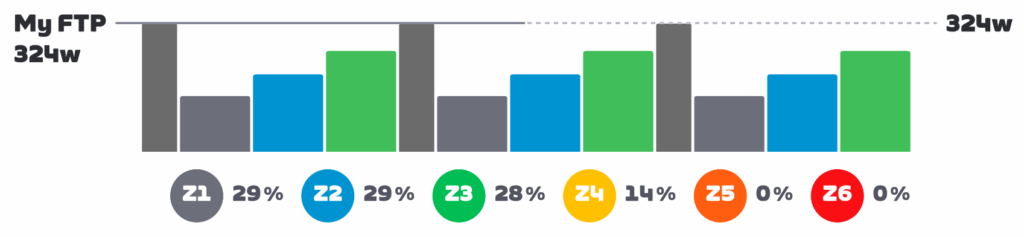
The idea was to use a different crank length setting for each of the three sets and record the pedal power data to my head unit. Zwift would be recording my smart trainer’s power data, which should remain consistent across the 3 sets. Then I could compare the smart trainer’s data to the power pedal data to learn how much the crank length setting actually modified the power readings on the pedals.
Simple enough, right? Let’s look at the test results…
Test Results
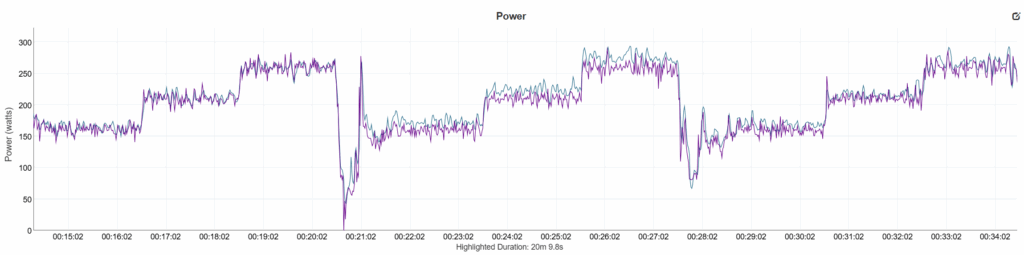
You can see the full dataset on DC Rainmaker’s Analyzer tool, but I’ve summarized it below. I rode the first set of intervals with the crank length set too short, the second set with it too long, and the third set with it just right.
(Note that for each 2-minute interval, I took a 60-second sample of the data from the middle of the interval to arrive at my average power values below. This reduces data funkiness at the start of the interval as ERG targets change and trainer resistance adjusts.)
Set 1 (Crank Length: 167.5mm)
| ERG Target W | Trainer | Assioma | % Variation | W Variation |
| 160 | 161.52 | 164.67 | 1.95% | 3.15 |
| 210 | 210.14 | 211.95 | 0.86% | 1.81 |
| 260 | 259.47 | 260.18 | 0.27% | 0.71 |
Set 2 (Crank Length: 177.5mm)
| ERG Target W | Trainer | Assioma | % Variation | W Variation |
| 160 | 159.76 | 172.25 | 7.82% | 12.49 |
| 210 | 210.56 | 224.42 | 6.58% | 13.86 |
| 260 | 259.85 | 276.05 | 6.23% | 16.2 |
Set 3 (Crank Length Set Accurately to 172.5mm)
| ERG Target W | Trainer | Assioma | % Variation | W Variation |
| 160 | 159.95 | 167.73 | 4.86% | 7.78 |
| 210 | 211.51 | 216.92 | 2.56% | 5.41 |
| 260 | 259.12 | 266.85 | 2.98% | 7.73 |
Takeaways
In simple terms, power is calculated by pedals like the Favero Assioma Duo as torque * angular speed (cadence). Torque is force * crank length.
Based on the math, changing crank length from 167.5 to 177.5 should increase power readings by 177.5/167.5, or +5.97%. And in fact, that’s what my test actually showed. The differences in power readings between the 167.5mm and 177.5mm crank length settings were:
- @160W Target: 5.87%
- @210W Target: 5.72%
- @260W Target: 5.96%
(These particular test numbers line up with the math quite nicely, although comparing other data like 172.5 to 177.5 doesn’t yield quite as clean a result. That’s sort of the nature of power testing, though. Between variations in power meter accuracy, pedalling style, drivetrain efficiency, and which data is actually being read and recorded by each recording device, you’ll easily see a variation of 1% from what the math says your results should be. And that’s OK.)
You may be wondering: in set 3, if the crank length is set accurately, why are the readings still higher on the pedals? I’d chalk this up to drivetrain loss, which most experts in the cycling world say runs between 2-3%. Every step of the way between your pedals and your hub, a bit of power is lost. Cranks, spiders, chainrings, chain, cassette… they can flex a bit, get worn, or be poorly lubricated. All those losses typically add up to a 2-3% reduction in power from what you’re putting into the pedals to what is actually delivered to your rear hub.
Power Meters and Zwift Racing
If power at the smart trainer is typically 2-3% lower than at your pedals, wouldn’t you want to use your pedals as your power source in Zwift? Well, yes, if no other factors were taken into account. Because we all want to put out more power, right? (Even if it’s unrealistic on some level, since outdoors, it’s the power at your rear hub that is driving your bike forward.)
There are other factors, though. Sticky watts is one factor that makes using a power meter on Zwift less desirable, unless you’re trying to cheat.
But I would submit that the biggest factor is that it’s very easy to change your power meter’s settings so it overreads power. While most modern mid and high-budget trainers are auto-calibrating, you can easily manipulate power data from a power meter.
Because of this, it’s become pretty standard for high-end indoor bike races to require riders to pair their smart trainer as the primary power source, even though they also require dual recording with a power meter.
Interestingly, I recently learned that Zwift Racing League leans this way as well, while stopping short of a hard requirement. From their rulebook:
6.1.3. Where a Smart Trainer is used, both its Power Meter and Resistance MUST be connected directly to the game as primary source. Participants using other forms of power meters when they have a smart trainer available may be penalised.
While Zwift allows event organizers to enable “hardware enforcement” that requires a power meter or smart trainer to be paired as the power source (no classic trainers/ZPower allowed), perhaps it’s time for Zwift to enable an even stricter setting, where only auto-calibrating smart trainers are allowed as a power source?
Your Thoughts
I hope you found this post interesting. Got questions? Thoughts on power meters or accuracy as they relate to Zwift racing? Share below!


Are you going to come up with a way to prove it’s Saturday tomorrow.
No, but you are welcome to take that project on. 😜
Very interesting article.
I think power meter results should never be accepted as primary source for something like ZRL of FRR (or any big race events with 3 letter acronyms).
I don’t necessarily disagree. But Zwift would need to build controls into the game in order to make that a workable situation for race organizers.
Can you expect the same kind of losses through the drivetrain from the bikes (kickr bike, watt bike, stages) that don’t use a a standard drive train?
I would think losses would still be similar.
I used to have a Stages Smart Bike and Stages told me to pair the pedal power meter and not the internal power meter. Either way, that bike was sticky as hell and should be banned from competition. I couldn’t not use sticky watts. I thought I was getting really good at racing and ready to go pro until I had someone call me out and I did the research. Not a great day in my life of and e-cyclist. It almost made me want to quit. Now I’m on a Zwift Ride. It came with a 165mm crank and I upgraded and installed a 172.5. I’m assuming there is no need to calibrate that anywhere?
Zwift Ride ships with 170mm cranks. But crank length doesn’t matter in terms of power measurement with a Zwift Ride, because power is measured by your trainer. Not your pedals.
I used an SB20, but it had other inaccuracy issues so I always used separate pedal power meters with it. To prevent sticky watts is actually easy. All you have to do is slow your cadence in a controlled manner when coming off a burst of power. The problem is that most people code themselves into taking every advantage they can get. Triggering sticky watts becomes second-nature, especially for those who don’t realize they’re doing it.
Thanks for shedding light on this. I wish Zwift would do more about it. I saw a YouTube video where a racer was exposed through his dual recordings that he had his crank length set to 190mm. I’ve also seen several racers who found out the hard way that they had their power meters set up to double their power.
like when i first started i wasn’t a newbie to cycling but new on Zwift , i had accidentally set my pedals to Double the power , thankfully with the advice from other riders and Zwift i was able to rectify this and went from A+ to C overnight
I’ve had 4 turbo trainers over the last 6 years and none come close to measuring my real world power. Tacx Vortex, Bkool, Wahoo Kickr V4 and Jet Black Victory. Power meter pedals have been my only constant accuracy. If power pedals were band then i would stick to racing outdoors. I’ve realised over the years you affect power readings considerably by changing flywheel resistances.
I’m in the same boat. My Neo 2T reads about 10% low. Always has. It otherwise works great over the past 30k miles. My Faveros match every other meter I use. Hardware enforcement would be a non-starter for me.
While sticky watts are possible, it is usually pretty obvious, and if you’re not taking advantage of them you’re only at a disadvantage due to the ~1s delay in readings.
If it ain’t broke…
I get it guys—I liked my higher PM numbers too, fought like mad with my belief and the community back in the day. But when you’ve got multiple smart trainers all agreeing, and one of them is a Tacx Neo (basically the gold standard for accuracy), it’s a safe bet the issue isn’t with the trainers 😉
A topic of constant curiosity. Especially during the ZWS when power variation was higher for some more than other using Wahoo trainers and Assimo pedals. Wonder if there’s much difference in crank based power meters and smart trainers. I’ve messed around with that idea, running 172.5 on Quarq (SRAM force AXS) with Wahoo V6. My setup but not enough time or probably smarts to get a good answer.
Love the tests and the timing of this article Eric 🙂 Thanks for getting the awareness and knowledge out there! Hopefully growing the pool of “those who care” 🤓
So basicly the powermeters are just as good as the trainer as long as you dont cheat ?
As someone who worked with this type of device for years in industrial settings. your findings are predictable. since the petal will get more torque flex than the smart trainer.
The smart trainer power is where one should measure as this is where power is applied.
readings at the pedal do not take into account gearing of the bike in process
What about those people who use one of those trainers that can use an external power source rather than it’s own built in source? They knowingly pass through a dodgy over reading power meter via the trainer. Example, a well known 65 year old on Rouvy has a very dodgy single sided crank arm power meter which vastly over reads and he uses it outdoors and indoors. He claims to make more power than the hour record holder in his age group and climb at 5W/Kg but in reality he is just an average club rider for his age as proved by his real life TT and hill climbing results. The data from his dodgy power meter looks like a seismograph recording an earth quake rather than a smooth line. At a steady state power output a legitimate rider’s power will vary by less than 15% from peak to maximum over say 60 seconds. Easy to spot for those of us who know what we are talking about.
I learned something new today. Thanks for the read.
Question though, what about connecting my power meter to the trainer and then getting the trainer to broadcast the power from my power meter to Zwift? Does this remove drivetrain loss but also keep within the rules of having your trainer as primary source? Wahoo can do this but maybe it only applies if your using the wahoo app not Zwift
It’s named Smart Link and else my trainer (Elite Suite) has this configuration possible and I can ride on Zwift with it. I’m interested too in Eric opinion about this possibility.
Doing so would break the rule that you must use your smart trainer as the power source.
The crank length setting gets recorded in the .fit file, correct? If so it should be relatively minor to ban impossible lengths, i.e. for cranks that simply do not exist. One prolific cheater in the past was caught with a 197.5 crank setting, I assume as analyzed by the fit file.
You don’t need to use ridiculous length cranks to get enough of an advantage to change the result of a race. If the race comes down to a sprint and you have 2-3% extra power (e.g. you set your cranks to 5mm longer than they really are) that can easily be enough to win, never mind that you worked less hard than the rest of the bunch for the whole race before the sprint.
Right, but the ridiculous lengths are low-hanging fruit to flag.
Some fun memories there ;-). What you say is potentially true, however zwift no longer allows anyone but the poster to download the dual fit file, the dual file is a manual upload anyway so is open to tamper. Thus comparison is hard, and the zwift file doesn’t contain the info, so there’s only manual processes available (as an organizer you would require the athlete to send the dual file to you manually) for even looking at it, and even then you couldn’t prove the contained info was correct, plus it would just be the dual. No useful into in the primary.
Finally, there’s the case of people doing the pass-through thing, additionally it’s still possible to do man-in-the-middle attacks on both the ANT and BT comms between smart trainer and zwift client, so the whole thing is just a hard problem if your goal is to say “this is a valid power source”
Unfortunately I’m not seeing any low-hanging fruit with regards to automated checks people could make with what Zwift provides. Zwift themselves should add crank length to the FIT file they record, they should add unit serial # as well IMHO, and they should build in dual-recording as well and make the secondary also record that as available and they should publish it.
Then we’d be in business – with serious organizers able to require an equipment verification video showing cranks and unit serial (as some do)
I didn’t know about rule 6.1.3. luckily i never got penalized. 😀
Eric, where do I check to see if my crank is set properly to 175mm (only relevant if using a power meter?)? I went into Wahoo and found my Kick’r, but saw nothing regarding crank size? I do not use my Garmin Rally’s on my trainer. Also, just want to confirm that the size of wheel setting is irrelevant, right, i.e. 700 x 32 vs. 700 x 28.
Crank length is only relevant if you’re using power meter pedals as your power source.
Thanks Simon.
So, does that mean, I would need to set my cranks shorter than they actually are to get correct results for my wattage on my powermeter pedals?
If by correct you mean having them match your smart trainer… you might need to set them shorter, yes. But I wouldn’t do that. I’d just set them to my actual crank length.
Eric, please see below, this bikesmithdesign.com link is hands-down the *best* clear and understandable article I’ve read on this topic. Notice the topic “Sweet Spot vs Dead Spot”, which I think will explain your “just right” question:
“You may be wondering: in set 3, if the crank length is set accurately, why are the readings still higher on the pedals? I’d chalk this up to drivetrain loss, which most experts in the cycling world say runs between 2-3%.”
I would theorize you’re instead maximizing physiological efficiency by reducing your Dead Spot losses to near-zero, IF I understood your question correctly.
I look forward to your thoughts on this site:
http://bikesmithdesign.com/Short_Cranks/crank-length-and-power.html
Whenever I buy a new outdoor PM, I test it extensively on local climbs, and when possible, directly against a power meter I already own. After I have enough data, I tweak the slope (on quarqs) or crank length (on pedal based systems) to match reality, to the best of my ability to determine anyway. I use online bike calculators to attempt to determine what my climb times should be, a bathroom scale, and a lot of experience with guesstimating CRR and CDA. Whether my outcome is perfectly accurate or not is not that important because if and when I race, reality dictates the outcome, not my PM. But that said, I do not find that commercial PMs are consistently well calibrated to each other, even other units of the same model, or to the online calculators, which themselves i do find to be very accurate/consistent. (My own legs are also strikingly consistent, so if I got a reading 5w over expected on a 30 minute effort I would know it was my power meter that was wrong.)
All that to say: there is no way to externally validate smart trainers and as such I do not trust them one iota. The best we can do is measure against other power meters, but that only works if you have gone to the effort of validating a PM outdoors (which I grant few will do), and having read about and observed trainers changing readings as they warm up, I don’t trust them even then. Therefore it’s more practical to use real/outdoor power meters when on zwift, and useful since it yields data directly comparable to outdoor efforts.
There are a million ways to cheat on zwift, and at the end of the day, who cares if the guy on the other continent is actually 2% better or 2% worse than you? It’s all just a motivational tool. It’s not healthy to be so invested in the outcome of your fake amateur bike game, or even a meatspace amateur bike game for that matter.