

We are all pros at something, but for the vast majority of us, it isn’t cycling. If you are like me, it isn’t home or yard do-it-yourself projects either. That is why it is important practice proper body mechanics during the performance of household and vocational tasks.
Having the strongest core and legs doesn’t mean a thing if you don’t use them properly. And if you don’t use them properly, you risk saddle time spent on the couch with a sore back!
Below you will find some tips to help protect your spine and joints. Add them to your database of things you should be doing, even if it takes a bit of EXTRA effort and thought to do so.
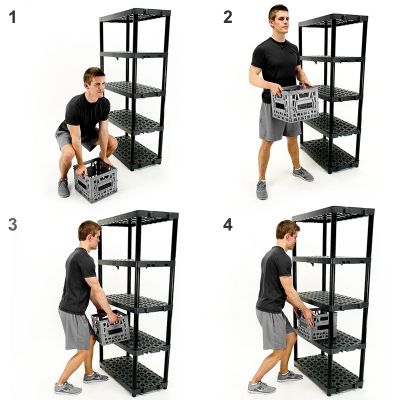
KNEE HEIGHT LIFTING
Start by standing close to the object with feet spread apart. Bend at the knees and hips and NOT at your spine. Hold the object close to your body as you use your legs to stand back up while lifting the object. Walk over to the surface you want to set the object onto and set it down bending at the knees slightly.
Do not bend at the spine. Also, be sure NOT to twist your spine, but to pivot your feet so that your feet are pointed forward to where you want to set the object.
Slide the object on the shelf to off load your body.

WAIST HEIGHT LIFTING
Start by standing close to the object with feet spread apart. Bend at the knees and hips and NOT at your spine. Hold the object close to your body as you use your legs to stand back up while lifting the object. Walk over to the surface you want to set the object onto and set it down.
Be sure to NOT twist your spine, but to pivot your feet so that your feet are pointed forward to where you want to set the object. Slide the object on the shelf to offload your body.
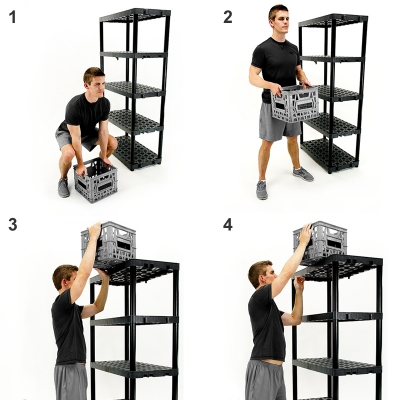
OVERHEAD LIFTING
Start by standing close to the object with feet spread apart. Bend at the knees and hips and NOT at your spine. Hold the object close to your body as you use your legs to stand back up while lifting the object. Walk over to the surface you want to set the object onto and raise it up overhead with a “one-hand-under and one-hand-over” technique as shown.
Set it down and DO NOT extend at the spine. Also, be sure NOT to twist your spine but to pivot your feet so that your feet are pointed forward to where you want to set the object. Slide the object on the shelf to offload your body.
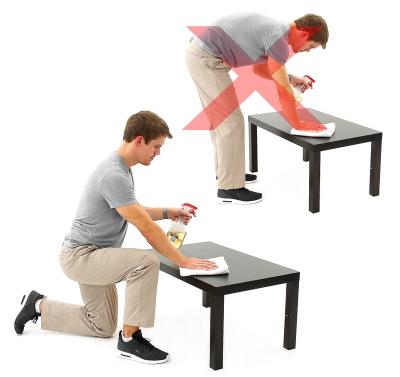
CLEANING LOW SURFACES
When cleaning a low surface such as a table, position yourself into a half-kneel position as shown. You should have one knee on the ground and the other knee bent with your foot on the ground.
Keep your spine straight. Place a pillow or folder towel under your down-knee if needed for comfort.
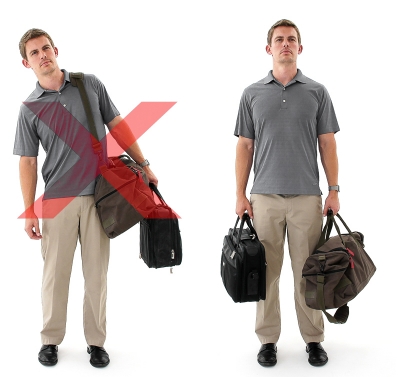
CARRYING A BAG OR SUITCASE
When carrying bags, be sure to distribute the weight evenly between the right and left side of your body. Maintain a straight spine. If you are carrying only one bag then switch sides periodically.
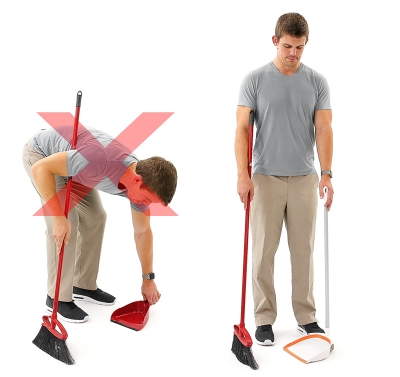
DUSTPAN SWEEP
Use a long-handled dustpan when sweeping the floor. Keep your spine straight.
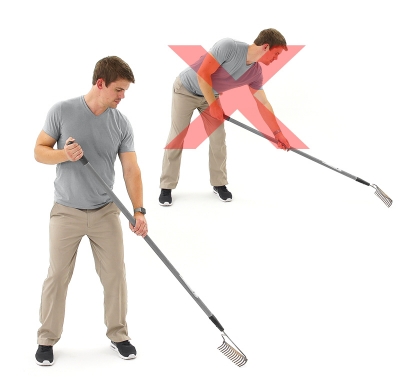
RAKING
When raking keep your arms close to the center of your body and do not bend over at the spine. Bend your knees and lunge if needed. Keep your spine straight.

MOWING THE LAWN
When mowing the lawn, walk with the mower to minimize bending over. Also, extend the handle, if adjustable, to improve reach. Keep your spine straight.
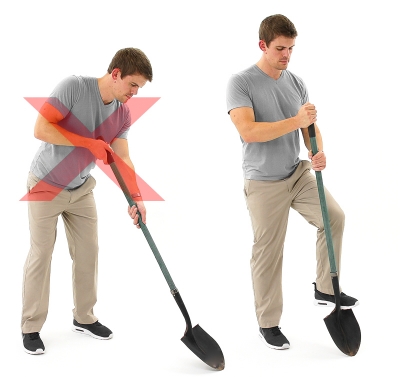
DIGGING WITH A SHOVEL
When digging with a shovel, keep the shovel tip close to your body and keep your spine straight.
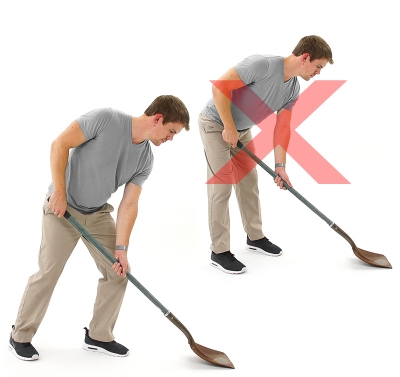
USING A SCOOP SHOVEL
When scooping with a shovel, move in a lunge pattern with one foot in front of the other as you bend your knees to move forward and back. Keep your spine straight.
The Follow-Up Appointment
Stay tuned, as in the next edition of this series I will introduce the theory of periodization for off-the-bike strength training and why it is important to your performance on the bike.
Your Call!
Do you have any physical therapy related topics or questions which haven’t been addressed that you feel would improve your cycling performance and enjoyment? Let me know!


As a physiotherapist and avid triathlete I am disappointed to see this kind of content still being published to mass audiences. The messages that are being promoted and images associated with them are non-evidence based and fear inducing. Research has time and time again found that messages like these, promoted by trusted sources have the power to change peoples beliefs. These beliefs become ingrained and implicit and subsequently will change behaviours in people.
When we are discussing topics so disabling as back pain, this can have a significant and damaging effect on peoples lives.
Many of the images that have been shared here and in the “Proper off the bike posture” article are contradictory when considering the position we are in on a bike or in a TT position. Why is it not safe to mow the lawn with an arched back but it is safe to sit on a bike for 5 hours? Why is it safe for strongmen to lift 100kg+ atlas stones but we can’t bend down to sweep some dirt off the floor?
I ask you to question whether this messages are: 1- evidence based in contemporary literature, 2- helpful to the reader, 3-potentially damaging to the public.
I have always admired the Zwift Community, and ZwiftInsider readers in particular, for their knowledge, expertise, and the passion with which they approach cycling-related issues. While fear was not the emotion I had intended to illicit through this instructional article on the basic tenets of proper positioning and body mechanics, it is with unease that I admit that I have never once throughout my educational and professional career come across substantiated evidence to consciously overlook the importance of an awareness of spinal protective procedures. Despite the lack of empirical evidence that a greater number of 100kg+ atlas lifting Strongmen have injured their spines, than those mowing the lawn with an arched back, I venture to guess it may be true. That doesn’t change my belief, however, that these contentions are not mutually exclusive, and proper positioning and body mechanics during the performance of all recreation, vocational, and activities of daily living should be given serious thought. For many more people’s lives have been changed by debilitating spinal injury the result of careless movement patterns than messages on the subject which may or may not have multiple contradictory aspects to debate, proper TT position notwithstanding. I also admire that you have taken this opportunity to open a dialogue on the subject, Jack. Please feel free to provide the evidence-based research which you feel will benefit our readers on this subject. They, like myself, will surely welcome any helpful information which will enhance their riding enjoyment and time spent out of the saddle. As a fellow Physiotherapist and cyclist I know this is something in which we both believe in passionately. Thank you!
Thanks for your response Christopher.
Patient beliefs are certainly important in back pain development and recovery (Darlow 2015). These beliefs could be shaped by multiple interacting influences but clinicians (us) and the media (this forum) have a powerful impact which may be positive or negative (Darlow 2014). Structural or patho-anatomical explanations, management advice which is interpreted as meaning the back requires protection, or poor prognostic expectations can all negatively influence patient beliefs (Dreischarf et al., 2016; Dankaerts et al., 2006). These messages are not supported by contemporary evidence which proposes there is no causative link between lifting and back pain (Wai et al., 2010). Furthermore, ergonomic and occupational health models such as those within the above post, often reinforce the notion that the back is vulnerable and weak by recommending ‘bracing’ and limiting spinal flexion (Wai et al., 2010). In contrast meaningful reassurance and clear empowering activity messages could have the potential to positively influence beliefs. Improved understanding of beliefs and how these impact behaviours will help us to mitigate potential adverse effects and make the most of their ability to be a positive influence in their patients’ lives.
I welcome any studies, to enhance my own learning, that support your post above that protection messages like these have a positive impact on reducing back pain and improving quality of life?
Thank you for opening my eyes to the thought that how a message is delivered is as important as the information itself. Perhaps that is a lesson that we should learn and apply to all aspect of our daily lives. I will be sure to consider your views in my future writing and practice and appreciate your zeal in attempting to protect and heal. That is an oath we both share, and a concept which you can rest assured is my primary motivation. Cheers…Jack!