

Update (March 18, 2025): Zwift’s v1.86 release includes frame and wheel performance tweaks, as well as Bike Upgrade functionality, all based on the results of the wind tunnel tests discussed below.
On August 27, I received a message from Zwift co-founder and original developer Jon Mayfield:

This got my attention. As you may know, I’ve published a lot of in-game performance data over the years, including the popular Tron vs Top Performers chart showing how Zwift’s Tron bike performs against other fast frame+wheelset combos in game.
“Disruptive changes re: bike performance”? What was Jon thinking of doing?
We chatted that day, and Jon shared a few key points:
- The fastest and slowest “standard” frames in Zwift are currently only separated by ~22 seconds in our standard ~50-minute test (see performance charts). Jon’s hunch was that this gap was too small and didn’t reflect real-world physics.
- With garage upgrades coming soon to Zwift, the team saw a need to increase this separation between frames in order to avoid weird situations like an upgraded slow frame (think Zwift Steel or similar) outperforming a fast frame like the Specialized Venge S-Works.
- If Zwift was going to change the performance of in-game frames, they wanted those changes to be backed by science. (While Zwift isn’t trying to be a simulator, in-game speeds have always been based on real-world physics whenever possible.)
With that in mind, Jon and his team were planning a visit to the Win Tunnel at Specialized headquarters in Morgan Hill, CA. Would I be interested in joining them?
Of course I would.
And that’s how I arrived here in late October:
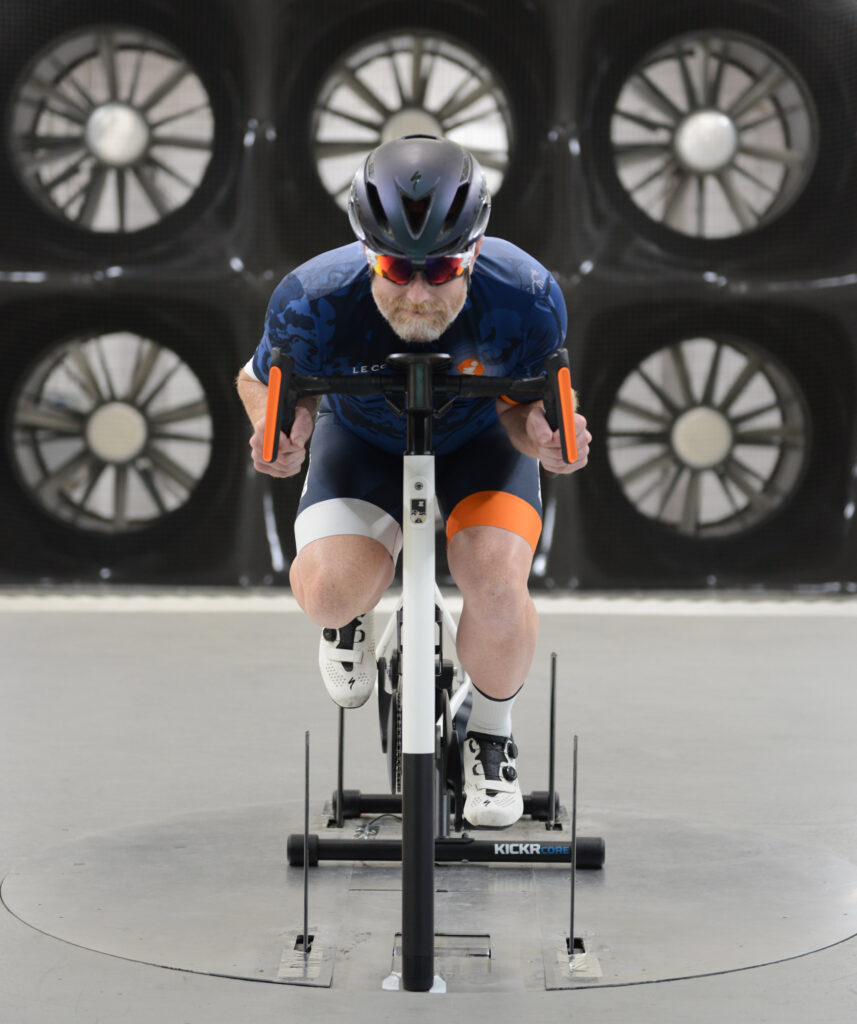
But I’m getting ahead of myself…
The Team
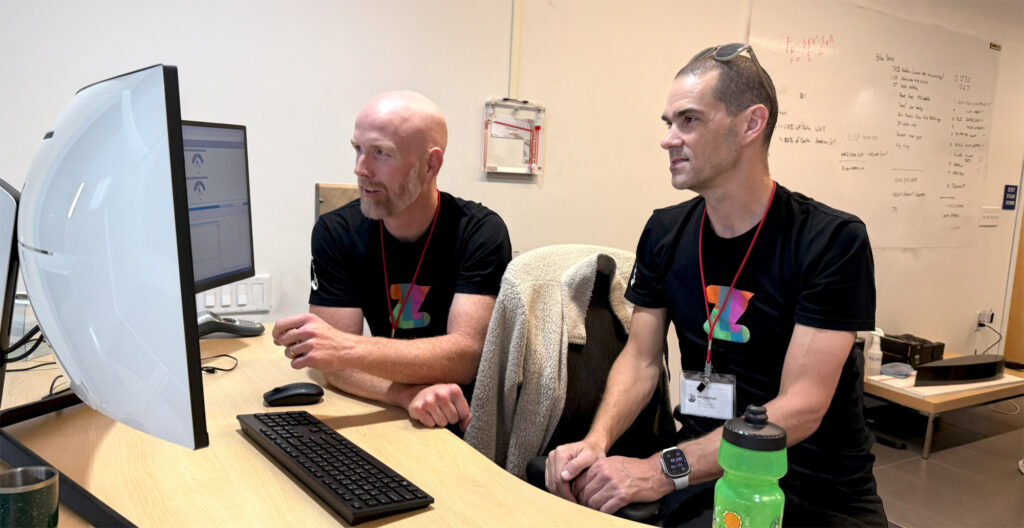
It was dark o’clock when I left my house in Kelseyville, CA to drive three hours south to Specialized HQ in Morgan Hill. I grabbed a quality espresso, then met up with Zwift’s team to get security badges so we could access the Win Tunnel. Zwift employees in attendance were:
- Jon Mayfield: VP Head of Game (and Co-Founder of Zwift)
- Mark Cote: VP Head of Product
- Scott Campbell: Senior Director of Game Design
- Mike Bhatt: Senior Technical Game Designer
- Nick Kalkounis: Director, Product Management
- Joseph Battisti: Global Product Marketing – Game & Content
Also with us was Lionello Bardina, R&D Engineer Aerodynamics from Specialized. His job was to run the tests while answering lots of questions and generally overseeing the tunnel’s usage.
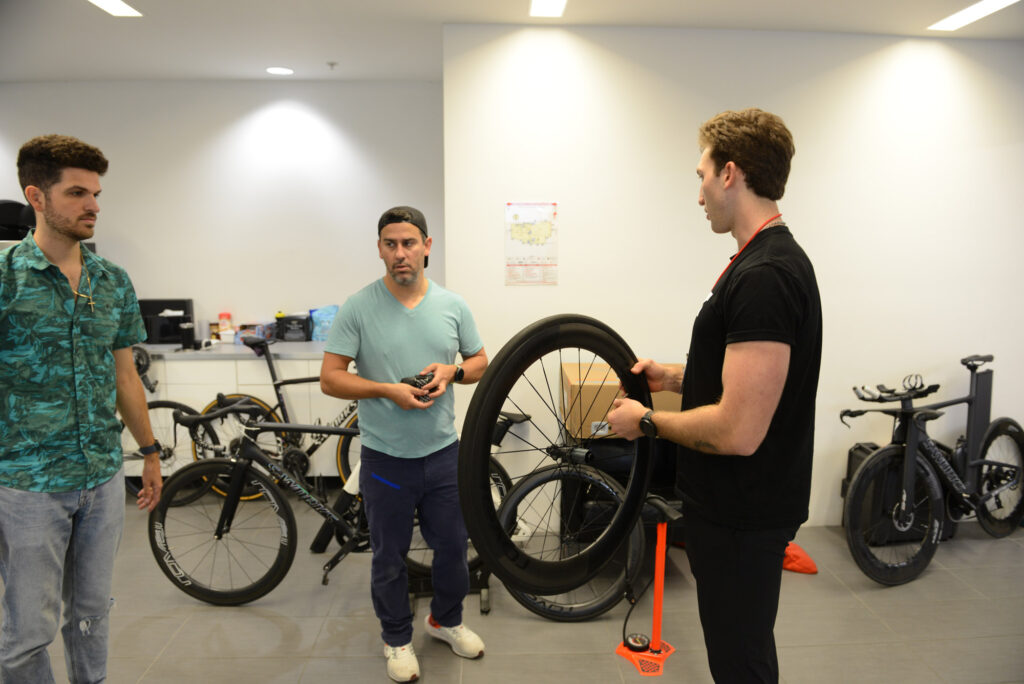
At first this seemed like a lot of cooks to have in the kitchen, but I soon learned that when it comes to robust wind tunnel testing, you need a small army! We had the tunnel booked for two days, and we were scrambling throughout both days to set up and complete all the planned tests.
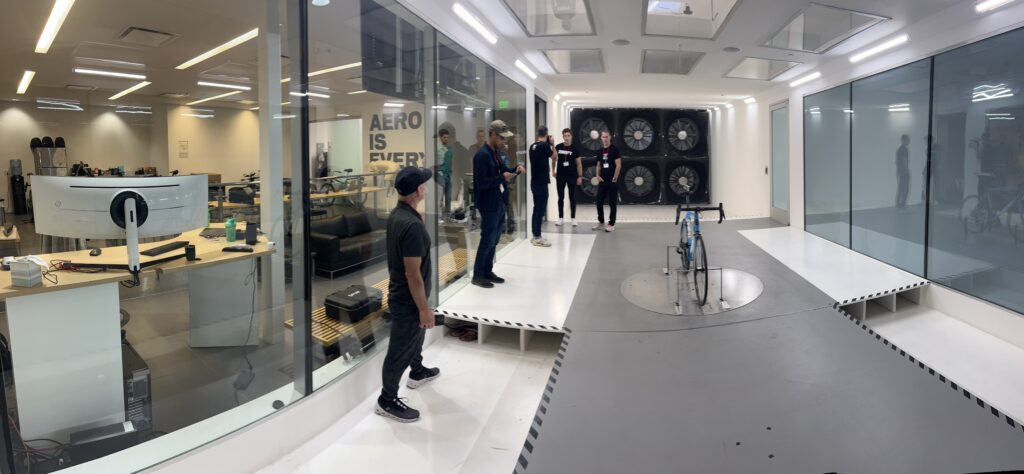
Some of the guys were working on setting up actual bikes – swapping out pedals, adjusting geometry, swapping out wheels, and properly attaching it to the tunnel’s apparatus.
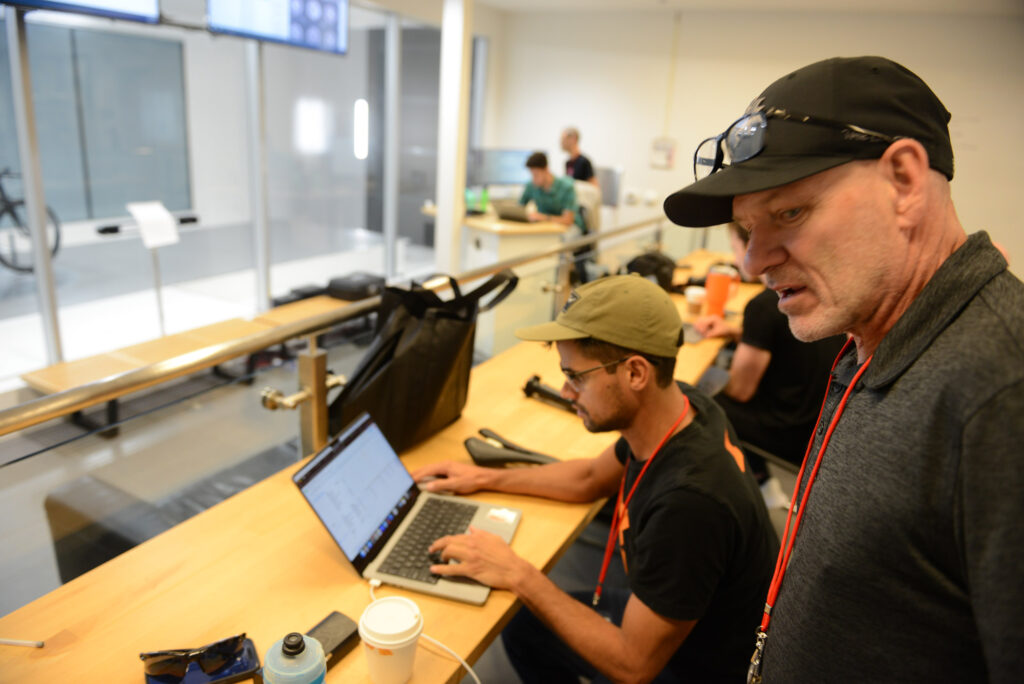
Others were taking notes, so data could be properly analyzed in the days to come. And of course Lio was manning the helm, sitting behind the computer to control the tunnel, run the actual tests, and gather the data for later analysis.
A Note About Mark Cote
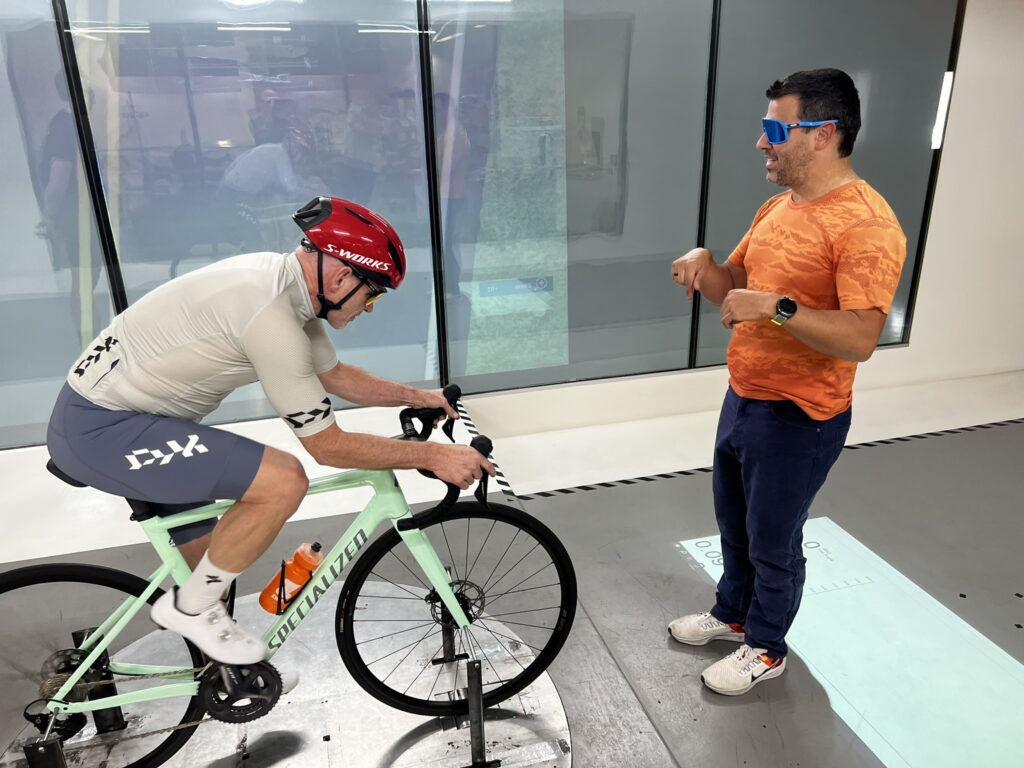
Within a few minutes of hanging out in the Win Tunnel, I came to the realization that there was a lot I didn’t know about Mark Cote.
Mark came to Zwift in early 2021 as the Senior Director of Content Programming after 12+ years at Specialized. We sat down for a nice Zoom chat just a few weeks after he arrived at Zwift, and he struck me as a likable, smart dude who could lead teams well and also wrap his head around data and make it actionable.
He was also a longtime Zwifter, having joined the platform in the early beta days of Jarvis Island. And he earned extra points when he saw my Venge ViAS in the office and shared that it was still the most aero bike frame they’d tested at Specialized at speeds over 30mph!
Mark has been at Zwift for almost 4 years now, and he’s currently leading the product teams at Zwift.
When we arrived at the Win Tunnel, Mark took charge. He stated the goals of the testing and explained the methodology we’d be using. Then as we got the first bike in the tunnel and the tests began, Mark started telling stories.
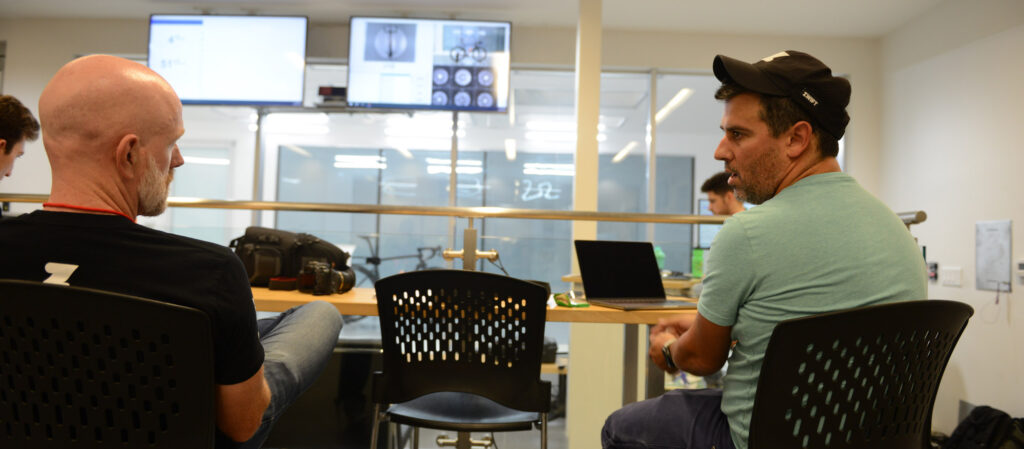
It turns out, he graduated from MIT in 2007 with a BS in Mechanical Engineering. And he wasn’t just anyone at Specialized: he led the development of the aero program and the design and build of the Win Tunnel with a few other key leaders at the company.
While he worked his way to leadership positions at Specialized and now Zwift, he’s also a brilliant engineer and aerodynamicist. And it was downright fascinating to hear him explain exactly how the Win Tunnel works while sharing memories of a scrappy team of employees and interns building and launching the audacious tunnel on a shoestring budget.
The Tests
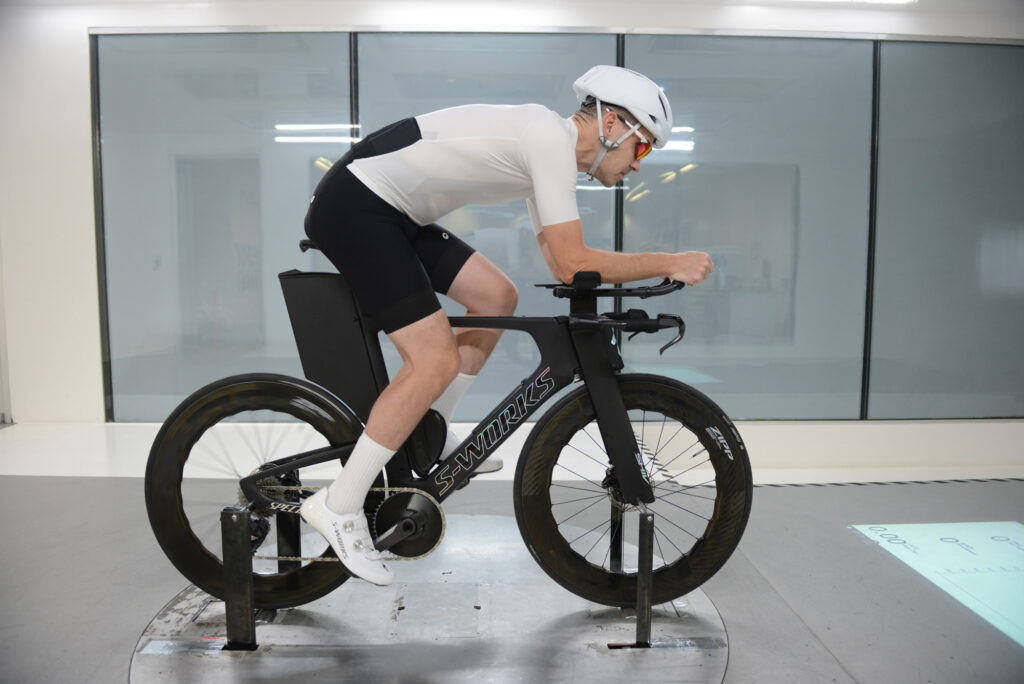
The team’s main goal for these tests was to establish a realistic delta between the slowest and fastest frames in Zwift.
(There were secondary goals of testing various wheelsets and different rider positions to gut-check the game’s wheel and rider physics as well. But I’m going to save that discussion for another post.)
So we tested a pile of frames, including:
- Stinner Steel (which the Zwift Steel frame is modeled from)
- Specialized Allez Sprint
- Specialized Tarmac SL6
- Jon Mayfield’s S-Works Shiv
- My Pinarello Dogma F
- Specialized Tarmac SL8
- My Specialized Roubaix SL4
- Specialized 2020 Venge
- Buffalo Bike
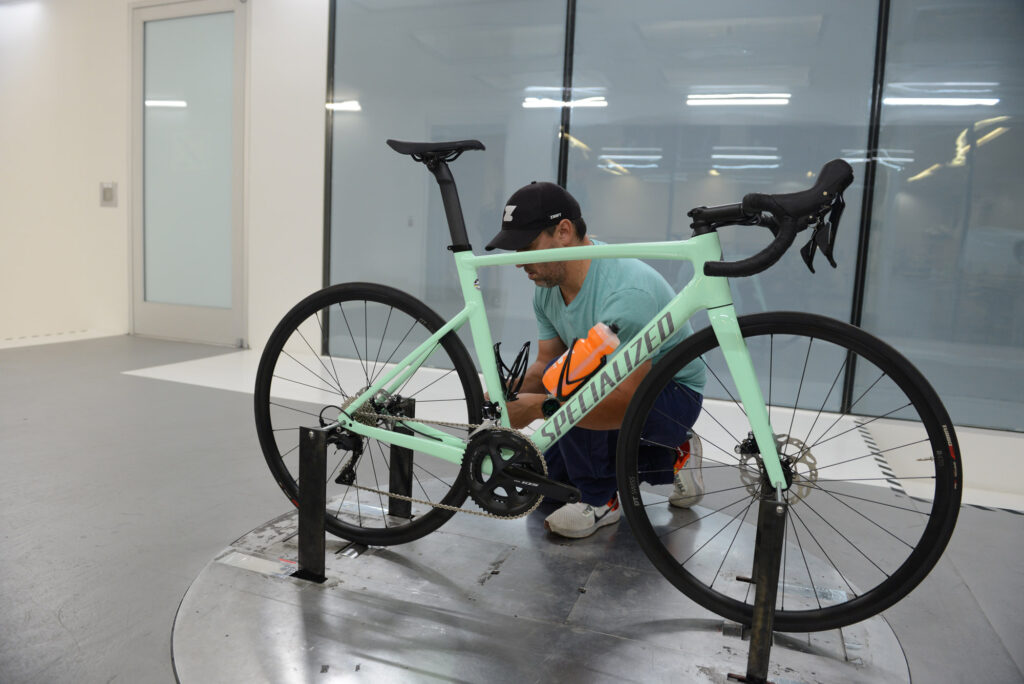
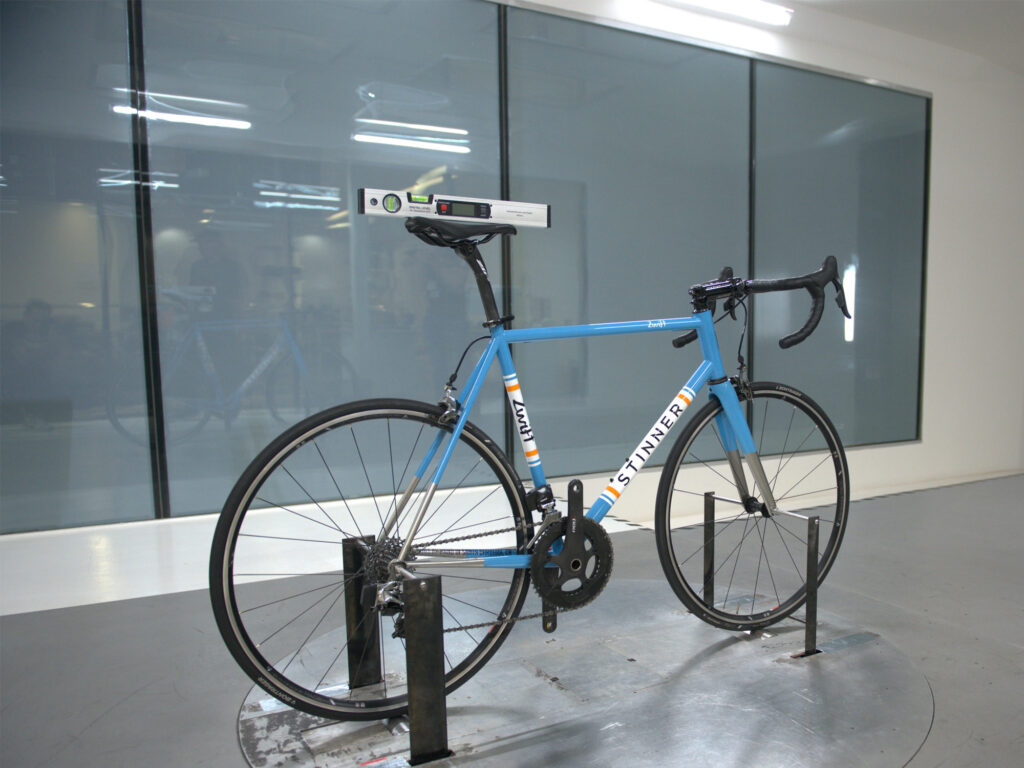
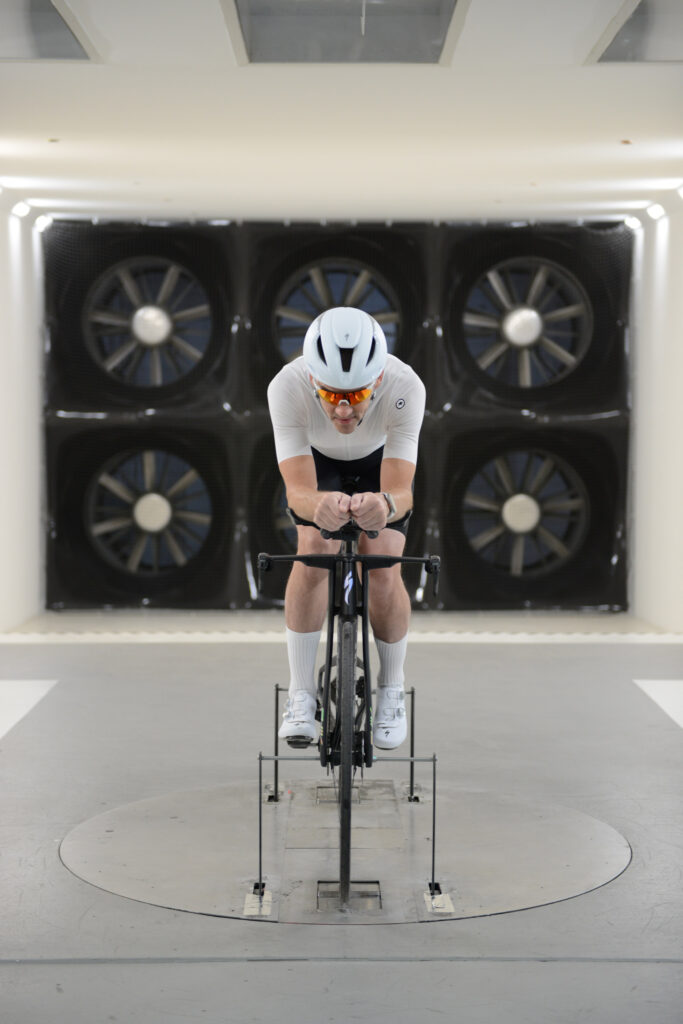
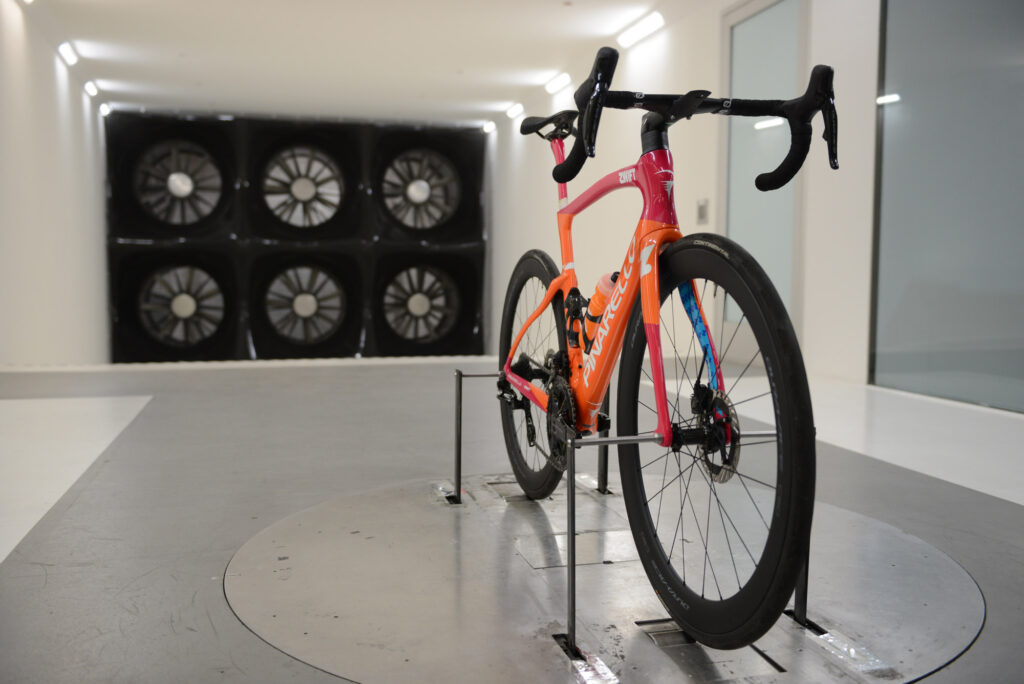
Bikes were tested with a basic alloy wheelset, as well as more advanced carbon hoops and even (in some cases) a disc wheel. The Win Tunnel is super precise, and it was amazing to look at the data and see how it could detect the difference between various setups at various yaw angles.
Jon had asked me to bring my Roubaix, because he had a hunch that some of the “slower” carbon frames would actually perform worse in the Win Tunnel than the steel frame. And you know what? He was right. My Roubaix was slower than the Stinner. Mark chalks this up to the cable routing and larger tubes.
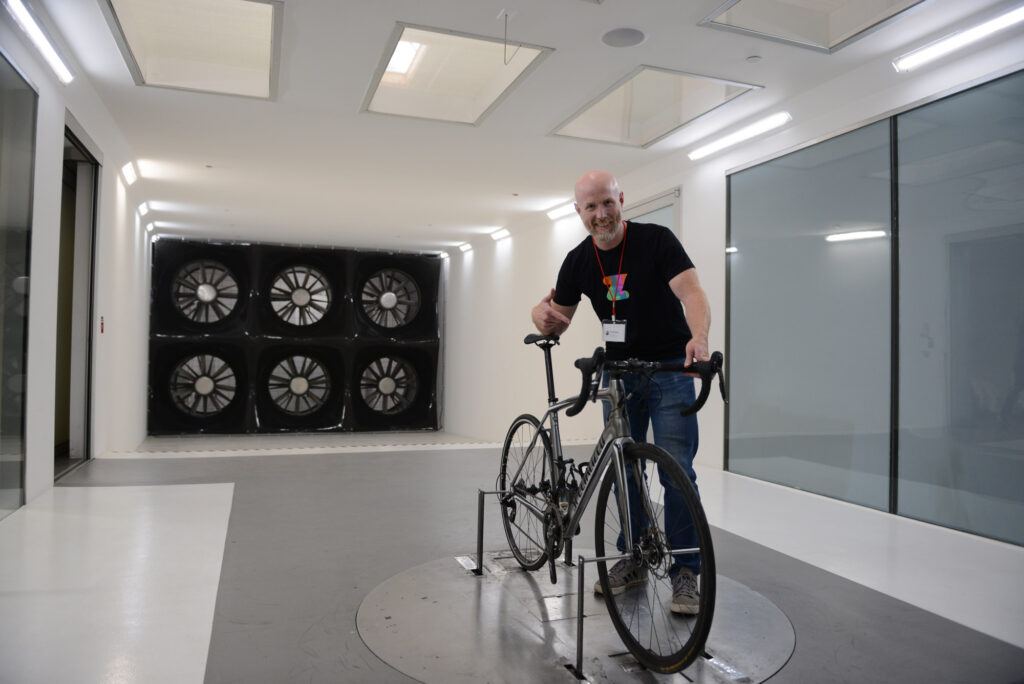
(But I still love that bike. I realized as it was sitting in the Win Tunnel that I’ve ridden over 50,000 miles on Zwift on that bike. It may not be the fastest frame outdoors, but it’s certainly been a great bike.)
After Hours
Of course, no Zwift outing would be complete without a ride. So after the first day we went for a spin. Here’s the crew lined out, with Jon in the wind:
Over the course of two days and a few meals, Mark Cote shared a lot of insider info about Specialized and the Win Tunnel that I’m not allowed to share here. We even got a sort of after-hours tour of some key rooms on campus, most of which were labeled “no photography.” Fascinating.
Specialized is turning 50 this year, and after looking at everything they do and how they do it, you begin to understand why. (And no, it’s not just because they have “Donut Thursdays” in the cafeteria each week. Although it was an epic selection of donuts + espresso.)
The Results
After two days of tests, Zwift’s team took all the data back to the office so they could crunch numbers and compare Zwift’s current frame performance to the wind tunnel data.
It turns out Jon’s initial hunch was correct: the difference in performance between Zwift’s slower and faster frames is smaller than it should be. Therefore, Jon and his team are planning to stretch that ~22-second difference into 65-70 seconds over an hour on a flat course, so in-game frame performance deltas more closely match what cyclists experience in the real world.
They plan to keep the fastest frames at their current CdA settings, while progressively slowing all other frames to effectively “spread out” the performance spectrum of in-game bikes. It’s worth noting that the overall aero performance “ranking” of frames in game lined up nicely with the test – that is, the fastest stuff in game is the fastest stuff in the tunnel. It’s really just the ranges (how much faster) that will be modified.
This change will be rolled out sometime in early winter, potentially soon after the new year. The tweaked frame performance will roll out along with the Garage Upgrades/Halo Bikes feature, so some of the performance lost in the slower frames can be reclaimed via upgrades if riders desire.
Concluding Thoughts, and What’s Next
Getting into the Win Tunnel is every road cyclist’s dream, so it was a huge privilege to be a part of Zwift’s visit to Morgan Hill. As I spun the pedals in the drops into a 50kph wind, I thought, “Zwift has taken me a lot of places, but I never thought it would take me here!”
I like that Zwift has chosen to take another look at bike performance. I’m impressed that they approached the task rigorously, with two long days of testing at the Win Tunnel. And I’m stoked that the result of all this work will be in-game bike performance that more closely matches the real world.
The upcoming changes are based on accurate, repeatable tests of real-world performance, so as much as I like to poke holes in things, there’s just not much here to complain about.
I’ve got a couple more articles planned on topics related to the Win Tunnel visit. First, we’ll be talking about the rider CdA testing that was done, and the results. (The goal is to make the CdA of our avatars as accurate as possible, which is sort of an impossible task when you consider the various body shapes, riding positions, and clothing of riders. That said, there’s probably room for improvement in Zwift’s current model.)
There will also, undoubtedly, be follow-up articles sharing updated performance numbers for frames. My bots are already complaining about all the miles they’ll have to put in!
Your Thoughts
What do you think of Zwift’s plans to modify frame performance, and what do you think of their approach to the problem? Share below!

I would love to see them bag the Tron Bike and disc wheels in non-TT races to make bike choice more of a thing. Unless you are climbing, the choice is fairly obvious during most races. Assuming Specialized is doing this because their bikes are rarely used other than the Athos to climb.
I’d be mad/sad if they prohibited the tron from races even though i’m not an avid “zwift racer”. I do ride in races and i’ve worked my tail off to get the tron. I want to use it!
Conversely, it was really really annoying to be new to ZRL and be the only one without a Tron bike, knowing that I had a disadvantage in experience, power, and bike choice. Couple this with the fact that I had done a good 10-20k meters of climbing without even knowing I needed to activate the Everest challenge, it soured my experience quite a bit at the beginning. That said, the Tron bike doesn’t really even seem like the best choice for any course anymore, so I suppose it matters less at this stage of 2024.
True, you want to use it. I do see the appeal of the tron bike, but it’s not always the fastest on pure flat or pure climbing races.
I do see why one would ban it in races, certain races that is, not all, because that could make it more interesting racing for some races. Idk.
This reminds me of Disney animators and sfx artists going to experience irl snow for Frozen
And given that most people that care are already on the fastest bikes they can get, and those that don’t care won’t notice/mind, I think this is all good
But they were animators right? Not MIT Graduate Meteorologists called ‘Director of content programming’ or something meaningless.
It’s stunningly bad and puzzling in equal measure when you see who zwift hire.
And, of course, real world performance of bikes is kind of meaningless. Firstly you’d need to have real world physics for it to work in the game and secondly, if some bikes are quicker than others in a game then everyone will just want to ride the fastest one – and anything you do to prevent them from doing that (making them ride miles or whatever) will just make them think the game sucks.
A complete waste of time and money that no doubt they all enjoyed.
The changes are definitely going to be interesting. Will they share the adjustments with you, saving you from hours of testing?
I wonder how it will work while keeping it “fair”. Someone new to Zwift, without access to the fastest gear (or restricted to 60-second slower gear) may be put off by that disadvantage. At the same time there should(?) be a reward system in place.
How awesome for you to go on that trip!!!! All of us in the bike-geek society are jealous!
Interesting read; I do like the idea of larger differences in frames/wheels performance, and agree with others that more racing events should be. “No Tron” and “No Disc Wheels” in order to allow the varied setups be part of the game more. Whilst I understand it is also a difficult balance trying to get newer riders to participate; we all had that period when we didn’t have a Tron yet, or were working towards the required level to get the better frames and wheel options.
Dont know about this one. Except lets say 5 Frames, people arent using much other frames in races. Those are the 5 fastest now, so they probably wont change much.
But the other frames might become a little less of an option if they become much slower. I sometimes take the Atomic Cruiser or the Safety bike for fun in group rides since its easily sustainable at the current differences, but if that gets changed a lot they will be just garage filling I am afraid.
There’s always a niche for using a slower bike to stay with a particular group – not races obviously, but group rides or pace partners where you want to add an extra 10w to your effort but stay with the group
Nice article. The big question is whether zwift have the cajones to slow everyone down. I hope they do, as the benefits are significant to things like pack dynamics too, but I think too many riders are used to clocking up unrealistic miles and it would cause too much uproar.
Tom Anhalt (who’s been in the Win Tunnel too!) had an AeroStinner built after his bike (a Tarmac or possibly a Cervelo?) was stolen.
I suspected that the drag differences between bikes were a little small.
Jon appears better positioned on that Allez Sprint than years ago, when he was a parachute.
Pastry mornings at Specialized are very nice.
Will Kelseyville change its name?
Based on the popular vote from a couple weeks back, Kelseyville won’t be changing its name. But I’m not sure how that whole process works…
Wow, great report, thank you!
Love that Zwift take their physics seriously, such a big part of the experience is the real-world-ness
Great news Eric and thanks for sharing!
It’s great news for regular Zwifters that race a lot but I’m wondering how they “sell” that changes to the larger part of zwifters and new users.
What a great experience and write-up! Looking forward to the updated specs. Would be very nice to see them specify exact numerical weight/CdA values for the equipment, rather than the vague and confusing star ratings they use now.
Yeah, I get that. And I talked to Jon about that very topic. Zwift’s take on this is that 1) it would be very expensive to get all in-game frames tunnel-tested for precise CdA values and 2) some manufacturers wouldn’t want those numbers released anyway.
So Zwift has chosen to go the easier route that also plays nice with bike makers. Which is probably the right move, despite us nerds wishing we could see the data.
@Eric Schlange – I fully understand your point on manufacturers but at the end of the day Zwift are assigning CdA and weight values to frames, testing is happening and folks are (back) calculating those values so the genie is out of the bottle…
By not publishing them it’s just making work. But thank *you* for doing all the testing and publishing the xls sheet as at least the final step is just quick, if slightly tricky, maths 🙂
Perhaps instead of providing exact CdA values, Zwift would consider expanding the current 1-4 star ranking system (for aero and weight). I’d love 1-10, but even 1-5 or 1-7 would be an improvement.
You’ve done a wonderful job breaking down all the bikes in your articles, but a bike’s score should reflect enough information to know which bikes are better on the flats or up a climb. For example, all TT bikes (including the basic Zwift one) have a 4-star rating for Aero. Seems silly.
With bike differences becoming more pronounced, it’s even more important to accurately reflect these differences.
Only took me until the last paragraph to realize you didn’t typo “win tunnel” and it’s a play on words. 🤦♂️
I’m with you on supporting Zwift trying to make Zwift more accurate and better while also keeping it fair and fun. I’m sure people will be loud and complain about it though.
Will there be modification to CdA for various body types? It feels like large powerful riders carry an unfair advantage in the game. Slighter framed humans should see a greater range of aerodynamic benefit. A kin to the changes in range between bike frames
That’s what Zwift is looking into. We tested various body types (male/female, skinny/heft, short/tall), different postures (quite upright to full aero tuck) and different clothing (loose-fitting MTB apparel to super tight race-fit stuff) in the wind tunnel.
That point cloud of data is now being analyzed to see if Zwift can make improvements to avatar CdA in game.
We are definitely looking into this, beyond the bike aero work.
Are the changes to the CdA part of a broader initiative aimed at enhancing Zwift’s physical model and pack dynamics? The speeds we encounter while riding solo and within a group are significantly higher than those observed in real life. Moreover, the draft model appears to be flawed, as there is a lack of perceived ease in pedaling while drafting within a group. It is essential to allow for recovery within the pack after making an effort to close the gap to the front group.
The draft model isn’t flawed. Zwift has just chosen to not feed wind resistance back to your trainer to control your trainer resistance the way it does with elevation. I suppose they could, at least for some trainers. As it is now, the perceived ease in pedaling comes to you through the reduced power that you are required to put out at a given speed within a pack vs. solo. When you are making less power in a pack you are by definition easing up on your pedaling vs. what you would be doing solo.
Has there been any movement on this?
It feels to me like height has too much influence over CdA, as though Cd is too low so A is made bigger to compensate.
I think it would be great if they added actual CdA/weight stats to the bikes instead of the opaque star ratings. That way we could more accurately compare bikes and choose what works without your bots putting in a million miles. Not that we don’t appreciate the work on your end!
Sounds like they took measurements at different yaw angles. Is this because wind is coming to the game? Or so they could avg it out vs head on or just in case for future data?
For now they’ve averaged it out vs head on, so frame performance is more representative of real-world performance.
But wind may come to the game in the future – it’s definitely been talked about!
Hi Eric – does this mean that all bikes and wheels (all manufacturers) will get realistic values? Until now, the values seemed to be partly coincidental…at least not always comprehensible.
I like the idea that I can use Zwift as a research platform to know what upgrades and frames be worth it IRL. Knowing those ratings are backed by data is pretty sweet!
Unless everyone is given the same frame and wheels for races and TTs, at least by pen, something I’ve wanted to happen for some time, this change is going to further disadvantage relative rookies.
The further a racer is below level 39, the bigger their aero disadvantage will be.
Great Article Eric… As some have mentioned. I too think the Disk Wheel should be pulled from be used during any of the Road Races…You would never see this in the Real World, and you certainly don’t want to promote the use of a Disk as such. I am for keeping the TRON Bike. It now not the Best of the Best, and can be beaten with a variety of other Set Ups… It is though, still a great All Rounder, and was/is a Bike that has to be “Earned”… Doing the Everest Challenge is still a great thing! # Keep them Coming, and I’m looking forward to your Up-Dates as they come out. 💪
Getting accurate data to base the decisions on is great, but conceptually I think they should balance accuracy with game design.
For example they could make the difference between a one and a four star bike greater, but make all bikes with the same star rating perform the same way. The new bike upgrade feature can work on top of that equalised baseline.
Congrats! What a cool experience, well deserved for the valuable service you give to us all.. We have the same bike …silver SL4 running on Zwift!
Super cool to see that you are actively co-creating together with Zwift & nice blog post! Ride on to Zwift to let you have this experience and just have you in.
I can only encourage Zwift to share more of their development processes. Super interesting.
Although I must say that I don’t believe ‘the many’ users care about detailed aero gain/loss of each bike. Cool for Zwift fans/geeks that are on this blog, sure! But, having options of personalized ‘custom made’ bikes sounds much more low hanging fruit then investigating aero gain details.
Question. With the upcomming upgrades to the frames we can earn will we reach the irl values due to these upgrades, or do they get updated and after that we can go beyond those values with the upgrades ?
Hi Eric, very interesting stuff. I wonder if only the flat tests will show new results because of the CdA changes or also the climb times will show bigger differences 🤷🏻♂️?
If the ranking places for all frames should stay in the same line for both tests and only the time gaps will be stretched out, then I would predict that there will be no big changes for future bike choices … but this we will see in January. Your poor bots 🙈😉.
After the new Pinarello and Canyon had arrived into the Drop-Shop, I wait for the Spec.Tarmac SL8 😎.
If ZHQ would bring wind into the game, then we would have to do much more strategic decisions within races … but all the segment times hunting wouldn’t make any sense then 🤷🏻♂️.
All times will show differences. There is aerodynamic drag any time you are moving.
Eric, have you done any tests on whether CdA currently varies for male and female riders of the same height and weight?
Mark stated that gender was part of the calculation on a recent podcast, but I can’t find any statements or test results on what the impact is.
Pretty sure there’s going to be as much variation here *within* each sex as between them, once you factor out height and weight. It’s down to shape differences at that point, right?
100% agree, in reality position is the most important factor and variability comes in all dimensions.
My question was specifically for “Zwift physics” where Eric has shown the detailed differences height and weight make, but I’ve not yet seen anything on gender which Zwift have said impacts CdA …
My tests have shown that gender doesn’t currently impact CdA on Zwift.
Thanks, for both the tests and confirming!
I apologize if this has already been asked, but has Zwift considered adding wind and direction to its physics engine? I think it would be really cool for more advanced race tactics and create unique opportunities for breaks and solo riders. A 14 mph cross wind would make for some interesting racing on the flats for example.
“the team saw a need to increase this separation between frames in order to avoid weird situations like an upgraded slow frame (think Zwift Steel or similar) wouldn’t outperform a fast frame like the Specialized Venge S-Works”
Are you sure with the “wouldn’t”? I thought it might be weird if it would…? Or what am I getting wrong?
Fixed!
It’s always a good thing to be more realistic. What I find strange that nobody seems to have noticed that climbing times on the big climbs are way off and much too fast. The math on climbs is not so difficult. They are only possible with about 4kg of weight (bike and gear) added to the entered body weight in Zwift. I find this a little annoying.
CdA’s of TT’s on the other hand are huge and way off from actual realistic values.
I’m curious about your remark that Zwift isn’t trying to be a simulation. Because it sure seems to me that that is exactly what they are at heart, a legitimate, reasonably accurate albeit somewhat simplified dynamic simulation routine based on real physics including drag, rolling resistance, inertia, and gravity. The fact that their simulation engine runs in an artfully executed imaginary world doesn’t make it any less of a legitimate simulation.
Looking forward to the rider cda article. Give me, 170cm 61kg, that Remco Evenepoel aero position please! Maybe I won’t get dropped on the flat or downhill…
Thanks Eric, love this kind of stuff! A good thing that the range is increasing, in my opinion. It makes the experience more real and it also gives you more meaningfull goals to work for, from a game-perspective. Would advice Zwift to not go too far with the whole CDa of rider types. This also further encourages foul play
Because nobody is going 35kph on 100w IRL. Is this the beginning of the end of Zwift Physics?
Maybe we can finally get a wind and proper drafting effects?
Too many directors, too little programmers in Zwift.
Interesting article but being a pedant I must say that photo after heading “The Tests” looks like Jon on his Shiv, not an Allez Sprint as caption says 🙂
Looks like it was corrected!
Yes, now I look double-silly 🙂
Fixed!
That old caption was for the old photo, which Specialized had me remove… 🙂
Did they mention anything about altitude compensation? It’s a little frustrating to see them tweak CdA and focus on optional features when the core mechanics of racing are still broken for 5% to 10% of their riders.
I’ve done multiple multi-month hops between the Bay Area and Colorado in the past few years. In 2021, I spent 2 months in Mountain View as COVID restrictions lifted and I was required to head back into the office, and in 2022 I spent a full month in South San Francisco for onboarding. As a result, I’ve been able to observe the effects of altitude over multiple acclimation cycles. Going up to 5000 ft costs me, personally, 7 to 8% power after acclimating (the rule of thumb is 1% per 1000 ft or 5%, but everyone is different). To put this in perspective, I was fairly easily able to tap out 360 W for 20 min at sea level in 2021 right before heading back up to altitude, but never got better than 335 W at altitude during that year.
It makes racing really hard and demoralizing to know that 85 to 90% of rides are oxygen doping (compared to what I’m breathing). I would really like a power buff or drag reduction to compensate for where I live.
They did not.
I’ve never talked to Zwift internally about it, but my immediate thought would be that it would be too easy to game any altitude compensation. If the game gave you an extra 5% based on location, people would start using VPNs based on Colorado, right? 😜
If it’s that big of an issue for you, you can buy small canisters of medically pure oxygen on Amazon. They’re not very expensive. The oxygen generator/concentrator machines are a bit more spendy.
So what was the difference betwen the Roubaix and Stinner? And how about the difference of Stinner to the SL8?
???
I’m not allowed to share the actual numerical results at this time. But you should see them reflected fairly accurately in game once Zwift updates frame performance parameters in the next month or so.
Is Jon Mayfield still with Zwift? I thought I read an article a while ago saying he got fired… confused…
He never left. Still very much in leadership.
Glad to hear! Actually, I found this article trying to confirm it..
Will you update the Tron vs Top Performers chart? Do you think the results will just spread everything to the right of the best Flat test time set up?
It was updated today: https://zwiftinsider.com/concept-z1-vs-top-performers/