

“Trainer Difficulty” is absolutely the most misunderstood Zwift setting (Menu>Settings). Zwift has said:
This adjustment won’t change how far or fast you ride, but it will change how climbs feel…
but that doesn’t really explain how the setting works. Hopefully, this post will help you wrap your head around Trainer Difficulty on Zwift.
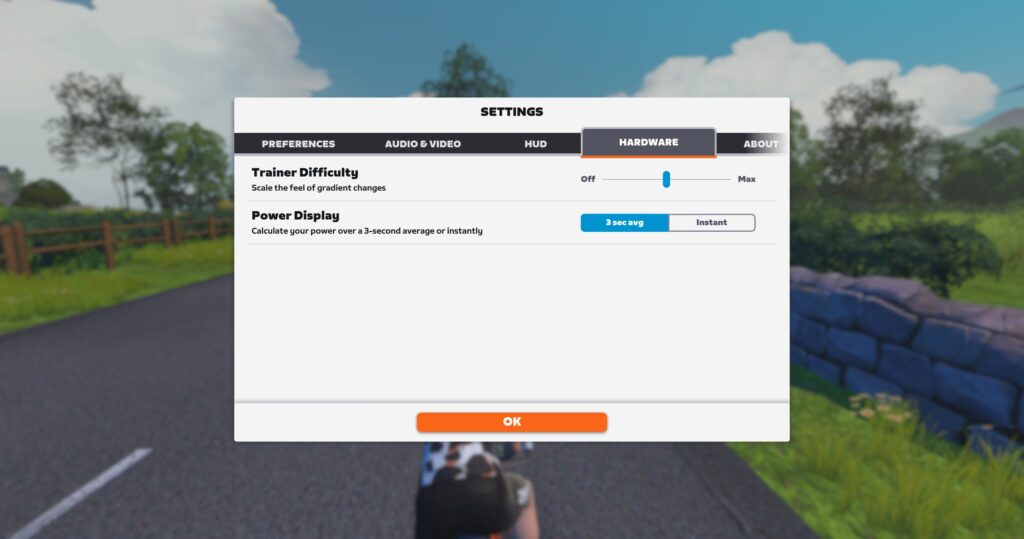
Here’s the best way to understand it: this setting is really “gradient feel scaling.” Zwift is constantly sending current gradient numbers to your smart trainer, and the trainer adjusts its resistance to match the gradient you are riding. The Trainer Difficulty setting simply scales the gradients sent to your trainer. Nothing more, nothing less.
Trainer Difficulty is set to 50% by default, which is why Zwift says it “treats the gradient as half of the true grade.” So when you hit a 10% climb in Zwift, your trainer is only giving you the resistance of a 5% climb.
Bump your Trainer Difficulty up to 100% and you’ll feel the full gradient. Set it to 0% and you won’t feel gradient changes at all!
How Trainer Difficulty Affects Your Ride
Lowering your Trainer Difficulty decreases resistance changes on hills. You still have to put in the same amount of power to get up (and down) the hill, but you will “feel” the hill less.
Another way to look at it: Trainer Difficulty determines how much shifting you will need to do. Where you might typically use ~7 of your gears when riding at the default 50% setting, lowering it to 25% would let you ride and only use ~4 gears, since the incline changes are less dramatic.
Increasing your trainer difficulty, on the other hand, will force you to use more gears. So instead of 7, you may use 10 or 12, since the hills will feel steeper and you will need to shift more to maintain a healthy cadence.
What It Does Not Do
Changing Trainer Difficulty does not change the power needed to get up the hill. You still have to put out the same watts to move the same distance as before… you’ll just be doing it in a different gear.
That’s why we think “Trainer Difficulty” really is a misleading name for the setting. Perhaps “Gradient Feel” or “Trainer Realism” would be better.
Frequently Asked Questions
Doesn’t a higher Trainer Difficulty make racing harder? Am I “difficulty doping” by running it lower?
A higher Trainer Difficulty will typically result in a higher variability index (VI) due to more resistance fluctuation. For many riders this may result in an overall effort which feels more difficult since maintaining steady power is easier than doing intervals.
But this isn’t true for everyone, and skilled shifting can reduce or eliminate the effect of resistance fluctuations.
In the end, watts are watts, and your Trainer Difficulty setting doesn’t change the power needed to cover any particular stretch of Zwift tarmac. So set it wherever you’d like!
I’m spinning out on descents. Can Trainer Difficulty help me here?
One common complaint from smart trainer owners is that they get dropped by other riders on downhills. Especially if you’re running Trainer Difficulty at 75% or more, steep gradients simply won’t offer the resistance needed to put power into the pedals.(Note: the same can happen outside!)
The problem comes when you’re racing against others who have their Trainer Difficulty set low, or perhaps are riding dumb trainers with a constant resistance. These riders will have the resistance needed to go hard on the descents, while you’re spinning out.
Trainer Difficulty can help here. Try lowering it to 25-40% when racing. This will allow you to put more power into the downhills without spinning out. Give it a try and tweak the setting until it feels good to you.
For more on this topic, read Trainer Difficulty On Descents: Did You Know? and Hanging with the Group Over Gradient Changes. Also–don’t forget the Supertuck!
I have a KICKR Climb, but it doesn’t respond to gradients because I’ve lowered my Trainer Difficulty. Is there a workaround?
There’s a pretty simple hack for this – see KICKR Climb Wheelsbase Hack for details.
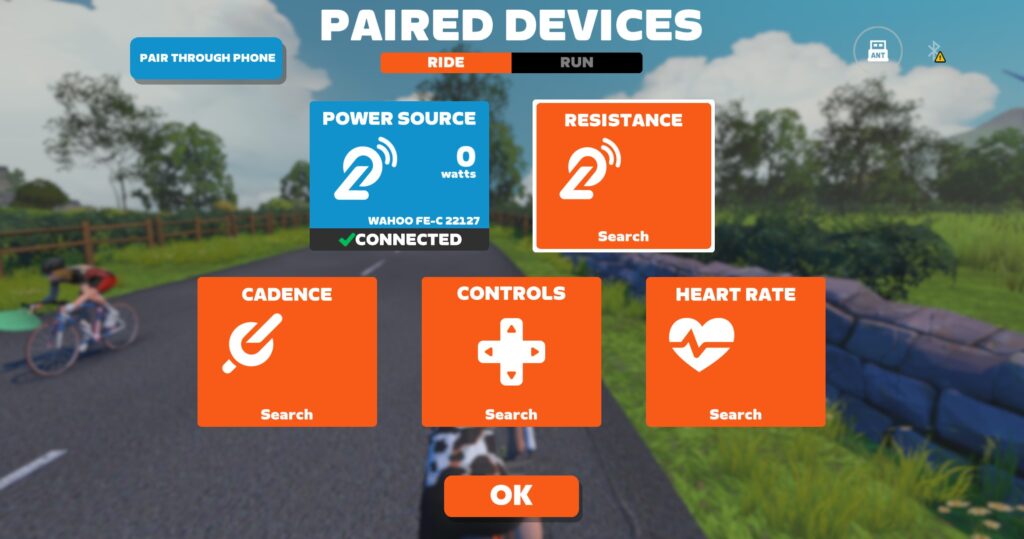
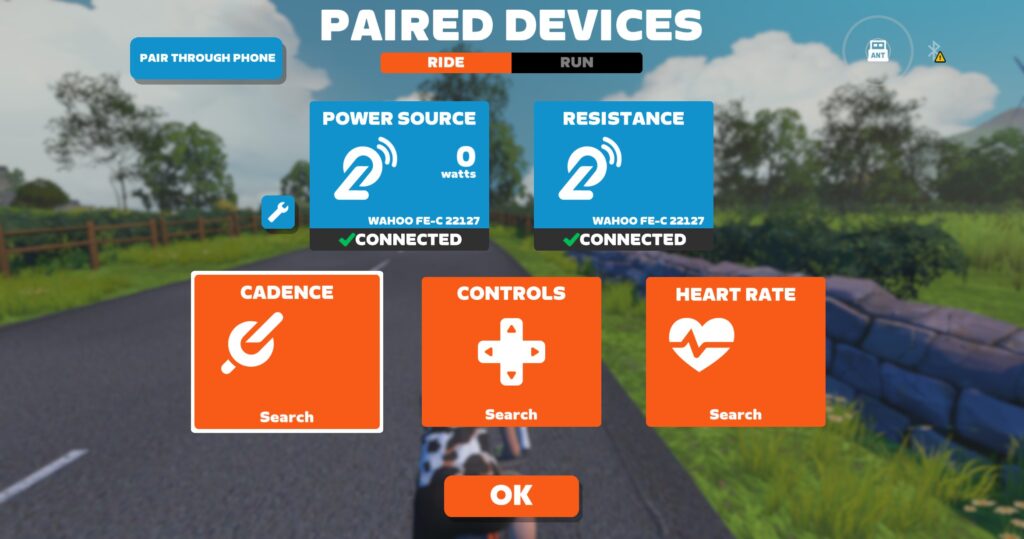
Why don’t I see “Trainer Difficulty” in my settings?
The slider is only visible once you’ve paired a smart trainer in the “Resistance” box in the pairing screen.
Should I Change My Trainer Difficulty Setting?
No need to change the setting if you are happy with the “feel” of your rides and aren’t struggling with yo-yoing in and out of the pack on group rides. If you think you’d like to adjust it, though, go ahead and give it a try–you can always set it back to 50%.

Thanks Eric for this article.
It helped clarify what this setting does. I was training at 50% (the default I think) and last spring, when I went outside to real hills, some of them kicked me pretty good. So I want to up the trainer feel of the hills for climbing so that when I go outside, there isn’t as big a difference.
Thanks – I am bumping up the setting to see if it helps with this.
Ride on!
I have the Kickr Core. Why don’t I feel the cobblestones, dirt, or wooden planks when I ride Zwift? Is there a setting I’m missing somewhere? I have already paired with bluetooth and the Controllable trainer.
The KICKR Core doesn’t have a road feel feature. That’s just the Tacx NEO trainer.
I don’t like the TD-setting at all, to me there shouldn’t be any other option than 100 %. What’s the point and sensation in going up the Alpe du Zwift without feeling its true gradient?
When I started Zwifting about two years ago I didn’t have a clue about TD and it took me a while before I became aware of it. Now I always use 100 % because it’s so much more real, and fun, and anything else feels rubbish to me. Everybody is of course free to use which setting they like but I think there are a large number of Zwifters out there who are not aware of the TD-setting and don’t know what they’re missing, spinning along on the default 50 %. A friend of mine had been training hard in the hills and mountains on Zwift to prepare for a mountainous MTB bike stage race in Europe. At the race he was shocked about how much harder the gradients felt compared to Zwift. He had of course been on the default TD all the time, not aware of this setting…
However, there is a downside to riding on a high TD (apart from that you obviously need low gears not to blow your knees…). Despite that you’ll need to produce the same amount of watts to go from A to B, on a rolling/hilly course it is definitely a disadvantage to ride on high TD. A disadvantage in how well you will perform compared to those on lower TD, that is. Feeling the true gradients is not a disadvantage at all, just pure joy and happiness…
When climbing the Alpe Du Zwift with the setting at 100% you must shift into a gear that is the right resistance for YOU. Say hypothetically for you that is 75 rpm at 250 watts. If you lower setting to 25% you will STILL have to change gears to get to 75 rpm at 250 watts. It WILL be a harder gear and the rear wheel will be spinning faster but the game will move you the same amount for every single watt and it WILL FEEL THE SAME to your legs. The ONLY TIME it becomes an issue is IF YOU RUN OUT OF GEARS at 100%!!! Lowering the setting will prevent this from happening. I bet this is what happened to you friend on his MTB. Mountain bikers run out of gears all the time! So YES! If you need to train for 40 RPM and 250 watts, you should set the TD to 100% and go up the radio tower!
Sorry but this is just a harmful comment. Many of us depend on the trainer difficulty to enjoy Zwift. I don’t have the gearing on my Wattbike to get up Alpe du Zwift on 100% trainer difficulty, so are you suggesting I don’t bother? This setting is not mandatory you shouldn’t mock something just because it doesn’t suit you.
I get what you’re saying if you are fortunate enogh to have the full bike setup, especially on your own bike. But as a smart bike user, I dont have any gears, and therefore cannot choose a torque that personal to me, which is what gears are for. I have to pedal at whatever Zwift throws at me. In this can the judicial use of ‘TD’ can be a life saver.
I always ride with setting at 100%. Personally I like the regular shifting. It turns what can be a rather monotonous task into one where you’re constantly having to pay attention to what’s happening (I use for general fitness over winter rather than training for races). With trainers in the past I’ve required music, etc., to overcome the boredom. I now usually ride 1.5 hours with nothing other than the zwift screen in front of me. The necessity to be on the ball keeps it interesting and the miles fly by.
This article really helps clarify what the slider is used for. Up until this point I thought that it was increasing or decreasing the resistance across the board. Does anyone know if this is available elsewhere? The issue I’m having is that my mountain bikes gearing is not great for riding many areas in Zwift. Even with the slider at 100% I find myself operating in the highest two gears 80% of the time. I believe that a way to increase overall resistance or a virtual shifting feature would help out a lot of riders who are not using road bikes.
I wish this feature existed in Zwift, but it does not! Depending on your trainer, there may be ways to hack it from the trainer’s side, via the app used to set it up. Might contact trainer support.
Thanks for this clarification. On the flats I’m always in top gear. I need to simulate a higher gear ie same power at lower cadence (I operate better at lower cadences). Do you know if the zwift auto gear changer would do this for me? Thx
Are you talking about virtual shifting, William? If so, yes. If you had a trainer that supported virtual shifting, it would set the resistance so you have plenty of virtual gears to work with.
That’s one of the big benefits of virtual shifting – you can use it with low-geared bikes that would otherwise just spin out on Zwift, like mountain bikes.
Read more at: https://zwiftinsider.com/virtual-shifting/
Just increase your weight in the game
Hi James I’m having the same problem got my 12 speed sram mtb hooked up and I’m mostly riding in 11th and 12th and people just fly by me did changing rider weight help????
Hello.
I have been using Zwift for 2 days.
I use Elite turbo muin smart b+ indoor trainer.
I can’t see the trainer difficulty setting in the settings menu. Why is it?
I use Zwift on my computer(Windows10) and on my Ipad.
I am still using the trial version.
Thank you.
Make sure you have your trainer paired in the “Controllable Trainer” box on the pairing screen.
Unfortunately I can’t pair my trainer in the controllable trainer box. 😞
Thank you.
My trainer only transmits power.
Csabi, and that is why you can’t find the slider. It affects the feedback. Yours doen’t have feedback from the programme to your trainer at all, so adjusting it isn’t an option.
Hello Eric, in the app of my iPad does not appear this function, why? Thank you
forget it now i see it sorry
Thanks for writing this up! I have a gravel bike SRAM 1×11, typically using the top 3-4 gears only, and can spin out on the descents. If I’m understanding this correctly, if I increase the TD setting to 100%, I will probably use more of my lower gears to climb. However I will probably still spin out on descents, unless my bike had higher gears. Does that sound correct?
Correct.
This may be a minor point, but does Zwift send gradients to the smart trainer, or does it send the required brake force (or maybe brake torque) based on all of grade, wind resistance and rolling resistance, the latter two being calculated by Zwift based upon the riders speed. Or maybe it sends both so the Kickr Climb can do it’s thing?
It sends gradient, rider+bike weight, wind resistance, and rolling resistance… maybe more?
It’s up to the trainer’s code to simulate the feel properly based on those parameters. (The parameters may vary a bit between Bluetooth and ANT+, because it’s two different protocols and specifications…)
That interesting (and surprising). Since all of those factors ultimately result in that single number (brake torque), it would allow for simpler design of trainers and for Zwift and its competitors to bring in sorts of different factors that they might imagine to make the experience more like IRL. For example, I think if Zwift could just transmit the brake torque it would be easy to implement draft feel.
The separate values could improve simulation, e.g. having the trainer physically incline or adjusting fan speed to simulate the wind.
Perhaps for smart trainers include in the algorithm load capacity (mine for example from 1 to 32) and wheel weight (mine 22kg) and in that way the setting would be more accurate
By the way is because I use a smart trainer why I don’t find the option of adjusting training difficulty???
Thanks for explaining how TD settings impact on the experience. One thing I’m finding out reading your post is that one has to shift through a climb… I’m confused as I thought that ERG mode was taking shifting out of the equation on rides. The times I’ve tried shifting gears made a slight difference for a few seconds, but after that, no notable difference from cycling in the previous gear.
You don’t need to shift in ERG mode. You DO need to shift in SIM mode (which is what is used outside of workouts on Zwift).
thanks eric, didn’t know this! does Zwift shift you automatically to SIM mode on regular rides?
Yes. SIM mode is basically what’s used as default. ERG is only for workouts.
HI Eric, I am new to Zwift and this comment is exactly what I have been searching looking for. I have been receiving mixed messages about exactly this. So in workouts (training- FTP tests,and plans, etc..) I do not need to shift- Zwift will automatically take care of that..,…however in Routes in Watopia, etc..I do need to shift my gears?
Correct, TB.
Thank you! I’ve been on Zwift for a few months. I’ve read tons of articles and watched hours of video, yet the basic notion that you have to SHIFT during regular rides totally escaped me! I feel like an idiot but I’m also excited to apply this knowledge on my favorite Innsbruck climb!!
My mph seems way off. I am new to Zwifting, however, not new to riding and I know what speed I am capable of riding. I tried the calibration method and it still is not close. Any suggestions? Thanks
Contact Zwift support, or your trainer support. It’s all based on the wattage your trainer/power meter is sending out. [email protected]
Is there an easier way of going into the menu, instead of starting your ride first then pausing to bring the menu button.
No need to pause. Just click the mouse or tap the screen to bring up the menu button. You can keep pedaling while in the menu…
You must be kidding. I thought everyone rode with trainer difficulty at 100% or you were cheating or certainly not preparing for the climb outside of equal difficulty. Really some riders go at 50%?? I missed that note. Got it now.
Default is 50%. I would guess the vast majority of people run it at that!
Trainer difficulty is especially useful for first folks like me that use different bike on my trainer compared to the bike I use on the road (they have different gearing). I’m surprised it defaults to 50-, rather than 100- percent tho
Zwift why don’t they sell a turbo trainer that sends a code to set the resistance when you click the button to start a race. Every one would be riding to the same resistance setting that would be a game changer😀
That would be like a real-life race where the organisers forced everyone to race with the same chainring/cassette ratios.
Hello!
I use zwift since 2 years. I always let the setup at 50%.
My ftp is 270. I go quite strong on flat TT, performing exactly what is expected with such http://ftp... But in Alpe du zwift, I cannot go beyond 220/230w continuous or I totally overheat. I thought it was because of lower pedalling speed, or anything else. But yesterday I touched the setup, put it at approx 25%. And surprisingly, today I was way faster, climbing over 250w. The feeling in climbs is much easier at previous speed, the difference is huge. This is not supposed to be this way. Should I be able to climb at my ftp? I guess yes if I adapt my speeds. So why do I need to loose the feel of climbing, to be able to climb at my real ftp? If I set to feel the real climb, I have a big power loss/ cannot perform at my ftp. Hope you understand me!
Trainer difficulty would change your watt to actual gear ratio relationship, any improvements would be due to you and/or your bike being more efficient operating withing a smaller range of gear ratio fluctuations.
N.CRX you have two groups of muscles slow and fast twitch; the amount of fast twitch muscle fibre is set at birth; climbers have plenty of fast twitch muscles, these muscles utilise different mechanisms for ATP generation (ATP is how all cells survive it is the molecule of life and responsible for energy production) ; fast twitch muscles have no mitrocondria which are the way slow twitch muscles generate ATP and energy. slow twitch are predominately used in high cadence exercises you are using oxidative mechanisms, fast twitch are engaged when the cadence drops. so going up at 100% TD means your using all your slow and fast twitch muscles energy use is rapid. at low TD you can spin up at high cadence so its more of oxygen based so slow twitch fibres are engaged fast not so much, energy use is slower and more efficient. So doing climbs at high wattage with low cadence is energy inefficient; climbing at high cadence at that wattage is efficicent. Hope this helps to explain whats going on with your information. so basically you are getting tired quickly at high TD but this wont happen at low TD
Producing a given wattage (say 250w) is more fatiguing at lower cadence / higher force (resistance) than it is at higher cadence / lower force. This is true IRL too
What is cadence at these various scenarios? I am thinking cadence my be very low on the Alpe. This would/could give you the perception that it is harder. For example, FTP at 270 and 90 rpm could be my norm on flats or roiling hills. But climbing at say 65-70 rpm and 270 would be very short lived if I had never trained in that rpm range, at those watts. Cadence is a ‘training zone’ most riders do not focus on. I am guessing at 65-70rpm up the Alpe my 270 would turn in to only being able to do it at around 230-240, maybe.
Eric, do you know if TD could be changed during a race and if so, is it allowed? As this would /could have major consequences.
Yes, you can change it on the fly. No rules preventing it that I know of. Wouldn’t have any consequences other than how it affects you!
Thank you Eric,
That is very good to know, but you say it has no consequences?
What about recovery after a steap climb @ say 5% followed by a descend @ 100%?
IMHO it has major consequences that way
Not sure what point you’re making, Rob. I said the only consequence is how it affects you – meaning there is no consequence outside of that, like being DQ’d from a race.
There is one important piece to this that needs to be made clear. At some point, when the gradient becomes very steep you will have an insufficiently low gear to enable peddling at comfortable cadence.
The gradient this happens at changes depending on trainer difficulty. Ie you may find that going up Alpe du Zwift with difficulty set to 50% is possible in your lowest gear at a reasonable 70rpm. However, set this to 100% and you cadence may drop into the 40’s! which is hard and very like real life.
While it is true that pushing the same watts in any difficulty setting you will go the same speed in game, the following is also true:
a) it is much easier to push out watts at comfortable cadence then below this. So likelihood of blowing up is lower with low difficulty setting.
b) it may be impossible to ride at lower watts due to very low cadence required to do this on a steep hill. Which means you either don’t get up or push more watts -and therefore go faster -until you can’t.
Great point, and this is what people talking about “cheating” do not understand. I have an 1x drivetrain and could not possibly go up the Radio Tower and keep a decent cadence (not even,say, 50 RPM standing). Reducing TD is the only way. In a way, reducing TD is like moving your front derailleur to a smaller chainring 😀
I think the TD wants improved or removed. It is not natural that if I want to simulate the outdoors I have to change gear 60 times per minute. In my opinion it would take a slider that regulates the speed of the changes slope and not intensity slope
Hi Eric, I can not seem to find intensity adjustment when using iPhone to drive program. I can Only see option to calibrate smart trainer. I can see ability to adjust intensity when using Apple TV (but prefer to drive program through iphone), if I adjust intensity Though Apple TV will it revert to default 50% when I close program through Apple TV? Is there a way to adjust using iphone.
thanks in advance
AB
Help. I moved my slider to 100% as I thought it would help me on downhills. I ride a Neo. Last night in a group ride on Harrogate A friend who I outweigh by more than 10KG went flying by. I was was doing 183 watts (above my threshold). I clicked on her stats and she was doing 73 watts. What do I do to catch the draft of these speedsters? It just doesn’t happen.
What happens if you turn the trainer difficulty to the OFF position?
Then your resistance never changes. Like riding a dumb trainer.
Perhaps this setting is too complicated for me…and if so, and the reasoning below is incorrect, I’d love to get a _mathematical_ explanation for the setting.
I do not understand why Zwift and others continue to say “This adjustment won’t change how far or fast you ride, but it will change how climbs feel…” There’s simple math involved here, and if at 50% it “feels” 50% easier to turn the crank than at 100, then the rider is not putting as much power to the crank. Or if the 50% rider “feels” that he’s putting the same effort to the crank, then he’s going to go faster than he would for the same effort at 100%, because the game is discounting the grades of climbs he’s riding.
Riders A and B are both climbing up to the radio tower (call it 14% grade for simplicity).
We stipulate that Zwift is not altering segment distances for different riders (let’s hope not!)
Rider A is set to 100% trainer difficulty.
Rider B is set to 50% trainer difficulty.
If both riders make the climb in the same amount of time…
Rider B’s effort will “feel” easier than the effort as rider A is making…because rider A is having to apply his power to climbing a 14% grade, while rider B is applying it to a 7% grade, and to do that in the same amount of time, Rider A will have to work harder.
Alternatively, if both riders put out a steady 100 watts…
Rider B’s 100 watts will “feel” like the same 100 watt effort as rider A is making, but he’s going to be going faster than rider A…because rider A is having to apply that 100 watts to climbing a 14% grade, while rider B is applying it to a 7% grade.
Saying that this setting “doesn’t change what 100 watts feels like” is not the same as saying it “doesn’t change what an effort of 100 watts accomplishes.” And what your power output accomplishes is determine your _speed_.
Add my vote to those who suggest that this “Trainer Difficulty” feature should not exist or at least should default to 100%. I’m not a strong climber, but I’d _much_ prefer having to work my butt off to get up to the radio tower, or never make it at all, than to have the game cheat the effort down for me in an obscure setting many riders don’t even know about.
The physical explanation for the trainer difficulty setting is kinematic decoupling. Bicycles in the real world have a fully kinematically coupled drivetrain in the forward going direction. Kinematics describes the physical operation of the drivetrain without consideration of any forces. One turn of the pedals results in a certain number of rotations of the rear wheel due to the kinematics of the drivetrain. Tire slip on the road surface is negligible, so forward speed of the bike is determined precisely by the pedaling cadence and by what gear you are in. The only way to change the kinematic relationship between the pedals and the wheel is to change gears.
Power comes into this picture when you consider the static and dynamic forces acting on the bicycle and rider and the torque that the rider must apply to the pedals to overcome these forces. Power is the rate of conversion of mechanical energy (work) by the rider. Power comes about by the torque the rider applies to the pedals with his or her legs, and the rate of rotation of the pedals. Torque time RPM’s. You can increase power by applying more torque at the same RPM or by increasing the pedaling RPM’s and keeping the torque constant.
In climbing on a bicycle, especially on steeper gradients, the majority resisting force that the cyclist feels through the pedals is due to gravitational forces, and is static in nature (does not change with speed). The only way to change the relationship between these static pedaling loads and pedaling cadence is to change the kinematics of the drivetrain by shifting gears. For most ordinary folks riding ordinary bicycles, it is very possible for the pedaling loads to rise to the point that they cannot apply enough torque, even in their lowest gear, to move the bicycle up a steep grade.
In the Zwift simulation, they have provided the Trainer Difficulty setting as a way to have variable kinematic decoupling between the actual rider on the trainer and the avatar in the simulation. Since the simulation is a true dynamic simulation based solely on the power generated by the rider on the trainer, kinematic coupling between the real rider and the avatar in the game is merely an illusion provided by the smart controllable trainers wherein the trainer is made to simulate the gradient that the avatar is riding on. If you have the trainer difficulty set to 100% and your trainer can simulate the full gradient of the virtual hill that you are riding on, it will feel like you are riding a real hill with the kinematics (gearing) of your own bicycle. If you lower the trainer difficulty setting but keep the same power output, which will necessitate pedaling at a higer cadence at the now lower torque, your pedaling speed and wheel speed on the trainer will then be different from that of your avatar. You are kinematically decoupled.
There are examples of kinematically decoupled drivetrains in the real world. Diesel-electric railroad locomotives use a diesel engine to drive an electrical generator which provides energy to electic motors that drive the wheels. Some trucks use hydrostatic drive systems in which the main engine drives a hydraulic pump which then in turn feeds energy to the hydraulic drive motors at the wheels. These systems have losses in energy associated with them. However, you can look at the Zwift simulation as being analogous to one of these real world kinematically decoupled drivetrains except it has no power transmission loss. It is as if you are turning a power generator (your trainer) and transmitting the power losslessly to the “motor” on your avatar in the game. It doesn’t matter to your avatar how you make the power, whether by spinning fast at a low torque or spinning slowly at a high torque. The power has the same effect on your avatar regardless.
Thank you! I realize now that my (obvious) mistake was thinking that when everyone said “it will ‘feel’ different but nothing will change” that “nothing” excluded _cadence_. To maintain the same power (and so speed) at a lower Trainer Difficulty, the rider will need to spin up the cadence.
What they mean is that the work needed to complete the climb remains the same.
Work = Force x Distance
For example, you can have two hills that both take 100Joules to complete.
One is steep but short (10N x 10m).
The other is less steep but longer (5N x 20m).
The person who finishes the work (100Joules) the fastest is the winner. (Incidentally, power is in watts. Watts are Joules/second. So power is the rate of work.)
So one hill is half as “steep” but you have to cover twice as much “distance” to do the same amount of work.
How you accomplish it doesn’t matter. To cover 20m on Hill 2 in the same time as 10m on Hill 1, you either need to pedal twice as fast or you need to shift to a gear that demands twice as much force. Or some combination in between.
Similarly, to cover 10m on Hill 1 in the same time as 20m on Hill 2, you can pedal half as fast or shift to a gear that demands half as much force. Or some combination in between.
So if I set TD as zero, it would be the same of enabling ERG mode? I will not need to change gears?
Not the same as enabling ERG mode. But it would just keep you at your trainer’s 0% gradient level of resistance, regardless of in-game terrain.
What is the setting “Workout Pain Effect” for?
It adds a blur to your screen as you near the end of hard intervals. Sort of a tunnel vision thing.
Is it not the case that max incline and power are good indicators of a trainer’s capacity to handle lower resistances too? I would guess an elite drivo ll is going to be happier at 9% than a flux S at the same even though both are capable? You don’t buy a car and redline it everyday if you want years of troublefree use. On top of that I’ve seen that manufacturers clarify these limits by speeds so a trainer with max 25% presumably has more flexibility for hard climbs in big rings too?
Hi Eric, i currently have a 25T easiest gear cassette 32T front, while doing the Epic KOM and Radio Finale, i was in 32/25 and barely made it up @ 50% TD i think i was at 17rpm cadence, would setting a lower TD essentially give me easier gears to spin with? should i just get a bigger cassette and call it an investment for the bigger routes to come.
Hiya, I am using Zwift and a Wattbike, I am 77Kg and FTP 215. Yesterday I had to do 2.5-3W/Kg 200-220W to stay in a group who were 1.5-2W/Kg. Why am I having to work harder? One bloke who was 6ft 2 and 215lbs av. 190W….please help!
So as of July 2020 a hack is the only way to get the KICKR Climb to work accurately with Zwift???
Great article; your site is awesome. I was riding with the difficulty set in the middle but then maxed it out because I was interested in “Veresting”.
What I’ve noticed:
It would be sweet if there was a way to keep it on “the middle” for climbs and “max” for descents.
After trying it on Max for a while, I think I’m going to go back to the middle.
I have a wahoo kickr and no matter how fast I pedal, my trainer will not go over 12/13 mph on straights and 13/14 mph going downhill. How can I fix this issue? Please don’t say pedal faster!!!🤣🤣
a few ideas…
1) make sure you have it paired as a controllable trainer
2) make sure it isn’t paired with another device that could be interfering with setting resistance
3) do an advanced spindown calibration: https://zwiftinsider.com/kickr-factory-spindown/
4) contact Wahoo support (it may just be broken)
5) pedal faster! 😄
I don’t know if this is an appropriate place to ask this; but I don’t have a “smart trainer”, is there a way I can follow along on my old trainer & just approximate by using my resistance levels. Just want to try this out to see what it’s all about?
Sure you can. Here’s a post to help you get started on Zwift with a classic trainer: https://zwiftinsider.com/getting-started-classic-trainer/
I just recently got the Kickr Snap smart trainer…I bumped my trainer difficulty to 100% and when i am doing a training session in ERG mode I feel absolutely NO inclines or declines. It is as if I am at 0% the entire time. What am I missing here? In sufferfest I can feel the resistance in workouts, but not zwift…I really like zwift but I can’t figure this out. Any suggestions? Does resistance only work with certain workouts?
In ERG mode you don’t feel inclines or declines. Rather, it changes resistance to force you to hold a particular wattage.
I’ve got mine set to 80% hurts my knees on 100% some says it cheating , i disagree as I personally find this allows more gear choice.
Can I please ask how I get released from the naughty step.. back in 2019 I started riding then Zwift entered my life…. I had an account but used to use the Wattbike in my local gym. The trainers that I used couldn’t have been set properly. In the last month or so I have signed up to ZwiftPower to race online with my bike club. I hadn’t realised being a newbie that I have unknowingly been riding out of Category… didn’t understand the jargon… I had no clue what a FTP let alone what watts were !!!!!
I have this Z code so although I can join in my points don’t count. I totally get it ….. NOW , I’ve contacted ZP to explain and asked what I have to do to hold my hands up and explain and be forgiven for my sins? But I have had no response and feel that I’ve been sentenced without being put before the judge to receive a fair trial.. Thank you for reading this and I will look forward to reading any comments.
best wishes and Ride On 👍🏻 Tracey
How does this effect sprinting? I hit much better powers on Sufferfest on anything form 1 to 30sec. Zwift seems to just top out (looking at power graph on bottom of screen. Sprinting in 52/13 cadence shoot up, ie. resistance is low
It doesn’t affect sprinting on flat ground, but it would certainly affect it on inclines or declines.
New to Zwift so getting caught up on all the settings and features. If I understand correctly, it appears trainer difficulty alters the elevation profile that the rider experiences. Set to 100% the rider feels the change in resistance simulated by the actual elevation profile shown on the screen. Lowering the trainer difficulty flattens the elevation profile resulting less varied resistance.
How come I’m not able to adjust Trainer difficulty when I´m using AppleTv or iPad?
Are you on an Elite trainer? Mine seems to keep going back to 50% (instantly) as well on the Elite, but the Wahoo doesn’t…
Interested on how this Trainer Difficulty setting compares semantically to Erg-Mode. Seems like finding similarities between these two technological circumstances would aid in the understanding of how TD effects the rider vs how it effects the “ride”
I was originally going to say that there’s no useful comparison, but actually…
Power = Force x Velocity
ERG holds Power constant. It adjusts Force in response to changes in Velocity (pedal velocity, cadence).
vs.
Work = Force X Distance
Trainer difficulty holds Work constant. It adjusts Distance in response to changes in Force (specifically, one variable of the Force calculation: grade).
I was watching a YouTuber “Everything is Photogenic” and from her critique of Trainer Difficulty I feel confident in referring to the setting as VIR “Variable Inertial Realism” 😉
Haha. Well, at that point, you might as well call it “Trainer Difficulty”.
To be serious, I think yours a good description with respect to Zwift races.
When it comes to the ways non-Zwift-racers use Zwift, it hardly matters. Functionally, it’s more like a cassette change. It doesn’t map 1:1, but with so many other fudge factors, the discrepancy is lost in the noise.
Ahh! I was just sent here by Zwift support as I find the ride feel doesn’t seem realistic, and was concerned about how it can be fixed. I see it has nothing to do with realism – or being a “simulator”, but is in fact is a game with a whole bunch of algorithms. Why is that so hard for me to grasp? I have been comparing apples to oranges.
I have a concern about the precision of being able to set the TD slide bar to an EXACT value like 40% or 50% or 60%. I hold a weekly zwift meetup with some friends. One friend of mine and I have the exact same body weight in zwift, both put out the same avg power going up the 4.6 mile Lutscher KOM (we compared our data on Strava. I was 243 watts, he was 244w), yet I beat him by 2.5 minutes up that climb. 25 minutes for me, 2.5 minutes longer for him. That’s a 10% difference. We both believe our TD slide bars are set to 50%. Is it possible that mine is on 48% and his is on 53%? Those two values are so close to 50% that they both look like 50% when looking at the slide bar. That is a 10% difference in trainer difficulty (53-48)/48 =10%. Wouldnt a 10% trainer difficulty difference make a 10% difference in climbing speed or climbing time on a long sustained climb assuming the same power output?
SUGGESTION: Trainer difficulty should be a field with a numerical entry just like body weight instead of a slide bar. Imaging if body weight was a slide bar going from 100 lbs to 250lbs. Would be impossible to set an exact body weight.
If I understand Eric’s article correctly, the TD won’t affect the climbing speed, if power and weight are same. Setting TD “too” low means you have to do more cadence, setting it “too” high means you have to apply more force on the pedal at lower cadence. The product of
velocity x force = work
Power being constant and weight set correctly, no difference would occur.
I consider different setup (trainer, platform, protocol, calibration…) causing the difference.
For fairness reasons, I would prefer choosing TD only functional when game is paused. In races, one can have benefit changing TD and unrealistic gear ratio (very small uphill makes steep climbs comfortable and very large gears downhill allow highest speeds. IRL you choose gearing at beginning (or change complete bike in TT at TdF🤣)
Eric,
I hope you can help. I have a Kickr and I do NOT have the “Difficulty Selector” visible for me to change it in order to work with Climber. Can you help?
If you don’t have the Trainer Difficulty slider in your main menu, that means you haven’t paired your KICKR as a Controllable Trainer (bottom-right on the pairing screen).
Eric,
Not sure you’ll see this as it’s an old article but last night I had a really tough session, put it down to tired legs, then changed the user so my wife could ride. She complained about it being really hard, even on slight climbs, and when I checked the difficulty, it was on Max.
Neither of us go in to settings and the level is normally set at default 50%.
Is there a keyboard shortcut that I may have hit to change the difficulty accidentally?
Thanks.
Hi Eric, if one adjusts TD, should you recalibrate your trainer?
Hello Eric,
I;m using a elite direto bike trainer and set the difficulty up to 100% but I don’t feel nothing.
What did I do wrong?
Although stated below, how to open up the trainer difficulty option is not clear at all for us Zwift beginners. I paired my smart trainer (Saris H3) as a power meter only and the “trainer difficulty” option did not appear as an option on the settings screen. Pairing my smart trainer as BOTH a power source AND controllable trainer brought up the trainer difficulty slide bar!
Hi. I cant se workout pain effect unless do a workout and regardless if I choose on in settings. I’m using the app with my Android Phone. Can you help me?
Best regards
Anders
This doesn’t seem quite right. Surely to put out the same power with a lower TD then you need to have a higher cadence?
Where this is particularly relevant is on steep hills. At a high TD, you are forced to lower cadence (as you would on a real hill) because your gears and power max out. Being able to coast up a hill at a high cadence with the benefits that brings (eg momentum) means those on a lower TD are “doping”.
Recent work out using erg mode. Avg power and Np are different. Is this related to trainer difficulty?
Not related to trainer difficulty. And average power will always differ from normalized power. Two very different metrics!
Hey Eric,
Thanks for this article. It was helpful for me to figure out what this setting was actually doing. After reading your explanation and experimenting with the setting, I realized one thing was confusing me regarding your explanation. In several places you refer to “power” (which is the rate at which energy is being expended, or work per unit time) when technically you were actually referring to “work” (the product of power and time).
For example, In the section “What It Does Not Do”, you state that the trainer difficulty setting “does not change the power needed to get up the hill”. This statement is a little ambiguous or misleading because there is no predefined amount of “power” required to go up a hill (in the real world or on Zwift). Assuming you have sufficient gears, you can go up a hill at low power (eg 100W) or high-power (eg 500W). what does not change is the total amount of “work” required to get to the top of hill regardless of power output.
The way I think about what Zwift is doing with this setting is as follows: With a setting at “0”, Zwift is ignoring the incline of the terrain you are on and instead setting the resistance and calculating your power output as if you were riding on flat terrain in your selected gear and at your current rpm. But it calculates your speed based on how fast your current power output would move you up this incline.
One way of thinking about it is that the lower your difficulty setting, the less friction there is between your virtual tires and the road surface so there is slipping occurring between what your wheel speed should be given your current gearing and rpm and what your actual ground speed is (the speed displayed by the system). Obviously, there is still some friction even at a setting of “0” or you would not make any forward progress.
Conversely, at a setting of “100”, there is no slippage at all and your wheel speed (the speed your bike would actually be moving at a given rpm and gear ratio) matches your road speed (displayed speed) and things look and feel as you would expect in the real world if you started going up a hill… not only is there more resistance, causing you to exert more power to maintain speed, or downshift to keep power consistent while losing speed.
I thought it might be helpful for others to make the distinction more clear between work and power and come up with analogies to make it more intuitive.
ride on! 🙂
hi – don’t understand how the same power is needed to get up a 10% climb at 100% trainer difficulty than the same climb at 50% over the same distance?
Because in game, the 10% climb is still a 10% climb. The only thing changing is how much resistance you’re feeling from your trainer. But you’re still riding the same climb on Zwift.
It’s like riding the climb in an easy gear vs a hard gear. Same climb, just a different cadence.
Hi Eric, does this mean that when I coast on a descent, the TD setting will have no impact on my speed? My speed would be the same at 0 and at 100 TD?
Correct. TD doesn’t change the in game physics. A 10% descent will still behave like a 10% descent in terms of your avatar physics (speed) regardless of TD setting. TD only affects the resistance you feel.
It isn’t quite correct to say it takes the same power to get up the climb. I think what people mean by this is that it takes the same power to get up the climb in the same amount of time. But what it literally takes the same amount of to get up the climb is energy. Power is simply the rate of expending energy. It is the result of the torque applied to the pedals and the rotational speed of the crank. Your power output is equal to your pedaling torque times your pedaling RPM (cadence). You can climb a hill at any power output that you want to. But to make it to the top, you have to put that power out for the required amount of time to get you there. Climb at low power, you climb slowly, it takes more time. Climb at high power, you climb faster, and you get to the top quicker. In Zwift, if you put out the same power at two different trainer difficulty settings, your avatar will climb the hill at the same speed, however, if you don’t change gears on your bike, your legs will be spinning the pedals faster and at a lower pedaling torque in the lower trainer difficulty situation and spinning more slowly and at a higher pedaling torque in the high trainer difficulty situation. In this example, power is the same and time-to-climb is the same. If you made two more runs up the hill at half the power output of the previous runs, but with the same higher and lower trainer difficulty settings, your avatar would climb at half the speed of the first two runs, and it would take you twice as long to get to the top. But for all four of these hypothetical runs up the hill, you would have expended the same amount of mechanical energy on your trainer moving your avatar from the bottom of the hill to the top. It is energy that is conserved in this universe. Not power.
This is just elementary school physics. You all forgot about the gravitational pull which you need to overcome when riding uphill. Gravity is a constant force that acts against cyclists when riding uphill. The steeper the incline, the more energy is required to overcome this force. The heavier the rider is, the more energy he needs to put out to overcome gravity.
Author of this post is not correct stating that change in TD will result only in the “feel” difference – what is the “feel” then?
Maybe it is the difference in amount of energy you need to spend in order to travel the same distance in the same time on the 14% gradient climb than on 7%…