

Despite being released in September 2019, the Tacx NEO 2T is still regarded as one of the best direct-drive smart trainers on the market and remains Tacx’s flagship trainer. It is one of the most respected products in the industry, which isn’t surprising since Tacx has a rich history in the indoor training space.
Tacx NEO 2T Summary
From the Zwift Insider Smart Trainer Index
Key Specs
- MSRP: $1399.99 USD
- Accuracy: +-1%
- Flywheel: Virtual
- Max Wattage: 2200 W
- Max Incline: 25%
Overall Rating
 (53 reviews)
Where to Buy
Origins of the Trainer
The evolution of Tacx’s best trainer has been steady, and it is in fact a brand I know well. My first indoor training was on a Tacx Ergo Flow trainer, purchased in 2007. At the time, I viewed this as “cutting edge” as its handlebar-mounted computer let me see my power output for the first time.
As Tacx released new models utilising virtual reality technology, I upgraded accordingly, acquiring the Tacx Cosmos which was a head unit and software that allowed the Tacx Flow to connect to a PC and ride Tacx’s groundbreaking “Real Life Videos.” These were videos of real-life routes which you could ride (as you pedaled, the video would move). At the time, this was revolutionary and saw me ride the legendary Col du Telegraph and Col du Galibier long before I was able to tackle them in real life. This has evolved into the current Tacx Training app with over 300 streamable training films from all over the globe.
As technology evolved, so did the trainers that Tacx engineered. There were incremental improvements year on year, with trainers such as the Tacx Bushido and the Tacx Genius, both wheel-on trainers.
As the “Direct Drive” revolution in turbo trainers commenced, Tacx released the NEO (correctly spelt using capitals) in 2015 and 3 years later, the NEO 2. These trainers had a virtual flywheel with magnets, differentiating them from competitors. A year later, the NEO 2T was released.
Did you know: the name “NEO” comes from the Neodymium magnets used in its design.
This Tacx indoor trainer is used by multiple teams within the pro peloton including INEOS Grenadiers, Trek Factory Racing, Jumbo-Visma, Quick Step-Alpha Vinyl, SD Worx, and SCOTT-SRAM MTB Racing Team.
Design
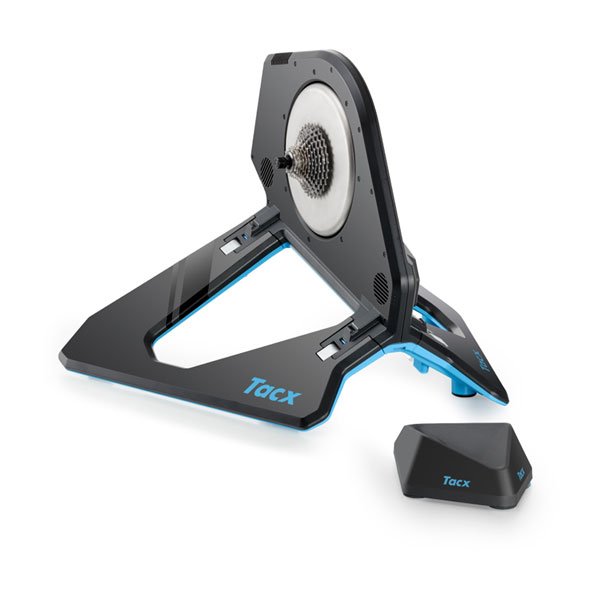
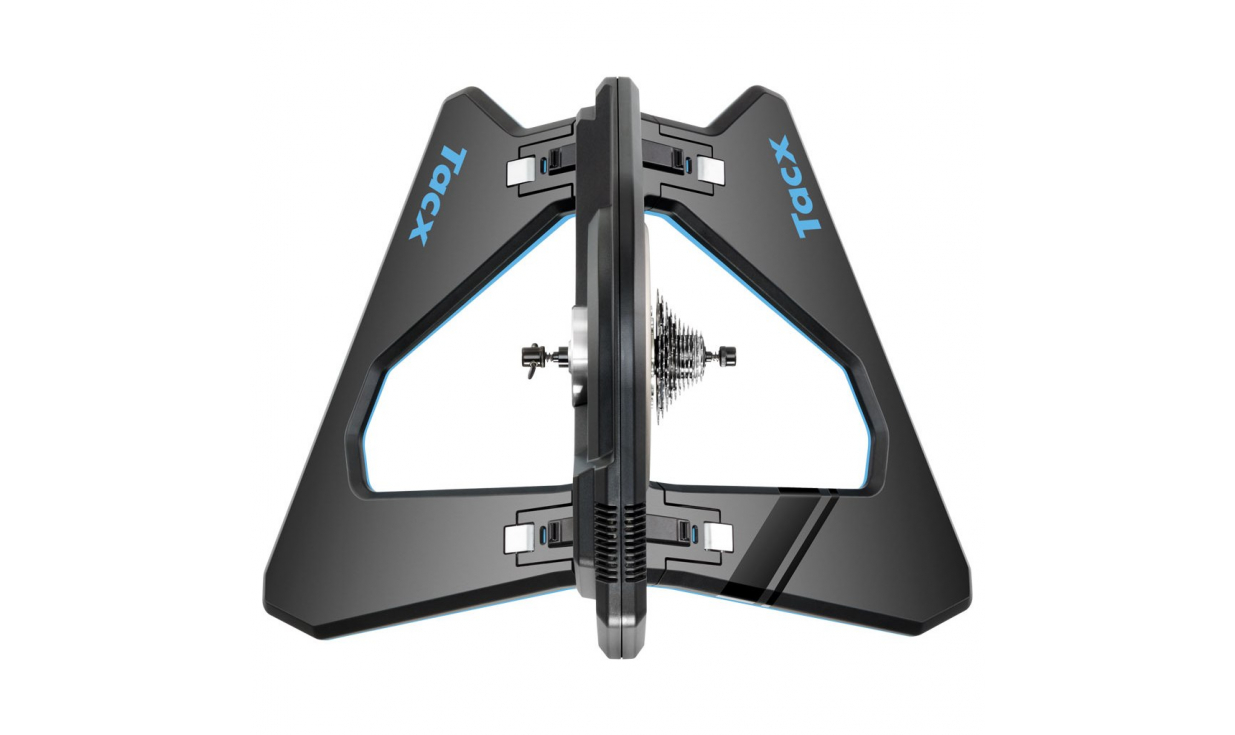
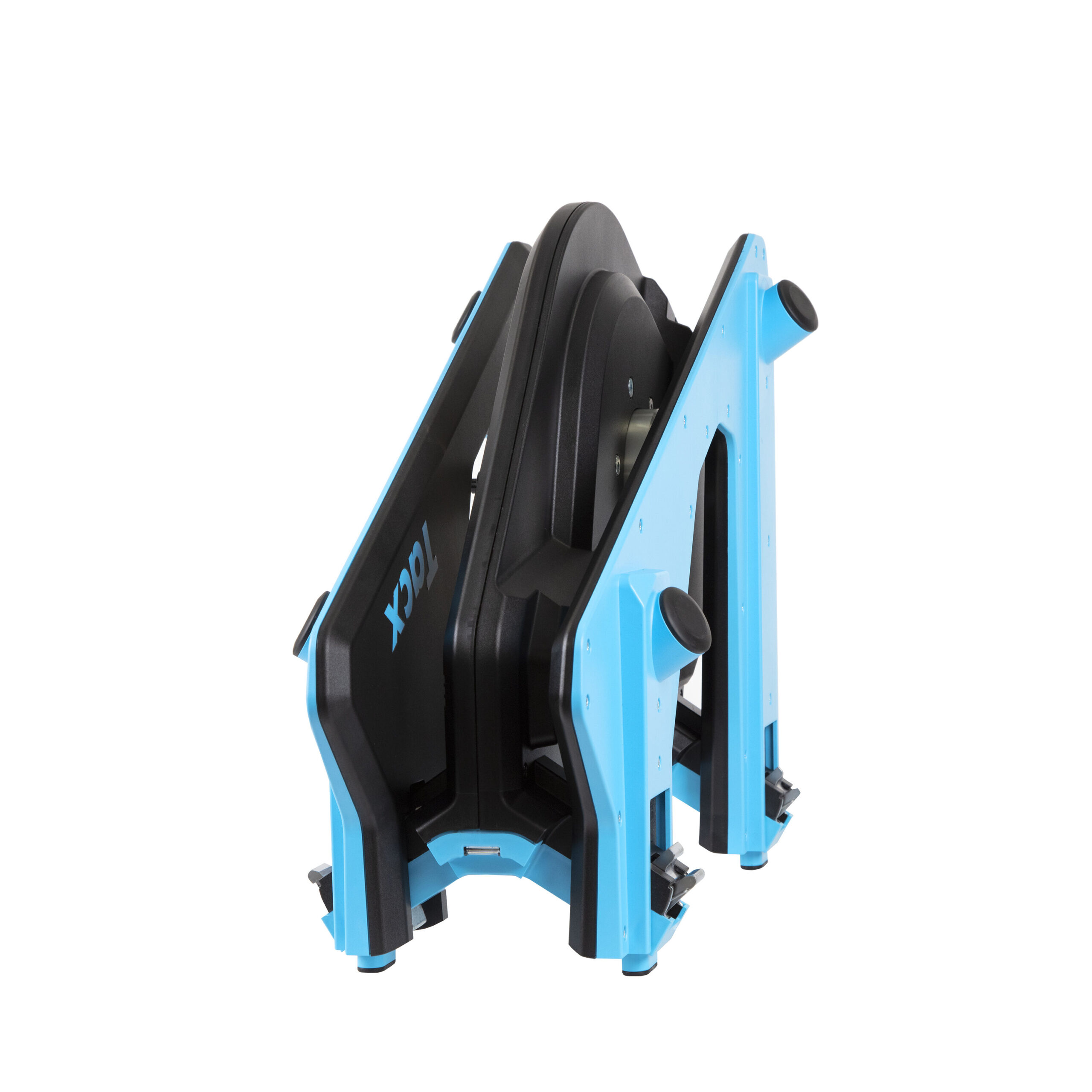
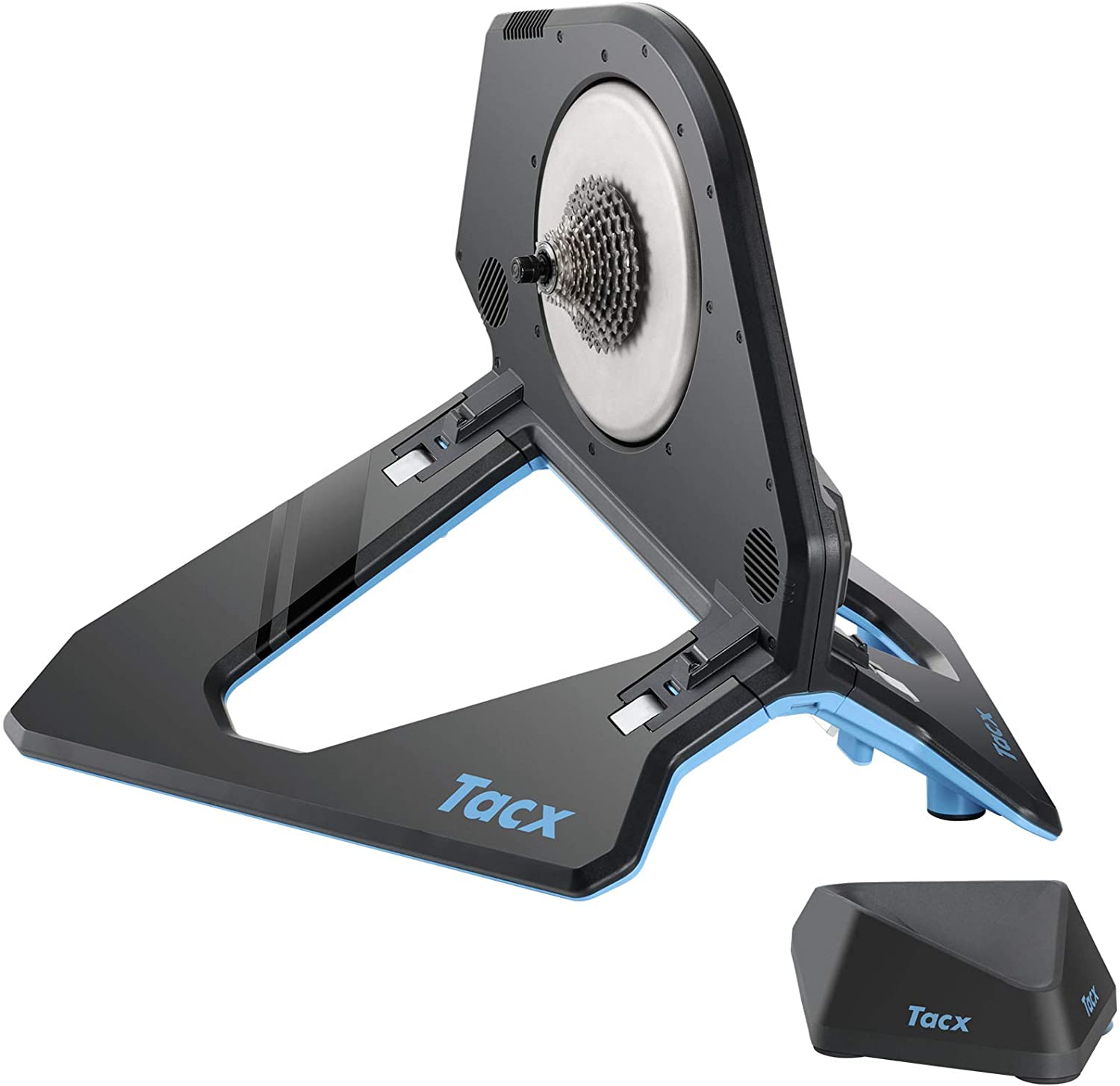
The Tacx NEO 2T is a technologically advanced trainer housed inside a robust, sleek, black plastic casing shaped like an arrowhead. It has foldable legs, enabling you to pack the trainer up when not in use. There are no handles to physically hold to manoeuvre the trainer into place and it is heavy, but the consequence is that the overall appearance is streamlined and aesthetically pleasing.
Unlike its competitors in the same price bracket such as the Wahoo KICKR and Elite’s Justo, it has a virtual flywheel, generated by 32 integrated Neodymium magnets, which are the strongest permanent magnets commercially available, up to 125kg, which is the largest of any trainer on the market. (Do not confuse this with the weight of the entire unit, which is 21.5kg).
What this means is that it simulates the virtual flywheel and you can change the resistance instantly, just like in the real world. With a standard flywheel, it takes a bit of time before it can change the resistance. Furthermore, this means on Zwift, when you descend, the flywheel will continue turning. The consequence of this is that compared to the Wahoo KICKR and Elite’s Justo, the trainer has a different “ride feel” and this I noticed, particularly when climbing, which is discussed in greater detail below. This resistance according to Tacx is due to their motor brake. As Tacx explains “Motor brakes use an electromotor to calculate resistance. The motor can both hold back (brake) and drive the wheel or chain. For a simulated descent, it will keep spinning — just like it does when you stop pedaling outdoors. The motor brake is the most powerful brake Tacx offers, and can generate high resistance at low speeds. This makes the motor brake perfect for simulating steep climbs. Tacx trainers with a motor brake are ideally suited for training on mountain stages.”
The arrowhead shape of the design means there is not a significant amount of clearance near the bottom bracket, chainstay, and the trainer. As a consequence Tacx have not released a device to replicate climbing gradients (like the KICKR Climb or Elite RIZER) as there would be a risk that your bike would hit the trainer when in the descent position. Instead, to provide that more interactive experience Tacx chose to release the NEO Motion plates that are designed to sit underneath the legs, allowing some fore-aft movement.
Overall, the trainer is elegantly designed and packed with technology. It has clean lines and the outer casing is made from plastic that feels sturdy. The one downside is that the foldout legs do create a wide footprint, but this ensures that you feel secure when riding and offers a sturdy platform when sprinting and accelerating out of the saddle.
Setup
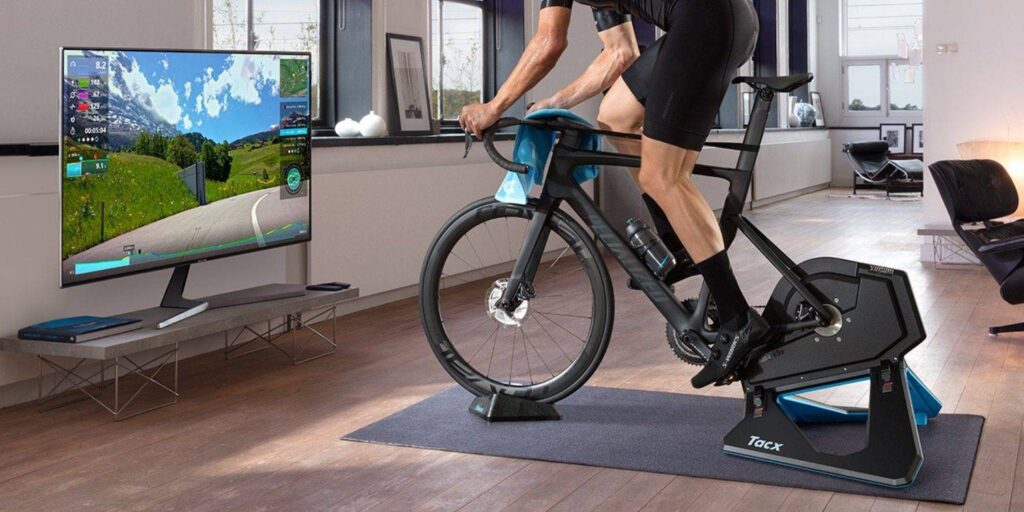
Setting up the unit is simple. As mentioned, there is no handle to hold to lift the trainer from the box, which would help, but I also appreciate that it would detract from its clean design.
Steps to setup the NEO 2T:
- Remove from the box
- Unfold the legs and click them into place.
- Install cassette – the trainer does not come with a cassette pre-installed, in contrast to the Wahoo KICKR, so you will need to install your cassette, and consequently you will need the required tools such as a chain whip and locking ring tool.
- Attach the correct axle adapter for your bike. All types are included.
- Attach your bike and use the wheel block that comes included to raise the front of your bike, if required.
It is worth noting that you don’t need to plug in the trainer for it to operate. It operates without the need for power, as power is generated when you start pedaling and it will connect as required. This means the trainer can be used without wires. Power is only used to operate the ‘downhill drive’ capability, so if you’re riding unplugged and you don’t pedal when descending on Zwift, the unit will stop. I recommend plugging in the power to use all its functionality when connected to Zwift.
The unit auto-calibrates, so there is no need to worry about any of that. In summary, it’s a simple setup process.
Ride Experience
Due to the virtual flywheel, the NEO 2T has a different feel to other trainers that I have used. It is really responsive but it “feels” harder to ride than others and I have been unable to generate the performances that I have previously with other different trainers, notably when I look at my watts per kilo over a 20-minute period.
This was a point that I discussed with Tacx directly. I spoke to one of the technicians about my experience and they eloquently noted that “each trainer has a unique feel and you need to find the one best suited to you.”
The simple way to explain the difference is that the NEO 2T “feels” more difficult than cycling outside and climbs feel more challenging, as witnessed by the fact that I need to change to my smaller front cassette when climbing on the Alpe du Zwift, which isn’t the norm for me. This is because I found the resistance is harder, which was set to 100% in Zwift. The advantage of this is that when you do ride outside, you will find it easier.
Despite the more challenging ride, the trainer does offer a smooth experience and is responsive when power is applied. Being Tacx’s most advanced trainer, you will expect it will have a few extra features which its lesser models don’t have that impact your experience. The three to note are:
“Road feel” – As Tacx state themselves “this feature works with Tacx software or the Zwift app to make the trainer vibrate and simulate the feeling of riding on different road surfaces such as cobblestone and gravel.” There are no other trainers on the market at the moment of writing that do this. The effect is achieved through the magnets which create vibrating patterns in the NEO, so other indoor trainers are not able to replicate this. I personally didn’t like this and turned it off. I don’t think that it adds much to the experience, but appreciate some might like it and this is purely down to personal preference.
Rocking motion – To replicate the natural movement of cycling in real life, there is a slight side-to-side, rocking motion. The advantage of this is that it does ensure a comfortable ride. If this is a feature that you like, then as mentioned previously, Tacx have released the NEO Motion plates which extend this experience.
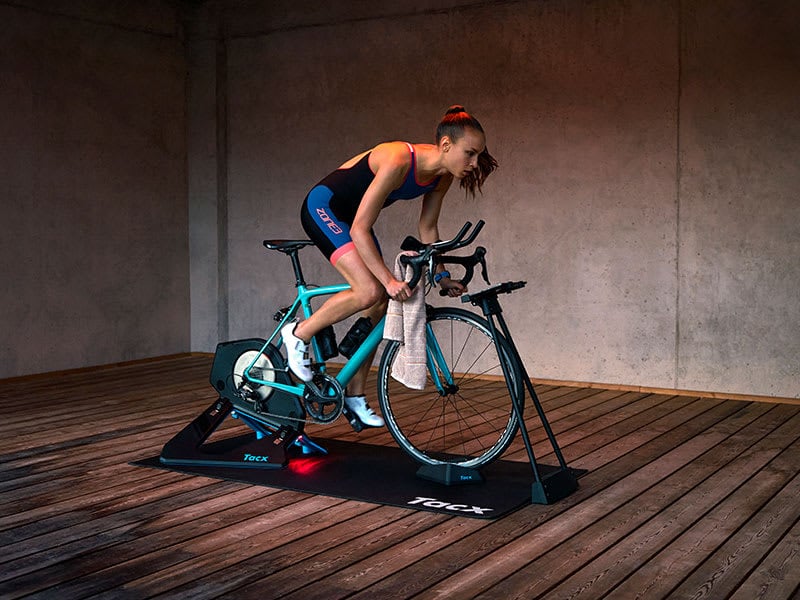
Effort lights – To denote the effort you are expending, LEDs change colour accordingly, lighting up your “Pain Cave” like a disco during long and dark winter training sessions. These are extra LEDs at the bottom of the trainer.
Reliability
The question many people ask about smart trainers is, “How reliable are the connections?” And the answer is simple. Very reliable.
This has been an area that I have paid close attention to because my previous Tacx trainer, the Flux S, would occasionally drop my Bluetooth connection, usually at crucial moments (notably when I was attempting my sub 1-hour Ven-Top climb). With the NEO 2T I have not experienced any connectivity issues, no dropped connections. It has been a solid and reliable performer.
Accuracy
The trainer is accurate, and this is clearly seen in my test where I rode the Volcano climb on Zwift. The largest discrepancy between my Garmin Vector 2S pedals and the NEO 2T was 1.22% (or 4 watts) over a 5-minute period, which is marginal at best. Data can be viewed here.
It is also worth noting that the slight discrepancy may be because the power measurement is taken from another section of the drive train.
| Time | Tacx NEO 2T | Garmin Vector 2S Pedals | Difference |
| 1 Second | 415 watts | 417 watts | 0.48% |
| 5 Seconds | 406 watts | 403 watts | -0.74% |
| 15 Seconds | 378 watts | 376 watts | -0.53% |
| 30 Seconds | 363 watts | 364 watts | 0.27% |
| 1 Minute | 356 watts | 359 watts | 0.84% |
| 5 Minutes | 325 watts | 329 watts | 1.22% |
| 10 Minutes | 289 watts | 290 watts | 0.34% |
One observation worth commenting about is that my ascent was the slowest of the three main trainers, by some 33 seconds. This relates back to my point about the difficulty of the trainer.
| Trainer | Time | Difference (whole number) |
| Elite’s Justo | 6.54.7 | 0 |
| Wahoo KICKR V% | 7.12.3 | 18 seconds |
| Tacx NEO 2T | 7.27.7 | 33 seconds |
In contrast to the steadier state ride, when undertaking tests to see how well the trainer handled sprints, the accuracy compared to my Garmin Vector 2S pedals shows a range in its results, indicating over short bursts, with high energy, the readings may vary. Data can be viewed here.
| Time | Tacx NEO 2T | Garmin Vector 2S Pedals | Difference |
| 1 Second | 764 watts | 793 watts | 3.66% |
| 5 Seconds | 731 watts | 763 watts | 4.19% |
| 15 Seconds | 663 watts | 689 watts | 3.77% |
| 30 Seconds | 478 watts | 489 watts | 2.25% |
| 1 Minute | 370 watts | 379 watts | 2.37% |
| 5 Minutes | 243 watts | 242 watts | -0.41% |
| 10 Minutes | 192 watts | 189 watts | -1.59% |
In terms of the power that I could generate, the Tacx NEO2T was the most “unforgiving,” being able to only hold 663 watts for 15 seconds. When sprinting, I felt that I was battling the resistance of the trainer.
| 5sec | 15sec | |
| Wahoo KICKR v5 | 806w | 756w |
| Justo | 757w | 687w |
| Tacx NEO 2T | 731w | 663w |
Noise – The trainer is quiet. Tacx noted that the “redesigned magnets have significantly improved the stillness of NEO 2T. Internal air displacement and vibrations are reduced, resulting in a remarkably silent trainer.”
Noise levels have been recorded at 57.8 dB. What does that mean? Well, it basically means that unless you have a state-of-the-art fan, or air conditioning unit, then the fan will be louder than the trainer. The key takeaway is that if you partake in early morning rides on Zwift, then you won’t need to worry about waking sleeping family members and/or the neighbours.
Erg Mode
My only negative observation with Erg mode is that there were fluctuations when trying to hold power at a lower wattage. For example, in the warm-up, when trying to hold 170 watts, I would easily fluctuate 15 watts over, then under. That said, when the resistance increased, the trainer was noticeable more stable and I was able to complete the designated workout without issue.
Tacx App
It is worth mentioning the Tacx App. The key feature of the app is that it gives you access to their library of “In Real Life” cycling videos, which was once their unique selling point and a cornerstone of their offering. This is a subscription-based service, but if you want a bit of variety apart from Zwifting then this is a genuine option and well worth using their 10-day trial.
If you already have a Garmin Connect, account, your login details work here. This app is only available for use with Tacx Smart trainers.
Cost
Being Tacx’s premium product comes with a price. It is one of the more expensive smart trainers on the market, retailing at £1,199.99 / $1399.99 USD.
Buy now at Garmin.com >
Buy now at Amazon >
Technical Specifications
- Weight: 47.4 lbs (21.5 kg)
- Product Dimensions: 22.6″ x 29.5″ (575 x 750 mm)
- Height: 21.7″ (55 cm)
- Accuracy: <1%
- Connectivity: ANT+ connectivity, Bluetooth wireless technology
- Power Requirements: 110-240 Volts
- Flywheel: Virtual
- Maximum Simulated Grade: +25%, Simulated Descent
- Maximum Power Output: 2200 Watts
- Resistance Type: Electromagnetic
- Cassette: Shimano/SRAM 9 to 11 speed compatible
- Campagnolo (compatible, requires special cassette body)
- SRAM 12 speed/XDR (compatible, requires special cassette body)
- Shimano 12 speed Microspline (not compatible yet, requires special cassette body)
- Axels: Width of rear fork: Race 130 mm, MTB 135 mm, 142 mm and 148 mm. Adapter for 135 x 10 mm available
- Calibration: No calibration needed
Summing Up
The rocking motion of the bike ensures a comfortable ride, making longer hours in the saddle not something to fear. Having the ability to have access to Tacx’s vast library of “In Real Life” cycling videos is a nice bonus and means that if you are training for a specific sportif, then there is every chance that you will be able to find the roads associated with it and try them before you go.
This is a top-end trainer with top-end specifications that comes with a top-end price tag. It is quiet, reliable, and accurate, and if you are prepared for a more challenging ride then this is the smart trainer for you.


I bought NEO2 (not 2T) in May 2019 and its circuit board overheated and burned out in June 2022, by which time it was out of warranty and I was simply not to get it repaired because the repairs weren’t cheap and there was no official guarantee on how long it would continue to work.
I use NEO2 with air conditioner every time, my weight <65kg, max power ratio <10w/kg, not human or temperature causes it to break down. And I heard NEO 2T working overheated not only once from other users. Because of this issue, I do not chose NEO2T, I purchased Wahoo KickR v5 in August 2022.
My experience is very different – I bought my first generation NEO in July 2016 and I have used it daily, then twice daily since April 2020. It has never had a fault in all that time.
neo original was a different type of beast. I’ve had two neo2 replaced and know of many people who had the same situation. my third one is now with 2 1/2 years. let’s see how it holds up.
I heard something similar to what Pedro said. NEO gen1 is different, tough guy.
Mine also died in similar fashion but Garmin were superb about replacement.
Repairs are also very cost effective, search Facebook for the turbo trainer doctor.
Ths 4 help, im living in Guangzhou CHN, as i know only Garmin NEO2T selling in CHN mainland. Mine is Tacx NEO, all those Tacx NEO series WITHOUT Garmin official guarantee. Here do have NEO series paid repairs seling on internet. My point is if you don’t repair something by official service, it seems no guarantee how long it will last after repaired, especially if you can’t come to the store to check first and pay later, you might be also have the problem of dispute after sending it for repair, those are the experience I had when I sent my work laptop for repair.
I purchased this trainer 2 years ago and absolutely love it. I’m a big cyclist (110 kg) and this unit is very stable even when I push the watts to my limit. I like how it responds to the different ride surfaces in Zwift, just as it would feel outdoors. It is pricey, but for me it has been well worth the investment so far.
Great review, which confirms all my experiences with the Neo 2T. Great for every ride except races. With it’s unforgiving power numbers you have no chance. Only comparing to the V5, 18 Seconds slower up the Volcano, 70 Watts losing in sprints (just think about the difference to all those other supposedly so accurate trainers, not speak of wheel-ons).
100% my experience as well. Awesome unit but is approximately 8-12% off of my 4 other power meters. Yep I have four different ones I tried on my old kinetic. It’s demoralizing to race with. I would bet many others have this experience as well. Awesome trainer for solo riding and workouts (after adjusting down ftp of course)
Yes I noticed the same power issues with my Neo 2t. It feels harder than the equivalent ride outside to me as well. On a 0% grade, I can easily cruise outside at 21mph but on the trainer I can barely sustain 20. I don’t understand how a trainer can be harder than the equivalent ride performance outside since the trainer is expensive. The only good thing it makes me faster and stronger for outside rides. The unit is not good for virtual races though.
Good review, fair. Climbs you tend to feel and since I haven’t been on other trainers I’ll believe what’s said there. Sprinting you get a nice quick movement that about feels like you’re outside though it’s similar to climbing with the TACX NEO 2T, you feel it after a bit.
You mention it felt harder and climb time was slower compared to other trainers. Id love to see a comparison between pedal power and trainer power for each of those three trainers during that ascent. Does it just feel harder or is it actually reporting a lower wattage?
As you say, the juxtaposition of our saying it’s “accurate” (within ~1% is the spec, right?) but also saying that it’s just HARDER is confusing to me. Comparing power meters against the trainer and seeing the two results close to each other should settle it, right? But “harder.” What?
(Not sure why that comment went in at that moment.)
I’m pretty sure I read in a comment somewhere (DC Rainmaker review?) that the TacX app has a separately-entered weight for the rider, which was somehow causing Zwift’s performance to be off.
(That doesn’t jibe with what our reviewer describes here, though. Straight watt figure, and we’re told he couldn’t sustain the same level over time.)
I definitely noticed my virtual speed does not correspond to the actual speed for the same gradient outside. I been using the Tacx training app and my weight input is correct. I am going to try Zwift again and see if I have a better experience. Using the Tacx app, my average speeds are slower than outside riding.
power and resistance are two different things; do 300 watts on a spin bike with no resistance will feel different to 300 w on a neo; easy to test this out by riding up a hill on zwift with td at zero and then at 100%; ride for 20 mins at zop end z3 hrt rate for both efforts and compare power and cadence and your general feeling of “how hard it felt” or do it at a set power and compare hrt metrics.
There is a link to my data included in the article.
Same question here. I have the same feeling that riding at the same power indoors on Neo 2T (ERG mode), I have to push harder. In other words, I can continuously ride with higher (5%+) power outdoors (measured by SRAM Force AXS crankset). So I was thinking Neo’s power indicator should have displayed a lower power number compared to the power meter if they were put together
I too have the same experience. I really think not having a flywheel which gives inertia makes all the difference for an indoor trainer. Since the Neo 2t does not have a flywheel, it cant simulate inertia at all.
For general riding on the Neo I disagree, the magents replicate intertia quite well if have your weight set correct in the Tacx app. That’s how you get the downhill freewheel affect.
Where intertia seems to be a struggle for the Neo is with ERG mode and steeper gradients because then it needs to have resistance and inertia at the same time, whereas for me the Neo is one or the other in some situations or that’s how it feels.
All the data is available for you to look at. On ZwiftPower. A link was provided in the article. All my data from the testing is made public for you to interpret. But I can tell you, the fact that it is the slowest at up the Volcano and nothing major has changed in my fitness, weight or anything like that, to me indicates it is the trainer.
I believe since Neo 2t does not have a flywheel, you have to work harder to maintain power. Its a bummer
I bought he NEO 2 in January this year. I’m a heavy rider and the sensation is that the trainer is very stable. Very happy with it, my previous one, an Elite Direto XR-T only lasted 3 and a half months before it broke without repair. This one seems much more resistant. For me, the ride feel is nice, and I like the diferent terrain feeling. very happy with it, hope it last a long time.
Hi Tim,
Would the NEO 2T feel harder to ride than the original NEO? I have an original ‘2016’ NEO with around 15000Kms and occaisionally follow the maintenance guide from Tacx to keep it running. But in the back of my mind I thought if it one day failed, I would replace it with the NEO 2T. I think up steep hills at least it would not slip like the original NEO does. Maybe Garmin/Tacx will bring out a new NEO or something else soonish? As I only use Zwift for my indoor workouts, I really like the road feel feature, I wish more brands would use it too! Cheers, Ben.
Hi, I don’t know as I have not ridden the NEO. Perhaps contact Tacx Customer Support.
I had one, but now that I’m full-time indoors I bought a Bike Smart. Got hooked on how this unit felt.
I’d be curious about your comparison of the two? I have the Bike Smart and the NEO2 as well. I love both (I travel a lot in the car and so needed a mobile trainer) but, for certain, I can’t match my Bike Smart performances on the NEO2. It isn’t a ton, but it’s enough to make a difference in a race.
it’s the same tech, so it seems bizarre to me.
I have a tacx neo 2t and the trainer is great, unfortunately, when paired with multiple other garmin devices it fails miserably. Wearing my HRM-pro and fenix 6 during an activity all appear fine (heart rate captured correctly. Unfortunately, when synced with connect, connect accepts the heart rate data from the fenix 6 (wildly inaccurate, a 2 hour training session with avg HRM pro heart rate dat at 165bpm vs fenix 6 95bpm.
This is a fenix 6 issue and garmin associates see the problem but state it is a limitation. They suggest I hold my hand off the handlebars during the ride…WHAT?
Another great and independent review – very interesting stats and the contrast of magnetic resistance. It’s great to see a verifiable, objective and fair assessment of bike kit – as opposed to reviews in many cycling magazines these days!
Thanks Nonno, to actually write a review is really time consuming as there is the testing, then trying to articulate your point clearly, concisely and considering all aspects is rather challenging. I agree with you about the reviews in bike magazines, they very often do not go into suitable level of detail and are often bland. The challenge with an article like this is you want to go into detail, but not too much detail that it becomes too intense to read. Often paragraphs get stripped out as I think I have gone too far and my approach is trying to get the middle ground, to hopefully inform the widest spectrum of people. Thanks for reading.
Performance numbers and the ‘harder’ comments are interesting. I went from a Direto to a Neo and lost ~5% performance. A friend lf mine went from Neo to a Kickr and gain a small amount of performance. the numbers above here shows the reviewer’s performance dropping by a similar ~5% for hard efforts which is a lot when racing on zwift, the difference between being in the winning group and getting dropped.
I feel that the virtual flywheel on the Neo
is much stricter than a physical flywheel, when climbing, at high resistance
(eg sprint) or in ERG mode, the resistance is very instantaneous and constant.
You must work slightly harder to keep up the power, there is less inertial at
higher resistance. Whereas with a physical flywheel it tends to give slightly
more momentum all the time which helps push a bit harder. On the neo if you
pause for a second in med-high resistance ERG mode or climbing it will punish
you immediately, whereas with a physical flywheel you get the extra bit of inertia.
I love my Neo, I like the strictness of the
power/flywheel, but when racing and hard efforts I feel it does make it
harder….great to see someone test and demonstrate this, other reviewers have
avoided or ignored this fact. I feel that I should train on the Neo, and then
race on a physical flywheel trainer
These could all be excuses for lack of
fitness and old age.
Related to the conclusion it is accurate but “feels hard” with ERG mode, the video explain the reason: https://m.youtube.com/watch?v=LBWikqoCUyE
Generally, when we ride outside, we all knows when crank stay in the 12 and 6 clock it will be the weakest output in the entire power cycle. But when we ride on flat, high speed makes the 12 and 6 easier compared to climbing even with similar cadence and power.
Back to the trainer. Why we always say heavier flywheel will have natural road feel since the heavier one also can make 12/6 clock easier. Also, the faster the flywheel, the smoother the 12/6 clock the same. Somehow, it means that the actual power outputs will have bigger variant diff off the target power.
I think when enabling ERG, NEO series will disable the virtual flywheel. So it will actually pretend a small/light flywheel trainer under ERG mode. So even ride with big chainring with much higher flywheel speed, it does not actually have much diff here, or say, too accurate and too smoothly so makes the 12/6 clock feels like climbing always, and feels hard here.
Maybe or not, for the other trainers like kickr, I think when riding with smallest chainring (like 39-28) will have similar situation feels harder too.
great review with some superb data; think all us neo owners knew whats posted here. Its not a surprise that many “top zwifters” have ditched the neo in favour of the kicker et al. 90 watts on a sprint is massive. even if you race with a different PM and use the neo as controllable you are still feeling those magnets for resistance. zwift racing really is the wild west!!!
So, train on a Neo, race on another flywheel trainer would be the ideal?
For the most part the Neo is brilliant, it just works, is super accurate, has enough movement to help comfort, downhill simulation, etc. I love it after coming from a Direto…. having said that on the Direto I scored ~5% better performance in races. So, day to day the Neo wins hands down…. but come race day losing 5% to others is a massive hit, but I’ve come to accept it becuase overall the Neo does so many things so well.
if zwift racing is your thing then a neo is bad; tacx designed a superb bit of kit unfortunately many wont like it as it makes them perform at their true level; i have been zwifting for many years and have seen many switch from this turbo to “others” as it allows them to perform better in races. 90 watts off a sprint vs the kicker is massive; well over 10% for the guy doing the review.
I use the Neo 2t for a month now and im a little bit confused about der ERG mode. When the change from a 200w interval to a 500w interval e.g sprinter workout . The resistance is getting so hard that i have a drop from 80 cadence to 30 and it feels brutal . Whats the best way to control this big gap of cadence/ watts ? With normal intervals i have no issues but . Sprintig intervalls are killing me.
set the high watt interval as a “free ride” this will disengage erg for that interval