

Let me say this up front: I don’t like time trials. The lone suffering, the mental gymnastics required to keep pushing constantly, the lack of strategic elements… all unattractive to me.
Which explains why I can count on one hand the number of Zwift time trials I’ve raced. And this includes team TTs, which I’ll admit are a bit more fun. But still not my cup of tea.
Yet here I was, setting up my virtual TT rig on a Saturday morning to take part in the weekly WTRL iTT. Why? Because every once in a while I get a hankering to do something different, something outside of my usual. Plus, after thinking through my post about Crit City Redefining ZwiftPower Categories, I had been wondering what sort of wattage I could hold in an all-out TT effort, where I wasn’t modulating wattage to sit in the draft.
By my calculations the race would last around 40 minutes. Not a bad length of time for a proxy FTP test. Let’s race!
TT Basics
Clearly, I’m not an experienced TT racer. I’ve already covered my lack of Zwift TT experience, and the only outdoor TT’s I’ve ridden have been few and always Merckx-style. I’m no TT specialist. That said, there are a few things I knew for sure going into this race:
- Don’t blow up early: the tendency is to start hard, which can burn you out for the rest of the race. Get up to speed quickly, but don’t fatigue yourself early.
- Equipment matters: when every second counts, you want the fastest possible setup. This is especially true with TT races, and more so on Zwift, where you don’t have to worry about whether your virtual cockpit fits or how your deep-dish wheels interact with crosswinds.
- Over-pace uphill, recover downhill: pushing hardest when you’re moving slowest (uphill) results in the fastest overall times. So push 5-10% over pace on uphills, and drop the power a bit once you’ve hit cruising speed on descents.
- Pacing is everything: this is the biggest thing to understand. Know the race route and your own power numbers, you should know what sort of pace you can hold. Stick to that pace, avoiding the temptation to go harder early or ease up when you’re suffering.
The Warmup
I began the morning with my typical race prep protocol: two pieces of caffeine gum and some PR lotion on the legs. Then it was over to Tick Tock, where I started by equipping myself with one of the fastest TT setups in Zwift: the Felt IA frame and Zipp 858/Super-9 wheels. This was a flat course, so bike choice was easy: simply use the most aero frame and wheels available.
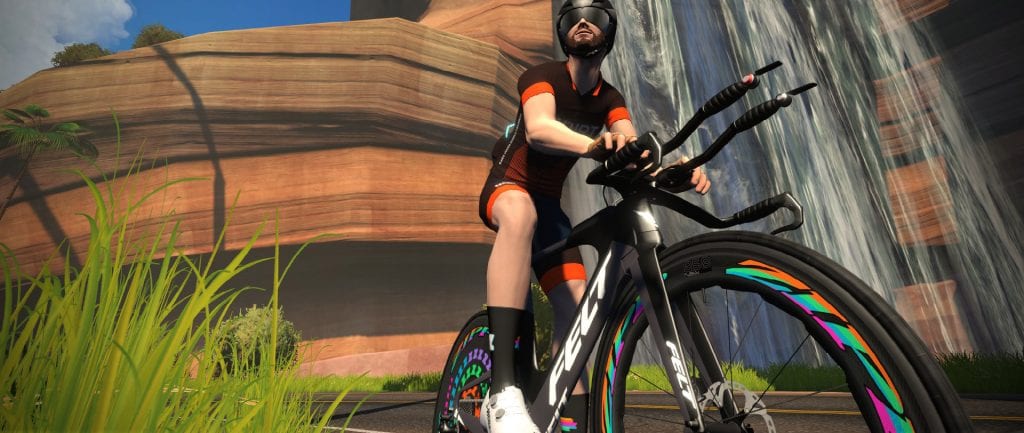
I added an aero helmet to complete the look, then headed out for a ~20-minute warmup where I made sure my heart rate got up to 160 a few times. Always a good idea to make sure the engine is firing on all cylinders.
Variability
We were riding one lap of Watopia’s Waistband, a 25.5 km (15.8 mile) route with only 95 m (312′) of elevation. This was good news: I like flat routes for TT’s, as I can keep my effort quite steady. I do best with low-VI efforts.
(What is VI, you ask? Variability Index, according to this TrainingPeaks article, is “a way to measure how smooth or ‘variable’ your power output was during the ride. It is calculated by dividing your Normalized Power by your Average Power. A steady and even output, like during a triathlon, should have a VI of 1.05 or less. During a criterium race your VI may be as high as 1.2 or more.”)
VI for indoor riding is generally lower than outdoor, given the steady-pedaling nature of Zwift rides. This is why you’ll hear cyclists say “Zwift racing is a lot like a TT effort.” Because power is more steady in Zwift races, even road races with drafting enabled, due to how Zwift’s pack dynamics and physics work. Additionally, a lower Trainer Difficulty setting (I run mine around 30%) will logically result in a lower VI, since you have less resistance fluctuation affecting your pedal pressure.
The Start
A TT race doesn’t start like a typical Zwift road race, since you don’t have the stronger riders attacking in order to establish that initial selection. Instead, a TT race start is all about getting yourself up to speed quickly, then settling into your rhythm.
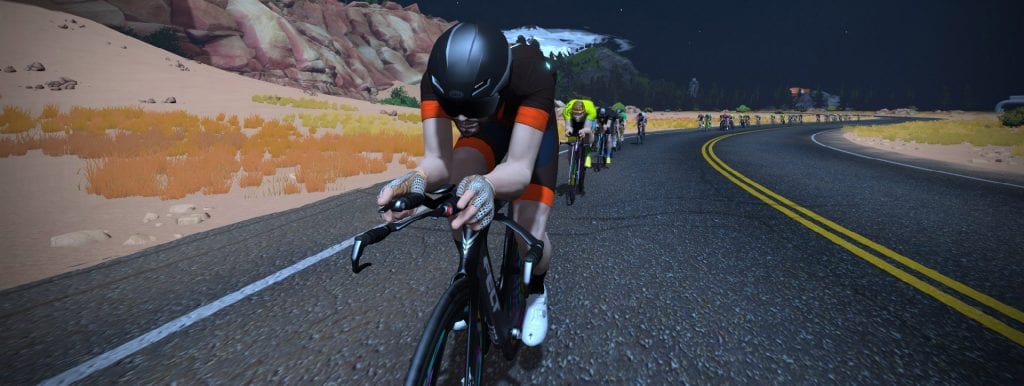
Our group immediately strung out, and I found myself in 2nd place, behind James Bailey. Right away I was second-guessing my effort level. Was I going too hard? I was holding 320-330 watts, and felt alright, but I also knew that this would be right on the limit of what I could do for 40 minutes on a good day. And I wasn’t convinced this was going to be a good day.
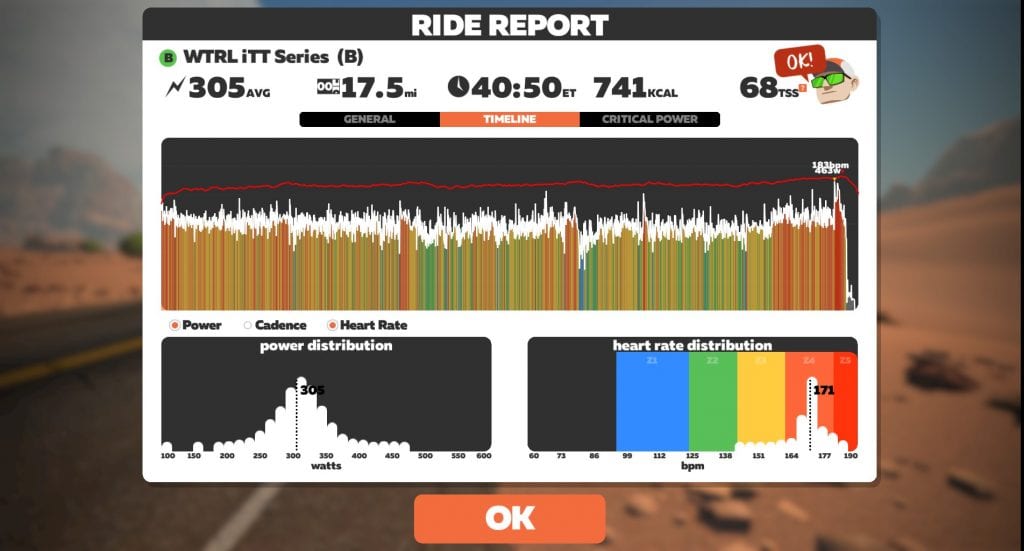
I averaged 320 watts over the first 10 minutes, covering 7.1 km. This would be my highest power average of the race, which means I did go a bit too hard, too early. Rookie mistake.
The Middle
I tried to hold my power steady in the 320 watt range, but I could tell I was flagging. I also did my best to up my effort on any inclines, following the TT mantra of go hardest when you’re going the slowest. But I was still losing ground, sinking to 7th place in our group of 40 by the halfway point.
I averaged 304 watts for the second 10 minute block, covering 7.1 km.
The third quarter of the ride was my worst. I was struggling to find the best cadence, swapping uncomfortably between spinning and mashing. I did find that working in a lower cadence in a tougher gear seemed to let me hold power a bit better, so that’s what I settled on. (Except when that got too hard, and I shifted to an easier gear. It wasn’t pretty.)
This was so different from the drafting-enabled road races I typically do in Zwift. Those races are all about making the front selection, attacking where it’s smart, and conserving energy for the final push. Here, though, I had to constantly remind myself to keep pushing, to go all in. Maintaining top speed was the priority, and that meant riding right at threshold almost constantly, regardless of what other riders were doing.
I was also riding in camera view 3 (first person view), which I like to do. I usually don’t use this view for normal road races, since I can’t see riders around me as well. But for a TT, why not? Let’s immerse ourselves in the painful experience!
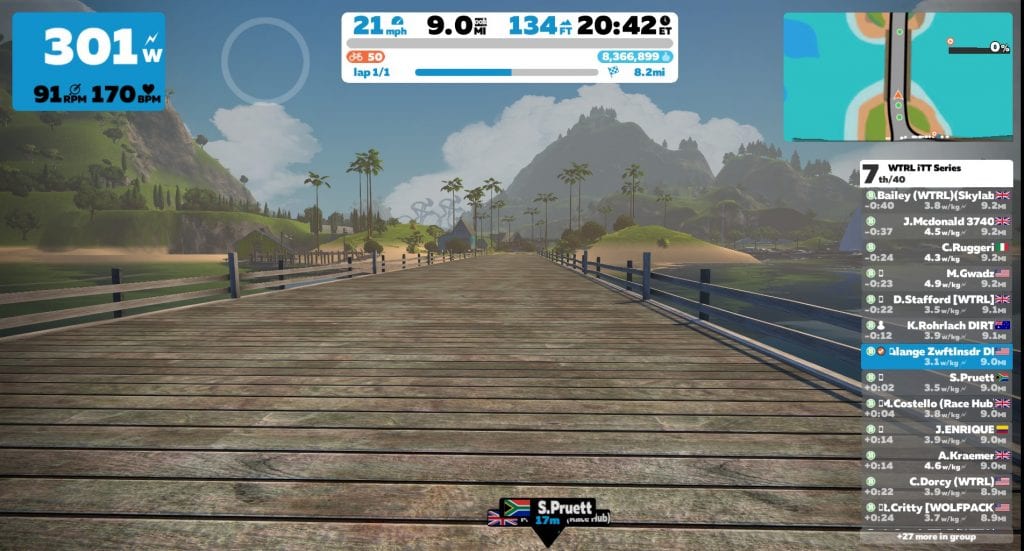
I kept a constant eye on the rider list, looking to see who was gaining on me and if I was gaining ground on those ahead. The results weren’t promising. I was losing ground to S Pruett and M Costello, and not gaining anything on my teammate K Rohrlach up the road.
I averaged 301 watts for the third 10 minute block, covering just 6.5 km. 320, 304, 301… things were trending in the wrong direction.
The Finish
As I left the volcano circuit with approximately 10 minutes to go, I steeled myself for a final hard effort.
Only 10 more minutes, Eric. You can push harder for 10 minutes.
I’d been passed by a hard-charging A Kraemer as we left the volcano, putting me in 9th place. But I had been paying attention to the riders up the road, and was pretty convinced that three of the eight ahead were going to be disqualified in the final results. (The first place rider was on zPower, and two other riders had been holding ~4.5 w/kg pretty steady.) If I was correct, that meant my current finish position was actually 6th, not 9th.
Two riders were just seconds up the road: S Pruett and K Rohrlach. If I could finish ahead of them, that would put me in 4th. It wouldn’t be a podium, but it would be close. And that was just the motivation I needed as we turned off of Ocean Boulevard toward the bridge toward Fuego Flats.
5 minutes left. You can do anything for 5 minutes!
I stood up, hammering my way across the dirt section and up the bridge, knowing Crr differences on these surfaces would make me roll even slower, so extra power would help me put time into the competition.
Pruett was 3 seconds ahead, Rohrlach 6 seconds…
I kept the power up, holding somewhere around 330-360 watts. By the time we passed the desert start pens, Pruett and Rohrlach were just wheel lengths ahead.
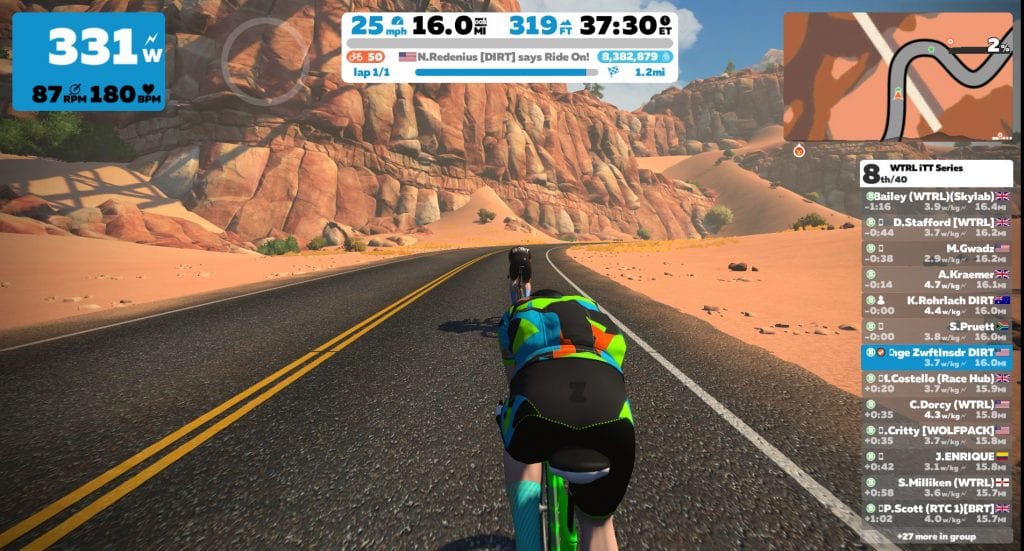
Pruett was pouring on the watts, but Rohrlach appeared to be flagging. I passed them both before we exited the loop section just before the sprint start line.
Less than 1 minute! Empty the tank!
I shifted and stood up, knowing the final sprint was only a ~35 second effort. Pruett put in a good dig, but I was able to stay ahead, finishing 7th. And just as I had predicted, that meant 4th place on ZwiftPower. James Bailey, the rider who began in the lead, would finish 1st. Well done, James!
And well done Rohrlach and Pruett – thanks for pushing me! (As it turns out, they are both DIRT teammates. Pruett just wasn’t wearing team kit.) We finished 4-5-6 on ZwiftPower – not a bad result for the DIRT squad.
I averaged 310 watts for the fourth and final 10 minutes, covering 7 km.
See my activity on Strava >
See my activity on Zwift >
See race results on ZwiftPower >
Takeaways
This was definitely closer to an FTP test than a typical Zwift road race. Here’s a power zones comparison between a recent Crit City road race and this TT. (Both races were right around 41 minutes long.)
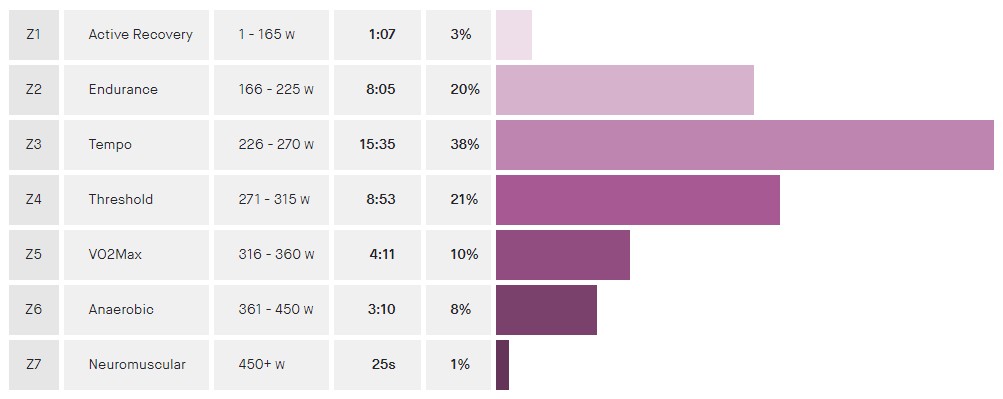
Crit City race 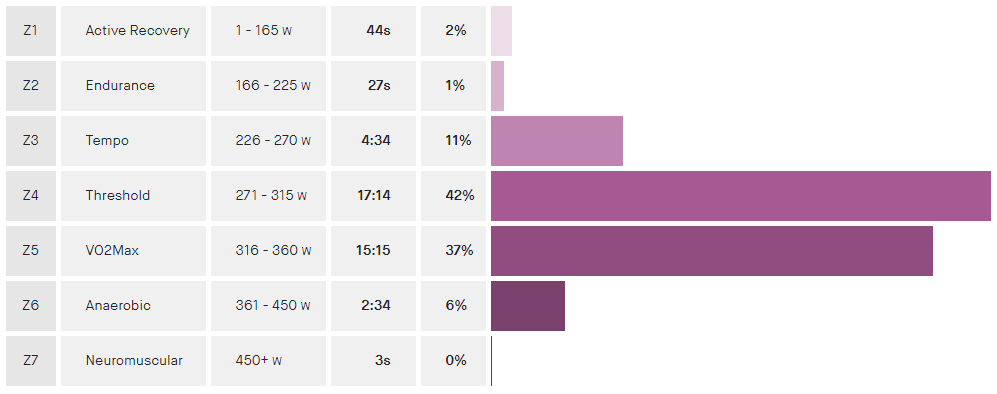
TT race
Notice how I spent much of my time in the lower-effort Tempo zone for the Crit City race? This is where I typically sit when I’m just hanging in the pack, conserving energy in the draft. In a flat TT, of course, the goal is to ride at your limit for the entire race. And I think I was pretty close to that! (My legs were sore for two days afterward.) Even though I’m not generally a big fan of the TT race, you can’t argue that it’s an incredibly challenging workout.
It would be really interesting to crunch the numbers and graph some sort of probability curve for race results based on a rider’s wattage and whether it’s a TT or standard road race. Because wattage certainly seems to correlate more closely to results in a TT compared to a road race, where strategy plays a more significant role. (See the results of this TT vs the Crit City race above as an example.) This makes the TT less interesting, in my mind. But I can see how it would appeal to a purist as well.
Lastly, I was left questioning whether I could have pushed harder, especially doing the 2nd and 3rd 10-minute blocks of this race. It was so challenging to stay focused and keep the power high during these sections, but I had good power at the very end of the race. Did that mean I had more to give in the middle?
There’s only one way to find out, and that’s to take on this awful challenge again sometime down the road. It probably won’t happen any time soon. But it will most certainly happen.
Your Comments
Are you a fan of the iTT? Got any tips for me? Share below!

Great write up, Eric! Apparently overthinking the process is something you’re good at. Like me. IMHO, you’re underestimating the strategy involved in TT events. Much of it is in preparation but pacing and managing the mental aspect is what makes it challenging.
Yeah, pacing is much more critical in a TT than a mass start event. In an MSE, if you foul up and go out too hard, you can recover in the pack obviously. I’m thinking (oh-oh) that you probably had more of a problem with pushing through the middle part of the event than going out too hard since you were able to match the starting level of effort in the fourth sector. Looks like 310 should be about your pace but I’m sure you figured that out.
I really like the mental gymnastics you employ at the end: “Only 10 more minutes. You can push harder for 10 minutes.” and “5 minutes. You can do anything for 5 minutes.” That is a sure way to make that last 5 minutes last about 20 minutes. Whenever I do that, every time I look at the clock it’s like: “Only 20 seconds have gone by? I was sure that was 2 minutes!” Kills me.
And then 10 minutes after the event, I’m sorta recovered and back to overthinking: “Dammit, I could’ve gone harder…”
Eric, this has probably been covered elsewhere on ZI before, so forgive my research laziness if so, but does headware make any difference on aerodynamics in Zwift? Guessing not and that the chose of helmet for this was purely to look and virtually “feel” the part psychologically, but thought I’d ask anyway. Had someone relatively new to Zwift and our cycling team ask me that the other day, and it occurred to me that I didn’t actually know the answer to the question, so the timeliness of this article is a perfect launch pad for that topic.
In our tests, we’ve found that no current headware gives any speed advantage.
Zwift has said that they’ve set up the system so headware COULD be a factor… but as far as we’ve seen, they aren’t yet.
Great job, good man! I can understand that you and many others are no fan of the ‘race of truth’. But a time trial from time to time is a good way to become a more allround cyclist. And for me the fact that it’s such a mental game makes it more rewarding, especially after a TT. There’s nothing quite like turning yourself inside out for a short time😀
Currently doing the TT tune up training plan to prepare myself for a few TT’s in the near future, hope to do some new Power PB’s.
I do think there’s good to be found in the mental training required to TT well. It doesn’t mean I enjoy it, though. 😁
I break my TT races into three stages based on distance.
1st stage I keep my power below ftp so I can gage how my legs are feeling
2nd stage I increase my effort keeping an eye on heart rate to make sure I leave some in the tank.
3rd stage I go all out,. especially in the last 5 kilometers.
Each stage should have higher average power. Works for me. When I try and hold the same power for the race, my times end being slower and average power drops.
Excellent concept, Richard! I’m definitely going to use that in my next TT. I’m certainly not going to go any slower than my last one…
Probably a strategy worth me trying, if I ever get brave enough to do this again.
Do some shorter ones, like the two I mentioned in my post.
I actually DO like TTs because I am the only one I can praise/blame for my performance. I was in that race and category with you, but much farther behind (17th on ZP). I will have to say, that race was BRUTAL!
I have fallen into the routine of doing the Maximus Shootout on Wednesdays and/or Zwift’s Fast Fridays. They both use the Tempus Fugit course which is ~11 miles. Doing a TT on the Waistband…NOTICEABLY different.
But like you said, pacing is crucial–that and knowing the course. I knew the extra 10k was going to hurt, but I still think I am recovering from that a bit.
I enjoy your articles…keep up your efforts!
Looking for longer TTs? The Summer Stampede races by the Herd Racing League are generally about 30-40k in length. They run on Mondays afternoon/evening for the Euro and American riders, Tuesday morning for ANZ. The next race is one lap of Out and Back Again.
This past week was 8 laps of the Volcano Circuit, just shy of 40k. It took me just over 56 minutes at 3.4 w/kg average. I actually raced it with trainer difficulty at 0%, treating it just like an FTP test. That meant the effort stayed strong on the downhills but still allowed me the flexibility to add power on the uphills. My graph was yellow and orange the whole way with some red at the end.
I had a teammate who spent most of the race just ahead of me, and chasing him gave me a ton of motivation to keep pushing to try to catch him (I didn’t). He said afterward that my presence not far behind his wheel was equal motivation for him!
There was also another rider behind me who put out some serious watts at the beginning and was probably 10 seconds ahead at one point, but had put himself on a road bike (there were actually many riders in the pen on road bikes, perhaps some confusion this wasn’t a traditional road race?), and he couldn’t maintain the wattage to hold in front of those of us on TT bikes. On the later laps, I noticed his wattage dropping to 0 when he hit the brief downhills, indicating to me he was on the rivet and trying to recover a bit. He tried to make a late race surge though, pushing back up to 4.5+, but seeing that motivated me and I also began pushing harder; it just wasn’t enough for him to close the 20s gap that had opened between us.
The point is, TTs can be exciting! You just have to find something to keep you motivated!
Would you only use the TT Bikes when doing TT’s?
Assume when free riding you’re better off using an Aero bike such as S5 and Enve SES3.4 wheels, so you can benefit from drafting other riders?
Yeah, I would only use a TT bike in a TT race. Unless perhaps I was going for a PB on a largely empty route…?
Stupid question, but thanks for answering it Eric 👍🏼
Thanks for the write up Eric. It was a great race!
Honestly, seeing you on the start line gave me an additional objective to testing my thresholds: To see if I could match and hopefully surpass your effort. Having followed your race series, I knew that our numbers were very similar. Hoping that more watts would be in my advantage over the flats.
Off the start I was shaken into reality when you had put significant ground on me (although less than 10 seconds on the road), First ten minutes at 340 watts for me which would equal my best 10min effort on ZP. Likewise equal best over first 20 mins.
I slowly started passing those between us, and then only you remained (except for the rest at the front, but they weren’t relevant), the carrot dangling in front of me, urging me on.
I was only too happy when I cruised passed you feeling strong and started seeing the time gap stretch (but only 3-4 seconds). Too short lived and reversing surprisingly quickly at the end considering I was well above threshold again. If I could just hold your wheel it would make for an interesting sprint. I’m glad it didn’t come down to that though as I just couldn’t find that kick needed at the end. Well done !
Let me know where I can pick up the team kit 😉
Ha! Great to read it from your perspective. Glad you were working hard too, because you made it look easy, sitting back there then passing me toward the end. 🙂
Yeah, you need a DIRT kit! Info on getting that is here: https://indoorspecialist.com/dirt-resources/
Great article, Eric, thanks. I (ok I am a Triathlete :-)) like TT’s, the short ones as well as the longer ones. Two weeks ago I did a 90km TT with the German Group Power&Pace, also Waistband, and yes, it is hard in the middle. But once you overcome this feeking, everything is fine and the fire is in for the last kilometres :-). But I also had to learn not to verpace at the beginning, some time a really hard lesson :-). So I think I will enjoy some other TT’s in the near future (and I like Bologna, but this is not a “real” TT).
Nice write up Eric. I simply love TTs, but they do require a bit of thought and planning. Working through the course, checking where your own physiology is, making adjustments for short term fatigue. I tend to have quite specific power targets for each bit of road, but with certain parts marked out for a more flexible approach depending on whether I am having a good day or not. It is definitely worth the effort – I have had some TTs where I have gone faster than lighter people who have put out more absolute power. They physics really makes a difference.
Good job Eric. An entertaining read as always. I have a question regarding road bike v tt bike, I have participated in a couple of handicap TT races. There Is no drafting but you can still pick between a road and tt bike…. Which is faster? All the speed tests are for roadvroad or TTvTT but the best of each bunch are not compared for which is the king of solo riding. I’d assume TT us fastest, but by how much? Thanks
TT bikes are much more aero, so unless your TT race is up the Alpe or some other really long, steep climb, the TT frame is the way to go.
Compare numbers on https://zwiftinsider.com/charts-frames/ and https://zwiftinsider.com/charts-tt/
Fastest TT frame is 94 seconds faster over our ~50 minute flat test.
Road frames are lighter, though, so they outperform the TT frames if you’re just looking at times up a long climb like the Alpe.