

USA-based InsideRide has been making rollers since 2005, and many Zwifters love their e-motion rollers. But I’ve had my eye on a different InsideRide product for months: the E-FLEX System.
This is a different sort of “rocker plate” in that it’s not a plate at all. It’s two pieces of hardware (one for the front of your bike, and one for the back) which together give you fore/aft as well as side-to-side motion abilities. InsideRide thinks it’s the next evolution of the rocker plate – but we’ll get more into that later.
I reached out to InsideRide a few times about getting a review E-FLEX unit, but they were always out of stock. The E-FLEX has been on the market for a year or more, but availability has been a challenge – they seem to sell out quickly! Finally I asked at the right time, and they shipped one over.
How It Works
The E-FLEX system consists of two pieces:
- At the back of your bike you have a platform that attaches to your trainer and allows it to move forward and backward as well as tilt left and right.
- Your front forks attach to a version of InsideRide’s Floating Fork Stand, a product also available for attachment to their rollers. This stand lets your front forks turn left and right (around 30 degress of motion, which will tilt your bike around 6 degrees) while also moving forward and backward.
It’s a system completely unlike any other rocker/motion system I’ve tested (and I’ve tested quite a few). Let’s dig in…
Wahoo KICKR and Core Only
I should mention here at the start: the E-FLEX only comes in two flavors currently: one which supports all Wahoo KICKR versions, and one for Wahoo KICKR Core.
Setup
The two parts arrived together in one box, and upon removing them I was struck by how small they were. I’ve grown used to dealing with full-length rocker plates, and the E-FLEX units are much lighter and smaller.
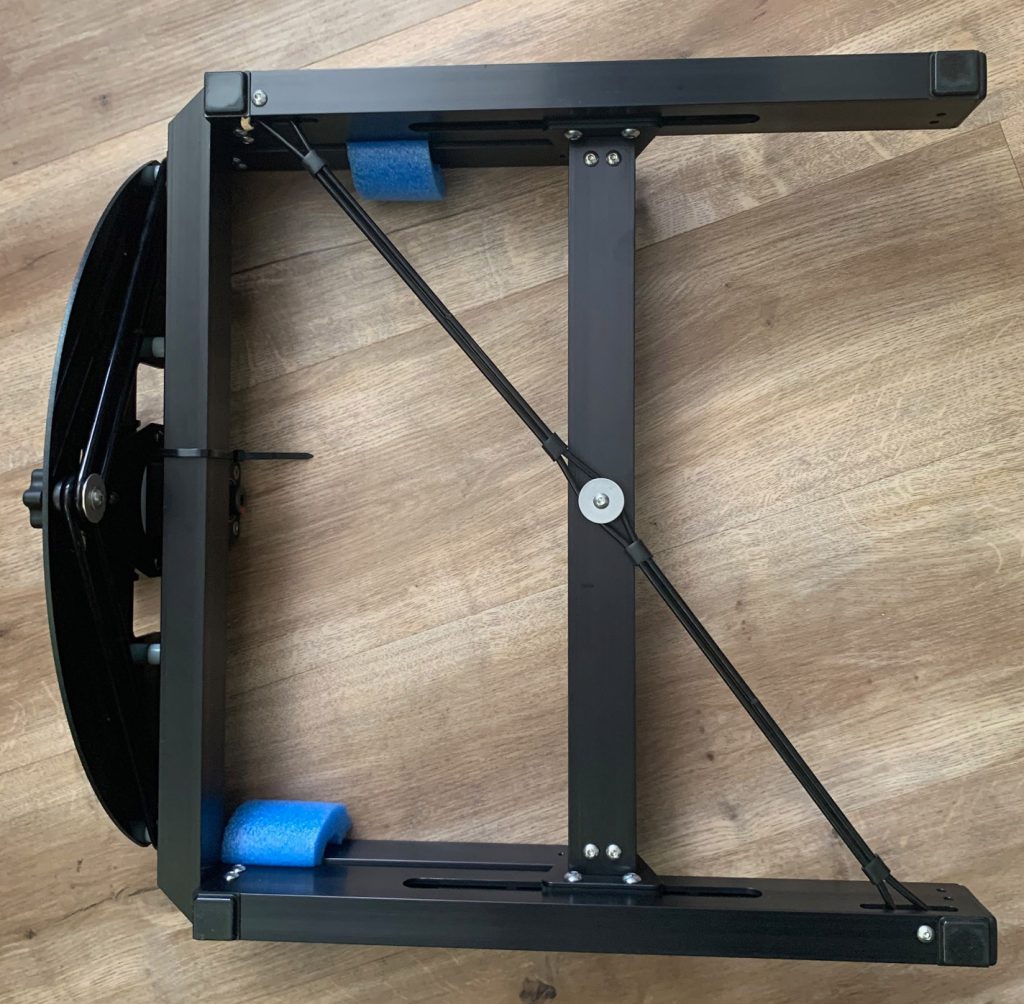
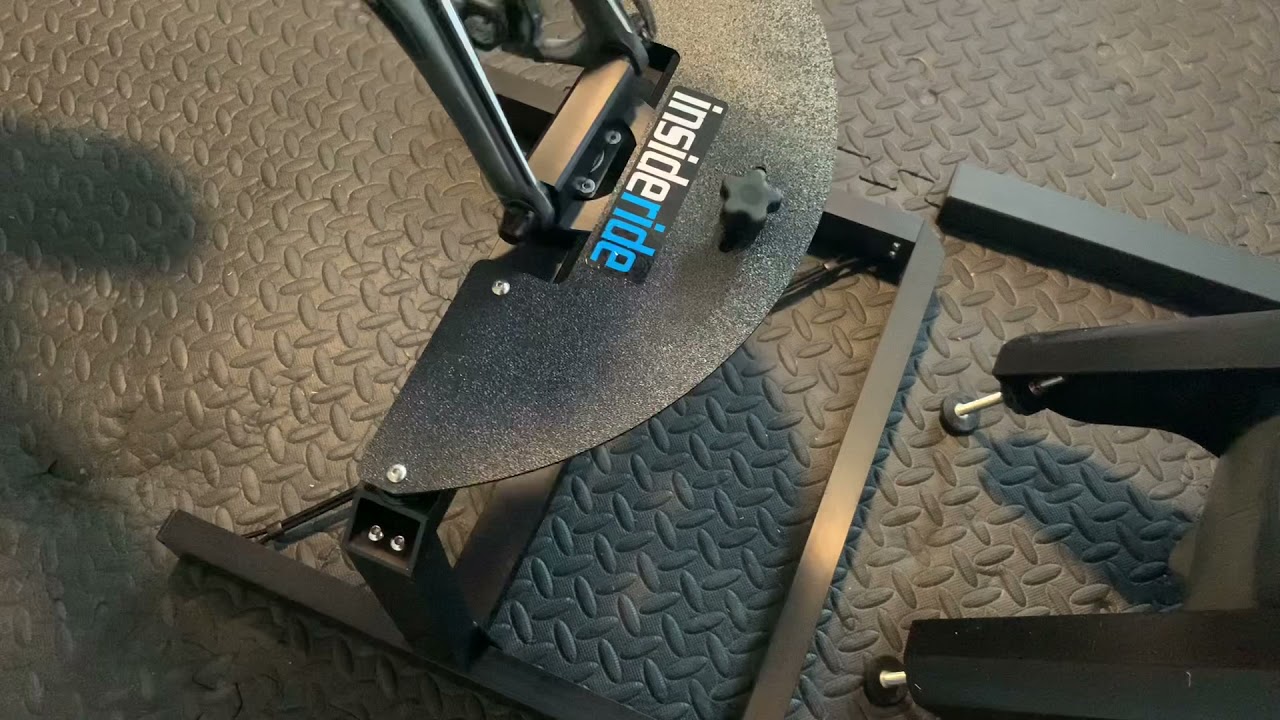
Front fork stand (not yet set up) 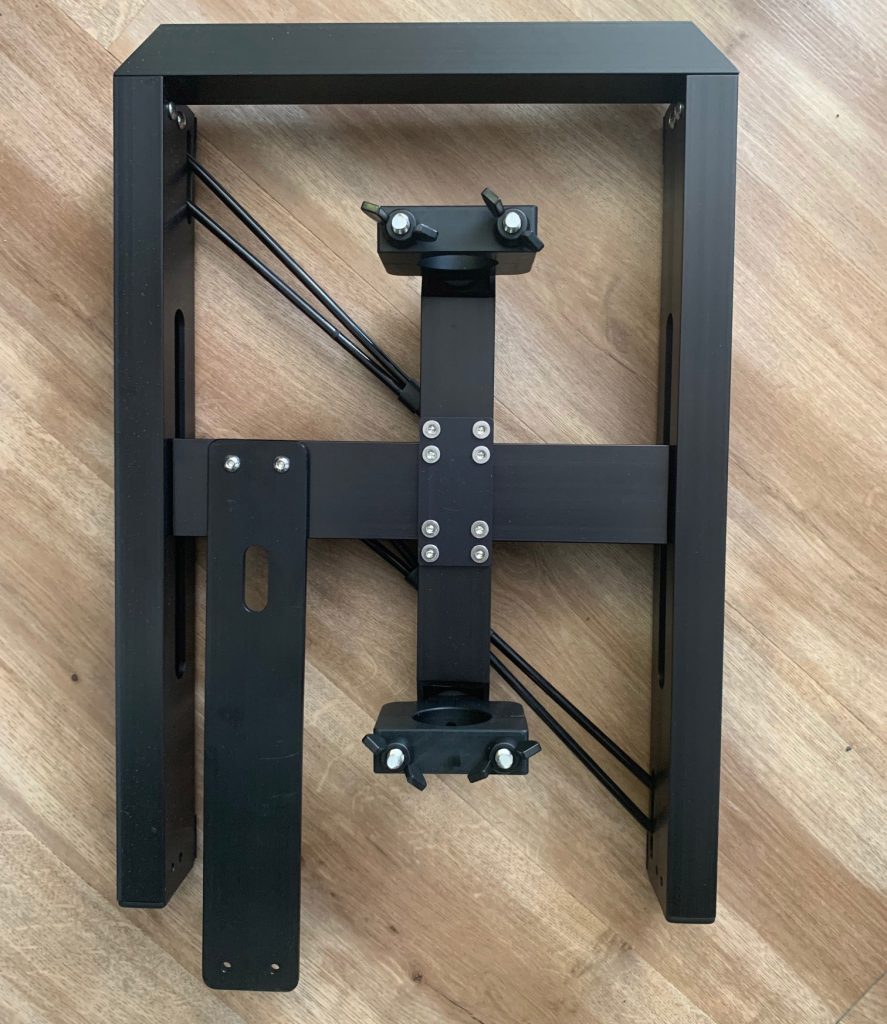
E-FLEX Trainer platform
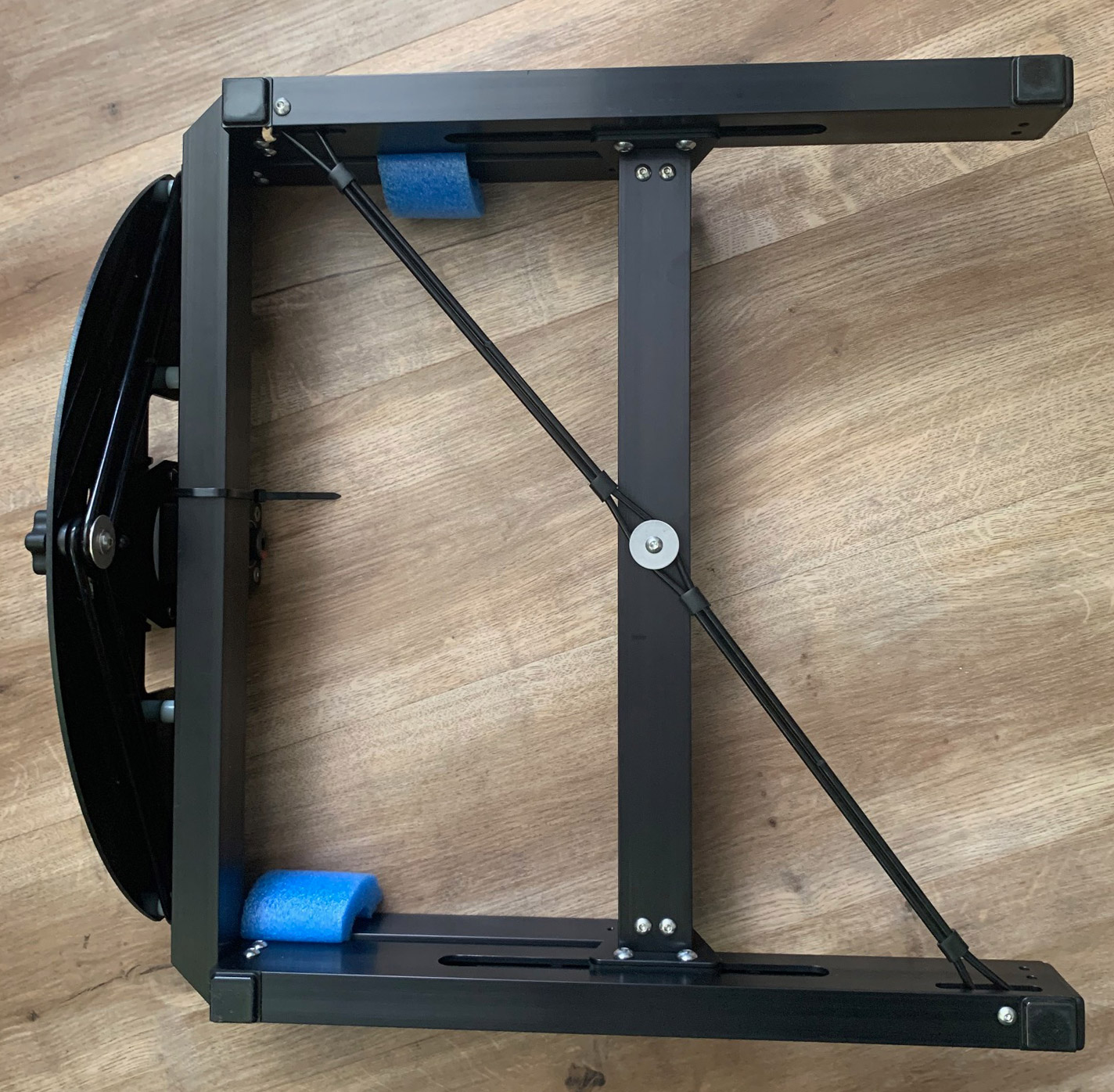
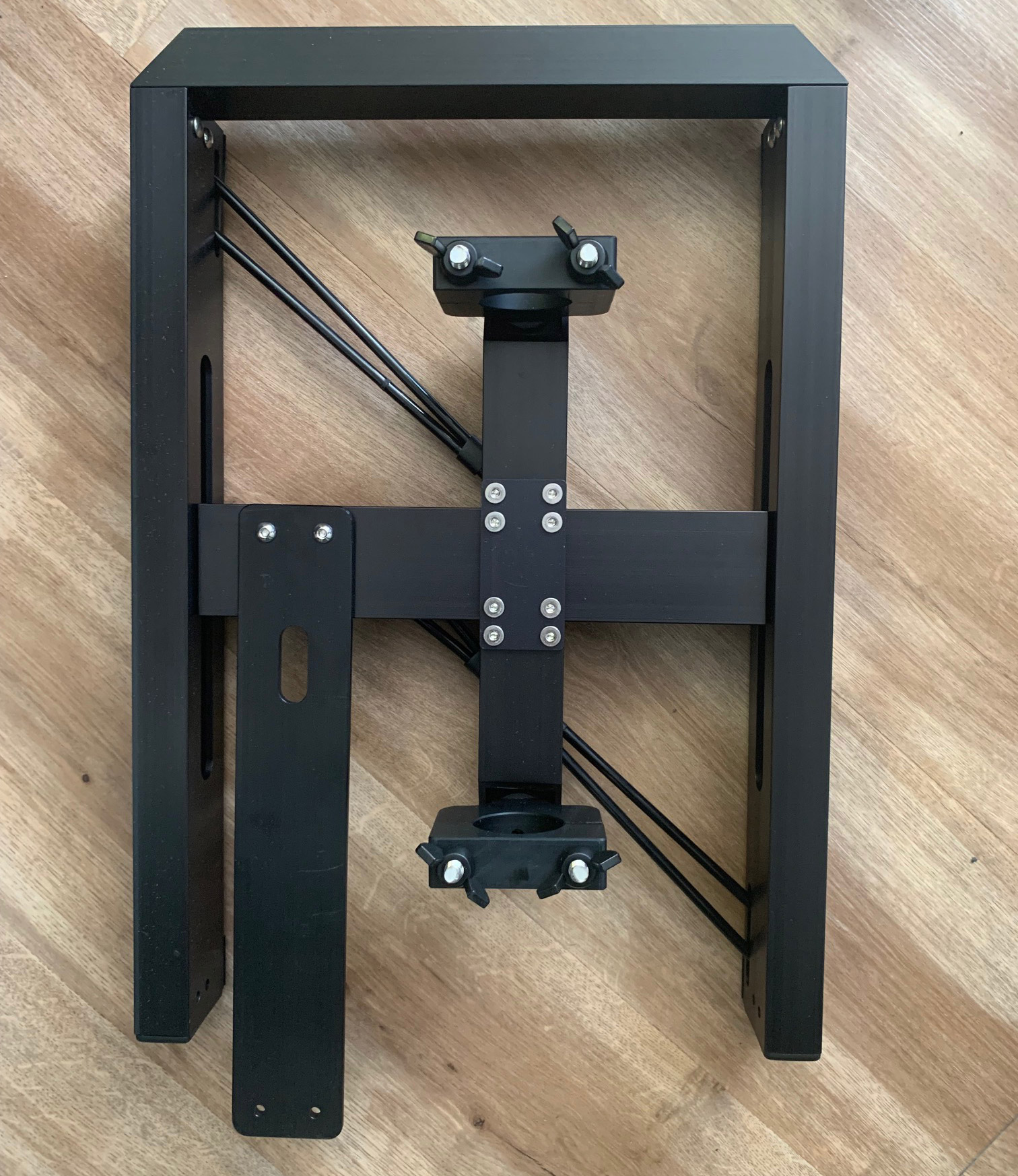
Setting up the E-FLEX is a bit more involved than a typical rocker plate, but it’s not technically challenging or time-consuming, either.
To assemble the rear unit you’ll need to take the adjustable feet off the end of your two KICKR legs, as well as removing the foot at the end of the middle leg (Phillips screwdriver required). Then lower it to its lowest setting, fold in the legs, set it in the channel on the platform, and secure it by hand with the wingnuts.
No inflating suspension balls or adjusting the tilt. It just worked.
The floating fork stand needs a few Allen screws installed with the included Allen key, then you just mount your front forks to it. My Zwift bike uses a standard quick release, but the stand is also compatible out of the box with most 12mm thru-axle forks. Your levers could be a problem though – InsideRide says, “Thru axles with rigid or non-folding levers will not work and must be replaced with either a folding or rotatable lever, or an axle that uses a hex key to tighten. Does not fit 15mm thru axles without additional hardware. Contact us for more info.”
Once my KICKR was secured to the rear unit, and the front unit had been set up properly, I just attached my bike frame on both axles. Here’s what the E-FLEX looked like completely assembled:
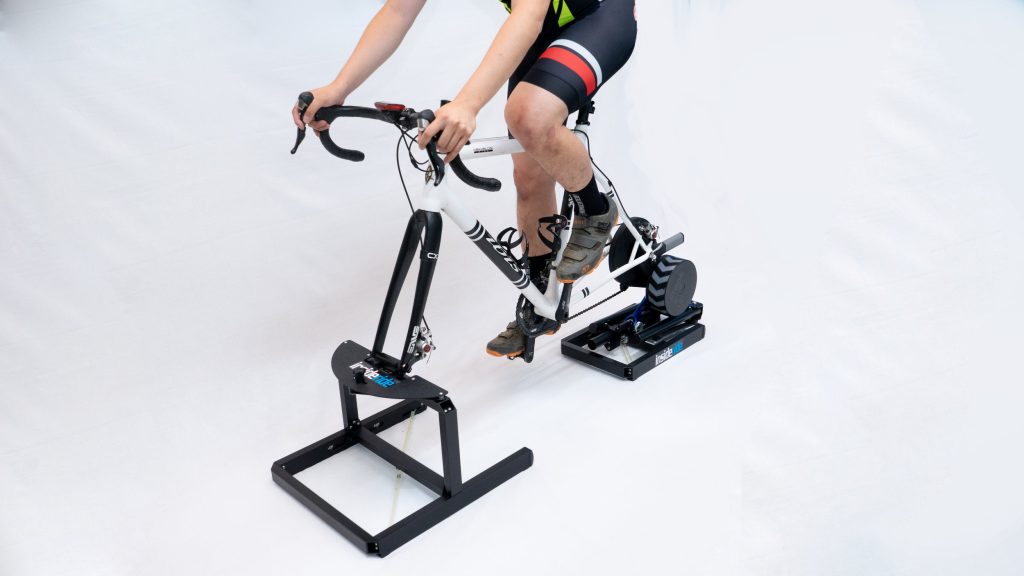
The build quality of the entire system seemed fairly bomb-proof and stable. But how would it feel? Time for a test ride!
Watch My Demo Video
I put together this video after spending several hours with the E-FLEX. The video demonstrates how it all works while riding at a social pace, sprinting in the saddle, climbing out of the saddle, and sprinting out of the saddle.
How It Feels: Side-To-Side
Hopping onto my new setup and joining the C. Cadence roadies on Tempus Fugit, I was immediately struck by how different this setup felt from the rocker plates I’ve reviewed over the years (and use daily). After recently reviewing the full-motion Velocity Rocker Plate, I suppose I expected the E-FLEX to feel pretty similar. Both are full-motion systems, right?
But it felt different. Very different!
Here’s why it’s different: with rocker plates, generally your entire bike rocks back and forth without your handlebars turning at all. Getting the rocker plate to rock requires swinging the bars side-to-side, which tilts them along with the rest of your bike.
With the E-FLEX, your bike only tilts side to side if your handlebars turn. Everything is pivoting on your steerer tube. Turn the bars right, and your bike leans to the left. Turn them right, and you tilt left.
In fact, the floating fork stand includes a locking nut which prevents your forks from turning. If you tighten this down (which you can do while riding), it locks your bike into an upright position – no side to side tilting.
As I spun around Watopia and got acquainted with the motion of the E-FLEX, I found myself conflicted. I thought rocker plate motion was quite natural. Was I living a lie? Was this handlebar-turning motion more realistic and reflective of outdoor riding?
After putting in several hours and a few hundred virtual kilometers atop the E-FLEX setup, I’ve come to a conclusion: the E-FLEX design gets it half-right. And so does the rocker plate!
But they’re different halves. Let me explain…
When it comes to side-to-side motion, the E-FLEX requires you to turn your handlebars in order to tilt the rest of your bike. Rocker plates, in contrast, require you to tilt your handlebars in the same direction as the rest of your bike frame.
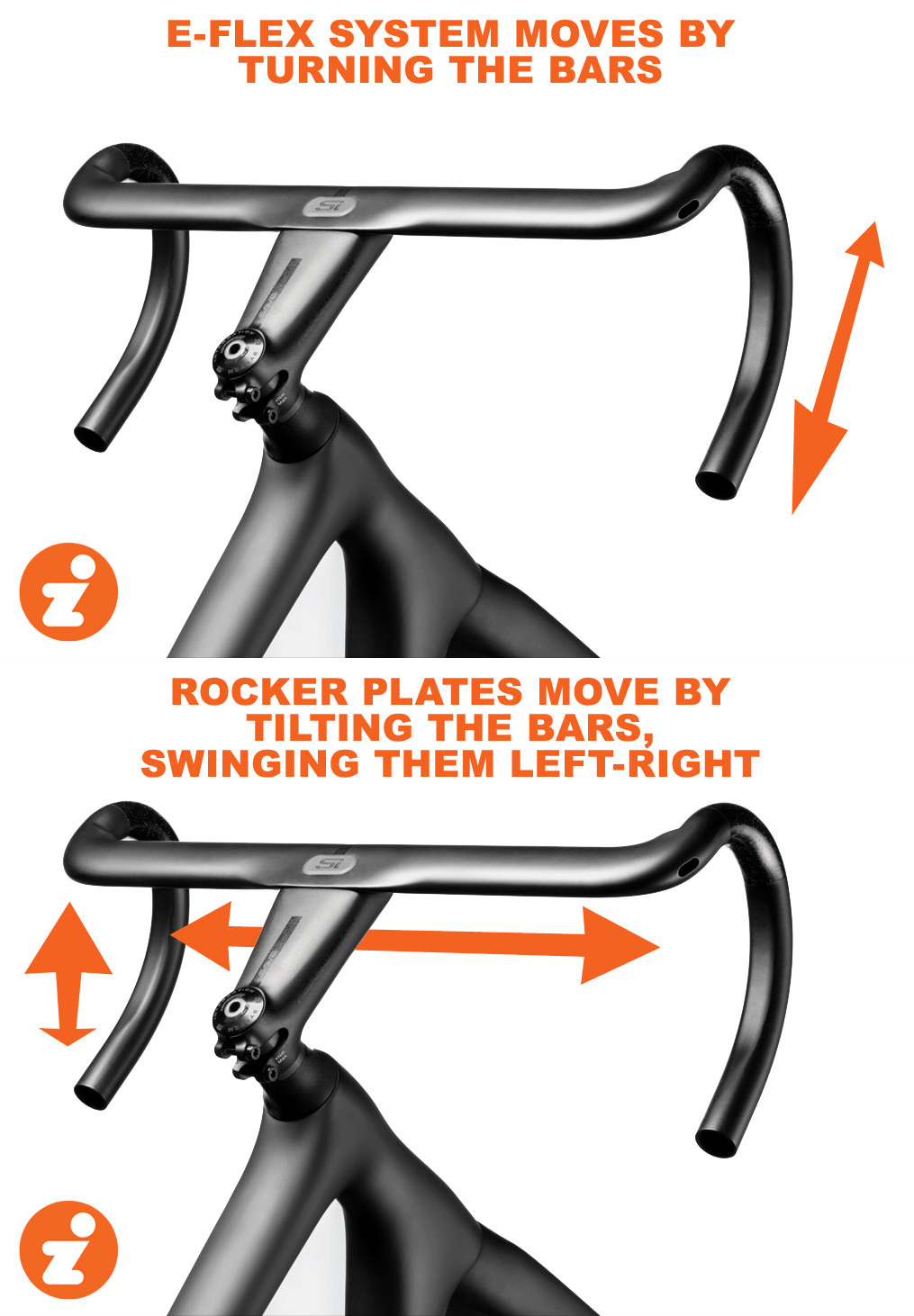
Which one is right? For me, the E-FLEX solution is best when you’re in the saddle. And the rocker plate system is best when you’re out of the saddle.
The E-FLEX’s tilting motion feels very natural when in the saddle. I quickly settled into a comfortable rhythm with the bars turning and my frame tilting ever so slightly as I rode in zone 2. As I ramped up the watts this motion would increase – just like outdoors. In fact, I can confidently say that this in-the-saddle motion is the most realistic I’ve felt from any setup I’ve ever tested.
I used the E-FLEX for my Zwift Academy Finish Line ride, and stayed seated throughout, putting in max efforts across three timed segments. Apparently it worked – I improved all my times substantially! (See the video here.)
But here’s the thing: I stayed in the saddle throughout my Finish Line ride because I couldn’t get comfortable with the out-of-the-saddle motion of the E-FLEX. When I’m hammering out of the saddle I need to be able to pull up on the bars, against my pedaling motion, and have the entire bike tilt. But pulling up doesn’t work on the E-FLEX… you need to pull back/push forward, turning the bars, to get your bike to tilt.
So I found out-of-the-saddle work frustrating with the E-FLEX. Despite spending a fair amount of time trying, I just couldn’t generate the power I typically can standing up. It was a frustrating feeling. And that’s why I think rocker plates do out-of-the-saddle movement better.
How It Feels: Fore/Aft
The E-FLEX unit really shines when it comes to fore/aft movement. Compared to the Velocity Rocker I recently reviewed, the motion of the E-FLEX is more natural, and it is also completely silent. Seriously!
The fore/aft movement is managed using what are essentially fancy rubber bands like you would use for resistance training. And the system seems to work very, very well. It would slide forward a bit when I got out of the saddle, slide back a bit when I sat down, and move ever so slightly forward and backward when I was hammering in a seated position.
In short, it moves the way it should, which results in a more natural and comfortable ride feel.
Stability
It’s worth noting that the E-FLEX setup is less stable than a standard rocker plate. Whereas most rocker plates are basically impossible to tilt over, the E-FLEX system definitely can be toppled and you might hit the deck if that happens.
A few different times in my rides, I found myself falling over with one or both of the E-FLEX units lifted off the ground on one side. I never actually went overboard, but the potential was there. It happened most often when I would sit up, hands off the bars, and wipe my face with a towel. This removed my stabilizing points but also effectively closed my eyes, removing the helpful visual input that would say “Eric, You’re falling over!”
The E-FLEX system is dampened so sublimely that, as you tilt over, it doesn’t get “tighter” – so you don’t feel that resistance that says “You’re reaching the edge of your tilt” like you would on a rocker plate. This is a credit to the E-FLEX’s design, but it’s also a double-edged sword.
I wouldn’t say the setup is dangerous in terms of stability, but you just need to know that you can topple your entire setup.
And just in case you’re wondering: the E-FLEX system will not work without the floating fork stand on the front. You can’t just attach your front wheel and enjoy the E-FLEX’s full range of movement. The reason is, the fork stand gives you left/right stability. Without it, you’ll just be flopping left to right… it’s impossible to stay upright. Trust me, I tried!
Pricing
The E-FLEX system is priced at $449+shipping, making it the most affordable full-motion setup on the market today. Buy it here >
Conclusions
Reviewing the E-FLEX system opened my eyes to the shortcomings of a standard rocker plate’s motion. Will there ever be a solution that incorporates the best of the E-FLEX and a rocker plate? We shall see.
Most Zwifters probably spend 90% or more of their time seated, and the E-FLEX system handles seated movement better than any other solution I’ve tested.
So I’d say InsideRide’s E-FLEX system is a highly recommended indoor movement solution, especially for those who simply want a bit of comfortable, natural motion and aren’t looking to get major frame movement in hard out of the saddle efforts.
For me personally, I want that big side to side out-of-the-saddle movement. So I’ll be sticking with a rocker plate for now, although I’ll be wishing it provided the superior seated motion of the E-FLEX.
Questions or Comments?
Post below!

Thanks Eric! I have been looking at the E-Flex for a while and as comments were contradictory I now understand where they come from.
The other one I was really interested in was the Rockr Axis who claimed to have solved the “natural” outdoor movement by changing the axis rotation.
loved your articles hope your doing well
I am doing great and still writing here from time to time 😀 thank you!
Yes… I’m going to get one of those ROCKR units soon, hopefully for a review.
I rode a Rocker plate for more than 2 years. I’ve been riding the E-Flex Motion System for about 1 year now. I love it and would not give it up. I don’t get out of the saddle much, just to give my bottom a rest. I can sit upright, no hands, and pedal all day without issues. There is an adjustment period. Once you’re comfortable with it, it truly makes riding a trainer much more pleasurable. Love the simple setup. Once it’s setup, no more adjustments. I couldn’t be more pleased and highly recommend this product to anyone who rides the Wahoo Kickr.
Crazy question, but did you consider putting the E-Flex on top of a rocker plate to get the out-of-saddle experience?
I did something with that in mind that was less invasive than setting the entire E-Flex on a rocker. I made a mini-rocker attached to the bottom of the E-Flex front section. It gives a hybrid system that includes Leverage Input (most rockers) and still offers the Steering Input (like from the E-Flex). It is a great mix that I think is the right direction for the future of indoor cycling. https://www.trainerroad.com/forum/t/inside-ride-kickr-e-flex-trainer-motion-system/20469/222?u=mcneese.chad
I have considered this, Adrian! May just try it, too…
I wonder how (or if) this system would work if you replaced the floating fork stand with the Elite Rizer which apparently also allows some fore/aft motion (so that you can shorten one of the sides of the triangle as the fork is raised.
Possibly. The Rizer definitely doesn’t have as much fore/aft range as the E-FLEX rear unit, though, so you might run into problems there. Not having tested the Rizer personally I can’t say much more. But would be keen to give it a go!
“For me personally, I want that big side to side out-of-the-saddle movement”
Get on some rollers 😉
Motion rollers are a fun and very realistic experience, but they are also limiting as a result of that very motion. I spent a full season on motion rollers, and found their limits. They help make the experience much more comfortable and enjoyable, but are scary in some racing and workout situations. The desire to get some of those benefits, while minimizing the detriments are what lead me to make my first rocker back in November 2015. After years of testing, a proper trainer setup (like my hybrid E-Flex rocker) gets a ton of that same feel while still offering more support and less risk than motion rollers. Great to have options, and rollers are a blast, but they are certainly not the right solution for everyone.
I’ve got rollers. But I’m not brave enough to sprint out of the saddle with them. And I certainly don’t want to use them for everyday Zwifting!
true, but you are compromising a lot of parts of the zwift experience
maybe a little bit of power on the short sprints, but I don’t think there are any other compromises?
bit confused when you said that you like the rocker plates out of saddle feel better, since in you finish line ride for ZA you said that you were doing most of your efforts in of the saddle because you do not like the out of saddle feel that much
I did the Finish Line Ride using the E-FLEX, whose out of the saddle feel I don’t like. So I stayed seated for those efforts.
But when I’m on a rocker plate (different from the E-FLEX) I’ll do out of the saddle efforts.
Eric, I’m interested to hear how your sprints efforts compare with and without the E-Flex, using your Kickr. I got the E-Flex a few months ago, to go with my Core. The issue I was having was that the trainer kept jumping backwards a few inches in hard sprint efforts. This wasn’t an issue most of the time, but was a huge issue in races with multiple intermediate sprints (e.g. 10 laps of Duchy Estate in the Herd Summer Series). It would travel so far that I’d have to bunny-hop the entire bike + trainer back into position. The E-Flex solved the issue, as the fore/aft absorbed all that energy that was causing the trainer to jump around. It was especially baffling for me, as I don’t have a strong sprint. I’m wondering whether you ever have a similar issue with you Kickr, noting that you’re a good sprinter. I love the E-Flex, but if it causes me to lose sprint power, I’m wondering whether I should just get a full Kickr instead, if your experience is that it stays grounded.
Hey Eric, thanks for your insightful review!
Here’s the scoop on why the E-FLEX is the way it is.
There are two underlying principles behind the E-FLEX: Direct rocking control and steer-balancing.
The direct rocking control is great for sitting, but it’s also very effective for standing. As you noted, when out of the saddle the tradeoff for controlled rocking is a more restricted feel at the handlebars…no way around it. While it may feel a bit odd at first, it cleans up the unwanted motion found in conventional rockers and provides an easy way to keep everything in sync. With a little practice, you can apply full arm pressure to the bars during hard efforts.
The steer/balance aspect of the E-FLEX is a bit more subtle, but adds another dimension to indoor riding. Because there are no springs, balls or curved elements driving the rocking motion, your body stays centered over the bike while you steer to control balance and rock the bike, something cyclists do intuitively. With conventional rockers, it’s standard practice to sway your hips to control the rocking motion. This can be learned by most people, but that balancing skill takes some time and ultimately determines how well you can ride a conventional rocker. I was never good at it and wanted to make a rocker that was easier to control.
All the best!
Larry
Inside Ride
If stability is an issue why don’t they install swing out stabilizer bars on the rear unit as with the Wahoo kickr
Will it wotk with the wahoo climb front system as well?
No. You need the eflex unit on the front forks, otherwise you’ll fall over.
I am very interested in the E Flex unit, but the tippy nature is a big concern. I watched the DC Rainmaker video and it seems not that hard to do especially when you briefly sit up and take the hands off the bars. The InsideRide website mentions the tippy nature and says it is part of the experience of using the unit (my words not theirs.) I would hope that InsideRide could have and option to add stability rails if someone needed them.I have scoured the web looking for home user reviews, but haven’t found anyone with long term thoughts. Thanks for your review.
I wrote two reviews, one for the original unit covered here as well as the new Plus version.
InsideRide E-Flex Review: Original Front Section (V1)
https://docs.google.com/document/d/1-eteKTtl1EC0r-4E0sv5-bgKstkK0HPDRspQS3eRQac/edit?usp=sharing
InsideRide E-Flex PLUS Review: New Front Section (V2)
https://docs.google.com/document/d/17TtOTIJ-gdMaiMDbQRm3-02P93lBEl3xhCvGF7mg30s/edit?usp=sharing
Let me know if you have any questions on these reviews.
Hello, we are working on a project and I would love to know more about this. We are interested in a full-motion bike that does the following:
Thank you.