

Your chosen bike frame and wheelset both affect speed in Zwift, so it makes sense for racers to do a little research and choose the best tool for the job. This is especially important in a time trial (TT) race, since there is no drafting and all your speed is entirely dependent on you and your bike!
While Zwift’s 4-star rating system for weight and aero is simple and easy to understand, performance varies even among frames with the same star ratings, because the stars are just an approximation. On top of that, Zwift’s addition of bike upgrades means racers need to take into account how a frame will perform when fully upgraded, not only when it’s first purchased.
Therefore, we’ve created several charts ranking all the TT bike frames based on their performance on flat roads and climbs, in un-upgraded and fully-upgraded states.
If you’re just looking for recommendations on what to buy, here are some helpful posts:
- Fastest Aero TT Bike Frames and Wheels at Each Zwift Level
- Top 5 TT Frames and Wheelsets on Zwift
- Zwift Shopping Guide: What To Buy from the Drop Shop at Each Level
- Master list of all frames on Zwift
Note: To simplify the charts, we have excluded frames no longer sold in the Drop Shop. Data on these charts is automatically updated as we perform fresh testing, so what you see below is always an accurate reflection of what’s in game.
Time Savings Over 1 Hour (Stage 0 Frames)
We begin with a simple chart showing how much time a particular frame will save you across 1 hour of riding at 300W (4 W/kg) compared to the most basic TT frame in game (the Zwift TT). These are “stage 0” frames, meaning no performance upgrades have been applied.
The chart is sorted from the best-performing frames to the worst, and you can sort based on flat performance or climb performance.
Time Savings Over 1 Hour (Stage 0 Frames)
Takeaways
When sorted by flat performance, you can easily see that the bottom ~5 frames have similar CdA (aero) settings in Zwift.
If you sort by climb performance, the speed falloff from one bike to the next is more even across the board. (This applies to road bike frames as well.)
The Canyon Speedmax CFR is the clear winner here, both on climbs and flats. The Trek Speed Concept and Ventum One, on the other hand, are both clear losers with their startlingly poor climbing performance.
Time Savings Over 1 Hour (Stage 5 Frames)
This chart is just like the one above, except these are “stage 5” frames, meaning all possible performance upgrades have been applied.
Read all about Bike Upgrades here >
Use the toggle to sort based on flat performance or climb performance.
Time Savings Over 1 Hour (Stage 5 Frames)
Takeaways
We shouldn’t see any major rankings changes here in terms of flat or climb performance, since all frames receive the same upgrades between stages 0 and 5.
Except there’s a bug (see “Misconfigured Frames” below), which means the Cervelo PX-Series and Ventum One both drop several slots between stage 0 and 5 in terms of flat performance, while improving more than the other frames in climb performance.
Apart from the misconfigured frames, all other frames gain roughly the same performance improvements between stage 0 and 5. (This test data has a margin of error of approximately 1 second, so you’ll see the frames reshuffled a bit due to this.) That performance improvement is almost 50 seconds on the flats, which is huge in a TT!
Time Savings, Stacked (Stage 0 vs Stage 5 Frames)
Next, we have one of our favorite charts, ranking frames based on total time savings across our flat and climbing tests. This chart lets you easily see the best all-around performers, and whether their performance leans to the aero or climbing side.
Use the toggle to see data for stage 0 frames, or fully-upgraded stage 5 frames.
Time Savings, Stacked (Stage 0 vs Stage 5 Frames)
Takeaways
There is clearly one TT frame sitting at the top: the Canyon Speedmax CFR. The Cadex Tri, Felt IA 2.0, and Scott Plasma RC Ultimate follow afterward with similar overall time savings, although the Cadex gains its time in the flats, while the Scott and Felt gain time in the hills.
Time Savings for Climbing (2 W/kg vs 4 W/kg)
Some readers have asked us to show frame performance at lower power numbers, which is a perfectly reasonable request. Here’s a chart, sorted by climb savings, which you can toggle between 2 W/kg (150W) and 4 W/kg (300W).
Time Savings for Climbing (2 W/kg vs 4 W/kg)
Takeaways
Making this change has the interesting effect of making lightweight bikes move up the climb rankings while the more aero-focused bikes drop.
This makes sense, of course. At lower speeds (2 W/kg), wind resistance is much lower, so aero performance matters much less than it does at higher speeds (4 W/kg).
Misconfigured Frames
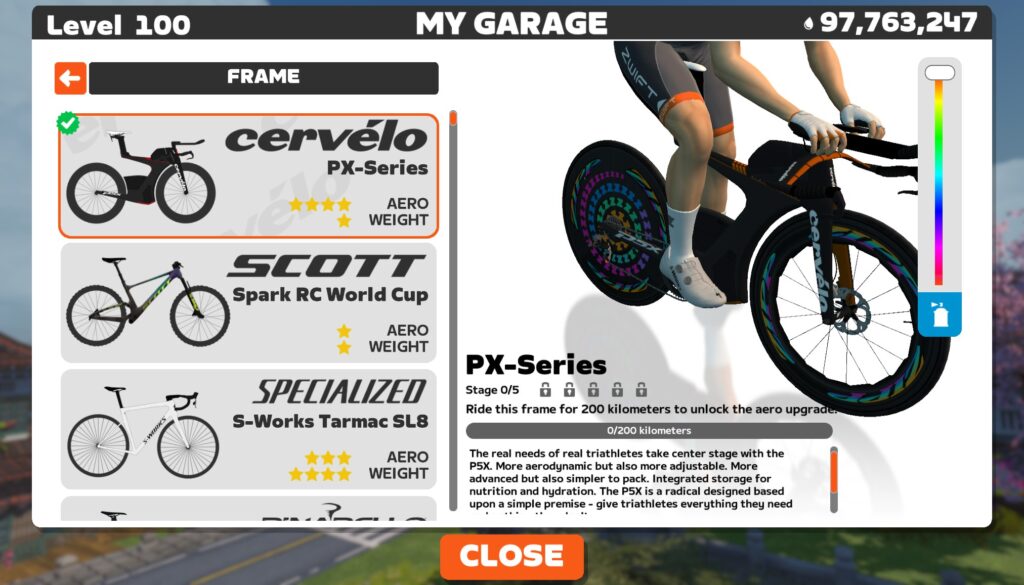
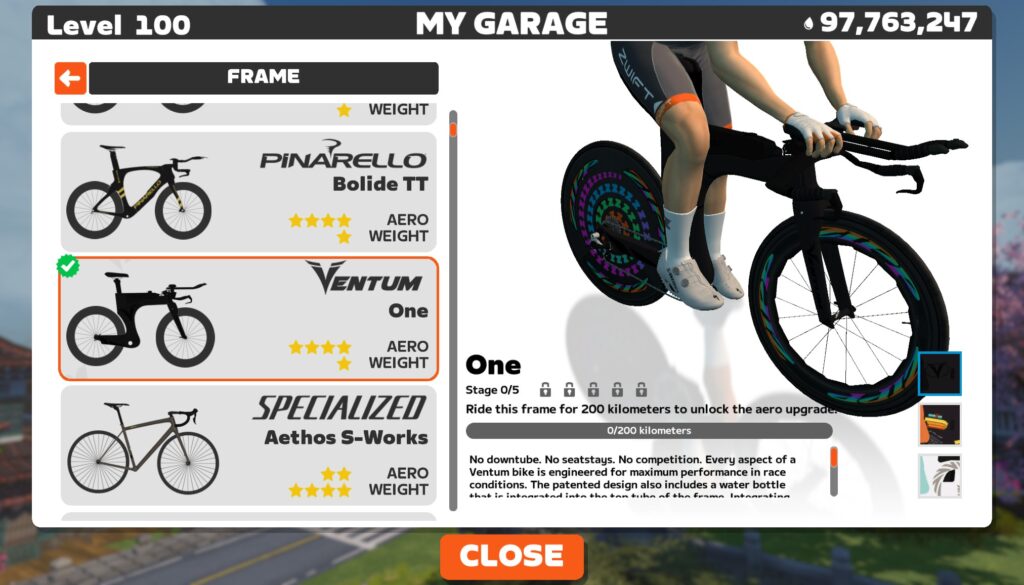
All of the TT frames on Zwift are supposed to be using the duration-based upgrade scheme. But for whatever reason (we assume it’s a misconfiguration), Zwift has configured the Cervelo PX-Series and Ventum One as distance-based upgrades, like standard road bikes.
This means that the upgrades applied to these frames as you progress from stage 0 to 5 are different than the upgrades applied to other TT frames. The end result? As mentioned above, the Cervelo PX-Series and Ventum One improve a bit more than their peers in flat performance between stage 0 and 5, while losing a bit in climb performance.
What About the Espada?
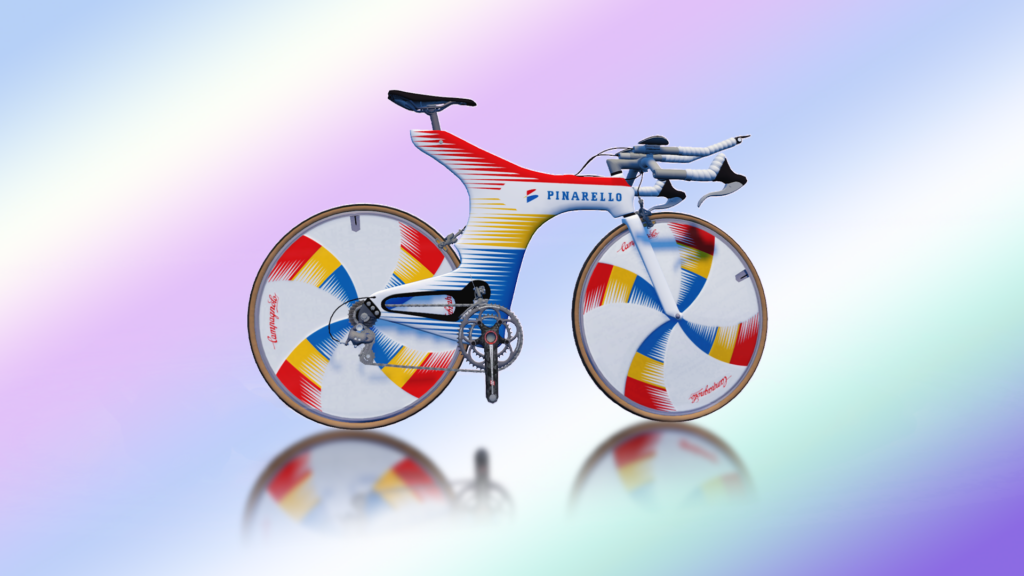
The Pinarello Espada is the only TT Halo Bike currently in Zwift. It is not listed above because it’s impossible to test the Espada frame without also testing the Espada wheels, since they are inseparable.
The Espada, it could be said, performs like a top-quality TT frame from the 1990’s. It loses ~25 seconds to the fastest TT frames in game paired with the fastest disc wheels across an hour of flat riding, while losing ~20 seconds on an hour-long climb to those same fast frames with disc wheels.
Testing Methodology
The data above was generated using our standard bot testing procedure. Our bot rides alone on Zwift, set to 75kg weight, 183cm height, using the Zwift TT frame and Zwift 32mm Carbon wheels. The aero (flat) test route is Tempus Fugit, the flattest course on Zwift, while the weight (climbing) test is done on Alpe du Zwift since it’s a long, steep, and fairly steady climb.
All of the data used by these charts comes from our public Google sheet of test data.
Questions or Comments?
We’d love to know what you think of these charts, including suggestions for improvements. Share your comments below.

Do you have any idea how much elevation is needed in a route so the Scott/FA become the better choice over the Cadex ?
Maybe include a rolling route next to Tempus and the Alpe. Rolling Highlands or something in Central Park.
Pretty much never unless it’s a pure uphill TT.
Then the aethos would be faster, no?
Surely the world hour record holding Pinarello Bolide TT bike should be ranked quite a bit higher than this…
Ganna’s bike was a custom job, track frame, 3D printed from scandium-aluminium-magnesium alloy and included a whole host of other optimisations. Not really the same bike.