

The fourth race of Zwift Racing League 2025/26 Round 2 happens Tuesday, November 25, and it’s a team time trial on the new Watts the Limit route in NYC. This is an interesting TTT route, with plenty of pitch changes to keep us on our toes and unique characteristics that make it a much faster course than you might think.
Let’s dig into crucial segments, escalators, bike choice tips, and more!
Looking at the Route
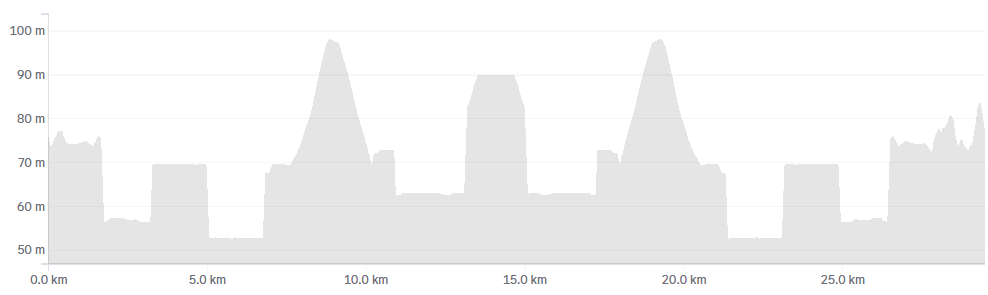
Watts the Limit is a fresh route from the recent New York map expansion. And while the Strava segment profile (above) may look lumpy – like a city skyline, in fact – it’s actually a fairly flat and fast route, thanks to escalators helping us out of the subway tunnels!
All categories will race a full lap of this out-and-back route, for a total of 31km with 219m of elevation. (Although it’s not really 219m, since ~95 of those meters are on escalators.)
Most of this course is close to pan-flat, with major elevation changes taking place quickly in between as you enter or exit subways. Here are the key points you’ll keep in mind as your team attacks this course:
- Lead-In Kicker @1km (300 meters at 3.7%): this little bump near the end of the lead-in is short enough that it’s best to just hammer hard if you’re on the front, and stay in the draft if you’re behind. Keep the watts high so your speed stays up, then grab recovery on the flats and descents that follow.
- Escalator @4.7km: the first of six escalators you’ll encounter today, these are going to play havoc with teams who have riders with widely varying weights. See “More On Escalators” below for details.
- Escalator @8.2km
- Manhattan Bridge @9.1km (1.2km at 1.6%): the bridge isn’t as steep from this side, so speeds will stay high and drafting will remain very important. Increase your power, but stay in formation. Recovery awaits on the back half of the bridge.
- Escalator @14.5km
- Hill to Grand Army Plaza @14.6km (400 meters at 2%): this little climb comes directly after the escalator, so keep the power up in order to maintain speed all the way up to the flat Grand Army Plaza turnaround at the top.
- Escalator @18.7km
- Manhattan Bridge @19.5km (1.1km at 2.4%): a bit steeper on this side, but still not a proper “climb,” so you’ll definitely want to lift the power while staying in formation up and over.
- Escalator @24.5km
- Escalator @27.8km
- Final Kicker @30.5km (300 meters at 3.7%): almost there! Hammer this kicker just like you did at the start of the race, then go all-in across the top to empty the tank and finish fast.
- Finish at 31km

More On Escalators
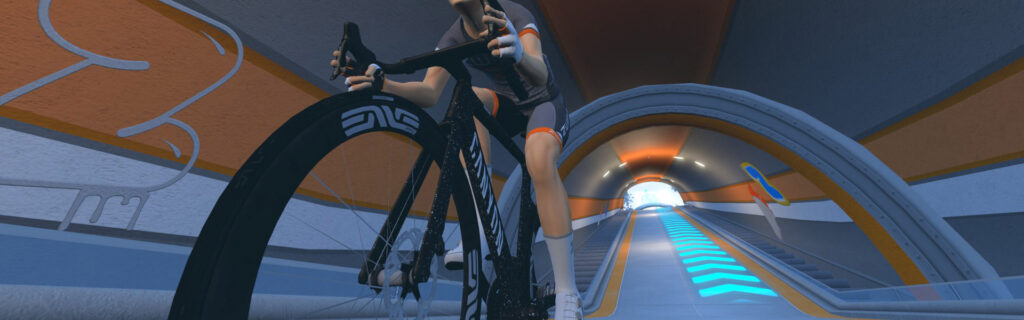
Warning: the new escalators in NYC may prove tricky if there’s a big difference between the highest and lowest rider weights on your team!
Community feedback is saying, and our tests are confirming, that heavier riders slow much more on the escalators than lighter riders. (Heavier riders, take heart: Zwift knows about this issue, and internal sources tell me a change is planned soon to make escalators perform much more uniformly across various riders. Light riders: enjoy the escalators while you still can! 😁)
I ran bots of various weights up one of the longer escalators on the route (the final escalator you’ll hit, in fact). Each bot’s power was set so they would all have approximately the same escalator entry speed (~46 kph), and that power remained steady as they went up and over the top of the escalator. Here’s how much each bot slowed down between entering and exiting the escalator:
- 50kg bot @261W: slowed 3.2 kph
- 75kg bot @339W: slowed 11 kph
- 100kg bot @390W: slowed 16.1 kph
Of course, most teams won’t have a 50kg (or even 25kg) weight difference between riders. But the heavier you are, the more you should plan to push on escalators to keep your speed high. And lighter riders will probably want to keep their power fairly steady, to avoid shooting off the front!
Two more escalator tips:
- Lower Your TD: These are steep, with gradients around 20%. If you have trainer difficulty set to 100%, it will feel like pedaling into a wall. I recommend setting TD to 50% or less for this course.
- Follow the Wheels Down: The downhill ramps will also wreak some havoc due to varying rider weights and power outputs. Pay close attention and try to maintain your single-file position before, during, and after descending the ramps to maximize your draft benefit and keep speeds high. If you’re a lighter rider on the front during one of these descents, hammer out some of the watts you’ve saved on the escalators, as the heavier riders will fly past otherwise!
Read more about the Watts the Limit route >
Bike Frame + Wheel Choice
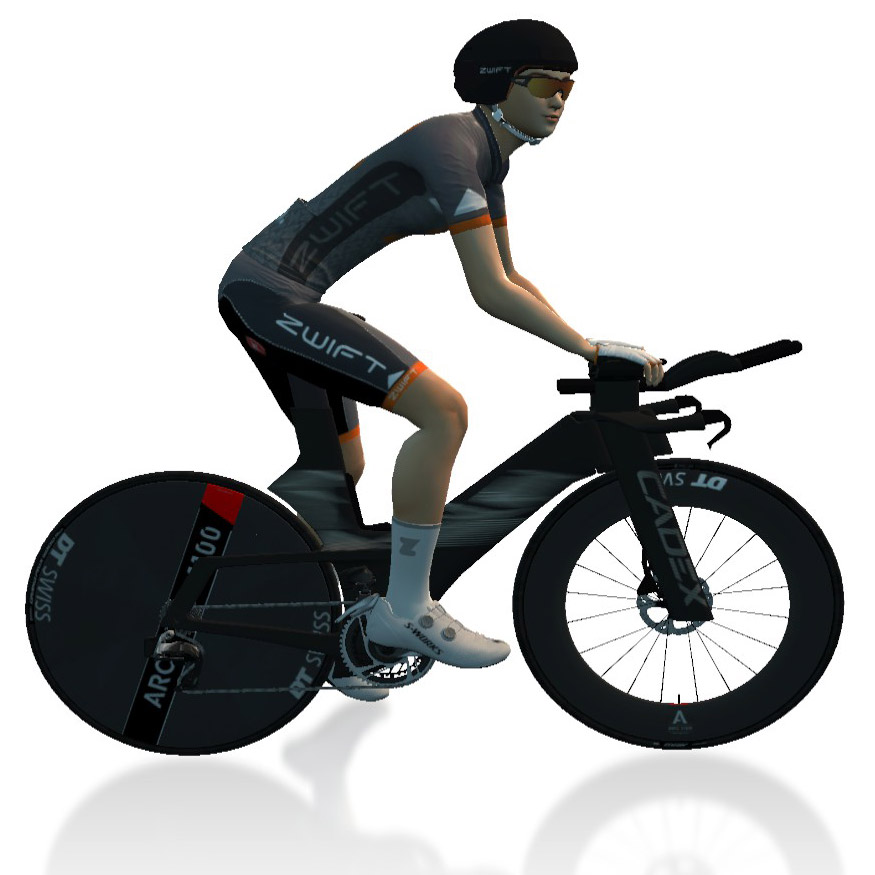
Bike choice here is simple: go aero. On a flattish route like this, weight doesn’t matter much, and aero is everything! The best setup by far is the CADEX Tri frame paired with the DT Swiss Disc wheels, but you’ll need to be at level 40+ to access this sweet rig:
If you don’t have access to this setup, check out “Fastest TT Bike Frames and Wheels at Each Zwift Level” and use the fastest TT frame and wheelset available at your level.
One more note on bike choice: upgrading your frame makes a big difference. A fully upgraded frame saves around 13 watts, or ~48 seconds per hour of riding. Read all about the performance improvements you receive from upgrades here.
More Route Recons
Many recon rides are planned each week on the upcoming ZRL route. If you’re unfamiliar with this course, jump into an event and familiarize yourself with the route! Find a list of upcoming ZRL recon rides at zwift.com/events/tag/zrlrecon.
Additionally, riders in the Zwift community do a great job every week creating recon videos that preview the courses and offer tips to help you perform your best on the day. Here are the recons I’ve found (comment if you find another!):
J Dirom
John Rice

TTTips
Successful team time trialing on Zwift requires a challenging combination of physical strength, proper pacing, and Zwift minutiae like picking a fast bike, understanding drafting in a TTT context, and getting your frame fully upgraded.
Flatter courses like this week give valuable seconds to teams with big pure-power riders who can keep their power high on the front while staying in single-file formation to conserve in the draft behind. Extra seconds can also be gained by pacing smartly, ramping up the effort on short climbs and recovering a bit once you’re up to speed on the short descents.
On a course like this week’s, I highly recommend all team members set their Trainer Difficulty to the same value so you’re all feeling the gradient changes similarly. (When one rider has it set to 100% and another 25%, the first rider may ramp up power much more than the second when a climb hits, which can make a mess of your team formation.)
Your goal in a ZRL TTT is to get four riders across the line in the shortest time possible. That means every team’s pace plan will differ based on each rider’s abilities. I highly recommend having an experienced DS on Discord directing your team, especially if your team contains some inexperienced TTT riders.
Lastly, if you want to go further down the TTT rabbit hole, I highly recommend Dave Edmond’s Zwift TTT Calculator tool.
Questions or Comments?
Share below!

As a 106 kg rider on a team where everyone else is between 70-80 kg (they really appreciate my pulls on flat TTTs), I sure hope they get this escalator thing changed before next week.
Based on observations of several heavier riders like myself (I’ll go up them averaging 4.5 W/kg and have people averaging 2.5-3.0 W/kg fly on by me, a lot of us had figured that the escalators just add X W to all riders (or remove X kg) and had feared what that would mean for racing. Looks like our guesses were probably right based on your observations.
That’s a huge power differential. Reminds me of when feathers first came out and they just dropped 10 kg from everyone. Did a lot less for me than for the light folks to the point where I almost considered them worthless for me and an unfair advantage for the light racers I was going up against.
Your guesses are in fact correct.
It won’t be fixed by next week. Lightweights, enjoy it while you can! 😜
“Of course, most teams won’t have a 50kg (or even 25kg) weight difference between riders.”
LOL
I can assure you that a 20-25kg weight difference between riders is NOT uncommon for female cat D teams.
Given the results of your bot testing, it would be great if we could avoid the NY escalators during races until the issue gets resolved.
Looking at the test results for the escalators, wouldn’t it be more realistic to put w/kg equal when the escalator starts? So that all hit the start at the same speed and then have the same w/kg going up. In your test the lightest rider is doing 5.2 and the heaviest 3.9. On a climb the heavier rider will always be much slower given these w/kg.
The good news is that zwift have recognised that it’s not fair, and have said they’re working on a fix in the next release.
The bad news is that will be too late for this TTT. Hopefully it’s done in time for race 6.
It really doesn’t make much of a difference. I tested it both ways, and the results were nearly the same either way.
Basically, everyone is getting X W added to their power (lets say it’s 150 W).
That means that a 50 W/kg rider is getting an extra 3W/kg added to their power, a 75 kg rider is getting 2 W/kg added, and a 100 kg rider is getting 1.5 W/kg added.
In order to stick together, the 100 kg rider will need to do the W/kg the 50 kg rider is doing plus another 1.5 W/kg.
I just made up 150 W added because it makes the math easy, and I wouldn’t be surprised if it’s a low estimate, given that I (at 106 kg) will get passed on the escalators while putting out 2+ more W/kg more than the people passing me.
Whether you start at the same power or the same speed, the heavier rider is going to be doing a LOT more work to keep up with their lighter teammates.
Given that we have to do 6 escalators per lap in this route, I wouldn’t count on a heavy rider to be able to do much in the way of pulling at all (except maybe on the descents) if they’re stuck with this wide of a spread.
What’s best to spend drops on for this course, Cadex Tri Level 5 upgrade or the fastest disc wheels? Don’t have drops for both!
Depends on what disc wheels you already have, I would think…
Upgrading the CADEX from 4 to 5 shaves around 27 seconds off of your flat hour time, based on https://zwiftinsider.com/upgrade-charts/
Check numbers here: https://zwiftinsider.com/charts-wheels to see what a wheel upgrade would save you.
I see the same problem being a heavy rider at 92kg.
However your test has the 50kg rider doing 5.2wkg on the climb, and the 100kg rider at 3.9wkg. If we do that on Alpe du Zwift the 50kg rider will also disappear in the distance at an alarming speed 🙂
I’m wondering what would happen at a similar wkg on the escalator
It really doesn’t make much of a difference. I tested it both ways, and the results were nearly the same either way. Check it out: https://docs.google.com/spreadsheets/d/17HYS6CBH0RN1mASd3his_cCaVtAFE-QUXYZr1S2WAbo/edit?gid=0#gid=0
a 50kg rider only has to put out ~260 W to maintain 45km/hr on flat? man I need to loose some weight…
@zwiftinsider Eric that’s some pretty important information about the escalators! Maybe consider turning it into its own post so it’s not buried in a ZRL post? Those of us who don’t do ZRL may miss it – i found it only because of reddit. thanks
Yeah, I may. Zwift will fix it probably a couple weeks after I take the time to write about it…
Why did you go with an inaccessible, hard to read profile chart?
Dont’t have a ZwiftHub chart
for this route yet.
“More on Escalators” was very, very helpful. Thank you.
Almost looks like a flat 1200-1400w on escalator.
What would help isolate the escalator component is escalator speed when entered at very low speed at different weights.
Plugging some numbers into a climbing speed calculator gives me a power estimate in that range. It shows that what you do on the escalator wont make much difference, entry speed is much more important
Seeing Zwift’s consistent dedication to releasing unproven and broken changes straight into their flagship racing league without considering the impact is almost impressive.
I thought WTRL were neutralising frame upgrades in these races?
Nope!