

A recent Zwift update added the Zwift Recumbent Trike to everyone’s garage:
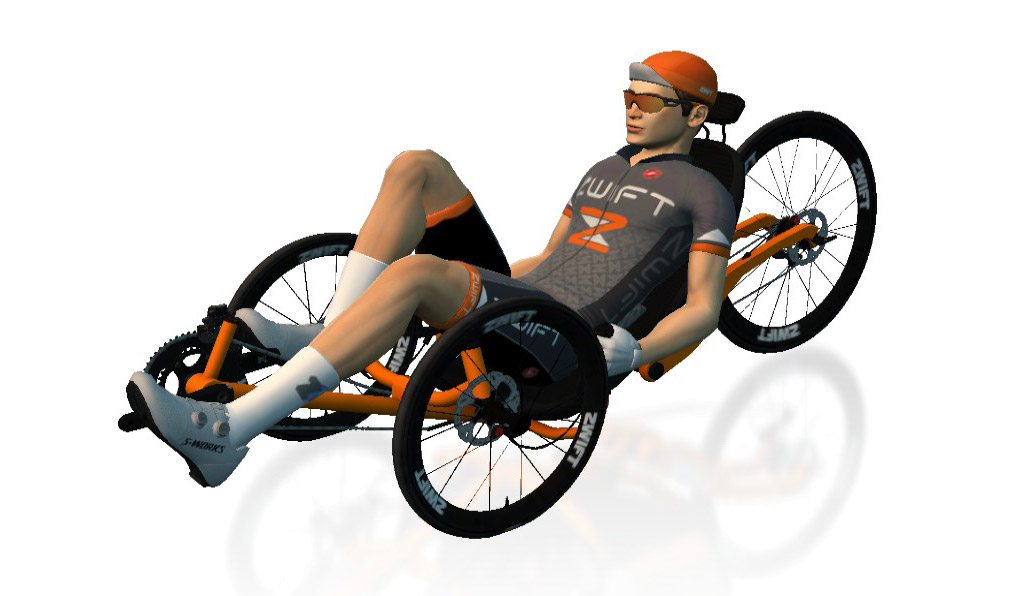
Here’s how it’s described in the Drop Shop:
“Engineered from real-world data and validated by World Ultra Cycling Association (WUCA), this recumbent trike combines low-drag efficiency with exceptional stability. Its aerodynamic position lets you hold speed with less effort, offering a fast, controlled ride from a whole new perspective.”
See our master list of all frames in Zwift >
It’s rated 4 stars for aero and 1 star for weight, like Zwift’s other recumbent (the Handcycle). But how does it actually perform? Since Zwift’s 4-star system isn’t the most granular of performance measurements, we ran the Recumbent Trike through our precise tests to measure performance at nerd-level detail. Let’s dive in!
Note: test results below are from a 75kg, 183cm rider holding 300W steady on the un-upgraded version of the Trike, unless otherwise noted.
Aero (Flat/Rolling) Performance
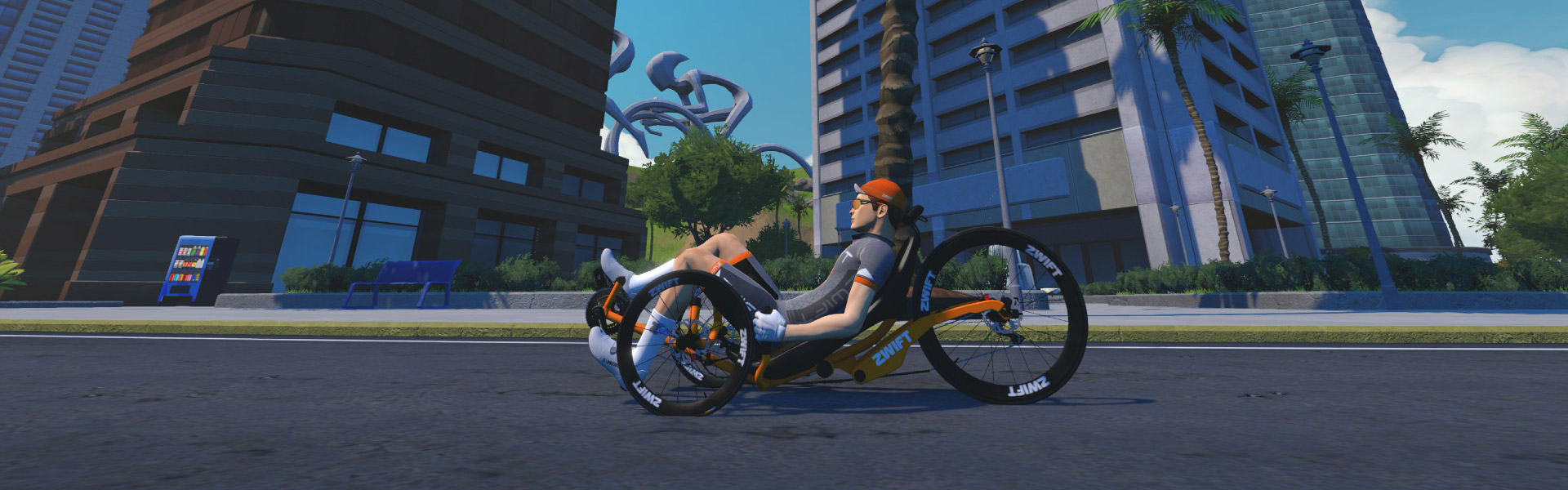
The Recumbent Trike is slower than the Handcycle in our flat tests, losing approximately 37 seconds to it over an hour of riding.
To compare the Recumbent Trike to in-game bicycles, we have to decide what bike setup we’re comparing, since the Recumbent uses just one set of wheels. If you pick a typical racing setup like the Specialized S-Works Tarmac SL8 with DT Swiss 65 wheels, we can see that the Recumbent Trike loses around 12 seconds in an hour of riding.
Climb Performance
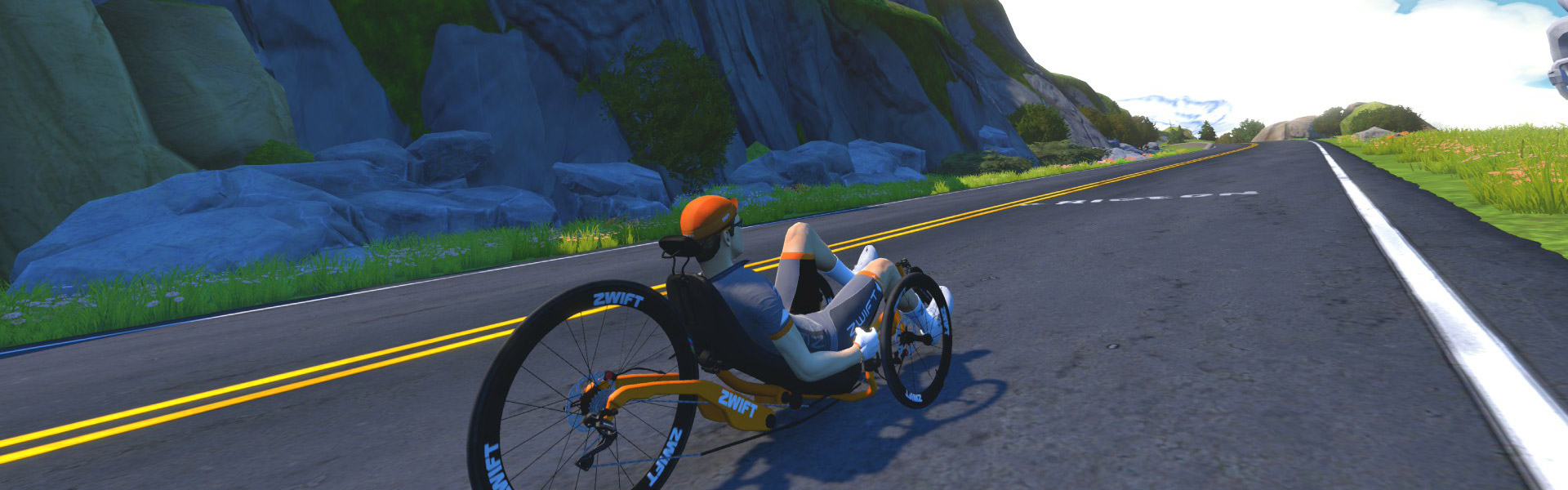
The Recumbent Trike is lighter than the Handcycle, and beats it handily in our climb tests, gaining around 65 seconds across an hour of riding.
While the Recumbent sort of held its own vs standard bikes in our flat tests, that is definitely not the case on climbs. Compared to that same Tarmac SL8 + DT Swiss 65 setup we referenced above, the Recumbent loses a lot of time, in the neighborhood of 410 seconds in an hour!
Upgrading Your Zwift Recumbent Trike
Like all frames in Zwift, the Recumbent Trike can be upgraded in five stages. It uses the Distance, Mid-Range upgrading scheme, giving it the following characteristics:
Performance At Each Upgrade Stage
This chart shows how many seconds this frame will save across 1 hour of riding compared to our stage 0 baseline frames (Zwift Carbon or TT). This is based on a 75kg rider, 183cm tall, at 300 watts, riding on tarmac.
Upgrade Stages (Distance, Mid-Range)
- 160km: Aero Upgrade for 50k Drops
- 200km: Weight Upgrade for 100k Drops
- 240km: Drivetrain Upgrade for 150k Drops
- 280km: Aero Upgrade for 200k Drops
- 320km: 5% Drops Earning Upgrade for 250k Drops
Drafting Details
The Recumbent, like the Handcycle, differs from other Zwift bikes in how it drafts and gives a draft to others. Specifically:
- An upright bike cannot draft a recumbent
- A recumbent can draft another recumbent
- A recumbent will get half the drafting effect when drafting an upright bike
Additionally, Zwift calculates rider CdA on the Recumbent Trike just like they calculate it for the Handcycle, which is the same way they calculate it for a standard bike. So your rider CdA is based on your height and weight, and doesn’t change based on the bike you’re on or the position of your avatar.
You can read more (and see our Handcycle test results) here, and I’ll use the rest of this paragraph to lodge a formal plea for Zwift to begin calculating “real-time rider CdA” based on the actual avatar positions we see on screen. Imagine if rider height mattered less when in the more flat-backed TT position, compared to the upright “in the draft” road bike position? More realism and dynamic performance? Yes please!
Conclusions
The Zwift Recumbent Trike is lighter than the Handcycle, but also less aero. If you want to climb in a virtually recumbent position, this is the frame for you. But when it comes to race performance, you’ll want to ride a standard road frame due to the way recumbents interact with the draft in Zwift.
Questions or comments?
What do you think of Zwift’s Recumbent Trike? Share below…
Important note: this post contains speed test results for Zwift frames or wheels. These results may change over time, and a bike's performance relative to others may also change. We don't always revise posts when performance rankings change, but we do keep current, master versions of our speed test results which are always available. See the frame charts, wheel charts, and Tron vs Top Performers for current performance data.

It loses 410 seconds to a Tarmac over an hour on flat roads. That’s like Six / Seven minutes. . . sorry, my middle schooler keeps doing that meme
No, it loses 410 seconds to the Tarmac across an hour of climbing. It’s decently fast on flat roads. Like recumbents IRL!
410 seconds seems pretty generous. IRL it might be closer to 540 seconds.
That’s, 7 8 9, minutes. So 6 is scared of 7. But 7 was supposed to have 3 square meal,
(I’ll raise your middle schooler joke with a worse dad joke.)
So if you’re looking for a frame to cheese races by being undraftable, it sounds like the handbike is the call? Plus handbike is low-end, while this recumbent is inexplicably the only Zwift-brand mid-range frame?
“I’ll use the rest of this paragraph to lodge a formal plea for Zwift to begin calculating “real-time rider CdA” based on the actual avatar positions we see on screen. Imagine if rider height mattered less when in the more flat-backed TT position, compared to the upright “in the draft” road bike position? More realism and dynamic performance? Yes please!”
We all want this on Zwift pls Also they could add so that when avatar is standing has a bigger cda etc. There are so many thing that Zwift could explore and they dont try to like a autobraking or braking on turns mode, a mode so that crr increases or decreases when many people go through a gravel road, velodrome, different race modes like @Eric Schlange has been trying that cannot be done irl, wind, more dynamic drafting and physics etc. All of this could be tried on the abandoned Zwift labs or similar and would refresh the platform.
It seems that Zwift is scared of trying new things but in reality thats where you engaged new people.
Who gives a flying flip about cda or any part of it when the avatar is doing it and you are in your pain cave riding on the hoods and not scrunched into a ball? I am mid-pack at watts but top-tier at watts IN AN AERO BALL. I lose 5W out of 300FTP and can do it for 40k. Allllllllllllllll of that means nothing in Zwift.
So, dippy though a recumbent may be, any change to aero, standing, whatever cda and all the aspects is pointless if we are all riding on the hoods in our pain cave.
you didnt understand what Eric means with this. He means changing cda so that when avatar is riding on the drops cda is lower than riding normally and so riding out of the saddle would have even higher cda
finishing up to L5 tomorrow, then this one is likely to be parked pretty permanently in my garage, and I like the “new perspective” part =) not the best for the etape du tour challenge though, but good exercise ^^
As someone who rides a recumbent both outdoors and on the stationary trainer, I was excited to see this. Now my avatar will finally look a little bit more like me.
Thanks for riding past me earlier! I had a really pleasant surprise seeing your recumbent trike. I now have mine and am so happy!
I guess I have turned into That Guy: my wheels sink to the axles through the plywood riding the stairs in London but THIS dippy thing they commit time to…
Are these expected to be road race legal (not asking about practical)? Will I get DQ’d if I race one?
Having campaigned for several years to get Zwift to represent a recumbent trike in the game, I am beyond delighted that it has finally happened. I’ve always felt a fraud riding the handbike, but it was closer to my everyday reality than an “upwrong” frame. It may only be a bit of coding and a few pixels, but it means so much!
I may have to get my old CaTrike 700 dusted off and put it on the trainor.
I would just have to figure out where to mount my tablet.
Come on Zwift, give recumbent riders a ride they can race with. A good start would be the two-wheeled Cruzbike Vendetta!