You finish a 3-hour endurance ride in Watopia, and the screen says you burned well over 2,000 kJ. A week earlier you did an 84-minute group ride that left you wrecked, and the kJ number was much smaller. Which ride needed more carbohydrate?
Most of us would say the long one. In real ride data, the answer was: about the same.
Looking at Three Different Rides
Here are three recent rides from one rider (myself) with a reference power (FTP) of 350 W, recorded on a Garmin Edge (the two indoor rides on Zwift, with the Edge recording the same ride):
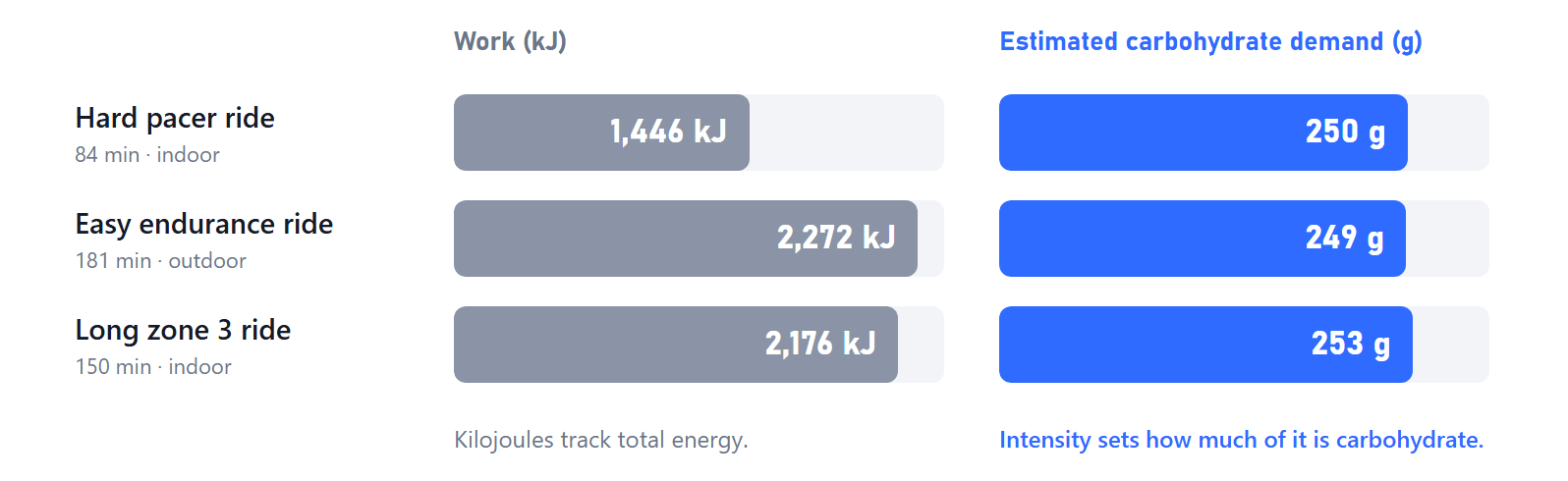
The easy ride did 57% more work than the hard one, and both came to roughly 250 g of carbohydrate.
Why Kilojoules Do Not Answer the Question
Kilojoules tell you how much work went into the pedals. They are a good guide to total energy: with typical cycling efficiency, 1 kJ of work costs roughly 1 kcal of food energy. But they say nothing about where that energy came from.
Your body runs on a mix of fat and carbohydrate, and the mix changes with intensity. At an easy pace, a large share of the energy comes from fat. As you push closer to your threshold, the share of carbohydrate climbs steeply, until almost everything you do comes from carbohydrate. Research on cyclists shows this clearly, and it also shows that the curve is personal: at the same watts, a well-trained rider burns less carbohydrate than a less-trained one.
So two rides with very different kJ can ask for the same carbohydrate, and two rides with the same kJ can ask for very different amounts. Time on the trainer matters, but intensity matters more.
Same Total, Different Rates
The totals match, but the rates do not. Per hour, the three rides respectively demanded about 180 g, 80 g, and 100 g of carbohydrate:
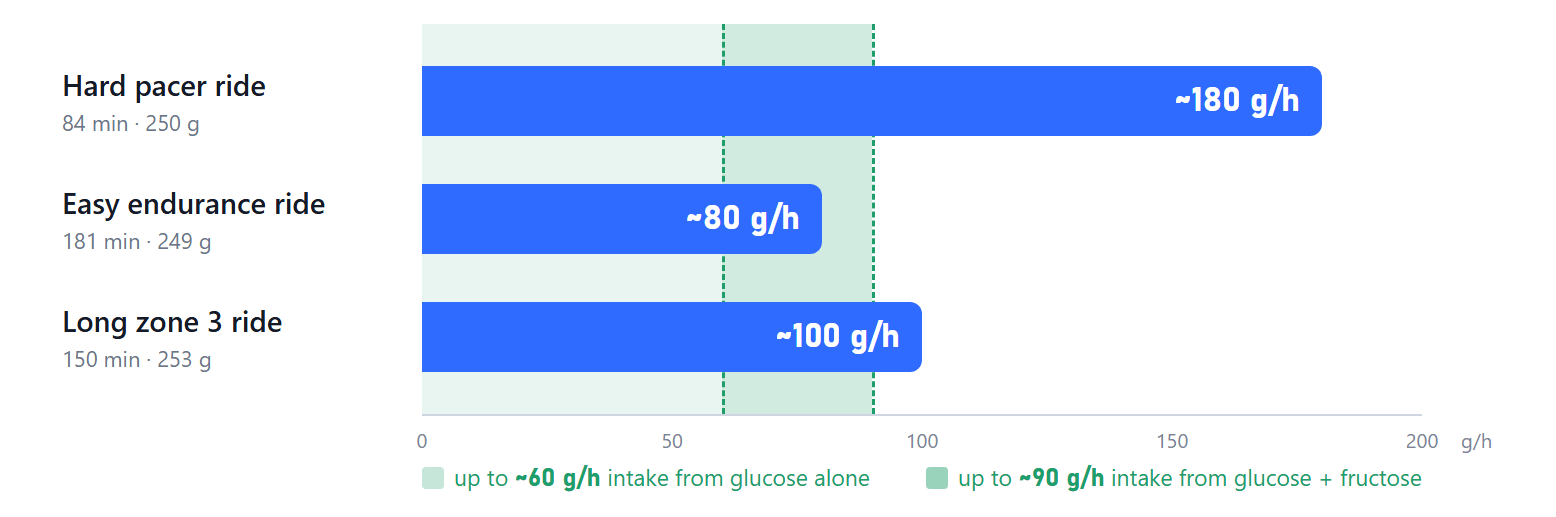
That changes how you fuel. Your gut has limits of its own: the guidance for long rides is usually up to about 60 g per hour from glucose alone, and up to about 90 g per hour from glucose and fructose together, with some trained riders going higher. On the easy 3-hour ride, 60 to 80 g per hour of drink mix or gels covers most of the demand. On the hard 84-minute ride, no stomach can keep up with 180 g per hour. That ride runs mainly on the glycogen you already have, which is one more reason to start hard sessions well fed and to refuel properly afterward.
What to Do With This on Zwift
- Judge a session by its intensity, not its length. A one-hour race or a hard group ride can cost as much carbohydrate as a long, easy spin.
- Plan intake for the long, steady rides. That is where eating on the bike pays off most, because your intake can match a big part of the demand.
- Arrive fuelled for the short, hard ones. You cannot eat fast enough to cover them, so what matters is what you ate before and after.
- Use kJ for total energy, not for carbohydrate. It remains a good number for daily food. It is the wrong number for determining carbohydrate demand.
How I Got These Numbers
Disclosure: I developed the tool that produced them. GC Demand & Fueling is a Garmin Connect IQ data field, available on the Garmin Connect IQ Store with a free 7-day trial, that estimates, second by second, how much carbohydrate a ride demands, from power, body weight, and a personal curve. Zwifters can use it by running an Edge head unit or a Garmin watch recording the same ride you do on Zwift. It is an estimate, not a measurement, and it shows demand, not what you ate. Intervals.icu now reads the ride total from the app automatically, into its “Carbs used” field.
Whatever you use, the main point stands without any app: look at how hard the ride was before you decide how much to eat.
Questions or comments?
Share below!