

I recently received an email from a Zwifter named David:
I have a request. In your race reviews, like today’s Crit City, you talk about the group you’re in, where that group is positioned in the race relative to other groups and where you are within your group. I would be very interested in an article on how you track all this – how you “see” the race.
As a newbie, I have a somewhat myopic view. I can see who is around me on the screen and I can see the list of riders on the right sidebar and the w/kg they’re putting out. But that’s only showing me maybe a dozen of the riders closest to me. I don’t really know how big my group is and I have no idea how many other groups are ahead or behind me.
Perhaps I’m reading more into your posts than there is. But if you’re able to share strategies for “seeing” the race, I expect there are plenty of others like me who would benefit.
This is such a smart question for a newbie ask, and an interesting topic for a post. So David: here’s your answer!
Before You Start
It may seem odd to talk about how you can “see the race” before the race even begins. But there’s so much that can be done pre-event which gives you more visibility into the actual race, thus allowing you to race smarter.
Depending on how important a particular race is to you, the additional prep time required may or may not be worth it. But I will tell you that many top-level Zwift racers spend a fair amount of time on race prep, and it shows in their results!
Know the Riders
Have you ever met someone new, then start seeing them everywhere you go? It’s funny how our brains work. The same is true on Zwift – while you can’t see faces, you can see rider names. And until you know which riders to look for, you probably won’t “recognize” them in game with all the other names floating by.
ZwiftPower is your best friend here. Find your event on the site, click on it, then filter the list by your race category. Now you have a list of your registered competition. Click the “Rank” column to sort them by ranking and you’ll see where you fit in the overall rankings, and who the favorites are for your event. Learn those names!
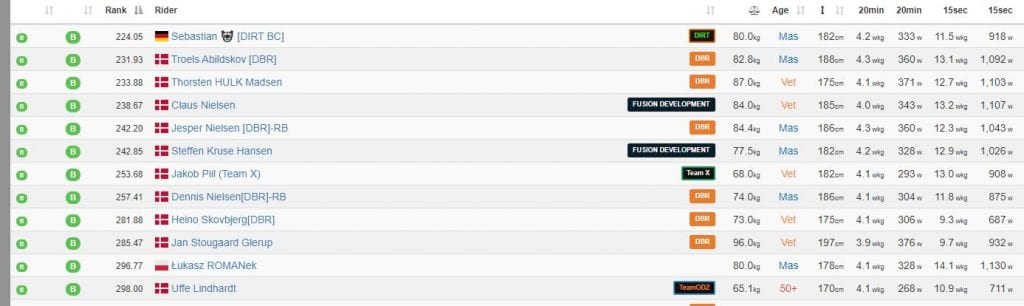
Want to dig deeper? Click a rider’s name and look at their recent results, power profile, and more. What you find there can inform your race strategy. Two quick examples:
- You may find that the top-ranked rider isn’t a very good sprinter, but has strong TT power. That means you need to watch for them to make an earlier attack or attempt a long final effort. You may also be able to make them suffer by putting in hard digs during the race, so they have to put in challenging, short efforts to stay with you.
- Or perhaps the top-ranked riders is a strong sprinter – and you are not! That means you don’t want the race to end in a pack finish, where you’ll be beaten. So maybe you’ll decide to attack extra hard up that final climb to try to break away and stay away to the finish.
While the ZwiftPower list won’t include racers who sign up at the last minute, it will get most of the riders in your event, as long as you look within a few hours of the event start.
Know the Route
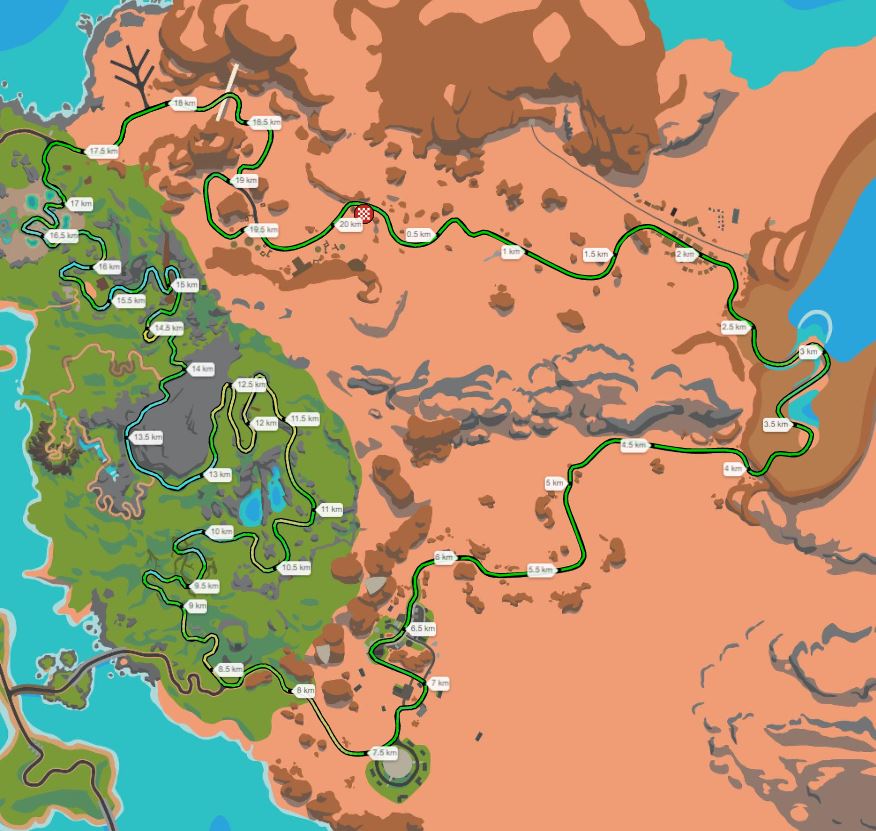
Knowing your race route is essential, and the better you know it, the smarter you can race. We won’t discuss formulating race strategy based on the route in this post (that’s a topic in itself!), but let’s talk about how knowing the route lets you see the future – a handy skill when we want to “see” the race!
If you know the route, you’ll know where the key attacks will probably happen. This isn’t 100% assured, of course, but after riding 300+ Zwift races (and watching countless more) I would say I can predict where on the course the key attacks will happen almost every time. I can see the future.
It’s simple, really: the attacks happen on the climbs. So look up the route in our route detail pages, get acquainted with the layout, and you’ll know what to expect. With advanced route knowledge, you’ll understand what is happening when the pack surges heading into a short climb, or backs off on the flats because they know a climb is coming. So not only does course knowledge let you see the future, it also gives you the ability to read the peloton’s hive mind!
Get a DS
For key races, many teams get a DS (“Directeur Sportif”) or “team car” helper who isn’t riding the race. Instead, their job is to watch the race and pass on important info to team riders via team voice chat. This is very helpful because the DS can click on your opponents to see their heart rates, look at live data in ZwiftPower, and generally do a whole lot of work that is tough to do when you’re hanging on for dear life in a race.
Because of how Zwift currently functions, the DS has to join the race like any other racer to properly “see” the race. Then once the race begins, they need to click another rider so they’re watching the race from the other rider’s perspective. It’s a bit of a hack, but it works.
During the Race
Using the Rider List
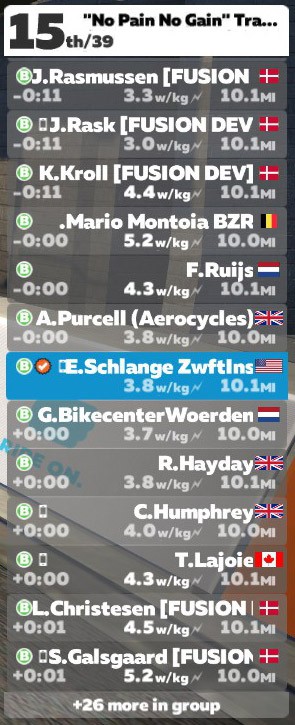
The rider list on the right is a very useful tool for racers, delivering data which isn’t always available on the main part of your screen. Here’s what the rider list displays:
- Your current placing in the overall race
- Total number of racers in your category
- Time gaps (which are really distance gaps)
- Rider w/kg
- Rider name (which includes team name)
- Rider country
- Rider category
- Rider distance
Zwift randomly displays rider names above avatars in the main portion of the screen, but it can still be hard to figure out who is who. I often use the rider list to figure out who is pushing the pace at the front – I will work my way close to the front of the pack, then look at who is still ahead.
I’ll also use the rider list to figure out the size of my rider group. I do this by drifting back in the pack until I see riders near the bottom of the list who are several seconds or more off the back. Then it’s easy math to figure out how big my pack is.
The rider list also lets me match up rider names to avatars. Perhaps I see names of riders who I know are strong racers (from prior experience or ZwiftPower research). I can then figure out that rider X is the one wearing this particular kit, while rider Y is wearing this other kit. Now I can mark them in my group, ready to grab their wheel if they make an attack.
The list is useful for spotting attacks or final sprints, too. A rider’s w/kg number turns orange when they hit 8 w/kg or more, so when you see that orange number you know something’s happening!
Changing Camera Angles
Are you barely hanging onto the pack, or safely in the middle of a large group? Has your starting group of 60 been whittled down to 20, or 50? Camera angle 6 is useful if you want to see how many riders are behind you. I often tap 6 on my keyboard for a quick look back so I get a full picture of the current peloton situation.
Team Radio
If you’re riding with one or more team members, using Discord for voice chat allows you to easily communicate race information back and forth. You might be in the breakaway while your teammates are in the peloton, and you can talk back and forth about how each group is behaving so you can decide if you want to keep pushing to stay away, or ease up and get caught.
And of course, if you have a DS helping you out, they’ll need to be on team radio as well.
Using ZwiftPower LIVE
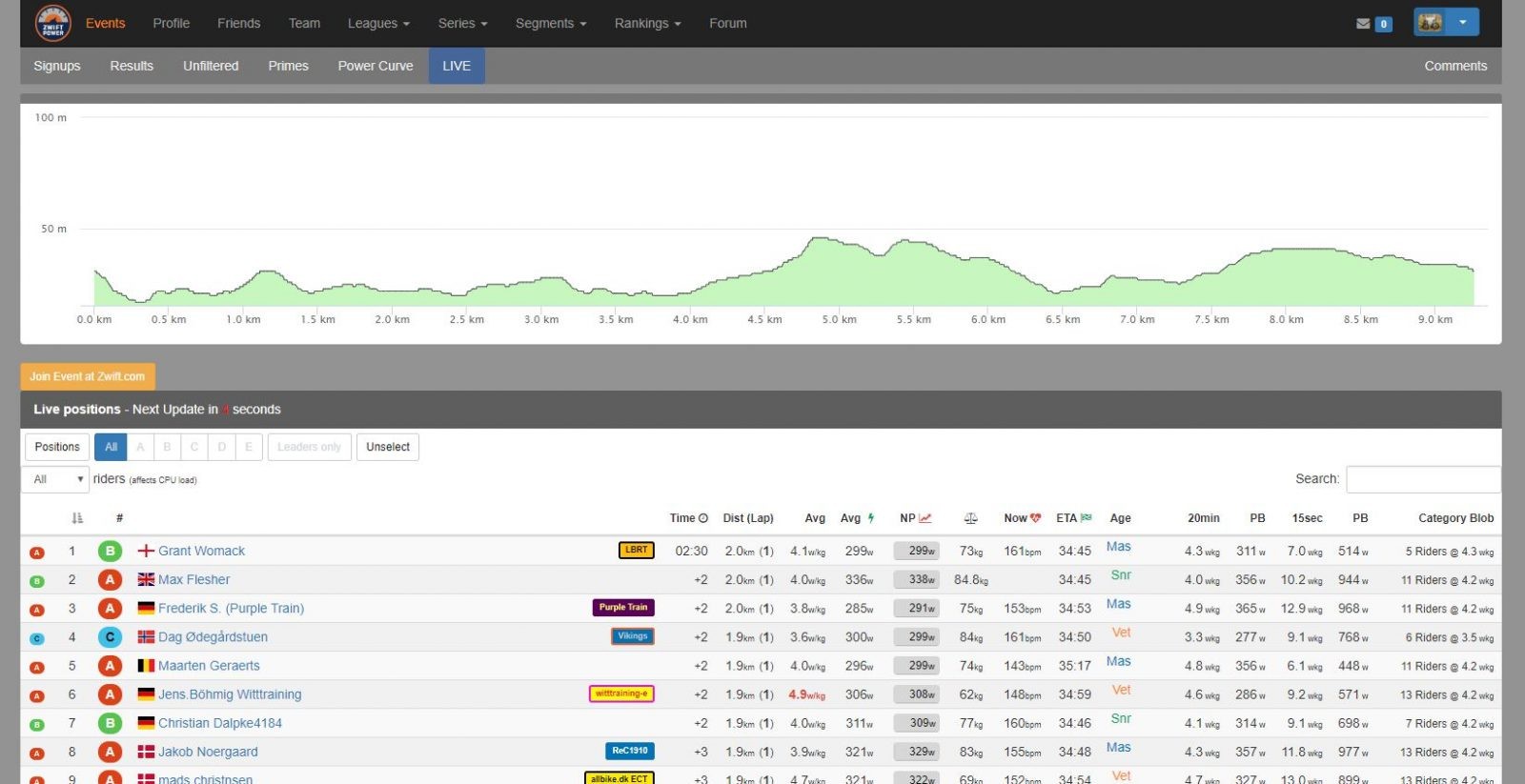
ZwiftPower’s “LIVE” tool gives you a level of insight into current race data that you simply can’t get anywhere else. Every 15 seconds, the tool refreshes the positions and data of everyone in your event, allowing you to see who is in which groups of riders and what their power and heart rate numbers look like.
You really need ZwiftPower open in a browser on a separate computer screen for it to be useful. But if you’re able to do that, you’ll find this to be a very handy tool.
Changing Minimap View
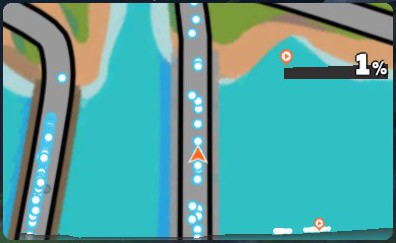
Close view 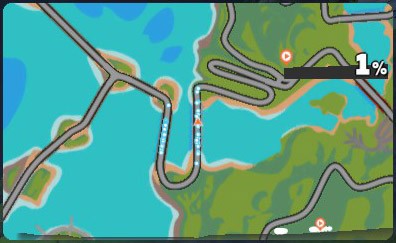
Far view 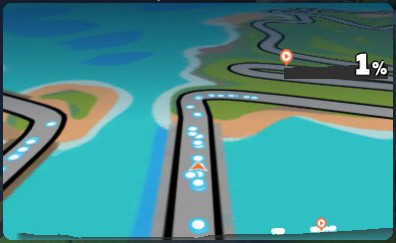
Perspective view
The minimap at the top-right of your Zwift screen has three different modes: zoomed in, zoomed out, and perspective. I often race with it zoomed out so I have a better chance of seeing riders up the road or chasing behind. Especially in chase/handicap races! Just click the minimap to toggle between views.
Seeing the Full Map
If you’re new to Zwift and still learning the routes, using one of the community’s map tools may help you better understand where you’re going. ZwiftGPS.com is a browser-based tool that shows your location (along with friends) on a Zwift map. Or ZwiftHack’s “ZwiftMap” tool overlays a simplified map on your game screen, so you don’t need a separate screen to view everything.
You can also use Zwift Companion and zoom in or out to view the world map.
What About You?
I certainly don’t employ all of these strategies in every Zwift race, but I’ve used all of them at different times. What tools or strategies do you employ to best “see” your Zwift race? Share your tips below!

Racing with a minimal user interface is very interesting and a lot of fun. Sometimes a bug will not display the riders list and therefor you race “blind” only seeing the other avatars on screen without their w/kg data. Race dynamics change a lot and racing is more tactical and opens more opportunities. Maybe one day we can experience race organizers being able to select this feature.
It would be REALLY interesting to race with no HUD at all. Totally different experience for sure!
You can with a hack but It would only be you and you will work a lot harder than the rest of the pack.
Racing only by visual of other riders and your instinct would be amazing I believe (Ofcourse still seeing your own data is important).
I believe this can be done with Zwift Hacks Zwift Preferences tool and then you select “Minimal UI” inside the tool before launching Zwift. Will it work in a race, I havent tried it.
It sure will! I did it recently: https://zwiftinsider.com/race-won-hudless/
Great post, Eric. One tool not mentioned here is the Zwift Companion app on your phone. It can provide another map view of the course and nearby riders, one that can zoom out further than the in-game on-screen minimap. This gives you the ability to have two different map views (one zoomed in tight, perhaps, and one with a wider view) in-game and on your phone. The phone app also can make it easier to message other riders in-game, or to send private messages to another rider if you’re not using voice tools like Discord.
It may also be worth noting that ZwiftPower live positions can be filtered by category as this can eliminate the need to scroll around the screen during a race.
This is fantastic stuff but I’m pretty sure when I’m on the rivet my brain is not going to handle all that multi-tasking well…haha. Maybe with practice…
Some of it comes with practice – some is just fun to try, but you decide it’s not worth the hassle. And some of it you’ll decide it’s definitely worth it, and you add it to your toolbelt!
You should view the list above as a bunch of ideas for you to test out, basically.
Thanks Eric for this great post. I’ll add a few things I use to watch the race. The mobile link app provides additional information that is useful. It has a longer list of riders nearby to give you a better sense of groups ahead and behind. It also give you more information about a rider such as level and age. For in race communications you can privately text them without other riders seeing your message. I also use the “0” key to augment the camera view. Once you hit the “0” key you can use the arrow keys to rotate the camera for a 360 view. Also the 9 with the 0 and the arrow keys lets you see up the road from about 1000 feet above. This gives a visual of how big the gaps are ahead and behind.
Cheers,
Richard Treadway.
https://www.strava.com/athletes/8196543
https://zwiftpower.com/profile.php?z=109147
Apologies if this is a stupid question, what trainer difficulty setting do you use when racing and do you change the setting depending on the course?
No stupid questions, just stupid answers! 😉
I run my trainer difficulty around 30%, and don’t generally change it much. I like to feel the feedback from changes in incline, but not so much that I have to shift constantly.
Max, for everything! Best way to know when you should hammer. My w/kg are consistently much lower than the racers I finish with and its because I can feel every opertunity to back off the pedals.
I do the same. Better feeling of workouts and races.
For me I look at the race format, the track and the competitors to get a sense of what might happen a day or two before the race. I might even check their power curve and see how they’ve been performing the last week or so; are they I proving, maintaining or in a lull. So I have a general expectation for the race rhythm, where the most likely tactical moves will be made, when, and by whom and if they will stick. I also know my own power curve so have an idea of how I will respond to it and my chances of success in hanging in with it. And with all that, who I don’t want with me at the finish line and what I might need to do to drop them.
I also have an idea that despite all that, a zwift race will typically start out hard, lull in the middle depending on duration and fatigue, possibly some attacks when I’m writing a group message, then some crescendo towards the end or oddly the last lap stalemate where everyone saves their matches for the sprint. If there’s a tactical move to be made within the first few minutes based on course recon I make sure I’m ready and mentally prepared to hang in there no matter what as that will be where the first selection is made and the podium determined.
The above is before the race, during the race itself I watch my metrics like HR and cadence to see how I’m holding up compared to my expectation, and the W/kg on the riders around me esp around those tactical crunch points to see who is making a move which can let me react quickly. I watch how the group responds to attacks and what the preferred average speed and power is, who appears to be strong and who is struggling. If it’s a chase race like Dadurday I set zwiftpower up on a separate screen like laptop to see the live positions and gaps between cat riders to better understand what needs to be done.
Trainer difficulty – it all depends on whether my training for the day benefits steady and controlled effort or something erratic to make pain more fun
Great stuff, Rich.
I use the companion app map view to admire the amount of no-mans land I’m riding through.
The first person view, 3, is a must for me. It takes significantly less mental awareness to maintain pack position when you never need to find your avatar. It also allows you to use peripheral senses more effectively.
+1 on that. Using iphone connected to a TV, I default to the first person shooter view. Drone view can be really nice on PC but without that option on the iphone view #3 is the way to go for me—and 100% trainer setting to feel the quick resistance changes, just seems more immersive. I do kind of wish there was the option to wipe all the HUD info, just race by feel alone, that would be very interesting to see if the data was actually mentally limiting performance, or helping make smart decisions…
I’m a light weight (62 kg) D racer who realized that I finally have a chance to podium based on recent race results in Zwift Power but was afraid of blowing up trying to keep up with the sandbaggers on the flats. I went into Zwift Power before the race and reorganized everyone based on their Weight/kg which allowed me to see how many racers are not D’s (8) and also saw that I was among the top D’s. I then knew that a 9th place finish guaranteed a win and since Zwift Power only showed half the riders signed up placing in the teens would most likely get a Zwift Power win.
I was right. I finished 19th but won on Zwift Power. Looking at the final race results everyone ahead of me had weight/kg greater than 2.75
Ha! Perfect. Yeah, I would think doing some research like you did would be ESPECIALLY helpful for D races, where sandbagging is the worst. Way to race smart!
Maybe not completely relevant I thought I’d share this article on Zwift racing I recently came across.
https://www.cyclingweekly.com/news/11-things-know-race-zwift-407278
I started Zwifting a year ago this month. While I’m a casual/recreational cyclist my experience mirrors that of the author.
Zwift racing is fun! Ride on!
My strategy is pretty much the same every race…..start hard and hang with the front group as long as I can. If I make it through the first climb with the front group or halfway through the race, I’ll let myself think about possible strategies. Otherwise, once dropped and riding in no-man’s land, I consider whether I can stay away from the next group (rarely possible) and once caught employee the hang on from here and hope I have sprint legs left. Have never been successful in breaking away…
Can you tell me what the % is on too of the minimap (top right hand corner) – not the gradient you see in the minimap- this % sits on top of the minimap itself
thanks Elaine