

UPDATE: the test results below are now outdated, due to Zwift modifying their Pack Dynamics. See the latest version of these tests for accurate data.
Our original TTT speed test post from 2020 gave team time trial riders some very welcome guidance about how to most efficiently ride their races. Then in 2021 Zwift rolled out “Pack Dynamics 3.0” and we ran a second test to see what, if anything, had changed in regards to TTT dynamics. (We found speeds hadn’t really changed, it was just harder to hold an efficient single-file formation due to a lack of sticky draft.)
Then in August 2022 Zwift+WTRL announced enhanced TTT features, including the ability to use TT frames and still draft.
Zwifters have been wondering how riding a TTT with a TT frame differs from riding it with a road frame. Is it just faster, or is the draft savings different? We decided to find out.
Test Goals
This set of follow-up tests set out to answer two questions:
- Is the power savings in TTT formations on a TT frame different than it is on a road bike?
- Are the different formations (churning or hybrid) more or less efficient on TT frames than they are on road bikes?
Test Parameters and Methodology
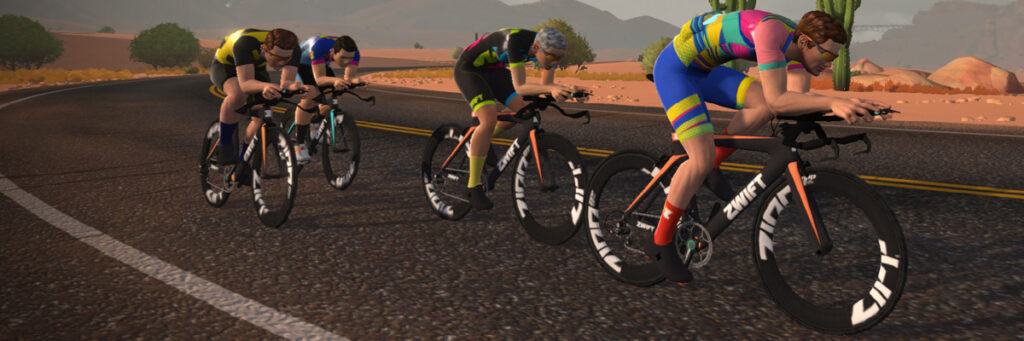
All of the test riders were set to 183cm height, 75kg weight, and rode Zwift TT frames with ZIPP 808 wheels.
Tests were done in an isolated event on Watopia’s Tempus Fugit route because it’s the flattest on Zwift, and it has a timed section (Fuego Flats Reverse, 4.4 miles long) which could be used to precisely measure the speeds of each test formation.
The ever-helpful James Bailey at Zwift HQ flipped the switch on our event so our TT bikes would be able to draft each other.
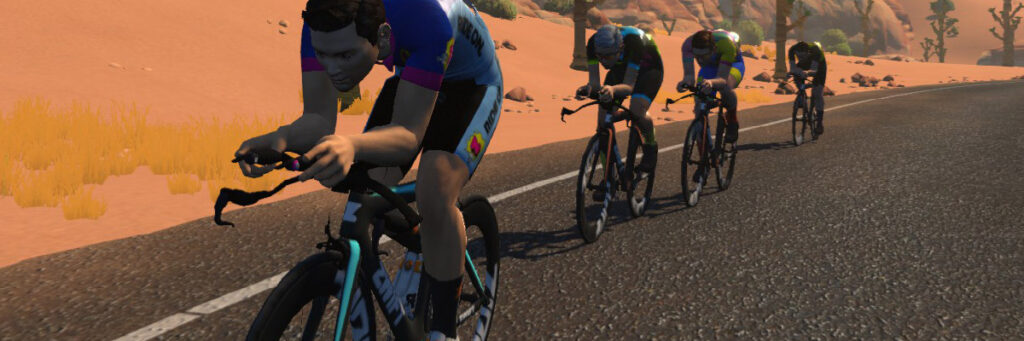
All of the tests were done with four riders.
Tests and Results
Test 1: the Churn
For our first test, we put all riders at the same 300W power setting. This resulted in a churning group of riders where one rider would surge from being in the draft near the back to being in the wind at the front, then dropping back to do it all over again. This “washing machine effect” is what you see at the front of many Zwift races.
- All riders @ 300W
- Segment time 9:53
- Speed: 42.9 kph
Test 2: Single File @300W
The second test had the lead rider holding 300W, with the other three riders in single file behind, holding the minimum wattage possible to stay in formation. This is what you would see in an outdoor team time trial:
- Rider 1 @ 300W, Rider 2 @250W, Rider 3 @ 225W, Rider 4 @ 214W
- Segment time: 10:09
- Speed: 41.7 kph
Notes:
- The “minimum wattages” stated for riders 2-4 on this test and other tests below should be considered approximations, as it is impossible to figure out the precise wattage required to hold formation due to Zwift’s dynamic physics engine and very small undulations in terrain, even on Fuego Flats.
- Riders received power savings of 17%, 25%, and 29% – the same power savings seen in our road bike TTT tests. As expected, the further back you are, the bigger the draft effect.
- In a TTT situation with all riders taking equal pulls on the front at these wattages, each rider would average 247W.
- Test 2’s segment time was 16 seconds slower than Test 1’s, despite riders holding no higher than 300W in both tests. This may seem odd at first, but it’s a result of the “churn”. Riders are speeding up while in the draft, then shooting ahead into the wind, only to be slowed and have another rider shoot past them. This little speed boost accounts for a significant time difference, as we see here.
- It’s worth noting here that we did a solo rider test at 300W steady, because we were curious if there was any advantage to the front rider if there were riders behind. There is not. Our solo rider turned in the same time as this 4-rider group.
Test 3: Single File @350W
This test is similar to Test 2, except we bumped up the front rider’s wattage to 350W to make sure the group would be faster than the churning pack in Test 1.
- Rider 1 @ 350W, Rider 2 @293W, Rider 3 @ 271W, Rider 4 @ 246W
- Segment time: 9:37
- Speed: 44.1 kph
Notes:
- Riders received power savings of 16%, 23%, and 30% (2nd, 3rd, and 4th rider respectively). Almost identical to the power savings seen in our road bike TTT tests.
- In a TTT situation with all riders taking equal pulls on the front at these wattages, each rider would average 290W. This is the crux of why TTT formation is so important: that even with Zwift’s “speed churning” from test 1, the four riders in this test significantly beat test 1’s time by riding efficiently in single file formation at a lower average wattage.
Test 4: Single File @400W
This test was very similar to Tests 2 and 3, we just bumped the front rider up to 400W.
- Rider 1 @ 400W, Rider 2 @327W, Rider 3 @ 293W, Rider 4 @ 281W
- Segment time: 9:06
- Speed: 46.6 kph
Notes:
- Riders received power savings of 18%, 27%, and 30% (2nd, 3rd, and 4th rider respectively). Almost identical to the power savings seen in our road bike TTT tests.
- In a TTT situation with all riders taking equal pulls on the front at these wattages, each rider would average 325W.
Test 5: Hybrid
For our final test we wanted to look at a strategy that many TTT teams use, wherein there is one designated rider in front, and the riders behind simply churn in the front rider’s draft. This reduces the hassle of trying to maintain single-file positioning while receiving some of the benefits. But how does it impact efficiency?
- Rider 1 @ 400W, Riders 2, 3, and 4 at @319W steady
- Segment time: 9:06
- Speed: 46.6 kph
Notes:
- In a TTT situation with all riders taking equal pulls on the front, each rider would average 339W. So not as efficient as single-file riding (average wattage is 14W higher than the single file test). But a much easier formation to hold!
Conclusions
Let’s answer the two questions we stated at the top of the page:
Is the power savings in TTT formations on a TT frame different than it is on a road bike?
It is not. Given that there’s a slight margin of error here, we’re confident there is no detectable power savings (or cost) in TTT formations on road bikes vs TT bikes. You’ll just go faster on a TT frame, but your power to chase a rider holding, say, 400W in front will be the same as it was on a road bike.
Are the different formations (churning or hybrid) more or less efficient on TT frames than they are on road bikes?
We don’t think so. Again, the numbers in our TT tests were very close to those in our road tests.
Single File or Hybrid Formation?
Clearly “The Churn” is not a good TTT formation. So what’s better – the single file formation, or the “hybrid” approach?
While the test results above confirm that single file is still the most efficient TTT formation on Zwift (as it is IRL), it’s much more difficult to hold a single file formation compared to the hybrid approach, especially on technical courses with lots of gradient changes and sharp turns.
So the “best” formation for your TTT squad will be the formation they’re able to hold. If you can pull off single file, do it! But if not, go hybrid. Either way, smash it!
Your Comments
Got comments or questions? Share below!

Has anyone noticed that the TT bike slows much faster than a road bike when you stop pedalling?
I had the same feeling
lol yea
Draft or not……
Even on the flats, it’s still a w/kg game.
In the real world a big rider would eat the small one and spit’im out
Yes, I’m faster on a road bike in zwift than RL, but even. ore slower on a TT than RL.
Zwift should fix the TT algorithm
I think you confused something there. On flat it’s just the watts and not the w/kg that make the big (i.e. 75kg) rider eat the small one (50kg).
Consider a totally flat route both holding about 300watts. They both would be around the same speed, although th bigger rider would work much less w/kg (4w/kg to 6 w/kg) than the smaller.
If they both would be able to hold 6 w/kg the bigger would ride at 420W and “fly away” from the smaller.
How deep does the draft effect go? By that I am asking where is the cap to the drafting effect in a pack. At what wheel back from the front does the draft cap out, and what is that savings?
In a TTT with real people, I always felt like after 3-4 people the benefit gets less because you get an amplification of even the smallest of gaps ahead of you (and you feel them all because they’re all ahead of you) as you have to close them or follow the wheel of the person closing them rather than just being able to ride a constant speed with no gaps forming in front of you as happens if you’re closer to the front of the line (and by gaps, I mean 1-3 m bubbles that happen when you don’t react as quickly to the terrain as the person in front of you or on a corner or something, less than a bike length, not a full on gap of 1s or more where you’re out of the draft entirely). In a pack, I’m not sure.
I think you need to watch this youtube video around this time point…
https://youtu.be/3g0xEhBlE_E?t=265
About 6th wheel
Great test, thanks. I was sort of surprised at your results because I had figured that the more aero bike was going to mean that there were going to be less aero savings to be found in the pack as lowering your CdA on the TT bike would mean there just wasn’t much room left to go lower by drafting.
A couple years ago I was on a team that did a 2 lap TTT of a flat-ish course (Tick Tock, maybe?) where we did the first lap in a strict straight single file line making sure to keep in the correct pull order at all times. The 2nd lap we tried to keep single file, but didn’t worry quite so much about small overlaps and didn’t worry about staying in the correct order at all. Pullers kept constant (or as close to constant without using robots as we could get) W on the front throughout the entire 2 laps (we were focusing on W rather than W/kg even though we were all of varying weight and height).
Even though not keeping in strict rotation order meant that the puller had to accelerate hard from the back to get to the front to pull at times (if they weren’t paying attention to where we were in the rotation), the overall average power for all riders (except me because I fell off on the ramp out of the tunnels in lap 2 and finished solo) was lower on the 2nd lap and everyone reported it feeling easier even though the puller was pulling at the same power and we’d already done a lap the other way first (time was also within a couple seconds).
To me, that says that the focus needed to keep a perfect line in the correct order, and always having to fill any gap yourself (which might mean momentarily creating a gap behind you and so on in a chain) causes you to burn a lot more matches, especially on a technical course, than having a designated puller, having the “on deck” person try to be positioned behind them and having everyone else just try to make sure there aren’t any gaps.
Maybe, if you specifically practice in a specific rotation on a specific course, you can save those 14W, but, in reality, having to fill the micro gaps that form because we’re not perfect robots ends up making that precise line more costly than it save for most people.
Looks like the offset of the more aero bike is made up by the (slightly) higher speed.
Technically the saving should be slightly less as rolling resistance is higher with TT bikes (heavier and slightly higher speed) but it’s such a small change that aero still dominates … well unless you’re *very* short and heavy 🙂
Fully agree that the surging to stay in perfect position can easily burn more matches than just accepting some churn for a very smooth power output.
So, if a course profile undulates enough to allow a supertuck, does that mean road bikes would be better given TT bikes “apply the brakes” when you stop pedalling?
Depends on how long the descent is. Probably no courses with a long enough supertuckable descent that the downhill speed would outperform the more aero TT frames.
Actually, Eric did a piece on this subject. TT bikes won’t go into supertuck at 0w but they’ll keep up with bikes in supertuck at 50w. The first week I raced (Mocha) at WTRL TTT with a TT bike, I came out of sweep position on the Hilly KOM descent. My teammates were on road bikes and in supertuck. I relaxed, kept the pedals turning and blew threw everybody including the guy 10 seconds ahead. When I looked up, it was putting out 100w. I was an instant convert.
Many thanks Eric. Important information to know that we only go faster on TT-bikes but the rest like draft effect and pack dynamic is still the same. After the TTT on Wandering Flats, some team members felt that it was a bit harder to hold the position because of less draft effect. Now I can tell them that their legs were the problem 🙈🤣🤣🤣.
That has blown my mind 🤯
We know, from test data, that the new TT speeds with drafting doesn’t favor the heavier riders as much as the lighter riders. Is there any benefit to mix a group of riders where some are on TT bikes and the heavier riders are on Road Bikes?
Wait…it’s more difficult to hold a single file than too dynamically and continually call out an audible formation moment for perfect slingshots thru the pack and at same time base it off what’s left in a rider roe tank?! Where’s my “not sure this was well thought thru gif” please.
Do you think there would be any change at all linear or exponential if you increased the number of riders to six lime a ZRL TTT or to eight like in a Thursday WTRL TTT?
Thanks. I think if you posted Nominal Power, it would be even more useful. It’s possible that nominal power might be the same or higher from speeding up and slowing down (as in keeping formation) compared to hybrid or other formations achieving the same time for higher average powers.
*Normalized
Not quite answering your question but looking at NP is interesting. Single File @300W gives an NP of 254W (that is without the extra power variations to actually achieve single file as you mentioned Ben). I estimated that if you wanted to match the speed of a 300 W churn using single file you’d only have an NP of 263W. Finally, the NP savings of Single File vs Hybrid are less than 3% (at 400W). (A 300W churn has an NP of 300W of course)
Wow, what amazing analysis!
Any chance we could see what adding a 5th, 6th, 7th and 8th rider would do to the times? How much benefit is it to have more riders?