I like to say, “I was heat training on Zwift before it was cool.” Mostly I like the wordplay, but also, there’s some truth to it: I hadn’t seen or heard of others doing heat training on Zwift when I began doing it in the summer of 2023. It seemed like the perfect training cheat code, though: if heat training delivers on its promise and indoor cycling lets you control your environment, then Zwift could be the place where heat training thrives.
So I got a CORE sensor and began a heat training cycle. I even wrote a post about it.
That post was supposed to be part 1 of a series, but that didn’t happen. Instead, I found myself struggling to make sense of the CORE metrics, and when I reached out to CORE for support, I got no reply. So I set the project aside.
Fast-forward to early 2025, and CORE was suddenly very visible in my world: Zwift added CORE metrics to the HUD, and CORE had lots of new staff, a completely revamped app and metrics, and a new version (2) of their sensor. It was time to dive back into the sweat sessions!
The Science
While CORE’s ability to measure your heat training is a relatively new development in the world of cycling, the concept of heat training is not new at all. Cyclists have done it for decades in preparation for hot races, and more recently, riders have embraced heat training to boost overall performance, following the results of various heat-training studies.
If you want to dig into the results of actual studies, here are a few:
- Heat acclimation improves exercise performance
- Hematological, skeletal muscle fiber, and exercise performance adaptations to heat training in elite female and male cyclists
- Heat acclimation causes a linear decrease in sweat sodium ion concentration
What do the studies show? In summary, heat training leads to the following adaptations:
- Increased hemoglobin mass
- Increased red blood cell volume
- Increased VO2max and FTP, in the neighborhood of +3-10%
- Earlier onset of sweating and an increased sweat rate
- Decreased sodium concentration in your sweat
Notably, these increases are observed in men and women equally, and occur among both elite and amateur athletes. So it’s no surprise that heat training, and specifically heat training with the CORE sensor, has become popular among pro cyclists and triathletes. It offers clear benefits for anyone racing in the heat, but also offers benefits similar to altitude training which lead to performance boosts even in cooler environments. Hence CORE’s mantra: “Train hot, race cool.”
(In fact, various sources have told me that most, if not all, World Tour teams are using CORE for heat training, even though CORE isn’t sponsoring the teams in any way. That should make us sit up and take notice…)
CORE Metrics (Just the Basics)
When I first jumped into heat training in 2023, the testing protocol and tracking were complex. Fortunately, CORE revamped their app and metric to simplify things! Here are the key metrics used when heat training with the CORE sensor:
- Core Temperature: your internal temperature
- Skin Temperature: your “external” temperature, as measured on your skin
- Heat Strain Index (HSI): uses your core and skin temperatures to measure how hard your thermoregulatory system is working to cool itself, on a scale of 0-10 (read more)
- Heat Zones: these break HSI into 4 zones
- Heat Zone 1: HSI of 0.0-0.9
- Heat Zone 2: HSI of 1.0-2.9
- Heat Zone 3: HSI of 3.0-6.9
- Heat Zone 4: HSI of 7+ (CORE recommends staying out of this zone, as too much time here can cause heat illness or worse)
- Heat Training Load: ranges from 0-10 and measures how much a particular training session contributes to your heat adaptation (read more)
- Heat Adaptation Score: tracks your heat adaptation progress to see how much of your potential you’ve reached, on a scale of 0 to 100%
- 0–24%: Thermal Rookie
- 25–49%: Heat Accustomed
- 50–89%: Heat Adapted
- 90–100%: Heat Champion
Putting all these together, what CORE users typically want to do is get their HSI to increase early in the session, so they are in the higher Heat Zones (upper zone 3 is ideal) where Heat Training Load accumulates more quickly during their session. This results in a higher Heat Training Load for the day, which means their Heat Adaptation Score will increase more quickly.
Zwift Integration: What It Is (and Isn’t)
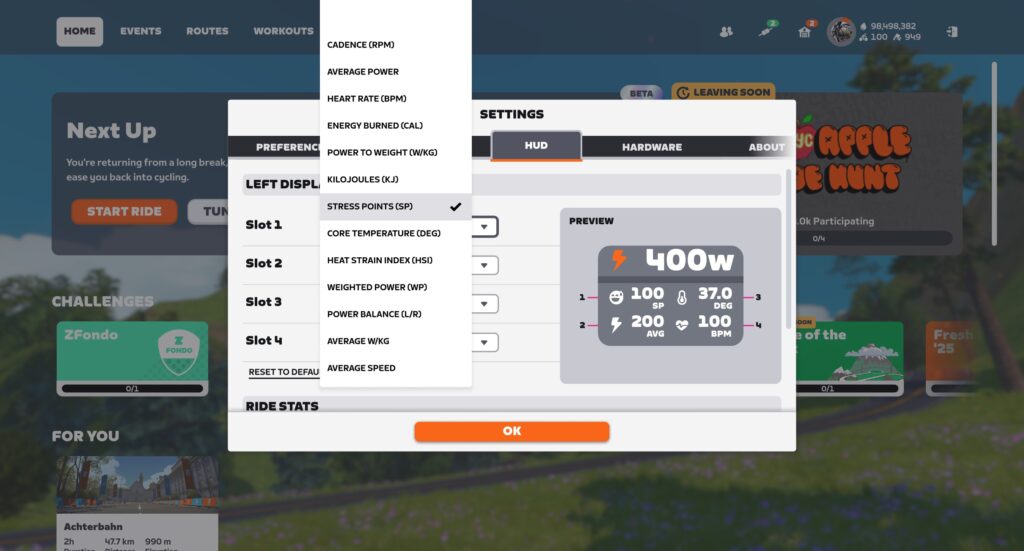
While CORE is now integrated into Zwift, it’s important to define what “integration” really means in this case. Zwift’s CORE integration simply means there are two CORE metrics available to be shown in the HUD (HSI and Core Temperature), and that data is recorded to your FIT file.
To really use CORE to its fullest, though, you’ll want to run the CORE app on your phone, so it can track your Heat Training Load for your session, and track your ongoing Heat Adaptation Score from day to day.
CORE App Basics
As explained above, despite Zwift’s basic integration with CORE, I think it’s safe to say the CORE app is essential for heat training with the CORE sensor.
The CORE app lets you configure your CORE sensor(s), track metrics for your active heat session, and track your overall Heat Adaptation Score. You can tap the Heat Adaptation Score gauge to see a historic view of your data as well:
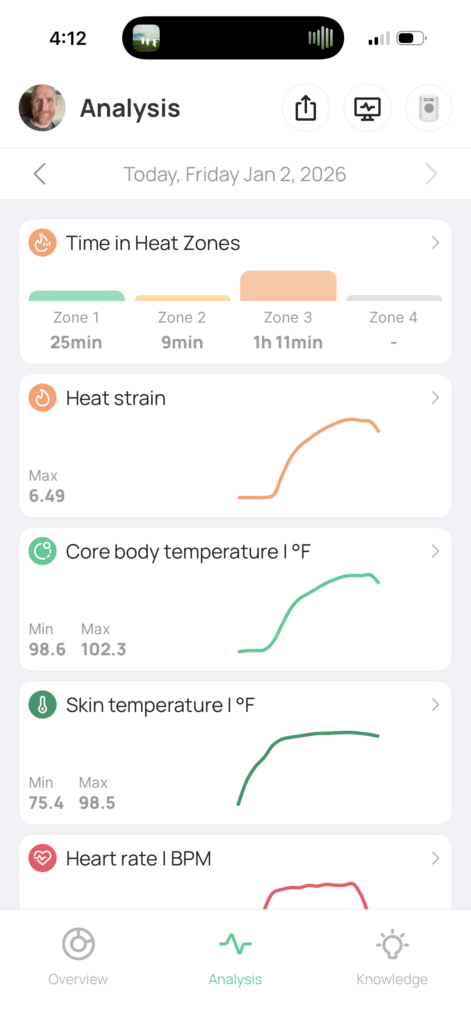
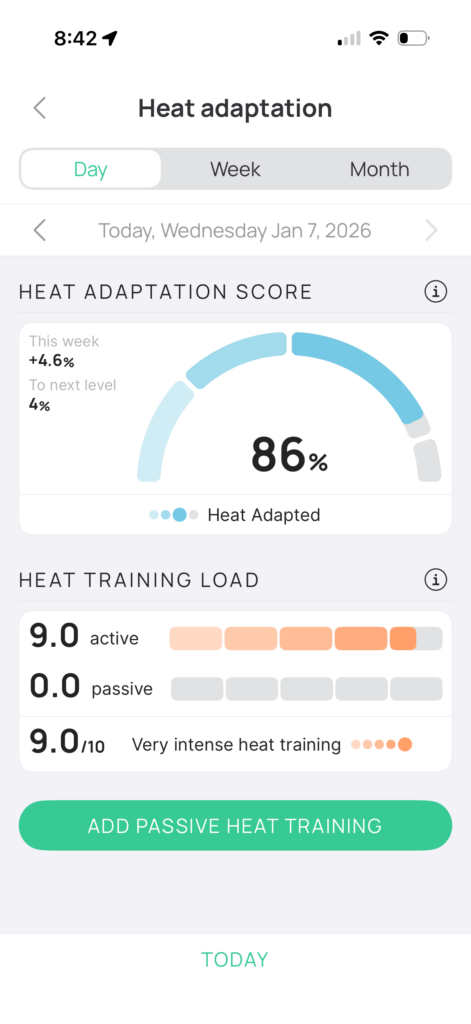
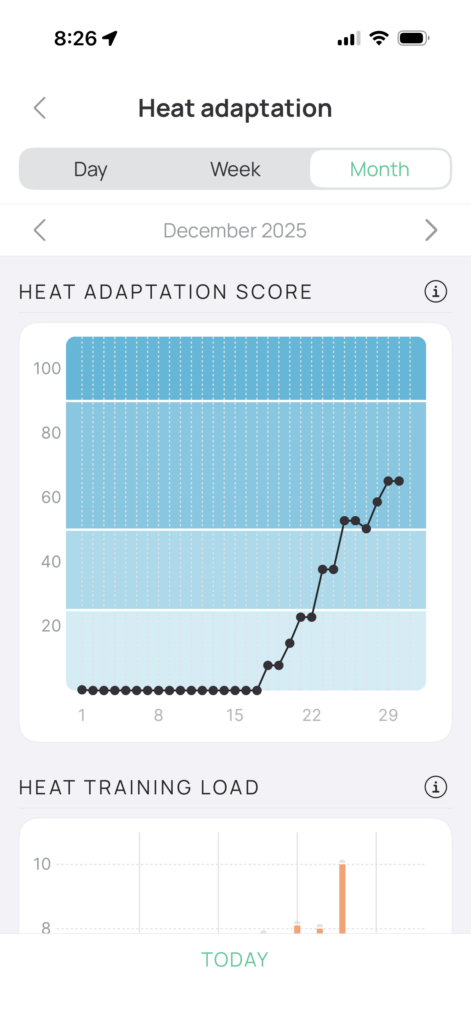
The CORE sensor has some on-board memory, so it isn’t just live-streaming data to connected apps… it’s actually storing that data. This is handy if you begin a session but forgot to open the CORE app, as it means you won’t lose that data.
The CORE app has come a long way since its early days. Today, coupled with simplified metrics explained above, it provides a clear view of your heat training progress. Still, there are some improvements I’d like to see:
- Refresh frequency: the app doesn’t update its data quickly during an active session, and this can be a bit maddening when you’re sweating profusely and wanting to see your progress toward a higher Heat Training Load. I’d love to see the app update all metrics at least every minute, if possible.
- Chart quality: the historic charts can’t be tapped to “drill down” into the data, and I’d like to see that feature added.
Trial By Fire
I’ve bounced in and out of heat training several times in the past years, without ever doing it enough to accumulate meaningful adaptation. That changed when I decided to buckle down and do some earnest heat training at the end of 2025.
Over a 3-week period from mid-December 2025 to early January, I completed heat sessions almost daily, working my way from a Heat Adaptation Score of 0 to 96%. And while the sessions were rather sweaty, I began to look forward to the efforts, to the ridiculousness of dripping so much water on the floor, to seeing my Heat Adaptation Score inch closer to 100%.
I learned a lot during those sessions, including:
- What to wear to stay as comfortable as possible, while keeping my temperature high so I could accumulate a lot of adaptation.
- How much I needed to drink, and what sort of electrolyte mix to use to facilitate replacing what I was losing.
- How to arrange towels on the floor and on my bike and within reach, to control sweat while also keeping laundry loads as small as possible.
- How to get my Heat Stress Index to increase quickly in a session, so I could get up to those higher Heat Zones and accumulate heat stress faster, resulting in an overall higher Heat Training Load.
- The disgusting joy of sitting on the floor in my sweaty clothes after a session, letting my temperature and heart rate slowly drop while accumulating additional heat stress seemingly “for free” (more on this below as well).
I’ll share more about these learnings in part 3 of this series, publishing tomorrow. Until then, here’s a recording of me riding a Tour de Zwift stage as a heat session. Watch as my power drops from the 200W+ to ~100W, while my heart rate actually increases! The human body is an amazing creation…
More Heat Training Resources
If you have questions about heat training, I highly recommend checking out CORE’s support articles, which are impressively detailed and thorough. Visit help.corebodytemp.com.
Up Next
This article began as one post, but it got way too long. So I’m splitting it into two, with the rest of the post publishing tomorrow. The second part covers my personal experience heat training, including lots of tips and tricks I learned along the way.
Performance improvements are also discussed, but (spoiler alert) I didn’t do a good job of tracking those scientifically, so the hard numbers aren’t really there.
Your Thoughts
Have you done any heat training? Have you used the CORE sensor to do so? Share your thoughts, questions, and experiences below!

 wpDiscuz