

Racing tactics. I see posts regularly about riders sitting in and then sprinting at the end, and how that isn’t right, or variations of that.
I think people don’t realize that’s how racing works. I’ve been racing a long time (40+ seasons). This is how racing works: you go as easy as possible until you have to go hard. And when it’s hard you absolutely have to stay in contact. If you can’t, your race is over, because once you lose the draft you’re done. If you can’t hold the wheels while saving 30% energy from the draft, there’s no way you can go faster than that while NOT drafting to catch back on.
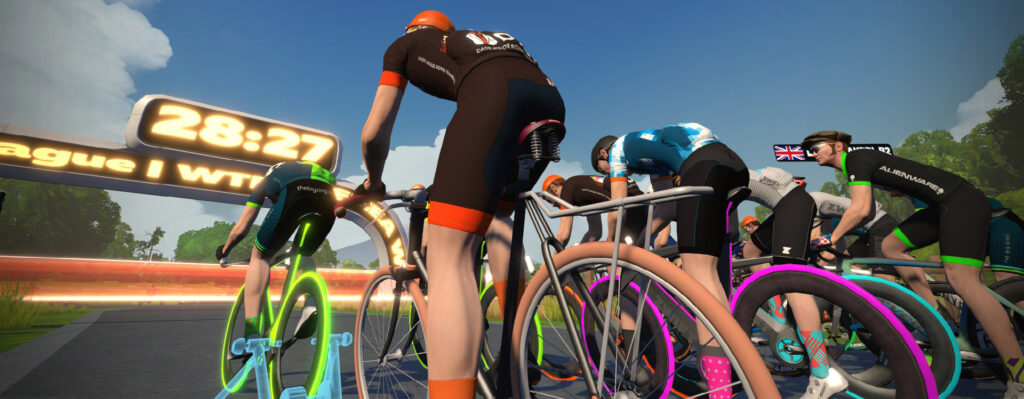
Tip #1: Don’t Get Dropped
Therefore, the first priority in a race is to “not get dropped”.
In Zwift, that generally means two things.
Tip #2: Go Hard To Start
First, go hard the first minute, and do NOT let gaps open up from the starting pen. Even though the course may not start for a bit, the race starts as soon as you are moving. There are so many riders who average higher than the lead group but because they didn’t go hard the first minute, they finish many minutes behind. You have to go hard at the start and stay in the front main group (let the one or two super-aggressive attackers go). After a minute, maybe at most two minutes for the lower level races, everyone eases up, and now the pace will become more real. I’m guessing you want to go 2x as hard as the advertised pace. D race? You need to do 3-4 w/kg for much of that first minute. Even if you think it’s murdering you, do it. If you can’t stay with the group for that first minute, I’d actually recommend quitting and joining the next race and trying again. It is absolutely that important, it will absolutely change your racing. You have to learn to go really hard and still be able to pedal after.
Tip #3: Push Over the Top
You have to keep going “through” the top of rises and hills. This is where the majority of people who shouldn’t get dropped end up getting dropped, just like the ones getting dropped at the start. These poor souls ease at the top of the hill or even a very short rise, let a 5-meter gap open, and it quickly becomes 10-15 meters and their race is over. If you climb “through” the top, and stay within 2-3 meters of the group, you can relax 15-20 seconds later when it flattens out or the downhill increases your speed. A good tip here is to surge as you hit any rise – if you’re doing 1.5 w/kg sitting in, surge to 2.5 as you hit the rise. you’ll see riders around you go from 1.5 to 3.5+ trying to hold position, then ease back a bit, the whole time you’re doing a steady 2.5.
(Note: if you get dropped during a hill then that’s just a climbing thing. If you get dropped on descents once you’re up to speed, it’s probably a weight thing. Both require being stronger, which is not really about tactics but more about fitness.)
Tip #4: Save It For When You’ll Need It
The thing with racing is that “real racing” is not about “working together” and “sharing the load.” It’s about breaking the other riders, cracking them, so that they are no longer in contention. Where and how you break the others is up to you. The basic premise though is that you need to save everything you have until someone tries to crack the group, then you need your reserves to outlast theirs.
It doesn’t do a racer any good (at least to benefit themselves) to pull any harder than “easy.” For me, that’s about 1-1.5 w/kg (80-120w). In more competitive races I might pull harder to help a teammate or force a momentarily distracted opponent to chase back on (almost always after cresting a rise, if I notice a competitor 5m off the back, I’m immediately surging to force them to chase an extra 10-15-30 seconds). In less competitive races I’ll pull harder to tire myself out. And to be fair, other times I’m going 1.0 w/kg because I got shelled and now I’m alone, I can’t do 4 w/kg for 5 or 10 minutes to catch, so my race is over.
Tip #5: Pull At 1/5 Your Jump
When the attacks come, you should be 100% ready to respond at max power. I tell my teammates they should pull at 1/5 of what they can jump, so if their jump is 800w, they shouldn’t pull harder than 160w. It’s reasonable for people to jump at 5x an easy effort. If your jump is 500w, don’t pull harder than 100w. If you can respond to two attacks in a row, even better, because the common tactic is to attack after someone else’s attack is neutralized.
Tip #6: Be Strong When It’s Hardest
When you pull at 1/5 your jump power you realize, wait, that’s really, really easy. Like really easy, like it’s not racing! What’s the point? Well, the point is that eventually, someone will attack at 5x their easy, and when they do, if you can’t respond, you’re going to be dropped, and now your race is over. If you’re racing to race, you must be strong at the hardest parts of the race, not the easiest.
As racers get more experienced, they’ll be able to judge a little better what they can do when “building reserves” and still respond to the big attacks. Maybe you can try going 1/4 your jump, and see what happens. Or 1/2 your jump. For me that’s a no-go, at best maybe 1/4 if I have to pull a minute or three, 1/3 if I’m following moves and can’t let a gap open. 1/2 means I’m desperately hanging on and hoping everyone else blows up before I do – I probably have a 20-second fuse at that power before I’m cooked.
Tip #7: Develop Your Peak
The other thing is to develop your peak power. Not everyone can break 10 w/kg, but 10 and 7 w/kg are realistic, attainable numbers by many men and women.
Tip #8: Training Isn’t Everything
Peak power is NOT all about training, it’s more about coordination, gearing, proper position on the bike (most Zwift videos I see have riders sitting far too upright to recruit their most powerful muscles), and, critically, being fresh. You cannot hit good peak power if you’re completely blown up or if you’re sitting upright, and the more you ride in your more powerful position, the more you’ll improve your useful peak power.
Tip #9: Ride Racier
On Zwift you don’t have to be low for aero like you do outside, but you’ll notice that you lean forward when working hard (like on a hill). That’s because you’re instinctively recruiting the muscles from the back part of your body, your glutes especially. If you’re not using these muscles, you’re probably leaving 30-50% (I’m guessing) of your peak power off the table. Learn to recruit these muscles by riding in a “racier” position regularly. If your glutes are sore after a ride, you have not been riding in that lower position consistently enough.

These are all great tips. Most of them apply IRL too (except for the killer starts, usually). Aki knows what he’s talking about.
I don’t quite get the part with holding an easy tempo like 100 W. In different races, on different courses and with all kinds of field size holding with a group (not always with the leading pack) means to be out of easy zone. I rode 16 races in cat C and in none of them 100 W or even 150 W (upper side of my zone 2) was enough to keep up with the pack. Am I missing something or reading it wrong?
100w might be a bit extreme but the main point is do as little as possible. Sit on the back of the group to save energy. Only time you need to be on the front is to try drop others or chases attacks until the final sprint.
a good stat post race is compare avg w/kg is there somebody similar weight but lower w/kg what are they doing to have an easier ride.
Keep in mind that I was referring to power for myself, a D rider that has a hard time going over 2.3 w/kg avg for a race. I pointed out that for me an easy pace would be 1-1.5w/kg or 80-120w.
All too often in races I’ll be at the front going 1.5 w/kg 120w and someone passes me going 2.3 w/kg at, say, 200w. They’re not attacking. They’re not surging. They’re just pulling, and I can follow without changing my effort very much, maybe 1.6 w/kg. And later, when they can’t follow a 5 w/kg move, they might wonder why. Or why others “just sit in and sprint”. It’s because they were bleeding away reserves while pulling for no reason. If you’re going to the front, generally speaking you should be doing it to hurt the others, not to coddle them.
The important bit is to not ride hard unless you have a reason. And when I say not to ride too hard, if you think it’s easy, that’s great! If you think it’s boring, that’s great!
Good reasons to ride hard include you wanting to instigate something, there’s a break up the road and you want to get it (surge hard at the start so you aren’t just bringing everyone up), or, most likely, someone else is instigating something and you have to respond.
Although the ebb and flow of pace can be slow in some events (there might be only 3 or 4 surges in 45 minutes), in a real race those efforts might be pummeling you once every minute or two, especially the higher level ones. It’s in those races that you have to preciously guard your reserves so you can respond to that 5th or 8th or whatever attack.
What does jump power refer to?
I’m guessing out of the saddle, but for how long?
In the context of the article, it seems he’s referring to the max power you can quickly produce when someone “jumps” to attack the field. So essentially your 1-5 sec power if I’m interpreting that correctly.
I split sprints up into the jump, the sprint, and, for real sprints to a finish line, the bike throw.
I generically think of my jump as the “rising power” portion of the sprint. For me it isn’t that long, maybe up to 5 seconds, but more likely about 3 or 4 seconds. Unless I’m having a back episode, I’m always standing for the jump.
My sprint is the drawn out part, where my power is high but fading. I try to get a flatter power curve, one that doesn’t drop super quickly. This typically goes out to about 17-20 seconds, and that’s about what a normal person can do for a full out anaerobic effort. Generally I’m out of the saddle this entire time.
After that, and in Zwift there are a LOT of sprints that take longer than 20 seconds to complete, it’s just hang on for dear life. Power drops pretty dramatically, legs are locking up, and anyone can see that I’m struggling to continue. At about 20-25 seconds in I usually sit down, which is my way of saying I’m blowing up.
In old school parlance, your snap. Aka how quickly you can spool up the watts. If you can hit 1000 watts in 4 seconds but the other rider hits it in 3 seconds, he has a gap on you.
Watch “Don’t get Dropped Cycling” Videos… Eric always does a great Job trying to read a Race, and making sure he try’s to stay in the Front Group… Go hard when needed, and don’t go hard when you don’t have too…Unless your the one trying to make things happen… In which case, go as hard as you know you can, and then still be able to recover, knowing that the Counter Attacks are coming!… And above all… Don’t RAGE QUIT! 😂
Same for Zwifty IMHO both have talent for explaining.
I’m always conflicted when I read advise the of “I’d actually recommend quitting and joining the next race and trying again” No one likes to be ‘off the back’ in a race but at the same time the percentage of quitters during each race is crazy high.
I see pretty much half the pack of every “open” race I do (aka not WTRL races) get shelled before we get out of the start pens, the fern shaped pattern roads where everyone lines up for the start. Some of those shelled go on to rack up impressive w/kg averages for the race, but finish many minutes behind me. If they could just do a harder effort for a minute at the start, they’d be in the front group, drafting, going 0.6 w/kg easier most of the time (a lot of time I’m going 1.6-1.8 w/kg sitting on wheels, versus 2.5 w/kg for the ones pulling), and then when someone makes a move, they’ll be able to respond. If they got more involved in the racing I suspect they’d enjoy it a lot more than if they just did a solo time trial a few minutes behind the group.
The problem with the initial surge is that it’s not normal riding for many people, just like bike racing IRL is not normal stuff for many people. By quitting and retrying the start, you learn what it takes, what it feels like, and what you can do after that initial super hard effort (or how long it takes before you can do anything but try to catch your breath). After you get through a few, that kind of effort becomes a “new normal”.
And then you’ll realize, oh, wait, that’s the same kind of effort I have to make to follow that move up that short hill or whatever. Then you realize, okay, I can categorize my bike racing efforts. There’s the “big efforts” like the start, responding to attacks, and, eventually, launching your own attacks. There’s the “easier efforts” where I’m waiting for the big efforts. And finally there are some efforts inbetween, most typically a high sustained effort for, say, 5-10 minute climbs.
The intent of the advice is great but reality is different. Intent: to be better at sport you typically have to practice that thing repeatedly. Quitting a race and joining another would force you to go hard, recover while waiting for the next start, go hard, etc. Reality is there may not be enough races in a row to make this an effective training technique. Alternative is to find a group workout with similar training goal and do that.
I agree that quitting all the time isn’t great. However, until one gets through the first difficult period of a race, it’s impossible to know what it’s like to get through that difficult period. In Zwift races, the first minute (of the Ds anyway) is always, always, always critical, and whoever sets out at a D pace (2-2.5 w/kg) will get shelled.
At the same time, anyone who stays on for that first minute, they’ll probably make it to the first difficult point with the group.
In real life races the hard part is usually the first 15-20 minutes, and it seems absolutely undoable the first time a racer does it. But you quickly start learning what you need to do differently, or how hard you can actually go, etc. And getting through that first minute, then you’re good. But if you never get through that first minute, but go on to finish the race, averaging the same w/kg as the lead group… I feel like you’re missing out on the potential to do better. If you can do 2.4 w/kg for 45 min, why not make it 45 min in the front group, not trailing in 5 min behind?
I don’t enter races to win. I enter races to do as best I can until either the race ends or I get shelled. Once I get shelled there’s usually no coming back because I’m going 100% trying not to get shelled. Therefore, if I get shelled on the flats there’s no way I can go 50% harder to catch back on, and if I get shelled on a climb, ditto. Therefore after I get shelled I sit up and think about what I could have done differently.
Usually, if I get shelled on the flats, it’s about me being inattentive (on Zwift it’s often me fiddling with music on YouTube) or I worked too hard just before, putting me in a vulnerable state. So the solution is to pay better attention or to not make as big an effort doing whatever it was I just did (usually a big surge, and I underestimated how hard I went).
If I get shelled on the hills, it’s one of two reasons. The first is I simply can’t sustain the pace for the time, like 2.8 w/kg or whatever for 10 minutes. Except for attacking prior and trying to get a 2 or 3 min gap, there isn’t anything I can do immediately about that. My FTP has been in the same range for 16 years, lowest weight in that time was 9kg lighter than now, so I know my parameters. The other is that everyone is going a pace I know I can do (like, say, 4 w/kg for a 45 second hill), but I can’t do it, which means I worked too hard before. So next time I race that course, I’ll try to work less up to that point so I have more reserves.
It actually annoys me when people quit a race just because they’ve been dropped. I use it as a ride of shame to motivate me not too get dropped again!
Keep in mind that some people (like myself) do races for training. If I’ve overestimated my recovery, it wouldn’t do me any good to keep going, so I’ll adapt to what I’ve learned (in this case my legs are horrible) and either soft pedal to the finish (my preference, as I hate quitting events), or I’ll stop.
I generally stop if it’s not good for me to keep going. For example, riding through a bad leg cramp, for example, can screw me up for a couple days, as the muscle might be super tender for that time. Stopping and not letting the muscle cramp can make it possible for me to train the next day without that super sore leg muscle.
I’ve also stopped on small, private, group rides, because either I was tired or I bonked. The rides were recon rides for a race the day after, and it made no sense for me to put any effort into finishing a recon ride. My team learned after a few of these that my performance the day before a race has little to do with how I’ll do during the race itself.
If I don’t have a team ride on the course, I’ll join a race using that course. If I have any difficulties during the event, I’ll drop out in order to save my legs for the following day. And hopefully I got far enough in to recon one or two important course features.
One thing to add is a proper warm-up. Especially if you’re one of the riders who try to lead the pack out of the pens which means 7+ w/kg in an A race. That’s extremely difficult to do if you’re legs are still cold.
In race tactics depend on your profile. If you’re a heavier rider you try to sit back in your group and don’t do more than necessary to not get dropped. As a lightweight rider, for every race that doesn’t end with an uphill, the goal is to hammer on every little hill in order to make as many people drop from the group as possible. Only way to win is to isolate yourself with other non-sprinters that means you need to drop all other riders.
Excellent point re warming up. 👍
I find that a high cadence ramp up to the top of my Z2 , a couple of minutes at FTP and a minute at 120%FTP (with a hard start) gets the job done. A bit of noodling around and after the efforts, 20 minutes and done.
Excellent tips!
Especially the tip about pushing over the top, I have lost soooo many positions myself because I let off the gas a little too early.
It’s funny, I race frequently on Zwift and frequently win races. I see but don’t use but a few of these tactics in nearly every race. Starting for instance, I now sit way back for the first minute and then counter attack as soon as the front is gassed, I then ride a tt style to create panic in the group. Usually 4 or 5 people do all the pulling only the for me to come back if there is no bridge.
Any race can be hard, I recommend making every race as hard as possible.
I can only speak for A races but assume it’s the same way in other categories.
In every bigger race, as soon as you lose the lead group the race is effectively lost. It’s not like a Tour de France race where you have a small lead group and a big pack behind them. There’s no way for a solo effort to catch a larger group in front of you unless on steep uphills where the draft effect is way smaller or you’re racing in a category below you.
None of that applies to races that have 10 or 20 participants but that’s not what the article is about or what people mean when they’re talking bout racing in Zwift.
This is one of the best articles I have read here for a long time :-). Kudos.
Hi Aki. Created an account just to say thanks again for all the Bethel races. Great to see you again and awesome that you keep finding ways to pass on your knowledge and encourage others to try racing.
I have found that for short punchy climbs over 5%, stay off the back just before the climb. Then accelerate and your momentum plus the draft of the pack will allow you to slice through the peleton with minimal effort, and will also put you at the front for the downhill where you can rest earlier, while others get on the gas to grab your wheel.
I’m no sprinter in comparison to riders (in Cat B) who can and will drop 12+w/kg so I have to rely on breakaways, usual on a climb or a tactic I like to call the “sickener” by making repeated short breakaways to reduce stamina reserves. I think that coming from a running background, while I don’t have the killer sprint, my recovery rate from a short burst is better.
Could you define “racier”? In the drops?