

Since its official rollout in October 2024, Zwift Racing Score has become fairly successful at bringing riders of similar ability together. Yet many mysteries remain about how it is calculated and how it changes over time. So here’s a full explanation to make sure both beginners and advanced riders are getting the most out of it.
Zwift Racing Score (ZRS) is Zwift’s own rider ranking system and is used to guide you to the most appropriate pen for most races you find on the calendar. In the Companion App, you can recognize ranked races by the number ranges shown at the bottom-left of the event card:
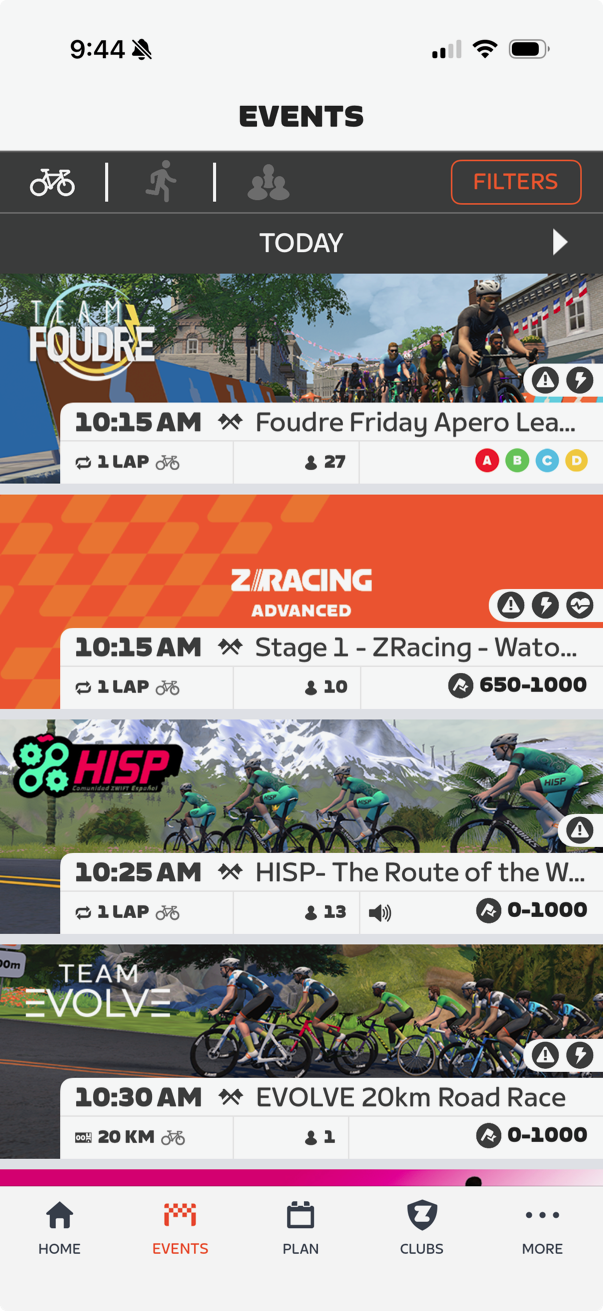
ZRS is simply a three-digit number where a higher figure indicates a higher racing ability. To get a ZRS, and thus the ability to enter ZRS-based races, you simply need to do at least three 10+ minute rides on Zwift. These can be free rides, workouts, or group rides.
ZRS is not to be confused with your ‘pace group’, indicated above your ZRS on the Companion App profile page, which is an older categorization system based purely on power which is sometimes still used in races (read more).
Pens
Your ZRS obviously decides the minimum pen level you need to join, but in many races, you can still choose to race up, meaning you a higher pen than the minimum one suggested. This is useful for riders looking for a real challenge. Try it, you might just surprise yourself!
Pen ranges can vary greatly between events, so there is no need to get hung up about the specific pen letter (A, B, C, D, and E) you are assigned to. One race you might be racing pen C, while in another race you might be forced to race pen A. It all depends on how the organizer has set up the event, and renders the specific letter of little importance.
If you want to aim for the win, pick a race where your ZRS is towards the top of the stated range. If you are up for a challenge, select something where you are one of the lower-ranked riders.
Power to Weight
ZRS is first and foremost an estimation of your racing ability. Before your first race, Zwift uses your 5-minute power record to give you an initial score, called a ‘seed’. Zwift calculates your seed not just in outright watts, but also in terms of watts per kilogram of body weight. It is therefore important to keep your registered weight accurate. Zwift does not prompt you for this, so make a note for yourself to do so every fortnight or so, particularly if you are in the process of losing weight.
Your seed score gets updated with each 5-minute power record you set. Therefore, the quickest way to increase your ZRS (even after your first race), is to set a new 5 minute personal best. Simply go for a free ride on a flat or steady incline route, warm up, then smash it for 5 minutes straight. If the power difference with your current ZRS is large enough, you will see your updated score after you finish your ride.
Results
Once you have done your first ranked race, your score will get updated based on where you finish. This goes for most ZRS-categorized races, but not all. Results in Friday Night Fun races, team time trials (TTT), Chase Races (where the whole pen works together as a group to beat another pen), as well as races where you need to score points on timed segments, never affect your ZRS. In general, you can expect ZRS-based race results to affect your score, while your score will only change after a non-ZRS-based event if you set a new 5-minute power record.
If you get beaten in a field that is weak relative to your score, your ZRS will decrease. Conversely, if you do well, your ZRS will increase. And if you finish on the podium, you’ll even get an extra score boost!
Skill
By taking results into account, your racing score also incorporates an element of skill. You might, for example, not have the highest power in the peloton, but you might still beat people by making better use of the draft effect, knowing better where to attack, or making the strategic choice to ignore a flyer.
You can also boost your ZRS by selecting races on your preferred terrain. If you are a sprinter, you might choose to race a short, popular, flat course that is likely to end in a bunch sprint. If you are a climber, you might pick a race on a course with a big hill, and if you identify as a puncheur, you might select something in between. Sure, others might do the same, but by paying attention to what sort of event you join, you at least avoid having to battle on unfavorable ground.
DNFs
Result-based adjustments are only done for riders who actually finish the event. This means that suffering a technical issue, such as an internet connection loss, does not affect your ZRS.
This may tempt some riders to purposely quit a race they are unexpectedly losing, to avoid a ZRS drop. Such a score reduction, however, is typically only a few points and nothing to worry about. You can simply recover it on your next race. Zwift racing etiquette therefore prescribes that it is better to just accept the situation and finish the race.
Uncertainty
Apart from using your power numbers and race results, ZRS uses a third, little-known factor: uncertainty. Riders who race a lot, and finish in predictable positions, give the system a high degree of certainty about their ability. Their score is largely left as it is. But for riders who have little race history, very volatile results, or both, the system will make larger changes to their ZRS, and their score will be a bit more “conservative”, slightly reducing their ZRS compared to a rider with less uncertainty.
This means that racing more often, and finishing close to prediction, can slightly increase your ZRS. This is one reason why, at the end of the race, riders often see that about two-thirds of riders get a score increase and only one-third a score decrease.
Another reason why races often have more scores going up than down is that races push riders to give that little bit extra, causing them to set new power records, which increase their ZRS. Power records automatically lapse after 90 days, but such score drops happen outside races. Race results therefore generally increase ZRS, while ZRS reductions due to lapsing power records largely go unnoticed to anyone but the rider in question.
Tanking
Zwift is aware that some riders might purposely finish in a low position to reduce their ZRS. They do so to enter an important race in a low pen, where they can then easily win. Judging this as an unfair racing practice, Zwift has implemented three ‘anti-tanking’ measures.
- The first measure is that Zwift will look at how much of an effort you put in. If you just use a race to pootle around and get the route badge, the system will notice this and keep your ZRS the same.
- The second measure is the use of a ‘floor’, which is the lowest your ZRS can go given the power and weight that was used to calculate it. Only the lapsing of a power record can reduce the floor.
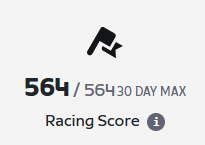
- The third measure is not (yet) visible in the Companion App, but can be seen at Zwift.com. Apart from your current ZRS, the website also shows the highest position your ZRS has been over the past month. Race organizers can use this 30-day max value, rather than your current ZRS, to allocate riders to starting pens. This prevents riders from purposely performing poorly in a race days before winning a big race in a low pen.
Final Thoughts
ZRS can be a highly motivating fitness indicator. If you are looking for a target, try to increase your ZRS to the next round figure. Alternatively, challenge a mate to increase their score by 50 points, to beat yours, or to see who is the first to beat your mutual rival.
One word of caution: don’t take it too far. Zwift is all about having fun, getting a good workout, and maybe getting in touch with fellow cyclists around the world. ZRS is a tool to help you reach those goals, but is not a goal in itself to obsess over. Because, in all truth, the only person who truly cares about your ZRS… is you!

