

UPDATE: Zwift has shared that this difficulty in moving up in larger packs is actually a bug, and will be fixed soon. Read the forum post >
Zwift’s Pack Dynamics 4.1 went live at the end of August, and the Zwift community has been debating its effects ever since.
We published TTT drafting tests on road bikes and TT bikes soon after PD4.1 was live, and in those posts I touched on the potential for wasting watts with PD4.1. Today we dig into this topic further, as it’s an important one for racers to grasp.
Defining “Wasted” Watts
In some sense, none of the watts we put into our pedals are wasted. It’s all hard, honest work that makes us stronger (if we skip the topic of overtraining, at least).
When I talk about “wasted” watts in the context of Zwift racing, I’m talking about power you’re putting into the pedals that isn’t making your avatar move faster. So much of racing is about conserving your energy so you have what it takes to go hard when needed. If you can hold your desired position in the peloton at 200W, but you’re putting out 225W to hold that same position, I would say you are wasting 25 watts.
As we’ll see, Zwift’s new Pack Dynamics 4.1 makes it very easy to waste watts in exactly this way.
Reducing Churn Through Stickiness
For years, Zwifters talked about the “sticky draft,” a feature of Zwift’s early pack dynamics which was put into place to help riders stay in the draft. The sticky draft was most apparent at slower speeds on climbs when you would come up behind another rider and “stick” to their back wheel instead of going around them. Sure, if you put out enough power you would break that stickiness and come around, but it sure hurt to feel like you were stuck on a wheel when you wanted to pass the rider!
Pack Dynamics 3 essentially got rid of the sticky draft. But I would say PD4.1 has brought it back in some sense. My guess is that the algorithm is different, but the effect is similar in packs: you can stay in the same fore/aft position, even if you put out more power.
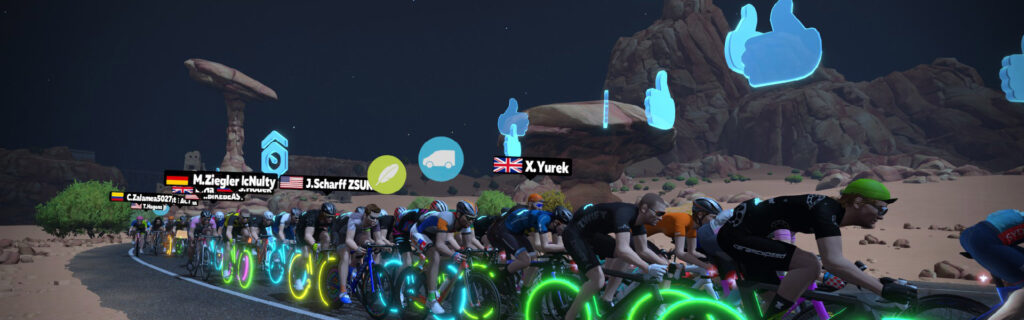
Wasting Watts – an Example
I’ve seen complaints from riders saying PD4.1 is “harder” in the pack and “more like a TT feel.” One Zwifter commented that, “it took me 30W more than usual to hang with the RoboPacer.”
Having ridden with RoboPacers and race packs quite a bit using PD4.1, I have to say I haven’t noticed it feeling harder to hang in the pack. I certainly notice the packs are slower, and it’s harder to move forward, and especially to move into the wind. But sitting in the pack doesn’t seem to require any more work than it did in the past.
I believe riders are wasting watts in the peloton because they expect their avatar to move forward and backward in the group like it did in the previous version of Pack Dynamics. With PD4, in a steady group you could add a bit of power and easily move forward, even slingshotting around the front rider(s) and into the wind. But in PD4.1, adding a bit of power probably won’t change your position in the pack at all! That means you might be able to hold your position in the pack at 200W… and bumping your power up to 230W might not change your position one bit.
Whatever Zwift implemented to reduce pack “churn” has made our fore/aft pack positions more “sticky,” creating a “power window” with 20-40W of wiggle room. Hold any wattage in that window and you’ll stay in your current position in the pack. Hold the top end of that wattage (say, 240W) and you’ll feel like it’s extra hard to hang with the group. Hold the bottom end of that wattage (say, 200W) and it should feel as easy as ever.
Here’s a quick video with my bot in RoboPacer Yumi’s group to illustrate this behavior:

In the video above, my bot begins by holding pack position on flat ground at 199W. I then bump it up to 239W, and my rider doesn’t change position in any noticeable, immediate way. Eventually my rider works his way to the front of the group. But if I had only bumped up the wattage to, say, 219W, he probably wouldn’t have moved forward much at all.
So in this video example:
- 199W is riding efficiently
- 239W is riding inefficiently
If this was a race, that 40W margin could very well be the difference between winning and losing.
How to Ride Efficiently
So how do you ride efficiently with PD4.1? First, stay off the front. If you find yourself rotating into the wind, you’re putting out way more power than necessary.
Second, test your power. When you’re sitting in the pack, at the position you want, ease up on your power slightly, until your rider begins to drop back. This tells you the minimum power you can hold to stay in your position. Do this often enough (RoboPacers are a great place to practice) and efficient riding will become second nature.
Is this a bug?
You may ask: given this potential for wasted watts, did PD4.1 break proper pack behavior? Does Zwift need to fix PD4.1?
I say no. This “sticky draft” issue is one riders can easily learn to use to their benefit, plus PD4.1 offers some key improvements:
- Slower pack speeds (more realistic, and more chances for the breakaway)
- Reduced churn (more realistic pack appearance)
Zwift continues to iteratively improve pack dynamics, which are a difficult thing to get right in a virtual cycling environment. If you have any doubts about whether Zwift’s changes are actually making things better, I would submit this video of me racing with Pack Dynamics 2.0 just over 2 years ago:

Check out that squirrelly, compressed pack of avatars riding through each other! Give me PD4.1 any day over that.
Questions or Comments?
Post below!

This is great. I’ve noticed a bigger spread in watts for similar places on similar courses/races, Your recent race recap also rang true and was informative.
It was always important, but it seems possible.that picking your spot is even more important now? That’s got to be a good thing?
I kind of miss the days when you would see the inside of another riders skull as you passed through them. But seriously, I don’t see how making the pack (peleton) slower relative to a breakaway is more realistic. In fact that seems exactly the opposite. As I the pack has less chance now of catching the break by working together than in previous versions. It seems to be a step toward eliminating the drafting advantage altogether making all races basically time trials.
It’s more realistic because now, the pack’s speed is based on the speed of the front person doing the pulling – same as outside.
Breakaway’s speed is based on the same thing.
So it’s much more realistic than it was.
Prior to PD4.1, the pack’s speed would be driven up artificially as riders slingshotted off the front then churned back into the pack continuously. That just doesn’t happen outdoors, and shouldn’t happen virtually either.
I repectfully, but strongly disagree. The slingshot effect, based on speed and momentum gained from drafting through a pack, is very real IRL. That’s why team time trials are faster than any of the individuals in the team could go, even over a short distance (eliminating fatigue factor). It’s also why breakaways are hard to sustain IRL, once the peleton starts chasing. It seems PD4.1 requires you to match or exceed the w/kg of the rider on the front in order to move up through the pack. IRL you move up through a pack by surfing wheels at significantly less effort than the leader, gaining speed and momentum. Granted, once you pass and become the leader, now you are in the wind and you have to pour on the power to maintain your speed/momentum advantage and it goes away quickly, so you depend on the next rider to come around you, etc., etc. But with repetition and over a long time/distance, those brief slingshot effects (what you call churning) add up to a lot of “free speed” instead of “wasted watts”. So I don’t think it’s at all realistic to artificially throttle down the group drafting dynamic to help the breakaway stay away. I agree with you that’s what’s happening, I just don’t agree that it is at all realistic.
The effect you are describing is real, but I think you may be misunderstanding the cause of it. If you watch the pro peloton (where speeds are as high as humans get), when the peloton is chasing down a breakaway, it does so by having strong riders on the front drive the pace. Riders on the front may take turns pulling to keep the pace high, but almost all of the pace is generated while a rider is pulling, not in the short amount of time that pulls are being swapped (slingshot effect).
While it is possible to gain a certain amount of speed by accelerating in someone’s draft, this effect is mitigated by having to pull out of their draft to pass them, rather than riding through the person in front of you without slowing down (which is what happened in Zwift).
You’re not wrong that IRL you can move up by surfing wheels, but you’re also limited by the fact that you need to steer around corners and can’t ride through the person in front of you. Also, you can’t move up by surfing wheels if a leadout train is drilling it at the front. Zwift has no way of knowing if you’re doing the watts you are because you want to move up in the group, or because you’re not paying attention. This seems like a solid (if learning curve required) middle ground that will require riders to actually make an effort to move up in the pack.
I like the idea that the group will have to make a concerted effort to chase down a breakaway, rather than doing it automatically without anyone in the chase group realizing they’re chasing.
For catching breaks – under 4.1 It requires more than one person trying and generally that doesn’t happen in zwift. Apathy and perception is keeping breaks clear now.
For surf – 4.1 does seem to have paceline style surf to it, but you can’t easily control which line you are in and get blocked. With steering the current pd4.1 likely works better.
Im not saying it’s a perfect simulation but it’s way better than it was
The challenge I have with the theory that its easier for the breakaway by slowing the blob, is that it impacts at the rear of the pack as well – its waaay too easy to get back on the blob after being dropped. So it doesnt reward breakaways of 3-5 riders, with single riders able to get back on doing less wkg
A breakaway seems to be easier … BUT it’s still not easy (to hold it and win a race by that). The riders in the pack (who now have to work together to chase successfully) have to learn that they can only move up in the wind with an effort on purpose and not by easy churning. In my opinion it’s more realistic and offers more strategies than before.
To gain positions in a bigger pack is much harder now … ok … BUT compare it with outdoor : there you often stay in your position because there is no place in front of you, so you have to overtake other riders on an outside lane through the wind … and THIS also requires a bigger watt effort … I think this could be the new logic in PD4.1
I like that breakaways now have a better chance. That fact that my yearly mileage goals got a bit harder (more realistic) to achieve, well, I suppose that’s good for my fitness.
Still a bit concerned how this will affect passing teammates in a TTT. Looks like we’re going to have to try to get in a paceline and stay in the correct order at all times (does someone being skipped have to rotate all the way to the front before pulling off or do they sit on the back and have people slot in in front of them?). I find TTT races stressful enough as it is because not being at my best feels like I’m letting my team down more than if I just don’t get the FTS/FAL/FIN points I’d been hoping for.
Maybe I’m a bit unusual but all that interests me on the ride is the 20km target in about 30 minutes and the average Wattage and Heartrate for the whole ride. If the C Pacer ride is turning out to be a bit easy I just move to the front to bump up the average or if its too hard, I focus on staying in the pack. The variation is huge however, I have had the 2.3Wkg ride go from 220W average one ride to 260W the next ride for no real reason.
You’ve just explained the reason! 😀
This is probably the wrong use case to optimise the game for.
Pack definitely stickier, although seems to be a bit dependent on the size of pack, small packs less sticky than large ones. Also finding that if you put the effort to move forward in a punch when you get to the front it’s now really easy to drift off the front. Whilst it makes a break getting away from the pack easier, it’s not realistic that it takes more effort to move up in a group than to ride of the front
This is what I find to be really weird. You can just float through the front half of the pack and off the front (unintentionally), after putting in a small dig. That didn’t seem to happen before.
Honestly love the direction Zwift has been moving with their pack dynamics. This PD4.1 iteration is another great step forward in realism. You mostly don’t race to your watts anyway… you race with what the bunch requires and what you have in the tank. 4.1 seems to facilitate this type of racing and pack behavior in the best way to date. Looking forward to more experimentation and nuance which will guide future pack dynamics evolutions.
It’s better and people hate it.
I think there are some real bugs/unintended outcomes with it but not specific to drafting.
It appears that very light riders outperform expectation on flat Vs downhill speed (non drafted). As in a 140w / 3.5w/kg Keeping pace with a 260w / 3.6 w/kg rider. Could be height related.
there also seems to be a generous minimum speed at low watts. Again flat terrain. 40w = 20kph. Could be that it shows as 0% but is slightly downhill.
I’m in the it’s harder camp. I can no longer sit in with the higher cat bots I previously rode with. (I almost died the other day after 30 minutes) The second you even slightly start drifting back you really need to pop much higher watts to catch back in and recover the speed. The smaller draft cone has to be playing into that. I’m not even talking about going at the front here, just staying mid to back part of pack.
I don’t have a problem with reducing the speed, but just wish they would find some happy medium..
I am totally with you. In races where the top riders are driving hard, if i drop a little bit back I can easily lose the pack and have to work twice as hard to catch up. that is the unrealistic part. Although i do like the less churning. Seems like they could tweak the logic a bit if you are in the back of the pack trying to latch on again. should be a bit easier to do that.
You think a per-rider algorithm that adjusts the draft based on inferred intent would be easier?
I find this update unrealistic. You may need 200 W to close a 50 m gap with a pack in front of you. However when you reach the riders at the back and you are supposed to be in the draft, it becomes very difficult to move up the pack even with a much higher power output, say 250 W, even if the general speed of the pack has not changed. It fells like you hit a wall as soon as you are in a group that was easy to catch just some moments before.
Also most of the times we see Zwift races with one or two people breakways…as IRL, the chances of them winning the race are very slim. So I am not sure that this change aimed at decreasing the speed of the pack to favour breakaways hits the mark. As others have noted, if you put 30-40 W more power than the other riders in your group, you should be able to move up, not just maintain position because of some artificial braking.
It’s a step backwards. The title already says it: Wasting watts. Outside you actively need to break when you’d otherwise bump into people while if there is space you just pass them on the left or right. Two active actions. In Zwift with this update: All the space in the world but you get stuck behind and ‘waste watts’. It’s fine to move to the left, catch more wind and get stuck behind them because no watts are wasted but expended to cut through the wind. The wasting watts is braking without doing it actively yourself, which is ridiculous. It’s a game and things need to be ‘hacked’ to create certain dynamics. It’s now done through what effectively constitutes braking… but without any visual cue it’s a disgrace.
Others have also mentioned above other tells that this is just off. You can catch back to the peloton. Closing a significant gap with a constant output. You catch up and… you’ll need to kick up watts quite dramatically at times to actually move forward. While in reality the latter should be a breeze. This shows the dynamics are off as well. No visual cue and unnecessary stickiness, that’s a no.
In terms of riding within the pack…I don’t notice any difference. I think this comes down to my style of riding / drafting …where I am constantly testing the minimum effort required to hold position or minimise the loss.
I guess that’s efficient pack drafting.
For me, I try to gain position going up…not really anywhere else.
I think opinions may be divided on any changes to the physics of the game as we all have different styles and tactics we are used to.
This is a very helpful article, especially after I got frustrated riding with the RoboPacers Maria (Island Hopper) and Coco (Tick Tock) recently. My numbers afterwards told me that I expended about 15% more W/kg, compared with the nominal W/kg for the ride. Based on what I read here today, I tried a ride each with Miguel (Volcano Flat) and Yumi (Tempus Fugit) and glued myself to the RoboPacer as closely as possible. Here is what I learned:
1) As mentioned already by other contributors, I could not rely on past experience to keep up with the RoboPacer, but had put myself into the frame of mind to unlearn and re-learn.
2) With Miguel, I expended 3% more power than nominal, and with Yumi about 7%. These are much more in line for what I knew from previous RoboPacer rides. Sometimes, a couple of strong riders drive up the overall pace, and that’s completely OK.
3) The best position for the Yumi pack was near the front of the pack, with 25-33% of the riders in front of me, and the rest behind. In such a position, I had to expend the least cognitive and physical energy to keep up.
4) The worst position was if I suddenly found myself with 65-75% of the pack in front of me. Suddenly, a lot of energy was required to keep up and even get back to the sweet spot near the front of the pack. When drafting IRL, that’s not realistic. In a steady group of riders, having 20 people pulling you along is quite comfortable, compared with 5 people in front of you. This needs improvement.
5) The heuristics for keeping a rider in position seem to be unnatural. Even if I did my level best to stay in the same position with a very even power output, occasionally the pack would start drifting past me for no apparent reason, with my avatar still sitting up and obviously drafting. It was as if I had suddenly lost the draft. IRL, that never happens while keeping the position. Again, room for improvement.
What might help the re-learning effort would be a widget on the HUD that tells you how much help you’re getting from drafting, power-ups, etc., compared with a solo effort. For a solo effort, that widget would show 0%. For normal drafting, it would be 10-30%, and for the coffee cup, it’s 100%. Since we don’t have the tactile or audio clues from IRL that we’re gaining or losing drafts, we need visual clues on Zwift instead.
Lot’s of interesting and perspectives in the comments. I haven’t seen any comments yet on how PD4.1 affects the final sprint strategies. Since it is significantly harder to build speed by drafting through the pack, does that mean the rider on the front when the sprint starts now has the advantage over everyone behind who are being throttled by the new PD? And the obvious follow-up is how much does a draft power-up negate that effect and is am Aero power-up now more valuable than a draft power up in the sprint?
I spent some time practicing sprints in Makuri while riding with Miguel. I didn’t have any issue overtaking the group starting from the back and ramping up to 8-10 w/kg during the sprint. It may be a bit different if others are also sprinting, but I think the general idea of PD 4.1 is that if you’re putting in more power than the person ahead of you, you’ll get around them.
If I’m in third position at the start of a sprint, and we’re all putting out 1000W, do I have to put out 1200W to move around the rider ahead of me? Seems like I should be able to sit in the draft at 700W, increase to 900W to gain momentum, and then move around at 1001W.
After some riding, my general impression is that it is very much like the old Sticky Draft just turned up even more. Same tactics used to defeat the old sticky draft seem to work pretty well with the new sticky draft. It “feels” a bit different, but I couldn’t really identify how. Overall it seems there is a significant amount more variation in power required to maintain your position in a pack now than before. But it’s all very subjective. Didn’t have a good situation to test any sprinting effects.
Very well said. That was my impression also. To me, everything just feels very sluggish and you get very little bang for your buck, so you end up focusing on how little power you can use to stay in the draft. That is not why I use Zwift.
The new drafting is hot garbage.
If I’m nailing the pace per the Robopacer, I will get dropped, no matter where I am in the group. I have to pull .2-.5 w/kg more than the robopacer to stay with the group. if you go around a turn on the outside of the group, you get dropped. if you lose concentration for 10 seconds you’re dropped. and if you get dropped you get f&$%§ed by the sticky drafting and can’t move back into the group.
For racing, you have to pay attention, but in group rides, it’s just significantly less fun.
I’m fine with slower kmh but not with having to constantly put out more effort than the robopacer just not to get dropped. When I put in a .5 w/kg higher effort in a group ride, I drop everyone, not barely hold on.
Just seriously hot garbage.
So helpful Eric! I’ve been worried about how the change would affect me (a lighter rider) on a fast ride. Today I followed your guidance precisely and was delighted to find it didn’t feel harder- in fact it was much smoother than usual. I avoided ever being in front of the Yellow Beacon and experimented with pushing lower watts to see how it affected my position. Thank you as always, worked a charm!
Does steering around a rider you’re ‘stuck’ on help move up? I’d try it, but being an Aussie, Zwift doesn’t want to sell me things so…
Seriously just said increasing power by 20%!!!! makes virtually ZERO difference to your speed and ‘making things better’ in the same article 😐
As with most updates seems to be an overall negative.
Riding with pacers now takes more watts to keep up, and frequently find myself doing 20% greater power than the pacer power and falling backwards. If I get stuck behind somebody else falling off the back of the pack requires a major dig to get back.
Zwift has added more fuel to the dumpster fire it has become.
I tested this in a small cat C Zwift Crit Club race tonight. I purposefully stayed off the front, instead sticking at the back of the lead 6-10 person group. I was able to do sub-2 w/kg (though that’s partially aided by my 90 kg weight) while hovering between full draft and having the 1-m “catch up” warning on screen. I’m guessing something like this has long been the case, but PD 4.1 hasn’t taken it away.
I found the new unpleasant settings, I tried to overtake but I was damn heavy, it was a bad experience.
So, I have to increase my power output by 20% in order to slowly move up through the pack? That seems… awful!
I’d much prefer a bit of churn to being locked in position like this.
That is a good description… “locked in position”. It’s a very frustrating experience when you add 1.5 w/kg and nothing happens.
Any tips on seeing the average wattage of a peleton in a race? To know the minimum wattage to maintain. Where the course is roling
The current effect might be a bit extreme but overall I believe it’s hard to argue that Zwift is headed in the right direction with this change.
Previously in group ride you often had this fenomenom that it was much easier to ride in the group in front of the leader then all the way in the back where you really had to push higher power to just hang on. Now it feels to me like it’s múch easier to just sit in the back and tag along.
As for racing, I believe these changes are changes in the right direction… with these dynamics breakaways actually become a real possibility where previously it was often enough to have just 1 guy pulling in the group behind with the swarm around him to speed up the pack just because of the slingshot mechanic. Racing is becoming more tactical this way and “sit in and wait for a bunch sprint” is not the default best tactic for every single race anymore which surely everyone agree’s is a good thing.
Strange, I found it extremely easy to ride mid/front of the pack, but riding the back was terrible. I was constantly getting stuck behind riders getting gapped and had to do big digs to get back up in the group. I think sweepers who dangle off the back in group rides are going to be working a lot harder.
In my rides with pace partners, I used to disable steering because I’d rather not have to think bout it. Now with steering disabled, I, like others, have found it’s very difficult to move up in the group. I can be stuck putting in 30+ watts extra power. But when I’ve enable steering, I can swing to the outside lane and maintain that same 30+ watts power and fly up through the group. So if the intent was to mimic the need to go into the wind in order to move up through the group, it hasn’t worked because going to the outside and actually into the wind is easier than moving up within the pack.
I don’t know whether I think it’s more realistic but I can say I enjoy it less.
Im a big fan of zwift and rarely complain, but find the new pack dynamics a miserable experience. It promotes a lazy draft as you get no bang for your buck, so you just veg out doing as low of watts as you can to hold your position. At times, I was doing a full 1 w/kg more than the rider in front of me and just remained on the rear wheel. I understand that zwift is trying to make it more realistic, but the entire experience feels sluggish making the challenge how to do as few watts as possible to stay in the draft. That is not why I use zwift. In addition, if this changed the speed of solo riding, it just made all of my benchmarks (PR’s) which I use to measure my current fitness useless. In my opinion, the new dynamics should disappear along with those multiple ghost pacers that are popping up.all over the place.
It didn’t change the speed of solo riding.
Interesting that you say it’s now too easy in the pack – most people are complaining the other way. Fortunately for you, if it feels too easy – that’s easy to fix! Attack off the front and try to stick the break. Make it interesting!
Thanks, Good news about not changing the speed of solo riding. If you position yourself towards the front of the group and remain vigilant in not drifting backwards, it seems to take lower watts to remain in that position. As someone else described it, it seems as if you are locked in position. But if you drift backwards and want to reposition yourself towards the front, it takes a much bigger dig to make progress. Also, if you are towards the back and someone in front of you is dropping back and losing the draft, it is very difficult to get past that rider even when your w/kg are much higher. I also noticed that when just riding solo and coming across other riders, I do get stuck behind them even when nobody is in front of them and I am doing more w/kg. To get a good base mile workout with a steady w/kg, I loved riding with the pace partners, but now I find it better and more consistent to just ride solo and use the TT bike to avoid any of the drafting dynamics.
Just an update. The zwift update a couple of weeks ago improved the drafting and stickiness immensly. The current drafting in racing, group rides and Pace Partners is great. Thanks for replying.
This misses the complexity that no real response to 10, 15, 20% more output creates. you have no idea what gear you can really ride in or how far back is safe when 50w incremental doesn’t move the needle if you fall off. this is especially evident with higher w/kg bots (Jacques, Genie, etc) where you are entirely unable to know what is required to get even 5-10m back alongside them if you drift back. It makes planning/pacing the ride far harder than 10 days ago. IRL if you drop 50w more than the guy in front of you you catch up and likely pass pretty quickly. how then is it sensible to so drastically mute this impact of much higher exertion in the game?
Very well said.
I’ve had my robopacer rides increase by 4-5% watts with the most frustrating part being a lack of movement makes it much harder to get back to the robopacer if things spread out.
Just watch IRL racing where helpers fetch bottles for their mates and come back through the peloton with ease carrying 5 kg of extra drinks . In zwift you ‘re just doing an ITT to go to the front . Changing dynamics and physics just to get another racing tactics outcome is ridiculous . By having even less draft then before it’s more of the same . push as hard as you can for as long as you can . If draft was realistic then none of those riding 80% of race at the front could win . Just as they don’t IRL . A massive step back in realism and racing pleasure
Totally agree steve. ZWIFT racing has always been a bit of a ‘time trial’ effort and is even more so now. While it may have fixed some issues, PD4.1 has certainly created others, like working harder in a pack to achieve the same pace, which makes no sense whatsoever.
I have done over 800 races on Zwift and plenty IRL as well and PD 4.1 couldn’t be any less realistic.
Several comments after the 1st round of ZRL (an excellent test of PD4.1) were along the lines of – ‘staying at/near the front was imperative to remain in the front group’, and ‘push to the front or you don’t stand a chance’. And the least realistic comment – ‘I chased back on because that’s now easier to do’.
The last comment is really concerning. How does PD4.1 know whether you are trying to get back onto the peloton or closing a gap to a breakaway? Because I’ve also read that the breakaway is now ‘harder to catch’? So which is it?
By the way I can ride the same speed on ZWIFT with less effort when on my own than when in a pack with PD4.1. I suppose people will comment that I cant be doing it right? Seriously, I suppose all my past results were just pure luck then?
They Eric just an observation, when you went up towards the front. It wasn’t due to your increase watts. The rider (smith) directly in front of you had an open lane, so by drafting behind him you are able to follow up. This also increased your speed delta compared to the group pace. If you gain enough positive speed differential over riders you run into, you will auto slip pass them.
It was actually a bug. The PD developer admitted it in the Zwift forum and said it be fixed in the next Zwift version.
please post link to this admission would like to read TY!
https://forums.zwift.com/t/pd4-1-causes-odd-robopacer-behavior/611170/153?u=cris_to
thanks cris… turns our we’re not all insane! a good epiphany. good day to all
I have noticed the changes in group riding now it seems unrealistic to put in more watts and not move up like before and like in a real world group rides when I put in the watts I move up instantly.
They have made it less realistic for me because in real road riding less watts take you to the back and more watts move to the front not more watts keeps you in the same position.I been on Zwift over two years and Ilike the older format.
i have no played around with this idea for 2 weeks. i don’t see it. maybe it’s because i’m taller (1.94m or so) or heavier (~88kg) but i don’t see this effect at all. riding with Genie i nearly put out equal watts to the bot just to hang on. and there is nearly no output (h300/l400w) that will meaningfully catch up to the group if i start to drop back. Genie should be riding 278w. on the topic of this thread i should be “sitting in” close to 225/240w. That is assuredly not even in the realm of reality which is fine. I can do it. But to speak about wasting watts as if it applies universally – regardless of bike, size, group, other riders, whatever — is entirely untrue. Period. I have many files to prove it.
But the bot is drafting too (typically), so you needing to match the bot’s power makes sense. You’re both drafting in the same pack.
On top of that, the fact that you’re significantly taller and heavier than the bot means you will have to put out even more power than the bot, everything else being equal.
Eric then how do your TTT articles compute? i’m theoretically in 2nd or 3rd position — 6-9m back — and acc to your tests the wattage required to “sit in” in the TTT control tests were significantly lower. further, if i’m outside, i’m never riding = power to the guy i’m behind. so i don’t follow. i know there’s some bug in the PD 4.1 setup regarding making up ground and i’m pretty confident it hits bigger riders harder but that aside… just trying to reconcile your TTT watt analysis by rider position with my experience. thanks again for all you do… I love zwift and in a sick way love trying to figure all this stuff out!
Because there’s a big difference between the draft effect you get in the middle of a large pack, vs a small paceline of riders in a TTT.
In a large pack you’re getting the draft of, say, 50 riders ahead of you. You’re effectively in a “tunnel” where draft is maximized (I’ve read that computer simulations show that properly-placed riders in large IRL race pelotons see a 90% power savings!).
In a TTT you’re just getting the draft from the rider or two ahead of you. A big help, but less draft than you’d get from being in a pack.
I’m really sorry to be so dumb and to belabor this… but wouldn’t your test conclusions — showing 18-28% watt savings to the #2-4 position rider in a group of 4 riders– be even more fodder for my question that i’m getting literally ZERO benefit in a pack of 20 riders behind Genie?
I‘m a 193cm tall and 100-105kg heavy rider. C CAT is my regular racing class. Last winter I was racing all official series and finished Top50 and almost winning one. My style of riding was the classic „chill and sprint“ with a lot of roll outs with 0 Watt inputs, followed by 600 Watts, standing effort, to get sucked back in and average around 300 Watts as a result. Now whenever I do this I get Auto-Breaking and loose so much places. So I stopped doing that, changed to a more pedal-friendly style. I‘m using too much power to stay inside the pack now. Racing got super hard. The crazy things happen on climbs when the group gets stretched out and PD does not work anymore. There is no more auto-breaking, no sticky draft. When I push out 500 to 600 Watts and rest a few milliseconds and do it again I average around 3,5-4,5 w/kg and I‘m overtaking almost everyone in C. The longer the climbs, the better. My anaerobic power is by far my best trait, otherwise I‘m lacking a lot 😅. When the climb is over and its forming a pack again torture starts all over again. I really dislike PD 4.1.
Hi Eric, after the latest update also depending PD4.1 … would you test for us how much your bot now (2nd Oct 2023) has to increase the power (from 199W) to pass riders mid-pack ?