

The inaugural Zwift World Series (ZWS) launched in August as a new flagship race series that encompassed both elite and community-level racers during peak Zwift season. The elite ZWS races were set to be the highest-profile, most competitive events on that platform during the 2024/25 season, with cash prizes and Zwift Games 2025 qualification on the line.
Related: Elite Community Racing Calendar Announced for Zwift’s 2024-25 Season >
But all of the planned elite racing went into limbo on December 3, when Zwift’s Director of Racing Sean Parry sent an email to all elite racers informing them of a pause to the Zwift World Series schedule.
The pause was due to concerns over the accuracy of smart trainer power readings, and it came just after elite riders had finished the qualification race for ZWS race #4.
For the full picture, including elite race schedule changes, I’ve included the original email from Sean below, as well as a follow-up he sent two days later:
Firmware Updates Incoming
First, it’s important that we put the pitchforks away. Or at least, don’t point them at the racers! While cheating in high-level cycling esports is always a concern, Zwift has been very clear in communicating that the hardware inaccuracies aren’t from riders intentionally trying to create an advantage by somehow miscalibrating or artificially increasing smart trainer power numbers. Rather, particular trainer models are reading high in specific “edge case” scenarios – particularly high-torque, low-cadence efforts found on steep climbs.
To ensure maximum fairness via reliable power data, the Zwift World Series Ruleset has a very short list of approved trainers:
- Tacx: Neo 2, Neo 2T, Neo 3M, Neo Bike
- Wahoo: Kickr v5, Kickr v6, Kickr Move, Kickr Bike v1, Kickr Bike v2, Kickr Bike Shift
- Elite: Justo, Justo 2
Based on Zwift’s emails and other sources, it seems that from the list above, only a few trainers from Wahoo and Elite are in question. Recent race annulments appear to be tied to Wahoo’s KICKR v6, KICKR Move, and KICKR v5 trainers as well as Elite’s Justo and Justo 2 trainers.
We haven’t heard anything from Elite on this topic, but Wahoo issued a statement detailing their firmware update plans, saying, “Zwift have been in communication with all the relevant hardware manufacturers and Wahoo is one of these. We have worked quickly on a fix for elite indoor riders competing in events over the coming month – this is now available for KICKR V6 and KICKR MOVE, we expect a fast follow for those KICKR V5. There will be a full rollout to all Wahoo users in early January 2025.”
Leading From the Front
The decision to pause the elite portion of their flagship race series was certainly not an easy one on Zwift’s part. But with so much on the line – athlete reputations, cash prizes, even the viability of indoor cycling as a high-level discipline – it feels like the responsible call. It may damage Zwift’s reputation in the eyes of some, but it helps ensure a bright future for a cycling discipline still in its infancy.
Apart from Zwift, perhaps it’s time for other organizations to step up and push accuracy standards forward as well. This includes trainer manufacturers primarily, but the industry also needs a neutral third party to test and certify trainers. (The UCI, incidentally, has been talking about doing just that in collaboration with Purdue University’s Engineering department for almost a year now. See their test rig mockup below.)
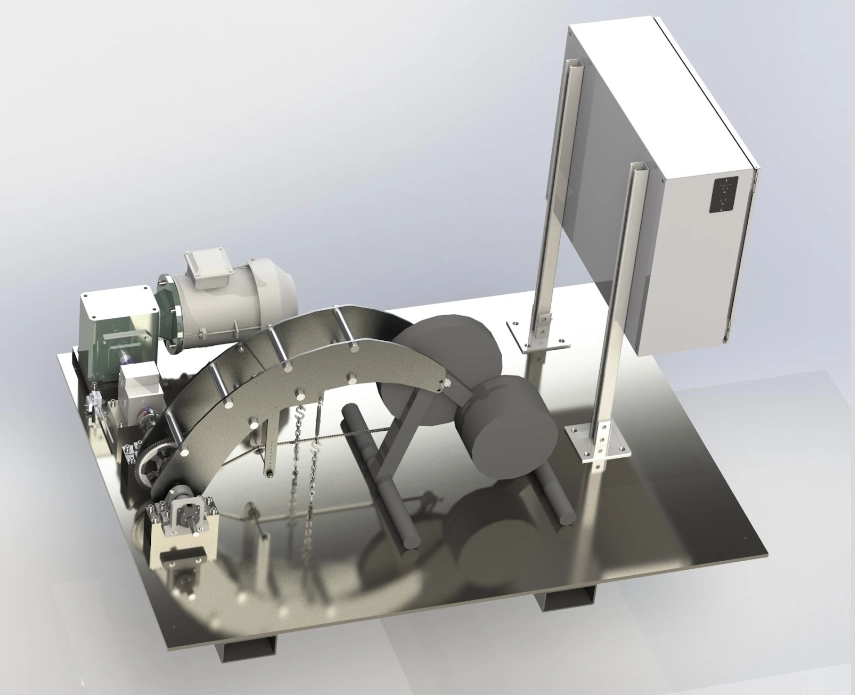
Trainer accuracy standards and specifications to date have been a bit of a “wild west” affair, with a lack of consistent testing and metrics across the industry. A trusted, neutral, third-party test/certification could go a long way toward ensuring accuracy and building trust in cycling esports race performances.
Until that happens, dual recording and subsequent performance verification will remain the standard in high-level indoor bike racing, and racers will need to shoulder the responsibility of ensuring their smart trainers and power meters are reading accurately in high-demand race situations.
Questions or Comments
Did Zwift make the right call in pausing their World Series? How concerned are you about trainer accuracy in Zwift racing? Share your thoughts below!

Do we know what’s wrong with “KICKR Core”? Has it ever been on the white-list?
Not accurate enough. It’s +-2%, but Zwift requires 1% for elite racing.
i’m attributing my poor showings to the -2% part.
Eric – I think some clarification on the +-1% or 2% accuracy claims is needed, I believe people are confused about what this means.. Correct me if I’m wrong but these percentages only relate to the same trainer putting out the same watts each time you ride it, as in if you put out 200watts on your trainer today, each time you ride it’ll be 1% or 2% either way of that. Not 200 watts on your trainer = 200 watts on everyone else’s trainer..
I believe the majority think that their trainers are as accurate as any other and must be correct because of this misleading value. Having been on Zwift for a few years now I see many people putting out unrealistic numbers on “accurate” trainers.. I myself have had 3 different direct drive, accurate?, expensive, trainers, Hammer/Saris, Wahoo Kckr V5, Kickr Bike, and I would say there’s a good 10% difference in the power numbers of just those three. For example I was putting out a good 280 watts up the Alpe on my self calibrating V5, yet when I went to the Kickr Bike I was struggling to keep 240 to 250 watts.. So some clarification might be needed for people as I do believe this is a confusing value/metric..
Do you know if any crank based power meters (SRAM, Quarq, etc) and a dumb trainer are in question about their accuracy?
Accuracy isn’t really in question, but sticky watts can be an issue. That’s one reason why Zwift requires elite racers to use their trainer as the power source and not their extra power meter. Read more: https://zwiftinsider.com/sticky-watts/
This is from SRAM / Quarq support:
“Our power meters send the current power and cadence data to the receiving head unit four times every second. When your device or Zwift only updates the data too slow it might be adjustable in the settings.”
Sram Force crank
PM-DZ-A1
FW: 10
By head unit this would be the Garmin USB ANT+ to laptop with Zwift running.
Sram claims updates every 0.25 seconds. I see sometimes the watt number getting stuck or taking 3-5 seconds to update from low to high watts and vice versa.
Is there there anyway to change Zwift’s update rate?
What has confused me over stickywatts is why Zwift (and other games) infer 0 watts in races if no power is being received. Keep it as is for group rides. It really does spoil so many high-end races.
I guess I should add: it’s easy, with most crank/spider/pedal-based power meters, to change the slope or other parameters in settings and thus increase the power reading of the device.
I wouldn’t call this an accuracy question as much as… they’re easy to hack. The devices themselves are accurate, but can be manipulated. To put a fine point on it.
Much more difficult to do that on a trainer that auto-calibrates, which is what all the approved trainers do. So that’s another big reason smart trainers are required as the power source.
exactly this. in the assioma app just below where you set the crank length you can literally make it read up to double the power with a slider. its not even a hack, just a setting at this point. if you are racing in elite races, def use those 1% trainers
I’d be concerned about 4iiii Precision having a left/right balance factor in the 4iiii app, for a single-sided left crank power meter (great as an amateur to monitor my outdoor efforts pre- long covid).
So by scheduling the next race on 22nd Feb Zwift are promising that all the bugs present in these trainers will be fully fixed and tested by then?
I’d say they’re giving the manufacturers a hard deadline to work toward. 🙂
The article says that a fix for KICKR V6 and KICKR MOVE is now available. Newest KICKR v6 Firmware is 5.4.29 (20 November, 2024). Is this the one which already includes the fix?
I very much doubt it. It sounds like Wahoo pushed the update out early to the elite racers, but not the general public…
No there was no pushout to the eliteracers (I’m one of them)…we are all on 5.4.29.. and waiting for any reply from wahoo…
love the idea for a 3rd party testing protocol. this would elevate the sport by providing another sense of validation to performances. too often i see world tour numbers in these elite races and see their strava outdoor performances as… not world tour. unintentional cheating isnt talked about enough.
i know in this specific case this is referring to edge case scenarios where the impact of overall performance is probably minimal unless abused specifically, but other unintentional cheating is def a problem as well
I’d be careful before accusing elite racers of cheating just because their numbers are world tour level, though.
There are lots of legit, strong racers at the top of Zwift racing who, for various reasons, will never be on a world tour team, despite having similar power numbers. I’ve spoken with more than one, in fact, who basically said, “I wanted to make a decent living and have a family, so I chose not to pursue pro cycling…”
To compete at the elite levels you have to do some power validation tests, dual record, etc… it’s not super easy to cheat the checks and balances Zwift has set up!
You nailed it. I know a few that never bothered to go pro as their career path was more lucrative or different life goals (or just the risk). The reality is conti level pros scrape by. Then add in returning to the sport masters and you get some strong riders without pro status.
And let’s not even talk about the poor LADIES who, even at some of the top levels of cycling, aren’t even making a living wage…
Trainer accuracy has never been about actual accuracy, just how much deviation there is in their measurement methodology. The fact there’s no static weight test for trainers (or powermeters for that matter) is more proof of that. There’s nothing external they’re “calibrating” to. So you can’t even verify when you do a manual calibration, because there’s nothing you’re physically calibrating it to. And trainers aren’t even measuring power at the source. At least a (spider/crank/pedal-based) powermeter is a direct measurement. But they’re all a bad as each other, to be honest. Even requiring 1% accuracy is ridiculous, the numbers are so small that it doesn’t have real material benefit, on a similar order as drivetrain inefficiencies.
The only way to have accurate data is to have an external third party testing and verification program. And the power applied at the pedal will always be greater than the power at the “wheel”/trainer due to mechanical losses.
If the power data of the trainer is same or less than that of the powermeter, then it’s probably fine. If it’s greater than the powermeter, then something’s off. And if the datasets don’t drift, otherwise I don’t think I’d trust anything more than that.
I don’t know what SRM are like now but, with mine, 12yrs ago, you could undertake a static weight calibration. Our Vectors – from V1 to V3 also allow this. The great caveat is that you need a calibrated weight, I was fortunate enough to work where we had scales measuring 10kg, mid-range, that were certified and regularly checked with lab certified weights.
I’m not sure I understand the benefit of having a neutral third party to test the trainers. I don’t mean that in the sense that we shouldn’t have more info available, but in the sense of what can one do with the data once it’s made available?
Is the idea to take this “trainer score” (for which the 2-3 hour automated protocol only varies between 100-800 watts) and only allow trainer manufacturers/models/firmware versions of a certain score to be competed on?
We don’t even know if the current protocol would have caught this issue. And if they are only testing up to 800 watts, they are going to miss all of the edge cases that elite sprinters might encounter, just as an example.
Well, any existing protocols can be changed, is the first thing I would say.
I see two potential benefits to having a reliable third-party testing protocol:
1) When shopping for a trainer, you can see an objective metric about its quality, instead of one the manufacturer essentially made up with no third-party oversight
2) Races could then require trainers that meet a certain objective standard
Slightly off topic, but the free wattage problem with the Wahoo Kickr Core that was supposed to have been fixed in the recent Wahoo firmware update is still an issue.
It would be nice to see some acknowledgement from Zwift or Wahoo that they are aware the issue is not solved and are at least working on it.
So, no word about fixing the Kickr Core that came with the Zwift Ride? It has the same problem and Zwift pushed me off on Wahoo but they email back once every 7 or 8 days asking me to do a factory calibration again but I’m sure they know it’s not going to fix it. They’re probably just hoping they can put me off until they hopefully have a fix sometime in January, without actually admitting it’s a Wahoo problem. All at the same time Zwift is continuing to sell the Zwift Ride knowing that the trainer is faulty. SHADY!!!
Is the FW update for Kickr v5 available yet? I am slightly confused because the Wahoo website shows an update I had not noticed before that mentions Feb 5, 2024, as release date:
KICKR v5 Firmware v4.5.74 – 5 February 2024
Is the year 2024 just a typo?
Well, I don‘t need this for racing anyway, just check from time to time to stay up to date with firmware and had not given up hope Wahoo would re-think about virtual shifting for v5 (which will never happen but in the meantime I don‘t care about this and future Wahoo products anymore).